Abstract—In this paper, it is proposed a Mean Shift tracking uses varied kernel functions by means of switching four kernels, such as Uniform, Triangular, Epanechnikov and Gaussian for Indonesia vehicle license plate tracking. The purpose of switching kernels is to keep or to maximize the mean of the similarity function outputs which implies a successful tracking process of the vehicle license plate. The experimental results show that the average accuracy of the proposed method provides better tracking performance in term of the Average of Percentage Accuracy of Object Tracking compared to the Standard Mean Shift. Mean Shift tracking using Switching Kernel results in better tracking accuracy than standard Mean Shift with an average tracking accuracy of 71.57%.
Index Terms— Mean Shift, Switching kernels, Object tracking, License plate tracking, Probability Density Function.
I. INTRODUCTION
IDEO-based vehicle license plate tracking and recognition system has always been an interesting and challenging research to do. Many of the application as well as related research that utilize the vehicle license plate detection and recognition system, such as automatic toll payment systems, intelligent transportation systems, intelligent parking systems, intelligent vehicle traffic regulation systems, traffic violations monitoring system, vehicle safety and accident prevention systems, automatic vehicle pilotage system, suspicious vehicle license plate tracking based on the reading of a camera mounted at each intersection of the highway, and others.
Vehicle license plate tracking and recognition system in a lot of research is known as Automatic License Plate Recognition (ALPR) [1], Automatic Vehicle Identification
Manuscript received November 17, 2017. This work was supported in part by Doctoral fellowship program funded by the Directorate General of Higher Education, Ministry of Research and Education, Indonesia.
Basuki Rahmat is a student doctoral program of Electrical Engineering Department, Institut Teknologi Sepuluh Nopember (ITS), Surabaya, Indonesia. He works as a lecturer of Informatics Engineering Departement of Universitas Pembangunan Nasional “Veteran” Jawa Timur, Indonesia. (email: [email protected]).
Endra Joelianto is with the Instrumentation and Control Research Group, Faculty of Industrial Technology, Bandung Institute of Technology, Bandung 40132, Indonesia (e-mail: [email protected]).
I Ketut Eddy Purnama and Mauridhi Hery Purnomo are with the Electrical Engineering Department, Institut Teknologi Sepuluh Nopember (ITS), Surabaya, Indonesia, 60111 (e-mail: {ketut, [email protected]}).
(AVI) [2], Car Plate Recognition (CPR) or Car Number Plate Recognition (CNPR) [3], Automatic Number Plate Recognition (ANPR) [4], and Optical Character Recognition (OCR) for the car [5].
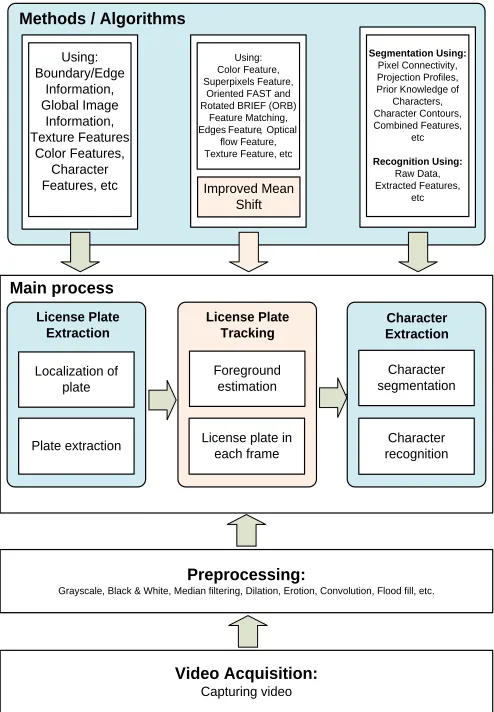
There are three major parts in video-based tracking and recognition system, namely: License Plate Extraction, to get the location of the vehicle license plate contained in the video frame. License Plate tracking, to track the license plate along frames of video, and License Plate Character Extraction, in which there are problems of license plate character segmentation and character recognition, in general, as shown in Fig. 1. However, this paper only limits on license plate tracking, using the Improved Mean Shift.
An Improved Mean Shift Performance Using
Switching Kernels for Indonesia Vehicle
License Plate Tracking Video
Basuki Rahmat, Endra Joelianto, I Ketut Eddy Purnama, and Mauridhi Hery Purnomo
V
Fig. 1. Video-based vehicle license plate tracking and recognition system.
Methods / Algorithms
Preprocessing:
Grayscale, Black & White, Median filtering, Dilation, Erotion, Convolution, Flood fill, etc.
Video Acquisition:
Capturing video
Character segmentation
Character recognition Foreground
estimation
License plate in each frame Localization of
plate
Plate extraction
Main process
License Plate Extraction
License Plate Tracking
Character Extraction
Using: Boundary/Edge
Information, Global Image
Information, Texture Features
Color Features, Character
Features, etc Improved Mean Shift
Using: Color Feature, Superpixels Feature,
Oriented FAST and Rotated BRIEF (ORB)
Feature Matching, Edges Feature , Optical
flow Feature, Texture Feature, etc
Segmentation Using: Pixel Connectivity, Projection Profiles, Prior Knowledge of Characters, Character Contours, Combined Features,
etc
Recognition Using: Raw Data, Extracted Features,
Mean Shift algorithm has been known to solve the problems of video object tracking. The Mean Shift algorithm is also adaptable for performance improvement in solving various problems of video-based object tracking. Including, among others, it can be mentioned to increase the performance of Mean Shift algorithm by utilizing the contrast between the object and the background along with the evaluation of a similarity in order to generate and to update the object model [6].
Another Mean Shift improvement has been carried out with the use of object detection by modeling through skeletonization star, followed by a search algorithm block and occlusion handling [7]. Another improvement has been done by using the Background Corrected Weighted Histogram included in the objective models in order to decrease background inference. Scale-adaptive methods are included in the Mean Shift for scaling and detection of occlusion is then taken care of by a scaled Normalized Cross Correlation [8].
Other methods, besides the usual Mean Shift, were also used to solve the problem of object tracking among others Camshift, Kalman Filter, Swarm Intelligence, Fuzzy C-Means, Support Vector Machines, and others [9]–[13]. Each method had its own advantages. The application of the Mean Shift to solve the object tracking problems has advantages as a powerful and a versatile non-parametric iterative algorithm [7],[14]–[15].
In this paper, it is proposed an improve Mean Shift performance accomplished by using a switching kernel mechanism to select an appropriate kernel function from four known kernel functions based on the Probability Density Function (PDF) of the object model and PDF of a candidate model. The switching kernel mechanism is based on the consideration that the kernel is one of the important and influential parts in the generating PDFs. By changing the kernel, the proposed algorithm attempts to maintain the highest performance in tracking an object in term of similarity evaluation described by the accuracy of tracking called percentage accuracy of object tracking (PAOT). Four kernel functions involved in the switching mechanism are Uniform, Triangular, Epanechnikov and Gaussian.
II. MEAN SHIFT TRACKING
Mean Shift is a non-parametric estimation method originally proposed by Fukunage and Hostetler in 1975 [16]. Combined with the similarity function, it can be used to find the optimal match value between the model and the candidate based on the gradient estimation of the value of the PDF in the kernel [17]. The similarity function is used to assess the similarity of PDF of the object model and PDF of the candidate model. For object tracking problems, color feature based Mean Shift technique has been widely used. PDF as the color probability functions is obtained by Parzen window using conversion from RGB to indexed colors.
Let {xi}i=1..n as target pixel locations, k(●) is a differentiable, isotropic, convex, monotonically decreasing kernel, and b(x) is the color index (1..m) of the pixel x, C or Cn is Normalization
factor, and h is the kernel bandwidth [14],[18] or the kernel
radius [7], then the probability of color feature u in object model qu and the probability of color feature u in candidate
model pu(x) can be expressed as (1) and (2) respectively [19].
( )
∑
= = u x b i u i x k C q ) ( 2 (1)∑
= − = u x b i h u i h x x k C x p ) ( 2 )( (2)
The relation between these two color probabilities (PDFs) can be calculated through similarity function (f1) or
Bhattacharyya coefficient (f2) by (3) [7] and (4) [14][15].
∑
=
= m
u
u u p x
q x
f
1
1( ) / ( ) (3)
∑
== m
u
u u x q
p x
f
1
2( ) ( ) (4)
Patch for candidate models would be shifted toward Mean Shift in a repeatable way to maximize the similarity parameter. Mean Shift has local convergent iterations rise toward higher density of a given probability distribution. The iteration process repeatedly goes until the highest density of the optimal estimation of the object location is achieved which indicates the object has been tracked successfully. Then the computation of Mean Shift vector to translate the Kernel window by m(x), is expressed as (5) [18].
− − − =
∑
∑
= = x h x x k h x x k x x m n i i n i i i 1 2 1 2 )( (5)
where
m(x) : the desired Mean Shift vector in one iteration within the kernel.
x
: the center location of the target in the previous video frame.i
x
: the pixel location within the kernel in the current frame.)
(
•
k
: kernel function.h : the kernel bandwidth (kernel radius).
Four kernel functions (
k
(
•
)
) considered in this paper are Uniform, Triangular, Epanechnikov and Gaussian with formulas given in Table I.III. PROPOSED METHODOLOGY
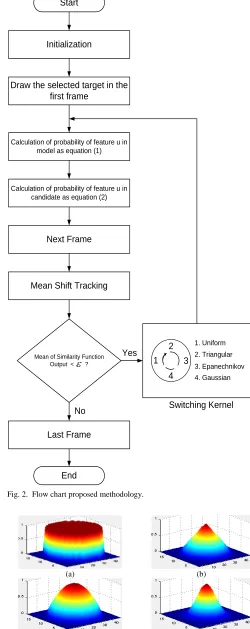
In the paper, the use of kernel functions is not static by using only one kernel function throughout the tracking process as is usually done over the years. The Mean Shift tracking utilizes varied kernel functions. The kernel function in the tracking process needs to be replaced by another kernel function by considering the value of the mean of the similarity function of the output within one frame of the video.
Assuming that the kernel function is very influential on the value of the PDF, it is possible that each kernel function selection will affect the tracking performance. Therefore, in order not to be confused thinking kernel functions to be selected, then only selected some kernel functions sequentially throughout the video frame. As for when to do the turn of the kernel function, i.e., when perceived the tracking performance declines characterized by decreasing the value of the parameter similarity. It was then that the algorithm should do the switching process of kernel functions.
Any value (ɛ) is chosen and compared to the mean of the output similarity function in one frame of video. After that, it is employed as a guideline for the kernel function to be switched to the subsequent kernel function. The value of ɛ is obtained from the mean of similarity function output from the standard Mean Shift tracking process using Gaussian kernel function. By (3) with j as a number of the frame, the value of ɛ is defined as in (6).
j
x
f
j
i
i
∑
=
=
11
(
)
ε
(6)The proposed process flow diagram of an improved Mean Shift tracking is described in Fig. 2.
IV. RESULTS AND DISCUSSION
The Mean Shift algorithm with switched kernel functions is tested against five video recordings of vehicles on the highway. The algorithm is applied to track Indonesia vehicle license plates. The mask of a Parzen window kernel using several types of Kernel functions, i.e., Uniform, Triangular, Epanechnikov and Gaussian, each with a radius h = 85% are shown in Fig. 3.
TABLEI
KERNEL FUNCTIONS
Kernel k(a)
Uniform
(
1)
2 1
≤ a I
Triangular
(
1− a) (
I a ≤1)
Epanechnikov
(
1)
(
1)
4
3 −a2 I a ≤
Gaussian
−
2 exp 2
1 2
a π
Mean Shift Tracking
Last Frame
End Start
No
Yes
Calculation of probability of feature u in model as equation (1)
Calculation of probability of feature u in candidate as equation (2)
1 2
3
4
Switching Kernel
1. Uniform
2. Triangular
3. Epanechnikov
4. Gaussian
Next Frame Initialization
Draw the selected target in the first frame
Mean of Similarity Function Output < ?
ε
Fig. 2. Flow chart proposed methodology.
(a) (b)
(c) (d)
Fig. 3. The mask of a Parzen window kernel using Kernel Function: (a) Uniform (b) Triangular (c) Epanechnikov (d) Gaussian.
The parameters used for testing are presented in Table II.
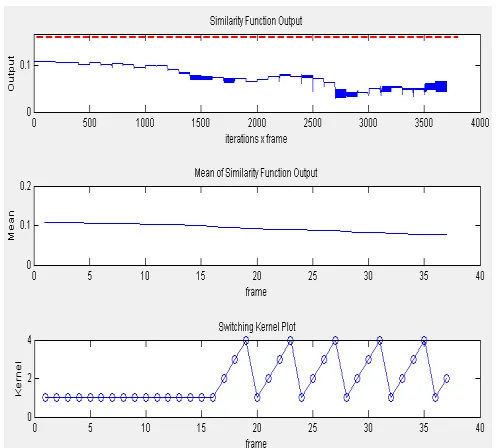
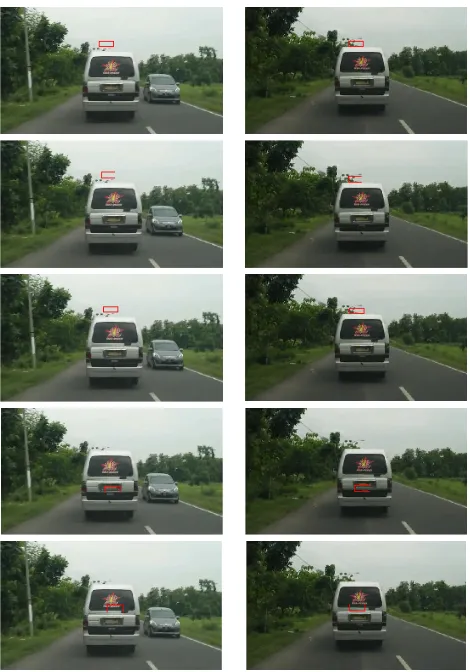
The results are shown in the following pictures. For Video 1, the test results are shown in such as Fig. 4 and Fig. 5.
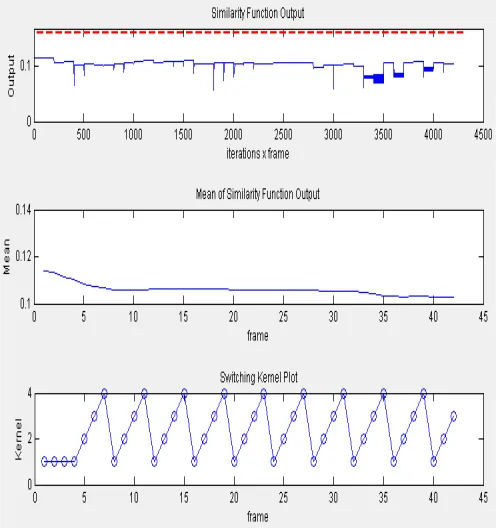
For Video 2, the test results are shown in such as Fig. 6 and Fig. 7.
For Video 3, the color of the car is similar to the color of the license plate, but instead the process of tracking the license plate was the most successful among other videos. This is possible because the entire surface of the car looks black, except for the license plate number, so it can be distinguished. Test results are shown in such as Fig. 8 and Fig. 9.
For Video 4, there is a patch image in the vehicle considered as occlusion similar to a license plate. It is sometimes considered as a number plate, so that complicates the process of tracking. From five videos that are used for testing, only this video that generates a tracking process of the proposed method is worse than the standard Mean Shift. Test results are shown in such as Fig. 10 and Fig. 11.
For Video 5, the video recording taken from the vehicle while driving under the bridge. Where the lighting is less and tends to be dark. In dark conditions, the condition of the vehicle license plate is still visible thus enabling the tracking process. From the test results, the proposed method produces equally good performance with standard Mean Shift with Gaussian kernel function. Test results are shown in such as Fig. 12 and Fig. 13.
TABLEII
MEAN SHIFT PARAMETERS
Parameter Value
the threshold for the similarity function 0.16 maximum number of iterations 100
Fig. 4. Similarity Function Output, Mean of Similarity Function Output and Switching Kernel Plot respectively of Video 1 License Plate Tracking.
Fig. 6. Similarity Function Output, Mean of Similarity Function Output and Switching Kernel Plot respectively of Video 2 License Plate Tracking.
Fig. 5. Video 1 Mean Shift Tracking using (from the top) Uniform, Triangular, Epanechnikov, Gaussian and Switching Kernel. Tracking results of frames 16, 32 are displayed.
Fig. 7. Video 2 Mean Shift Tracking using (from the top) Uniform, Triangular, Epanechnikov, Gaussian and Switching Kernel. Tracking results of frames 16, 32 are displayed.
Fig. 8. Similarity Function Output, Mean of Similarity Function Output and Switching Kernel Plot respectively of Video 3 License Plate Tracking.
Fig. 9. Video 3 Mean Shift Tracking using (from the top) Uniform, Triangular, Epanechnikov, Gaussian and Switching Kernel. Tracking results of frames 20, 40 are displayed.
To determine the accuracy of tracking, it is considered Percentage Accuracy of Object Tracking (PAOT) defined in (7).
100
%
Frame
Frame
in
on track
Object
N
1 N
1
x
PAOT
∑
∑
=
(7)The test results are summarized in Table III.
Annotation of Kernel Functions: a : Uniform
b : Triangular c : Epanechnikov d : Gaussian
Fig. 11. Video 4 Mean Shift Tracking using (from the top) Uniform, Triangular, Epanechnikov, Gaussian and Switching Kernel. Tracking results of frames 15, 30 are displayed.
Fig. 12. Similarity Function Output, Mean of Similarity Function Output and Switching Kernel Plot respectively of Video 5 License Plate Tracking.
Fig. 13. Video 5 Mean Shift Tracking using (from the top) Uniform, Triangular, Epanechnikov, Gaussian and Switching Kernel. Tracking results of frames 15, 30 are displayed.
TABLEIII
PERCENTAGE ACCURACY OF OBJECT TRACKING (%)
Video
Standard Mean Shift (MS) MS using Switching Kernel a b c d
1 42.11 36.84 34.21 76.32 84.21 2 27.78 27.78 27.78 55.56 69.44 3 53.49 53.49 51.16 88.37 88.37 4 6.45 6.45 6.45 45.16 38.71 5 57.15 54.29 60.00 77.14 77.14
From the test results, the standard Mean Shift with a Gaussian kernel function produced better results among others. When compared with the proposed method head to head, the proposed method yields better performance. In 5 trials, two times obtained better than the standard Mean Shift. Two times obtained an equally good result. The rest is worse than the standard Mean Shift. The Average of Percentage Accuracy of Object Tracking (PAOT) of the proposed Mean Shift switching algorithm was 71.57% better than the Standard Mean Shift. Therefore, the average accuracy of the proposed methodology produced better performances.
V. CONCLUSION
The paper considered a Mean Shift algorithm with switched kernel functions for vehicle license plate tracking of the video recording. The algorithm was carried out by switching four kernel functions (Uniform, Triangular, Epanechnikov and Gaussian) in order to get a successful tracking process of the license plate by maintaining the maximum value of the mean of the similarity function outputs. From the experimental results, the average accuracy of the proposed Mean Shift tracking algorithm resulted in better performances than the Standard Mean Shift. The results established that each kernel function is superior in a certain condition of the moving license plate in the video recording.
ACKNOWLEDGMENT
The first author is grateful to the doctoral fellowship program funded by the Directorate General of Higher Education, Ministry of Research and Education, Indonesia.
REFERENCES
[1] R. M. Khoshki and S. Ganesan, “Improved Automatic License Plate
Recognition (ALPR) system based on single pass Connected Component Labeling (CCL) and reign property function,” 2015, pp. 426–431.
[2] Y. Chang, Z. Su, and L. Qian-Yu, “A New Traffic Incident Detection
Method Under Low-Volume Condition Based On Automatic Vehicle Identification,” in 2012 9th International Conference on Fuzzy Systems and Knowledge Discovery, 2012, pp. 2853–2859.
[3] J. A. Khan and M. A. Shah, “Car Number Plate Recognition (CNPR)
system using multiple template matching,” in 2016 22nd International Conference on Automation and Computing (ICAC), 2016, pp. 290–295.
[4] M. Zhu, C. Liu, J. Wang, X. Wang, and Y. Han, “A Service-Friendly
Approach to Discover Traveling Companions Based on ANPR Data
Stream,” in 2016 IEEE International Conference on Services
Computing (SCC), 2016, pp. 171–178.
[5] A. Jain and J. Sharma, “Classification and interpretation of characters
in multi-application OCR system,” in 2014 International Conference
on Data Mining and Intelligent Computing (ICDMIC), 2014, pp. 1–6.
[6] N. Li, D. Zhang, X. Gu, L. Huang, W. Liu, and T. Xu, “An improved
mean shift algorithm for moving object tracking,” in Electrical and
Computer Engineering (CCECE), 2015 IEEE 28th Canadian Conference on, 2015, pp. 1425–1429.
[7] S. P. Sahoo and S. Ari, “Automated human tracking using advanced
mean shift algorithm,” in Communications and Signal Processing
(ICCSP), 2015 International Conference on, 2015, pp. 789–793.
[8] S. B. Setyawan, D. Purwanto, and R. Mardiyanto, “Visual object
tracking using improved Mean Shift algorithm,” in 2015 International Conference on Information Technology Systems and Innovation (ICITSI), 2015, pp. 1–7.
[9] C. Xiu and F. Ba, “Target tracking based on the improved Camshift
method,” in 2016 Chinese Control and Decision Conference (CCDC),
2016, pp. 3600–3604.
[10] R. P. Tripathi, S. Ghosh, and J. O. Chandle, “Tracking of object using
optimal adaptive Kalman filter,” in 2016 IEEE International
Conference on Engineering and Technology (ICETECH), 2016, pp. 1128–1131.
[11] V. Kaltsa, A. Briassouli, I. Kompatsiaris, L. J. Hadjileontiadis, and M. G. Strintzis, “Swarm Intelligence for Detecting Interesting Events in
Crowded Environments,” IEEE Trans. Image Process., vol. 24, no. 7,
pp. 2153–2166, Jul. 2015.
[12] S. K. Mahapatra, S. K. Mohapatra, S. Mahapatra, and S. K. Tripathy, “A Proposed Multithreading Fuzzy C-Mean Algorithm for Detecting
Underwater Fishes,” in 2016 2nd International Conference on
Computational Intelligence and Networks (CINE), 2016, pp. 102–105. [13] F. Alsulami, K. Ahmadi, and E. Salari, “Detection and tracking of dim
objects in infrared (IR) images using Support Vector Machine,” in 2016 IEEE International Conference on Electro Information Technology (EIT), 2016, pp. 357–361.
[14] D. Comaniciu, V. Ramesh, and P. Meer, “Kernel-based object tracking,” IEEE Trans. Pattern Anal. Mach. Intell., vol. 25, no. 5, pp. 564–577, May 2003.
[15] H. Zhi-Qiang, L. Xiang, Y. Wang-Sheng, L. Wu, and H. An-Qi, “Mean-Shift Tracking Algorithm with Improved Background-Weighted
Histogram,” in Intelligent Systems Design and Engineering
Applications (ISDEA), 2014 Fifth International Conference on, 2014, pp. 597–602.
[16] K. Fukunaga and L. Hostetler, “The estimation of the gradient of a density function, with applications in pattern recognition,” IEEE Trans. Inf. Theory, vol. 21, no. 1, pp. 32–40, Jan. 1975.
[17] D. Comaniciu and P. Meer, “Mean shift: a robust approach toward feature space analysis,” IEEE Trans. Pattern Anal. Mach. Intell., vol. 24, no. 5, pp. 603–619, May 2002.
[18] K. Chen, S. Fu, K. Song, and C. G. Jhun, “A Meanshift-based imbedded computer vision system design for real-time target tracking,” 2012, pp. 1298–1303.
[19] Y. Ukrainitz and B. Sarel, “Mean Shift Theory and Applications,”
Weizmann Inst. Sci. http//www. wisdom. weizmann. ac. il/~ vision/courses/2004_2/files/mean_shift/mean_shift. ppt, 2004.
Basuki Rahmat, He is a lecturer at bachelor degree in Universitas Pembangunan Nasional Veteran Jawa Timur. He received the bachelor degree in Instrumentation Physics from Institut Teknologi Sepuluh Nopember Surabaya in 1995. He received a master degree in Instrumentation and Control from Institut Teknologi Bandung, in 2000. Currently, he is a Ph.D. candidate in Electrical Engineering at Institut Teknologi Sepuluh Nopember, Surabaya. His research interests are an intelligent system, soft computing, image and video processing, intelligent control, MATLAB, PHP, Python and Delphi Programming.
Endra Joelianto, received the bachelor degree in Engineering Physics from Institut Teknologi Bandung (ITB), Indonesia in 1990. He received Ph.D. in Engineering, from The Australian National University (ANU), Australia in 2002. Currently, he is the staff of Instrumentation and Control Research Group, Faculty of Industrial Technology, Institut Teknologi Bandung (ITB), Indonesia and Research Professor at Centre for UnManned System Studies (CentrUMS), ITB, Indonesia. His research interests are Hybrid/Discrete Event Control Systems, Advanced Control, Embedded Control Systems and Intelligent Systems. He is a member of IEEE.
I Ketut Eddy Purnama, received the bachelor degree in Electrical Engineering from Institut Teknologi Sepuluh Nopember (ITS), Surabaya, Indonesia in 1994. He received his Master of Technology from Institut Teknologi Bandung, Bandung, Indonesia in 1999. He received a Ph.D.
degree from the University of Groningen,