CrossMark
Published by DiscoverSys
Anti-inflammatory effect of red piper crocatum
leaves extract decrease TNF-α and IL-6 levels in
wistar rat with atherosclerosis
Sri Wahjuni,1* Wita, I W ,2 Mantik Astawa, I N3
ABSTRACT
Background: This research aims to find a cure for anti-inflammation, based on the utilization of red piper crocatum. The research was started with descriptive study to explore active components of red piper crocatum leaf and followed by experimental study to investigate red piper crocatum activity of the leaf extract in anti-inflammation induced Wistar rat. In this research observed three dominant components: caryophyllene bicyclo [5.2.0] none, 2 methylene-4,8,8-trimethyl-4-vinyl; phytol; 5,9-propano-5H- benzocycloheptene, 6,7,8,9-tetrahydro-7,11-bis(methylene); 4,4-ethynedioxy-2-hexadecen-15-15 olide 1,4,9-trioxaspiro [4,15] eic os-6-en-8-one, 10 methyl; 1H-1,2,4-triazole-5(H)-thione,4-allyl-3-(3-furyl); Benzofuran,2,3-dihydro-2-methyl-7-phenyl which are possibly active to inhibit anti-inflammation to atherosclerosis. Bad eating habits also can cause various health problems, such as obesity, dyslipidemia, inflammation to atherosclerosis. This study was conducted to investigate of red piper crocatum leaves extract as an anti-inflammation through decrease of biochemistry markers TNF-α and IL-6 levels.
Method: This is a true experimental with randomized pre-test and post-test control group design, using 50 Wistar rats that are divided
into 5 groups: control group using 0 mg/kg BW red piper crocatum leaves extract, treatment group 1 using 50 mg/kg BW red piper crocatum leaves extract, treatment group 2 using 100 mg/kg BW red piper crocatum leaves extract, treatment group 3 using 150 mg/kg BW red piper crocatum leaves extract, and treatment group 4 200mg/kg BW red piper crocatum leaves extract.
Results: It was observed that intake of 150 mg/BW red piper crocatum leaves extract results in the highest significance decrease of 45.63% of TNF-α levels from (28.62 ± 1.25 to 15.56 ± 7.20 рg/mL) and a significance decrease of 15.42% of IL-6 level from (134.64 ± 1.98 to 113.87 ± 4.30 рg/mL).
Conclusion: It can be concluded that intake of red piper crocatum leaves extract acts as anti-inflammation for Wistar rats with atherosclerosis through decrease of TNF-α and IL-6 levels. Further research is required to determine whether the application of red piper crocatum leaves extract on human will result in similar effects of anti-inflammation.
Keywords: Consumption habit, instant food, dyslipidemia, atherosclerosis, red piper crocatum leaves extract.
Cite This Article: Wahjuni, S., Wita, I., Astawa, I. 2016. Anti-inflammatory effect of red piper crocatum leaves extract decrease TNF-α and IL-6 levels in wistar rat with atherosclerosis. Bali Medical Journal 5(2): 240-244. DOI:10.15562/bmj.v5i2.210
INTRODUCTION
Inflammation is a complex biological response of body tissues to harmful stimuli, such as pathogens, damaged cells or irritants and a protective response involving immune cell, molecular mediator and blood vessels has been known that there is a significant correlation between high lipid serum levels and inci-dents of atherosclerosis, a trigger of coronary heart disease. Coronary heart disease presents as a results of blood circulation disturbance and abnormality of cardiac electricity or other forms of arrhythmia.
This leads to unorganized myocardial contrac-tion, blood flow obstruccontrac-tion, and blood flow regurgitation. All of these conditions resulted in the return of the blood flow on each contraction back to the heart (shunts), blood flow abnormality and may end up with heart failure.1 Atherosclerosis is a slowly progressive disease, present in large to medium arterial muscle and elastic artery. The main sites of atherosclerosis are abdominal aorta,
coronary artery, popliteal artery, thorax descend-ing aorta, internal carotid artery, and the circle of Willis. Risk factors, such as hypertension, chronic hypercholesterolemia, immune system distur-bance, toxin and virus are also involved in the arterial endothelial wall destruction. This damage induces permeability changes of endothelial cells and leads to the increase of plasma constituents, such as lipoprotein, that can easily enter to artery wall. Damaging of these endothelial cells could also change the trombosistein of lumen artery property that can leads to adhesion of thrombo-cyte to the blood and induce inflammation. If this damaging process exists continually for a long time, it will be followed by continuous athero-sclerosis and leads to the thickening of tunica intima and results in disturbance of blood flow on that site.2 Managing eating habits is one way to overcome this condition. Decreased plasma 1Faculty of Mathematics and Basic
Science, Udayana University, Bali, Indonesia
2Faculty of Medicine, Udayana University, Bali, Indonesia 3Faculty of Veterinary Medicine, Udayana University, Bali, Indonesia
*Correspondence to: Sri Wahjuni
Faculty of Mathematics and Basic Science, Udayana University, Denpasar
Volume No.: 5
Issue: 2
First page No.: 240
P-ISSN.2089-1180
E-ISSN.2302-2914
cholesterol can be restored by raising the choles-terol turnover rate. Faster cholescholes-terol replacement can be achieved through intake of flavonoid in red piper crocatum leaves. This flavonoid in metabo-lism acts as an antioxidant that could breakdown lipid peroxidation chain of hypercholesterolemia patients.3
Hypercholesterolemia-induced atherosclero-sis is a multifactorial disease that also correlates to pro-inflammation cytokine, such as IFN-α, IL-1, IL-6 and TNF-α. Some research reported that atherogenic diet could increase formation of IL-6 and TNF-α, but did not significantly affects IL-1 production.4,5,6
Based on the background above, this research was conducted to investigate the role of red piper crocatum leaves as an anti-inflammation through the decrease of IL-6 and TNF-α level in Wistar rat with atherosclerosis.
MATERIALS AND METHOD
This study employs two research methods: descriptive explorative to determine the active components of red piper crocatum leaves extracted with n-butanol; followed by experi-mental study to observed their anti-inflamma-tion activity. Leaf extract was obtained through maceration process using methanol and followed by partition using butanol. Crude extract obtained was the identified by applying GC-MS instrument.
This study used a true experimental randomized pre- and post-test control group design to deter-mine the role of red piper crocatum leaves extract for anti-inflammation. Research was conducted using 50 Wistar rats and divided into 5 groups, i.e. P0 for control with 0 mg/kg BW red piper crocatum leaves extract, P1 for treatment with 50 mg/kg BW red piper crocatum leaves extract, P2 for treatment with 100 mg/kg BW red piper crocatum leaves extract, P3 for treatment of 150 mg/kg BW red piper crocatum leaves extract, and P4 for treatment of 200 mg/kg BW red piper crocatum leaves extract. Rats were fed with high-cholesterol diets for 13 weeks to achieve atherosclerosis, and then were treated with various concentration of red piper crocatum leaves extract for 6 weeks. TNF-α and IL-6 levels rats’ serum for atherosclerosis (pre-test) and after treated (post-test) were then observed. All data obtained were analyzed statistically to determine the mean difference of treatment using one-way ANOVA at 5% significant level.
Animal ethical clearance was obtained from local authority body at Veterinary Faculty of Udayana University, Bali, Indonesia. Around
1 ml of blood was taken from rat aorta which was anesthetized before dissected. The blood was centrifuged for 15 minutes at the rate of 3.000-3.500 rpm. TNF-α and IL-6 kid, FS TBHBA (2,4,6-tribromo-3-hydroxybenzoic acid) was then added to the serum obtained. The mixture was then incubated for 10 minutes at a temperature of 37oC. Then the optical density of the mixture was determined using spectrophotometer at 546 nm of wave number.
RESULTS
Descriptive study
Around 1,200 g of red piper crocatum leaf powder was macerated with methanol overnight. From this process, 158g of crude extract was obtained. This crude extract was then tested for antioxidant activ-ity using DPPH test. The test results are presented in Table 1.
The crude extract was then purified by applying partition using petroleum ether, chloroform, n-bu-tanol and water. It was found that partition by using n-butanol produce the highest antioxidant activity that was indicated by their DPPH test. Therefore, the n-butanol extract was then identified phyto-chemically using a number of reagents as indicated in Table 2.
The most active extract was then identified by applying GC-MS. The chromatogram is presented in figure 1. Based on library database of the GC-MS instrument there were four compounds detected as indicated in Table 3.
Decrease of TNF-α Level
Mean of TNF-a serum levels pre- and post-test data are presented in Table 3.
Data on Table 1 were normally distributed with p > 0.05 and their variances were also homogenous with p > 0.05. All pre-test data were comparable (p > 0.05), therefore, the mean differ-ent of various treatmdiffer-ent of fish oil can be only
performed based on post-test data and analyzed using one-way ANOVA. It was observed that there are differences between all treatments. The differences determined by using Post Hoc Test (LSD). The Post Hoc Test results are presented on Table 4.
Data on Table 3 were normally distributed with
p > 0.05 and their variances were also homogenous with p > 0.05. The mean difference of various Red piper crocatum treatments can be obtained from the basis of post-test data, but only if all pre-test data are comparable. It was obtained that all pre-test data are comparable with p < 0.05, therefore, mean different of the treatment were obtained based on post-test data and analysed using one-way ANOVA.
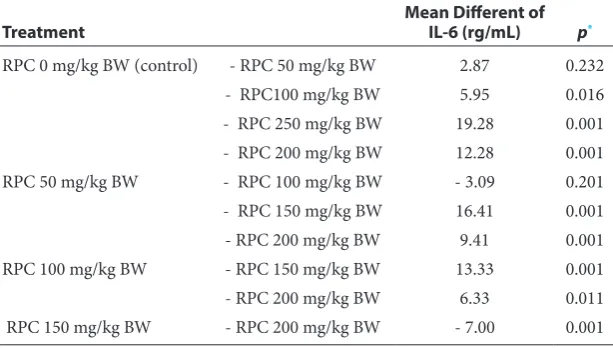
There were significant differences of treatment obtained with p < 0.0. After that the data were analysed using Post Hoc Test to measure the difference. Post Hoc test results were summarized in Table 6.
Decrease of IL-6 Levels
Mean of pre- and post-test data of IL-6 serum levels are presented on Table 5.
Table 1 Antioxidant activity test of red piper crocatum leaves crude extract
Absorbance
Sample (minutes)Time Test 497 nm 517 nm 537 nm A 517 nm inhibition%
Crude extract
5 sampleDPPH 0.714 0.635 0.785 0.593 0.698 0.515 0.0790 0.0180 71.22 %
60 sampleDPPH 0.651 0.527 0.704 0.508 0.613 0.468 0.0720 0.0105 85.42 %
Table 2 Phytochemical Test of n-Butanol Extract
No. Compounds Reagent Colour Changes Results
1. Alkaloid Meyer
Wagner
Yellow-orange (without white precipitate)
Yellow-brown (without brown
precipitate)
-2 Flavonoid
Willstatter NaOH 10% H2SO4 concentrated
Bate Smith-Metcalf
Yellow-crimson Yellow-brown Yellow-crimson
Yellow-red
+ + + + 3 Triterpenoid Lieberman-Burchard H2SO4 10% Yellow-brown Yellow-brown + +
4 Saponin Hot water + HCl No foam formation
-5 Phenolate (Tannin) Hot water + FeCl3 Yellow-greenish black +
6 Steroid Lieberman-Burchard H2SO2 10% Yellow-brown Yellow-brown
-Remarks: (+) = containing tested compound (-) = not containing tested compound
Table 3 Compound Identified Based on GC-MS Chromatogram
Peaks Retention time (tg) % Area Compound identified
1 14.06 1.39 Caryophyllene bicyclo[5.2.0] none,2
methylene-4,8,8-trimethyl-4-vinyl
2 21.55 4.67 Phytol
4 28.57 18.37 4,4-ethynedioxy-2-hexadecen-15-15
olide 1,4,9-trioxaspiro [4,15] eic os-6-en-8-one, 10 methyl
6 29.35 31.98
Benzofuran,2,3-dihydro-2-methyl-7-phenyl
Table 4 Resume of Post Hoc Test of TNF-α Levels
Treatment
Mean Different
of TNF-a (pg/mL) p*
RPC 0 mg/ kg BW (control)
- RPC50 mg/
kg BW 0.79 0.770
- RPC 100 mg/
kg BW 3.69 0.177
- RPC 150 mg/
kg BW 12.55 0.001
- RPC 200 mg/
kg BW 1.10 0.686
RPC 50 mg/
kg BW - RPC 100 mg/ kg BW 2.90 0.287
- RPC 150 mg/
kg BW 11.76 0.001
- RPC 200 mg/
kg BW 0.30 0.911
RPC 100
mg/kg BW -RPC 150mg/kg BW 8.86 0.002
- RPC 200mg/
kg BW - 2.59 0.339
RPC 150
mg/ kg BW - RPC 200 mg/kg BW - 1.45 0.001
RPC = Red piper crocatum *significant p < 0.05
Table 3 Mean of TNF-α serum levels data
Treatment TNF-a ( pg /mL)
Pre-test Post-test
RPC 0 mg/kg BW (control) 28.98 ± 6.00 28.11 ± 5.94
RPC 50 mg/ kg BW 29.12 ± 5.79 27.32 ± 5.01
RPC 100 mg/kg BW 29.02 ± 5.34 24.42 ± 5.74
RPC 150 mg/kg BW 28.62 ± 4.72 15.56 ± 7.20
RPC 200 mg/ kg BW 29.02 ± 5.06 26.02 ± 8.34
DISCUSSIONS
The research results indicate that the highest decrease of 12.55 pg/mL of TNF-a was obtained from intake of 150 mg/kg BW RPC. Increase of RPC to 200 mg/ kg BW could not improve the decrease of TNF-a levels. This condition indicates that concentration of 200 mg/kg BW RPC has already active compound flavonoid. Therefore, it could not decrease of TNF-a levels any further. A research found that there is no transcription of NF-Kb, so that no further produc-tion of TNF-a because of the active compound.7
Inflammation is a response to tissue damage during vascularization. This response is followed by an important process, such as endothelial process. Endothelium is an important part of blood vein that plays an important role in atherosclerosis. Endothelium is a main target of mechanical and chem-ical damage due to dyslipidemia risk factor. Chronic, continuous, and prolonged dyslipidemia resulted in pro-inflammation response and prothrombic which are initially acute becomes chronic. This will be followed by infiltration of leukocyte cells, mainly monocyte cells to lower subendothelial tissue to form macrophage cells. These cells will destroy all remains of LDL-C, oxidized to form foam cells and later will cause the formation of atheroma.8
The last two decades’ research obtained that red piper crocatum leaves is effective as an anti-inflam-mation. This is because red piper crocatum is rich in flavonoids. These flavonoids are anti-inflamma-tion flavonoids that can inhibit the pro-inflamma-tory cytokine.5, 6, 9 In this study, red piper crocatum leaves extract which is rich of flavanol was applied and proven to have an anti-inflammation effect. This anti-inflammation effect is due to activation of endothelial nuclear factor-kappa beta (ENF-Kb) on peripheral vein. ENF-Kb is a transcription factor distributed on all endothelial cells that has a role in controlling vascularization.
A research has found that the role of flavonoid as an anti-inflammation compound is due to their action as immunomodulator.9 In addition, their role as anti-inflammation compound is as a result of the flavanol effect. These acids are substrate for trigger-ing the formation of pinocembrin and pinostrobin. These two flavanol are endothelium-dependent vasodilator, which can cause relaxation of ordinary coronary artery and paradoxical vasoconstriction on atherosclerosis artery.
Data in Table 4 indicate that there is a decrease of IL-6 levels since the intake of 50 mg/kg BW of RPC. Even though there is a decrease of IL-6 levels caused by treatment of 50 mg/kg BW RPC which is about 2.87 pg/mL, the decrease is not significant statistically with p > 0.05. Meanwhile an intake of 100 mg/kg BW RPC resulted in significant decrease of IL-6 levels by 5.95 pg/mL with p < 0.05. In addi-tion, intake of 150 mg/BW RPC has also a similar trend to significantly decrease the IL-6 levels by 19.28 pg/mL with p < 0.05. However, increase of concentration to 200 mg/BW RPC intake did not significantly decrease the IL-6 levels, indicated by p > 0.05.
Red piper crocatum leaves are rich of pinocem-brin and pinostrobin. These two flavanol are antioxidants that have anti-inflammation prop-erties. In the endothelial cells experiencing activated inflammation, increased selectin and VCAM-1 expression were observed. VICAM-1 induces monocyte adhesion. This adhesion was also induced by pro-inflammation cytokines, such as 1L-1β and TNF-α. These cytokines were induced by CRP protein produced as a results of IL-6 response by signalling protease-activated receptor, uptake of oxLDL through oxLDL recep-tor-1 (LOX-1) and by interaction of CD40-CD40 ligand in artery intima.10 IL-6 has an important role in inflammation response and this cytokine is secreted by activated-macrophage, which leads to phebric and known as endogenous pyrogen. IL-6 was also initiated the acute phase response, marked by production of acute phase protein by the hepatocyte.11
Table 5 Mean of IL-6 Serum Levels Data Pre- and Post-Test
Treatment
IL-6 (pg/mL)
Pre-test Post-test
RPC 0 mg/kg BW (control) 134.58 ± 2.21 133.15 ± 4.01
RPC 50 mg/kg BW 134.24 ± 2.64 130.28 ± 3.59
RPC 100 mg/kg BW 134.75 ± 2.51 127.20 ± 5.56
RPC 150 mg/kg BW 134.64 ± 1.98 113.87 ± 4.30
RPC 200 mg/kg BW 135.34 ± 4.57 120.87 ± 7.89
RPC = Red piper crocatum
Table 6 Resume of Post Hoc Test of IL-6 Levels
Treatment Mean Different of IL-6 (rg/mL) p*
RPC 0 mg/kg BW (control) - RPC 50 mg/kg BW 2.87 0.232
- RPC100 mg/kg BW 5.95 0.016
- RPC 250 mg/kg BW 19.28 0.001
- RPC 200 mg/kg BW 12.28 0.001
RPC 50 mg/kg BW - RPC 100 mg/kg BW - 3.09 0.201
- RPC 150 mg/kg BW 16.41 0.001
- RPC 200 mg/kg BW 9.41 0.001
RPC 100 mg/kg BW - RPC 150 mg/kg BW 13.33 0.001
- RPC 200 mg/kg BW 6.33 0.011
RPC 150 mg/kg BW - RPC 200 mg/kg BW - 7.00 0.001
CONCLUSION
1. Intake of 150 mg/kg BW RPC decreases the TNF-a serum levels in Wistar rat with athero-sclerosis by around 45.63% (from 28.62±4.72 to 15.56±7.20 рg/mL).
2. Intake of 0 mg/kg BW RPC decreases the IL-6 serum levels in Wistar rat with atherosclero-sis by around 15.42% (from 134.64±1.98 to 113.87±4.30 рg/mL).
ACKNOWLEDGMENT
The author would like to thank Prof. Dr. dr. I Wayan Wita, SpJP. and Prof. Drh. N. Mantik Astawa, Ph.D. for their invaluable supervision on the Journal.
REFERENCES
1. Vinay, K., Abbas, A.K., and Nelson, F. 2004. Pathologic
basic of disease 7th ed. Elsevier saunders. New York.
2. Szmitko, P.E., Wang, C.H., Weisel, R.D., De-Almmeida, J.R.,
Anderson, T.J., and Verma, S. 2003. New Markers of Inflammation and Endothelial Cell Activation. Circulation 108: 1917-1923.
3. Kanjwal, M. 2004. Peripheral Aterial Disease-The Silent Killer. JK-Practitioner, October-December:1 (no.4):235-232.
4. Stefan, J., Mikko, P.S.A., Bengt, K., and Jan-Nilsson. 1996. Human Monocytes/ Macrophages Release TNF-□ in
Response to Ox-LDL. Arteriosclerosis, Thrombosis, and
Vascular Biology.16:1573-1579.
5. Ahmed, E. 2001. Immune Mechanism in Atherosclerosis. Dissertation. ISSBN: 91-628-4612-4. Konferensrummet, Centrum för Molekulär Medicin, Karolinska Sjukhuset. 6. Han, S.N., Leka, L.S., Lichtenstein, A.H., Ausman, L.M.,
Schaefer, E.J., and Meydani, S.N. 2002. Effect of Hydrogenated and Saturated, Relative to Polyunsaturated, Fat on Immune and Inflammatory Responses of Adults with Moderate Hypercholesterolemia. Journal of Lipid Research. 43(3): p. 445-52.
7. Chen, G., and Goeddel, D.V. 2002. TNFR-1 Signaling: A Beautiful Pathway. Science. 296: p. 1634 – 1635.
8. Baraas-Faisa. 2006. Kardiologi Molekuler Radikal Bebas, Disfungsi Endotel, Aterosklerosis. Antioksidan Latihan Fisik dan Rehabilitasi Jantung. Bagian Kardiologi FKUI/ RS Jantung Harapan Kita. Jakarta.
9. Akhlaghi M., Brain B., 2009. Mechanism of flavonoid pro-tection against myocardial ischemia reperfusion injury. Journal of Molecular and Cellular Cardiology, 46: 309-17. 10. Bonetti, P.O., Lerman, L.O., and Lerman, A. 2003.
Endothelial Dysfunction: A Marker of Atherosclerosis Risk. Aterisoscler Thromb Vase Biol. 23: p. 168-175. 11. Coico, R., Li, S.J., and Benyamin, E. 2003. Element of
innate and acquired immunity Immunology. In:
immu-nology. A Short Course, 5th ed. New Jersey, John Wiley &
Sons p: 11 – 26.