4629 A REVIEW ON SPECTROPHOTOMETRIC AND CHROMATOGRAPHIC METHODS FOR THE ESTIMATION OF PHENYLEPHRINE IN BULK AND
DIFFERENT DOSAGE FORMS
A. Geetha Susmita*, G. Rajitha and T. Lakshmi Bhavani
Institute of Pharmaceutical Technology
Sri Padmavati Mahila Visvavidyalayam (Women's University), Tirupati-517502, Andhra Pradesh, India.
*Corresponding author E-mail:[email protected]
ARTICLE INFO ABSTRACT
Key Words
Phenylephrine, Nasal decongestant,
UV Spectroscopy, Liquid Chromatography
Phenylephrine hydrochloride is used as nasal decongestant. Oral phenylephrine is extensively metabolized by MAO enzyme in the gastrointestinal tract and liver. It is a direct selective alpha adrenergic receptor agonist; it does not cause release of endogenous noradrenalin, as pseudoephedrine does. Phenylephrine hydrochloride (alpha-adrenergic, sympathomimetic agent) is a useful vasoconstrictor of sustained action with little effect on the myocardium or the central nervous system. Phenylephrine is rarely used to increase the blood pressure as a vasopressor in unstable patients with hypotension. It is available in the following dosage forms: nasal drops, nasal spray, eye drops and phenylephrine injection. Phenylephrine is also available as oral tablets, chewable tablets, oral disintegrating tablets, capsules, suspensions and sachets formulations. This review shows different methods developed for the determination of Phenylephrine and along with combinations like UV-spectroscopy and liquid chromatography.
INTRODUCTION:
Phenylephrine is 3-[(1R)-1-hydroxy-2- (methyl amino) ethyl] phenol, appears as a white or almost white, crystalline powder. It dissolves in dilute mineral acids and in dilute solutions of alkali hydroxides. The Phenylephrine is a base with a pKa value of 8.97 and melts about 174°C.1,2 It is used as a sympathomimetic amine that acts predominantly on α-adrenergic receptors. Phenylephrine is official in IP, BP, EP and USPNF pharmacopoeia3. It is mainly used to treat nasal congestion, but may also be useful in treating hypotension and shock,
hypotension during spinal anesthesia, prolongation of spinal anesthesia, paroxysmal supraventricular tachycardia, symptomatic relief of external or internal haemorrhoids and to increase blood pressure as an aid in the diagnosis of heart murmurs.
Figure 1: Structure of Phenylephrine
O H
NH CH3 OH
H
Molecular Formula: C9H13NO2 An Elsevier Indexed Journal ISSN-2230-7346
4630
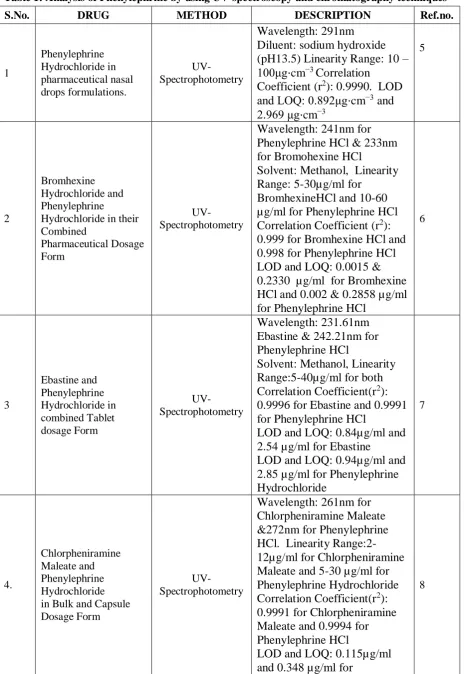
Table 1: Analysis of Phenylephrine by using UV-spectroscopy and chromatography techniques
S.No. DRUG METHOD DESCRIPTION Ref.no.
1
Phenylephrine Hydrochloride in pharmaceutical nasal drops formulations.
UV- Spectrophotometry
Wavelength: 291nm Diluent: sodium hydroxide (pH13.5) Linearity Range: 10 – 100μg⋅cm−3 Correlation
Coefficient (r2): 0.9990. LOD and LOQ: 0.892μg⋅cm−3 and 2.969 μg⋅cm−3
5
2
Bromhexine Hydrochloride and Phenylephrine
Hydrochloride in their Combined
Pharmaceutical Dosage Form
UV- Spectrophotometry
Wavelength: 241nm for Phenylephrine HCl & 233nm for Bromohexine HCl
Solvent: Methanol, Linearity Range: 5-30µg/ml for
BromhexineHCl and 10-60 µg/ml for Phenylephrine HCl Correlation Coefficient (r2): 0.999 for Bromhexine HCl and 0.998 for Phenylephrine HCl LOD and LOQ: 0.0015 & 0.2330 µg/ml for Bromhexine HCl and 0.002 & 0.2858 µg/ml for Phenylephrine HCl
6
3
Ebastine and Phenylephrine Hydrochloride in combined Tablet dosage Form
UV- Spectrophotometry
Wavelength: 231.61nm Ebastine & 242.21nm for Phenylephrine HCl
Solvent: Methanol, Linearity Range:5-40µg/ml for both Correlation Coefficient(r2): 0.9996 for Ebastine and 0.9991 for Phenylephrine HCl
LOD and LOQ: 0.84µg/ml and 2.54 µg/ml for Ebastine
LOD and LOQ: 0.94µg/ml and 2.85 µg/ml for Phenylephrine Hydrochloride
7
4.
Chlorpheniramine Maleate and Phenylephrine Hydrochloride in Bulk and Capsule Dosage Form
UV- Spectrophotometry
Wavelength: 261nm for Chlorpheniramine Maleate &272nm for Phenylephrine HCl. Linearity Range:2-12µg/ml for Chlorpheniramine Maleate and 5-30 µg/ml for Phenylephrine Hydrochloride Correlation Coefficient(r2): 0.9991 for Chlorpheniramine Maleate and 0.9994 for Phenylephrine HCl
LOD and LOQ: 0.115µg/ml and 0.348 µg/ml for
4631 Chlorpheniramine Maleate
LOD and LOQ: 0.200µg/ml and 0.608µg/ml for
Phenylephrine Hydrochloride.
5
Phenylephrine,
Dimethindine Maleate and its major toxic impurity; 2-ethyl pyridine, in raw material and nasal gel
TLC
Stationary phase: Silica Gel TLC F254 plates
Mobile phase: toluene: Acetone: isopropyl alcohol: ammonia (5.3:2.7:1.8:0.4,by volume) Retention factor(Rf): 0.26 ±0.01 for Phenylephrine 0.54 ± 0.02 for Dimethindine Maleate. 0.72 ± 0.01 for 2-ethyl pyridine, Correlation coefficient (r2): 0.9990 for Phenylephrine, 0.9990 for Dimethindine Maleate and 0.9994 for 2-ethyl pyridine.
9
6
Paracetamol, Phenylephrine hydrochloride,
Nimesulide, Cetrizine and Caffeine in bulk and pharmaceutical dosage form
HPTLC
Stationary phase: Merck aluminum plates precoated with silica gel 60 F254.
Mobile phase: Toluene: Ethyl acetate: Methanol: Formic acid (16:2:4:0.8, v/v/v/v).
Retardation factor: Paracetamol (0.37),
Phenylephrine hydrochloride (0.09), Nimesulide (0.70), Cetrizine (0.27) and Caffeine (0.51). Wave length: 212 nm. Linearity range: 200-1400 ng band-1 for Paracetamol, Nimesulide, Cetrizine, Caffeine and 100-1400 ng band-1 for Phenylephrine hydrochloride.
10
7
Two Binary Mixtures Containing Ketorolac Tromethamine (KTC) with Phenylephrine Hydrochloride (PHE) and with Febuxostat (FBX) in bulk drug and in combined dosage forms.
HPTLC
Stationary phase: Merck HPTLC aluminum sheets of silica gel 60 F254
Mobile phase: Chloroform methanol–ammonia (7:3:0.1, v/v) and (7.5:2.5:0.1, v/v) for KTC/PHE and KTC/FBX mixtures, respectively.
Wave length: 273 and 320 nm for Mixtures 1 and 2,
respectively. Linearity range: 0.20–0.60 and 0.60–1.95 μg band−1 for KTC and PHE (Mixture 1), respectively, and
4632 0.10–1.00and 0.25–2.50 μg
band−1 for KTC and FBX (Mixture 2), respectively. Correlation coefficient (r2) : > 0.999.
8
Ascorbic acid, Phenylephrine, Paracetamol and Caffeine in tablet
HPLC
Mobile Phase: Acetonitrile and Phosphate buffer (pH 6.50) (10 : 90, v/v). Stationary Phase: monolithic column, Onyx Monolithic C18 (100 x 4.6 mm) Flow Rate: 1.0 ml/min Wavelength: 210 nm
(Phenylephrine, Paracetamol) 235 nm (Ascorbic acid and Caffeine) Linearity Range: 50 150µg/ml. Retention time: Correlation Coefficient (r2): 0.9992 for ascorbic acid, 0.9994 for phenylephrine, 0.9999 for paracetamol and 0.9992 for caffeine.
12
9
Bromhexine and phenylephrine HCl in its Pharmaceutical combined dosage form
RP-HPLC
Mobile Phase: Buffer (pH 5.0)-Acetonitrile-Triethylamine (80:20:0.25). Stationary Phase: C18 column (25 cm × 0.46 cm) Hypersil BDS. Flow Rate: 1.0 ml/min. Linearity Range: 4-12μg/ml for Bromhexine and 5-15μg/ml for Phenylephrine HCl. Wavelength: 225nm Retention time: Bromhexine and Phenylephrine HCl were found to 3.66min and 5.29min respectively. Correlation Coefficient (r2): 0.99 for Bromhexine HCl and 0.99 for Phenylephrine HCl
13
10
Ebastine and Phenylephrine
hydrochloride in tablet dosage form
RP-HPLC
Mobile Phase: Buffer: Acetonitrile (20 : 80 ) % v/v Stationary Phase: Inertsil ODS-3 (250 mm × 4.6 mm i.d. 5 μm particle size). Flow Rate: 0.5 ml/min. Wavelength:230nm Linearity Range: 50-100µg/ml Retention Time: henylephrine hydrochloride and Ebastine was 3.90 min and 5.83 min respectively. Correlation Coefficient (r2): 0.998 for Phenylephrine hydrochloride
4633 and 0.999 for Ebastine.
LOD: 0.352µg/ml for
Phenylephrine hydrochloride and 0.248 μg/mL for Ebastine. LOQ: 1.068μg/mL for
Phenylephrine hydrochloride and 0.752μg/mL for Ebastine.
11
Phenylephrine hydrochloride and Chlorpheniramine maleate in
pharmaceutical dosage form
RP-HPLC
Mobile phase: 0.01M
phosphate buffer: acetonitrile (70: 30).
Stationary Phase: Princeton C8 analytical column (250 x 4.6mm, 5µm)
Flow Rate:1ml/min Wavelength: 230nm
Linearity Range:5-60 µg/mL Correlation Coefficient (r2): 0.9996 for Phenylephrine hydrochloride and 0.9998 for Chlorpheniramine maleate. LOD: 0.28 µg/mL for phenylephrine hydrochloride and 0.36 µg/mL for
Chlorpheniramine maleate. LOQ: 0.86 µg/mL for phenylephrine hydrochloride and 1.1µg/mL for
Chlorpheniramine maleate.
15
12
Ebastine and phenylephrine
hydrochloride in tablet
RP-HPLC
Mobile phase:
MeOH:KH2PO4(80:20 pH 5.5) Stationary Phase: Prontosil C18 [4.6(id) × 250mm] Flow Rate: 1.5ml/min Wavelength: 275nm Solvent: Methanol
Retention Time: 3.5 min for ebastine and 1.8 min for phenylephrine HCl
16
13
Phenylephrine HCl and CetrizineHCl in Tablet dosage form
RP-HPLC
Mobile Phase: Buffer (0.1 M Ammonium dihydrogen phosphate pH 5.2 ± 0.05) : Acetonitrile (50:50% v/v) Stationary Phase: Princeton SPHER C18 column (250 mm x 4.6 mm id, 5 μ particle size) Flow Rate: 1.0ml/min
Wavelength: 225nm, Linearity Range: 10-60µg/ml for
Phenylephrine hydrochloride and 5-30µg/ml for Cetrizine
4634 HCl. Retention Time:2.19 ±
0.05 min for phenylephrine hydrochloride and 4.16 ± 0.05 min for CetrizineHCl
Correlation Coefficient (r2): 0.9998 for both.
14
Tropicamide and Phenylephrine Hydrocholride in ophthalmic formulation
RP-HPLC
Mobile Phase: Buffer (0.05M KH2PO4, pH-4) and methanol in the ratio of 60:40 v/v. Stationary Phase: ODS Hypersil C18, 250mm × 4.6mm, 5μ (Particle Size) column. Flow Rate: 1.0 ml/min Wavelength: 216nm
Retention Time: 3.290 min for Tropicamide and 5.063 min for Phenylephrine Hydrochloride Correlation Coefficient (r2): 0.999 for Tropicamide and 0.998 for Phenylephrine Hydrocholride. Linearity Range: 4-12µg/ml for
Tropicamide and 25-70 µg/ml for Phenylephrine Hcl
18
15
Dextromethorphan Hydrobromide, Phenylephrine Hydrochloride And Triprolidine
Hydrochloride In Bulk And Combined Tablets Dosage Forms
RP-HPLC-PDA
Mobile Phase:
Methanol:acetonitrile: 0.1M potassium dihydrogen phosphate buffer (75:15:10) adjusted to pH 6.8with sodium hydroxide. Stationary Phase: Kromasil C18 (250 × 4.6mm, 5μm) Flow Rate:1.0 ml/min Wavelength: 271nm
Linearity Range: Dextromethorphan
Hydrobromide, Phenylephrine Hydrochloride and Triprolidine Hydrochloride were 48 - 112, 24 – 56 and 16-14 mcg/ml, respectively. Retention Time: Dextromethorphan
Hydrobromide, Phenylephrine Hydrochloride and Triprolidine Hydrochloride were measured at 2.547, 3.783 and 6.017 min, respectively. Correlation Coefficient (r2):
Dextromethorphan - 0.999 Phenylephrine Hydrochloride - 0.998. Triprolidine
4635 Hydrochloride - 0.997
16
Ketorolac
Tromethamine And Phenylephrine in Pharmaceutical Dosage Form
RP-HPLC-PDA
Mobile Phase: Phosphate Buffer (pH 3.0): Acetonitrile (60:40), Stationary Phase: Zodiac, C18 (150×4.6× 5μm) Flow Rate: 1.0 ml/min,
Wavelength: 303nm, Linearity Range: 36-84µg/ml for
ketorolac tromethamine and 60-140 µg/ml for
phenylephrine. Retention Time: 4.1 min. for ketorolac tromethamine and 2.9 min. for phenylephrine. Correlation Coefficient (r2): 0.9995 for ketorolac tromethamine and 0.9996 for phenylephrine. LOD: 0.75µg/ml for ketorolac tromethamine and 1.89µg/ml for phenylephrine
LOQ: 2.29µg/ml for ketorolac tromethamine and 5.73µg/ml for phenylephrine
20
17
Phenylephrine And Ketorolac In Injectable Preparations
RP-HPLC-PDA
Mobile Phase: Buffer and Acetonitrile (30:70). Stationary Phase: Std BDS C8column (250mm × 4.6 mm id,5μm particle size) Flow Rate: 1 ml/min, Wavelength: 220nm Retention Time: 2.313min for Phenylephrine Hydrochloride and 3.090min for Ketorolac. Correlation Coefficient (r2): 0.9992 for phenylephrine and 0.9994 for ketorolac
Linearity Range: 20-120μg/ml for Phenylephrine and 6-36μg/ml for ketorolac.
21
18
Phenylephrine hydrochloride and Guaifenesin in bulk drug and
pharmaceutical dosage form
RP-HPLC-PDA
Mobile Phase: 5Mm
ammonium acetate: acetonitrile (80:20 v/v), Stationary Phase: A Zorbax reverse phase C18 column(150 × 3.0mm, 3.5µm) Flow Rate: 1ml/min,
Wavelength: 222nm
Linearity Range: 1-5µg/ml for Phenylephrine hydrochloride and 15-75µg/ml for
Guaifenesin. Retention Time: 1.62 min for phenylephrine
4636 hydrochloride and 2.28min for
guaifenesin. Correlation
Coefficient (r2): > 0.999. LOD: 0.11 µg/mL for Phenylephrine hydrochloride and 0.08 µg/mL for Guaifenesin.LOQ: 0.34 µg/mL for Phenylephrine hydrochloride and 0.26 µg/mL for Guaifenesin.
19
Acetaminophen, Phenylephrine Hydrochloride and Dextromethorphan Hydrobromide in Liquicap Dosage form
RP-HPLC with Gradient programme
Stationary Phase: Inertsil C18 column (250 × 4.6mm, 5µm) Mobile phase: The
composition of mobile phase A (90:10) buffer: acetonitrile and mobile phase B (50:50) buffer: acetonitrile. Timed gradient programme time/A% is 0.0/100, 6.0/100, 6.5/85, 16.0/0, 16.5/100, 20.0/100. Flow Rate: 1.5ml/min
Wavelength: 272nm, Retention Time: Acetaminophen - 5min. Phenylephrine hydrochloride - 3min. Dextromethorphan hydrobromide -15min. Correlation Coefficient (r2): Acetaminophen - 0.9999 Dextromethorphan Hydrobromide-0.9998
Phenylephrine Hydrochloride -0.9999
23
20
Phenylephrine, Acetaminophen, Guaifenesin and Dextromethorphan in tablet dosage form
RP-HPLC with Gradient programme
Stationary Phase: C18 column Altima (150 x 4.6 mm, 5µ) Mobile phase:
Orthophosphoric acid in a 1000ml of water as Solvent A and Acetonitrile as Solvent B Timed gradient programme time/A% is 0/88, 3/88, 10/15, 10.5/88, 13/88. Flow Rate: 1.0ml/min. Wavelength: 272nm. Linearity Range: Phenylephrine - 2.0-7.0μg/mL, Acetaminophen –
130-455μg/mL, Guaifenesin 50-300μg/mL and
Dextromethorphan 2.5-15 μg/mL respectively.
4637 Phenylephrine is also used to treat
sinus congestion, or congestion of the tubes that drain fluid from your inner ears, called the Eustachian.4 This paper focuses on the review of available methods for the analysis of phenylephrine. The literature survey reported several analytical methods for the determination of Phenylephrine, which include UV- spectrophotometry, Thin Layer Chromatography (TLC), High Pressure Thin Layer Chromatography (HPTLC), High Performance Liquid Chromatography (HPLC), Reverse Phase-HPLC (RP-Phase-HPLC) in bulk and different dosage forms.
CONCLUSION:
This review specifies the reported spectroscopic and chromatographic methods developed and validated for the estimation of Phenylephrine and along with different combination drugs. Rendering to this review it was concluded that for the analysis of phenylephrine, different spectroscopic and chromatographic methods are available for single component as well as for different combinations. It was found that the Mobile phase containing Acetonitrile, methanol, phosphate buffer were common for most of the chromatographic methods for faster elution. The flow rate was found to be in the range 0.5-1.5ml/min for the shorter retention time. Methanol was used as a common solvent in most of the spectroscopic and chromatographic methods.
All these methods were found to be simple, economic, accurate, reproducible and precise in nature. Most of the methods were of UV absorbance detection and RP-HPLC as these methods offer best available reliability, repeatability, analysis time and sensitivity. In future, there is a scope for the development of validated hyphenated methods for the estimation of Phenylephrine and combination with other drugs in the biological fluids.
REFERENCES:
1. http://www.drugbank.ca/drugs/DB 00388 (APRD00365).
2. https://pubchem.ncbi.nlm.nih.gov/c ompound/phenylephrine.
3. Amee H. Patel, DR. Sagar, D. Solanki, “Analytical method development and validation for simultaneous determination of Ebastine and Phenylephrine hydrochloride in combined pharmaceutical dosage form”, International Journal of Pharmaceutical Research and Bio-science, 2014; Volume 3 (2):279-294.
4. https://www.drugs.com/search.php ?searchterm=phenylephrine.
5. Ivana Savic, Goran Nikolic, Vladimir Bankovic, “Development
and validation of
spectrophotometric method for Phenylephrine hydrochloride estimation in nasal drops formulations”, Macedonian Journal of Chemistry and Chemical Engineering, Vol. 27, No. 2, pp. 149–156, 2008.
6. DR Mevada, K Bhalodiya, B Maniar, K Dadhania, S Faldu, “Development and Validation of First Order Derivative Spectrophotometric Method for Simultaneous Estimation of Bromhexine Hydrochloride and Phenylephrine Hydrochloride in their Combined Pharmaceutical Dosage Form”, PharmaTutor Magazine, Vol.2(6), pp. 132-138, 2014.
4638 Uniformity for Simultaneous
Estimation of Ebastine and Phenylephrine Hydrochloride in Combined Tablet Dosage Form”, International Journal of Pharm Tech Research, Vol.6, No.2, pp 537-545, April-June 2014.
8. S. J. Wadher, T. M. Kalyankar, P. P. Panchal, “Development and Validation of Simultaneous Estimation of Chlorpheniramine Maleate and Phenylephrine Hydrochloride in Bulk and Capsule Dosage Form by Ultra-Violet Spectrophotometry”, International
Journal of ChemTech
Research,Vol.5, No.5, pp 2410-2419, July-Sept 2013.
9. Maha A Hegazy, Medhat A Al-Ghobashy, Basma M Eltanany, Fatma I Khattab, “Purity Indicating TLC Method for Quantitative Determination of Phenylephrine and Dimethindine Maleate in Presence of Dimethindine Maleate Impurity: 2-ethyl pyridine in Nasal Gel”, Journal of pharmaceutical research,Volume 1(1),pg no.1-6, 2016.
10. Sagar S. Vidhate, Sachin E. Potawale, Saurabh S. Kardile, Arun M. Kashid, Amol S.Bansode, Abhijeet A. Bidkar, Hemant M. Washimkar, Pravin D. Pawar, “Development and validation of HPTLC method for simultaneous quantification of Paracetamol, Phenylephrine hydrochloride, Nimesulide, Cetrizine and Caffeine in bulk and pharmaceutical dosage form”, Der Pharmacia Sinica, Vol. 6(7):1-8,2015.
11. Fawzy A. El Yazbi, Ekram M. Hassan, Essam F. Khamis, Marwa A.A. Ragab, Mohamed M.A. Hamdy, “Development and Validation of a High- Performance
Thin-Layer Chromatographic Method for the Simultaneous Determination of Two Binary Mixtures Containing Ketorolac Tromethamine with Phenylephrine Hydrochloride and with Febuxostat”, Journal of Chromatographic Science, 2016, Vol. 54, No. 5, 819–828, doi: 10.1093/chromsci/bmv250.
12. Petra Koblova, Hana Sklenarova, IvanaBrabcova and Petr Solich, “Development and validation of a rapid HPLC method for the determination of ascorbic acid, phenylephrine, paracetamol and caffeine using a monolithic column”, The Royal Society of
Chemistry DOI:
10.1039/c2ay05784k, 2012.
13. Jivani N. P., Vekariya. H., Rajput H. P., “Stability Indicating HPLC Method Development and Validation for Simultaneous Estimation of Bromhexine and Phenylephrine HCL in its Combined Pharmaceutical Dosage Form”, J. Pharm Sci Bioscien c Res., volume 6(4):523-528,2016. 14. Thakor Khushbu A., Dr.
T.Y.pasha, Patel Parth U., Chauhan Ruchita J., Patel Nidhi H., “Development and validation of analytical method for simultaneous estimation of Ebastine and Phenylephrine hydrochloride in tablet dosage form”, International Bulletin of Drug Research., Vol4(7): 16-40, 2014.
15. Renu Sehrawat, Mamta Khatak, Anil Kumar, Sunil Khatak, “Development and validation of RP-HPLC method for simultaneous estimation of phenylephrine
hydrochloride and
4639 sciencia Vol.3 (2), April-June
2013.
16. R.S. Wagh, R.A. Hajare, A.G. Tated, P.A. Gadbail, F.A. Khan, S.D. Kayal, “Development and validation for simultaneous determination of Ebastine and Phenylephrine hydrochloride in tablet formulation by RP-HPLC”, International Journal of Pharmaceutical Research and Development, Vol. 3(7): 214-220, September, 2011.
17. S.S. Deo, F. Inam, T. B. Deshmukh, T. L. Lambat, “Development and validation of RP-HPLC method for simultaneous determination of phenylepherine hydrochloride and cetirizine hydrochloride in tablet dosage form, International Journal of Pharmaceutical Sciences and Research, Vol. 6(9): 4069-4074, 2015.
18. Harshit B Patel, Payal Chauhan, Bhavesh D Prajapati, Samir K
Shah, “RP-HPLC method
development and validation for simultaneous estimation of tropicamide and phenylephrine hydrocholride in ophthalmic formulation”, International Journal of Institutional pharmacy and Life sciences, Vol.4(5), September-October, 2014.
19. Kotaiah.Paidipala, Kamarapu.SK, “Method development and validation of RP-HPLC method for simultaneous estimation of dextromethorphan hydrobromide, phenylephrine hydrochloride and triprolidine hydrochloride in bulk and combined tablets dosage forms”, International Journal of Pharmacy and Biological Sciences, Vol.3(3), pp 172-179, Jul-Sept 2013.
20. Ankita dwivedi, Vaishali Jadhav, Ashish Jain, “Development and validation of RP-HPLC method for simultaneous estimation of ketorolac tromethamine and phenylephrine in pharmaceutical dosage form”, International journal of analytical, pharmaceutical and biomedical sciences, Vol. 5(7), July-2016.
21. Prasuna Sundari, Anitha kusuma, Prathima Srinivas, “A validated RP-HPLC method for the simultaneous estimation of phenylephrine and ketorolac in injectable preparations”, International Journal of Chemical & Pharmaceutical Analysis, Vol.3 (2), January-March 2016.
22. Buchi N. Nalluri, CH. Suma, K.Vasantha, A. Prabhakar Reddy, CH. Ajay Kumar, “Simultaneous estimation of Phenylephrine hydrochloride and Guaifenesin in bulk drug and pharmaceutical dosage forms by RP-HPLC-PDA method”, Journal of Chemical and Pharmaceutical Research, Vol. 5(8): 188-194, 2013.
23. P. G. Bhortake, R. S. Lokhande, “Simultaneous Determination of Acetaminophen, Phenylephrine Hydrochloride and Dextromethorphan Hydrobromide in Liquicap Dosage form by RP-HPLC”, International Journal of Pharma Research & Review, Vol. 3(9):9-14, Sept 2014. 24. Vijay Kumar Rekulapally and