P. A. Pangarkar
Department of Pharmaceutics IBSS College of Pharmacy, Malkapur-443101, Maharashtra, India.
E-mail: [email protected] Address for correspondence
Access this article online www.japer.in
Crystal modification of Irbesartan in presence of additive
INTRODUCTION
Polymorphism is the ability of the drug exist in different crystalline forms, one of the most important physical factors, which affect the bioavailability and therapeutic efficacy of drug, is the existence of active ingredients in various crystal forms having different internal structure and physical properties.[1-2] Possible
reasons are a change of the relative growth rates of the different crystal faces caused by solvent and impurity interaction. [3-5] Crystallization of API by
various methods using different solvents and in the presence of additive can affect the different physicochemical properties, namely crystal shape, crystal size, melting point, solubility pattern, dissolution characteristics. [6-7]
Impurity molecules generally absorbed on all the crystal faces, totally inhibiting crystallization, or on
selective faces, leading to alter morphology. Crystallization in the presence of additives has considerable effect on shape of carbamazepine crystals. [8] It has long been recognized that the
presence of trace amounts of impurities can have substantial effects on the kinetics of crystal nucleation, growth morphology and dissolution. [9-10] the adsorbed
molecule may become incorporated in the crystal surface, thereby introducing lattice strains that influence the apparent solubility of crystal habit modification. This leads to inhibition of active site necessary for crystal growth. Currently, there is considerable interest in modifying the properties of drug using different crystallization techniques or additives in order to improve the compaction behaviour of the crystals. Irbesartan is a non peptide specific competitive antagonist of the angiotensin II receptor (AT1 subtype) used orally for treatment of hypertension. Irbesartan is water-insoluble, lipophilic and highly permeable according to Biopharmaceutical Classification System. The drug exhibits low bioavailability related to its poor water solubility. Thus present study reveals to modify the crystals of irbesartan in the presence of additives to improve Irbesartan is a non peptide specific competitive antagonist of the angiotensin II receptor used orally for treatment of hypertension. Irbesartan exhibits low bioavailability related to its poor water solubility. The present research carried out for crystal modification irbesartan in the presence of different additives, to improve the solubility and dissolution rate. The additives used for the crystal modification were PVP K30, PEG 4000, HPMC and Tween 80. The modified crystals were characterized by Scanning electron microscopy, FT-IR spectroscopy, differential scanning calorimetry and X-ray diffraction. The comparative solubility and dissolution rate of modified crystals and the untreated irbesartan were studied. The SEM results different morphology (size and shape) in the presence of additives. FT-IR spectra of untreated irbesartan when compared with the various crystals obtained in the presence of additives showed no significant change in their characteristic peaks. Also DSC spectra showed slight change in the melting endotherm of modified crystals and the XRD spectra revealed slight change in diffraction pattern. The FT-IR, DSC and XRD indicate crystal modification in the presence of additives. The modified crystals obtained in the presence of PEG 4000 showed maximum solubility and dissolution rate compared to other modified crystals and untreated irbesartan.
Keywords: Crystal modification, Irbesartan, FT-IR, DSC, Solubility, dissolution rate.
ABSTRACT ABSTRACT ABSTRACT ABSTRACT P.A. Pangarkar*, R. R. Thenge,
N.M. Mahajan, V.S. Adhao, P.V. Ajmire
Department of Pharmaceutics, IBSS College of Pharmacy, Malkapur-443101, Maharashtra, India.
solubility, dissolution rate and compaction characteristics.
Fig.1. Irbesartan
MATERIALS AND METHODS
Irbesartan obtained as a gift sample from Aurobindo Pharmaceutical, Hyderabad, India.
PVP K-30, PEG 4000, HPMC, and Tween 80 were purchased from SD Fine Chem. Mumbai. All the solvents used for recrystallization purchased from Qualigens, Mumbai and of analytical grade. Modification of Irbesartan crystals in the presence of additives Irbesartan (2 gm) was dissolved in 25 ml of ethanol at 650C on water bath containing additives
such as polyvinyl-pyrollidone (PVP-K30), polyethylene glycol (PEG-4000), hydroxypropyl methyl cellulose (HPMC) and Tween 80 with the concentration of 1% W/V. The solution was then filtered through Whatmann filter paper and the filtrate was kept at room temperature for 24 hours to afford well defined crystals of irbesartan. Then the crystals were spread on a Petri plates and dried overnight in a vacuum desiccators for 2 days. The modified crystals were stored in well closed container for further studies.
Scanning electron microscopy
The surface morphology of untreated irbesaran and modified crystals were characterized by scanning electron microscope (Jeol Instruments, Japan). Samples were mounted on a metal stub with an adhesive and coated with gold ions for 5-6 minutes under vacuum. The photomicrographs of samples were taken at 10kV and various magnifications.
Infrared spectroscopy
The modified crystals and untreated irbesartan were scanned and recorded in the range of 4000-400 cm-1
by using Infrared spectrophotometer, (Bruker, Alfa-T,
Germany). The crystal samples were triturated with dried potassium bromide (KBr) using mortar and pestle. The mixture after grinding into fine powder was kept uniformly in suitable die and compressed into a pellet form by using hydraulic press. The resultant pellet was mounted in a suitable holder in the IR spectrophotometer.
Differential scanning calorimetry
After calibration, thermograms were obtained by DSC (DSC 821e, Mettler Toledo, Switzerland) heating all the samples (5 mg) of untreated irbesartan and modified crystals at a constant heating rate of 100C/min with chart speed of 40 ml/min under an
atmosphere of nitrogen. The exact peak temperatures, melting point and heat of fusion were automatically calculated. The temperature range for the scan was 300C to 3000C for all the samples.
X-ray diffraction spectroscopy
X-ray diffraction pattern of untreated Irbesartan and modified crystals were obtained using the X-ray diffractometer (Bruker, D8 Advance, Germany) at 40 kV, 30 mA and a scanning rate of 0.020 /min at the
diffraction angle 2 θ over the range of 10- 80 using Cu (as anode) radiation of wavelength 1.5406 Å.
Solubility studies
The solubility of untreated Irbesartan and modified crystals were determined by adding excess solid (150 mg) to 100 ml media (distilled water) taken in a well stopper flask. The samples were stirred for 8 hours with the help of a magnetic stirrer with hot plate at 100 rpm at 37.50C. The temperature was controlled
using a water bath. After 8 hours of stirring, an aliquot of the samples were withdrawn, filtered through Whatmann filter paper, suitably diluted and absorbance was measured spectrophotometrically using UV visible spectrophotometer (Shimazdu, SL-1800, Japan.) at 244 nm.
Dissolution studies
appropriate amount of sample, paddle was rotated at the speed of 75 rpm and the dissolution medium (900 ml) 0.1 N HCL was maintained at temperature 37 ±
0.50C. After specific time intervals, an aliquot (5 ml)
was withdrawn and replaced with fresh and equal quantity of dissolution medium. The samples were suitably diluted and absorbance was measured at 244 nm using U.V. spectrophotometer (Shimazdu, SL-1800, Japan.).
Preparation of compacts
All the crystal samples were ground using mortar and pestle to achieve a similar particle size distribution for each batch. Compact were prepared directly from the ground crystals using 10 mm flat-faced punches on a hydraulic press (Chamunda, Pilot Press-II, India). The material for each tablet was weighed (150 mg), introduced into the die and compacted at various compression pressures, 0.5, 1, and 1.5 tons. The compaction surfaces were lubricated with 2% w/w magnesium Stearate before compaction.
Crushing strength of compact
Crushing strengths were determined from the force required to fracture the compacts by diametric compression using tablet hardness tester (Pfizer type). The crushing strength of various crystal samples was noted.
RESULT AND DISCUSSION
Scanning electron microscopy
The crystal morphology of untreated irbesartan and modified crystals obtained in presence of additives were studies by scanning electron microscopy. The SEM showed that the untreated irbesartan has smaller and irregular size and shape of crystals shown in Fig.2 (a). After crystallization of commercial sample from ethanol and in the presence of additives showed difference in the crystal morphology. The recrystallized irbesartan from ethanol showed the needle shaped crystals Fig.2 (b). This is due to the effect of solvent on the crystal habit of the irbesartan. The crystals obtained in the presence of additives had also changed the size and shape (crystal habit). The
crystals obtained in the presence of PVP K30 have thin rod shaped crystals Fig.2 (c) where as the crystals obtained from HPMC showed equant shape crystal Fig.2 (e). The crystals in presence of PEG 4000 and Tween 80 and showed thin pole shaped crystals Fig.2 (d) and (f). SEM results conclude that the crystals obtained in the presence of additives showed the morphological changes and confirms the variation in the crystal habit, which indicate the influence of additives on crystallization of irbesartan. The changes in morphology of irbesartan crystals could be due to variations in face dimensions or the appearance or disappearance of some faces. Under certain conditions of crystallization, one set of crystal faces may be induced to grow faster than others, or the growth of another set of faces may be retarded.
Infrared spectroscopy
All the crystals including untreated irbesartan, recrystallized from ethanol and crystals grown in presence of additives prepared by solvent evaporation showed characteristic peaks in Fig.3.(a-h) Characteristic peaks of Irbesartan appeared at 3436.51 cm-1 (N-H stretching), 2959.70 cm-1 (C-H
stretching), 1732.65 cm-1 (C=O stretching), 1408.96 cm-1 (C=C stretching) and 1616.01 cm-1 (N-H
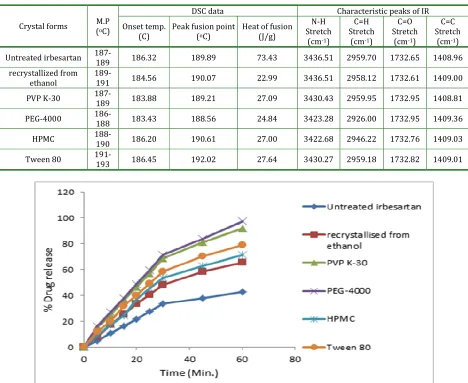
bending). FT-IR spectra of untreated irbesartan when compared with the modified crystals obtained in the presence of additives shows slight or no significant changes in their characteristic peaks indicates no polymorphic modifications (structural modification). The characteristic peaks of untreated irbesartan and modified crystals were shown in Table.1.
Differential scanning calorimetry
The thermal behaviour of untreated irbesartan and crystals in the presence of additives are shown in Fig.4.(a-h). The DSC thermo gram of all the modified crystals showed slight variation in their endothermic peaks compare to untreated irbesartan. The DSC curve showed that untreated irbesartan appeared on sharp endothermic peak at about 189.890C corresponding to
presence of PVP K30, PEG 4000 showed the shift of endothermic peak towards lower temperature at 189.210C, and 188.560C respectively. Shift of
endothermic peak towards lower temperature indicates the decrease in the melting point of drug in crystals. This decreased melting point accounts for increased solubility of drug, where as the irbesartan recrystallized from ethanol, crystals obtained in presence of HPMC and Tween 80 showed shift of endothermic peak towards upper temperature at 190.070C, 192.020C, 190.610C and respectively,
indicating increase in melting point of drug in crystals. This melting point accounts for the decrease in the solubility of drug. Also the DSC data showed that there was slight modification in the crystal of irbesartan due to the presence or absence of additives.
Powder X-ray diffraction
The XRD spectra of modified crystals were studied by X-ray diffractometer. In the XRD spectra the sharp peaks at diffraction angle (2θ) 7.20, 7.12, 7.16, 7.07, 7.11, 7.14 were obtained in untreated irbesartan, methanol, PVP-K30, PEG-4000, HPMC, Tween 80 respectively. The X-ray diffraction pattern of untreated irbesartan has more number of peaks when compared to modified crystals in the presence of additives shown in Fig.5. The XRD spectra obtained from ethanol and PEG-4000 were similar and no significant difference occurred. The spectra obtained from PVP-K30, HPMC and Tween showed difference in d-spacing values and intensity of peaks. The XRD spectra of untreated irbesartan and recrystallized from alcohol in the absence or presence of various additives exhibited essentially similar diffraction patterns (2θ values), suggesting that particles crystallized in the presence of additives did not undergo structural modification. However, the differences in the relative intensities of their peaks may be attributed to differences in the habit of crystals, which may be attributed to the different solubility of the drug in the crystallization media. Solubility studies
The solubility study showed that the untreated irbesartan was the least soluble (3.402 µg/ml) and the crystals obtained in presence hydrophilic polymer showed the improvement in the solubility. Increased in the solubility of crystals obtained in the presence of polymer are due the increased in the wettabiliy of crystals in the presence of polymer. Crystals obtained in presence of PVP was the most soluble (12.09 µg/ml) with 3.55-fold increase in solubility. The order of increasing solubility is PEG-4000 > PVP K-30 > Tween 80 > HPMC > recrystallized from ethanol > untreated irbesartan.
Dissolution studies
The dissolution profile of untreated irbesartan and modified crystals were shown in Figure.6. All the crystals obtained in the presence of additives showed better dissolution rate than untreated irbesartan. Crystals obtained in the presence of PEG-4000 show highest dissolution rate in 60 min. than crystals obtained in the presence of PVP K-30, Tween 80, HPMC and ethanol. Increased in the dissolution rate of modified crystals in the presence of various additives are due to the adsorption of hydrophilic polymer on the surface of crystals. These may increase the wetting properties of crystals in the presence of polymers.
Compressional studies
the growth of crystals in the presence of polymer improved the compression properties.
CONCLUSION
Crystal modification of irbesartan was carried out in the presence of additives. The modified crystals showed the significant change in size and shape. Solubility and dissolution rate of modified crystals were markedly increased compared to untreated irbesartan. The FT-IR, DSC and XRD data supports the change in the crystal habit of irbesartan with improved dissolution rate and compaction properties.
ACKNOWLEDGEMENT
The Author are thankful to the Management and Principal, IBSS College of Pharmacy, Malkapur for providing necessary facilities to carried out this work. Authors also thankful to Diya Labs, Mumbai and AISSMS college of Pharmacy, Pune for providing SEM, FTIR, XRD and DSC facilities repectively.
(a)
(b)
(c)
(d)
(e)
(f)
Fig.3. FT-IR spectra of : (a) untreated irbesartan, (b) recrystallised in ethanol, (c) PVP-K30, (d) PEG-4000, (e) HPMC and (f) Tween80.
Fig.4. DSC thermogram: (a) untreated irbesartan, (b) recrystallised in ethanol, (c) PVP-K30, (d) PEG 4000, (e) HPMC (f) Tween 80.
Table 1: Melting point, DSC and FT-IR data of modified crystals in the presence of additives
Crystal forms M.P
(oC)
DSC data Characteristic peaks of IR
Onset temp. (C)
Peak fusion point (oC)
Heat of fusion (J/g)
N-H Stretch
(cm-1)
C=H Stretch
(cm-1)
C=O Stretch
(cm-1)
C=C Stretch
(cm-1)
Untreated irbesartan
187-189 186.32 189.89 73.43 3436.51 2959.70 1732.65 1408.96
recrystallized from ethanol
189-191 184.56 190.07 22.99 3436.51 2958.12 1732.61 1409.00
PVP K-30
187-189 183.88 189.21 27.09 3430.43 2959.95 1732.95 1408.81
PEG-4000
186-188 183.43 188.56 24.84 3423.28 2926.00 1732.95 1409.36
HPMC
188-190 186.20 190.61 27.00 3422.68 2946.22 1732.76 1409.03
Tween 80
191-193 186.45 192.02 27.64 3430.27 2959.18 1732.82 1409.01
Fig. 6: Dissolution rate profile of untreated irbesartan and modified crystals in the presence of additives.
REFERENCES
1. Kapoor A, Majumdar D. K, Yadav M.R. Crystal forms
of nimesulide-asulfonanilide (non-steroidal anti
inflammatory drug). Indian J. Chem. 1988;37B:
572-575.
2. Shekunov B. Yu, Grant D.J.W Latham, R.J, Sherwood
J.N. In situ optical interferometric studies of the
growth and dissolution behaviour of paracetamol
(acetaminophen) crystals. 3. Influence of growth in
the presence of p-acetoxyacetanilide. J. Phys. Chem.,
1997; B101: 9107–9112.
3. Finnie S, Ristic R.I, Sherwood J.N, Zikic A.M.
Characterisation of growth behaviour of small
paracetamol crystals grown from pure solutions.
Chem. Eng. Res. Design (Trans. IChemE), 1996; A 74:
835–838.
4. Prasad K. V. R, Ristic R. I, Sheen, D. B, Sherwood J. N.
Crystallization of paracetamol from solution in the
presence and absence of impurity. Int. J. Pharm.
2001;215: 29-24
5. Adhiyaman. R., Bsau. SK., Crystal modification of
dipyridamole using different solvents and
crystallization conditions. Int. J Pharm. 2006; 14:
321(1-2):27-34.
6. Nokhodchi A, Bolourtchian N, Dinarvand D. Crystal
modification of phenytoin using different solvent
and crystallization condition. Int J Pharm. 2003; 250:
85-97.
7. Nokhodchi A, Bolourtchian N, Dinarvand D.
Dissolution and mechanical behaviour of
recrystallized carbamazepine from alcohol solution
in the presence of additives. J Cryst Growth. 2005;
250: 85-97
8. Klug, D.L, The influence of impurities and solvents on
Industrial Crystallization. Butterworth-Heinemann,
Boston, 1993. pp. 65–87.
9. Weissbuch, I, Leiserowitz, L, Lahav M. Tailor-made
additives and impurities. In: Mersmann, A. (Ed.),
Crystallization Technology Handbook. Marcel
Dekker, New York, 1995. pp. 401–457.
10. Fachaux J.M, Guyot-Hermann A.M, Guyot J.C, Conflant
P, Drache M, Veesler S, Boistelle R. Pure paracetamol
for direct compression. Part II. Study of the
physicochemical and mechanical properties of
sintered-like crystals of paracetamol., Powder
Technol. 1995; 82b: 129–133.
11. Femi-Oyewo M.N, Spring M.S. Studies on
paracetamol crystals produced by growth in aqueous
solutions. Int. J. Pharm. 1994; 112: 17–28.
12. Friedrich H, Fussnegger B, Kolter K, Bodmeier R.
Dissolution rate improvement of poorly
water-soluble drugs obtained by adsorbing solutions of
drugs in hydrophilic solvents onto high surface area
carriers. Eur. J. Pharm. Biopharm. 2006; 62: 171–
177.
13. Grzesiak A.L, Lang M.D, Kim K, Matzger A.J,
Comparison of the four anhydrous polymorphs of
carbamazepine and the crystal structure of form I. J.
Pharm Sci. 2003; 92: 2260–2271.
14. Sekizaki H, Danjo K, Eguchi H, Yonezawa Y, Sunada
H, Otsuka A. Solidstate interaction of ibuprofen with
polyvinylpyrrolidone. Chem. Pharm. Bull. 1995; 43:
988–993.
How to cite this article: P.A. Pangarkar*, R. R. Thenge, N.M.
Mahajan, V.S. Adhao, P.V. Ajmire; Crystal modification of Irbesartan in presence of additive; J. Adv. Pharm. Edu. & Res. 2014: 4(1): 106-113.