Copyright © 2013 IJECCE, All right reserved
Improvisation of MAC Protocol for Wireless Sensor
Network
P. Iswarya
PG Student/Me C&C Ganadipathy Tulsi’s Jain EngineeringCollege, Vellore, Tamilnadu [email protected]
D. Santhosh Kumari
Assistant Professor Ganadipathy Tulsi’s Jain EngineeringCollege, Vellore, Tamilnadu [email protected]
V. Jayaprakasan
Professor Ganadipathy Tulsi’s Jain Engineering College, Vellore, TamilnaduAbstract -Wireless sensor networks are collection of sensor nodes connected via wireless LAN links. The information gathered at sensor node is propagates in the form of radio signal to control room via multi hop communication. In the networks, many sensors where lying in same channel to pass message, so as well as minimize the power efficient and delay for sensor networks. An Efficient Medium Access (MAC) protocol is critical for the performance of a Wireless Sensor Networks (WSN), especially in terms of energy consumption. IMAC is a Time Division Multiple Access (TDMA) scheme that extents the common single hop TDMA to a multi hop sensor network, using a high-powered base station to synchronize the nodes and to schedule their transmission and receptions. The protocol first enables the base station together with topology (connectivity) information. A scheduling algorithm, then determines when each node should receive data and the access point announces the transmission schedule to the other nodes. The performance of EEMAC is compared to existing protocols based on simulations in NS2 (network simulator). In this paper, we discuss about the Energy Efficiency of the MAC (EEMAC) and improvising the MAC protocol (IMAC), based on simulation results we show that IMAC has smaller energy and delay compared to EEMAC.
Keywords - Wireless Sensor Network, Energy Efficiency, Medium Access Control.
I. I
NTRODUCTIONWireless Sensor Networking is an emerging technology that as a wide range of potential applications including environment monitoring, smart spaces, medical systems and robotics exploration. The wireless sensor networks are made up of one or more battery-operated sensor devices with embedded processor, small memory and low power radio. Sensor networks are composed of large number of nodes to cover the target area. Nodes in wireless sensor network communicate with each other to give a common task.
These Wireless Sensor Networks have severe resource constrains and energy conservation is very essential. The Sensor node’s radio in WSN’s consumes a significant amount of energy. Substantial research has been done on the design of low power electronic devices in order to reduce energy consumption of these sensor nodes.
The Medium Access Control (MAC) protocol directly controls the communication module, so it has important effect on the nodes energy consumption. One of the main functions of the MAC protocol is to avoid collisions from interfering nodes. Designing power efficient MAC protocol is one of the ways to prolong the life time of the
network. In this paper we carried the study of the energy efficient MAC protocols for the Wireless Sensor Networks.
The remainder of this paper is structured as follows. Section II discusses challenges in the design of the MAC protocol. Section III presents the different proposed MAC protocols emphasizing their strength and weakness wherever possible. Section IV discusses the overview of IMAC. Section V presents the comparative results. Finally, section VI concludes the paper.
II. MAC P
ROTOCOLD
ESIGNC
HALLENGESThe Medium Access Control protocols for the wireless sensor networks have to achieve two objectives. The first objective is the creation of the sensor network infrastructure and the MAC scheme must be establish the communication link between the sensor nodes. The second objective is to share the communication medium fairly and efficiently.
A. Properties of a Well Defined MAC Protocol
To design a good MAC protocol for wireless sensor networks, the following attributes must be considered.i) Energy Efficiency: The sensor nodes are battery
powered and it is often very difficult to change or recharge batteries for these sensor nodes. Sometimes it is beneficial to replace the sensor nodes rather than recharging them.
ii) Latency: Latency requirement basically depends on the
application. The detected events must be reported to the sink node in real time in the sensor network applications. So that the suitable action could be taken immediately.
iii) Throughput: Throughput requirement also varies with
different applications. Some of the sensor network application requires sampling the information with fine temporal resolution.
iv) Fairness: In many sensor network applications when bandwidth is limited, it is necessary to ensure that the sink node receives information from all sensor nodes fairly. However among all of the above aspects the energy efficiency and throughput are the major aspects. Energy efficiency can be increased by minimizing the energy waste.
B. Reasons for Energy Waste
The reasons for wastage of energy in a MAC protocol for Wireless sensor networks are the following:
Copyright © 2013 IJECCE, All right reserved ii) Overhearing: Sometime nodes can pickup which are
destined to other nodes.
iii) Packet overhead: Energy is also required for sending and receiving control packets due to this less useful data packet can be transmitted.
iv) Idle listening: Extra energy is also consumed for listening to receive possible traffic which is not sent. [10]
III. E
NERGYE
FFICIENTMAC P
ROTOCOLS FORWSN
The medium access control protocols can be broadly divided into two categories [9],
1. Schedule based 2. Contention based
The schedule based protocols can avoid collisions, overhearing and idle listening by scheduling the transmit and listen periods but have strict time synchronization requirement. The contention based protocols have relaxed time synchronization requirement and can easily adjust to the topology changes by joining some new node.
A. Sensor S-MAC
Sensor S-MAC [3] is a contention based MAC protocol is modification of IEEE 802.11 protocol specially designed for the wireless sensor networks. S-MAC includes four major components periodic listening and sleeping, collision avoidance, overhearing avoidance, and message passing.
Fig1. Periodic Listen and Sleep Intervals in S-MA The basic scheme is shown in figure 1. After the sleep period, the nodes wake-up and listen whether communication is addressed to them, or they initiate communication themselves. This implies that the sleep and listen periods should be (locally) synchronized between nodes. Each active period is of fixed size, with a variable sleep period. At the beginning of each active period, nodes exchange synchronizations information. Following the SYNC period, data may be transferred for the remainder of the active period using RTCTS. The advantage of S-MAC are energy waste caused by idle listening is reduced by sleep schedules and time synchronization overhead may be prevented by sleep schedule announcements. S-MAC has some disadvantages: the period length is limited by delay and cache size; the active time must adapt to highest traffic load to guarantee reliable and timely message transmission: the idle listening will relatively increase when traffic load is low.
B. Time out- MAC:
MAC protocols such as Timeout– MAC upon S-MAC by introducing support for variable load and providing further energy savings. In event- driven networks with sources generating bursty traffic or networks with period traffic, we can further reduce the energy consumption and increase node lifetime if we take into account the nature of the traffic. As the S-MAC protocol does not work well
when the traffic load fluctuates. To overcome this problem, the T-MAC protocol introduces the timeout value to finish the active period of a node. If node does not hear anything within the period corresponding to the timeout value, it allows the node to go into sleep state. T-MAC [2] in variable workloads uses one fifth the power of S-MAC. In homogeneous workloads T-MAC and SMAC perform equally well. Figure 2 shows the basic scheme of the T-MAC protocol.
Fig.2. The basic data flow of the T-MAC protocol The energy consumption in the timeout T-MAC protocol is less than the S-MAC protocol. But the Timeout T-MAC protocol has high latency as compared to the S-MAC protocol
C. B-MAC (Berkeley Media Access Control)
BMAC is a CSMA/CA based MAC protocol. BMAC [9] has low power listening and extended preamble to achieve low power communication. Nodes have to awake and a sleep periods, and each node can have an independent schedule. If a node wishes to transmit, it precedes the data packet with a preamble that is longer than the receiver’s sleep period. During the awake period, a node samples the medium and if preambles detected it remains awake to receive data. BMAC use clear channel assessment (CCA) and packet back offs for channel arbitration, link layer acknowledgement for reliability, and low power listening (LPL). The experimental results show BMAC has better performance in terms of latency, throughput and often energy consumption as compared to S-MAC.
D. Lightweight MAC
LMAC [4] is a TDMA based MAC protocol. It takes into account the physical layer properties. The intension of the protocol is to minimize the number of transceiver switches, to make the sleep interval for sensor nodes adaptive to the amount of data traffic. During its time slot, a node will always transmit a message which consists of two parts: control message and a data unit. The control message has a fixed size and is used for several purposes. It carries the ID of the time slot controller, it indicates the distance of the node to the gateway in hops for simple routing to a gateway in the network, it control data will also be used to maintain synchronization between the nodes and therefore the nodes also transmit the sequence number of their time slot in the frame.
Copyright © 2013 IJECCE, All right reserved time slot. Both the transmitter and receivers turn off their
transceivers after the message transfer has completed.
E. Eyes MAC
The TDMA based EMACs protocol divides time into time slots, which nodes can use to transfer data without having to content for a medium or having to deal with energy wasting collisions of transmission. A node can assign only one slot to itself and is said to control this slot. After the frame length, which consists of several time slots, the node again has a period of time reserved for it.
A time slot is further divided in three sections: communication Request (CR), Traffic Control (TC) and the data section. In the CR section other nodes can do requests to the node that is controlling the current time slot. Nodes that have a request will pick a random start time in the short CR section to make their request. The controller of a time slot will always transmit a TC message in the time slot. The time slot controller also indicates in its TC message what communication will take place in the data section. If a node is not addressed in the TC section nor its request will approved, then the node will resume in standby state during the entire data section. The TC message can also indicate that controlling node is about to send an omnicast message. After the TC section the actual data transfer takes place.
F. EEMAC
Energy efficiency is one of the most important requirements for wireless sensor networks. EEMAC, an efficient MAC protocol for low-traffic delay- tolerant wireless sensor networks. EEMAC uses synchronous distributed transmission scheduling to achieve high energy efficiency. It was developed following strict design guides and keeping focus on meeting all requirements of MAC protocols designed for wireless sensor networks. EEMAC [11] analyzes the active duration of the super frame and entered the sleep mode status inside this active period. By this mechanism, the idle listening will be decreased and leads to more energy efficiency. The EEMAC approach takes into account both the techniques of idle listening and packet collision to overcome the energy consumption problem.
The MAC IEEE 802.15.4 has active and inactive modes. The inactive period allow nodes to sleep periodically, but most of the application are delay-critical, so, EEMAC just select the active mode. It is apparent that it takes time for each state transition, but as mentioned in this time is very short and does not affect the performance of work and also has a significant effect on the overall energy consumption in the network. It considers a beacon-enabled network with no inactive part in the super frame, in which the nodes can sleep since when they do not have any packet to send. Given this, it allows nodes to enter the shutdown state, when they have no packets to send to the coordinate.
EEMAC consider the case when radios are allowed to enter the shutdown state if there is no packet to be transmitted. Radio shutdown has been shown to be very effective in conserving nodes energy consumption, it consider a beacon-enabled network with no inactive part in the super frame in which the nodes can sleep. Since the power consumption in the idle state is several times more
than what might be considered reasonable, it is not sufficient to keep the nodes in the idle state when they are not transmitting or receiving. We must therefore find alternative ways to put the nodes to sleep even in active part of the super frame. However, for benchmarking purpose, it starts out by leaving the nodes in idle state when they are not active. It allows the nodes to enter the shutdown state when not active and evaluate its impact on the power consumption, and efficiency.
IV. O
VERVIEW OFP
ROPOSEDS
YSTEMA. Introduction of IMAC
In this system IMAC consists of base station and sensor nodes that are in the transmission range of at least one base point. Each base point (BS) is used to coordinate a fraction of sensor nodes. The base point is assumed to be able to reach the entire sensor in its networks in one hop since it is supposed to have a lot of energy and processing power. However, it can also decrease its transmission range so as to help the sensor nodes determine their next hop in their route to BS. The path from the sensor nodes to BS is over multiple hops since sensor nodes have limited energy.
IMAC is based on the scheduling of the transmission of the sensor nodes by BS. The protocol consists of adjustment and scheduling phases. The adjustment phase provides topology information about the network to the BS, where as scheduling phase determines the schedule of the transmissions at the BS, broadcast this schedule to all the nodes in the network over one hop.
The transmission in our system is performed over three ranges. The longest transmission range belongs to the coordination packets of BS. The base point uses this range in order to reach all the sensor nodes in one hop and directly control their transmissions. The shortest transmission range is used in the transmission of the data packets from sensor nodes to BS. This range must be chosen to be the lowest range. The medium transmission range is used in the tree construction so as to learn the interferers of each sensor node. The sensor network belonging to a particular BS can operate in one of four phases: the topology learning phase, the topology collection phase, the scheduling phase and topology adjustment phase. During the topology learning phase, every node identifies its neighbors, interferers and parent in the tree containing BS as root and the shortest paths from each node to BS. In the topology collection phase, each node sends its neighbor, interferer and parent information to Bs so that BS has complete topology information at the end of this phase. During the scheduling phase, each node transmits according to the schedule announced by BS at the beginning of the phase and sleeps when it does not transmitting or receiving any packet. And in the topology adjustment phase the BS adjusts, if any new node comes or any node out of the range.
Copyright © 2013 IJECCE, All right reserved priority of the time allocated to the node. Here back off
technique is used when the packet is dropped.
B. Case Diagram
B.1 Base Station as Actor
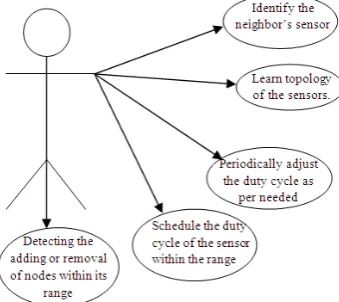
The base stations identify the neighbor sensor nodes and learn topology of them and assign and schedule the duty cycle as per the topology. And detect the adding and removal of nodes within its range is shown in the figure 3.
Fig.3. Use case diagram for Base Station
B.2 Sensor as Actor
The sensors indentify the neighbor sensor nodes and learn topology of the lower level hierarchy and send the information to higher level sensor nodes is shown in the figure 4.
Fig.4. Use case diagram for sensor
C. Data Flow Diagram
Fig.5. Data flow diagram
D. Sequence Diagram
Fig.6. Sequence diagram
A sequence diagram is Unified Modeling Language (UML) is a kind of interaction diagram that shows how processes operate with one another and in what order. A sequence diagram show, as parallel vertical lines (lifelines), different processes or objects that live simultaneously, and, as horizontal arrows, the messages exchanged between them, in order in which they occur. This allows the specification of simple runtime scenarios in a graphical manner. The figure 6 represents the sequence diagram for the MAC protocol which defines how the nodes interact with base station in a timely manner for sending and receiving the message.
E. Methodology
This protocol operates in four phase: Topology learning phase, Topology collection phase, Scheduling phase, Adjustment phase.
E.1 Topology Learning Phase
Copyright © 2013 IJECCE, All right reserved topology learning coordination packet, the BS floods the
network with the tree construction packet; a node first decides whether it comes from a neighbor (or) interferer based on received signal strength. If the transmitting node is a neighbor of the receiving node and is the next hop on a smaller cost than previously learned path, the receiving node updates this cost by including its own cost and rebroadcast the tree construction packet. At the end of flooding, it chooses its parent node to be the next hop neighbor on least cost path to the BS.
At the end of this phase each node knows its parent, neighbors and interferers.
E.2 Topology Collection Phase
The topology collection phase is the period at the end of which AP receives the complete topology information. The topology collection phase starts with the coordination packet of the AP named topology collection packet that is transmitted by the AP over the longest range. Upon receiving the topology collection packet broadcasted by the BS, each node transmits its local topology packet, listening the node’s parent, neighbor and interferers to its parents using the shortest range transmission. It uses CSMA scheme.
E.3 Scheduling Phase
BS explicitly schedules all the nodes based on its knowledge of the complete network topology. The scheduling frame is divided into time slots. The slot extends the packet duration by a guard interval to compensate for synchronization error. At the beginning, the BS broadcast the scheduling packet. At the beginning of the scheduling frame each node generate data packet, which are sent to the BS according to the schedule using the shortest transmission range level. The data packet includes the data that are to be sent to the BS together with any new topology information, consisting of the nodes neighbor and interferer. If the length is not enough to carry all new topology information, this information is included in the round robin fashion in each data packet. When node receives a packet, it does not attempt to transmit it immediately. Instead, it enqueues the packet and sleeps until its next scheduled time slot. The scheduling algorithm ensures that all packets reach the BS by the end of the scheduling phase.
E.4 Adjustment Phase
This phase is included at the end of the scheduling phase to indentify the complete network topology and detect the movement of nodes or the addition of the application. If the number of successfully scheduled nodes is not 100%, this means that some confliction nodes may have been scheduled for the same slot during the scheduling phase due to incorrect topology information at BS.
The adjustment phase helps the protocol to update the schedule for small changes in the topology without restarting the topology learning phase. The adjustment phase begins when the BS broadcast to all the sensor nodes an adjustment coordination packet. This adjustment phase uses medium transmission range level to detect interferer. If the node detects any new neighbor or
interferer in this phase, they include this information in their data packet transmitted during the scheduling phase.
V. C
OMPARATIVER
ESULTSThe evaluation is carried out with the ns2 simulations by performing several experiments that illustrate the performance of the system. Table 1 represents the parameter used in the simulation.
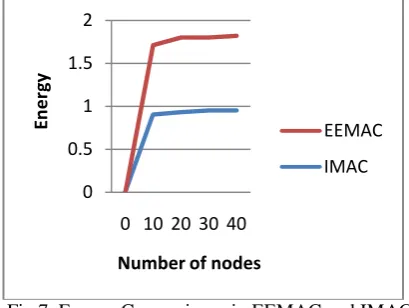
We compare the performance of EEMAC and IMAC according to the performance metrics. We calculate the energy and delay of the both protocols and shows that the performance of IMAC is better than EEMAC.
Figure 7 and 8 represents the graph of energy and delay comparison in EEMAC and IMAC.
This result shows that IMAC has smaller delay and energy consumption compared to EEMAC.
Fig.7. Energy Comparisons in EEMAC and IMAC
Fig.8. Delay comparison in EEMAC and IMAC Table 1: Parameters used in the simulation
Parameter Value
Simulation time Number of nodes Traffic model Node Placement Performance parameter Routing protocol
300 35 CBR Uniform Energy consumption,
End to End delay AODV 0
0.5 1 1.5 2
0 10 20 30 40
En
er
gy
Number of nodes
EEMAC IMAC
0 0.05 0.1 0.15
0 10 20 30 40
D
el
ay
X
10
-3
Number of nodes
Copyright © 2013 IJECCE, All right reserved
VI. C
ONCLUSIONThis paper propose a novel channel access scheme, IMAC, which exploits the application specific characteristics of sensor networks to meet their power, energy efficiency and delay. The basic assumption of IMAC is that Base Station (BS), which is the destination of all the sensor data packets in the networks, has unlimited power where as the sensor nodes have to remain alive for several years. BS can then reach all the nodes in the network in one hop by increasing its transmission power level. This helps the nodes to be synchronized easily and to be directly scheduled by BS after a topology update phase assuming static networks, which is true in most of the applications such as parking lot, traffic light.
We minimize the time slot between the nodes. BS is where every node has generated exactly one packet at the beginning. Nodes for each time slot and schedule the nodes at each level separately from other levels. Based on simulations, we observe that IMAC scheme has smaller delay and consume much less power compared to the EEMAC.
R
EFERENCES[1] V. Bharghavan, A. Dermers, S.Shenker and L.Zhang,“Macaw:
A medium access protocol for wireless LANS,”in proceedings of the ACMSIGCOMM Conference, 1994.
[2] T.V.Dam and K.Langendoen,”An adaptive energy efficiency
MAC protocol for wireless sensor networks,”SenSys ’03, Los
Angeles, CA, Nov 2003.
[3] W.Ye,J.Heidemann, and D.Estrin,”Mediumaccess control with
coordinated adaptive sleeping for wireless sensor
networks,”IEEE/ACMTrans on Netw.vol.12, no.3, pp.493-506, 2004.
[4] L.F.W.van Hosesel and P.J.M.Havinga,”A lightweight Medium
Access Protocol (LMAC) for wireless sensor networks: Reducing preamble Transmissions and transceiver state switches,”In 1stworkshop on Networked Sensing Systems (INSS
2004), June 2004.
[5] Joesph Polastre, Jason Hill, David culler.Versatile Low Power
Media Access for wireless sensor networks. In proceeding of the second ACM Conference on Embedded Networked sensor systems (SenSys’04), November 3-5, 2004.
[6] Haugang Gong, Ming Liu, Yinchi Mao, Li-junchen and LiXie
“Traffic Adaptive MAC Protocol forwireless sensor network” X.Lu and W.Zhaoc (Eds): ICCMMC 2005, LNCS 3619, pp.1134-1143, 2005 Springer-Verlag Berlin Heidelberg 2005.
[7] Changsu Suh, Young-Baeko, “A Traffic Aware Energy Efficient
MAC Protocol for wireless sensor networks”, IEEE 2005.
[8] T.Neiberg, S.Dulman, P.Havinga, L.van Hoesel and
J.Wu,”Collaborative Algorithams for Communication in wireless sensor networks”, Ambient Intelligence: Impacton Embedded Systems, Kluwer Academic Publishers, ISBN 1-4020-7668-1, November 2006.
[9] Li De-Liang Peng Fei,”Energy efficient MAC protocols for
wireless sensor networks”, INFORMATION AND COMMUNICATION TECHNOLOGIES Beihang University, Beijing, 100083, Mar 2009.
[10] Cano, C.Bellatta, B.Sfairopoulou, A.Barcelo”A Low Power
Listening MAC with scheduled wake up after transmissions for WSNs vol- 14 pp.221-223 ISSN-7798 April 2009.
[11] Hiren Kumar Deva sarma, Avijit Kar “Energy Efficient Routing Protocol for wireless sensor networks with node and sink mobility” 978-1-4244-8064-7/11 May 2010 IEEE.
A
UTHOR’
SP
ROFILEP. Iswarya
She is a Master Student in Anna University, Chennai, India and has completed her graduation in B.E Electronics and Communication Engineering in the year 2011 at Anna University, Chennai, India.
D. Santhoshkumari
has completed her graduation in B.E Electronics and Communication Engineering in the year 2005 in Anna University, Chennai, India and completed her post graduation in M.Tech Applied Electronics in the year 2008 at M.G.R University, Chennai, India. She
has been working as Assistant professor at
Ganadipathy Tulsi’s Jain Engineering College, Vellore, India for the past 8 years. She is working towards her researching the field of Mobile Ad-Hoc Network. Her area of specialization includes Optical and Mobile Communication, Microwave Engineering and Ad-Hoc Networks.
V. Jayaprakasan
has received his Bachelor’s Degree in Electronics
and Communication Engineering from
Bharadhidasan University, Tiruchirappalli, India in the year 1999 and Master’s Degree in Communication Systems from Anna University, Chennai, India in the year 2006. He has started his teaching profession in the year 2006 in Ganadipathy Tulsi’s Jain Engineering College, Vellore. Earlier he has 11 years industrial experience in an electronics based industry. At present he is a Professor in Electronics and Communication Department. He has published 1 research papers in International Journals and 2 research papers in
International Conferences. His areas of interest are Wireless
communication, Networking and Signal Processing. He is a life member of ISTE.
Copyright © 2013 IJECCE, All right reserved
VI. C
ONCLUSIONThis paper propose a novel channel access scheme, IMAC, which exploits the application specific characteristics of sensor networks to meet their power, energy efficiency and delay. The basic assumption of IMAC is that Base Station (BS), which is the destination of all the sensor data packets in the networks, has unlimited power where as the sensor nodes have to remain alive for several years. BS can then reach all the nodes in the network in one hop by increasing its transmission power level. This helps the nodes to be synchronized easily and to be directly scheduled by BS after a topology update phase assuming static networks, which is true in most of the applications such as parking lot, traffic light.
We minimize the time slot between the nodes. BS is where every node has generated exactly one packet at the beginning. Nodes for each time slot and schedule the nodes at each level separately from other levels. Based on simulations, we observe that IMAC scheme has smaller delay and consume much less power compared to the EEMAC.
R
EFERENCES[1] V. Bharghavan, A. Dermers, S.Shenker and L.Zhang,“Macaw:
A medium access protocol for wireless LANS,”in proceedings of the ACMSIGCOMM Conference, 1994.
[2] T.V.Dam and K.Langendoen,”An adaptive energy efficiency
MAC protocol forwireless sensor networks,”SenSys ’03, Los
Angeles, CA, Nov 2003.
[3] W.Ye,J.Heidemann, and D.Estrin,”Mediumaccess control with
coordinated adaptive sleeping for wireless sensor
networks,”IEEE/ACMTrans on Netw.vol.12, no.3, pp.493-506, 2004.
[4] L.F.W.van Hosesel and P.J.M.Havinga,”A lightweight Medium
Access Protocol (LMAC) for wireless sensor networks: Reducing preamble Transmissions and transceiver state switches,”In 1stworkshop on Networked Sensing Systems (INSS
2004), June 2004.
[5] Joesph Polastre, Jason Hill, David culler.Versatile Low Power
Media Access for wireless sensor networks. In proceeding of the second ACM Conference on Embedded Networked sensor systems (SenSys’04), November 3-5, 2004.
[6] Haugang Gong, Ming Liu, Yinchi Mao, Li-junchen and LiXie
“Traffic Adaptive MAC Protocol forwireless sensor network” X.Lu and W.Zhaoc (Eds): ICCMMC 2005, LNCS 3619, pp.1134-1143, 2005 Springer-Verlag Berlin Heidelberg 2005.
[7] Changsu Suh, Young-Baeko, “A Traffic Aware Energy Efficient
MAC Protocol for wireless sensor networks”, IEEE 2005.
[8] T.Neiberg, S.Dulman, P.Havinga, L.van Hoesel and
J.Wu,”Collaborative Algorithams for Communication in wireless sensor networks”, Ambient Intelligence: Impacton Embedded Systems, Kluwer Academic Publishers, ISBN 1-4020-7668-1, November 2006.
[9] Li De-Liang Peng Fei,”Energy efficient MAC protocols for
wireless sensor networks”, INFORMATION AND COMMUNICATION TECHNOLOGIES Beihang University, Beijing, 100083, Mar 2009.
[10] Cano, C.Bellatta, B.Sfairopoulou, A.Barcelo”A Low Power
Listening MAC with scheduled wake up after transmissions for WSNs vol- 14 pp.221-223 ISSN-7798 April 2009.
[11] Hiren Kumar Deva sarma, Avijit Kar “Energy Efficient Routing Protocol for wireless sensor networks with node and sink mobility” 978-1-4244-8064-7/11 May 2010 IEEE.
A
UTHOR’
SP
ROFILEP. Iswarya
She is a Master Student in Anna University, Chennai, India and has completed her graduation in B.E Electronics and Communication Engineering in the year 2011 at Anna University, Chennai, India.
D. Santhoshkumari
has completed her graduation in B.E Electronics and Communication Engineering in the year 2005 in Anna University, Chennai, India and completed her post graduation in M.Tech Applied Electronics in the year 2008 at M.G.R University, Chennai, India. She
has been working as Assistant professor at
Ganadipathy Tulsi’s Jain Engineering College, Vellore, India for the past 8 years. She is working towards her researching the field of Mobile Ad-Hoc Network. Her area of specialization includes Optical and Mobile Communication, Microwave Engineering and Ad-Hoc Networks.
V. Jayaprakasan
has received his Bachelor’s Degree in Electronics
and Communication Engineering from
Bharadhidasan University, Tiruchirappalli, India in the year 1999 and Master’s Degree in Communication Systems from Anna University, Chennai, India in the year 2006. He has started his teaching profession in the year 2006 in Ganadipathy Tulsi’s Jain Engineering College, Vellore. Earlier he has 11 years industrial experience in an electronics based industry. At present he is a Professor in Electronics and Communication Department. He has published 1 research papers in International Journals and 2 research papers in
International Conferences. His areas of interest are Wireless
communication, Networking and Signal Processing. He is a life member of ISTE.
Copyright © 2013 IJECCE, All right reserved
VI. C
ONCLUSIONThis paper propose a novel channel access scheme, IMAC, which exploits the application specific characteristics of sensor networks to meet their power, energy efficiency and delay. The basic assumption of IMAC is that Base Station (BS), which is the destination of all the sensor data packets in the networks, has unlimited power where as the sensor nodes have to remain alive for several years. BS can then reach all the nodes in the network in one hop by increasing its transmission power level. This helps the nodes to be synchronized easily and to be directly scheduled by BS after a topology update phase assuming static networks, which is true in most of the applications such as parking lot, traffic light.
We minimize the time slot between the nodes. BS is where every node has generated exactly one packet at the beginning. Nodes for each time slot and schedule the nodes at each level separately from other levels. Based on simulations, we observe that IMAC scheme has smaller delay and consume much less power compared to the EEMAC.
R
EFERENCES[1] V. Bharghavan, A. Dermers, S.Shenker and L.Zhang,“Macaw:
A medium access protocol for wireless LANS,”in proceedings of the ACMSIGCOMM Conference, 1994.
[2] T.V.Dam and K.Langendoen,”An adaptive energy efficiency
MAC protocol forwireless sensor networks,”SenSys ’03, Los
Angeles, CA, Nov 2003.
[3] W.Ye,J.Heidemann, and D.Estrin,”Mediumaccess control with
coordinated adaptive sleeping for wireless sensor
networks,”IEEE/ACMTrans on Netw.vol.12, no.3, pp.493-506, 2004.
[4] L.F.W.van Hosesel and P.J.M.Havinga,”A lightweight Medium
Access Protocol (LMAC) for wireless sensor networks: Reducing preamble Transmissions and transceiver state switches,”In 1stworkshop on Networked Sensing Systems (INSS
2004), June 2004.
[5] Joesph Polastre, Jason Hill, David culler.Versatile Low Power
Media Access for wireless sensor networks. In proceeding of the second ACM Conference on Embedded Networked sensor systems (SenSys’04), November 3-5, 2004.
[6] Haugang Gong, Ming Liu, Yinchi Mao, Li-junchen and LiXie
“Traffic Adaptive MAC Protocol forwireless sensor network” X.Lu and W.Zhaoc (Eds): ICCMMC 2005, LNCS 3619, pp.1134-1143, 2005 Springer-Verlag Berlin Heidelberg 2005.
[7] Changsu Suh, Young-Baeko, “A Traffic Aware Energy Efficient
MAC Protocol for wireless sensor networks”, IEEE 2005.
[8] T.Neiberg, S.Dulman, P.Havinga, L.van Hoesel and
J.Wu,”Collaborative Algorithams for Communication in wireless sensor networks”, Ambient Intelligence: Impacton Embedded Systems, Kluwer Academic Publishers, ISBN 1-4020-7668-1, November 2006.
[9] Li De-Liang Peng Fei,”Energy efficient MAC protocols for
wireless sensor networks”, INFORMATION AND COMMUNICATION TECHNOLOGIES Beihang University, Beijing, 100083, Mar 2009.
[10] Cano, C.Bellatta, B.Sfairopoulou, A.Barcelo”A Low Power
Listening MAC with scheduled wake up after transmissions for WSNs vol- 14 pp.221-223 ISSN-7798 April 2009.
[11] Hiren Kumar Deva sarma, Avijit Kar “Energy Efficient Routing Protocol for wireless sensor networks with node and sink mobility” 978-1-4244-8064-7/11 May 2010 IEEE.
A
UTHOR’
SP
ROFILEP. Iswarya
She is a Master Student in Anna University, Chennai, India and has completed her graduation in B.E Electronics and Communication Engineering in the year 2011 at Anna University, Chennai, India.
D. Santhoshkumari
has completed her graduation in B.E Electronics and Communication Engineering in the year 2005 in Anna University, Chennai, India and completed her post graduation in M.Tech Applied Electronics in the year 2008 at M.G.R University, Chennai, India. She
has been working as Assistant professor at
Ganadipathy Tulsi’s Jain Engineering College, Vellore, India for the past 8 years. She is working towards her researching the field of Mobile Ad-Hoc Network. Her area of specialization includes Optical and Mobile Communication, Microwave Engineering and Ad-Hoc Networks.
V. Jayaprakasan
has received his Bachelor’s Degree in Electronics
and Communication Engineering from
Bharadhidasan University, Tiruchirappalli, India in the year 1999 and Master’s Degree in Communication Systems from Anna University, Chennai, India in the year 2006. He has started his teaching profession in the year 2006 in Ganadipathy Tulsi’s Jain Engineering College, Vellore. Earlier he has 11 years industrial experience in an electronics based industry. At present he is a Professor in Electronics and Communication Department. He has published 1 research papers in International Journals and 2 research papers in
International Conferences. His areas of interest are Wireless