This is an open access journal, and articles are distributed under the terms of the Creative Commons Attribution-Non Commercial-ShareAlike 4.0 License, which allows others to remix, tweak, and build upon the work non-commercially, as long as appropriate credit is given and the new creations are licensed under the identical terms.
© 2018 Journal of Advanced Pharmacy Education & Research | Published by SPER Publication
127
Relationship of Musculoskeletal problems with quality of
working life among critical care nurses
Alice Khachian
1, Jale Mohammad Aliha
2, Hamid Haghani
3, Mahnaz Sarabi
4*1Department of Medical Surgical Nursing, School of Nursing and Midwifery, Iran University of Medical Sciences, Tehran, Iran, 2Faculty of Nursing and Midwifery, Iran
University of Medical Sciences, Tehran, Iran, 3Faculty of Management, Iran University of Medical Sciences, Tehran, Iran, 4School of Nursing and Midwifery, Iran University
of Medical Sciences, Tehran, Iran.
Correspondence: Mahnaz Sarabi,School of Nursing and Midwifery, Iran University of Medical Sciences, Tehran, Iran. E_mail: [email protected]
ABSTRACT
Introduction: Musculoskeletal problems is one of the most important issues resulted by undesirable body form in time of working. Describing the effect of different levels of musculoskeletal problems on the quality of working life is important for selection of preventive strategy. This study aimed to investigate the relationship between musculoskeletal problems and Quality of Working Life (QWL) of nurses in critical care units. Methodology: In this descriptive - correlative study, 384 nurses selected amongst from the critical care unit of selected hospitals in Tehran based on multistage sampling. Data were collected using a three part questionnaire including demographic information, QWL researcher-made questionnaire and Nordic musculoskeletal problems questionnaire; then, it was analyzed using SPSS v.22 software and descriptive and inferential statistics. Findings: The results showed that highest incidence of musculoskeletal problems in the subjects are related to low back and knee with 61.2% and 59.1% respectively. It was found that 68.7% of the considered nurses had average quality of working life. Also in this study, investigation of the relationship between musculoskeletal problems and the mean of QWL showed that there is statistically significant meaningful relationship between the musculoskeletal problems and quality of working life for nurses (p value <0.001). Generally, people who had no musculoskeletal problems had higher quality of working life and the people who had musculoskeletal problems had lower quality of working life and the more musculoskeletal problems there were, the less the score of QWL life was. Results: Based on the findings of this research, physical conditions and musculoskeletal problems can affect the quality of working life of critical care nurses and therefore, the optimization of this condition is significantly effective on improvement of the quality of working life conditions.
Keywords: Musculoskeletal problems, quality of working life, Nurse, Nordic questionnaire
Introduction
Between the resources of an organization such as capital, equipment, human resources and information gained from researches, the managers consider human resources as the most important source of the organization. Therefore, human resource is the most basic strategic resource of any organization. Undoubtedly, the success of the organization and workplace depends on the more efficient human resources. Surely human resources is the most
important factor for the effectiveness and efficiency of the organizations as social systems and it has been taken into account in last decades [1]. Nurses are the largest service provider in the healthcare system, therefore, they have influential effect on quality of health care services and productivity of health care system. Mission of the nurses, as one of the most professional members in health care team is to maintain and improve the quality of care to the standard level, whilst they play a vital role in the health care system of the country [2].
Quality of work life (QWL) is a multidimensional concept and it is measured to understand the people, labor and organization. Understanding and improving the quality of working life of nurses is an important factor to reach high levels of quality in patients’ health care. QWL of nurses means that they can meet their important individual needs through experiences and trainings within
Access this article online
Website: www.japer.in E-ISSN: 2249-3379
How to cite this article: Alice Khachian, Jale Mohammad Aliha, Hamid Haghani, Mahnaz Sarabi.Relationship of Musculoskeletal problems with quality of working life among critical care nurses. J Adv Pharm Edu Res 2018;8(1):127-134.
128 Journal of Advanced Pharmacy Education & Research | Jan-Mar 2018 | Vol 8 | Issue1
the organization [3]. Quality of working life reflects in employee’s reaction to their job satisfaction and mental health; in fact, it is a comprehensive and complete plan that focuses on enhancement of employee’s satisfaction and it is necessary to recruit, retain and make job satisfaction in all organizations [4]. According to Brooks and Anderson, the quality of nurses’ working life is the degree to which they can meet their personal needs and necessities by working in health centers and finally achieve their organizational objectives. Therefore, it is obvious that job satisfaction is more than the salary and work itself and it includes providing an environment in which a person can feel being accepted and fitted [5]. The quality of working life shall not be mistaken with the concept of living standards that are generally determined by level of income [6]; rather it includes all measures to preserve and protect the body and soul of employees that finally make them happy and satisfied [7].
Nurses spend a considerable period of time in the hospital. Also, they have to work with high workload and stress in emergency situations [6]. Working conditions varies in different units of hospitals; for example, nurses experience too much stress in the emergency ward and intensive care units and general wards have respectively moderate to low levels of stress [8]. Stressors in intensive care unit include having heavy responsibility of patient care, responding quickly and promptly to urgent situations, dealing with unexpected events and mortality, making working relationship with nurses and other health staff, with more work and less rest [9]. Job stresses can affect the human health and cause health problems including mental and physical health problems, heart disease, musculoskeletal problems and weight loss or gain [10] and finally can reduce the quality of patient care,
performance as well as quality of life [11]. Although there is stress in all jobs, in careers deal with human health, it is more frequent and important. Also, the evidences show that nursing is a carrier with high level of stress [12]. Physical health is an extremely important factor in people’s lives and its association with QWL creates a factor that supports the health of nurses [13]. Every job has its own risks and health problems, and there is no exception for health care workers. According to reports, Musculoskeletal Problems is one of the most important problems of nursing staffs [14]. Additionally, Work related Musculoskeletal Problems is one of the most important health related working issues in the industrial and developing countries [15] . Various studies showed the high
risk of pain in neck and waist in nurses which is related to physical and psycho-social factors [16, 17] .
The nurses suffer from occupational low back pain more than other employees because nursing interventions include ergonomic, physical and personal risk factors. Specifically, nurses in critical care unit are more prone to low back pain due to some factors like caring patient in a leaning forward state for a long time, carrying some body parts of patients during repositioning, and spending longer time for patient care. In addition, high work load and repetitive movements of body in these organs will provide the context for the emergence of these problems [18]. Physical and mental work load of the nurses not only
can cause some Musculoskeletal Problems, but also it can affect the quality of their working life [19]. As nurses declared, they are low energy after completion of their work because of high workload and they fail to make balance between their professional and personal lives [3]. This study is performed to investigate the relationship
between Musculoskeletal Problems and quality of working life for nurses in Intensive Care Units.
Materials and Method
Journal of Advanced Pharmacy Education & Research | Jan-Mar 2018 | Vol 8 | Issue1 129
the current tools for measuring QWL and finally, Walton and Brooks – Anderson tools were selected. Considering the requirements of this study, 20 questions were selected from these 2 questionnaires and a researcher-made questionnaire was provided with 4 dimensions including life at work- life outside of work, work design, work context and work world.
In order to get consent of drafters of the questionnaire, the researcher contacted them (Walton and Brooks – Anderson), then, the original copy of questionnaire was translated from English to Persian and the translated version was retranslated to English by a person fluent in English, without having access to the original English copy then, the original copy was compared with the first and second copy of translation and the mismatches were eliminated and the Persian copy became the final tool. In the next stage, both Face Validity and Content Validity method were used to determine the validity of the questionnaire. In the first step, the face validity was determined and for this purpose, the questionnaire was handed to 10 faculty members of School of Nursing and Midwifery of the Universities of Iran, Tehran and Shahid Beheshti; then their opinions were collected and the questionnaire experienced some minor changes and also the phrases with ambiguity or inappropriate phrases were modified. After collecting the opinions of experts, Contents Validity Ratio (CVR) was used to assess the content validity quantitatively and ensure that the most important (necessity of question) contents were selected; also Contents Validity Index (CVI) was used to ensure that the questions are designed appropriately to measure the contents [20].
Reliability is the other important factor for evaluation the quality of tools. Reliability is defined as the degree of Internal Consistency and Stability of a tool. In fact, reliability is one of the most important factors that determine the quality of tool. Reliability represents the accuracy and correctness of measurement for a tool. The reliability refers to the consistency and stability of measuring the existing traits or structures within a defined tool. Internal consistency means that how much all of the subsets of a tool can measure the considered feature [21]. Cronbach's alpha is used most frequently to measure the internal consistency of a tool. In this way, it is supposed that in the event of dividing tool into two parts through different ways, the each part of tool will measure the considered features. Considering the fact that this QWL questionnaire has multiple dimensions, the researcher
must ensure that the existing statements have consistency in one dimension and measure the similar characteristics to determine the Internal Consistency. Cronbach's alpha (alpha coefficient) was used to measure this type of reliability. The Cronbach's alpha represents the consistency of a group of items that measure an item. Cronbach's alpha shall be in the range of 0.70 to 0.80 in order to have a good and adequate internal consistency [22]. The alpha coefficient was 0.76 for this study. Finally,
the questionnaire included 17 questions, the answers were designed based on Likert scale and it has a total score ranged from 17 to 85. Therefore, the overall level of quality of working life was identified in three ranges of favorable, average and unfavorable on this scale. The third part of the questionnaire was according to standardized musculoskeletal problems questionnaire of Nordic, and so far the ergonomics and occupational health specialists applied it successfully in various studies and its validity and reliability have been evaluated in several studies. This questionnaire is provided on the basis of self-report and the respondent must indicate that in which of the 9 parts of their body (neck, shoulders, elbows, wrists/hands, upper back, low back, hips, knees, feet/ankle) he/she has pain or discomfort during the past 12 months. In addition, questions were asked about having pain or discomfort in these organs during last 7 days and the frequency of pain is measured in different organs. Finally, data was analyzed using SPSS software version 22 and descriptive-inferential statistical tests.
Findings
130 Journal of Advanced Pharmacy Education & Research | Jan-Mar 2018 | Vol 8 | Issue1
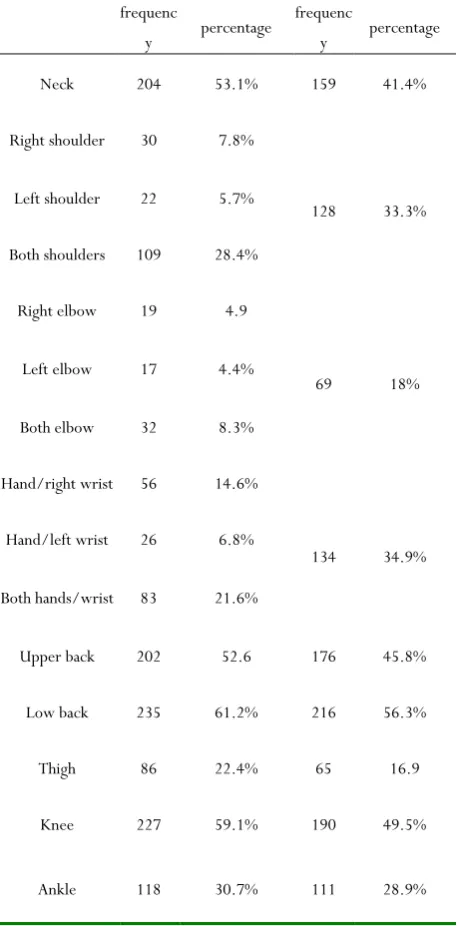
working in CCU. Additionally, 53.6% of their working shifts were in circulation, 22.1% were on night, 16.1% on morning and 8.1% on evening. Based on their professional rank, 64.1% were nurse, 30.2% were incharge of shift and 5.7% were head nurse; while 63.3 % of them were official employees, 23.2% were contractual employees and 13.5% were on their internship term. 83.1% were working in one institute and 47.7% of them were working more than 45 hours per week. The highest percentage of musculoskeletal problems among the subjects were in the low back (61.2%), knee (59.1%), neck (53.1%) and upper back (52.6%) respectively (Table 1). About the quality of working life of nurses, 14.8% of them had desired quality of work life, 67.7% were in average level and 17.4% had a poor quality of working life; the average score of the quality of working life has been reported in Table 2.
Also, investigating the relationship between
musculoskeletal problems and QWL in this study showed that there is statistically a significant relationship (p value <0.001) between the quality of working life and musculoskeletal problems; generally, the quality of working life for people who had no musculoskeletal problems was higher than those with musculoskeletal problems, also, the score of the quality of working life was decreased by intensifying the musculoskeletal problems (Figure 1).
Discussion
The objective of this study was to evaluate musculoskeletal problems and QWL as well their relationship. As reported, work related musculoskeletal problems are one of the serious health problems in the industrial and developing countries [15]. Due to ever increasing side effects of these problems throughout the world, the WHO1 decided to call the first decade of the third millennium “a decade for fighting against musculoskeletal complications as a Silent Epidemic [23]. After respiratory problems, musculoskeletal disorders are the second cause of absence from work because of short-term illness (less than two weeks) [24]. Considering the incidence of musculoskeletal disorders, both preventing and reducing of aforementioned disorder has become more important throughout the world [25].
Nursing is one of the jobs that require substantial physical activity. In terms of physical activity, nursing is ranked
1 Word Health Organization
second after industrial jobs [26]. A significant number of clinical nurses are suffering from musculoskeletal problems all around the world and in fact no nurse is completely immune from damages [14]. Health care employees, especially those working in hospital environments, experience higher job stress, therefore occurrence of musculoskeletal disorders are higher among them [27]. Back pain is one of the most important musculoskeletal problems among nurses, with a prevalence higher than 87% and incidence of 47% per year [13]. Also, about 85% of nurses have experienced at least once musculoskeletal pain and its level is 65.7% in the lower back, 41.5% in the ankle and 29% in shoulder [28]. A study in Sweden indicated that musculoskeletal
disorders accounted for the highest costs in the healthcare system. Also, 1.3% and 2.4% of GDP2 in America and Canada is respectively spent on indirect costs caused by these problems [24]. In addition to direct and indirect costs of treatment, the incidence of these problems leads to emotional problems, burnout, absenteeism, loss of working time, leave or decision for changing work. A study conducted on more than 43,000 nurses in five countries showed that 17-39% of nurses are planning to leave their profession in the next year because of job-related physical pressure [14].
Another study conducted in Melbourne, Australia indicated that 75.9% of nurses working in intensive care unit and 52.2 percent of nurses working in other units were suffering from low back pains [29]. This impressive statistic about musculoskeletal problems may be caused by specific conditions of work in these units, the nature of the nurses’ duties and too much dependence of patients to nurses for meeting their basic needs [30]. So, evaluating this problem can help us to better identify workplace conditions, severity of injury, treatment, rehabilitation, lack of ability to perform duties, preventive measures and quality of life of people with musculoskeletal problems [13].
Since having a secure and healthy workplace and a proper physical condition is one of the effective factors on QWL of employees, therefore, providing a condition in which all employees are proud of what they do, is one of the indicators of proper workplace. In addition, the physical condition of environment must be appropriate and the employees make sure that justice is preserved [31]. Enhancing the quality of working life in any organization, particularly for the professions associated to human beings
Journal of Advanced Pharmacy Education & Research | Jan-Mar 2018 | Vol 8 | Issue1 131
(such as nursing), is extremely important, while it affects the different levels of job. Studies showed that enhancing quality of working life is resulted in increasing productivity, quality of product and organizational effectiveness, saving costs and decreasing absence from work that all of them will cause sustainability and improvement in the quality of employees’ participation. Additionally, the quality of working life affects the performance of employees and through increasing QWL, the organization will achieve its objectives and needs. The quality of working life includes a wide range of aspects in working environment and it affects employees' health as well as it has positive effect on learning and organizational commitment. It is generally believed that the quality of working life will create more flexible, motivated and honest workplace [32]. In the present study, we investigated the relationship between musculoskeletal problems and the quality of working life in intensive care nurses. The findings indicated that the incidence of musculoskeletal problems is higher in low back than other organs, it is consistent with the findings of Schmidt et al (2012) for Brazilian nurses and the research performed by Balghanabadi et al (2014) in Iran. In the study conducted by Sori et al (2011) on 230 automakers in assembly line found that there is a relationship between musculoskeletal disorders and the quality of life. Generally, the odds ratio of musculoskeletal disorders for those who had lower quality of life is more than those who had enjoyed a better quality of life [15]. Additionally, in a study conducted by Roux et al. on 1202 people, the indicators of quality of life and its relationship with musculoskeletal disorders were examined. The findings showed that people with musculoskeletal disorders were faced with considerable decrease in indicators of QWL [33]. The study conducted by Sharifnia et al. (2011) showed that 81% of people experience back pain at least 1 time, 29.5% Wrist pain, 50% neck pain, 35.5% shoulder pain and 63.5% Knee Pain during last year.
The results of this study showed that Musculoskeletal Problems occurring in different organs of nurses working in the intensive care unit depend on the nature of their work and also some demographic variables of them. There was a significant relationship between these problems and average quality of working life statistically. In addition, the people with no Musculoskeletal Problem had enjoyed higher quality of working life and the people with Musculoskeletal Problem had lower QWL. In fact,
the more musculoskeletal problems there were, the less the score of QWL life was.
The most important limitation of this study was to trust self-reporting about the disorder. Musculoskeletal Problems is an abstract term that means differently among various working groups and nationalities. Since, the pain threshold is varied among different people, the standardized Nordic questionnaire was used to balance this limitation.
Conclusion
Employees often make peace with poor working conditions but the cost of this compromise would be increasing prevalence of occupational injuries and low quality of works. Unlike, the proper environmental working factors and good physical condition during work time cause to reduce environmental injuries, improve cooperation and understanding between staff and management on the basis of consensus, and as a result the productivity will increase [30]. Thus, these findings can help the managers of health care systems to reduce and control Musculoskeletal Problems and finally, increase the quality of working life for employees by taking some measures such as training courses in the field of principles of working, increasing the number of nurses to meet the standard ratio based on the number of patients and using some nurse aids to help the nurses in Intensive Care Units.
Acknowledgement
It is hereby appreciated the assistance of Research Vice-Chancellor of Iran University of Medical Sciences who approved the project and supported it financially and also we shall thank the chiefs of selected hospitals in Tehran and all of the dear nurses who work in the mentioned hospitals and completed the questionnaires with so much care and kindness and assisted us during this project.
Table 1: Absolute and relative frequency distribution
of musculoskeletal problems in intensive unit care’s
nurses during last 12 months or 7 days
Organs Musculoskeletal problems
during 12 months ago
Musculoskeletal problems during 7 days
132 Journal of Advanced Pharmacy Education & Research | Jan-Mar 2018 | Vol 8 | Issue1
frequenc
y percentage
frequenc
y percentage
Neck 204 53.1% 159 41.4%
Right shoulder 30 7.8%
128 33.3%
Left shoulder 22 5.7%
Both shoulders 109 28.4%
Right elbow 19 4.9
69 18%
Left elbow 17 4.4%
Both elbow 32 8.3%
Hand/right wrist 56 14.6%
134 34.9%
Hand/left wrist 26 6.8%
Both hands/wrist 83 21.6%
Upper back 202 52.6 176 45.8%
Low back 235 61.2% 216 56.3%
Thigh 86 22.4% 65 16.9
Knee 227 59.1% 190 49.5%
Ankle 118 30.7% 111 28.9%
Table 2: Mean and standard deviation (sd) of the dimensions of QWL for nurses working in intensive
care units
Dimensions of QWL Mean Sd
life at work- life outside of
work 55.61 21.66
work design 53.51 16.41
work design 49.56 23.43
work world 32.66 24.71
Figure 1: Box chart of association of QWL with
musculoskeletal problems during 12 months ago 0: no musculoskeletal
1: Musculoskeletal problems in 1 to 3 organs 2: Musculoskeletal problems in 4 or more organs.
References
1. Habibzadeh. H, Ghorbanzadeh. K, Khalkhali. H, Mohammadpor, Y. 2010. Investigate the relationship between quality of work life and clinical competency. Journal of Nursing and Midwifery in uromie, 10, 332-339
2. Khaghanizade. M, Ebadi. A, Cirati nair. M, Rahmani. M. 2008. The study of relationship between job stress and quality of work life of nurses in military hospitals. J Mil Med, 10(3),175-184
3. Azarang. S, Yaghmayi. F, Shiri. M. 2013.
Correlation dimensions of quality of work life of nurses and demographic characteristics. Nursing research, 7, 18-24
4. Chobineh. A, Daneshmandi H, Parand. M, Ghobadi. R, Haghayeghi. A, Darisi.F. 2013. Assessment the quality of work life and its influencing factors in medical sciences university staff. Ergonomics Journal, 1, 56-62
5. Battu. N, Chakravarthy. G. 2014. Quality of worklife of nurses and paramedical staff in hospitals. International Journal of Business and Administration Research Review, 2, 200-207
Journal of Advanced Pharmacy Education & Research | Jan-Mar 2018 | Vol 8 | Issue1 133
8. Awosusi, M (2010) Assessment of Quality of Working-Life of Nurses in Two Tertiary Hospitals in Ekiti State, Nigeria. African Research Review, (40) 113-124
9. Mcgrath, A, Reid, N, Boore, J (2003) Occupational stress in nursing Student (44)
10. Teles, M, Barbosa, M, Vargas, A, Gomes, V, Ferreira, E, Martins, A, Ferreira, R (2014) Psychosocial work conditions and quality of life among primary health care employees: a cross sectional study Health and quality of life outcomes (12) 2-12. doi:10.1186/1477-7525-12-72
11. Williams, E, Manwell, L, TR, K, Linzer, M (2007) The relationship of organizational culture, stress, satisfaction and burnout with physician-reported error and suboptimal patient care: Results from the MEMO study Health Care Manage Rev (32) 203-212.
12. Mohammadi. A, Sarhangi. F, Ebadi. A,
Daneshmandi. M, Raeisifar. A, Amiri. F, Hajamini. Z. 2011. Relationship between psychological problems and quality of work life of intensive care units’ nurses. Iranian journal of critical care nursing. 4(3), 135-140
13. Schmidt, D, Dantas, A. R. S (2012) Quality of work life and work related musculoskeletal disorders among nursing professionals. Acta Paul Enferm (25) 701-707
14. Nakhaee, M. Faraj xadeh, Z., Tabibi, S., Saadatjo, A., Mahmuodirad, G. & Hosseini, M. 2007. Evaluate ergonomic conditions in the work of the nursing staff -hospitals of Birjand University of Medical Sciences. Journal of Birjand University of Medical Sciences, 13, 71-77
15. Sori, H., Tahmasebi zade, H., Montazeri, A., Jafari, M. & Eyni, E. 2011. Relationship between quality of life and musculoskeletal disorders in car manufacturing workers. Journal of Gazvin University of Medical Science, 15, 32-37
16. Bernal. D, Campos-Serna. J, Tobias. A, Vargas-Prada. A, Benavidas. A, Serra. C. 2014. Work-related psychosocial risk factors and musculoskeletal disorders in hospital nurses and nursing aides: A systematic review and meta-analysis. International journal of nursing studies, 14, 1-45
17. Bahrami. A, Akbari. H, Namayandeh. M, Abdollahi, N. 2009. Assessment hospital staff musculoskeletal complaints in Kashan. Feyz, 12, 33-38
18. Ovayolu, O., Ovayolu, N., Gence, M. & Col-Araz, N. 2014. Frequency and severity of low back pain in nurses working in intensive care units and influential factors. Pak J Med Sci, 30, 70-76
19. Pekkarinen, L., Elovainio, M., Sinervo, T., Heponiemi, T., Aalto, A., Noro, A. & Finne-Soveri, H. 2013. Job demands and musculoskeletal symptoms among female geriatric nurses. Journal of occupational health psychology, 18, 211-219 20. Hosseini, Z. Ghorbani, Z. Ahmadi, A. 2015, Face
and Content Validity and Reliability Assessment of Change Cycle Questionnaire in Smokers, Journal of School of Dentistry Shahid Beheshti university of Medical Sciences, 39 (2) 147-154
21. Shakurnia A, Fakoor M, Elhampour H, Taherzade M 2011, Evaluation of Validity and Reliability of the Questionnaire of Student Evaluation of Teaching, Medical sceintific journal, 10(6) :583-593
22. Gholami Fesharaki.M, Talebian. D, Aghamiri. Z, Mohmmadian. M. 2011, Reliability and validity
assessments for Najmie job satisfaction
questionnaire, Arak Medical University
Journal,14(58) 63-69
23. Marzban. A, Adibi. M, Tavakoli. M.2006.
Importance of ergonomics and investigate the extent and causes of musculoskeletal diseases in the port of Abadan operational staff with strategies. Research project
24. Raeisi. S, Hosseini. M, Attarchi. S, Golabadi. M, Rezaei. M, Namvar. M. 2013. The association between job type and ward of service of nursing personnel and prevalence of musculoskeletal disorders. Razi Journal of Medical Sciences. 20 (108). 1-9.
25. Bolghanabadi. S, Dehghan. H, Puor. M. 2014. The relationship between musculoskeletal disorders, stress and fatigue in workers of a food industry. Journal of Ergonomics. 2(1). 54-62
26. Gorgi. Z, Assadollahi. Z, Ghafarian. A, Rezaeian. M. 2012. The Prevalence of Musculoskeletal Disorders in the Employees of Office Systems at Rafsanjan University of Medical Sciences in 2012. Journal of Rafsanjan University of Medical Sciences. 12(12). 992-1003
134 Journal of Advanced Pharmacy Education & Research | Jan-Mar 2018 | Vol 8 | Issue1
nurses by NASA-TLX index and CMDQ. Health System research. 10(4). 775-785
28. Attar. S. 2014. Frequency and risk factors of musculoskeletal pain in nurses at a tertiary centre in Jeddah, Saudi Arabia: a cross sectional study. BMC Research notes. 7(61). 101-106
29. Nikpour. S, Nori tajer. M, Haghani. H, Ravandi. A. 2010. Musculoskeletal disorders among nurses in teaching hospitals affiliated to Iran University of Medical Sciences and Health Services. Iran Journal of Nursing. 22(60) 8-18
30. Khoshbakht. M, Baghaei. M, Hasavari. F,
Kazemnejad Leili. E, Blourchian. M. 2010. Evaluation of body posture ergonomic during work in intensive care units’ nurses in teaching hospitals of guilan university of medical scinces in Rasht city in 2010. Journal of guilan university. 21(65). 22-29 31. Goudarzvand-Chegini. M, Mirdoozandeh. G. 2012.
Relationship between quality of work-life and job satisfaction of the employees in public hospitals in Rasht. Zahedan J Res Medical Sciences. 14(2). 108-111
32. Dehghan nayeri. N, Salehi. T, Asadi noghabi. A. 2009. Quality of work life an productivity of clinical nurses and their relationship with each other. Nurses. 8(9). 27-37