ISSN 1392–124X INFORMATION TECHNOLOGY AND CONTROL, 2010 Vol. 38, No. 1, 5–7
QUANTIZED FEEDBACK CONTROL FOR NETWORKED CONTROL SYSTEMS
UNDER INFORMATION LIMITATION
Qing-Quan Liu1,2, Guang-Hong Yang2,3
1School of Information Science and Engineering, Shenyang Ligong University Shenyang, 110159, China
e-mail: [email protected]
2College of Information Science and Engineering, Northeastern University Shenyang, 110004, China
3State Key Laboratory of Integrated Automation for Process Industries (Northeastern University) Shenyang, 110004, China
Abstract. This paper investigates quantized control problems for linear time-invariant systems, where the sensors and controllers are geographically separated and connected by a digital communication network. This kind of problems arise in the source coding of signals between controllers and sensors in systems where feedback loops are closed using bandwidth-limited communication links. Sufficient conditions for stabilization of the unstable plant in the presence of limited information are derived. A lower bound on data rates, above which there exists a quantization, coding and control scheme to guarantee both stabilization and a certain control performance, is presented. The proof techniques rely on both information-theoretic and control-theoretic tools. An illustrative example is given to demonstrate the effectiveness of the proposed scheme.
Keywords:information limitation, networked control system, quantized control, feedback stabilization.
1. Introduction
In recent emerging applications, such as sensor networks, networked control systems and industrial control networks, the main purpose is to achieve some performance objectives, employing multiple sensors and actuators transmitting and receiving information over a digital communication network (see [24]). In a number of new technological settings, feedback con-trol designs are constrained by bandwidth limitations in the communication channels between sensors, con-troller and actuators. This paper will discuss quan-tized control employing feedback channels with se-vere data-rate constraints.
Issues of the type discussed are motivated by sev-eral pieces of work in the recent literatures. The re-search on the interplay among coding, estimation, and control was initiated by [1]. A high-water mark in the study of quantized feedback using data-rate lim-ited feedback channels is known as the data-rate the-orem that states the larger the magnitude of the un-stable poles, the larger the required data rate through the feedback loop. The intuitively appealing result was proved (see [2-5]), indicating that it quantifies a fundamental relationship between unstable physi-cal systems and the rate at which information must be processed in order to stably control them. When the
stabilization and system models, and was also ex-tended to multi-dimensional systems (see [6-8]). The research on Gaussian linear systems was addressed in [9-11]. Information theory was employed in con-trol systems as a powerful conceptual aid, which ex-tended existing fundamental limitations of feedback systems, and was used to derive necessary and suffi-cient conditions for robust stabilization of uncertain linear systems, Markov jump linear systems and un-structured uncertain systems (see [12-16]). The de-centralized control schemes were addressed in [17]. The result on continuous-time linear Gaussian sys-tems was derived in [18]. The result on time-varying communication channel was derived in [19]. The sur-vey papers [20] and [21] gave a historical and techni-cal account of the various formulations.
Existing analyses of quantized control under data-rate constraints rely on designing a quantization, coding and control policy to guarantee stability or sta-bilization of systems. Although the literatures above presented necessary and sufficient conditions for sta-bility or stabilization, the cost must always become unbounded when the data-rate is reduced to the lower bound. This implies that the data rate which is too low affects performance significantly, regardless of the coding and control scheme in use. Thus, a
nat-ISSN 1392 – 124X INFORMATION TECHNOLOGY AND CONTROL, 2011, Vol. 40, No. 3
works address the issue.
In this paper, we address quantized control de-signs to achieve both stabilization and a prescribed control performance in the presence of limited infor-mation. This is motivated by the fact that it is com-mon in networked control systems to address the myr-iad standard control design issues such as rise time, gain and phase margins, etc. To deal with the issues, we need to have the capacity to transmit a great deal more data through the channel. A switched-adaptive quantization technique using µ-law quantizers was addressed in [25]. Here, a quantization scheme for networked control systems is presented. Furthermore, we will generalize the technique for quantized state feedback to quantized output feedback. More specifi-cally, we consider a single-input single-output (SISO) linear system with quantized measurements of the output.
The remainder of this paper is organized as fol-lows: Section 2 introduces several preliminaries and problem statement. Section 3 addresses quantized control under information constraints. The results of numerical simulation are presented in Section 4. Con-clusions are stated in Section 5.
2. Preliminaries and problem statement
Consider a linear control system described by
X(t+ 1) =AX(t) +BU(t) +HD(t),
Y(t) =CX(t) (1)
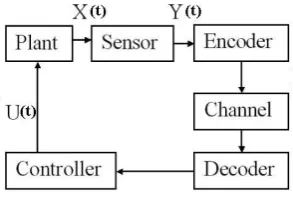
where X(t) is the Rn-valued plant state, U(t) is theRm-valued control input,Y(t) is theRp-valued observation output, D(t)is the Rq-valued bounded process disturbance, respectively.A,B,HandCare known constant matrices with appropriate dimensions (see Fig.l).
The following is assumed to hold:
A0. Without loss of generality, suppose that the pair (A,B) is controllable, and the pair (A,C) is ob-servable.
A1. The sensors and controller are geographically separated and connected by noiseless communi-cation channels. In this case, the measurement of the plant output is quantized but the control signal is not.
A2. The initial conditionX(0)and disturbanceD(t) are possibly non-Gaussian and mutually inde-pendent random variables with zero mean, sat-isfyingkX(0)k2 < φ
0 < ∞ andkD(t)k2 <
φD<∞, respectively.
Figure 1. Networked control systems.
As in [22], given a positive integerNand a non-negative real number ∆(t), we define the quantizer
q:R→Zwith sensitivity∆(t)and saturation value
N by the formula
q(z) =
N+, ifz >(N+ 1/2)∆(t)
N−, ifz¹ −(N+ 1/2)∆(t)
b z
∆(t)+12c, ifz >−(N+ 1/2)∆(t) andz¹(N+ 1/2)∆(t)
(2) where we define bzc := max{k ∈ Z := k < z, z∈R}. The indicesN+andN−will be employed when the quantizer saturates. The scheme to be used here is based on the hypothesis that it is possible to change the sensitivity (but not the saturation value) of the quantizer on the basis of available quantized measurements. The quantizer may counteract distur-bances by switching repeatedly between “zooming out" and “zooming in" (see [22]). Assume that we havenquantizersqi :R→Zwith sensitivity∆i(t) and saturation valueNi (i= 1,· · ·, n). Then we de-fine the quantizerq:Rn →Znas
q(X(t)) := [q1(x1(t))q2(x2(t))· · · qn(xn(t))]T.
We summarize the main definitions from [23]. LetX andXˆ denote two random variables. The dif-ferential entropyh(X)is defined as
h(X) :=EX[logp(1X)]
where we denote by p(X) the probability density function ofX. Here, we writelog2(·)simply aslog(·)
throughout this paper. The conditional differential en-tropy ofXgivenXˆ is defined as
Quantized Feedback Control for Networked Control Systems Under Information Limitation 7
betweenXandXˆ is defined as
I(X; ˆX) :=h(X)−h(X|Xˆ) =EX,Xˆ[logp(X| ˆ X) p(X) ].
The information rate distortion function betweenX
andXˆ is defined as
R(D) := infp( ˆX|X)∈Ξ{I(X; ˆX)}
with Ξ = {p( ˆX|X) : EX,Xˆ[d(X,Xˆ)] ¹ D}. Therein, d(X,Xˆ) is a distortion function or distor-tion measure andDis a constant given. The data rate
R(t)is given by
R(t) = 1
hI(X; ˆX)(bits/s)
wherehis the transmission time for I(X; ˆX). See [23] for further details.
Our performance objective is the linear quadratic (LQ) cost
J := limt→∞supEX0(t)QX(t) (3) whereQis a positive definite matrix. Our purpose is to minimize the cost (3) in the presence of the process disturbance.
In this paper, we formulate quantized control problem for networked control systems with limited data rates of a digital communication channel. Then, we will deal with the LQ control problem for the fully- and partially-observed systems. Thus, the main problem proposed here is to present a lower bound on data rates, above which there exists a quantization, coding and control scheme to stabilize the system (1) in the mean square sense
limt→∞supEkX(t)k2<∞. (4) 3. Digital control under information limitation
This section deals with quantized feedback con-trol for linear time-invariant systems under informa-tion limitainforma-tion. First, a preliminary lemma from [23] is presented.
Lemma 1. Let x ∈ R denote a random variable andxˆ denote an estimate of x. The expected distor-tion constraint is defined as D ∈ R+. For a given
DºE(x−xˆ)2, there must exist a quantization and
coding scheme ifR(D)satisfies
R(D)º1 2log
σ2(x)
D (bits)
whereσ2(x) =E(x−Ex)2.
Proof. See [23].
Remark 1. Lemma 1 presents a lower bound on the amount of information which is needed to reconstruct the initial condition to some distortion fidelity. Then, the quantization and coding scheme is proposed to guarantee stabilization of the system (1) under the limitation ofR(D). We stress that the data rateR(t)
(bits/sample) of the communication channel must be greater thanR(D)such that there exists a control pol-icy to stabilize the system (1). Clearly, more informa-tion available at the decoder will lead to better control performances.
In this case with information limitation, our main task is to present a lower bound on the data rate, above which there exists a quantization, coding and con-trol scheme to achieve concon-trol objectives given. The data rate R(t) plays a key role as we show below. First, we deal with quantized state feedback stabiliza-tion problem. Letλi(·)denote theith eigenvalue of a matrix and let (·)ij denote an element of a matrix
(i, j = 1,· · ·, n). Then, we have the following re-sult:
Theorem 1. Consider the fully observed system (1). Letµ∈(0,1). Define
Φ :=µI−(A−BK)0(A−BK),
Ψ :=A0A−(A−BK)0(A−BK).
Under assumptionsA0−A2stated in Section 2, there
exists a control policy of the form
U(t) =−KXˆ(t)
satisfying that all eigenvalues ofA-BKhave magni-tudes smaller than 1, such that the system (1) is sta-bilizable in the mean square sense (4) with
J= limt−∞supX0(t)QX(t)¹ 1−µ1 kH0QHkφD
if the data rateR(t)satisfies the following inequality:
R(t)> 1 2
P
|(MΨM0)ii λi( ¯Φ) |>1
log|(MΨM0)ii
λi( ¯Φ) |(bits/sample)
whereMis the unitary matrix that diagonalizes
Φ =M0Φ¯M.
Proof. The closed-loop system (1) may be written as
X(t+ 1) =AX(t)−BKXˆ(t) +HD(t).
Namely,
X(t+1) =A(X(t)−Xˆ(t))+(A−BK) ˆX(t)+HD(t).
Q. -Q. Liu , G. -H. Yang
,
,
,
This implies that
EX0(t+ 1)QX(t+ 1)
=trace[QEX(t+ 1)X0(t+ 1)]
=trace[QAE(X(t)−Xˆ(t))(X(t)−Xˆ(t))0A0]
+trace[QHED(t)D0(t)H0])
+trace[Q(A−BK)EXˆ(t) ˆX0(t)(A−BK)0]
+2trace[Q(A−BK)EXˆ(t)D0(t)H0]
+2trace[QAE(X(t)−Xˆ(t))D0(t)H0]
+2trace[QAE(X(t)−Xˆ(t)) ˆX0(t)(A−BK)0] (5) holds. By assumptionA2, we see thatX(t)andD(t) are mutually independent. Then,
EXˆ(t)D0(t) = 0,
E(X(t)−Xˆ(t))D0(t) = 0. (6) Substituting (6) into (5), we may get
EX0(t+ 1)QX(t+ 1) =trace[QAΣ
X(t)|Xˆ(t)A0]
+trace[Q(A−BK)ΣXˆ(t)(A−BK)0]
+trace[QHΣD(t)H0] where we define
ΣXˆ(t):=EXˆ(t) ˆX0(t),
ΣX(t)|Xˆ(t):=E(X(t)−Xˆ(t))(X(t)−Xˆ(t))0,
ΣD(t):=ED(t)D0(t).
If assume that
EX0(t)QX(t)>trace[QAΣ
X(t)|Xˆ(t)A 0]
+trace[Q(A−BK)ΣXˆ(t)(A−BK)0] which is equivalent to
µEX0(t)QX(t) =trace[QAΣ
X(t)|Xˆ(t)A0]
+trace[Q(A−BK)ΣXˆ(t)(A−BK)0] (7)
withµ∈(0,1), we may obtain
EX0(t+ 1)QX(t+ 1) =µEX0(t)QX(t)
+ED0(t)H0QHD(t).
This implies
EX0(t)QX(t) =µtEX0(0)QX(0)
+Pt−i−i=0 1µiED0(i)H0QHD(i)
¹¹µtkQkφ 0+1−µ
t 1−µkH
0QHkφ D.
Thus,
J = limt→∞supEX0(t)QX(t)¹ 1−µ1 kH0QHkφD. (8)
Clearly, if we can design a quantization and coding scheme such that (7) holds, there exists a control pol-icy of the formU(t) =−KXˆ(t)to stabilize the sys-tem (1) with the costJsubject to (8).
To guarantee that (7) holds, we set
µtrace[ΣX(t)] =trace[AΣX(t)|Xˆ(t)A 0]
+trace[(A−BK)ΣXˆ(t)(A−BK)0].
Notice that
ΣXˆ(t) =EXˆ(t) ˆX0(t)−EX(t)X0(t) +EX(t)X0(t)
= ΣX(t)−E(X(t)X0(t)−Xˆ(t) ˆX0(t))
= ΣX(t)−E(X(t)−Xˆ(t))(X(t)−Xˆ(t))0
= ΣX(t)−ΣX(t)|Xˆ(t)
where we defineΣX(t):=EX(t)X0(t). Substituting the equations above into (7), we have
µtrace[ΣX(t)]
=trace[AΣX(t)|Xˆ(t)A0]
+trace[(A−BK)ΣXˆ(t)(A−BK)0]
=trace[A0AΣ
X(t)|Xˆ(t)]
+trace[(A−BK)0(A−BK)Σ ˆ X(t)]
=trace[A0AΣX(t)|Xˆ(t)]
+trace[(A−BK)0(A−BK)(Σ
X(t)−ΣX(t)|Xˆ(t))]
=trace[(A0A−(A−BK)0(A−BK))Σ
X(t)|Xˆ(t)]
+trace[(A−BK)0(A−BK)Σ X(t)].
Thus, we have
trace(ΦΣX(t)) =trace(ΨΣX(t)|Xˆ(t)),
where we define
Φ :=µI−(A−BK)0(A−BK),
Ψ :=A0A−(A−BK)0(A−BK).
Then, it holds that
EX0(t)ΦX(t) =E(X(t)−Xˆ(t))0Ψ(X(t)−Xˆ(t)).
LetMbe the unitary matrix that diagonalizes
Φ =M0Φ¯M.
Define
¯
X(t) :=MX(t),
˜
X(t) :=MXˆ(t).
It follows that
EX¯0(t) ¯Φ ¯X(t) =E( ¯X(t)−X˜(t))0MΨM0( ¯X(t)−X˜(t)).
,
Quantized Feedback Control for Networked Control Systems Under Information Limitation 9
Here, we quantize, encodeX¯(t)and obtain the quan-tization valueX˜(t). Thus, it follows that
n
X
i=1
λi( ¯Φ)Ex¯2i(t) = n
X
i=1
(MΨM0)
iiE(¯xi(t)−x˜i(t))2.
Then, we set
∆i(t) =
q
12|(MλiΨ( ¯MΦ)0)
ii|Ex¯ 2
i(t) (9) and
Ni>
q
|(MΨM0)ii
λi( ¯Φ) | (10) when
|(MΨM0)ii λi( ¯Φ) |>1.
In the case where|(MΨM0)ii
λi( ¯Φ) | ¹1, the corresponding
¯
xi(t)needs not be quantized. Namely, we implement the quantizer of the form (2) with sensitivity∆i(t) and saturation value Ni (i=1,· · ·, n) subject to the conditions (9) and (10), respectively.
Now, we further argue the relationship between the data rateR(t)and the control objectives given. We setDi(i= 1,· · · , n)subject to
Di=
(
|(MλiΨ( ¯MΦ)0)
ii|Ex¯ 2
i(t) when| (MΨM0)
ii λi( ¯Φ) |>1
Ex¯2
i(t) when|(MΨM
0)
ii λi( ¯Φ) | ¹1.
Then, by Lemma 1, we set
R(D)º1 2log
Ex¯2
i(t)
Di º12log
σ2(¯xi(t))
Di (bits). For transmitting the information ofx¯i(t), the corre-sponding data rateRi(t)must satisfy the following condition:
Ri(t)> 12log|(MΨM
0)
ii
λi( ¯Φ) |(bits/sample) when|(MΨM0)ii
λi( ¯Φ) |>1
or
Ri(t) = 0(bit/sample) when|(MΨM
0)
ii λi( ¯Φ) | ¹1.
Thus, it follows that
R(t) >Pni=1Ri(t)
= 1
2
P
|(MΨM0)ii λi( ¯Φ) |>1
log|(MΨM0)ii
λi( ¯Φ) |(bits/sample).
Remark 2. In Theorem 1, the parameter µ plays a key role in the relationship between control perfor-mances and the data rate of the communication chan-nel. Namely, if we want to obtain better performance, we have to increase the data rate.
We now turn to the problem of stabilizing the system
X(t+ 1) =AX(t) +Bu(t) +HD(t),
y(t) =CX(t) (11)
with quantized measurements of the output. Here,
u(t)∈Ris the control input andy(t)∈Ris the plant output. The case in which the plant output as well as the control input is a scalar is the most interesting. Clearly, considering this case avoids extraneous com-plexity and makes our conclusions most transparent.
Then, we establish the following result:
Theorem 2. Consider the partially-observed system (11). Letµ∈(0,1). Denote byyˆ(t)the quantization value ofy(t). Define
Ξ :=µI−(A−BkC)0(A−BkC),
Ω :=A0A−(A−BkC)0(A−BkC).
Under assumptions A0−A2 from Section 2, there
exists a control policy of the form
u(t) =−kyˆ(t)
satisfying that all eigenvalues ofA-BkChave mag-nitudes smaller than 1, such that the system (11) is stabilizable in the mean square sense (4) with
J= limt−∞supX0(t)QX(t)¹ 1−µ1 kH0QHkφD
if the data rateR(t)satisfies the following inequality:
R(t)> 1 2
P
|(NΩN0)ii λi(¯Ξ) |>1
log|(NΩN0)ii
λi(¯Ξ) |(bits/sample)
whereNis the unitary matrix that diagonalizes
Ξ =N0Ξ¯N.
Proof. The closed-loop system (11) may be written as
X(t+ 1) =AX(t)−BkCXˆ(t) +HD(t).
Namely,
X(t+1) =A(X(t)−Xˆ(t))+(A−BkC) ˆX(t)+HD(t).
Arguing as before, if we assume that
EX0(t)QX(t)>trace[QAΣ
X(t)|Xˆ(t)A0]
+trace[Q(A−BkC)ΣXˆ(t)(A−BkC)0]
which is equivalent to
µEX0(t)QX(t) =trace[QAΣ
X(t)|Xˆ(t)A0]
+trace[Q(A−BkC)ΣXˆ(t)(A−BkC)0] (12)
withµ∈(0,1), we may obtain
EX0(t+ 1)QX(t+ 1) =µEX0(t)QX(t)
+ED0(t)H0QHD(t).
This implies
EX0(t)QX(t) =µtEX0(0)QX(0)
+Pt−i−i=0 1µiED0(i)H0QHD(i)
¹µtkQkφ 0+1−µ
t 1−µkH
0QHkφ D.
Thus, it holds that
J = limt→∞supEX0(t)QX(t)¹ 1−µ1 kH0QHkφD. (13) Clearly, if we can design a quantization and coding scheme such that (12) holds, there exists a control pol-icy of the formu(t) =−kyˆ(t)to stabilize the system (11) with the costJ subject to (13).
To guarantee that (12) holds, we set
µtrace[ΣX(t)] =trace[AΣX(t)|Xˆ(t)A0]
+trace[(A−BkC)ΣXˆ(t)(A−BkC)0].
Thus, it follows that
trace(ΞΣX(t)) =trace(ΩΣX(t)|Xˆ(t))
where
Ξ :=µI−(A−BkC)0(A−BkC),
Ω :=A0A−(A−BkC)0(A−BkC).
Then,
EX0(t)ΞX(t) =E(X(t)−Xˆ(t))0Ω(X(t)−Xˆ(t)).
LetNbe the unitary matrix that diagonalizes
Ξ =N0Ξ¯N.
Define
¯
X(t) :=NX(t),
˜
X(t) :=NXˆ(t).
Thus,
EX¯0(t)¯Ξ ¯X(t)
=E( ¯X(t)−X˜(t))0NΩN0( ¯X(t)−X˜(t)).
Here,X˜(t)may be viewed as the estimate value of
¯
X(t). Thus, it follows that n
X
i=1
λi(¯Ξ)E¯x2i(t) = n
X
i=1
(NΩN0)iiE(¯xi(t)−x˜i(t))2.
It follows from the observability of the pair (A, C) that
I(y(t); ˆy(t)) =I(X(t); ˆX(t)).
Furthermore,
I(X(t); ˆX(t)) =I( ¯X(t); ˜X(t)).
Then,
R(D) = infp(ˆy(t)|y(t))∈Γ0{I(y(t); ˆy(t))}
= infp( ˜X(t)|X¯(t))∈Γ{I( ¯X(t); ˜X(t))}
where Γ = {p( ˜X(t)|X¯(t)) : E[d( ¯X(t),X˜(t))] ¹
D}.
Then, we set
∆(t) =
s
12Πi∈Λ| λi(¯Ξ)
(NΩN0)ii
|Ey2(t) (14)
and
N > q
Πi∈Λ|(NλiΩ(¯NΞ)0)
ii| (15) whereΛ ={i∈ {1,· · · , n}:|(NΩN0)ii
λi(¯Ξ) |>1}. Namely, we implement the quantizer of the form (2) with sensitivity∆(t)and saturation valueN sub-ject to the conditions (14) and (15), respectively.
Now, we further argue the relationship between the data rate R(t)and the control objectives given. We setDsubject to
D= Πi∈Λ| λi(¯Ξ)
(NΩN0) ii
|Ey2(t)
For transmitting the information ofy(t), the cor-responding data rateR(t)must satisfy the following condition:
R(t)>1
2log Πi∈Λ| (NΩN0)
ii
Quantized Feedback Control for Networked Control Systems Under Information Limitation 11
Remark 3. Although the argument presented above only deals explicitly with the input single-output (SISO) case, it is possible to extend the result of Theorem 2 to deal with multi-input multi-output (MIMO) case.
4. Numerical example
Issues of the type discussed in this paper arise in the coordinated motion control of autonomous and semiautonomous mobile agents, e.g., unmanned air vehicles (UAVs), unmanned ground vehicles (UGVs), and unmanned underwater vehicles (UUVs). To illus-trate the proposed quantization and control scheme for linear control systems under information limi-tation, we present a practical example, where three of the states of an unmanned air vehicle evolve in discrete-time according to
X(t+ 1) =
10..92 126 −2.53.37 0−0.61.23
0.74 0.27 1.75
X(t)
+
21..1215
0.24
u(t) + 2.3W(t),
y(t) =£0.31 −0.30 0.29¤X(t).
The initial condition X(0) = [180 10 −80]0 and
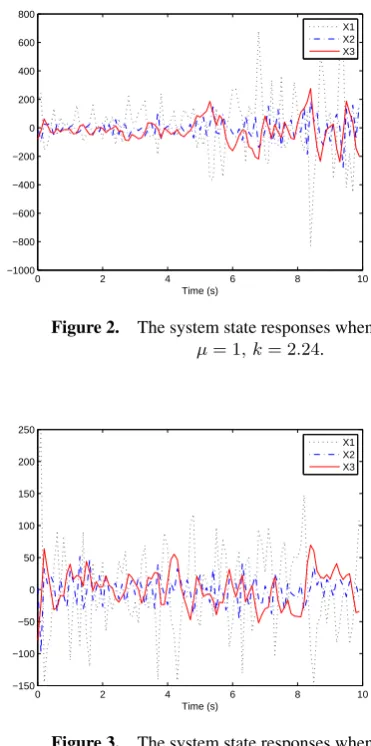
φD= 0.51. Let the sampling periodh= 20ms. We select the controller gain k = 2.24 satisfy-ing that all eigenvalues ofA−BkC lie inside the unit circle. If letR(t) = 150(bits/s) andµ = 1, a corresponding simulation is given in Fig. 2. Clearly, the closed-loop system is unstable, regardless of the quantization and control scheme in use, when the data rateR(t)is smaller than the lower bound (i.e., 156 bits/s), which was derived in [3], [6], [9] and etc. To guarantee stability of the system above, we increase the data rate and setµ = 1,R(t) = 160 (bits/s). The corresponding simulation is given in Fig. 3. Here we are interested in the qualitative dynamics of lin-ear control systems operating nlin-ear the lower bound. However, the costJ is rather poor although the sys-tem may be stabilizable in the mean square sense.
To improve the control performance, we imple-ment the quantization and control scheme on the ba-sis of the condition proposed in Theorem 2. If let
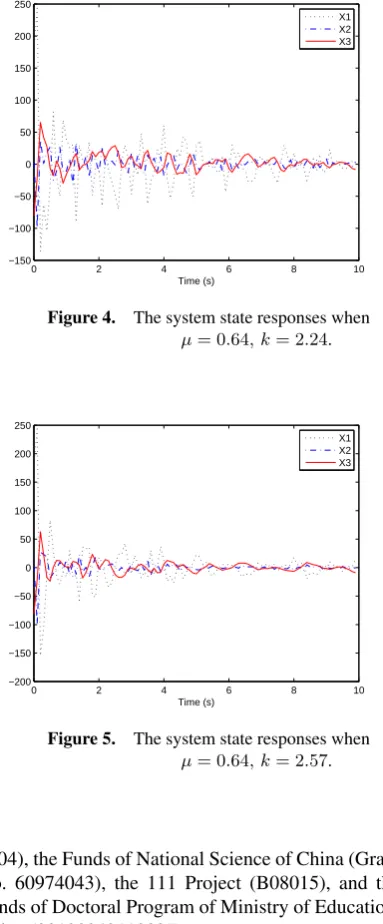
µ = 0.64andR(t) = 400 (bits/s), we may obtain
J = 17.39. The corresponding simulation is given in Fig. 4. Clearly, the larger data rate may lead to the bet-ter control performance. If we change the controller law, and setk = 2.57, we may obtainR(t) = 460
(bits/s) andJ = 12.51. The corresponding simula-tion is given in Fig. 5. It means that the control law
0 2 4 6 8 10
−1000 −800 −600 −400 −200 0 200 400 600 800
Time (s)
X1 X2 X3
Figure 2. The system state responses when
µ= 1, k= 2.24.
0 2 4 6 8 10
−150 −100 −50 0 50 100 150 200 250
Time (s)
X1 X2 X3
Figure 3. The system state responses when
µ= 1, k= 2.24.
has an important effect on the control performance in the case with information limitation.
5. Conclusion
This paper addressed quantized control problems for networked control systems with limited data rates. The approach taken here relied on both information-theoretic and control-information-theoretic tools. We developed a number of techniques, for both fully- and partially-observed systems, which enable one to achieve some given control objectives. The simulation results have illustrated the effectiveness of the proposed quantiza-tion, coding and control scheme.
Acknowledgment
0 2 4 6 8 10 −150
−100 −50 0 50 100 150 200 250
Time (s)
X1 X2 X3
Figure 4. The system state responses when
µ= 0.64, k= 2.24.
0 2 4 6 8 10
−200 −150 −100 −50 0 50 100 150 200 250
Time (s)
X1 X2 X3
Figure 5. The system state responses when
µ= 0.64, k= 2.57.
0604), the Funds of National Science of China (Grant No. 60974043), the 111 Project (B08015), and the Funds of Doctoral Program of Ministry of Education, China (20100042110027).
References
[1] W.S. Wong, R.W. Brockett. Systems with finite communication bandwidth constraints II: Stabiliza-tion with limited informaStabiliza-tion feedback, IEEE Trans-actions on Automatic Control, Vol.44, No.5, 1999, 1049-1053.
[2] J. Baillieul.Feedback designs for controlling device arrays with communication channel bandwidth con-straints, in ARO Workshop on Smart Structures, Penn-sylvania State Univ,Aug. 1999.
[3] J. Baillieul. Feedback designs in information based control, Stochastic Theory and Control Proceedings of a Workshop Held in Lawrence, Kansas, B. Pasik-Duncan, Ed. New York: Springer-Verlag,2001, 35-57.
[4] J. Baillieul. Data-rate requirements for nonlinear feedback control, Proc. 6th IFAC Symp. Nonlinear Control Syst., Stuttgart, Germany,2004, 1277-1282. [5] K. Li, J. Baillieul. Robust quantization for
digi-tal finite communication bandwidth (DFCB) control,
IEEE Transactions on Automatic Control, Vol.49, No.9, 2004, 1573-1584.
[6] G.N. Nair, R.J. Evans. Stabilizability of stochastic linear systems with finite feedback data rates, SIAM J. Control Optim., Vol.43, No.2, 2004, 413-436. [7] N. Elia, S. Mitter.Stabilization of linear systems with
limited information,IEEE Transactions on Automatic Control, Vol.46, No.9, 2001, 1384-1400.
[8] N. Elia.When Bode meets Shannon: Control-oriented feedback communication schemes, IEEE Transac-tions on Automatic Control, Vol.49, No.9, 2004, 1477-1488.
[9] S. Tatikonda, S. Mitter. Control under communi-cation constraints, IEEE Transactions on Automatic Control, Vol.49, No.7, 2004, 1056-1068.
[10] S. Tatikonda, S. Mitter.Control over noisy channels,
IEEE Transactions on Automatic Control, Vol.49, No.7, 2004, 1196-1201.
[11] S. Tatikonda, A. Sahai, S. Mitter.Stochastic linear control over a communication channel, IEEE Trans-actions on Automatic Control, Vol.49, No.9, 2004, 1549-1561.
[12] N.C. Martins, M.A. Dahleh, N. Elia.Feedback sta-bilization of uncertain systems in the presence of a direct link, IEEE Transactions on Automatic Control, Vol.51, No.3, 2006, 438-447.
[13] N.C. Martins, M.A. Dahleh.Feedback control in the presence of noisy channels: ‘Bode-like’ fundamen-tal limitations of performance, IEEE Transactions on Automatic Control, Vol.53, No.7, 2008, 1604-1615. [14] G.N. Nair, S. Dey, R.J. Evans.Infimum data rates for
stabilizing Markov jump linear systems, Proc. IEEE Conf. Decision and Control, 2003, 1176-1181. [15] A. Sahai, S. Mitter. The necessity and sufficiency
of anytime capacity for stabilization of a linear sys-tem over a noisy communication link Part I: Scalar systems, IEEE Transactions on Automatic Control, Vol.52, No.8, 2006, 3369-3395.
[16] J.Q. Sun, S.M. Djouadi. Robust stabilization over communication channels in the presence of unstruc-tured uncertainty, IEEE Transactions on Automatic Control, Vol.54, No.4, 2009, 830-834.
[17] S. Yu¨ksel, T. Basar. Communication constraints for decentralized stabilizability with time-invariant policies, IEEE Transactions on Automatic Control, Vol.52, No.6, 2007, 1060-1066.
[18] C.D. Charalambous, A. Farhadi, S.Z. Denic. Con-trol of continuous-time linear Gaussian systems over additive Gaussian wireless fading channels: A separa-tion principle, IEEE Transactions on Automatic Con-trol, Vol.53, No.4, 2008, 1013-1019.
Quantized Feedback Control for Networked Control Systems Under Information Limitation 13
Control, Vol.54, No.2, 2009, 243-255.
[20] J. Baillieul, P. Antsaklis. Control and communica-tion challanges in networked real time systems, Pro-ceedings of IEEE Special Iss. Emerg. Technol. Netw. Control Syst, USA: IEEE,2007, 9-28.
[21] G. N. Nair, F. Fagnani, S. Zampieri, R.J. Evans. Feedback control under data rate constraints: An overview, Proceedings of IEEE Special Iss. Emerg. Technol. Netw. Control Syst, USA: IEEE, 2007, 108-137.
[22] D. Liberzon, D. Nesˇi´c. Input-to-state stabilization of linear systems with quantized state measurements,
IEEE Transactions on Automatic Control, Vol.52, No.5, 2007, 767-781.
[23] T. Cover, J. Thomas.Elements of Information The-ory.New York: Wiley,2006.
[24] P. Orlowski.System degradation factor for networked control systems, Information Technology And Con-trol, Vol.37, No.3, 2008, 233-244.
[25] Z. Peric, J. Nikolic. A. Mosic, S. Panic,A switched-adaptive quantization technique usingµ-law quantiz-ers, Information Technology And Control, Vol.39, No.4, 2010, 317-320.
Received December 2010.