Copyright © 2012 CTTS.IN, All right reserved
A Survey of EIGRP and OSPF Protocols on Voice
Conferencing Applications
Md. Nazmul Islam Khan
Dept. of Electrical Engineering, Blekinge Institute of Technology, Karlskrona, Sweden, [email protected]
Shafiul Hasan
Dept. of Electrical & Computer Engineering, Presidency University, Bangladesh,
[email protected]
Mohammad Nazrul Islam
School of Computing, Blekinge Institute of Technology, Karlskrona, Sweden, [email protected]
Md. Ahsan Ullah Ashique
School of Computing, Blekinge Institute of Technology, Karlskrona, Sweden, [email protected]
Abstract — The demand of real-time applications over IP network in both home and industry has been increasing faster than ever. However, it must be kept in mind that IP networks are best-effort networks that were basically designed for non-real time applications. Networks need to be more intelligent, secure and need to ensure a high level of performance when routing the real-time traffic. While the performance of such traffic can be affected through deploying inefficient routing protocol in the network, it also brings new challenges for network designers and engineers to evaluate the routing performance efficiently and effectively. The research analyzes how well different dynamic routing protocols respond to various performance differentials when subjected to a voice conferencing application on IPv4 network. The analysis helps better understand the protocols’ comparative merits and suitability for deployment under the real-time traffic. The dynamic routing protocols that are considered in the study are Enhanced Interior Gateway Routing Protocol (EIGRP) and Open Shortest Path First (OSPF). As the simulation results demonstrate, EIGRP protocol has been a very effective routing protocol for voice conferencing application, which ensures its particular suitability irrespective of network load.
Keyword — OSPF, EIGRP, Real-Time Application, IPv4 and OPNET.
1.
I
NTRODUCTIONLately, computer has become an important tool which is used not only to perform our daily tasks, but also to socialize people using different social networking sites, viz. twitter, facebook and the like. While, connection between multiple computers has been a necessity, Internet connections and the modem price are becoming increasingly affordable to everyone. The computers in any network use IPV4 or IPV6 addresses to get connected to the Internet and the network using TCP/IP protocol ensures the efficient routing of data packets based on these IP addresses [1].
The demand of real-time application such as voice conferencing over IP network in both home and industry has been increasing faster than ever. It is very advantageous and cost effective to provide such voice communication services over any new or existing IP network. However, it must be kept in mind that IP networks are best-effort networks that were basically designed for non-real time applications. Networks need to be more intelligent, secure and need to ensure a high level of performance when routing the real-time traffic. While, the performance of such traffic can be affected through deploying inefficient routing protocol in the network, it also brings new challenges for network designers and engineers to evaluate the routing performance effectively and efficiently.
Copyright © 2012 CTTS.IN, All right reserved (EIGRP). On the other hand, the examples of link-state
protocol are Open Shortest Path First (OSPF) routing protocol and Intermediate System to Intermediate System (IS-IS) routing protocol. Both types of routing protocols have significant role to define the success of the network. However, all of these protocols do not have similar properties and their behaviors differ from one network environment to another. At the same time, in order for routers to effectively and efficiently distribute data, the proper choice of the routing protocol has been a very crucial factor for determining the overall network efficiency. In what follows, it is necessary to simulate these protocols in an ideal environment and to contemplate how they perform under a particular real-time application in IP network. More specifically, it is important to determine the most suitable routing protocol that can optimize the traffic goal in respective network. Following this, the study has subjected two dynamic routing protocols, namely OSPF and EIGRP in order to assess their performance under voice conferencing application in IPv4 network, which eventually ascertain the relative performance merits of each routing protocol for deployment in such network. OSPF and EIGRP protocols are reckoned as the most prominent network layer mechanisms for the practical networks. The choice of these two protocols is also motivated by the fact that they have been proposed by the Interior Gateway Protocol (IGP) working group of the Internet Engineering Task Force (IETF). In addition, these protocols provide loop-free routes as well as low bandwidth utilization features.
Over the past few years, some researches [e.g., 4, 5, 6, 7, 8] have been conducted to evaluate the performance of the routing algorithms. However, research works addressing the performance of most popular dynamic routing protocols in IP network have been lacking. As a matter of fact, there has not been enough inclusive evaluation study previously attempted to contrast the dynamic routing performance for real-time application. The authors in [1] incorporated a thorough discussion on RIP, EIGRP and OSPF protocols, subsequently evaluating the performance behavior among them through simulation study. Network convergence, network convergence activity, CPU utilization, throughput, queuing delay, and bandwidth utilization were successfully measured in their study. Meanwhile [9] examines the VoIP performance over an IP network, where the authors documented that the performance of real-time traffic such as VOIP is affected by different routing behaviors. Various aspects of network had been specified in their simulation model in order to evaluate the performance of the routing protocols. The analysis of the study had led to the conclusion that OSPF protocol can be efficiently used in any enterprise network to support the VoIP service.
The rest of the paper is organized as follows. Section 2 of this paper describes the existing routing protocols considered in the study. Section 3 presents the simulation
environment, while a discussion on the results obtained upon running the simulation experiments is documented in section 4. Finally, the conclusions along with exploring avenues for future research are drawn in section 5.
2.
D
YNAMICR
OUTINGP
ROTOCOLSThe main purpose of a routing protocol is to explore the shortest and most efficient path during the data transmissions in the network. Moreover, the routing algorithm establishes the communications and formalizes agreement among nodes, which is essential to the overall performance of the network [3]. This section continues with a description of OSPF and EIGRP protocols and presents a comparison among them.
2.1. OSPF
OSPF is a standardized Link-State routing protocol, designed to scale to support large networks. OSPF exhibits following Link State characteristics:
• OSPF uses the Dijkstra Shortest Path First algorithm to determine the shortest path among links to the destination.
• A hierarchical network design is formed and the relationships with the adjacent routers are established by the OSPF.
• A change in the link condition is advertised to the directly connected links using Link-State Advertisements (LSAs).
• No limitation is appeared on hop-count for OSPF. The cost is considered as an important metric, which is dependent on the bandwidth available for a particular link.
In addition, OSPF will build and maintain three separate tables: A neighbor table that contains a list of neighbor routers, a topology table that contains a list of all possible routes to all known networks within an area. Finally, a routing table, which contains the best route to each known network [15].
2.2. EIGRP
EIGRP is a cisco-proprietary hybrid routing protocol, incorporating features of both Distance-Vector and Link-State routing protocols [16]. EIGRP adheres to the following hybrid characteristics:
• EIGRP utilizes Diffusing Update Algorithm (DUAL) to calculate the most efficient path among all the feasible possibilities. In addition, the purpose of DUAL also includes providing a loop-free routing environment. • EIGRP generates and maintains the neighbour relationships with adjacent routers within the same Autonomous System (AS).
• Reliable Transport Protocol (RTP) is used to ensure delivery of most EIGRP packets.
Copyright © 2012 CTTS.IN, All right reserved
3.
E
XPERIMENTALD
ESIGNThis section comprises a description of the designed network model and the necessary parameters that are realized in configuring the network model.
3.1. Evaluation Platform
The design of an efficient network model and its performance evaluation are of immense importance in a real-world network scenario. However, it is a challenging task to evaluate the performance of the proposed network in a real situation. Therefore, a number of network simulators have been introduced in order to design and simulate the network models in several perspectives. In the discussion that follows, Network Simulator 2 (NS-2) [5] and Optimized Network Engineering Tools (OPNET) [11] are the two very well-known simulators. NS-2 is open source software while OPNET is a commercial simulator and the kernel source code of OPNET modeler is not open for all. However, OPNET has gained considerable popularity in academia as it is being offered free of charge to academic institutions. That has given OPNET an edge over NS-2 in both market place and academia. In addition, OPNET has a comprehensive built-in development environment to design and simulate real-life network models. This makes the simulation of real-life network environment close to reality.
This research is conducted using discrete event simulation software known as OPNET, which is just one of several tools provided from the OPNET Technologies suite. In order to undertake the experimental evaluation, the most recently available version, namely OPNET Modeler 16 has been adopted in our study.
3.2. Performance Metrics
Specific network layer protocols demand on an own set of performance metrics to evaluate the network efficiency. In order to evaluate the performance of the routing protocols, convergence duration, jitter, end-to-end delay and throughput are considered as performance metrics in our study.
Factors that differentiate one routing protocol from another include the speed that it adapts to topology changes called as convergence, while Convergence Duration measures how fast a set of routers reaches the state of convergence [1].
Jitter is defined as a variation in the delay of received packets. At the sending side, packets are sent in a continuous stream with packets spaced evenly apart. Due to network congestion, improper queuing or miss-configuration, the steady stream becomes lumpy or the delay between packets varies [12].
The average rate at which the data packet is delivered successfully from one node to another over a communication network is known as throughput. The throughput is usually measured in bits per second (bits/sec). A throughput with a higher value is more often an absolute choice in every network [13].
The end-to-end delay is the time needed to traverse from the source node to the destination node in a network. The
end-to-end delay is measured in second. The delay assesses the ability of the routing protocols in terms of use- efficiency of the network resources [14].
Several approaches are possible to offer IPv6 connectivity over the MPLS core domain. They vary from a couple of standpoints: transitioning strategy, scalability, data overhead, and configuration. IPv6 MPLS with IPv6-based core compares the different solutions in relation to the support of IPv6 in MPLS [9].
3.3. Network Modeling
The network models of the current study are designed, in the OPNET simulator, by taking help of different network entities. An example of such network models is presented in Fig. 1. The network entities used during the design of the network model are application configuration, profile configuration, failure recovery configuration, QoS attribute configuration, subnets, servers, routers, switches and workstations. These model objects are basically a series of network components that allow attribute definition and tuning.
Fig. 1. Network Topology
Six subnets named according to the divisions of Bangladesh are interconnected to each other, where all the subnets contain routers, switch and workstations. The routers within each subnet are configured by using EIGRP and OSPF routing protocols. The internal infrastructure of the network topology is shown in Fig. 2. Application configuration is an essential object that defines the transmitted data, file size and traffic load. In our study, and voice conferencing (PCM Quality) are chosen for data traffic analysis. On the other hand, profile configuration is employed to create the user profiles whereas these profiles are specified on different subnets for generating the application traffic. Two profiles are created to support the video streaming and the voice conferencing traffic. In addition, failure link has been included and configured in all the scenarios of our study. This allows us to evaluate the convergence activity of the network.
Copyright © 2012 CTTS.IN, All right reserved efficiency of the network is ensured. To implement the
QoS, IP QoS Object called QoS Parameters has been considered into the workspace to deploy Weighted Fair Queuing (WFQ). The WFQ is a scheduling technique that allows different scheduling priorities on the basis of Type of Service (ToS) and Differentiated Service Code Point (DSCP). The routers are connected to each other using the PPP_DS1 duplex link. The switches are connected to the routers using the same type of duplex link while the workstations are connected to switches using the Ethernet 10 BaseT duplex link.
Fig. 2. Internal Infrastructure of Network Topology
4.
R
ESULTS ANDA
NALYSISThis section presents details of the experiments carried out to evaluating the routing performance for real-time applications in an IPv4 network. We considered total simulation time as 900 seconds over which the performance statistics of convergence duration, jitter, throughput and end-to-end delay are collected. In order to achieve the simulation accuracy in OPNET, three replications are run for each experiment, with different constant seeds of the Pseudo Random Number Generator (PRNG). The constant values of the seeds are used since it minimizes the variance of the simulation results and thus allows a better comparison of the routing protocols. In OPNET, the PRNG is supported by Berkeley Software Distribution (BSD)’s algorithm, providing safe random numbers. We understand that three simulation replications were reasonably sufficient since all such replications portray quite similar graphical results. Thus, the interpretation and analysis of he results led us to the same conclusion.
In our study, data rate for PPP_DS1 links is set to 1.544 Mbps. We apply background load on each network by varying the link utilization, where the variation is made between 0% to high 80%. This is shown in Table 1.
Table (1) Link Utilization values Time
in (sec)
Link utilization in (%)
Link value in (bps)
0 0 0
200 20 308800 (1544000*0.2)
400 40 617600 (1544000*0.4)
600 60 926400 (1544000*0.6)
800 80 1235200 (1544000*0.8)
4.1. Convergence Duration
Fig. 3. Convergence Duration for Voice Conferencing Application
As seen in Fig. 3, the convergence time of EIGRP is faster than OSPF networks. The figure shows that the convergence time of EIGRP is less than OSPF when a link fails at 400 seconds and recovers at 800 seconds following the change in link utilization. When a change occurs in the network, an EIGRP router detects it and sends query only to the immediate neighbors in order to discover a successor and this way, the message propagates to all the routers in the network. In the case of OSPF, the routers within an area update the topology database by flooding LSAs to the neighbors and the routing table is thus recalculated. As a consequence, OSPF takes more time to converge.
4.2. Jitter
Fig. 4. Jitter for Voice Conferencing Application
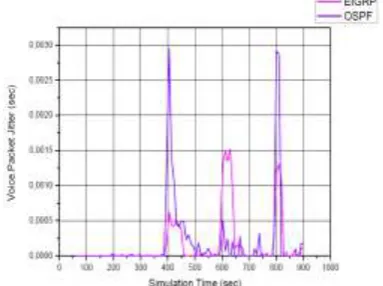
Copyright © 2012 CTTS.IN, All right reserved 0.0004 sec. Meanwhile, the average delay variation for
OSPF is found to be about 0.0011 sec. At about 400 seconds of the simulation time, the network experiences 40% background load, where the delay variations of EIGRP and OSPF are found approximately 0.0029 sec and 0.0006 sec, respectively. With the background load changing to 60 %, the performance of OSPF tends to increase dramatically. One can observe that the delay variation of OSPF is quite satisfactory between 600 to 800 seconds of the simulation time. However, In the case of 80 % load (at about 800 seconds), EIGRP again starts outperforming over OSPF, which is maintained until the end of the simulation time.
4.3. End-to-End Delay
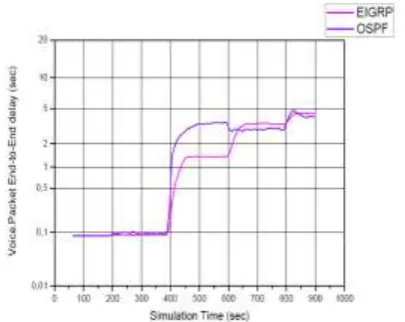
Fig. 5 shows the end-to-end delay of EIGRP and OSPF protocol for the voice conferencing application. As can be seen, the end-to-end delay starts to rise for both EIGRP and OSPF with 40% network load at about 400 seconds. The delay is found approximately l20 ms for the EIGRP network. In contrast, the delay of OSPF network exceeds 120 ms under such a load. For both protocols, the end-to-end delay gradually rises due to high congestion in the link. The background load of 60% and 80% (between 400 seconds to 800 seconds) are not taken into consideration since the delay reached to its maximum value of 120 ms.
Fig. 5. End-to-End Delay for Voice Conferencing Application
4.4. Throughput
Fig. 6. Throughput for Voice Conferencing Application The throughput outcome of the routing protocols is shown in Fig. 6. The traffic received by both EIGRP and OSPF is found to be decreasing for any increase in load in the network. Among the two protocols, it appears that EIGRP throughput is relatively higher than that of OSPF. For instance, with 40 % network load (at about 400 sec) the received packets of EIGRP are about 11.2 % higher and with 80 percent network load (at about 800 sec) the received packets of EIGRP are about 13.3 % higher than those of OSPF. This implies that even with a higher congestion in the network, EIGRP maintains a dominating performance over OSPF.
5.
C
ONCLUSIONThis research makes contribution in three areas. Firstly, the research makes use of computer simulation tools and discourses different aspects of the network design, so as to explore the routing performance behavior in an IPv4 network. Secondly, the study analyzes the performance of the two most widely used routing protocols (EIGRP and OSPF) for the voice conferencing application. In this respect, using the simulation environment, an analysis is carried out on the results of convergence duration, jitter, end-to-end delay and throughput. Finally, an investigation is also made into aspects as to how well these protocols respond to the change of background load in the network. The key observations of the research are as follows. EIGRP performs quite well in our simulation. It achieves the highest amount of data packets and the lowest amount of end-to-end delay. It is encouraging to note that the OLSR performance is not degraded to a much extent even in the presence of a high load in the network. On the other hand, OSPF suffers from achieving a significant throughput and a lower end-to-end delay as a means of dropping more data packets in the network. Meanwhile, EIGRP converges faster than OSPF network as EIGRP is able to learn the topology and updates rapidly. In addition, we observe that packet delay variation of OSPF network is higher than that of EIGRP.
The pursuit of future research may include aspects relating to evaluation of OSPFv3, EIGRP and RIP for the real-time applications. In addition, security analysis for such protocols can be pursued in any future research.
R
EFERENCE[1] Thorenoor, S.G.,"Dynamic Routing Protocol Implementation Decision between EIGRP, OSPF and RIP Based on Technical Background Using OPNET Modeler," in Proceedings of the International Conference on Computer and Network Technology (ICCNT 2010), Vol. 12, no.2, pp 191-5, May 2010.
Copyright © 2012 CTTS.IN, All right reserved Technology (Natural Science Edition), v 6, n 3, pp.
41-5, June 2000.
[3] Chandra Wijaya, “Performance Analysis of Dynamic Routing Protocol EIGRP and OSPF in IPv4 and IPv6 Network,” 2011 vol. 36, no. 1, pp. 76-84, March 2011.
[4] Kisten, S. Ping-Tsai Chung., “Analysis and experimentation on dynamic routing protocols: IGRP and OSPF,” in Proceedings of the International Conference on Internet Computing, pp. 591-3 vol.2, June 2003.
[5] Baranski, J., Crocker, M., Lazarou,G. “Dynamic routing protocol performance in a faulttolerant Ethernet-based IP network, ” in Proceedings of the International Conference on Systemics, Cybernetics and Informatics, pp. 1-5 Vol. 8, Sept 2004.
[6] Yee, J.R., “On the International routing protocol enhanced interior gateway routing protocols: is it optimal?” in International Transactions in Operational Research, v 13, n 3, pp. 177-94, May 2006.
[7] Al-Saud, K.A. Tahir, H.M., El-Zoghabi, A.A., Saleh, M.” Performance evaluation of secured versus non-secured EIGRP routing protocol,” in Proceedings of the International Conference on Security & Management (SAM 2008), pp. 292-7, July 2008.
[8] Talal Mohamed Jaffar, “Simulation-Based Routing Protocols Analysis ” in Ph. D thesis, The Faculty of Electrical Engineering at Georgia Institute of Technology, 2007.
[9] Xianhui Che, Lee J. Cobley , “VoIP Performance over Different Interior Gateway Protocols”, in Proceedings of the International Journal of Communication Networks and Information Security (IJCNIS), Vol. 1, No. 1, April 2009. [10] Nohl, A.R, Molnar, “The convergence of the
OSPF routing protocol” in Proceedings of the International Conference on Systemics, Cybernetics and Informatics, v 47, n 1-2, p 89-100, May 2002.
[11] OPNET Simulator, Retrieved 15 June, 2010, [Online], Available: http://www.opnet.com [12] B. Fortz, J. Rexford, M. Thorup., “Traffic
engineering with traditional IP routing protocols,” in IEEE Communications Magazine, pp. 118-124, vol. 40, Oct. 2002.
[13] K. Salah, P. Calyam, and M.I. Buhari, “Assessing readiness of IP networks to support desktop videoconferencing using OPNET," International Journal of Network and Computer Applications, vol. 31, issue. 4, pp. 921-943, November, 2008. [14] J. Slay, M. Simon., “Voice over IP forensics, ” in
Proceedings of the 1st international conference on Forensic Applications and Techniques in Telecommunications, Information, and
Multimedia, and Workshop, Vol.10, issue 3, pp. 21-28, Aug 2008.
[15] Wu, Bing, "Simulation Based Performance Analyses on RIPv2, EIGRP, and OSPF Using OPNET", Math and Computer Science Working Papers. Paper 11.