Syntactic Structures as Descriptions of
Sensorimotor Processes
Alistair Knott
In this paper I propose a hypothesis linking elements of a model of theo-retical syntax with neural mechanisms in the domain of sensorimotor pro-cessing. The syntactic framework I adopt to express this linking hypothesis is Chomsky’s Minimalism: I propose that the language-independent Logical Form (LF) of a sentence reporting a concrete episode in the world can be in-terpreted as a detailed description of the sensorimotor processes involved in apprehending that episode. The hypothesis is motivated by a detailed study of one particular episode, in which an agent grasps a target object. There are striking similarities between the LF structure of transitive sen-tences describing this episode and the structure of the sensorimotor processes through which it is apprehended by an observer. The neural interpretation of Minimalist LF structure allows it to incorporate insights from empiricist accounts of syntax, relating to sentence processing and to the learning of syn-tactic constructions.
Keywords: embodied cognition; generative syntax; neural models of language; reaching-to-grasp; sensorimotor processing
1 Two Strategies for Investigating the Neural Correlates of Syntax
At least since Chomsky’sAspects (Chomsky, 1965), it has been traditional for lin-guists to think of syntactic models as describing something in the domain of psy-chology, rather than just as characterising sets of well-formed sentences. In prac-tice, theoretical linguists rarely try to express the detailed claims of their models in terms which would be intelligible to neuroscientists or experimental psychol-ogists. However, if a syntactic theory really does describe the cognitive system, then ultimately we might expect the theoretical devices it employs (representing syntactic structures or operations) to correspond to brain mechanisms which are identifable in their own right. For instance, if a theory uses a particular device to represent how phrases are formed, or how long-distance syntactic dependen-cies are sanctioned, we might expect to be able to find a mechanism in the brain which ‘implements’ the device, and ultimately explains why it has a role to play in the overall theory. The mechanism should be independently identifiable using the techniques available to neuroscience. Neuroscience is maturing rapidly; there are now many well-established methods for investigating brain structures and pro-cesses at several levels of hierarchy. So eventually we might expect to be able to
I am grateful to the Marsden Fund of New Zealand for support of this work. I would like to thank the two anonymous reviewers for their helpful comments.
express a hypothesis linking terminology or devices from syntactic theory to iden-tifiable brain mechanisms.
Poeppel and Embick (2005) provide a useful discussion of this expectation. They argue that it is not a foregone conclusion: that some syntactic theories are expressed at a level of detail which is unlikely ever to correspond to measurable observations in neuroscience. In order to move towards a linking hypothesis, they suggest that syntactic theories should be formulated in ways that highlight the gen-eralclasses of computationwhich must be carried out by the syntactic system—and to seek theories in which the proposed types of computation are plausibly imple-mentable by neural machinery. It is not clear what syntactic formalisms Poeppel and Embick intend to rule out through this proposal, but it is certainly helpful for a theory to be explicit about the general types of computation which the syntactic mechanism must be capable of, and to focus the search for a linking hypothesis on a search for neural mechanisms which can implement computations with the right properties.
There is another strategy for seeking brain mechanisms underlying syntactic devices, which is in some ways complementary to that proposed by Poeppel and Embick: namely to focus the search for a linking hypothesis on the semantic do-mains which have been most intensively studied within neuroscience. Promising areas of neuroscience to consider are those which study perceptual and motor mechanisms (which I shall refer to jointly as ‘sensorimotor’ mechanisms). Models of sensorimotor mechanisms are among the most detailed in neuroscience, because it is through these mechanisms that the brain interfaces with the world, and they are therefore the easiest to study empirically. If we want to look for neural mech-anisms underlying a particular syntactic structure, it may be helpful to begin by studying examples of the structure featuring concepts with obvious links to sen-sorimotor mechanisms, rather than concepts taken from some arbitrary semantic domain. For instance, if we are interested in the neural mechanisms underlying predication, it might be helpful to look first at ‘concrete’ sentences like The cat is white rather than arbitrary predications like The idea is popular or The company is solvent. We know quite a lot about the neural mechanisms involved in perceiving concrete objects and properties, so if we begin withThe cat is white, we have a point to start from on the neuroscience side.
Syntactic Structures as Descriptions of Sensorimotor Processes 3
2 A Project Which Combines the Two Strategies
In this paper, I will summarise a research project which pursues both of the strate-gies outlined above. The aim of the project is to suggest how the devices of a formal syntactic theory can be linked to neural mechanisms. In line with the second strat-egy just discussed, the project focusses on sentences in a concrete domain, which express propositions that could conceivably be apprehended through well-studied sensorimotor processes. In line with the first strategy, the syntactic formalism used to analyse these sentences is one which emphasises simple computations, for which there is some prospect of a neural implementation.
The project focusses on a single example episode: one in which a man reaches for and grasps a cup. The sensorimotor mechanisms involved in experiencing this episode have been particularly closely studied, so it is possible to formulate a fairly detailed model of the processing that takes place when it is apprehended. On the syntactic side, the project focusses on the sentences which most directly report this example episode: transitive sentences such as The man grabs the cup, He grabs it, L’homme prend la tasse, L’homme le prendand so on.1 My aim is to juxtapose a
de-tailed model of the sensorimotor processes needed to apprehend the cup-grabbing episode against a model of the syntax of the example sentences, and look for for-mal similarities between the two models. If there are nontrivial similarities, this might provide some insight about how syntax reflects sensorimotor mechanisms, and ultimately, how syntax supervenes on neural mechanisms more generally.
The project is described at length in a recently published book (Knott, 2012). The book introduces both the sensorimotor and syntactic models ‘from scratch’, since there are few readers who are familiar with the details of both fields: as a re-sult the key ideas are interspersed with a large amount of motivating background material. The purpose of the current paper is to present the key ideas in the book with a minimum of background material. I will begin in Section 3 by introducing the syntactic model, which is a version of Chomsky’s Minimalism. In Section 4 I will introduce the overall form of the sensorimotor model I adopt, and in Section 5 I describe the form of the correspondence between syntax and sensorimotor pro-cessing which I envisage. In Sections 6 and 7 I introduce a detailed model of the sensorimotor processing through which a cup-grabbing episode is apprehended and stored. In Section 8 I make some proposals about how the syntax of the ex-ample sentences can be linked to the detailed sensorimotor model. In Section 9 I introduce a computational model of language processing and language acquisi-tion which draws on these proposals. In Secacquisi-tion 10 I consider how the proposals might extend beyond the example cup-grabbing sentences, and note some areas for further work.
3 A Syntactic Model of Transitive Cup-Grabbing Sentences
3.1 Choosing a Syntactic Formalism
To begin with, we need a syntactic formalism in which to describe the structure of the example cup-grabbing sentences. Of course, there are many formalisms to
choose from. In the project I am describing, I use an early version of Chomsky’s Minimalism (Chomsky, 1995b). In fact I will eventually adopt a heavily revised ver-sion of Minimalism which incorporates ideas from more empiricist syntactic frame-works, so I encourage non-Minimalist linguists not to stop reading here! However, I do want to adopt some of the key tenets of a standard Minimalist model. There are several reasons for this, which I will discuss in turn.
To begin with, Minimalism strongly emphasises simple general-purpose com-putations in the way advocated by Poeppel and Embick. The Minimalist pro-gramme aims to reduce to a minimum the amount of theoretical machinery re-quired to generate the well-formed sentences in a language. Two simple operations, Merge and Move (or latterly Copy), do much of the work involved in generating a syntactic structure. I don’t want to claim that Minimalism is the only formal-ism which adopts a small repertoire of basic computational operations. There are other formalisms which place an equal emphasis on computation, and posit an equally minimal repertoire of computations. For instance in categorial grammar, syntactic derivations are produced (largely) by two operations, ‘functional com-position’ and ‘type-raising’. And there is interesting research exploring the neu-ral basis of these operations in non-linguistic domains; see for instance Steedman (2002). Nonetheless, Minimalism arguably meets Poeppel and Embick’s criteria for linguistic formalisms: if we find neural mechanisms which plausibly implement Merge and Copy, we can make a substantive claim about how syntactic analyses refer to neural mechanisms.
ar-Syntactic Structures as Descriptions of Sensorimotor Processes 5
gued that entertaining the meaning of a concrete sentence involves a process of ac-tive sensorimotor simulation (see e.g. Gallese and Goldman, 1998; Jeannerod, 2001; Gr`ezes and Decety, 2001; Barsalouet al., 2003; Feldman and Narayanan, 2004). In this paper I want to provide a syntactic framework for expressing this idea. But for the moment, my point is just that the Minimalist device of LF allows partic-ularly strong, optimistic statements connecting syntactic structures and language-independent neural processes.
Some further reasons for adopting a Minimalist framework relate to the ac-tual structure of LF as proposed within Minimalist models. I will briefly introduce this structure in the next section, and then describe why it has some appeal as the basis for an account of the neural mechanisms underlying syntax.
3.2 The LF Structure of a Transitive Cup-Grabbing Sentence
Minimalist LF representations have a strongly recursive structure. The primitive structural unit in LF representations is the X-bar schema, which is illustrated in Figure 1. X-bar theory (Chomsky, 1970; Jackendoff, 1977) long predates Minimalism,
Spec XP
X’
X Comp
Figure 1: The X-bar schema
and forms an important part of many non-Chomskyan models of syntax, in par-ticular HPSG (Pollard and Sag, 1994). The theory was originally introduced as a refinement of the general hypothesis that syntactic structure is lexical in origin, i.e. that the lexical items in a sentence contribute or ‘project’ their own elements of lo-cal syntactic structure. X-bar theory states this idea parsimoniously, positing that lexical items of all grammatical classes project a phrase with the same basic form, namely the XP structure shown in Figure 1. XP contains a position for the lexi-cal item projecting the structure, lexi-called the head (X), and also two positions where semantic material required by the head can appear, the specifier (Spec) and the complement (Comp). These latter two positions can be recursively filled by other XPs.
could be termed ‘right-branching’ LF structures, or more accurately, ‘complement-branching’ structures (since LF encodes hierarchical semantic structure rather than left-to-right linear order). These complement-branching structures, in conjunction with principles allowing movement of syntactic elements from one position to an-other, support a distinctively Chomskyan style of syntactic model.
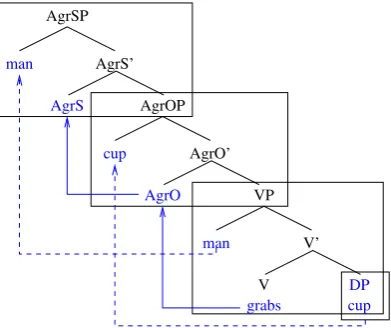
The basic LF structure of the transitive sentenceThe man grabs a cupin the Minimalist model of Chomsky (1995b) is shown in Figure 2. As can be seen, the LF
man AgrSP
AgrS’ AgrOP
AgrO’ VP
V’ V AgrS
AgrO
grabs man
cup
DP cup
Figure 2: Basic LF structure ofThe man grabs a cup, in the Minimalist model of Chomsky (1995b). Each XP (including the complement of VP) is shown in a box. Head-raising oper-ations are shown with solid lines; DP-raising operoper-ations are shown with dashed lines. structure of a clause is strongly complement-branching. I have omitted the internal structure of noun phrases (which I will call ‘determiner phrases’ or ‘DPs’, following Abney, 1987), which introduce some measure of left-branching structure when they appear in specifier positions. But within a DP, Minimalist analyses again envisage a largely complement-branching structure of XPs (see e.g. Abney, 1987; Zamparelli, 2000; Alexiadouet al., 2007). The idea that the LF structure of clauses and DPs is predominantly complement-branching is characteristic of Minimalism.
Syntactic Structures as Descriptions of Sensorimotor Processes 7
A final adaptation of X-bar theory in Minimalism is that X-bar schemas im-pose a fixed temporal order on the surface form of sentences: the specifier of an XP appears to the left of its complement at PF (Kayne, 1994). For this reason I will con-tinue to use the term ‘right-branching’ to describe the predominant complement-recursive structure in LF.
The LF structure shown in Figure 2 is generated through a process called derivation, which involves the step-by-step merging of XPs, interspersed with vari-ous movement operations, latterly reconstrued as Copy operations.2 The key move-ment operations are shown in colour in the figure. During derivation, the inflected verb initially appears at the head of VP, but must raise to the heads of AgrOP and AgrSP in turn to ‘check’ its inflections. The verb’s arguments (a subject and an ob-ject) initially appear at the specifier and complement of V, where they are assigned thematic roles (AGENTandPATIENT), but they must raise to the specifiers of AgrOP and AgrSP respectively, to be assigned ‘Case’ by the heads of these projections. At the end of the derivation, we have an LF structure holding multiple copies of the inflected verb, subject and object at different positions.
For Minimalists, the requirements that inflected verbs ‘check’ their features at higher heads, and that DPs are assigned ‘Case’ at higher specifier positions, are simply formal stipulations, which are mainly justified by the roles they play in the expression of a larger theory of syntax which economically accounts for a sizeable body of linguistic data. My aim in the current paper is to consider what these devices might correspond to in a model of neural mechanisms. But I will briefly outline the theoretical roles they play in the Minimalist model.
The LF structure produced by derivation illustrated in Figure 2 forms the ba-sis for two accounts. One is an account of syntactic variations between languages— in particular of differences in the canonical ordering of constituents (e.g. sub-ject, verb and object). The other is an account of nonlocal syntactic dependencies within a clause within any given language. The account of cross-linguistic differ-ences turns on the idea that PF structures are formed by ‘reading out’ LF struc-tures, with the constraint that only one copy of each moved constituent is pro-nounced. Differences in canonical constituent order between languages are mod-elled as differences in the conventions governing this read-out process: thus speak-ers of English (which has subject-verb-object or SVO order) learn to pronounce the subject ‘high’, and the verb and object ‘low’, while speakers of M¯aori (which has VSO order) learn to pronounce the verb ‘high’. The Minimalist account of nonlocal dependencies explains agreement relationships between apparently distant syn-tactic items by appealing to unpronounced material at LF. For instance, in English, there is agreement between subjects and verbs, even though subjects appear out-side the local domain of the verb at PF. In Minimalism agreement is explained by referring to the structure of LF, in which the verb is present at the head of AgrSP as well as at the head of VP.
2 I will continue to refer to them as movement operations, though I will certainly adopt the
3.3 Prospects for a Sensorimotor Interpretation of Minimalist LF Structures
To summarise the previous section: Minimalist LF structures are formed from in-stances of the X-bar schema (including many functional projections), joined to-gether into predominantly right-branching structures. They contain two kinds of nonlocality: one resulting from movement (copying) of DPs to Case-assigning po-sitions, and one resulting from successive movement (copying) of Vs to feature-checking positions.
Both these properties of LF structures could potentially have interesting parts to play in an account of the relation between sensorimotor processing and syntactic structure. Firstly, LF structures are created from simple building blocks (XPs) com-bined in a simple general way. There are some sensorimotor models which argue that sensorimotor processing is likewise decomposed into simple building blocks, recursively combined to create right-branching structures. I will discuss one of these in Section 4. If any relationship can be found between the building blocks of LF and the building blocks of sensorimotor processing, this would be a very inter-esting discovery. Secondly, there is interinter-esting evidence for multiple occurrences of certain representations during sensorimotor processing (see Section 6.3 for details). For instance, in the process of apprehending an episode in which a man grabs a cup, multiple distinct sensorimotor representations of both the agent (the man) and the patient (the cup) are activated. Perhaps these provide some basis for the Minimalist device of movements occurring during derivation of an LF structure. I will pursue this idea in Section 8.
4 A Proposal about the General Form of Sensorimotor Processing
An interesting proposal about the ‘building blocks’ of sensorimotor processing was made by Dana Ballard and colleagues (Ballardet al., 1997), in the context of a gen-eral model of embodied cognition. In this section I will introduce Ballardet al.’s model.
4.1 Deictic Representations
Syntactic Structures as Descriptions of Sensorimotor Processes 9
Ballardet al.argue that deictic representations play an important role in struc-turing cognitive processing at the embodiment level. For instance, deictic repre-sentations reflecting the current position of the eye can help plan the next saccade: when this is executed, it will generate a new set of deictic representations, so deic-tic representations and saccades are naturally organised into alternating sequences. To take another example, deictic representations play an important role in the or-ganisation of motor actions. When we want to act on a target object, we typically make a saccade to the object first (Land and Furneaux, 1997; Johanssonet al., 2001). This creates deictic representations of the object in visual cortex and in parietal and premotor cortex (Geyeret al., 2000, Murataet al., 2000). Representations in the latter areas encode the object’s motor affordances, and are used to select and eventually control a motor action (see e.g. Cisek and Kalaska, 2010). Note that motor actions are not only initiated by deictic representations—they also bring about new deic-tic representations: for instance, when an agent touches a target object, the tactile sensors of his hand are ‘momentarily deployed’ to the cup (see e.g. Goodwin and Wheat, 2004), in much the same way that saccades momentarily deploy the fovea to a particular point in the visual field.
4.2 Deictic Operations
Ballardet al.’s model is interesting because it identifies commonalities between at-tentional actions (e.g. saccades) and motor actions (e.g. reach movements). Actions of both types are modelled asdeictic operations: cognitive operations which bring about updates in the agent’s physical relationship with the environment, and also in his internal cognitive representations. When talking about deictic operations in general terms, Ballardet al. make use of a notion ofcontext, which includes infor-mation about the agent’s cognitive representations at any given time and also about the physical state of the agent and his environment at that time. To formalise their definition a little: a deictic operation is executed in aninitial context, and results in the establishment of anew context; it also generates areafferent sensory signalas a side-effect. The reafferent signal is a deictic representation which provides sen-sory feedback that the operation actually occurred. For instance, if the operation involves attending to a particular object in the environment, the natural reafferent signal confirming the operation has taken place is a sensory representation of the object. The general form of a deictic operation is shown in Figure 3.
Initial context Deictic operation Reafferent signal New context
C1 O1 S1 C2
Figure 3: General form of a deictic operation
4.3 Deictic Routines
Initial context Deictic operation Reafferent signal New context
C1 attend to cup cup C2
C2 grab C3
Figure 4: A simple deictic routine with two cycles
illustrates the recursive nature of deictic routines: the new context created by the first operationattend to cup(C2) is also the initial context for the second operation grab.
Note that we need to talk about recursion rather than simple iteration. A point which Ballardet al. repeatedly stress is that deictic operations and represen-tations typically cannot be interpreted by themselves: they tend to ‘implicitly refer’ to the operations and representations which preceded them. For instance, the de-ictic operationgrab does not specify a target: the target is specified implicitly by the deictic representation in place at the time whengrabis executed. According to this model, an agent selects the target of a motor action simply by attending to it, and then activating the general motor programme ‘grab’. This motor programme has various free parameters: the location to reach for, the hand shape to form, and so on. The prior action of attention activates deictic representations in motor path-ways which fix the values of these parameters. Thinking of the ‘grab’ programme as a deictic representation accurately reflects the neural mechanisms involved in actually controlling an action. To take another example, the deictic representation cuponly provides partial information about a cup: it specifies its visual properties, but not its location in the world, since it is always centred on the retina, at the fovea. To establish where the fovea is currently directed, we must refer back to the deictic operation which positioned the fovea, namelyattend to cup.
In the general case, to recover the meaning of a deictic representation, we must make reference not just to the immediately preceding deictic operation, but to some sequence of preceding deictic operations. For instance, in order to inter-pret the deictic representations at the end of a grab action, when the agent’s hand is touching the cup (at contextC3in Figure 4) we must refer back to thegraboperation which directly led to these sensations, but interpreting thegraboperation in turn re-quires reference back to the precedingattend to cupoperation, as discussed above. The interpretation of deictic operations and representations is right-recursive: it requires recursive reference to a preceding deictic routine.
In Section 6 I will outline a detailed model of reaching-to-grasp which as-sumes the framework of deictic routines just sketched. But first I will introduce the basic proposal I want to make about the relation between syntax and sensorimotor processing, which is also expressed using the terminology of deictic routines.
5 A Sensorimotor Interpretation of LF Structures and of the X-Bar Schema
Syntactic Structures as Descriptions of Sensorimotor Processes 11
sensorimotor processes are organised into deictic routines, which are composed of deictic operations in a similarly right-branching way. Having introduced a model of syntax and a model of sensorimotor processing, I will now formulate some pro-posals which link these two models. Recall that my propro-posals are only about the syntax of ‘concrete sentences’, which describe episodes that can be directly appre-hended through sensorimotor processing.
I will first make a general proposal linking syntactic structures to deictic rou-tines.
Proposal 1 The LF of a concrete sentence reporting an episodeE pro-vides a description of the deictic routine through which E is experi-enced.
One way of thinking about Propoal 1 is as an expression of the kind of simulation-ist account of sentence meaning advocated by theorsimulation-ists like Gallese and Goldman (1998) and Feldman and Narayanan (2004). In Minimalism, the LF of a sentence represents its meaning—or at least, as much of its meaning as can be encoded syn-tactically. The novel thing about the proposal is that it expresses a simulationist account of meaning in a way which links recursively structured syntactic represen-tations to recursively structured sensorimotor routines. This opens the way for a much stronger statement of the proposal, which links the basicbuilding blocks of LF structures to the basicbuilding blocksof sensorimotor routines. Ultimately, what I want to propose is a general sensorimotor characterisation of the X-bar schema from which LF structures are formed, as follows:
Proposal 2 Each X-bar schema in the LF of a concrete sentence de-scribes a single cycle in the deictic routine described by the LF struc-ture.
More specifically, I want to suggest that each constituent within the X-bar schema has a well-defined sensorimotor interpretation.
Proposal 3 The components of an X-bar schema describe a cycle of a deictic routine, as follows:
• the maximal projection (XP) describes the initial context in which a deictic operation occurs;
• the head (X) describes the operation itself;
• the specifier describes the reafferent signal of the operation; • the complement describes the new context which the operation
brings about. As shown in this figure:
new context XP
Spec X’
X Comp
initial context
reafferent signal
Proposal 2 and its extension Proposal 3 express very strong claims, as they link the basic structural element from which syntactic structures are formed to the basic element from which sensorimotor processes are formed. (Recall we are still restricting our attention to concrete sentences.) One of the attractive aspects of Minimalism is that it envisages simple building blocks for syntactic structures. One of the attractions of Ballardet al.’s model is that it envisages simple building blocks for sensorimotor process (at least at the embodiment timescale). I want to suggest that there is a relationship between the building blocks in each domain.
An important idea implicit in the above proposals is that the right-branching organisation of LF structures mirrors the right-branching structure of deictic rou-tines. A corollary of Proposal 3 is that a right-branching structure of XPs describes a sequence of deictic operations, i.e. a deictic routine. This is illustrated in Figure 5, which shows a right-branching structure of two X-bar schemas, XP and YP. The
C3 XP
X’
X YP
Y’
Y [Comp,YP]
O1
O2 C1
C2
Figure 5: Sensorimotor interpretation of a right-branching structure of two X-bar schemas red labels show some of the sensorimotor interpretations which are sanctioned by Proposal 3. XP describes the initial context (C1) for some deictic operation (O1). The complement of XP describes the new context (C2) brought about by this op-eration. Since YP appears at this position, it also describesC2, which is therefore also the initial context for a second deictic operation (O2), bringing about a third context (C3). Thus by Proposal 3, a right-branching strucure of X-bar schemas de-scribes a deictic routine. (Note that if LF structures are in general right-branching, Proposal 1, that LF structures describe deictic routines, is also a corollary of Proposal 3.)
Because Proposal 3 is expressed in terms of the building blocks of LF struc-tures, it makes very strong and specific predictions about the relationship between syntax and sensorimotor processing foranyconcrete sentence. The proposal pre-dicts that we can take any sentence describing a concrete episode, and find a map-ping of the right kind between the LF of this sentence and the structure of the sen-sorimotor processing through which the described episode is apprehended. Given that the accounts of LF structure and of sensorimotor processing are derived from completely separate data (well-formedness judgements vs data about neural pro-cesses), using completely different methodologies (syntactic argumentation vs ex-perimental neuroscience), finding a mapping of the predicted kind would provide good empirical support for the generalisation expressed in Proposal 3.
Syntactic Structures as Descriptions of Sensorimotor Processes 13
semantic feature checking (see the illustration in Figure 2). If the LF structure of a concrete sentence really does describe sensorimotor processing, we should make several further predictions, namely that these movement operations can also be given sensible sensorimtotor interpretations. In the next three sections I will ex-amine these predictions. In Sections 6 and 7 I will introduce a model of the sen-sorimotor processing required to apprehend a cup-grabbing episode and to store it in working memory. In Section 8 I will examine the relationship between this model and the LF model introduced in Section 3.2, considering both the overall right-branching structure of LF and the re-entrant structures associated with DP movement and head raising.
6 Sensorimotor Processing Involved in Apprehending a Cup-Grabbing Episode
In this section I will argue that the sensorimotor processing through which a cup-grabbing episode is apprehended takes the form of a deictic routine with three cy-cles, with the structure shown in Figure 6. The argument is given in much more detail in Knott (2012); I will just summarise it here.
Initial context Deictic operation Reafferent signal New context
C1 attend man man C2
C2 attend cup cup C3
C3 grab man C4/cup
Figure 6: Deictic routine involved in experiencing a cup-grabbing episode
6.1 Cycle 1: Attention to the Agent
The deictic routine shown in Figure 6 is somewhat more complex than the short routine used for illustrative purposes in Section 4.3. The main reason for this is that it provides an account of the apprehension of a wholeepisode, rather than just of the execution of a motor action. A cup-grabbing episode has an agent, as well as a motor action and a target. I will begin by arguing that whenever an observer apprehends an episode involving an agent through sensorimotor means, the agent must be attended to first.
As a starting point, note that the agent of the grab action—the man—could be someone external to the observer, but could also be the observer himself. In a sentence reporting the observed episode, this difference is reflected in the sen-tence’s subject, and in the verb’s subject agreement features (I grab vs He grabs). Interestingly, apart from these differences, the LF of the sentence is the same in these two scenarios. Proposals 1–3 make a strong prediction from this observa-tion: that the sensorimotor processes through which an agent apprehends his own actions are largely the same as those through which he apprehends the actions of others.
cortex of macaque monkeys which respond to specific grasp movements whether they are initiated by the monkey itself or by an observed third party (di Pellegrino et al., 1992). It has since been corroborated in many other studies finding common representations for observed and executed actions (see Fadigaet al., 2005 for a sum-mary). The hypothesis has been put to work in several ways in neural models of language, in particular in accounts of language evolution trading on the sugges-tion that area F5 is the macaque homologue of Broca’s area (see e.g. Rizzolatti and Arbib, 1998; Arbib, 2005). But the main use I want to make of the hypothesis is in an account of the very first sensorimotor operation an observer must perform when apprehending an episode.
If we accept that agents use assemblies in premotor cortex to represent the ac-tions of others as well as their own acac-tions, this raises the question of how an agent is able to distinguish between his own actions and those of other people. There are several models of how this distinction is made. My model derives mainly from accounts by Haggard (2008) and Farrer and Frith (2002). The basic idea is that the neural circuitry activating action representations in premotor cortex must be configuredfor either action execution or action observation before representations in this area can be interpreted. There is good general evidence that the brain can switch between alternative general modes of connectivity, implemented by distinct large-scale neural networks (see e.g. Bressler and Menon, 2010). I argue that action execution and action observation require the establishment of different modes of connectivity within the mirror system. In ‘execution mode’, premotor representa-tions are activated through a well-studied sensorimotor pathway which maps vi-sual representations onto motor affordances (as discussed in Section 4), and in turn they generate overt motor actions. In ‘perception mode’, premotor representations are activated through a completely different neural pathway through the superior temporal sulcus, specialised for analysing biological movements (see e.g. Jellemaet al., 2000), and a mechanism is in place to prevent these premotor representations re-sulting in overt actions, so that the observer does not reflexively imitate the actions he sees.
The above account can be neatly expressed using the terminology of deictic routines. Action representations in premotor cortex are a variety of deictic repre-sentation: they cannot be interpreted in isolation, because in isolation we do not know whether to attribute them to ourselves or to some external agent. In order to interpret them, we must make reference to a prior mode-setting operation. The mode-setting operation can therefore be modelled as a deictic operation.
Syntactic Structures as Descriptions of Sensorimotor Processes 15
operation establishing perception mode is also plausibly attentional in origin. In the most obvious scenario it is triggered by attention to an external agent in the world, who presents a salient enough stimulus to the observing agent to cause him to engage his action perception circuitry. In this case, the deictic operation required to interpret activity in premotor cortex involves a regular action of visual atten-tionas well asa mode-setting operation. The reafferent side-effect of this attentional action is a representation of the particular external agent who is attended to.
To summarise: when an observer apprehends an episode in which an agent executes an action, he must attend to the agent (generating a representation of the agent as a reafferent side-effect) before activating a representation of the action in premotor cortex. The agent attended to could be the observer himself or it could be an external agent, but in either case we can speak of an action of attention to this agent, resulting in activation of a representation of this agent.
6.2 Cycle 2: Attention to the Target
If the observed action involves reaching for a target object, the observer must also attend to this object before activating a representation of the action. As already noted in Section 4, an agent executing a reach action typically fixates the target ob-ject very early in the reach, probably before a detailed grasp motor programme has been activated (Land and Furneaux, 1997; Johanssonet al., 2001). So if the observer of the action is the agent, there is quite good evidence that the target must be at-tended to before a motor programme is activated. Interestingly if the observer is watching an external agent perform a grasp action, there is also evidence that atten-tion to the target precedes activaatten-tion of a motor representaatten-tion. Observers watching an external agent reach for a target typically saccade to the target well before the agent’s hand reaches it (Flanagan and Johansson, 2003; Webbet al., 2010). They are able to infer the observed agent’s intention, and then put themselves into the same attentional state as the agent while the action is still under way. This establishment of joint attention plays a crucial role in computational models of learning in the mirror system, because it allows agents to use visual representations of their own actions to learn how to recognise the actions of external agents (see e.g. Oztop and Arbib, 2002; Oztopet al., 2005).
To summarise: in a deictic model of the perception of a reach-to-grasp action, two deictic operations must occur before the grasp action itself can be activated. First, the agent of the action must be attended to. This operation is either an action of attention to onesself, if one is executing the action, or an action of attention to an external agent. Second, the target of the action must be attended to. If one is exe-cuting the action, this operation is needed to fix the parameters of the motor action to be executed. If one is watching an external action, the operation is executed in order to establish the same attentional state as the observed agent. In either case, it is only once the agent and patient have both been attended to that a single motor programme can be selected.
6.3 Cycle 3: Action Monitoring and Completion
these compete amongst one another until a winning programme is selected, either as the programme to be executed (see e.g. Fagg and Arbib, 1998) or as the winning hypothesis about the type of action being performed (Oztop and Arbib, 2002).
Once a motor programme has been selected in this fashion, the character of sensorimotor processing changes. In the case of action execution, a physical tion is initiated, which is shaped in real time by the representations currently ac-tive in the agent’s sensorimotor pathways (Cisek and Kalaska, 2010). The agent’s neural pathways, motor effectors and physical environment together implement a dynamical system, which (if all goes well) moves towards an attractor state where the agent is holding the target. In the case of action perception, processing also has the character of a dynamical system, this time a simulated one (see again Oztop and Arbib, 2002; Oztopet al., 2005).
Again it is useful to cast this processing within the framework of deictic rou-tines. Activating the ‘grab’ representation in premotor cortex is an operation which initiates a dynamical system. This operation has its own reafferent sensory conse-quences, and also eventually results in a new context in which new deictic opera-tions are possible. I will consider these two aspects of the operation in turn.
What is the reafferent sensory signal associated with the execution of or ob-servation of an action? When we are in the process of executing an action, we are aware of our body moving: there is a characteristic ‘match’ betwen the pattern of outgoing motor signals and the pattern of incoming sensory signals, because the sensory signals are produced by our motor movements. This match signal appears to be involved in producing the sense of agency that we feel when we perform an action, through which we are able to attribute the action to ourselves (Farrer and Frith, 2002; Farrer et al., 2008). Of course, our conception of self is highly mul-timodal. Different elements of this construct are activated at different stages of action execution. We have already seen that one component of an agent’s concep-tion of self is activated at an early stage during acconcep-tion preparaconcep-tion (Haggard, 2008, Chambonet al., 2012). Another component is activated when an action as actually under way (Farreret al., 2008). (Chambonet al. refer to these two conceptions as ‘propsective’ and ‘retrospective’ concepts of self.) The circuits which control action execution must include some mechanism for binding together these different facets of our concept of self.
A very similar point can be made about action perception. As argued in Section 6.1, an observer initially attends to an external agent as a salient object in the world. But when the observer begins to monitor that agent’s actions, the agent is represented differently, as a characteristic pattern of movement, rather than as a static object. (See Ramsey and Hamilton, 2010 for evidence that action observation involves dissociable representations of the observed agent as a token individual and as an animate entity.) Again, our conception of an observed agent is a multi-modal construct, and different facets of the construct seem to be accessed at differ-ent points during action perception: the action perception mechanism must include a mechanism which integrates these different representations of observed agents.
Syntactic Structures as Descriptions of Sensorimotor Processes 17
mechanism for binding together the different representations of the agent obtained through these two different actions of attention.
I now consider the new context brought about by the grasp motor action: namely the state in which the agent is holding the target object. As already noted in Section 4, this state is well modelled within the framework of deictic routines, because it has both physical and attentional components. Successfully executing a grasp action achieves a substantive physical change in the world: the agent’s hand moves to achieve stable contact with the target. But it also deploys the agent’s tac-tile senses to the target object, providing him with information about the target in a new modality. Just as there are two actions of attention to theagentin the course of apprehending a reach-to-grasp action, there are quite clearly two actions of at-tention to thetarget, again in different modalities, and again occurring at different times. The target is first attended to in the visual modality, as part of the process of preparing the grasp action, and it is later attended to in the haptic modality, when the action is complete. Again, the structure of the sensorimotor routine plays a crit-ical in the formation of a cross-modal representations of the target object. At the point when a stable grasp is achieved on the object, the visual representation of the object axiomatically corresponds to one of its motor affordances (see e.g. Oztopet al., 2004).
At this point, I have motivated the arguments for the deictic routine illus-trated in Figure 6. In the initial contextC1, the observer attends to the agent (who is himself or an external agent), and as a reafferent consequence receives a represen-tation of the agent (man) and establishes a new contextC2. In this context, objects in the agent’s perispace compete for attention, and the observer attends to a cup, activating a representation of the cup as a reafferent consequence, and establishes a third contextC3. In this context, the agent activates the motor programmegrab, and an action is dynamically monitored. While the motor programme is under way, a dynamic representation of the agent is activated as a reafferent consequence, and when the action is complete, we enter a final contextC4, in which a haptic repre-sentation of the cup is active.
rather than with dynamical movements themselves, the additional complexity of action monitoring may not be visible in the sensorimotor signals that interface with language.
7 Working Memory Representations of Sensorimotor Routines
One outstanding question from Section 5 concerns what’s meant by the assertion that an LF representation ‘describes’ a sensorimotor routine. Clearly I do not want to propose that sentences directlyreport sensorimotor processes, as these arise in real time. We can execute sensorimotor routines without engaging language, and we can produce concrete sentences which are unrelated to our current sensorimotor environment. The standard assumption in psycholinguistics is that sentences pro-duced by a speaker reflectrepresentationsof events and states, held in that speaker’s working memory (Levelt, 1989). I certainly want to adhere to that idea. I there-fore need to provide an account of how the cup-grabbing episode is represented in working memory. Ideally, this should be framed within a more general account of episode representations in working memory. Ultimately, I need to re-express the proposals about LF made in Section 5 in a way which connects to an account of working memory episode representations.
In Sections 7.1 and 7.2 I make a suggestion about how concrete episodes are stored in working memory. In Sections 7.3 and 7.4 I discuss how this mechanism interfaces with language, and in the light of this, give a more precise interpretation of LF.
7.1 A Model of Episode Representations in Working Memory
My account of working memory is based on Alan Baddeley’s recent model of ing memory for episodes (Baddeley, 2000). Baddeley suggests that there is a work-ing memory medium called theepisodic buffer, which holds semantic representa-tions of episodes, and which interfaces with the well-knownphonological buffer (Baddeley and Hitch, 1974) in a way which supports language processing.
Baddeley’s main argument for the episodic buffer hinges on the fact that ex-periencing a concrete episode often takes a significant amount of time. (Apprehen-ding an episode involves monitoring it as it occurs; this may take several seconds, often longer.) In order to store the episode in long-term memory, it must be encoded in the hippocampus, as a preliminary to being consolidated in cortical long-term memory (McClellandet al., 1995). But storing associations between representations in the hippocampus can only be achieved through the mechanism of long-term potentiation (LTP), which requires them to be active within about 100ms of each other (Abrahamet al., 2002). Baddeley concludes that experienced episodes must be buffered in a working memory medium, and then replayed to the hippocampus at a speed which allows them to be associated through LTP. Additional evidence for the existence of short-term memory representations of observed episodes is re-viewed in Swallowet al.(2009).
Syntactic Structures as Descriptions of Sensorimotor Processes 19
working memory (see e.g. Shastri, 2001, 2002; Changet al., 2002; Plate, 2003; van der Velde and de Kamps, 2006). I make a new suggestion, which is based on the assumption that concrete episodes are experienced as deictic routines. My sugges-tion is that a concrete episode like the cup-grabbing episode is stored in the episodic buffer as aplanned sequence of sensorimotor operations, i.e. a planned deictic routine (see Takac and Knott, 2013 for an implemented model). This view of working mem-ory episode representations is interesting for several reasons. Firstly, it offers a new solution to the question of how thematic roles are bound to participants in episode representations. Any neural model of episode representation must have a way of identifying the roles played by the different participants in an action (in our case, agent and patient). The deictic routine through which an episode is experienced distinguishes these roles clearly, because they are associated with different serial positions in the routine. Secondly, the neural mechanisms which support the prepa-ration of sensorimotor sequences have been intensively studied, and we know quite a lot about them. If these prepared sequences are examples in a ‘concrete’ domain of working memory episode representations, then studying their properties may help us formulate a more general model of these representations which extends beyond concrete episodes. Thirdly, viewing working memory episode representa-tions as prepared sequences fits well with their role in Baddeley’s model of replay to the hippocampus. The hippocampus is often seen as specialised for storing se-quentially structured information (Wallenstein, 1998; Eichenbaumet al., 2004), and is known to support fast replay of sequences (see e.g. Foster and Wilson, 2006; Diba and Buzs´aki, 2007). If working memory episode representations are prepared sensorimotor sequences, they can be communicated to the hippocampus by being replayed, in simulation, at high speed, in a mode where each of them activates an assembly in the hippocampus. Finally, thinking of working memory episode rep-resentations as supporting simulation accords well with the simulationist accounts of propositional meaning already mentioned (Gallese and Goldman, 1998; Feldman and Narayanan, 2004 and others).
In the remainder of this section I will refine my sensorimotor interpretation of LF in a way which makes reference to the model of working memory for episodes just outlined. The basic idea will be that an LF representation describes a deictic routineas it is replayed from episodic working memory, rather than as it occurs in real time. In Section 7.2 I discuss the mechanics of the working memory replay oper-ation, and make a suggestion about the pattern of sensorimotor signals activated during a replayed sensorimotor routine. In Sections 7.3 and 7.4 I discuss the lin-guistic reflexes of these signals, and give a more precise sensorimotor definition of LF which makes reference to these.
7.2 Sensorimotor Signals Active During a Replayed Sensorimotor Routine
As just mentioned, we know a lot about the neural mechanisms which store pre-pared sequences of sensorimotor operations in working memory. These mecha-nisms are mainly in dorsolateral prefrontal cortex (see e.g. Barone and Joseph, 1989; Averbecket al., 2002; Averbeck and Lee, 2007) and the supplementary motor areas (Shima and Tanji, 2000).
they support the execution of sensorimotor operations in sequence, they actually identify the different prepared operations individually, andin parallel. For instance, within the prefrontal representation encoding the cup-grabbing routine, it is pos-sible to identify assemblies encoding each of the three prepared operations, at-tend man,attend cupandgrab(see especially Averbecket al., 2002). I will make this explicit by designating the prefrontal sequence planplanattend man/attend cup/grab.
There is also evidence that planning representations remain tonically active while the planned sequence is being executed (see Averbeck and Lee, 2007; also the computational models of Rhodeset al., 2004 and Takac and Knott, 2013). When a cup-grabbing episode is replayed from working memory, we therefore generate a mixture of sustained and transient signals to be activated, as shown in Figure 7. The sustained signals are all active in prefrontal areas; the transient ones occur in
Sustained signals Transient signals
Initial Deictic Reafferent New context operation signal context planattend man/attend cup/grab c1 attend man man c2 planattend man/attend cup/grab c2 attend cup cup c3 planattend man/attend cup/grab c3 grab man c4/cup
Figure 7: The time course of signals occurring during the replay of the cup-grabbing episode in working memory
the sensorimotor areas which are active during actual sensorimotor experience, in accordance with simulationist models.
Another important property of the prefrontal sequence-planning mechanism is that it makes use of a representation of ‘the current context’ which is updated af-ter each operation. Executing a planned sequence of operations relies on tonically active representations of the planned operations, but also on a dynamically chang-ing representation of context. There are several different models of these context representations (see e.g. Domineyet al., 1995; Houghton and Hartley, 1995; Beiser and Houk, 1998; Takac and Knott, 2013). I will remain neutral about their exact nature; in Figure 7 I just refer to them asc1–c4.3
7.3 The Interface Between Replayed Sensorimotor Sequences and Language
In Section 7.1 I proposed that an LF representation describes a sensorimotor routine as it is replayed from working memory. Before I consider how this proposal applies to the cup-grabbing sentence, I want to state it as concretely as possible, by provid-ing an explicit proposal about how sensorimotor signals interface with lprovid-inguistic representations at the level of neural circuits.
3 Note that in earlier examples of deictic routines I used capitals to denote contexts (C 1. . .Cn).
These were understood as denoting contexts as represented by a theorist watching an agent: they combine objective information about the agent’s current physical state with information about his current sensorimotor representations. ‘Subjective’ contexts (c1. . .cn) are basically
Syntactic Structures as Descriptions of Sensorimotor Processes 21
I first assume that there is an area of the human brain which encodes motor plans associated with linguistic actions (e.g. planned articulatory actions), which I will call thepremotor output area. This roughly corresponds to what others have called the ‘phonological output buffer’, and have localised in parts of Broca’s area and adjacent areas of prefrontal and articulatory premotor cortex (see e.g. Henson et al., 2000; Sahinet al., 2009).
I further assume that the human brain contains a number of neural circuits specialised for concrete language which I will callinterface circuits, each of which links an area expressing sensorimotor signals to the premotor output area, so that activating sensorimotor signals in these areas can activate arbitrary motor plans (in particular articulatory plans). These circuits can hold learned associations be-tween individual sensorimotor concepts and individual motor movements: they allow the production of atomic symbolic gestures, of the kind posited in Bickerton’s (1995) account of ‘protolanguage’. There may be several interface circuits, linking different classes of sensorimotor signal to the premotor output medium. I assume each of these circuits evolved separately, through an adaptive mutation allowing a particular class of sensorimotor concepts to be associated with overt expressive behaviours.
Now consider what happens when a sensorimotor routine stored in episodic working memory is replayed, and we generate a pattern of sensorimotor signals like the one shown in Figure 7. This will produce a pattern of signals in the pre-motor output area. Importantly, this pattern of output signals need not reflect the pattern of sensorimotor signals in every detail. There may not be an interface circuit for every sensorimotor area. And different circuits may express sensorimotor sig-nals at different levels of detail. Thus when a prepared deictic routine is replayed, the pattern of signals evoked in the premotor output area will reflect the pattern evoked in sensorimotor areas,as filteredby the interface circuits. With this idea in mind, I will state more precisely how I suggest we can interpret the LF of a concrete sentence.
Proposal 4 The LF of a concrete sentence reporting an episodeE pro-vides a description of the pattern of signals activated when the deic-tic routine through which E is experienced is replayed from episodic working memory, including signals activated in the premotor output area.
7.4 The Replay Mechanism as the Basis for an Account of Head Raising
Proposal 4 suggests that LF reflects the structure of replayed sensorimotor routines, but also the properties of the interface circuits linking sensorimotor areas to the linguistic output medium. A key question now is: what are these interface circuits, and what are their properties?
rather, simulated). For instance, in the pattern shown in Figure 7 there is a repre-sentation of the motor operationgrabin the planning medium (where it is tonically active), and another in the ‘deictic operation’ medium (where it is transiently active in Cycle 3). Likewise there are multiple representations ofmanandcup: these fea-ture both as actions of attention and as transient reafferent object representations.
The presence ofsustainedrepresentations of deictic operations in the pattern of activity created by a replayed deictic routine prompts an interesting suggestion about the neural mechanisms underlying the Minimalist account of head raising. Recall from Section 3.2 that an inflected verb generated at the head of VP must raise to the head of AgrOP and then the head of AgrSP, to check its ‘agreement features’. AgrSP and AgrOP are headed by bundles of subject and object agreement features respectively, while VP is headed by the verb. But the verb is allowed to appear at higher head positions, and its agreement features are allowed to appear at lower head positions. The Minimalist account of head-raising allows, indeed requires, heads to appear ‘out of position’: it is through this device that a Minimalist analysis explains the extended syntactic domain of the verb and its agreement features.
If, as I am suggesting, a right-branching LF structure describes a temporal se-quence of deictic operations, and if the head of each XP in an LF structure signals a deictic operation (see Proposal 3), then the principles which sanction head-raising must be interpreted as allowing heads to describe deictic operationsout of sequence. They allow the head of an XP to report not just the deictic operation presently oc-curring, butall deictic operations in the deictic routine currently being rehearsed, including those which have already occurred and those which have yet to occur. A natural way of explaining this is to suggest that the linguistic signals of deictic op-erations come from the area where they are planned, and are therefore tonically ac-tive in parallel during replay, rather than from the areas where they are transiently expressed one by one. I will suggest a further elaboration of the ‘sensorimotor’ interpretation of an XP to this effect:
Proposal 5 The head (X) of an XP in the LF structure of a concrete sen-tence describes a deictic operation in a replayed deictic routine as it is represented in the prefrontal area storing the deictic routine.
Given that the prefrontal area holding prepared deictic routines represents their component deictic operations tonically, and in parallel, it follows from Proposal 5 that all the heads in a right-branching structure of XPs describe the same set of deictic operations.
Syntactic Structures as Descriptions of Sensorimotor Processes 23
sequence is replayed.
Independently of these considerations, there is also good evidence that the processing of verbs and their inflections (the elements involved in head-raising) does indeed involve the dorsolateral prefrontal cortex. Left dorsolateral prefrontal cortex is an area associated with the production and interpretation of verbs (see Peraniet al., 1999; Tranelet al., 2001; Pulverm ¨ulleret al., 1999) and the processing of verb inflections (see Shapiro and Caramazza, 2003; Shapiroet al., 2012).
8 A Sensorimotor Interpretation of the LF of the Cup-Grabbing Sentence
We can now consider how the general proposals just made about the LF struc-ture of concrete sentences apply to our particular cup-grabbing scenario. We have a Minimalist model of the LF of a transitive sentence reporting a cup-grabbing episode (see Figure 2). And we have a model of the pattern of neural signals ac-tivated when the deictic routine through which a cup-grabbing episode is experi-enced is replayed from episodic working memory (see Figure 7). Proposal 4 asserts that the LF of the cup-grabbing sentence can be construed as a description of the pattern of signals activated during replay—i.e. that the LF structure in Figure 2 can be thought of as a description of the pattern shown in Figure 7. Proposal 2 asserts that in addition, each X-bar schema in the LF structure describes one cycle of the replayed deictic routine. And Proposal 3, extended by Proposal 5, suggests roles for each constituent in each X-bar schema. In this section I will examine these as-sertions, and in the process make some further general suggestions about how to interpret the Minimalist account of LF in sensorimotor terms.
8.1 General Alignment of the LF Structure and the Deictic Routine
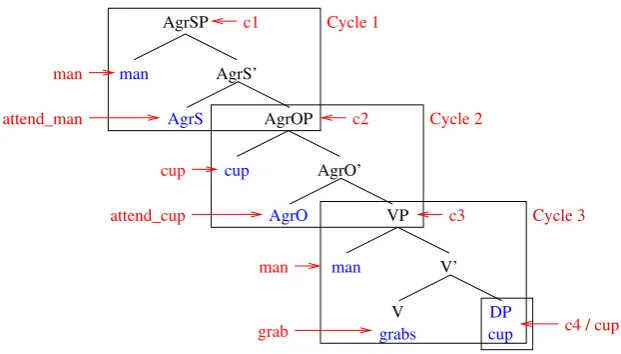
At the level of X-bar schemas, the LF of a transitive cup-grabbing sentence aligns well with the deictic routine it is supposed to represent. The LF structure contains three XPs, and the deictic routine contains three cycles. We can therefore interpret each XP as describing a single cycle of the deictic routine. The predicted sensori-motor interpretations are shown in Figure 8. AgrSP describes Cycle 1 of the routine (an action of attention to the agent), AgrOP describes Cycle 2 (an action of attention to the patient), and VP describes Cycle 3 (execution/monitoring of the ‘grab’ mo-tor programme). According to Proposal 3, each X-bar schema describes a context-update operation: XP describes the context in which a deictic operation is executed and its complement describes the new context which it brings about. This allows us to interpret the right-branching chain of XPs (AgrSP, AgrOP, VP, DP) as describing the four contextsc1–c4in the deictic routine. The general form of the LF structure certainly corresponds well to the general form of the deictic routine.
In Sections 8.2 and 8.3 I will consider the interpretation of specific elements within the LF structure.
8.2 Sensorimotor Interpretations of Argument Positions
man AgrSP
AgrS’
AgrOP
AgrO’
VP
V’
V
AgrS
AgrO
grabs man
cup
DP cup man
c1
c2
c4 / cup man
attend_man
cup
attend_cup
grab
c3 Cycle 1
Cycle 2
Cycle 3
Figure 8: Sensorimotor interpretation of the LF structure of The man grabs a cup. Sensorimotor interpretations are shown in red.
The subjectmanappears at the specifier of AgrSP and the specifier of VP. The object cupappears at the specifier of AgrOP and the complement of VP.
If we assume the alignment of X-bar schemas and deictic routine cycles shown in Figure 8, and the sensorimotor interpretations of specifier and complement po-sitions made in Proposal 3, these popo-sitions correspond exactly to the popo-sitions in the deictic routine where representations of man and cup are active. The speci-fier of AgrSP is predicted to describe the reafferent sensorimotor signalman—and the wordman appears at this position. The specifier of AgrOP is predicted to de-scribe the reafferent sensorimotor signal cup—and the word cup appears at this position. The specifier of VP is predicted to describe the second activation of the signalman, this time as a reafferent signal generated during monitoring of the mo-tor programme—this is the other position where the wordmanappears. So far so good.
The remaining position, the complement of VP is predicted to describe the consequent state of the action, in which the agent is holding the cup. This is the other position where the word cupappears. This position is interesting syntacti-cally, because it is the only place where an argument appears as a complement, rather than as a specifier. Within the sensorimotor model, we can make two predic-tions about it. On one hand, since the wordcupoccupies this position, we predict it will describe the reafferent signalcup. But equally, since it is a complement posi-tion, we predict it to describe the consequent state of the action taking place in the third cycle of the deictic routine, namely thegrabaction.
represen-Syntactic Structures as Descriptions of Sensorimotor Processes 25
tation with the goal motor state.
In summary, the sensorimotor interpretations predicted for all four argument positions by Proposal 3 are quite plausible. In fact one might well go further, and suggest they may provide helpful insights into the Minimalist concepts of ‘speci-fier’ and ‘complement’. Recall that the aim of the paper is to seek a linking theory connecting syntactic constructs to neural mechanisms. Without such a theory, syn-tactic constructs like ‘specifier’ and ‘complement’ are justified purely through the roles they play in a larger theory of syntax. Sensorimotor characterisations of these terms provide a way of thinking about them empirically which is entirely indepen-dent from the role they play in syntax. If the indepenindepen-dent conceptions of ‘specifier’ and ‘complement’ line up with the conceptions motivated from syntactic theory, as they seem to in the cup-grabbing example, this has the character of an empirical result: it suggests that the empirical conceptions may be the basis forthe theoreti-cal conceptions, explaining why these conceptions play a useful role in a theory of syntax.
8.3 Sensorimotor Interpretations of Head Positions: V, AgrS and AgrO
I will next consider the sensorimotor interpretations of head positions which are predicted by Proposal 3. Proposal 3 asserts that the head of an XP denotes a deictic operation: thus the items appearing at V, AgrS and AgrO are predicted to describe the three deictic operations in the deictic routine through which the cup-grabbing episode is apprehended.
The case of V is quite straightforward: the word which appears at this posi-tion (grabs) is easily thought of as describing the third operaposi-tion in the deictic rou-tine, activation of thegrabmotor programme. The more interesting cases are AgrS and AgrO. In Minimalism, these heads hold the ‘agreement features’ of the sub-ject and obsub-ject respectively. Agreement features classify the subsub-ject and obsub-ject into broad semantic categories along various dimensions, principallyPERSON,NUMBER andGENDER, though exactly how categories are defined within these dimensions varies from language to language. The sensorimotor interpretation of LF sees these bundles of agreement features (e.g. 3RD PERSON SINGULAR, MASCULINE) as ‘de-scriptions of attentional operations’. Does this proposal make sense?
To begin with, it should be noted that Agr projections as originally proposed in Minimalism were seen as carrying features with no real semantic content; Agr features were traditionally checkedand then erased, so they were not visible in the LF structure presented to the semantic system. In my interpretation, Agr heads carry as much semantic conent as other heads; they describe sensorimotor operations, just like other heads: so they are certainly used somewhat nonstandardly in my interpretation. In any case, the question to consider is whether it is plausible to think of Agr features as describing attentional operations.
attends to the agent of a cup-grabbing episode is also fundamental in implementing that observer’s ability to distinguish between himself and external agents. Recall that action episodes are represented within the observer’s mirror system. In my account, the circuitry in the mirror system has to be configured for execution of actions or for perception of external actions before signals in the system can be interpreted—and these mode-setting operations must also be construed as atten-tional operations, which direct attention to the agent of the observed episode. So at least with regard to the 1STand 3RD PERSONfeatures of AgrS, it makes perfect sense to think of agreement features as describing attentional operations.
Whether this idea extends to other agreement features, and to AgrO as well as AgrS, is a matter for further work. Certainly there is a plausible attentional basis for the distinction between 1ST and 3RD PERSON at AgrO. The attentional action through which an agent establishes himself as a reach target is very different from that which establishes an external target. There are specialised sensorimotor path-ways controlling actions directed towards the self, and these actions have different dynamics from those directed externally (see e.g. Petreska and Billard, 2009; Ferri et al., 2010). As regards the other PERSON feature, 2ND PERSON, attending to the addressee is substantially different from attending to a third party. When a speaker is producing an utterance, the addressee must already have been established as a focus of attention, so rehearsing an action of attention to the addressee involves a special kind of reattention which could plausibly be linguistically marked. There is also some reason to suppose that the distinction between SINGULARandPLURAL is attentional in origin. For instance, the brain area which most plausibly encodes syntactic plurality, the left temporoparietal junction (Domahset al., 2012) is also ac-tivated by attentional operations parsing a visual stimulus as a group rather than as a single entity (Yamaguchiet al., 2000). A computational model of the attentional origin of the singular-plural distinction is given in Walles (2010).
I will conclude with some comments aboutGENDERfeatures. These features are much more open-ended semantically than PERSON and NUMBER, and much more language dependent (Corbett, 1991). Can these features be thought of as re-flecting aspects of an attentional action? I think this is also plausible. The impor-tant thing to note is that attentional actions like attend man or attend cup involve top-down establishment of open-class object representations as well as saccades to external points in the world. When an observer executesattend cup, he activates a representation of a cup as a search goal, which can be matched against object repre-sentations arriving bottom-up, so there is some way of knowing whether the action is successful (Tomita et al., 1999; Hasegawaet al., 2000; Hamker, 2004). I suggest that while most of the open-class properties of attentional operations are expressed through their reafferent sensory consequences (i.e. through nominal expressions), we can also read someof these properties from representations of the operations themselves, which are signalled by heads. Recall my assumption that there are ‘in-terface circuits’ linking areas evoking sensorimotor signals to a language-specific premotor output area (see Section 7.3). These circuits are allowed to have different capacities. I suggest that the circuit which generates linguistic reflexes of the open-class semantic properties of deictic operations has rather limited capacity, and that GENDERagreement features are generated through this channel.
Syntactic Structures as Descriptions of Sensorimotor Processes 27
head positions AgrS, AgrO and V. The interpretation of V is certainly plausible. The interpretation of the 1STand 3RD PERSONfeatures that appear at AgrS and AgrO is also very plausible, and again seems to provide some insight into the neural basis of these agreement features. But more work is needed to determine whether there are sensorimotor correlates of the other agreement features that can appear at AgrS and AgrO.
8.4 A Sensorimotor Interpretation of V-Raising and Agreement
In Section 7.4 I suggested that the heads of XPs should be understood as describing deictic operations ‘as they are planned’ rather than as they are evoked in sequence. This idea, taken together with known properties of the sequence-planning mech-anism in prefrontal cortex, led to an interesting sensorimotor interpretation of the Minimalist device of head-raising. Now that we have sensorimotor interpretations for the AgrS, AgrO and V heads in the cup-grabbing sentence, it is useful to re-consider this sensorimotor account of head-raising, to see how it applies in this particular case.
Consider the English version of the sentence, The man grabs the cup. In the surface structure of this sentence, the subjectThe manappears outside the VP, and is therefore syntactically somewhat remote from the verb. Any account of syntax has to explain why the verb’s inflection has to agree with the subject, even though the verb is not near the subject. The Minimalist account of head-raising explains this by positing that the inflection-ssignals an agreement feature which actually ‘belongs’ at a position above VP, where itisnear the subject. It is allowed to appear on the verb because at LF the verb ‘covertly moves’ up to the position where it really belongs.
In my proposed sensorimotor interpretation of head-raising, the subject agree-ment inflection on the verb is a signal of properties of the attentional action which established attention on the agent of the cup-grabbing action. (Specifically, it sig-nals that this operation involved configuring the mirror system for action observa-tion rather than acobserva-tion execuobserva-tion.) The reason why the inflecobserva-tion is allowed to ap-pear on the verb is that linguistic reflexes of attentional actions are generated from the region where they are planned, and are therefore tonically active. According to this interpretation, the phenomenon of agreement is seen as reflecting the machin-ery through which episodes are stored in, and replayed from, working memory. The interpretation suggests a specific neural mechanism which accounts for the syntactic phenomenon of subject-verb agreement, as it is accounted for within the Minimalist model.