Please cite this article as: M. Gholami, Islanding Detection Method of Distributed Generation Based on Wavenet, International Journal of Engineering (IJE), IJE TRANSACTIONS B: Applications Vol. 32, No. 2, (February 2019) 242-248
International Journal of Engineering
J o u r n a l H o m e p a g e : w w w . i j e . i rIslanding Detection Method of Distributed Generation Based on Wavenet
M. Gholami*
Department of Electrical Engineering, University of Science and Technology of Mazandaran, Behshahr, Iran
P A P E R I N F O
Paper history: Received 21 October 2018
Received in revised form 30 December 2018 Accepted 03 Januray 2019
Keywords:
Islanding Detection Wavelet Transform Feature Extraction Wavenet
A B S T R A C T
Due to the increasing need to distributed energy resources in power systems, their problems should be studied. One of the main problem of distributed energy resources is unplanned islanding. The unplanned islanding has some dangers to the power systems and the repairman which are works with the incorrect devices. In this paper, a passive local method is proposed. The proposed method is based on wavelet transform and a new classifier named as wavenet. The wavelet transform is used to extract features from the current waveform of current at thepoint of common coupling(PCC) point. PCC is assumed as the connection point of distributed generation to the distribution system. The proposed method is implemented on a 15 bus grid in MATLAB/SIMULINK software. The results show the high accuracy of islanding detection of the proposed method. In this paper, one wind turbine is assumed as a distributed resource.
doi: 10.5829/ije.2019.32.02b.09
1. INTRODUCTION1
Distributed Generation (DG,) is a new source which is used in distribution systems. DGs are connected directly by distribution system operators or indirectly by customers. The DGs usually are connected near the consumer ming centers. The high use of DGs leads to improvement of power quality, improvement of voltage profile, a decrease of losses [1].
In another hand, the reduction of fossil energies and environmental issues forces the countries to use the distributed energy resources (DER) [2]. The main DERs which are used in the world are wind energy, solar energy, fuel cells, and microturbines. The islanding detection of DERs when is connected to a distribution system is a vital problem. The islanding detection methods are divided into four main categories [3] names Remote methods [4, 5], local methods, signal processing methods [6] and intelligent classifiers based methods [7]. Local methods are divided into two subcategories named active [8-16] and passive [17-21]. In passive local methods, the islanding status is detected based on assessing and monitoring of voltage or current waveforms of DG connection point [22]. When the
*Corresponding Author Email: [email protected]. (M. Gholami)
difference between the demand and generation in the distribution system is low, the islanding detection of distribution system with passive methods became difficult. The situation in which the islanding detection methods cannot detect the islanding status correctly is defined as None Detection Zone (NDZ) of each method. The passive methods have big NDZs, so, the researchers suggest the active methods. In active methods, a voluntary disturbance is applied to the network, and the network response is assessed. The active methods have no NDZ, but the methods are so complicated and have undesirable effects on the power quality of the power system. In another hand, the passive methods are so simple and have no effect on the power quality of the network.
A passive method is presented which has been used adaptive identifier method for estimating of the frequency deviation of the point of common coupling (PCC) link as a target signal that can detect the islanding condition with near-zero active power imbalance [23]. Main advantage of the adaptive identifier method over other signal estimation methods is its small sampling window. The utility circuit breaker current has been measured at the grid side, and the islanding condition has
been detected based on a feature extracted from the measured signal before the utility circuit breaker openingc[24]. Discrete wavelet transform has been used to extract the features of the measured current, and then, the artificial neural network has been trained in order to detect the islanding conditions based on the extracted features. A new islanding detection method based on the chaos theory that can detect the islanding condition with near-zero active power mismatch has been introduced [25]. The method has been used the modified frequency of the point of common coupling (PCC) link as an input signal of forced Helmholtz oscillator. The obvious change between chaotic and normal motions in the forced Helmholtz oscillator is its main advantage over other oscillators. TheW-transform and S-transform have been used to extract the negative sequence voltage during an islanding event [26]. The energy content and standard deviation of the S-transform contour has been clearly shown in detecting islanding events and disturbance because of load rejection. The ANNs have been combined with Wavelet, which is capable of decomposing the signals into different frequency bands [27]. The features have been then trained using the ANN model to identify the islanding condition. The approach can detect islanding conditions with a high degree of accuracy and high-quality factor of load performance.
In this paper, a passive method based on wavelet transform and a powerful classifier named as wavenet are presented. The NDZ of the proposed method is small because of using wavelet transform. To show the high capability of wavenet transform in distinction, this classifier is compared with the artificial neural network (ANN) and Decision Tree (DT). The proposed method is suitable for non-converter based generators.
The contributions of the paper are as follows:
Proposing a new combination of algorithms (Wavelet + RELIEF + Wavenet) which can detect the islanding status of the DGs with high accuracy.
Using Wavenet as a classifier for detecting the islanding status of DGs.
The propsoed algorithm has negligible NDZ. This paper is organized as follows. In section 2, the proposed algorithm is introduced. In section 3, the implementation model and the case study are presented. In section 4, the results are shown and finally, in section 5, the conclusion is drawn.
2. PROPOSED METHOD
The proposed algorithm has three phases: i. Feature extraction, ii. Feature selection, and iii. Classification. In this paper, the current waveform of the connection point of DGs to the distribution system (PCC) is used to detect the islanding status of the DG. The wavelet transform is used for feature extraction from the current waveform.
The RELIEF method which is one the famous method in the field of feature selection is used to select the most powerful and effective features. The wavenet classifier is used to classification and detection of the islanding status of DG.
2. 1. Feature Extraction In this paper, the wavelet
transform is used to extract the features from the current waveforms. To extract the useful features, it is needed to have frequency analysis on the transient signals of current waveforms in the connection point. This analysis is carried out by a discrete wavelet transform. One of the main issues in using the wavelet transform is selecting the best mother wavelet. Correct selection of mother wavelet shows some effective features of the waveforms which will be hidden with an incorrect selection of mother wavelets. Another advantage of the wavelet transform is the high flexibility of this tool for frequency analysis.
In this paper, the Daubechies mother wavelet or db is used. This mother wavelet has arbitrary discipline. The non-symmetry waveform and non-explicit function are the main property of the db mother wavelet. In this paper, one of the d mother wavelets named db5 is used to twelve levels. Three features of each detail and approximation waveforms are extracted. The minimum point, maximum point and the mean value of the mentioned waveforms are selected as the extracted features. The total number of extracted features in this paper and based on the proposed method is 72.
2. 2. Feature Selection As it is mentioned before,
in this paper RELIEF is used as a feature selection technique. RELIEF is a statistical method for feature selection. At first, the algorithm randomly finds a sample subset from the database. For each scenario in the selected subset, the nearest hit and nearest miss based on Euclidean metric are calculated. The nearest hit is a scenario which has the lowest Euclidean distance and at the same time has the same class. The nearest miss is a scenario which has the lowest distance and at the same time has the opposite class.
is appropriate for continuous and discrete data. In this paper, 6 of 72 features are selected by RELIEF algorithm. The higher number of features leads to the higher time of classification and in another hand, the lower number of features leads to the lower accuracy of classification. The 6 features are selected by a sensitivity analysis.
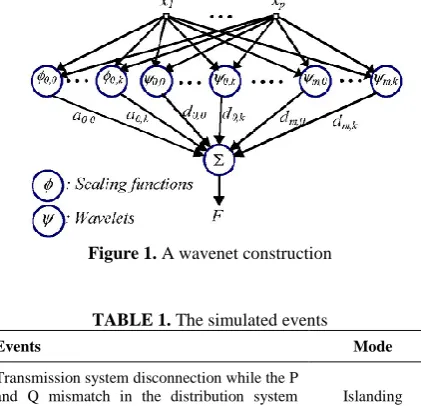
2. 3. Wavenet Figure 1 illustrates a wavenet
construction with p inputs and a single output. This construction is very similar to the radial basis function network. The wavenet construction includes two functions: scaling functions and wavelets. Wavelets are a new family of localized basis functions and they are functions with a combination of powerful features, such as orthonormality, a locality in time and frequency domains, different degrees of smoothness, fast implementations, and in some cases compact support.
2. 4. Proposed Algorithm In this section, the
proposed algorithm is introduced step by step.
First Step: 200 scenarios are simulated by MATLAB/SIMULINK software. Some of these scenarios are classified as islanding mode and other is classified as a non-islanding mode. The simulated events are listed in Table 1.
Second Step: The current waveforms of the point of PCC are saved.
Third Step: The 72 features are extracted from the current waveform by the wavelet transform.
Fourth Step: The 6 selected features are produced by RELIEF algorithm.
Figure 1. A wavenet construction
TABLE 1. The simulated events
Mode Events
Islanding Transmission system disconnection while the P
and Q mismatch in the distribution system between 0 to 30 percent
Non-Islanding Load switching
Non-Islanding Motor switching
Non-Islanding 3 Phase short circuit
Fifth Step: Training the wavenet with the scenarios of the database.
Sixth Step: Testing the trained wavenet by the test database.
3. IMPLEMENTATION ON MATLAB/SIMULINK SOFTWARE
The proposed algorithm is implemented on 15 bus grid and IEEE 37bus test system.
3. 1. 15 Bus Grid The schematic of the 15 bus grid
is shown in Figure 2. This grid is connected to the transmission system with bus 1. It is assumed that there is one wind turbine in the grid.
The 15 bus grid is implemented on SIMULINK. The implemented model is shown in Figure 3.
Some appropriate events should be simulated, to build scenarios for the database. To model the islanding status, some scenarios are simulated. In these scenarios, the difference between the demand and generation in the distribution system is assumed to be low. This assumption makes the islanding detection more difficult because due to the low difference of demand and generation in the distribution system, the transferred power from the transmission system is low. The low transmitted power leads to a little change in the waveform due to the disconnection of the transmission system.
G WT
1 2 3 4 5 6
7
8 9 10
11 12 13 14 15
Figure 2. The 15 bus grid schematic
Figure 3. Schematic of 15 bus grid in
In this paper, the difference between the demand and generation in the distribution system is varied between 0 to 30 percent of the total loads randomly. This percent is selected based on literature [16].
Some events such as load switching, short circuit and motor switching in different buses are simulated for the non-islanding cases. These events make some disturbances in current waveforms. The simulated events are listed in Table 1.
In each simulated scenario, the current waveforms of bus 6 are saved. The wind turbine is connected to the distribution system on bus 6. The simulated grid’s specifications are summarized in Table 2.
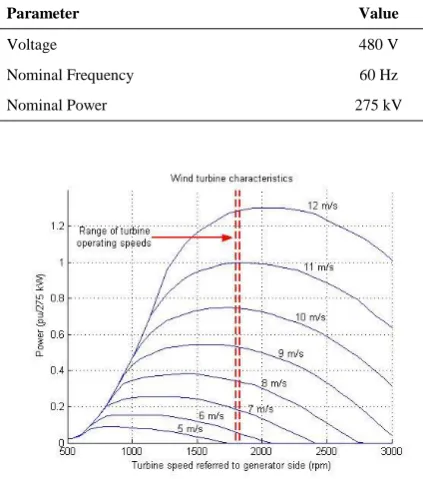
The wind turbine specification is presented in Table 3. The wind turbine characteristic curve is shown in Figure 4. The grid lines parameters are listed in Table 4.
3. 2. IEEE 37 Bus In the second case study, the IEEE
37 Bus [24] is selected. The IEEE 37 Bus schematic is shown in Figure 5. More penetration is selected in this case study. In this grid some modifications are considered in the standard form of the network. For example it is considered that there are 4 WTs which are connected to buses 741, 710, 729 and 724.
TABLE 2. 15 bus grid specification
Value Parameter
480 V Voltage
60 Hz Frequency
TABLE 3. Wind turbine specification
Value Parameter
480 V Voltage
60 Hz Nominal Frequency
275 kV Nominal Power
Figure 4. Wind turbine characteristic curve
TABLE 4. Lines Parameters
X (Ohm) R (Ohm)
To From Line No.
42.54 2.4
2 1
1
34.1 5.07
11 1
2
25.81 1.45
3 2
3
26.81 2.3
12 2
4
0.33 0.02
4 3
5
6.97 1.3
7 3
6
26.29 4.53
13 3
7
6.55 0.57
5 4
8
57.72 3.84
14 4
9
13.56 0.9
6 5
10
26.7 4.6
15 5
11
28.86 1.92
8 7
12
53.89 3.04
9 8
13
42.63 6.34
10 9
14
Figure 5. The IEEE 37 Bus schematic
The scenarios for islanding and non-islanding situations conditions are generated using monte carlo similation and based on Table 1.
4. SIMULATION RESULTS
At the first step some discucsision are presented for the changes in the current and voltage waveforms of PCC based on specifiec changes. These discussion are about 15 bus test systems.
In Figure 6 the PCC current waveform in islanding status with 30% mismatch is shown, while in Figure 7 the mismatch is 5%. The transmission system connection is a loss in 2.0 second.
In Figure 8, the PCC current waveform in load switching case and in Figure 9, the 3 phase short circuit cases are shown. The short circuit is occurred in the second 2 and is removed in 2.05.
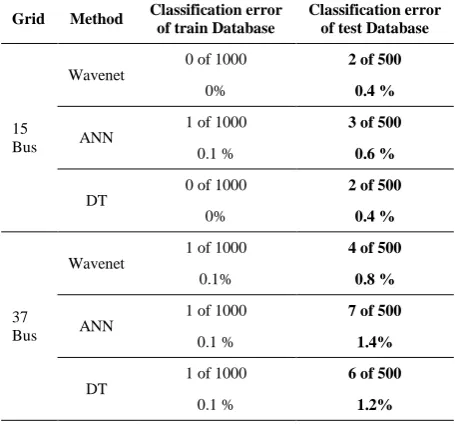
The classification error of the wavenet is shown in Table 5. The classification errors of the wavenet for the train and test database are shown in Table 5. The classification errors of ANN and DT are shown in Table 5.
As it is shown in Table 5, the wavenet can classify the islanding detection of the case study with negligible error. The classification error shows the accuracy of wavenet transform in comparison to the ANN and DT.
Figure 6. The PCC current waveform in 30% mismatch
Figure 7. The PCC current waveform in 5% mismatch
Figure 8. The PCC current waveform in load switching
Figure 9. The PCC current waveform in short circuit
TABLE 5. Classification error of wavenet and ANN and DT
Classification error of test Database Classification error
of train Database Method
Grid
2 of 500
0 of 1000 Wavenet
15 Bus
0.4 %
0%
3 of 500
1 of 1000 ANN
0.6 %
0.1 %
2 of 500
0 of 1000 DT
0.4 %
0%
4 of 500
1 of 1000 Wavenet
37 Bus
0.8 %
0.1%
7 of 500
1 of 1000 ANN
1.4%
0.1 %
6 of 500
1 of 1000 DT
1.2%
0.1 %
5. CONCLUSION
In this paper, a novel passive local method for islanding detection of distributed generation is presented. In the proposed method, for the first time wavelet transform, RELIEF algorithm and wavenet classifier are used. The proposed method has negligible NDZ. Due to the implementation result, the classification error is negligible (0.4% in 15 bus and 0.8% in IEEE 37 bus) in the presented test cases.
MATLAB software is used to implement the proposed method. 15 bus case study and IEEE 37 bus are selected. The wavenet classifier is compared to the ANN and DT.
6. REFERENCES
2. Ashtiani, N.A., Gholami, M. and Gharehpetian, G., "Optimal allocation of energy storage systems in connected microgrid to minimize the energy cost", in Electrical Power Distribution Networks (EPDC), 2014 19th Conference on, IEEE, (2014), 25-28.
3. Khamis, A., Shareef, H., Bizkevelci, E. and Khatib, T., "A review of islanding detection techniques for renewable distributed generation systems", Renewable and Sustainable Energy Reviews, Vol. 28, (2013), 483-493.
4. Redfern, M., Usta, O. and Fielding, G., "Protection against loss of utility grid supply for a dispersed storage and generation unit",
IEEE Transactions on Power Delivery, Vol. 8, No. 3, (1993), 948-954.
5. Xu, W., Mauch, K. and Martel, S., "An assessment of dg islanding detection methods and issues for canada, report# cetc-varennes 2004-074 (tr), canmet energy technology centre–varennes",
Natural Resources Canada, (2004).
6. Karegar, H.K. and Sobhani, B., "Wavelet transform method for islanding detection of wind turbines", Renewable Energy, Vol. 38, No. 1, (2012), 94-106.
7. Pham, J.-P., Denboer, N., Lidula, N ,.Perera, N. and Rajapakse, A., "Hardware implementation of an islanding detection approach based on current and voltage transients", in Electrical Power and Energy Conference (EPEC), IEEE. (2011), 152-157.
8. Hung, G.-K., Chang ,C.-C. and Chen, C.-L., "Automatic phase-shift method for islanding detection of grid-connected photovoltaic inverters", IEEE Transactions on Energy Conversion, Vol. 18, No. 1, (2003), 169-173.
9. Zeineldin, H. and Kennedy, S., "Sandia frequency-shift parameter selection to eliminate nondetection zones", IEEE Transactions on Power Delivery, Vol. 24, No. 1, (2009), 486-487.
10. Zeineldin, H. and Conti, S., "Sandia frequency shift parameter selection for multi-inverter systems to eliminate non-detection zone", IET Renewable Power Generation, Vol. 5, No. 2, (2011), 175-183.
11. Zeineldin, H.H. and Salama, M.M., "Impact of load frequency dependence on the ndz and performance of the sfs islanding detection method", IEEE Transactions on Industrial Electronics, Vol. 58, No. 1, (2011), 139-146.
12. Lopes, L.A. and Sun, H., "Performance assessment of active frequency drifting islanding detection methods", IEEE Transactions on Energy Conversion, Vol. 21, No. 1, (2006), 171-180.
13. Du, P., Ye, Z., Aponte, E.E ,.Nelson, J.K. and Fan, L., "Positive-feedback-based active anti-islanding schemes for inverter-based distributed generators: Basic principle, design guideline and performance analysis", IEEE Transactions on Power Electronics, Vol. 25, No. 12, (2010), 2941-2948.
14. Yafaoui, A., Wu, B. and Kouro, S., "Improved active frequency drift anti-islanding detection method for grid connected photovoltaic systems", IEEE Transactions on Power Electronics, Vol. 27, No. 5, (2012), 2367-2375.
15. Karimi, H., Yazdani ,A. and Iravani, R., "Negative-sequence current injection for fast islanding detection of a distributed resource unit", IEEE Transactions on Power Electronics, Vol. 23, No. 1, (2008), 298-307.
16. Ropp, M.E., Begovic, M., Rohatgi, A., Kern, G.A., Bonn ,R. and Gonzalez, S., "Determining the relative effectiveness of islanding detection methods using phase criteria and nondetection zones",
IEEE Transactions on Energy Conversion, Vol. 15, No. 3, (2000), 290-296.
17. Funabashi, T., Koyanagi, K. and Yokoyama, R., "A review of islanding detection methods for distributed resources", in Power Tech Conference Proceedings, 2003 IEEE Bologna, IEEE. Vol. 2, (2003) 6. doi: 10.1109/PTC.2003.1304617
18. Jang, S.-I. and Kim, K.-H., "An islanding detection method for distributed generations using voltage unbalance and total harmonic distortion of current", IEEE Transactions on Power Delivery, Vol. 19, No. 2, (2004), 745-752.
19. Freitas, W., Huang, Z. and Xu, W., "A practical method for assessing the effectiveness of vector surge relays for distributed generation applications", IEEE Transactions on Power Delivery, Vol. 20, No. 1, (2005), 57-63.
20. Hagh, M.T. and Ghadimi, N., "Radial basis neural network based islanding detection in distributed generation", International Journal of Engineering, Transactions A: Basics, Vol. 27, No. 7, (2013), 1061-1070.
21. Zeineldin, H. and Kirtley, J.L., "Performance of the OVP/UVP and OFP/UFP method with voltage and frequency dependent loads", IEEE (2009). http://hdl.handle.net/1721.1/73162 22. Bae, B.-Y., Jeong, J .- K., Lee, J.-H. and Han, B.-M., "Islanding
detection method for inverter-based distributed generation systems using a signal cross-correlation scheme", Journal of Power Electronics, Vol. 10, No. 6, (2010), 762-768.
23. Bakhshi, M., Noroozian, R. and Gharehpetian, G., "Islanding detection scheme based on adaptive identifier signal estimation method", ISA Transactions, Vol. 71, (2017), 328-340. 24. Vatani, M., Sanjari, M.J. and Gharehpetian, G.B., "Islanding
detection in multiple‐dg microgrid by utility side current measurement", International Transactions on Electrical Energy Systems, Vol. 25, No. 9, (2015), 1905-1922.
25. Bakhshi, M., Noroozian, R. and Gharehpetian, G.B., "Novel islanding detection method for multiple dgs based on forced helmholtz oscillator", IEEE Transactions on Smart Grid, Vol. 9, No. 6, (2017), 6448 - 6460.
26. Ray, P.K., Mohanty, S.R. and Kishor, N., "Disturbance detection in grid-connected distributed generation system using wavelet and s-transform", Electric Power Systems Research, Vol. 8, No. 3, (2011), 805-819.
RESEARCH NOTE
Islanding Detection Method of Distributed Generation Based on
Wavenet
M. Gholami
Department of Electrical Engineering, University of Science and Technology of Mazandaran, Behshahr, Iran
P A P E R I N F O
Paper history: Paper history: Received 21 October 2018
Received in revised form 30 December 2018 Accepted 03 Januray 2019
Keywords: Islanding Detection Wavelet Transform Feature Extraction Wavenet هدیکچ
ازفا هب هجوت اب ی
ش لوت عبانم زا هدافتسا نوزفازور ی
د هکبش رد هدنکارپ اه ی م ،تردق ی اب ی تس ی دروم نآ هب طوبرم تلاکشم
ب هجوت ی رتش گب رارق ی دنر . ی ک ی لصا تلاکشم زا ی زج ی هر ا ی همانرب ندش ر ی ز ی ارب هک تسا هدشن ی
س ی متس نچمه و تردق ی ن ارب ی دارفا ی ا اب هک ی ن س ی متس م راک ی ،دننک رطخ ا ی داج م ی دنک مه هب و ی ن هعلاطم دروم رطاخ ی سب ی را ی ققحم زا ی ن هتفرگ رارق
ا رد .تسا ی ن هلاقم ی ک لحم شور ی غ عون زا ی لاعفر اپرب هدش هئارا شور .تسا هدش هئارا ی
ه دبت ی ل هسلاک و کجوم دنب ی دج ی د ی بصع هکبش مان هب ی
کجوم ی ( Wavenet ا .تسا ) ی ن ور رب شور ی ی ک هکبش ی 15 هساب رد مرن رازفا MATLAB/SIMULINK پ ی هدا زاس ی اتن .تسا هدش ی
ج اب تسا رداق هدش هئارا شور هک تسا هداد ناشن هدمآ تسدب
سب تقد ی را لااب یی زج ی هر ا ی لوت عبنم ندش ی
د خشت ار هدنکارپ ی
ص ا رد .دهد ی ن بروت زا هلاقم ی ن داب ی ناونع هب ی ک لوت عبنم ی د
سا هدش هدافتسا هدنکارپ .ت