Modern Journal of Language Teaching Methods
(MJLTM)
ISSN: 2251 - 6204
www.mjltm.com
Editor – in – Chief
Hamed Ghaemi, Islamic Azad University, Iran
Editorial Board
Abednia Arman
, PhD in TEFL,
Allameh Tabataba’i University,
Tehran, Iran
Azizi Masoud
, PhD in Applied
Linguisitcs, University of Tehran,
Iran
Basiroo Reza
, PhD in TEFL,
University of Tehran, International
Campus, Iran
Elahi Shirvan Majid
, PhD in
TEFL, Ferdowsi University of
Mashhad, Iran
Fernández Miguel
, PhD, Chicago
State University, USA
Ghaemi Hamide
, M.A. in Speech
and Language Pathology, Mashhad
University of Medical Sciences,
Iran
Grim Frédérique
M. A., Associate
Professor of French, Colorado State
University, USA
Izadi Dariush,
PhD candidate in
Applied Linguistics, Macquarie
University, Sydney, Australia
Kargozari Hamid Reza
, PhD
Candidate in TEFL, Payame Noor
University of Tehran, Iran
Kaviani Amir
, Assistant Professor
at Zayed University, UAE
Kirkpatrick Robert
, Assistant
Professor of Applied Linguistics,
Shinawatra
International
University, Thailand
Morady Moghaddam Mostafa,
PhD
Candidate
in
TEFL,
University of Tabriz, Iran
Ndhlovu Finex,
PhD, Linguistics
Programme, University of New
England, Australia
Raddaoui
Ali Hechemi,
PhD,
Associate Professor of Applied
Linguistics,
University
of
Wyoming in Laramie, USA
Rezaei Saeed
, PhD in TEFL,
Sharif University of Technology,
Tehran, Iran
Rolstad Kellie,
PhD, Associate
Professor of Education, University
of Maryland, USA
Shahbazirad Mohammad
, PhD
in English language and Literature,
Yerevan State University, Armenia
Weir George R. S.,
PhD in
Philosophy
of
Psychology,
University of Strathclyde, Glasgow,
UK
Zegarac
Vladimir
,
PhD,
University of Bedfordshire, UK
Vol. 4, Issue 1, March 2014
P
age
4
Abstracting/Indexing
Index Copernicus 2011
Linguistics Abstract
EBSCO Publication
Lulu Publication
Vol. 4, Issue 1, March 2014
P
age
5
Directory of Open Access Journals
Pro - Quest
Modern Language Association
Cabell's Directory
Vol. 4, Issue 1, March 2014
P
age
6
COPE
Directory Of Research Journal Indexing(DRJI)
Indian Citation Index
International Society of Universal Research in
Sciences
Vol. 4, Issue 1, March 2014
P
age
7
J-Gate
JournalSeek
Ulrich's
Education Full Text (H.W. Wilson)
Vol. 4, Issue 1, March 2014
P
age
8
SHERP RoMEO
Electronic Journals Library
Vol. 4, Issue 1, March 2014
P
age
9
TABLE OF CONTENTS
THE WORLD WIDE WEB AND THE REPRESENTATION OF CULTURE WITHIN THE ELT CONTEXT
Maryam Sharif and Mostafa Zamanian………...11 WORD-FORMATION: A SYSTEMATIC WAY TO ENRICH WORD POWER OF MEDICAL STUDENTS
Akbar Solati………. 20 EXPLICITATION IN SUBTITLING AND DUBBING: A CASE STUDY OF TWO HARRY
POTTER’S MOVIES
Marzieh Bagheri, Azadeh Nemati and Jamal Abdolrahimzade………...34 THE EFFECT OF PROVIDING BACKGROUND KNOWLEDGE AND PREVIEWING
QUESTIONS ON IMPROVING LISTENING COMPREHENSION OF EFL LEARNERS
Mohamad Sadegh Bagheriand Mohamad Mahdi Bahadori……….. 47 COMPUTER ASSISTED LANGUAGE LEARNING IN ELT CONTEXTS
Ghasem Barani……… 57 THE RELATIONSHIP BETWEEN IRANIAN EFL LEARNERS’ LEARNING STYLE PREFERENCES AND THEIR READING COMPREHENSION ABILITY
Giti Mousapour Negari and Ezzat Barghi ………..67 A SURVEY OF THE APPROACHES EMPLOYED IN TEACHING LITERATURE IN AN EFL CONTEXT
Hoda Divsar ………74 THE EFFECT OF USING PICTOGLOSS ON IRANIAN EFL LEARNERS' READING
COMPREHENSION ABILITY
Azra Khoshkar and Ali Asghar Eshagh Nimvari………..….. 86 MODELS OF INDIVIDUAL DIFFERENCES IN SLA AND THE ROLE OF INTELLIGENCE
Abdorreza Tahriri, Maryam Danaye Tous and Amin Majouri ……….….104 TOWARDS THE INCORPORATION OF CRITICAL PEDAGOGY IN ELT MATERIALS
DEVELOPMENT: A SURVEY ON THE IRANIAN TEACHERS AND UNIVERSITY PROFESSORS’ ATITUDES
Hamideh Marzban and Mostafa Zamanian ………..114 THE EFFECT OF GROUP WORK INSTRUCTION ON WH-QUESTION MAKING
Azadeh Nemati and Jamileh Deltalab ………. 133 THE EFFECT OF LEXICAL FREQUENCY KNOWLEDGE ON IRANIAN EFL LEARNERS’
SPEAKING ABILITY
Masoumeh Shahrestanifar and Ramin Rahimy ………146 THE RELATIONSHIP BETWEEN STUDENT' LEARNING STYLES AND THEIR LANGUAGE LEARNING STRATEGIES
Shiva Farajolahi and Ali Asghar Eshagh Nimvari ………...157 THE RELATIONSHIP BETWEEN MULTIPLE INTELLIGENCES, LEARNING STYLES AND GENDER
Zahra Ahanbor and Firooz Sadighi ………. 176 EMP STUDENTS’ USE OF READING STRATEGIES AND THE IMPACT OF STRATEGY
INSTRUCTION ON MEDICAL TEXT COMPREHENSION
Maryam khoshbouei Jahromi ……….185
Vol. 4, Issue 1, March 2014
P
age
10
A SOCIOLINGUISTIC STUDY OF GENDER DIFFERENCES IN PERSIAN WRITTEN PERFORMANCE
Yahya Keikhai and Javad Shirvani ……….. 209 DYNAMIC AND FORMAL EQUIVALENCE IN PERSIAN TRANSLATION OF ENGLISH
IMPERATIVES IN MOVEI SCRIPTS
Elham Moghtadi and Gaffar Tajalli ………228 DEVELOPMENT AND VALIDATION OF MATERIALS FOR ISOLATED FORM-FOCUSED INSTRUCTION
Jessie S. Barrot ………267 A NEEDS ANALYSIS STUDY FOR THE ENGLISH CURRICULUM AT THE TEACHING STAFF TRAINING PROGRAM IN A TURKISH UNIVERSITY
Abdullah Arslan and Abdullah Coşkun……….. 283 THAT-CLAUSES IN NATIVE AND NONNATIVE ACADEMIC WRITING
Abdurrahman Kilimci……… 301 THE EFFECT OF READING-BASED WORD-GENERATION TECHNIQUES ON WRITING PROFICIENCY OF IRANIAN INTERMEDIATE EFL LEARNERS
Mostafa Zamaniyan and Zahra Asvad ………..318 THE IMPACT OF PORTFOLIO WRITING ON IRANIAN EFL LEARNERS' AUTONOMY
Zahra Jafari and Hamid Gholami………. 328 ON THE VALIDITY OF IELTS WRITING COMPONENT; DO RATERS ASSESS WHAT THEY ARE SUPPOSED TO?
Masoud Azizi and Khadijeh Majdeddin………337 THE IMPACT OF SELF-ASSESSMENT ON SELF-REGULATION AND CRITICAL THINKING OF EFL LEARNERS
Parvaneh Kahrizi, Majid Farahian and Seifodin Rajabi……… 353 A READER-RESPONSE APPROACH TO READING: DOES IT HAVE AN EFFECT ON
METACOGNITIVE READING STRATEGIES?
Majid Farahian and Majid Farshid ………371 L'EFFET DU RÉSUMÉ DE TEXTE SUR L'APPRENTISSAGE DE LA LECTURE
Farzaneh Bagheri and Maryame Soudipour ………...384
Vol. 4, Issue 1, March 2014
P
age
11
THE WORLD WIDE WEB AND THE
REPRESENTATION OF CULTURE WITHIN THE ELT
CONTEXT
Maryam Sharif Mostafa Zamanian
Department of Foreign Languages, Shiraz Branch, Islamic Azad University, Shiraz, Iran
ABSTRACT
Today, the Internet has proven to be quite useful in language programs, and English has established itself as the unifying language of the World Wide Web. Since culture is considered as the integral part of the language instruction, the cultural content of ELT materials needs to be selected with extreme caution. Therefore, the present study is an attempt to put the cultural content of the online ELT materials under close scrutiny in order to verify the degree to which culture has been represented appropriately. To this end, 60 web pages on four websites presenting online reading materials were selected from among myriads of websites designed for EFL/ESL students around the world, and a content analysis of the reading materials was carried out following Aliakbari's (2004) model along with Ramirez and Hall’s (1990) categorization. The results of the analysis revealed that there seems to be an inclination towards the culture of the Inner Circle countries in the reading materials in question, and that the ‘religion, arts, and humanities’ sphere has dominated other cultural themes. Hence, the representation of culture on the Web needs to be reexamined if English language is aimed to be used as a means of intercultural communication in the era of globalization.
KEY WORDS: culture, globalization, content analysis, ELT websites, online reading materials
1. Introduction
The close interrelation between language and culture cannot be denied. In fact, language and culture can be regarded as the two sides of a coin (Rashidi & Najafi, 2010). “Culture thus shapes and is shaped by language” (Kulkarni, Rajeshwarkar, & Dixit, 2012, p.15).
Due to the unquestionable significance of culture in language programs, attempts have been made throughout the years to inject culture into language lessons. However, the integration of culture into language programs is by no means easy (Sharif & Yarmohammadi, 2013), and “prior to the injection of culture into the language classroom, sound decisions must be made regarding the cultural content of language materials and the manner culture is going to be presented” (Sharif & Yarmohammadi, 2013, p. 13452).
Vol. 4, Issue 1, March 2014
P
age
12
Crotazzi and Jin (1999), as cited in McKay (2003), have distinguished between three types of cultural content that can be specified in language materials: source culture which draws upon the learner’s home culture, target culture that focuses on the culture of Inner Circle countries whose first language is English, and international culture which relies on the culture of different countries around the globe. Aliakbari (2004) speaks of another type of cultural content which he refers to as neutral with little or no interest in culture; materials discussing science, history, geography, morphology, etymology, grammatical features, etc. are culturally neutral (Ur, 1996).
As McKay (2003) puts it, the question of which cultural content to present in language materials has induced a large body of research, investigating the cultural content of ELT textbooks at secondary, institutional, and even tertiary levels (see Aliakbari, 2004; Khajavi & Abbasian, 2011; Rashidi & Najafi, 2010; Ziaei, 2012; Juan, 2010; and Sharif & Yarmohammadi, 2013).
Before the invention of the computer, the cultural content of ELT materials could be considered “one of the best recourses for introducing culture knowledge” (Juan, 2010, p. 138). Nowadays, with the advent of the computer and the Internet, the World Wide Web has become a reliable source for the online presentation of ELT materials. In essence, “…textbook writers and publishers, in order to appear more innovative and flexible, have embraced technology and adapted materials and methods accordingly, including CD’s, DVD’s, downloadable content and media as well as extensive web support for teachers and students” (Reimann, 2009, p. 86).
Studies analyzing the cultural content of ELT textbooks abound, yet published studies investigating the cultural content of online ESL/EFL materials are scarce. This paucity aroused the researchers in this study to probe into the nature of the cultural content of ELT materials which appear on the World Wide Web in order to find out whose culture is being represented on the Web and what cultural themes/topics have been introduced. Therefore, this study strives to seek answers to the following research questions:
1. Whose culture is being represented on EFL/ESL websites and to what extent?
2. What cultural themes and topics are presented on EFL/ESL websites? 3. Are these ELT websites a congruent and effective medium for instructing the target and international cultures at the era of globalization and, at the same time, revering learners’ national identity and home culture?
2. The World Wide Web and ELT Materials
Thanks to the widespread use of the Internet today, e-learning and online instruction have been facilitated. This process has especially been fostered with the advent of the World Wide Web, a system of hypertext documents for accessing and viewing online information (Richards & Renandya, 2002). As a matter of fact, the World Wide Web, which developed in the mid 1990s, is “an international on-line database that allows the sharing of linked multimedia documents” (Carter & Nunan, 2001, p. 208).
“The ease with which Web documents can be created, as well as their worldwide accessibility, multimedia capabilities, and interactive functions, make the
Vol. 4, Issue 1, March 2014
P
age
13
Web an attractive environment for carrying on computer-based instruction” (Richards & Renandya, 2002, p. 374). The numerous advantages of the Web in the instruction of a second language have also been reported in the literature. According to Harmer (2001), “almost any website has potential for students of English” (p. 148) e.g., L2 learners of English can read authentic materials on different topics in English while surfing the net; they have also shown a growing interest in the use of social networks like facebook and twitter by means of which they can improve their communicative ability; students are also able to individualize their practices and can progress at their own pace using the Web. In addition to the websites which provide information in different areas of specialty through the medium of English, there have been a plethora of websites designed especially having language learners in mind, and there are also myriads of websites for ESL/EFL teachers. A number of researchers consider the Web as “an extension of an L2 culture or society” (Carter & Nunan, 2001, p. 208). That is to say, all these websites have the potential to mirror the culture of the society in question (Kulkarni et al., 2012).
The literature has already documented the investigation of the cultural content of the Web by different scholars (Kulkarni et al., 2012). However, these websites have focused, for the most part, on the impact of culture on web design and marketing strategies (see Würtz, 2005; Ali & Lee, 2011), and the investigation of culture as represented on ELT websites has been neglected. Therefore, this study aims at conducting a cultural content analysis on ESL/EFL websites to investigate how culture is represented on the Web.
3. Method
3. 1. Materials/Websites
For the present study, the cultural content of 60 ELT web pages designed for adult language learners was put under investigation. In fact, the corpus for this study was selected from among a total of 30 ELT websites with reading sections published from 1998 to date. Out of this corpus, the following 4 websites whose reading materials had been graded were analyzed:
1. http://easyworldofenglish.com/readings/readings.aspx?c=2f1db 2. http://web2.uvcs.uvic.ca/courses/elc/studyzone
3. http://www.newsinlevels.com/level-2/simpleenglishnews
4. http://www.breakingnewsenglish.com/english-news-readings.html
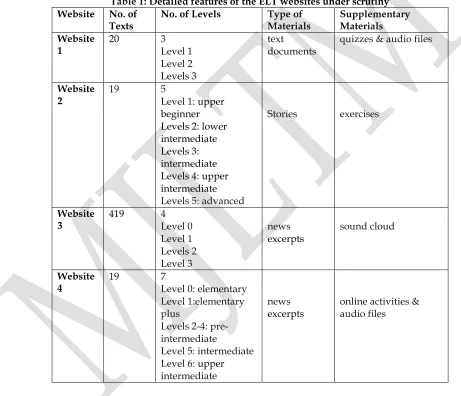
The websites, called website 1, website 2, website 3, and website 4 hereafter for the ease of discussion, were presenting their materials in 3, 5, 3, and 7 levels of language proficiency respectively (see Table 1 for more details). To keep consistency, only the intermediate level was analyzed due to the fact that “intermediate-level learners seem to be the audience who can profit most immediately from the web-based courseware. Beginners need the carefully graded and structured material already provided by textbooks and may find it difficult to use the Web at all, because their English is too limited to cope with the operating instructions of the browser programs. Nor is there a pressing need to develop special materials for advanced ESL learners because one can easily find many Web documents that are interesting and appropriate” (Richards & Renandya, 2002, pp. 374-375).
Vol. 4, Issue 1, March 2014
P
age
14
The websites included 20, 19, 419, and 19 lessons respectively. For the sake of consistency, the first 15 passages on each website were analyzed. It must be noted that the intermediate level on website 2 contained merely 5 passages; thus, in order to select the 15 texts required, the lower and upper intermediate levels were also taken into consideration for analysis. Likewise, the reading materials on website 3 had been arranged in 6 categories; to select passages from all categories, the first passage from each category was selected, followed by the second passage from each category, followed by the third passage until number 15 was served.
Table 1: Detailed features of the ELT websites under scrutiny Website No. of
Texts No. of Levels Type of Materials Supplementary Materials
Website
1 20 3 Level 1
Level 2 Levels 3
text documents
quizzes & audio files
Website
2 19 5 Level 1: upper beginner Levels 2: lower intermediate Levels 3: intermediate Levels 4: upper intermediate Levels 5: advanced
Stories exercises
Website
3 419 4 Level 0 Level 1 Levels 2 Level 3
news excerpts
sound cloud
Website
4 19 7 Level 0: elementary Level 1:elementary plus
Levels 2-4: pre-intermediate
Level 5: intermediate Level 6: upper intermediate
news excerpts
online activities & audio files
3. 2. Model of Analysis
The reading passages on the selected websites were analyzed based on Aliakbari’s (2004) model of analysis which is a modification of Ramirez and Hall’s (1990) model. In his model, Aliakbari (2004) has specified 8 categories to represent
Vol. 4, Issue 1, March 2014
P
age
15
cultural references including reference to English speaking countries (H), reference to Western countries whose official language is not English (I), reference to Eastern countries (L), cross-national comparison (M), reference to Iran (N), reference to Islam or Islamic values (O), general texts which have to do with science, biographies, historical events, life stories, etc. (J), and texts wherein cultural references have, intentionally or unintentionally, been dropped (K).
In addition, in order to investigate the cultural themes presented in the reading sections of the above-mentioned websites, Ramirez and Hall’s (1990) categorization of major cultural themes was used; the categorization embraces 5 major themes (i.e., social; personal; religion, arts, humanities; political systems/institutions; environmental), each of which consists of several subthemes.
3. 3. Content Analysis Procedure
As part of the procedure of web analysis, content analysis was conducted since it is one of the earliest methods utilized in web analysis (Herring, 2010). According to Herring (2010), traditional models of content analysis rely on “notions such as comparable units of analysis, fixed coding schemes, and random sampling to fit the requirements of web research” (p. 11). Thus, as the first step, ‘theme’ was selected as the unit of analysis. “An instance of a theme might be expressed in a single word, a phrase, a sentence, a paragraph, or an entire document” expressing an idea (Zhang & Wildemuth, 2009, p. 3).
As for the second step, a coding scheme had to be designed. As Zhang and Wildemuth (2009) put it, coding schemes can be derived from the data, earlier studies, and theories. “The adoption of coding schemes developed in previous studies has the advantage of supporting the accumulation and comparison of research findings across multiple studies” (Zhang & Wildemuth, 2009, p. 4); therefore, in the case of this study, the categories were labeled (H), (I), (L), (M), (N), (O), (J), and (K) after Aliakbari’s coding scheme wherein the labeling process was arbitrary.
Finally, the frequency and percentage for each category were calculated and the results were tabulated in Table 2. The frequency and percentage of cultural themes and subthemes depicted within our corpus were also calculated, the results of which appear below in Table 3.
4. Results
Table 2: Frequency and Percentage of cultural references to each category Category Website 1 Website 2 Website 3 Website 4 Total
H 6 (40%) 5 (33.3%) 3 (20%) 6 (40%) 20 (33.3%) I 1 (6.8%) 1 (6.8%) 5 (33.3%) 4 (26.6%) 11 (18.3%) J 7 (46.4%) 2 (13.1%) 2 (13.4%) 3 (20%) 14 (23.3%)
K 1 (6.8%) 1 (6.8%) 0 (0%) 0 (0%) 2 (3.4%)
L 0 (0%) 6 (40%) 5 (33.3%) 2 (13.4%) 13 (21.7%)
M 0 (0%) 0 (0%) 0 (0%) 0 (0%) 0 (0%)
N 0 (0%) 0 (0%) 0 (0%) 0 (0%) 0 (0%)
O 0 (0%) 0 (0%) 0 (0%) 0 (0%) 0 (0%)
Vol. 4, Issue 1, March 2014
P
age
16
Direction:
H, Reference to English speaking countries
I, Reference to non-English speaking Western countries J, General texts
K, Texts whose identity has been dropped L, Reference to eastern countries
M, Cross-national comparison N, Reference to Iran
O, Reference to Islam and Islamic countries
As Table 2 makes it explicit, the four websites showed slight variation in the extent they adhered to each of the eight categories specified in Aliakbari’s model. Yet considering the total number of references to each category, H (reference to English speaking countries) came first with 33.3%, J (general texts) with 23.3% ranked second, followed by L (reference to Eastern countries) with 21.7%, followed by I (reference to non-English speaking Western countries) with 18.3%. This is while category K, with only 3.4%, did not receive much attention, and no cases of reference to categories M, N, and O were observed.
It is noteworthy that, amongst the Inner Circle countries highlighted in this study, merely America and England were referred to, and there was no mention of other English-speaking countries. As for the European countries, there were frequent references to Spanish-speaking countries; likewise, there were instances of reference to Germany and Italy. Finally, the eastern countries depicted within our corpus included Russia, Turkey, China, and Saudi Arabia.
The frequencies and percentages in Table 3 also revealed that among major cultural themes, ‘religion, arts, and humanities’ (40%) outnumbered other themes, followed by social category (21.3%), followed by environmental sphere with 18.3%. There was less emphasis on political (11.6%) and personal (8.4%) themes, however.
Within the ‘religion, arts, and humanities’ category, literature/music/arts (75%) dominated other subthemes. Whereas within the social sphere, the subtheme leisure was underscored with 53.9%, and, within the environmental themes, the greatest emphasis went to weather (45.4%).
Table 3: Frequency and percentage of major cultural themes and subthemes
Cultural Theme Website
1 Website 2 Website 3 Website 4 Total Social Leisure Population/Nationality Work Social Class Attitudes 4 2 0 2 0 0 1 0 0 0 0 1 4 3 0 0 1 0 4 2 0 2 0 0 13 (21.3%) Personal Eating/Shopping Family Relationships Housing 3 3 0 0 0 0 0 0 0 0 0 0 2 2 0 0 5 (8.4%)
Vol. 4, Issue 1, March 2014
P
age
17
Religion, Arts, Humanities Literature/Music/Arts Folklore/History Linguistic Variation/Nonverbal Behavior 4 1 3 0 0 14 14 0 0 0 3 1 2 0 0 3 2 1 0 0 24 (40%) Political Systems/Institutions Government Education Law and Justice
0 0 0 0 0 0 0 0 4 2 0 2 3 0 1 2 7 (11.6%) Environmental
Nature and Natural Resources
Geography Weather
Economic Development Urban vs. Rural
4 0 0 4 0 0 0 0 0 0 0 0 4 3 1 0 0 0 3 1 0 0 2 0 11 (18.3%) 5. Discussion
This study aimed at probing into the cultural content and cultural themes of online EFL/ESL materials. Drawing upon the results of the content analysis, the research questioned posed earlier in the study will be answered below:
In reference to the first research question (i.e., whose culture is being represented on EFL/ESL websites and to what extent?), it must be pointed out that the websites under investigation showed a 33.3% inclination towards English-speaking countries, particularly the U.S. and the U.K., and a 18.3% interest in Western countries, especially Spanish-speaking countries. Of course, this is in line with Blinka et al.’s (2012) findings who maintain that “extant research on youth online content and culture is mostly based on U.S. and Western context” (p. 277). Despite the fact that there were a few instances of reference to Eastern countries, Islamic countries (except for one reference to Saudi Arabia) and Iran had no place on the analyzed websites. This fact has been reported by a number of studies carried out by Iranian authors focusing on ELT textbooks used in Iran.
As for the second research question (i.e., what cultural themes and topics are presented on EFL/ESL websites?), it must be noted that, among various cultural themes, ‘religion, arts, humanities’, social, and environmental spheres had the greatest number of references respectively; in contrast, political and personal spheres were undervalued in comparison with other categories. This is consistent with Ramirez and Hall’s (1990) findings that the political/institutional category showed the least amount of representation. It is worth mentioning that, within our corpus, ‘religion, arts, humanities’, social, and political spheres combined made up 73.3% of the total themes, which all indicate ‘large C culture’ ¹, where as the total percentage of environmental and personal spheres representing ‘small c culture’ reached 26.7%. Hence, it can be concluded that the ELT websites under scrutiny adhere to large C culture. These
Vol. 4, Issue 1, March 2014
P
age
18
findings contradict what Juan (2010) observed that materials referring to small c culture are abundant, whereas large C culture materials are insufficient.
With respect to the third research question (i.e., are these ELT websites congruent for instructing the target and international cultures and revering learners’ home culture?), it is worth mentioning that the treatment of culture on ELT websites seems to be inappropriate since, as McKay (2003, p. 1) puts it, this illusion that “the cultural content for ELT should be derived from the cultures of native English speakers” needs to be changed at the age of globalization, and as there were no references to Islamic traditions and Iran, conclusions can be drawn regarding the inadequacy of the cultural content of ELT materials in promoting the learners’ sense of national identity.
6. Conclusion
In conclusion, there appears to be a great tendency both towards English-speaking countries, especially the U.S. and the U.K., and towards general texts among ELT website designers. This inclination towards English-speaking countries could, of course, be justified by the facts that online ESL/EFL materials are usually prepared within the Inner Circle countries, and educators often find them motivating to language learners (Mc Kay, 2003). On the other hand, at times, ELT website designers avoid cultural points and try to remain as neutral as possible with respect to culture since ELT materials are often marketed worldwide, and they have to generalize in terms of cultural topics and content (Reimann, 2009).
Also, from the analysis of cultural themes and subthemes, it follows that cultural references are restricted to titles or chapter units (Reimann, 2009). This biased and superficial representation of culture on ELT websites must be avoided as it might result in generalization and stereotypes (Aliakbari, 2004).
Note
From anthropological point of view, culture is defined as "the way people live" (Chastain, 1988, p. 302). This definition is referred to as small c culture. Another definition of culture, often called large C culture, focuses on "the economic, social, political history and the great politicians, heroes, writers, and artists of the country" (Chastain, 1988, p. 303).
REFERENCES
Ali, M., & Lee, H. (2011). The impact of culture and social interaction on weblog design: A Malaysian case. Journal of Enterprise Information Management, 24 (5), 406-423.
doi:10. 1108/17410391111166495
Aliakbari, M. (2004). The place of culture in the Iranian ELT textbooks in high school level. The Linguistic Journal, 1, 1-14. Retrieved May 29, 2012, from
www.paaljapan.org/resources/proceedings/2004/Aliakbari.pdf
Blinka, L., Subrahmanyam, K., Šmahel, D., & Seganti, F. R. (2012). Differences in the teen blogosphere: Insights from a content analysis of English- and Czech-language weblogs. Young, 20, 277-296.
Vol. 4, Issue 1, March 2014
P
age
19
doi: 10.1177/110330881202000304
Carter, R., & Nunan, D. (2001). The Cambridge guide to teaching English to speakers of other languages. Cambridge: Cambridge University Press.
Chastein, K. (1988). Developing second-language skills: Theory and practice. Orlando: Harcourt Brace Jovanovich Publishers.
Harmer, J. (2001). The practice of English language teaching. Essex: Longman.
Herring, S. C. (2010).Web content analysis: Expanding the paradigm. In J. Hunsinger, M. Allen, & L. Klastrup (Eds.), The International Handbook of Internet Research (pp. 233-249). Berlin: Springer Verlag. Preprint.
Juan, W. (2010). A content analysis of the cultural content in the EFL textbooks.
Canadian Social Science. 6 (5), 137-144.
Kulkarni, R. B., Rajeshwarkar, P. R., & Dixit, S. K. (2012). Cultural analysis of Indian websites. International Journal of Computer Applications, 38 (8), 15-21. Retrieved Sep 7, 2013, from
www.ijcaonline.org › Archives › Volume 38 › Number 8
Khajavi, Y. & Abbasian, R. (2011). English language teaching, national identity and globalization in Iran: The case of public schools. International Journal of Humanities and Social Science, 1(10), 181-186. Retrieved May 29, 2012, from
www.ijhssnet.com/journals/Vol_1_No_10_August_2011/23.pdf
McKay, S.L. (2003). Toward an appropriate EIL pedagogy: Re-examining common ELT assumptions. International Journal of Applied Linguistics, 13(1), 1-22.
Ramirez, G. A., & Hall K. J. (1990). Language and culture in secondary level Spanish textbooks. Modern Language Journal, 74, 48-65.
Rashidi, N. & Najafi, R. (2010). The representation of culture in Iran Language Institute advanced level textbooks. Journal of Language Teaching and Research, 1(5), 624-631. doi:10.4304/jltr.1.5.624-631
Reimann, A. (2009). A critical analysis of cultural content in EFL materials.
宇都宮大学国際学部研究論集, 28, 85-101.
Richards, J. C. & Renandya, W. A. (2002). Methodology in language teaching. Cambridge: Cambridge University Press.
Sharif, M. & Yarmohammadi, L. (2013). Culture, national Identity, and globalization between the lines of reading comprehension texts in Iran. Elixir Linguistics and Translation, 56, 13452-13455. Retrieved Sep 19, 2013, from
www.elixirpublishers.com/.../1363153082_56%20(2013)%2013452-13
Ur, P. (1996). A course in language teaching: Practice and theory. Cambridge: Cambridge University Press.
Würtz, E. (2005). A cross-cultural analysis of websites from high-context cultures and low-context cultures. Journal of Computer-Mediated Communication, 11 (1), 1-25. Zhang, Y. & Wildemuth, B. (2009). Qualitative analysis of content In Wildemuth, B.
(ed.), Applications of social. research methods to questions in information and library science, Westport, CT: Libraries Unlimited, 308-319.
Ziaei, S. (2012). Examining cross-cultural clues as to globalization and Iran's culture in an international ELT book series: American English File. Mediterranean Journal of Social Sciences, 3 (1),141- 148.
doi: 10.5901/mjss.2012.03.01.141
Vol. 4, Issue 1, March 2014
P
age
20
WORD-FORMATION: A SYSTEMATIC WAY TO
ENRICH WORD POWER OF MEDICAL STUDENTS
Akbar Solati (Ph.D.)
North Khorasan University of Medical Sciences, Bojnurd, Iran [email protected]
ABSTRACT
Communication is an important thing in human’s life. Every time and everywhere people do it to get their needs. They use language as the main tool in this process of communication. Every language is in constant need for new words. In fact, when it comes to medical language, it is no exceptions. This is mainly because of the development in the technological field. By learning new medical words, medical students can improve their comprehension, production and communication in foreign language. In the early days, it may seem difficult, confusing and an onerous task for them because of the length of medical words and complex process of forming new words, but once they learn the word-formation process, the process by which new words are created, the words become easier to read and understand. Following Bauer (1983) and Plag (2003) word-formation process, this study attempts to offer a detailed analysis and description of the affixes to emphasize the important role they play in the acquisition of medical terminology. For the purpose of this study, the roots, prefixes and suffixes have been divided into twelve, nine and ten sets, respectively to: facilitate medical terms learning, improve their medical vocabulary and deepen their understanding of medical terms.
KEY WORDS: Word-formation, Affixation, Medical terminology, Medical student.
Introduction
For effective and accurate communication, the health sciences have developed their own jargon, labeled “medical terminology". In fact, medical terminology is a science-based vocabulary for describing the human body and its associated conditions, components, and processes. As most medical terms are based on terms of Greek and Latin languages, medical terminology is consistent and uniform throughout the world. Mainly, the terms related to diagnosis, surgery and procedures have Greek origins, whereas anatomical terms have Latin origins. As maintained by Cohen and DePetris (2014), "medical vocabulary is vast, and learning it may seem like learning the entire vocabulary of a foreign language. Moreover, like the jargon that arises in all changing fields, it is always expanding (p. 4)". Therefore, this study is going to acquaint medical students with the word parts and processes from which most medical terms are formed. When students have used these processes to learn the medical terms, they will have the tools to learn other medical terms in the same way; by understanding the word parts than just memorization of the whole. In the main, the language of medicine makes accurate use of its roots, prefixes and suffixes that keep the same meaning when
Vol. 4, Issue 1, March 2014
P
age
21
they appear. By learning these meaning, students can analyze and remember many words. With a little effort, students' vocabulary will grow quickly, and they will be able to make sense of thousands of new words.
Words and their parts
Words are meaning-bearing units which makes sentences, paragraphs, and ultimately texts. They consist of one or more parts which are called morphemes. In order to understand the structure of a word, we have to understand what a morpheme is. A morpheme is the smallest unit of language that has a meaning or a grammatical function. Words are formed from one or more morpheme. For example, the word "hyperlipemia" consist of three morphemes: "hyper-", "lip", and "-emia". We know that "system" can be used by itself, but " hyper -" or "- emia " cannot be used by themselves; they should be attached to those morphemes that can be used alone. Therefore, morphemes are divided into two categories: free morphemes and bound morphemes. Free morphemes can have meaning in isolation and can stand by themselves. Bound morphemes, however, cannot stand by themselves. They have to be added to free morphemes to form new words.
Word-formation processes in English
The term word-formation, as the name suggest, is dealing with the formation of word. Word-formation as defined by Plag (2003) is "the study of the ways in which new complex words are built on the basis of other words or morphemes (p. 17)". Furthermore, Yule (1996) states:
"In linguistics, word-formation is the creation of a new word. Word-formation is sometimes contrasted with semantic change, which is a change in a single word's meaning. The line between word-formation and semantic change is sometimes a bit blurry; what one person views as a new use of an old word, another person might view as a new word derived from an old one and identical to it in form‟ (p. 53).
According to Yule (2006), word-formation processes are "the study of the processes whereby new words come into being in a language" (p. 64). On the word of him, word-formation processes include compounding, coinage, borrowing, blending, clipping, back-formation, conversion, acronyms, derivation, infixes, prefixes, suffixes, and multiple processes (ibid). Bauer (1983) & Quirk et al (1985) put word-formation process into two main groups. The first one includes affixation, compounding and conversion, but the second one includes clipping, blending, acronyms, etc. On the other hand, Plag (2003, p. 9) describes word-formation processes in a more complex classification. According to him, word-formation consist of two kinds of processes, they are derivation and compounding. Furthermore, he divides derivation into two subcategories, those are affixation, which is included: prefixation, suffixation, and infixation; and non-affixation, which is included: conversion, truncation, and blending.
The present study focuses on affixes, and their importance in learning medical terminology. In other words, the study tries to offer a detailed analysis and description
Vol. 4, Issue 1, March 2014
P
age
22
of the affixes to emphasize the important role they play in the achievement of medical terminology.
Affixation
Words are formed in different ways. One of the methods of forming words is adding bound morphemes to the beginning or to the end of free morphemes. This kind of word derivation is called affixation. According to Yule (2006, p. 70) It is the most common word-formation process accomplished by means of a large number of small "bits" of the English called affixes.
An affix is a bound morpheme which is attached to the beginning or to the ends of a base, root or stem to make new derivations (Plag, 2003). A base, root or stem, is the free morpheme in a word which carries the principal meaning. According to their position in the base, root or stem, affixes can be classified into three types:
1. Prefix: it is an affix attached to the beginning of a root, stem, or base like in- which appears in words such as incapable, invalid.
2. Infix: it is an affix inserted into the root itself. Infixing is somewhat rare in English.
3. Suffix: it is an affix attached to the end of a root, stem, or base like –ly which appears in words such as happily, quickly.
In forming new English words, only prefix and suffix are used. In other words, in English word-formation, infixes do not occur. Shaffer (2000, p. 2) points out that the use of prefixes and suffixes has been and remains one of the main and most productive methods through which the stock of English words has grown and developed.
Medical terminology word parts
Most medical terms are made of word parts combinations. These word parts are used to define specific information about anatomy, physiology, diagnoses, conditions, status, and treatments. Understanding word parts and their meanings; simplifies learning medical terminology. As Jones (2011) states:
"It is impossible to memorize thousands of words over the course of one or two quarters or semesters. It is possible, however, to memorize the word parts and the rules that will enable you to build the thousands of words you will need to function effectively as a health care professional" (p. 2).
Word parts used to create medical terminology are: root, prefix, suffix, combining vowel, and combining form, defined below.
Root
Root is the main part or foundation of each medical word that establishes the basic meaning of the word. It can be combined with a prefix or suffix. All medical terms have one or more roots; usually Greek or Latin origins. According to Radu (2008), "in medical English, 98% of medical terms have Latin and Greek origins and have their own rules of word building with distinctive characteristics"(p.145). They appear anywhere within the term: at the beginning (e.g., urinalysis), in the middle
Vol. 4, Issue 1, March 2014
P
age
23
(e.g., prognosis) and at the end (neoplasm). In medical terminology, the root usually, but not always, indicates a body part or body system or colors.
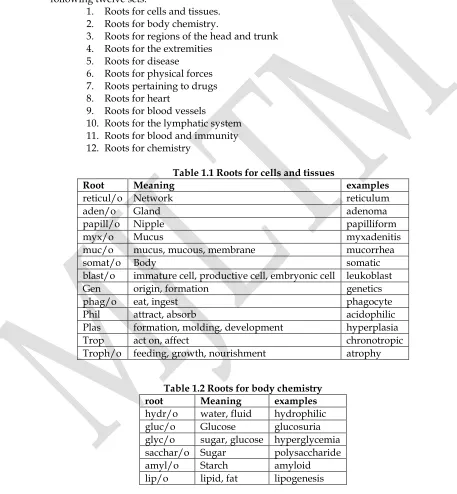
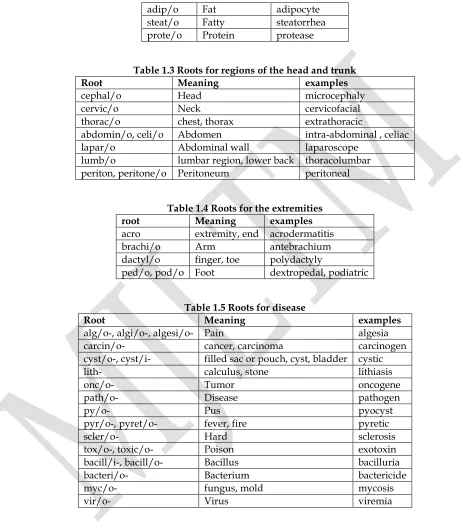
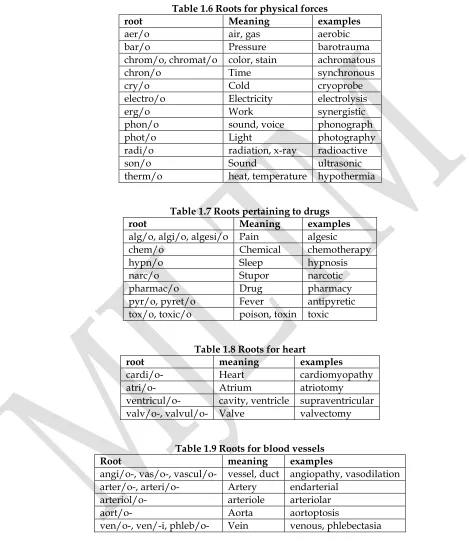
The following tables include the most commonly used roots in medical terminology and an example for each. Roots are separated from their combining vowel with a slash (/). For the purpose of this study the roots have been divided into the following twelve sets.
1. Roots for cells and tissues. 2. Roots for body chemistry.
3. Roots for regions of the head and trunk 4. Roots for the extremities
5. Roots for disease 6. Roots for physical forces 7. Roots pertaining to drugs 8. Roots for heart
9. Roots for blood vessels
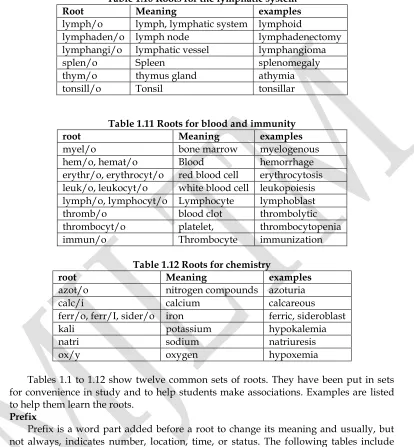
10. Roots for the lymphatic system 11. Roots for blood and immunity 12. Roots for chemistry
Table 1.1 Roots for cells and tissues
Root Meaning examples
reticul/o Network reticulum
aden/o Gland adenoma
papill/o Nipple papilliform
myx/o Mucus myxadenitis
muc/o mucus, mucous, membrane mucorrhea
somat/o Body somatic
blast/o immature cell, productive cell, embryonic cell leukoblast
Gen origin, formation genetics
phag/o eat, ingest phagocyte
Phil attract, absorb acidophilic
Plas formation, molding, development hyperplasia
Trop act on, affect chronotropic
Troph/o feeding, growth, nourishment atrophy
Table 1.2 Roots for body chemistry
root Meaning examples
hydr/o water, fluid hydrophilic gluc/o Glucose glucosuria glyc/o sugar, glucose hyperglycemia sacchar/o Sugar polysaccharide
amyl/o Starch amyloid
lip/o lipid, fat lipogenesis
Vol. 4, Issue 1, March 2014
P
age
24
adip/o Fat adipocyte
steat/o Fatty steatorrhea prote/o Protein protease
Table 1.3 Roots for regions of the head and trunk
Root Meaning examples
cephal/o Head microcephaly
cervic/o Neck cervicofacial
thorac/o chest, thorax extrathoracic
abdomin/o, celi/o Abdomen intra-abdominal , celiac
lapar/o Abdominal wall laparoscope
lumb/o lumbar region, lower back thoracolumbar periton, peritone/o Peritoneum peritoneal
Table 1.4 Roots for the extremities
root Meaning examples
acro extremity, end acrodermatitis
brachi/o Arm antebrachium
dactyl/o finger, toe polydactyly
ped/o, pod/o Foot dextropedal, podiatric
Table 1.5 Roots for disease
Root Meaning examples
alg/o-, algi/o-, algesi/o- Pain algesia
carcin/o- cancer, carcinoma carcinogen
cyst/o-, cyst/i- filled sac or pouch, cyst, bladder cystic
lith- calculus, stone lithiasis
onc/o- Tumor oncogene
path/o- Disease pathogen
py/o- Pus pyocyst
pyr/o-, pyret/o- fever, fire pyretic
scler/o- Hard sclerosis
tox/o-, toxic/o- Poison exotoxin
bacill/i-, bacill/o- Bacillus bacilluria
bacteri/o- Bacterium bactericide
myc/o- fungus, mold mycosis
vir/o- Virus viremia
Vol. 4, Issue 1, March 2014
P
age
25
Table 1.6 Roots for physical forces
root Meaning examples
aer/o air, gas aerobic
bar/o Pressure barotrauma
chrom/o, chromat/o color, stain achromatous
chron/o Time synchronous
cry/o Cold cryoprobe
electro/o Electricity electrolysis
erg/o Work synergistic
phon/o sound, voice phonograph
phot/o Light photography
radi/o radiation, x-ray radioactive
son/o Sound ultrasonic
therm/o heat, temperature hypothermia
Table 1.7 Roots pertaining to drugs
root Meaning examples
alg/o, algi/o, algesi/o Pain algesic
chem/o Chemical chemotherapy
hypn/o Sleep hypnosis
narc/o Stupor narcotic
pharmac/o Drug pharmacy
pyr/o, pyret/o Fever antipyretic tox/o, toxic/o poison, toxin toxic
Table 1.8 Roots for heart
root meaning examples
cardi/o- Heart cardiomyopathy
atri/o- Atrium atriotomy
ventricul/o- cavity, ventricle supraventricular valv/o-, valvul/o- Valve valvectomy
Table 1.9 Roots for blood vessels
Root meaning examples
angi/o-, vas/o-, vascul/o- vessel, duct angiopathy, vasodilation arter/o-, arteri/o- Artery endarterial
arteriol/o- arteriole arteriolar
aort/o- Aorta aortoptosis
ven/o-, ven/-i, phleb/o- Vein venous, phlebectasia
Vol. 4, Issue 1, March 2014
P
age
26
Table 1.10 Roots for the lymphatic system
Root Meaning examples
lymph/o lymph, lymphatic system lymphoid
lymphaden/o lymph node lymphadenectomy lymphangi/o lymphatic vessel lymphangioma
splen/o Spleen splenomegaly
thym/o thymus gland athymia
tonsill/o Tonsil tonsillar
Table 1.11 Roots for blood and immunity
root Meaning examples
myel/o bone marrow myelogenous
hem/o, hemat/o Blood hemorrhage
erythr/o, erythrocyt/o red blood cell erythrocytosis leuk/o, leukocyt/o white blood cell leukopoiesis lymph/o, lymphocyt/o Lymphocyte lymphoblast
thromb/o blood clot thrombolytic
thrombocyt/o platelet, thrombocytopenia
immun/o Thrombocyte immunization
Table 1.12 Roots for chemistry
root Meaning examples
azot/o nitrogen compounds azoturia
calc/i calcium calcareous
ferr/o, ferr/I, sider/o iron ferric, sideroblast
kali potassium hypokalemia
natri sodium natriuresis
ox/y oxygen hypoxemia
Tables 1.1 to 1.12 show twelve common sets of roots. They have been put in sets for convenience in study and to help students make associations. Examples are listed to help them learn the roots.
Prefix
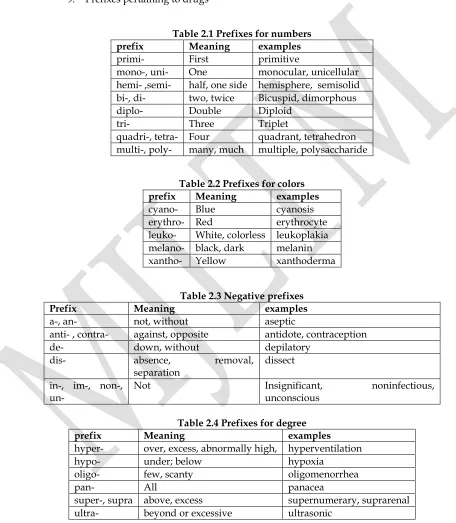
Prefix is a word part added before a root to change its meaning and usually, but not always, indicates number, location, time, or status. The following tables include the most commonly used prefixes in medical terminology and an example for each. For the purpose of this study the prefixes have been divided into the following nine sets.
1. Prefixes for numbers 2. Prefixes for colors 3. Negative prefixes 4. Prefixes for degree
5. Prefixes for size and comparison
Vol. 4, Issue 1, March 2014
P
age
27
6. Prefixes for time and position 7. Prefixes for position and direction 8. Prefixes for disease
9. Prefixes pertaining to drugs
Table 2.1 Prefixes for numbers
prefix Meaning examples
primi- First primitive
mono-, uni- One monocular, unicellular hemi- ,semi- half, one side hemisphere, semisolid bi-, di- two, twice Bicuspid, dimorphous
diplo- Double Diploid
tri- Three Triplet
quadri-, tetra- Four quadrant, tetrahedron multi-, poly- many, much multiple, polysaccharide
Table 2.2 Prefixes for colors
prefix Meaning examples
cyano- Blue cyanosis
erythro- Red erythrocyte leuko- White, colorless leukoplakia melano- black, dark melanin xantho- Yellow xanthoderma
Table 2.3 Negative prefixes
Prefix Meaning examples
a-, an- not, without aseptic
anti- , contra- against, opposite antidote, contraception
de- down, without depilatory
dis- absence, removal,
separation
dissect
in-, im-, non-, un-
Not Insignificant, noninfectious,
unconscious
Table 2.4 Prefixes for degree
prefix Meaning examples
hyper- over, excess, abnormally high, hyperventilation
hypo- under; below hypoxia
oligo- few, scanty oligomenorrhea
pan- All panacea
super-, supra above, excess supernumerary, suprarenal ultra- beyond or excessive ultrasonic
Vol. 4, Issue 1, March 2014
P
age
28
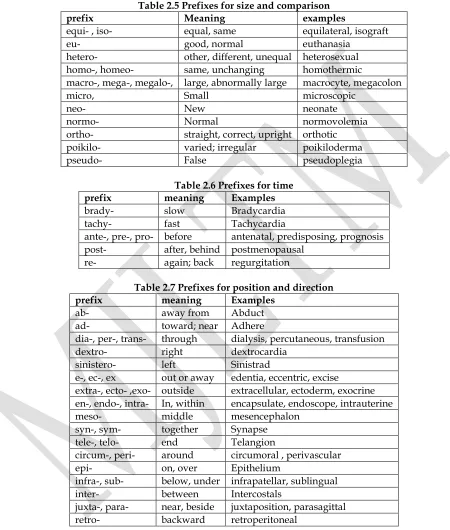
Table 2.5 Prefixes for size and comparison
prefix Meaning examples
equi- , iso- equal, same equilateral, isograft
eu- good, normal euthanasia
hetero- other, different, unequal heterosexual homo-, homeo- same, unchanging homothermic
macro-, mega-, megalo-, large, abnormally large macrocyte, megacolon
micro, Small microscopic
neo- New neonate
normo- Normal normovolemia
ortho- straight, correct, upright orthotic
poikilo- varied; irregular poikiloderma
pseudo- False pseudoplegia
Table 2.6 Prefixes for time
prefix meaning Examples
brady- slow Bradycardia
tachy- fast Tachycardia
ante-, pre-, pro- before antenatal, predisposing, prognosis post- after, behind postmenopausal
re- again; back regurgitation
Table 2.7 Prefixes for position and direction
prefix meaning Examples
ab- away from Abduct
ad- toward; near Adhere
dia-, per-, trans- through dialysis, percutaneous, transfusion
dextro- right dextrocardia
sinistero- left Sinistrad
e-, ec-, ex out or away edentia, eccentric, excise
extra-, ecto- ,exo- outside extracellular, ectoderm, exocrine en-, endo-, intra- In, within encapsulate, endoscope, intrauterine
meso- middle mesencephalon
syn-, sym- together Synapse
tele-, telo- end Telangion
circum-, peri- around circumoral , perivascular
epi- on, over Epithelium
infra-, sub- below, under infrapatellar, sublingual inter- between Intercostals
juxta-, para- near, beside juxtaposition, parasagittal retro- backward retroperitoneal
Vol. 4, Issue 1, March 2014
P
age
29
Table 2.8 Prefixes for disease
prefix Meaning examples
dys- abnormal, painful, difficult dysplasia
mal- bad, poor maladaptive
pachy- Thick pachyemia
xero- Dry xerosis
staphylo- grapelike cluster staphylococcus strepto- twisted chain streptobacillus
Table 2.9 Prefixes pertaining to drugs
prefix Meaning examples
anti- Against antidote
Contra- Against contraceptive Counter- opposite, against countercurrent
Tables 2.1 to 2.9 show nine sets of prefixes. They have been put in sets for convenience in study and to help students make associations. Examples are listed to help them learn the prefixes.
Suffix
Suffix is a word part added at the end of a root. It gives essential meaning to the root or merely changes its grammatical function, i.e., create a noun or an adjective. A suffix usually, but not always, indicates procedure, condition, disease, or disorder. The following tables include the most commonly used suffixes in medical terminology and an example for each. For the purpose of this study, suffixes have been divided into the following ten sets.
1. Suffixes that mean "condition of"
2. Suffixes that mean "pertaining to" or "resembling" 3. Suffixes pertaining to drugs
4. Suffixes for medical specialties 5. Suffixes for body chemistry 6. Suffixes for disease
7. Suffixes for diagnosis 8. Suffixes for surgery 9. Suffixes for blood
10. Word for disease used as suffixes
Table 3.1 Suffixes that mean "condition of"
Suffix meaning Examples
-ia,-ism,-sis, -y condition of phobia, alcoholism, acidosis, tetany
Vol. 4, Issue 1, March 2014
P
age
30
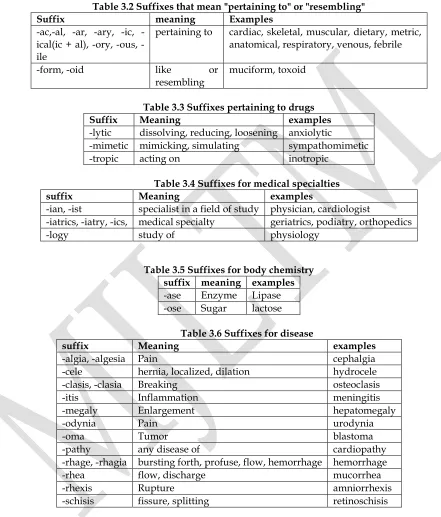
Table 3.2 Suffixes that mean "pertaining to" or "resembling"
Suffix meaning Examples
ac,al, ar, ary, ic, ical(ic + al), ory, ous, -ile
pertaining to cardiac, skeletal, muscular, dietary, metric, anatomical, respiratory, venous, febrile
-form, -oid like or
resembling
muciform, toxoid
Table 3.3 Suffixes pertaining to drugs
Suffix Meaning examples
-lytic dissolving, reducing, loosening anxiolytic
-mimetic mimicking, simulating sympathomimetic
-tropic acting on inotropic
Table 3.4 Suffixes for medical specialties
suffix Meaning examples
-ian, -ist specialist in a field of study physician, cardiologist
-iatrics, -iatry, -ics, medical specialty geriatrics, podiatry, orthopedics
-logy study of physiology
Table 3.5 Suffixes for body chemistry suffix meaning examples -ase Enzyme Lipase -ose Sugar lactose
Table 3.6 Suffixes for disease
suffix Meaning examples
-algia, -algesia Pain cephalgia
-cele hernia, localized, dilation hydrocele
-clasis, -clasia Breaking osteoclasis
-itis Inflammation meningitis
-megaly Enlargement hepatomegaly
-odynia Pain urodynia
-oma Tumor blastoma
-pathy any disease of cardiopathy
-rhage, -rhagia bursting forth, profuse, flow, hemorrhage hemorrhage
-rhea flow, discharge mucorrhea
-rhexis Rupture amniorrhexis
-schisis fissure, splitting retinoschisis
Vol. 4, Issue 1, March 2014
P
age
31
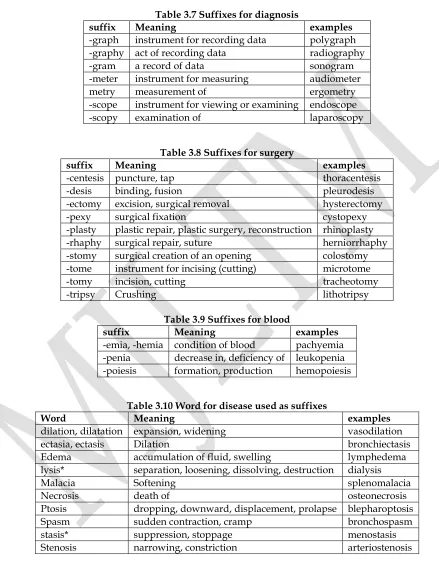
Table 3.7 Suffixes for diagnosis
suffix Meaning examples
-graph instrument for recording data polygraph -graphy act of recording data radiography
-gram a record of data sonogram
-meter instrument for measuring audiometer
metry measurement of ergometry
-scope instrument for viewing or examining endoscope
-scopy examination of laparoscopy
Table 3.8 Suffixes for surgery
suffix Meaning examples
-centesis puncture, tap thoracentesis
-desis binding, fusion pleurodesis
-ectomy excision, surgical removal hysterectomy
-pexy surgical fixation cystopexy
-plasty plastic repair, plastic surgery, reconstruction rhinoplasty -rhaphy surgical repair, suture herniorrhaphy -stomy surgical creation of an opening colostomy -tome instrument for incising (cutting) microtome
-tomy incision, cutting tracheotomy
-tripsy Crushing lithotripsy
Table 3.9 Suffixes for blood
suffix Meaning examples
-emia, -hemia condition of blood pachyemia -penia decrease in, deficiency of leukopenia -poiesis formation, production hemopoiesis
Table 3.10 Word for disease used as suffixes
Word Meaning examples
dilation, dilatation expansion, widening vasodilation
ectasia, ectasis Dilation bronchiectasis
Edema accumulation of fluid, swelling lymphedema
lysis* separation, loosening, dissolving, destruction dialysis
Malacia Softening splenomalacia
Necrosis death of osteonecrosis
Ptosis dropping, downward, displacement, prolapse blepharoptosis
Spasm sudden contraction, cramp bronchospasm
stasis* suppression, stoppage menostasis
Stenosis narrowing, constriction arteriostenosis
Vol. 4, Issue 1, March 2014
P
age
32
Tables 3.1 to 3.10 show ten sets of suffixes. They have been put in sets for convenience in study and to help students make associations. Examples are listed to help them learn the suffixes.
Combining vowel
Combining vowel is a single vowel, usually an “o” and occasionally "a, e, u or i", that connect roots to suffixes and roots to other roots. It is used to make the term easier to pronounce but do not influence the meaning of a root word.
Combining form
Combining form is the combination of the root and combining vowel. It has no meaning of its own; root with a combining vowel attached (e.g. lip/o-); joins a root to another root or to a suffix. For example, in the word "radiology", the combining form is "radi/o".
How to identify medical terms
To identify medical terms take the following steps: 1. Identify the suffix.
2. Identify the root. 3. Identify the prefix.
Remember that most terms have only two parts so do not think you will find all three all the time. A few terms only have one part. For example, in "pericardial",
Suffix (1) root (2) prefix (3) -al cardi peri-
According to steps mentioned above, "–al", "cardi" and "peri-" are suffix, root and prefix, respectively.
How to define medical terms
To define medical terms take the following steps: 1. First start with the suffix. Find out what it means.
2. Next, go to the beginning of the word. It will be either a prefix or a root. Find out what it means.
3. Then, if there is another part, it will be a root.
4. Last, once you have all the meaning put them together. For example, in "polyadenoma",
poly- aden/o -oma
Word parts: prefix root suffix
Meaning: many gland tumor
suffix meaning (1) + prefix meaning (2) + root meaning (3) = term's meaning (4) tumor + many + gland = tumor of many glands
Vol. 4, Issue 1, March 2014
P
age
33
According to steps mentioned above, the meaning of "polyadenoma" will be "tumor of many glands". In fact, you can figure out the meaning of a term by putting together the meaning of each word part.
Conclusion
Medical terminology is the basic part in the learning of medical English. In fact, terminology-centered learning proves to be an efficient way to bring the students into medical English world (Radu, 2008, p. 145). According to this study, we may draw the following conclusion:
1. One of the essential skills that medical students need to master is to identify and define the commonly used roots, combining forms, suffixes, and prefixes introduced in this study.
2. Learning medical terminology will be much easier once students understand how word parts work together to form medical terms.
3. Using the knowledge of word parts to analyze unfamiliar medical terms made the process of learning medical term easier.
4. In spite of the significance of affixes (word parts) to medical students, processes of word-formation are often neglected in English for Medical Students (EMS) in classrooms and teaching materials.
To put it briefly, as students expand their knowledge of medical terminology, they will be able to: understand medical record documentation, communicate more effectively with other health care team members, and perform work responsibilities.
REFERENCES
Bauer, L. (1983). English word-formation. Cambridge, UK: Cambridge University Press.
Cohen, B. J. & Depetris, A. (2014). Medical terminology: an illustrated guide. Lippincott William & Wilkins, a Wolters Kluwer business. China Jones, B. D. (2011). Comprehensive medical terminology. Delmar, Cengage
Learning. United State of America.
Plag, I. (2003). Word-formation in English. Cambridge: Cambridge University Press. Quirk, R., Sidney G., Geoffrey, L. & Jan, S. (1985). A comprehensive grammar of the
English language. New York: Longman.
Radu, M. (2008). English for medical purpose teaching. Romanian Journal of Dentistry. Vol. LIV, No. 2-3.
Yule, G. (1996). The Study of Language. Cambridge, New York: Cambridge University Press.
Yule, G. (2006). The Study of Language. Cambridge, New York: Cambridge University Press.
Vol. 4, Issue 1, March 2014
P
age
34
EXPLICITATION IN SUBTITLING AND DUBBING: A
CASE STUDY OF TWO HARRY POTTER’S MOVIES
Marzieh Bagheri
Department of Translation Studies, Science and Research Branch, Islamic Azad University, Fars, Iran
Azadeh Nemati
Department of English Language Teaching, Jahrom Branch, Islamic Azad University, Jahrom, Iran
Jamal Abdolrahimzade
Department of English Language Teaching, Abadeh Branch, Islamic Azad University, Abadeh, Iran
ABSTRACT
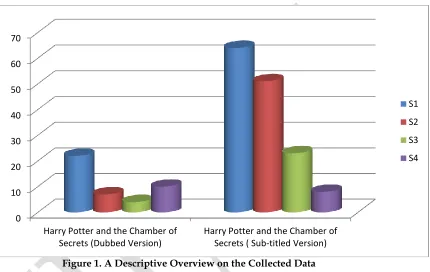
The present work aimed at investigating explicitation strategies pointed out by Klaudy (2008) with special reference to movie subtitling on the one hand, and movie dubbing on the other. In this regard, a Harry potter’s movie, namely “Harry Potter and the Chamber of Secrets” was selected to be studied. First, the movie was watched carefully in search for the explicitation strategies applied by the translators. These included 1) obligatory, 2) optional, 3) pragmatic, and 4) translation inherent explicitations. Then, each and every strategy was placed in its corresponding category based on the model introduced. In search for any statistically significant differences among the frequencies of the strategies applied in both versions of the movie, the Chi-square procedure was carried out. The results of the study indicated that there were statistically significant differences among the frequencies of the strategies applied, comparing the subtitled vs. the dubbed versions. The researcher argued that these differences might be due to the limitations the act of movie dubbing contains, as opposed to movie subtitling.
KEY WORDS: Dubbing, Subtitling, Explicitation strategies, Harry Potter, Klaudy’s Model.
1. Introduction
Dubbing is the post-production process of recording and replacing voices on a motion picture or television sound track subsequent to the original shooting. The term most commonly refers to the substitution of the voices of the actors shown on the screen by those of different performers, who may be speaking a different language. The procedure was sometimes practiced in musicals when the actor had an unsatisfactory singing voice, and remains in use to enable the screening of
Vol. 4, Issue 1, March 2014
P
age
35
visual material to a mass audience in countries where viewers do not speak the same language as the original performers. Dubbing also describes the process of an actor re-recording lines spoken during filming in order to improve audio quality or reflect dialog changes.
On the other hand, subtitling is a way of presenting the audience with the written translated text of the material being spoken and happening in a film or a movie. While dubbing is the act of interpreting, subtitling is in fact translating. Concerning subtitling, there must be a lot of additional issues taken into account. The script background, font family, font size, font color, etc., are just some of these examples (Karamatiroglu, 2000).
With the growing pace of technology, the number of movies made, dubbed and/or subtitled rises each and every day. The translators of the scripts tend to use several translation strategies. These strategies, as Yule (1996) believes, are related to the natures and closeness of the languages families. In terms of the strategies picked up by translators, it would be important to mention that all have met specific ends. Explicitation and implicitation (Vinay and Darbelnet 1995, Blum-Kulka 2001, Baker 1993, Klaudy 2008, etc.), domestication and foreignization (Venuti, 2004), etc., are all among the various translation strategies used while translating a text from a source to a target language.
Concerning these translation strategies, the present study attempted to clarify and describe dubbers’ and subtitlers’ tendency in using explicitation strategies during translation process, using Klaudy’s (2008) model, in a Harry Potter movie with its corresponding dubbed and subtitled versions. The extent to which the instance of translation strategies might be considered as manifestations of explicitation in dubbing and subtitling versions of the movie was the main concern of this work. In other words, the frequencies of the so-called strategies and the significance of the differences in question was the leading purpose of the present study, which aimed at providing an answer to the following research question:
Considering translations of Harry Potter and the Chamber of Secrets movie from English into Persian, which one is more explicit: the dubbed version or the subtitled one?
In technical terms, film translation is called language transfer. In other words, audiovisual language transfer denotes the process by which a film or a television program is made comprehensible to a target audience who is unfamiliar with the original Source Language (SL). There exist several forms of audiovisual language transfer. The main forms of language transfer are ‘subtitling’ and ‘dubbing’. “Subtitling is defined as supplementing the original voice sound track by adding written text on screen, and dubbing is replacing the original voice sound track with another voice in another language" (O’Connell, 2007, p. 169). In fact, “The role of subtitles is to facilitate access to audiovisual products in a foreign language” (Kapsaskis, 2008, p. 42).
Many scholars have provided definitions for subtitles. Subtitling is defined as the rendering of the verbal message in filmic media in a different language, in the shape of one or more lines of written text, which are presented on the screen in synch
Vol. 4, Issue 1, March 2014
P
age
36
with the original verbal message (Gottlieb, 2004). In addition, subtitling is defined in Shuttleworth and Cowie (1997, p. 161) as “the process of providing synchronized captions for film and television dialogue.”
Traditionally, there existed two types of subtitles: ‘inter-lingual’ subtitles, which imply transfer from an SL to a Target Language (TL), and ‘intra-lingual’ subtitles, for which there is no change of language (Díaz Cintas, 2003). Karamitraoglou (2000) defines subtitling as translation of the spoken/written source text of an audio-visual product into a written TT which is added on to the images of the original product at the bottom of the screen. Gottlieb (1994) also presents two general categories for subtitling. He uses the model of translation initiated by Jackobson (1959/2004) and categorizes subtitling as ‘inter-lingual’ and ‘intra-lingual’. While in intra-lingual subtitling, the target language is the same as the source language, it is viewed different from the source language in inter-lingual (diagonal) subtitling. Gottlieb (1994)