P R O T O C O L
Open Access
The effect of rehabilitation interventions on
physical function and immobility-related
complications in severe stroke
—
protocol
for a systematic review
Mark P. McGlinchey
1,2*, Jimmy James
2, Christopher McKevitt
1, Abdel Douiri
1, Sarah McLachlan
1and Catherine M. Sackley
1Abstract
Background:Stroke rehabilitation aims to optimise function and reduce complications post-stroke. Rehabilitation to optimise physical function post-stroke has beneficial effects for survivors of mild to moderate stroke. However, little is known about the effectiveness of interventions to rehabilitate physical function or manage immobility-related complications for survivors of severe stroke. The systematic review aims to evaluate the effectiveness of rehabilitation interventions on physical function and immobility-related complications in severe stroke and identify topics for future research in this area.
Methods:A systematic review of relevant electronic databases (MEDLINE, Embase, CINAHL, AMED, PEDro, DORIS
and CENTRAL) between January 1987 and July 2017 will be undertaken to identify eligible published randomised controlled trials (RCTs) in any language. Ongoing RCTs will be identified by searching health-care trial registers (Stroke Trials Registry, ClinicalTrials.gov). Hand searches of identified study reference lists will also be performed. The PRISMA statement will be used to guide the systematic review. Two reviewers will screen search results, select studies using pre-defined selection criteria, extract data from and assess risk of bias for selected studies. Studies comparing the effect of one type of rehabilitation intervention to another or usual care on physical function and immobility-related complications for patients with severe stroke will be included. Studies may include participants with all levels of stroke severity but must provide sub-group analysis based on stroke severity. Studies will focus on any phase of the stroke rehabilitation pathway and will be grouped and analysed according to their timeframe post-stroke into acute and early sub-acute (up to 3 months post-stroke), early sub-acute to late sub-acute (from 3 to 6 months post-stroke) and chronic (greater than 6 months post-stroke). If sufficient studies demonstrate homogeneity, a meta-analysis will pool results of individual outcomes. The GRADE approach will be used to assess the evidence strength. Discussion:The results of this systematic review will summarise the strength of evidence for rehabilitation interventions used in the rehabilitation of physical function and immobility-related complications in severe stroke and identify gaps in evidence.
Systematic review registration:The systematic review was registered with the International Prospective Register of Systematic Reviews (PROSPERO)—registration numberCRD77737.
Keywords:Stroke, Stroke rehabilitation, Physical therapy speciality, Physical therapy modalities, Occupational therapy, Nursing, Recovery of function, Activities of daily living, Complications
* Correspondence:[email protected]
1
School of Population Health and Environmental Sciences, Faculty of Life Sciences and Medicine, King’s College London, Addison House, Guy’s Campus, London SE1 1UL, England
2Physiotherapy Department, St Thomas’Hospital, Guy’s and St Thomas’NHS
Foundation Trust, London, England
Background
Stroke is the second most common cause of death and third most common cause of disability globally [1, 2]. In 2013, there were 10.3 million new cases of stroke, 6.5 mil-lion deaths and 113 milmil-lion disability adjusted life years (DALYs) attributed to stroke worldwide [3]. The number of stroke survivors, estimated to be 25.7 million, is expected to rise over the next few decades primarily due to popula-tion growth and ageing [3]. In addition to the considerable number of people affected by stroke, stroke has a significant economic cost that includes the direct health-care costs to treat stroke, lost productivity and informal care costs [4,5].
One method to manage the sequelae of stroke is stroke rehabilitation, a process that commences soon after stroke that enables a person to achieve their opti-mal physical, cognitive, communicative, emotional and social level of function [6–8]. Physical function can be defined as the ability to perform various physical activ-ities and includes functioning of the upper limbs (e.g. grasping objects), lower limbs (e.g. walking), and activ-ities of daily living (e.g. washing, dressing) [9, 10]. Re-habilitation of physical function comprises a large component of stroke rehabilitation programmes deliv-ered by health-care professionals, such as physiothera-pists and occupational theraphysiothera-pists [11]. Whilst several systematic reviews support the use of rehabilitation in-terventions to improve aspects of physical function post-stroke, such as motor function, balance, walking speed and activities of daily living [12–14], it is not clear from these reviews if these interventions can be pro-vided to stroke survivors with differing levels of stroke severity, particularly severe stroke.
Severe stroke can be understood as a stroke resulting in a significant amount of brain tissue damage and mul-tiple neurological impairments, which leads to a
signifi-cant loss of function [15]. Dependent upon how it is
measured, it is estimated that between 14 and 31% of people who sustain a stroke globally have a severe stroke [16–20] and this cohort of the stroke population experi-ence worse outcomes compared to survivors of less se-vere stroke [21–30]. In the initial hospitalisation phase post-stroke, they are more likely to develop acute med-ical complications, which are negatively associated with functional recovery [21]. In addition, as many as 40% of patients with severe stroke have died by 3 months com-pared to just under 5% for those patients with mild stroke [22–24]. Survivors of severe stroke spend longer in hospital, which results in increased hospital costs, and demonstrate slower and less functional recovery, which results in greater dependency upon hospital discharge [16,17,25–27]. For those who are discharged from hos-pital alive, severe stroke survivors are at least eight times more likely to be discharged to a nursing home [27,28]. Longer-term care costs, which mostly support severe
stroke survivors, represent 49% of total stroke care spending globally [5]. In the first-year post severe stroke, mortality can be as high as 60% [22] and survivors of
se-vere stroke also experience very high levels of
immobility-related complications, such as falls, contrac-ture, pain, and pressure sores [29, 30]. Due to this re-sidual disability, the physical assistance provided by caregivers to look after survivors of severe stroke as well as the psychosocial and emotional impact of the stroke on caregivers result in high levels of caregiver burden [31, 32]. Because of the range of issues faced by survi-vors of severe stroke, rehabilitation should focus on ad-dressing these poor outcomes, particularly reduced physical function and its associated complications.
However, the extent to which rehabilitation can address these outcomes is not clear. As most studies investigating the efficacy of specific rehabilitation interventions on physical function included stroke survivors with mild to moderate levels of stroke severity [12–14], it is not known if research findings are applicable to survivors of severe stroke, who have very different clinical presentations com-pared to survivors of less severe stroke. It is not clear whether rehabilitation should focus more on the restor-ation of function, which may not always be possible or is often incomplete, or more on reducing immobility-related complications, which may reduce the longer term burden for caregivers of severe stroke survivors. Due to the lack of clarity in the literature regarding the optimal rehabilita-tion management for survivors of severe stroke, there is an urgent need to summarise evidence-based rehabilita-tion intervenrehabilita-tions designed to optimise physical funcrehabilita-tion and reduce immobility-related complications for this co-hort of the stroke population.
Aims
This systematic review aims to:
Establish the effectiveness of rehabilitation
interventions on physical function and immobility-related complications for survivors of severe stroke.
Identify questions for future rehabilitation research for survivors of severe stroke.
Methods
The systematic review will be conducted in accordance with the Preferred Reporting Items for Systematic
Reviews and Meta-analyses (PRISMA) statement [33].
The protocol was registered with the International Pro-spective Register of Systematic Reviews (PROSPERO) on September 22, 2017 (registration number CRD477737)
[34]. The protocol has been reported according to the
Preferred Reporting Items for Systematic Reviews and Meta-analysis Protocols (PRISMA-P) 2015 checklist (see Additional file1).
Eligibility criteria
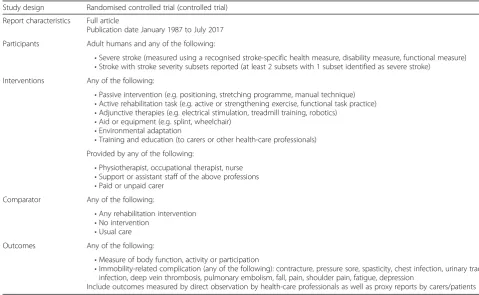
Studies will be selected according to the eligibility criteria below and in Table1, which are based upon the PICO (par-ticipant, intervention, comparator and outcome) format.
Participants
The review will include studies of adult stroke patients, defined as ≥18 years of age. As the review is investigat-ing the effectiveness of rehabilitation interventions in se-vere stroke, studies may include patients with all levels of stroke severity but must include sub-group analysis based on stroke severity. Stroke severity will be defined using a score on either a validated and routinely used stroke specific health measure, e.g. National Institutes of Health Stroke Scale (NIHSS), Orpington Prognostic Scale (OPS); functional measure, e.g. Functional Inde-pendence Measure (FIM), Barthel Index (BI); or disabil-ity measure, e.g. Modified Rankin Scale (mRS) [35–39]. Whilst some measures, such as the OPS or mRS, use the same pre-defined cutoff scores to determine stroke
se-verity [32, 35], other outcome measures, such as the
NIHSS, BI or FIM, do not have as clearly defined cutoff scores to determine stroke severity. For the purposes of this review, an NIHSS score≥16, BI score≤45 (modified BI≤9) and FIM score < 40 will be indicative of a severe stroke [16,17,40–44]. The mean/median severity scores and standard deviation/interquartile range of a study’s
patient cohort must fall within the severe stroke cat-egory to be included in the study.
Interventions
The review will include studies that involve the provision of rehabilitation interventions used to manage problems relating to physical function or immobility-re-lated complications post-stroke. For the purposes of the review, a rehabilitation intervention will be defined as any non-surgical or non-pharmacological intervention used in current clinical practice as part of the usual re-habilitative care of stroke patients. These interventions may be delivered by rehabilitation staff (e.g. physiothera-pists, occupational theraphysiothera-pists, nurses) or by people who have received training by rehabilitation staff, such as paid or unpaid carers of stroke survivors. It will not include interventions that primarily address problems related to cognitive, communicative or swallowing dys-function post severe stroke. The list of interventions
covered by the systematic review is in Table 1. The
re-view will include studies of rehabilitation interventions that are provided in any phase of the post-stroke path-way and in any physical or geographical location. The review will note whether the authors have used a recog-nised framework to describe the intervention, such as the Template for Intervention Description and Replica-tion (TIDier) checklist and guide [45].
Table 1Eligibility criteria for screened references
Study design Randomised controlled trial (controlled trial)
Report characteristics Full article
Publication date January 1987 to July 2017
Participants Adult humans and any of the following:
•Severe stroke (measured using a recognised stroke-specific health measure, disability measure, functional measure)
•Stroke with stroke severity subsets reported (at least 2 subsets with 1 subset identified as severe stroke) Interventions Any of the following:
•Passive intervention (e.g. positioning, stretching programme, manual technique)
•Active rehabilitation task (e.g. active or strengthening exercise, functional task practice)
•Adjunctive therapies (e.g. electrical stimulation, treadmill training, robotics)
•Aid or equipment (e.g. splint, wheelchair)
•Environmental adaptation
•Training and education (to carers or other health-care professionals) Provided by any of the following:
•Physiotherapist, occupational therapist, nurse
•Support or assistant staff of the above professions
•Paid or unpaid carer Comparator Any of the following:
•Any rehabilitation intervention
•No intervention
•Usual care Outcomes Any of the following:
•Measure of body function, activity or participation
•Immobility-related complication (any of the following): contracture, pressure sore, spasticity, chest infection, urinary tract infection, deep vein thrombosis, pulmonary embolism, fall, pain, shoulder pain, fatigue, depression
Comparators
The review will include studies that have a comparator. The comparator will be any of the following: another type of rehabilitation intervention, usual care or no intervention. Usual care may be defined as the rehabili-tation that the patient would normally receive as part of undergoing stroke rehabilitation.
Outcomes
The review will include studies that focus on the pri-mary outcomes of physical function and post-stroke complications. As function can be defined according to body function, activities and participation [10], physical function will be assessed using measures of body func-tion, e.g. Fugl-Meyer Assessment, Motricity Index, Modified Ashworth Scale; activity, e.g. BI, FIM, Motor Assessment Scale; and participation, e.g. Stroke Impact Scale [46–48]. An immobility-related complication may be defined as any medical problem arising after a stroke because of immobility or reduced physical activity [49].
These complications are listed in Table 1. The review
will also note whether studies have included an eco-nomic evaluation.
Study design
As the review will compare the effectiveness of one type of rehabilitation intervention to another, to usual care or no intervention, it will include studies where participants have been randomly allocated to one of two or more treatment groups. Therefore, it will include randomised controlled trials (RCTs) as the primary study design. If there are no RCTs that meet the eligibility criteria, quasi-experimental or non-randomised controlled trials will be considered for inclusion. However, the ability to establish the effectiveness of a physical rehabilitation intervention may be reduced with this type of study de-sign and this will be specifically highlighted when report-ing the results of the systematic review.
Report characteristics
In order to avoid language or cultural bias, studies in any language or geographical location will be included. Studies not written in English will be translated into English using university-based translation services. Fol-lowing a scoping review of the literature which demon-strated very few studies conducted before 2000 and to ensure studies reflect current clinical practice, the review will limit the search to 30 years (1987 to 2017).
Information sources
Electronic searches of the following databases will be conducted: MEDLINE, Embase, Cumulative Index to Nursing and Allied Health Literature (CINAHL), Allied
and Complementary Medicine Database (AMED),
Physiotherapy Evidence Database (PEDro), Database of Research in Stroke (DORIS) and the Cochrane Central Register of Controlled Trials (CENTRAL). Databases will be searched from January 1987 to July 2017. Pub-lished abstracts from relevant stroke conferences (e.g. ESO, UKSF, SRR) will also be searched from January 1987 to July 2017. Ongoing studies will be identified by searching the Stroke Trials Registry ( www.strokecenter.-org/trials/) and ClinicalTrials.gov. These sources will be searched from 2012 to 2017 as it will be assumed that studies before these dates will have been completed and published. References from included studies will be hand searched and any potentially relevant study will be in-cluded for review. Forward citation checks of inin-cluded studies will also be performed.
Search
A search strategy has been developed that focuses on the following key search terms: severe stroke and stroke disability, stroke rehabilitation and physical rehabilita-tion (including individual intervenrehabilita-tions listed in Table1), physiotherapy/physical therapy, occupational therapy, nursing care, functional recovery, physical function, ac-tivities of daily living and immobility-related complica-tions (including individual complicacomplica-tions listed in
Table1). Search terms have been established by scoping
searches using Medical Subject Headings (MeSH). The
MEDLINE search strategy is detailed in Appendix. This
search will be adapted for the other databases.
Data management
The results from the literature search will be uploaded to a reference management programme (Refworks). Du-plicate references will be identified using the
manage-ment programme and removed. A final list of
non-duplicated references will be generated by one au-thor (MM).
Study selection
The titles and abstracts of the search results will be screened, and full text will be obtained for relevant stud-ies. Two review authors (MM and JJ) will complete this process manually and independently, and any difference in opinion will be resolved by a third review author (CS). Full-text articles will be reviewed to determine if studies included through screening meet the inclusion criteria. An inclusion/exclusion checklist has been devel-oped based on the eligibility criteria. Two review authors (MM and JJ) have piloted the checklist (Table1).
Data collection process and data items
Two review authors (MM and JJ) will independently per-form data extraction for all eligible papers identified through the screening process. A data extraction proforma
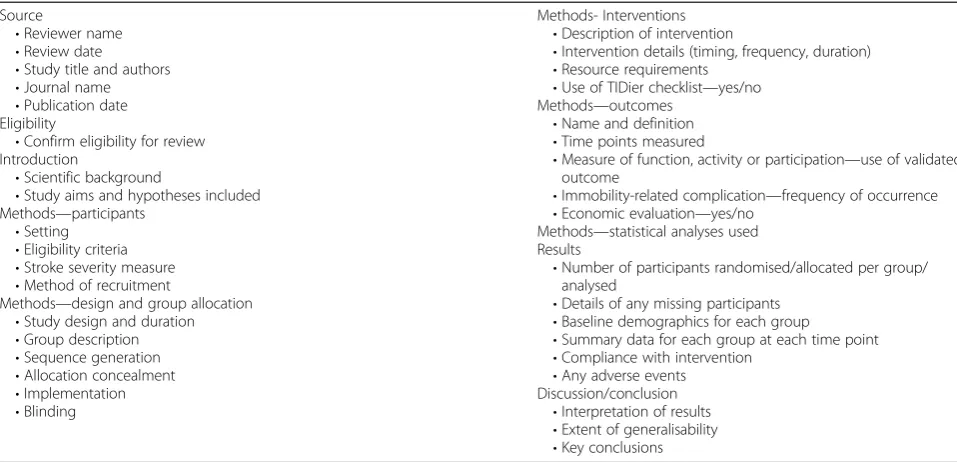
has been developed based on the Cochrane handbook for systematic reviews of interventions and the CONSORT statement for reporting randomised trials [50, 51]. The form focuses on study design and methods, participants, intervention details, outcome measures used, and results (Table2). The form has been piloted independently by the lead author (MM). A Microsoft Excel document will be used to manage the data extraction.
Risk of bias
Risk of bias of included studies will be performed by two review authors independently (MM and JJ). Information will be collected using the Cochrane Collaboration tool for assessing the risk of bias which focuses on sequence generation, allocation concealment, blinding, incomplete
outcome data and selective outcome reporting [50]. An
overall score will not be generated but a risk of bias judgement of ‘high’,‘low’or‘unclear’will be given for in-dividual domains. Any difference in opinion will be re-solved by a third review author (CS). The studies’risk of bias will be presented in a table, and a narrative sum-mary will be produced. Based on the assessment of risk of bias, a sensitivity analysis excluding studies with a high risk of bias will be performed.
Data synthesis and analysis
If more than five adequately powered studies demon-strate homogeneity across studies in terms of rehabilita-tion intervenrehabilita-tions and outcomes, results for individual outcomes will be pooled quantitatively using both meta-analysis with fixed and random effect models and inter-preted as appropriate. Possible sources of heterogeneity
among studies, if observed, will be investigated. RevMan will be used as the meta-analysis software. Data from di-chotomous outcomes, e.g. post-stroke complications will be analysed using risk ratio with 95% confidence inter-val. Data from standardised outcome measures of motor function and functional recovery will be treated as con-tinuous data and will be analysed using mean differences with 95% confidence intervals. If studies demonstrate substantial differences in terms of data collected or only a few studies are found, a qualitative review of results will be performed. This will include a summary of study design, sample size, participant characteristics, outcomes and results. As there may be differences in recovery rates and outcomes according to the time post-stroke, a sub-group analysis will be conducted to explore the ef-fects of time post-stroke. Studies will be grouped into three timeframes determined on the basis of when pa-tients are recruited to the study: acute and early sub-acute (up to 3 months post-stroke), early sub-acute to late sub-acute (from 3 to 6 months post-stroke) and chronic (greater than 6 months post-stroke). These timeframes have been chosen based on recommendations for the standar-dised measurement of sensorimotor recovery in stroke trials [52].
Quality of the evidence
Assessment of the strength of the evidence will be per-formed using the Grading of Recommendations Assess-ment, Development and Evaluation (GRADE) approach
[50]. The five domains considered by the GRADE
ap-proach include risk of bias, inconsistencies between studies, indirectness, imprecision and publication bias.
Table 2Data extraction form checklist
Source
•Reviewer name
•Review date
•Study title and authors
•Journal name
•Publication date Eligibility
•Confirm eligibility for review Introduction
•Scientific background
•Study aims and hypotheses included Methods—participants
•Setting
•Eligibility criteria
•Stroke severity measure
•Method of recruitment
Methods—design and group allocation
•Study design and duration
•Group description
•Sequence generation
•Allocation concealment
•Implementation
•Blinding
Methods- Interventions
•Description of intervention
•Intervention details (timing, frequency, duration)
•Resource requirements
•Use of TIDier checklist—yes/no Methods—outcomes
•Name and definition
•Time points measured
•Measure of function, activity or participation—use of validated outcome
•Immobility-related complication—frequency of occurrence
•Economic evaluation—yes/no Methods—statistical analyses used Results
•Number of participants randomised/allocated per group/ analysed
•Details of any missing participants
•Baseline demographics for each group
•Summary data for each group at each time point
•Compliance with intervention
•Any adverse events Discussion/conclusion
•Interpretation of results
•Extent of generalisability
The quality of the evidence will be ranked high, medium, low or very low by two review authors independently (MM and JJ).
Discussion
As survivors of severe stroke experience worse outcomes compared to survivors of less severe stroke, it is not clear if rehabilitation interventions designed to manage the residual physical problems for this cohort of the stroke population are effective. The results of this sys-tematic review will summarise the strength of evidence for interventions used in the rehabilitation of physical function and immobility-related complications in severe stroke. If there is no, limited or inconclusive evidence for any of the identified interventions, the systematic re-view will identify where further research is required.
Appendix
MEDLINE search strategy
1. exp Stroke/ 2. severe stroke.mp. 3. stroke severit*.mp. 4. stroke disabilit*.mp.
5. exp Physical Therapy Modalities/ 6. exp Occupational Therapy/ 7. exp Nursing Care/
8. physical rehabilitation.mp. 9. exp Stroke Rehabilitation/ 10. exp Patient Positioning/ 11. exp Posture/
12. exp Exercise/
13. exp Exercise Therapy/ 14. passive exercise.mp.
15. exp“Range of Motion, Articular”/ 16. manual technique.mp.
17. active exercise.mp. 18. Resistance Training/
19. exp Muscle Stretching Exercises/ 20. exp Electric Stimulation/
21. exp Electric Stimulation Therapy/ 22. exp Wheelchairs/
23. seat?.mp.
24. exp“Equipment and Supplies”/ 25. exp Teaching/
26. exp Education/ 27. exp Motor Skills/ 28. exp Movement/ 29. motor function.mp. 30. motor recovery.mp. 31. exp“Recovery of Function”/ 32. exp“Activities of Daily Living”/ 33. functional independence.mp. 34. physical independence.mp.
35. complicatio*.mp. 36. exp Pain/ 37. exp Contracture/ 38. exp Pressure Ulcer/
39. exp Respiratory Tract Infections/ 40. Muscle Spasticity/
41. Venous Thrombosis/ 42. exp Pulmonary Embolism/ 43. exp Urinary Tract Infections/ 44. exp Accidental Falls/
45. exp Fatigue/ 46. exp Depression/ 47. 1 or 2 or 3 or 4
48. 5 or 6 or 7 or 8 or 9 or 10 or 11 or 12 or 13 or 14 or 15 or 16 or 17 or 18 or 19 or 20 or 21 or 22 or 23 or 24 or 25 or 26
49. 27 or 28 or 29 or 30 50. 31 or 32 or 33 or 34
51. 35 or 36 or 37 or 38 or 39 or 40 or 41 or 42 or 43 or 44 or 45 or 46
52. 47 and 48 and 49 53. 47 and 48 and 50 54. 47 and 48 and 51
55. limit 52 to (“all adult (19 plus years)”and randomized controlled trial)
56. limit 53 to (“all adult (19 plus years)”and randomized controlled trial)
57. limit 54 to (“all adult (19 plus years)”and randomized controlled trial)
Additional file
Additional file 1: Prisma-P checklist. (DOCX 33 kb)
Abbreviations
AMED:Allied and Complementary Medicine Database; BI: Barthel Index; CENTRAL: Cochrane Central Register of Controlled Trials; CINAHL: Cumulative Index to Nursing and Allied Health Literature; DORIS: Database of Research in Stroke; FIM: Functional Independence Measure; GRADE: Grading of Recommendations Assessment, Development and Evaluation; mRS: Modified Rankin Scale; NIHSS: National Institutes of Health Stroke Scale;
OPS: Orpington Prognostic Scale; PEDro: Physiotherapy Evidence Database; PRISMA: Preferred Reporting Items for Systematic Reviews and Meta-analyses; TIDier: Template for Intervention Description and Replication
Acknowledgements
This project is sponsored by King’s College London and has overall control of the design, conduct, analysis, interpretation and dissemination of the systematic review. The authors would like to thank Claire Simcox for providing feedback on the data extraction form.
Funding
This project forms part of MM’s PhD which is funded by The Dunhill Medical Trust [grant number RT62/0116]. The funder has had no input on the design of the protocol and will have no input on the analysis and interpretation of the results of the systematic review, or publication of the systematic review.
Availability of data and materials
Not applicable
Authors’contributions
MM is the guarantor of the review. MM, CS and CM were involved in the design of the protocol and systematic review. MM conducted the scoping searches. MM and JJ piloted the inclusion/exclusion form. MM and SM piloted the data extraction form. MM will be first reviewer, and JJ will be the second reviewer for the systematic review. AD provided statistical support for the systematic review. MM drafted the manuscript. All authors read and approved the final manuscript.
Ethics approval and consent to participate
Not applicable
Consent for publication
Not applicable
Competing interests
The authors declare that they have no competing interests.
Publisher’s Note
Springer Nature remains neutral with regard to jurisdictional claims in published maps and institutional affiliations.
Received: 5 May 2018 Accepted: 2 November 2018
References
1. GBD 2016 Causes of Death Collaborators. Global, regional, and national age-sex specific mortality for 264 causes of death, 1980–2016: a systematic analysis for the Global Burden of Disease Study 2016. Lancet. 2017;390: 1151–210.
2. GBD 2016 DALYs and HALE Collaborators. Global, regional, and national disability-adjusted life-years (DALYs) for 333 diseases and injuries and healthy life expectancy (HALE) for 195 countries and territories, 1990–2016: a systematic analysis for the Global Burden of Disease Study 2016. Lancet. 2017;390:1260–344.
3. Feigen VL, Norrving B, Mensah GA. Global burden of stroke. Circ Res. 2017; 120:439–48.
4. Evers SM, Struijs JN, Ament AJ, van Genugten ML, Jager JH, Van Den Bos GAM. International comparison of stroke cost studies. Stroke. 2004; 35:1209–15.
5. Patel A, Berdunov V, King D, Quayyum Z, Wittenberg R, Knapp M. Current, future and avoidable costs of stroke in the UK: executive summary part 2: Stroke Association; 2017.https://www.stroke.org.uk/sites/default/files/costs_ of_stroke_in_the_uk_report_-executive_summary_part_2.pdf. Accessed 20 Apr 2018
6. National Institute for Health and Care Excellence. Stroke rehabilitation. Long term rehabilitation after stroke. 2013. NICE guideline (CG 162).
7. Hebert D, Lindsay MP, McIntyre A, Kirton A, Rumney PG, Bag S. Canadian stroke best practice recommendations: stroke rehabilitation practice guidelines, update 2015. Int J Stroke. 2016;11(4):459–84.
8. Langhorne P, Bernhardt J, Kwakkel G. Stroke rehabilitation. Lancet. 2011;377: 1693–702.
9. Patient-Reported Outcome Measurement Information System (PROMIS). PROMIS Network. http://www.healthmeasures.net/explore-measurement-systems/promis. Accessed 20 Apr 2018.
10. World Health Organization. The ICF- An Overview. 2001.https://www. cdc.gov/nchs/data/icd/icfoverview_finalforwho10sept.pdf.Accessed 20 Apr 2018.
11. De Wit L, Putman K, Lincoln N, Baert I, Berman P, Beyens H, et al. Stroke rehabilitation in Europe - what do physiotherapists and occupational therapists actually do? Stroke. 2006;37:1483–9.
12. Veerbeek JM, van Wegen E, van Peppen R, van der Wees PJ, Hendriks E, Rietberg M, et al. What is the evidence for physical therapy poststroke? A systematic review and meta-analysis. PLoS One. 2014.https://doi.org/10. 1371/journal.pone.0087987.
13. Pollock A, Baer G, Campbell P, Choo PL, Forster A, Morris J, et al. Physical rehabilitation approaches for the recovery of function and mobility following stroke. Cochrane DB Syst Rev. 2014.https://doi.org/10.1002/ 14651858.CD001920.pub3.
14. Legg LA, Lewis SR, Schofield-Robinson OJ, Drummond A, Langhorne P. Occupational therapy for adults with problems in activities of daily living
after stroke. Cochrane DB Syst Rev. 2017.https://doi.org/10.1002/14651858. CD003585.pub3.
15. Teasell R, Pereira S and Cotoi A. The rehabilitation of severe stroke. 2016.
http://www.ebrsr.com/evidence-review/22-rehabilitation-severe-stroke. Accessed 20 Apr 2018.
16. Jorgensen HS, Nakayama H, Raaschou HO, Vive-Larsen J, Steier M, Olsen TS. Outcome and time course of recovery in stroke. Part I: outcome. The Copenhagen stroke study. Arch Phys Med Rehabil. 1995;76:399–405. 17. Jorgensen HS, Nakayama H, Rancho HO, Vive-Larsen J, Steier M, Olsen TS.
Outcome and time course of recovery in stroke. Part II: time course of recovery. The Copenhagen stroke study. Arch Phys Med Rehabil. 1995;76:406–12. 18. Kelly-Hayes M, Wolf PA, Kennel WB, Sytkowski P, D’Agostino RB,
Gresham GE. Factors influencing survival and need for institutionalization following stroke: the Framingham study. Arch Phys Med Rehabil. 1988;69:415–8.
19. Islam MS, Anderson CS, Hankey GJ, Hardier K, Carter K, Boradhurst R. Trends in incidence and outcome of stroke in Perth, Western Australia during 1989 to 2001. The Perth community stroke study. Stroke. 2008;39:776–82. 20. Royal College of Physicians. SSNAP annual results portfolio April 2016–
March 2017.https://www.strokeaudit.org/. Accessed 20 Apr 2018. 21. Kim BR, Lee J, Sohn MK, Kim DY, Lee SG, Shin YI, et al. Risk factors and
functional impact of medical complications in stroke. Ann Rehabil Med. 2017;41(5):753–60.
22. Bamford J, Santrock P, Dennis M, Burn J, Warlow C. Classification and natural history of clinically identifiable subtypes of cerebral infarction. Lancet. 1991; 337:1521–6.
23. Heuschmann P, Kolominsky-Rabas P, Misselwitz B, Hermanek P, Leffmann C, Janzen R, et al. Predictors of in-hospital mortality and attributable risks of death after ischemic stroke: the German stroke registers study group. Arch Intern Med. 2004;164(16):1761-8.
24. Bhaskar S, Stanwell P, Bivard A, Spratt N, Walker R, Kitsos G, et al. The influence of initial stroke severity on mortality, overall functional outcome and in-hospital placement at 90 days following acute ischemic stroke: a tertiary hospital stroke register study. Neurol India. 2017;65(6):1252–9. 25. Xu XM, Emma Vestesson E, Paley L, Desikan A, Wonderling D, Hoffman A,
et al. The economic burden of stroke care in England, Wales and Northern Ireland: using a national stroke register to estimate and report patient-level health economic outcomes in stroke. Eur Stroke J. 2017.https://doi.org/10. 1177/2396987317746516.
26. Dour A, Grace J, Sarker SJ, Tinnling K, McKevitt C, Wolfe CDA, et al. Patient-specific prediction of functional recovery after stroke. Int J Stroke. 2017; 12(5):539–48.
27. Saxena SK, Ng TP, Yong D, Fong NP, Gerald K. Total direct cost, length of hospital stay, institutional discharges and their determinants from rehabilitation settings in stroke patients. Acta Neurol Scand. 2006;114:307–14.
28. McKenna K, Tooth L, Strong J, Ottenbacher K, Connell J, Cleary M. Predicting discharge outcomes for stroke patients in Australia. Am J Phys Med Rehab. 2002;81:47–56.
29. Sackley C, Brittle N, Patel S, Ellins J, Scott M, Wright C, et al. The prevalence of joint contractures, pressure sores, painful shoulder, other pain, falls and depression in the year after a severely disabling stroke. Stroke. 2008;39:3329–34. 30. Langhorne P, Stott DJ, Robertson L, MacDonald J, Jones L, McAlpine C,
et al. Medical complications after stroke: a multicentre study. Stroke. 2000;31:1223–9.
31. Luengo-Fernandez R, Paul N, Gray A, Pendlebury S, Bull L, Welch S, et al. Population-based study of disability and institutionalization after transient ischemic attack and stroke 10-year results of the Oxford vascular study. Stroke. 2013;44:2854–61.
32. Rigby H, Gubitz G, Phillips S. A systematic review of caregiver burden following stroke. Int J Stroke. 2009;4:285–92.
33. Moher D, Liberati A, Tetzlaff J, Altman DG, The PRISMA Group. Preferred reporting items for systematic reviews and meta-analyses: the PRISMA statement. PLoS Med. 2009.https://doi.org/10.1371/journal.pmed.1000097.
34. Moher D, Shamseer L, Clarke M, Ghersi D, Liberati A, Petticrew M, et al. Preferred reporting items for systematic review and meta-analysis protocols (PRISMA-P) 2015 statement. Syst Rev. 2015;4:1.
35. Brott TG, Adams HP, Olinger CP, Marler JR, Barsan WG, Biller J, et al. Measurements of acute cerebral infarction: a clinical examination scale. Stroke. 1989;20:864–70.
37. Keith RA, Granger CV, Hamilton BB, Sherwin FS. The functional independence measure: a new tool for rehabilitation. Adv Clin Rehabil. 1987;1:6–18.
38. Mahoney FI, Barthel DW. Functional evaluation: the Barthel index. Md State Med J. 1965;14:61–5.
39. van Swieten J, Koudstaal P, Visser M, Schouten H, et al. Interobserver agreement for the assessment of handicap in stroke patients. Stroke. 1988; 19(5):604–7.
40. Askiel B, Saha C, Williams LS. Percent change on the National Institutes of Health stroke scale: a useful acute stroke outcome measure. J Stroke Cerebrovasc. 2009;18:56–9.
41. AVERT Trial Collaboration Group. Efficacy and safety of very early mobilisation within 24 h of stroke onset (AVERT): a randomised controlled trial. Lancet. 2015;386(9988):46–55.
42. Taub NA, Wolfe CDA, Richardson E, Burney PGJ. Predicting the disability of first-time stroke sufferers at 1 year. 12-month follow-up of a population-based cohort in Southeast England. Stroke. 1994;25:352–7.
43. Wade DT, Hewer RL. Functional abilities after stroke: measurement, natural history and prognosis. J Neurol Neurosurg Psychiatry. 1987;50:177–82. 44. Alexander MP. Stroke rehabilitation outcome. A potential use of predictive
variables to establish levels of care. Stroke. 1994;25(1):128–34.
45. Hoffmann TC, Glasziou PP, Boutron I, Ruairidh M, Perera R, Moher D, et al. Better reporting of interventions: template for intervention description and replication (TIDieR) checklist and guide. BMJ. 2014;348.https://doi.org/10. 1136/bmj.g1687.
46. Fugl-Meyer AR, Jaasko L, Leyman I, Olsson S, Steglind S. The post-stroke hemiplegic patient. 1. A method for evaluation of physical performance. Scand J Rehabil Med. 1975;975:13–31.
47. Carr JH, Shepherd RB, Nordholm L, Lynne D. Investigation of a new motor assessment scale for stroke patients. Phys Ther. 1985;65:175–80.
48. Demeurisse G, Demol O, Robaye E. Motor evaluation in vascular hemiplegia. Eur Neurol. 1980;19:382–9.
49. Bhalla A, Birns J. Management of post-stroke complications. Switzerland: Springer International; 2015.
50. Higgins JPT, Green S. Cochrane handbook for systematic reviews of interventions version 5.1.0: The Cochrane Collaboration; 2011.www. handbook.cochrane.org. Accessed 20 Apr 2018
51. Altman DG, Schulz KF, Moher D, Egger M, Davidoff F, Elbourne D, et al. The revised CONSORT statement for reporting randomized trials: explanation and elaboration. Ann Intern Med. 2001;134:663–94.
52. Kwakkel G, Lannin NA, Borschmann K, English C, Ali M, Curilov L, et al. Standardised measurement of sensorimotor recovery in stroke trials: consensus-based core recommendations from the stroke recovery and rehabilitation roundtable. Int J Stroke. 2017;12:451–61.