ISSN 2286-4822 www.euacademic.org
Impact Factor: 3.1 (UIF) DRJI Value: 5.9 (B+)
Cooperation in Project Management: The Impact of
Cooperation on Project Performance
HAIWAD AHMAD BS-(P&G Engineering), BUITEMS Quetta, Pakistan SYED NISAR AHMED Visiting Faculty Member, BUITEMS Quetta, Pakistan
Abstract:
The intention of the study was to inspect the affiliation of cooperation and project performance. This research also intends to inspect the changes in project performance by providing different modifications in cooperation. In order to evaluate the primary data, assortment procedure, that is questionnaire, was used. It was dispensed to 100 subjects. The outcomes of the study publicized that Cooperation is positively allied with Project performance. The analysis also reveals that there is a qualified relationship between cooperation and project performance and indicates two consistent researches that anticipate to deliver the superlative potential of judgment, how cooperation can provide performance in any field. As cooperation among employees is enhanced, the project performance gets influenced positively. The strength of this affiliation depends upon how cooperation acts to improve and enhance project performance.
Key words: cooperation, project performance
Introduction:
and human civilization are all centered on cooperation (Nowak 2006). For cooperation to reveal even, the future must have an appropriately large tracker. This measures that the significance of the next combat between the equivalent two folks needs to be excessive enough to make disloyalty a lossmaking policy (Axelrod 2006). Cooperation is a vital foundation of human interface. Voluminous projects stay unaccomplished due to deficiency of cooperation, more than in the case of any other project issues. To preserve the cooperation of project folks, it is essential to provide an optimistic 1st response to the project (Erno-Kjolhede, 2000). The cooperation of the project workforces must be clearly occasioned. Several aspects that impact cooperation in a project atmosphere embrace workforces’ necessities, reserve necessities and budget restrictions, former know-hows, contradictory determinations, and deficiency of even organizational provision (Badiru 2007). Project performance expands entire excellence of a project in traits of its operative worth to recipients, to relate efficiency, claims and preservation (University of Minnesota, Office of information technology).
alternate manner, by allocating their capitals; they can accomplish interactions which develop project performance.(Cai et al. 2012).
Godwin Idoro has provided former data regarding interaction between project planning and project performance. The basic intention of this research is to evaluate the relationship between cooperation and project performance. This research evaluates the gap in 5 ways. At the first extent this research is different from the research of Godwin Idoro in variable aspect. He evaluated the interdependence between project planning and project performance, while in this research the interaction between cooperation and project performance is experienced. Secondly no literature exists currently where such a model is being reviewed. Thirdly this research is supervised in Pakistan while the former was accomplished in Nigeria. Fourthly for the primary data collection, I used 100 questionnaires and distributed in different students (both bachelors and masters) in organizations of Pakistan, while he used 130 questionnaires (92 for public clients and 38 for private clients) and dispensed it in different organizations of Nigeria, in order to form a research sample. Fifthly I used Pearson correlation and linear regression for analyzing the data and checking of the significance level while the former research was checked and analyzed by using t-test and Spearman correlation. Different organizations believe that improved performance of project can be obtained by cooperation among the employees of project under consideration. But, does cooperation actually impact project performance? This research aims to respond such questions.
to further extend it to worldwide research and inspect the correlation accordingly. This study will expose new opportunities of research for students in the future forecasting and will enrich their thoughts. For forthcoming and advanced research this study will reveal the basic info to them.
Literature Review:
Cooperation:
Cooperation is defined as a chain of group work together for the strength of individual and to achieve a common advantage and goals of organization by sharing expertise (technical assistance), technology, information, help, arrangement, training and other resources (education, cost etc.).(Johnson & Johnson 1992; Slavin 1982a, 1983b, 1995). Cooperation is the basis of human interaction. Many projects fail due to absence of cooperation and coordination than any of project factors. To sustain the cooperation of project individuals, you must give an encouraging first reaction to the project (Erno-Kjolhede 2000). To complete a complex project successfully cooperation is the major factor of many task workers or sub-workers. In any of cases, they have to be motivated to knock down an action or activity, which payback the overall project (Cai et al. 2012). The study(Branzei et al. 2005) applies cooperative game theory to explain setting reward in a project that has already been late. In games to win it, the key aspiration is cooperation (Oechssler 2001). The cooperation of the project people must be definite. People concerned with project must have some basic information about the benefits of the project. Individual needs, resource needs, and cost short comings, previous work and absence of maintained working of organization are some of the key points that affect cooperation in a project boundary;
A representative way to define is that cooperation must have the following aspects: a definite level of cooperative struggles required, optimistic thoughts for future projects, pessimistic thought of absence of cooperation, profundity of cooperation in successful project(Brussels 2007). A cooperative game theory admits of obligatory agreements to choose a cooperative strategy in the mutual interest of those who agree. Cooperative organizations, too, are seen as being in the mutual interest of the members, but there has been little contact between the two bodies of thought (McCain 2008). For adequately slow updating of aspirations, and small chance, it is shown that in the long run both players cooperate most of the time (Ray et al. 1996). Companies cooperate not according to their wish only but also they are required to do it. They cooperate in strategic alliance with their partners who come coincidently (Rezmer 2011).
Project Performance:
Project performance is the quality of a project in terms of its effective value to beneficiaries, to apply, success, applications and preservation (University of Minnesota, Office of information technology).
The successful methods applied to work face and results are well and beneficially related to the performance ratio of project and project support (Thamhian and Gemmill 2004). Performance method must be simultaneously applied for optimizing the project. Authors suggested a method to facilitate project performance via a multi-criteria approach which focuses on three axes i.e. project task, performance indicator categories and a breakdown of the performance triptych (effectiveness, efficiency and relevance) and project performance also depends upon the decision making criteria in multi-project approach (Matthieu Lauras, Guillaume Marques, 2010)
There are four important factors that are selected from the project work plan and obligatory for project performance: Budget, Actual, Plan to date, Estimated time to complete. (University of Minnesota, Office of Information Technology). Performance of project typically reflects the values of the project customers in how they will be screening their projects (Barclay, Osei-Bryson, Kweku-Muata, 2010). Two assessments of team learning, exploitative learning and exploratory learning, link positively with project performance. Exploratory learning relates positively to project performance and slack resources play an essential role in the relationship between exploratory learning and project performance (Haung, Jing-Win, Li, Yong-Hui 2012).
Linkage of Cooperation and Project Performance:
development and can capture market through innovation only when they have good cooperation among the employees who are performing together. The improvement of these variables in every aspect is required to get the goal (Servajean-Hilst 2013). For existence of cultural confusions among organization, a general statement remains on the properties that develop team performance. The basic finding is the large number of performance characters that are deducted from the human resource. Organizational values that conclude individual’s and professional’s necessity showed to have a good effect on Cooperation Commitment, risk management and continuously carry overall team performance (Thamhian 2004).
Current study on teams shows the importance of relationships to achieve high team performance when working in a cooperative environment. For research and development (R&D) virtual project teams, relationships among cooperation, project performance are likely to improve creativity and innovation (Jawadi and Bonet-Fernandez 2013). Research shows the best project performance is obtained when there is high cooperation between customer and project manager, and average levels of structure, when the project manager and project owner work together in partnership (Turner, Rodney, Müller, Ralf 2004)
Hypothesis:
H1: Cooperation is positively associated with project performance.
H0: Cooperation is not positively associated with project performance.
Methodology:
managers. Both self-served and transmitted questionnaire were used for this persistence. 100 out of 100 questionnaires were gathered back. The response rate was 100 %. The questionnaire encompassed 10 items / questions, out of which 5 items were confined for cooperation and 5 items were confined for project performance. Cooperation items were adopted and reformed from Cooperative Learning Implementation Questionnaire by Centre for the Study of Learning and performance (1998). Out of 25 dimensions of cooperative learning, the questions of cooperation within work were selected only. Project performance items were adopted and reformed from the USAID/PPL/LER, 2011.USAID Evaluation policy, Washington DC and from Past project evaluation performance. There were several dimensions of project performance out of which the items of performance related with project were selected. The consistency standards of the scale are publicized in the correlation metrics onward. To test the hypothesis, regression and correlation analysis were used.
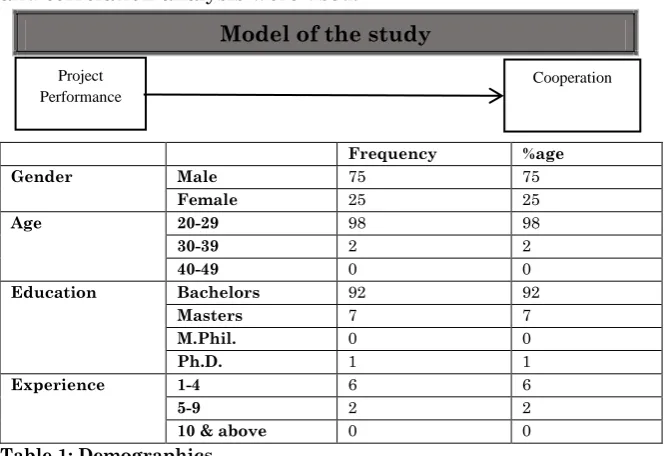
Model of the study
Frequency %age
Gender Male 75 75
Female 25 25
Age 20-29 98 98
30-39 2 2
40-49 0 0
Education Bachelors 92 92
Masters 7 7
M.Phil. 0 0
Ph.D. 1 1
Experience 1-4 6 6
5-9 2 2
10 & above 0 0
Table 1: Demographics Project
Performance
Results and discussion:
1. Correlation Analysis:
The correlation between the two variables namely cooperation and project performance as well as item to item correlation between cooperation and project performance items was checked, the results of which are reported in the correlation matrix. Both variables in the research are found to be extremely correlated with each other. All over the analysis, cooperation will be denoted by cop and project performance will be denoted by ppr.
Cop Ppr
Cop 1 0.748**
Ppr 0.748** 1
** Correlation is significant at 0.01 level of significance Table 2a: Correlation Matrix (Variable to Variable):
Table 2a shows the correlation matrix. As revealed in the table, the correlation values show that cooperation is strongly positively correlated to project performance with the value of 0.748 respectively at the significance level of 0.01.
cop1 cop2 cop3 cop4 cop5 ppr1 ppr2 ppr3 ppr4 ppr5 cop1 1 .527** .418** .384** .372** .460** .442** .480** .311** .211* cop2 .527** 1 .303** .241* .397** .207* .400** .352** .347** .168 cop3 .418** .303** 1 .243* .382** .285** .320** .408** .361** .299** cop4 .384** .241* .243* 1 .352** .263** .330** .591** .438** .393** cop5 .372** .397** .382** .352** 1 .303** .436** .560** .483** .427** ppr1 .460** .207* .285** .263** .303** 1 .297** .399** .170 .261** ppr2 .442** .400** .320** .330** .436** .297** 1 .421** .450** .445** ppr3 .480** .352** .408** .591** .560** .399** .241** 1 .534** .366** ppr4 .311** .347** .361** .438** .483** .170 .450** .534** 1 .397** ppr5 .211* .168 .299** .393** .427** .261** .445** .366** .397** 1
** Correlation is significant at 0.01 level of significance * Correlation is significant at 0.05 level of significance Table 2b: Correlation Matrix (Item to Item)
specified intervals / levels while the rest of them are insignificant.
2. Regression Analysis:
The third step of the research was regression analysis (linear regression) to investigate the hypothesis of the research. In order to examine the H1 of the research, regression was run retaining cooperation as an independent variable and project performance as dependent variable. The results of which are as:
Variables Β t-stat Significance
Cop .796 11.172 .000
R square = 56.0 % Adjusted R square = 55.6 %
** Correlation is significant at 0.01 level of significance.
The above table demonstrates that the coefficient of cooperation is 0.796, which is positive and is extremely significant at 0.01 level of significance. It can be concluded from the value that if we increase cooperation by one unit, the resultant will be an increase of 0.796 in project performance. The t-stat of cooperation is 11.172 which also demonstrates that the result is extremely significant. The complete fit of the model is 56.0% (adjusted R square = 55.6%). So cooperation is found to be positively associated with project performance and hence H1 accepted.
Recommendation:
From the end result of the research, the following recommendations are drawn:
Evaluate/ provide such a cooperative environment so that to achieve quality performance within any project.
Regulate performance assessing patterns within the staff.
The employees should be enforced to cooperate with each other as it is the basic key to perform well in an organization.
Develop cooperative skills for the sake of resolving matters associated with performance.
Initiate a project by describing the needs, resources and proper planning in order to perform a project effectively.
Risks allied in the project and its minimizing solutions should be clearly demonstrated.
Appreciate and value cooperative work rather than individual one.
Provide more time for cooperative work so that employees can better understand each other.
The manager should look after the employees and provide proper scheduling for performance build up. Employees should not be warned on their first
attempt. Time and more attempts should be provided to them to achieve project performance.
Employees should be given specific work according to their ability, so that they feel, what they are exploiting is factual class of work.
Employees should be handled with good behavior and attitude so that they take the project work as of their own and perform well.
In order to expect cooperation from the employees, cooperation and coordination with the employees should be fulfilled.
Project specifications, objectives and budget should be pre-defined so that employees perform properly and achieve goals in time.
Quality of work and proper documentation of project was responded more in the survey, so these should be assumed in evaluating project performance.
upon performance of the project in an operative manner.
Limitations and future research:
This research was associated with certain limitations. One of the imperative limitations of the research included the relatively small size of the sample, so inadequate response was attained. In order to evaluate/ expand future research, larger sample should be taken/ used to analyze the correlation more intensely and meticulously.
Second limitation was deficit of resource and short timing of the research due to which data assortment was not from disparate set of organizations and from all fields of life. Much precise measurements can be attained in future researches if the data is collected from a wide set of organizations.
Another deficit of the research was that encompassed just 2 variables which didn’t include more vital variables to be compared and evaluated. For precise assessment there should be more than 2 variables in future research.
Furthermore, no enough data was available on two variables so now it is the area of focus.
Finally due to inadequate budget the data collection was made from the organizations of Pakistan, particularly from organization in Baluchistan only, future study should outspread the research in diverse frameworks having an appropriate budget in order to increase its applicability to a much widespread framework.
Conclusion:
efficiently enhanced by cooperation. The purpose was to correlate cooperation with project performance, which is proved from the results that increasing cooperation will enhance project performance.
BIBLIOGRAPHY:
Abu, R., Flowers, J. 1997. “The effects of cooperative learning methods on achievement, retention, and attitudes of home economics students in North Carolina.” Journal of Vocational and Technical Education 13(2).
Axelrod, R. 2006. The Evolution of Cooperation. Basic Books. Badir, A. 2012. “Triple C Model of Project Management:
Communication, Cooperation, and coordination.”
Badiru, Adedeji B. 2007. “Communication, Cooperation, and Coordination Model for Process Improvement of C2 Projects.”
Bandiera, O., Barankay, I., and Rasul, I. 2005. Cooperation in collective action. Economics of Transition. 13(3): 473– 498.
Barclay, C., Kweku-Muata, Osey-Bryson. 2010. “Project performance development framework: An approach for developing performance criteria & measures for information systems (IS) projects.” Int. J. Production Economics 124: 272-292.
Branzei et al. 2005. Cooperative Lot Sizing Games in Supply Chains.
Brussels. 2007–2013. “International Scientific and Technological Cooperation in Research Framework Program.” European Management Journal 7.
Cai, X., Hall, N. G., Zhang, F. 2012. “Cooperation and Contract Design in Project Management with Outsourcing”, revised for Operations Research.
Centre for the Study of Learning and performance. Forbes, D. E. 2000. Project Management Information Systems.
National Academy Press.
Henderson, G., and Bannerman, P. 2011. Six Sigma Quality Improvement with Minitab "Why Project Performance Varies?
Hilst, S. 2013. “Stage of development, governance and performance of inter-firm innovation cooperation: a conceptual model and propositions.” IPSERA Conference France.
Huang, Jing-Wen, and Li, Yong-Hui. 2012. “Slack resources in team learning and project performance.” Journal of Business Research 65(3): 381-388.
Idoro, G. 2012. Evaluating Levels of Project Planning and their Effects on Performance in the Nigerian construction industry. Australasian Journal of Construction Economics and Building 9(2): 39-50.
Jawadi, N., Fernandez, D. 2013. “An examination of the factors influencing relationship building and performance in virtual R&D project teams.” Department of Research, Ipag Business School in its series Working Papers with number 40, 29.
Karandikar, R., Mookherjee, D., Ray, Debraj, Vega-Redondo, Fernando. 1998. “Evolving aspirations and cooperation.” Journal of Economic Theory 80(2): 292-331.
Kjølhede, E.E. 2000. “Project Management Theory and the Management of Research Projects.” Working Paper 3. Department of Management, Politics and Philosophy. Copenhagen Business School
Marques, G., Gourc, D., Lauras, M. 2010. “Multi-criteria performance analysis for decision making in project management.” Int. J. Project Manage 29(8): 1057-1069. McCain, Roger, A. 2008. “Cooperative games and cooperative
Nowak, M. 2006. “Five Rules for the Evolution of Cooperation”. Science 314(5805): 1560-1563.
DOI: 10.1126/science.1133755
Oechssler, J. 2001. “Cooperation as a Result of Learning with Aspiration Levels.” Journal of Economic Behavior & Organization 49: 405–409.
Rezmer, A. 2011. “Compulsory cooperation and coincidental cooperation.” Journal of Positive Management 2(1):75-83.
Slavin, E. R. and Cooper, R. 1999. “Lessons Learned from Cooperative Learning Programs.” Journal of Social Issues.