R E S E A R C H
Open Access
-convergence for proximal point algorithm
and fixed point problem in CAT(0) spaces
Shamshad Husain
1*and Nisha Singh
1*Correspondence:
1Department of Applied Mathematics, Aligarh Muslim University, Aligarh, India
Abstract
In this paper, we prove the
-convergence of a modified proximal point algorithm
for common fixed points in a CAT(0) space for different classes of generalized nonexpansive mappings including a total asymptotically nonexpansive mapping, a multivalued mapping, and a minimizer of a convex function. The results in this paper generalize the corresponding results given by some authors. Moreover, numerical example is given to illustrate and show the-convergence of the proposed
algorithm for supporting our result.MSC: 47H09; 47H10; 47J25; 65K10
Keywords: Proximal point algorithm; Total asymptotically nonexpansive mapping; Nonexpansive multivalued mapping;
-convergence
1 Introduction
Let (Y,θ) be a geodesic space andh:Y →(–∞,∞] be a proper convex function. By arg minr∈Yh(r), we denote the set of minimizers of a convex function. To solves∈Ysuch
that
h(s) =min
r∈Y h(r),
in optimization theory a powerful tool is the well-known PPA which was introduced by Martinet [1].
Rockafellar [2] studied, the convergence to a solution of the convex minimization prob-lem in the framework of a Hilbert space by the PPA. He also proved that the sequence{sm}
converges weakly to a minimizer of a convex functionhsuch that∞m=1πm=∞.
Bacak [3] introduced the PPA in a CAT(0) space (Y,θ) as follows:
⎧ ⎨ ⎩
s1∈Y,
sm+1=arg minr∈Y[h(r) +2π1mθ2(r,sm)], ∀m∈N,
whereπm> 0,∀m∈N, and he showed that, ifhhas a minimizer and
∞
m=1πm=∞, then
the sequence{sm}-converges to its minimizer [4].
Cholamjiak [5] modified the PPA in CAT(0) spaces (Y,θ) by using the Halpern method as follows:
⎧ ⎨ ⎩
rm=arg minr∈Y[h(r) +21rθ2(r,sm)],
sm+1=amu⊕(1 –am)rm, ∀m∈N,
wherer> 0,limm→∞am= 0, and
∞
m=1am=∞. He proved that the sequence{sm}
con-verges to its minimizer.
Cholamjiak et al. [6] modified the following PPA in CAT(0) spaces as follows:
⎧ ⎪ ⎪ ⎨ ⎪ ⎪ ⎩
qm=arg minr∈Y[h(r) +2π1mθ
2(r,s
m)],
rm= (1 –bm)sm⊕bmT1qm,
sm+1= (1 –amT1sm⊕amT2rm, ∀m∈N
and established some strong convergence theorems of the proposed algorithm to common fixed points of nonexpansive mappings and to minimizers of a convex function. Chang et al. [7] established some strong convergence theorems of the PPA to a common fixed point of asymptotically nonexpansive mappings and to minimizers of a convex function in CAT(0) spaces.
Kitkuan and Padcharoen [8] studied the iteration process in CAT(0) spaces as follows:
⎧ ⎪ ⎪ ⎨ ⎪ ⎪ ⎩
pm= (1 –am)sm⊕amTmsm,
rm= (1 –bm)pm⊕bmTmpm,
sm+1= (1 –cm)rm⊕cmTmrm, ∀m∈N,
where{am},{bm}, and{cm}are real sequences in (0, 1). They also proved some strong
con-vergence theorems for generalized asymptotically quasi-nonexpansive mappings under certain conditions.
Markin [9] and Nadler [10] introduced the study of fixed points for multivalued con-tractions and nonexpansive mappings using the Hausdorff metric. Shimizu and Takahashi [11] proved the existence of fixed points for multivalued nonexpansive mappings in con-vex metric spaces, that is, every multivalued mappingT :Y→C(Y) has a fixed point in a bounded, complete, and uniformly convex metric space (y,θ), whereC(Y) is the family of all compact subsets ofY.
Motivated and inspired by the above results, we propose the modified proximal point algorithm with the process for three asymptotically nonexpansive mappings and multival-ued mappings in CAT(0) spaces. Under suitable conditions, we prove some convergence theorems of the proposed method. Further, we provide a numerical example to illustrate and show the efficiency of the proposed algorithm for supporting our main results.
2 Preliminaries
A subsetWof a CAT(0) spaceYis said to be convex if, for anys,r∈W, we have [s,r]⊂ W, where
[s,r] :=ts⊕(1 –t)r: 0≤t≤1
is the unique geodesic joiningsandr.
In this paper, we can write (1 –t)s⊕trfor the unique pointqin the geodesic segment joining fromstorsuch that
θ(s,q) =tθ(s,r),θ(r,q) = (1 –t)θ(s,r),
wheret∈[0, 1].
Lemma 2.1 Let Y be a geodesic space in a CAT(0)space.For all s,r,q∈Y and t∈[0, 1], we have
(i) θ2((1 –t)s⊕tr,q)≤(1 –t)θ2(s,q) +tθ2(r,q) –t(1 –t)θ2(s,r), (ii) θ((1 –t)s⊕tr,q)≤(1 –t)θ(s,q) +tθ(r,q).
Definition 2.1 LetT :W→Wbe a mapping.
(i) An elements∈Wis said to be a fixed point ofT ifs=Ts. Denote byG(T)the set of fixed points ofT;
(ii) semi-compact if every bounded sequence{sm} ⊂W, satisfyingθ(sm,Tsm)→0as
m→ ∞, has a convergent subsequence;
(iii) nonexpansive ifθ(Ts,Tr)≤θ(s,r)for anys,r∈W;
(iv) asymptotically nonexpansive if there exists a sequence{em} ⊂[0, +∞)and
limm→∞em= 0such that
θ Tms,Tmr≤(1 +e
m)θ(s,r), ∀s,r∈W,m≥1;
(v) ({νm},{μm},ρ)-total asymptotically nonexpansive, if there exist nonnegative
sequences{νm},{μm}withμm→0,νm→0and a strictly increasing continuous
functionρ: [0, +∞)→[0, +∞)withρ(0) = 0such that
θ Tms,Tmr≤θ(s,r) +νmρ θ(s,r)
+μm, ∀s,r∈W,m≥1;
(vi) uniformlyL-Lipschitzian if there exists a constantL> 0such that
θ Tms,Tmr≤Lθ(s,r), ∀s,r∈W,m≥1.
Definition 2.2 Let{sm}be a bounded sequence in a CAT(0) space (Y,θ). For anys∈Y,
we put
ˆ
r s,{sm}
= lim
m→∞supθ(s,sm).
Then,
1. The asymptotic radiusr(ˆ{sm})of{sm}is given by
ˆ
r {sm}
=infrˆ s,{sm}
2. The asymptotic centerA({sm})of{sm}is the set
A {sm}
=s∈Y:rˆ s,{sm}
=ˆr {sm}
.
In a complete CAT(0) space,A({sm}) consists of exactly one point [6].
Definition 2.3 A sequence{sm}in a CAT(0) spaceYis said to be-convergent to a point
s∈Yifsis the unique asymptotic center of{um}for every subsequence{um}of{sm}. In
this case, we writelimm→∞sm=sof{sm}and denoteW(sm) :=
{A({um})}, where the
union is sum over all subsequences{um}of{sm}.
Lemma 2.2([6]) If{sm}is a bounded sequence in a complete CAT(0)space withA({sm}) =
{s},{um}is a subsequence of{sm}withA({um}) ={u},and the sequence{θ(sm,u)}converges,
then s=u.
Lemma 2.3([10]) Assume that a subset of a complete CAT(0)space(Y,θ)is closed,convex andT :W→W is a total asymptotically nonexpansive mapping.Let{sm}be a bounded
sequence in W such thatlimm→∞sm=t andlimm→∞θ(sm,Tsm) = 0.ThenTt=t.
LetCB(W) be a collection of all nonempty and closed bounded subsets andP(W) be a collection of all nonempty proximal bounded and closed subsets ofW, respectively. Let H(·,·) be the Hausdorff distance onCB(W) defined by
H(A,B) :=max
sup
s∈A
dist(s,B),sup
r∈B
dist(r,A), ∀A,B∈CB(W).
A subsetW⊂Y=∅is said to be proximal if, for eachs∈Y, there exists an element r∈Wsuch that
θ(s,r) =dist(s,W) :=infθ(s,q) :q∈W.
It is well known that each weakly compact convex subset of a Banach space is proximal as well as each closed convex subset of a uniformly convex Banach space is also proximal.
LetT :Y→2Y be a multivalued mapping. An elements∈Yis said to be a fixed point
ofT ifs∈Ts.
Definition 2.4 A multivalued mappingT :Y→CB(Y) is called nonexpansive if
H(Ts,Tr)≤θ(Ts,Tr), s,r∈Y.
Recall that a functionh:W→(–∞,∞] is said to be convex if, for any geodesic [s,r] :=
{cs,r(a) : 0≤a≤1}:={as⊕(1 –a)r: 0≤a≤1}joinings,r∈W, the functionh◦cis convex,
i.e.,
h cs,r(a)
For allπ> 0, define the Moreau–Yosida resolvent ofhin a complete CAT(0) spaceYas follows:
Jπ(s) =arg
r∈Y
min
h(r) + 1 2πθ
2(r,s)
, ∀s∈Y.
Leth:Y→(–∞,∞] be a proper, convex, and lower semi-continuous function. The set F(Jπ) of fixed points of the resolventJπ associated with h coincides with the set
argr∈Yminh(r) of minimizers ofh. Also, for anyπ> 0, the resolventJπ of his
nonex-pansive [4,12].
Lemma 2.4([13]) Let(Y,θ)be a complete CAT(0)space and h:Y→(–∞,∞]be proper, convex,and lower semi-continuous function.Then,for all s,r∈Y andπ> 0,we have
1 2πθ
2(J
πs,r) –
1 2πθ
2(s,r) + 1 2πθ
2(s,J
πs) +h(Jπs)≤h(r).
Lemma 2.5([1]) Let(Y,θ)be a complete CAT(0)space and h:W→(–∞,∞]be a proper convex and lower semi-continuous function.Then the following identity holds:
Jπs=Jμ
π–μ
π Jπs⊕ μ πs
, ∀s∈Y
andπ>μ> 0.
Lemma 2.6([11]) Let{am},{bm},and{rm}be sequences of nonnegative real numbers such
that
am+1≤(1 +bm)am+rm, ∀m∈N.
If∞m=1bm<∞and
∞
m=1rm<∞,thenlimm→∞amexists.
3 Convergence results
Now we construct and prove the main result of this paper.
Theorem 3.1 Let(Y,θ)be a complete CAT(0)space and W be a nonempty closed con-vex subset.Let T :W →P(W)be a multivalued mapping andPT be a nonexpansive mapping.Let h:Y→(–∞,∞]be a proper convex and lower semi-continuous function, A,B,C:W→W be three total asymptotically nonexpansive mappings with{μm}and{νm}
being nonnegative real sequences such that∞m=1μm<∞and
∞
m=1νm<∞.There exists
a constant M1> 0such thatζ(θ)≤M1θ,θ≥0with G(A)∩G(B)∩G(C)=∅and
Ξ:=G(A)∩G(B)∩G(C)∩G(T)∩arg min
r∈Wh(r)=∅.
Let{sm}be defined by
⎧ ⎪ ⎪ ⎪ ⎪ ⎪ ⎨ ⎪ ⎪ ⎪ ⎪ ⎪ ⎩
pm=arg minr∈Y[h(r) +2π1mθ2(r,sm)],
qm= (1 –cm)pm⊕cmAmzm,
rm= (1 –bm)qm⊕bmBmym,
sm+1= (1 –am)rm⊕amCmxm,
where zm∈PT(pm),ym∈PT(qm),and xm∈PT(rm)for each m∈N.Let{am},{bm},and
{cm}be sequences in[0, 1]for all m∈Nand{πm}be a sequence withπm> 0for all m∈N.
Then
lim
m→∞θ(sm,t) exists for all t∈Ξ.
Proof Lett∈Ξ. Thent= At =Bt=Ctandh(t)≤h(r) for anyr∈W. So, we have
h(t) + 1 2πm
θ2(t,t)≤h(r) + 1 2πm
θ2(r,t)
for eachr∈W, and so we havet=Jπmtfor eachm∈N. Sincepm=JπmsmandJπm is nonexpansive, we have
θ(pm,t) =θ(Jπmsm,Jπmt)≤θ(sm,t). (3.2) Now, using (3.1), (3.2), and Lemma2.1(ii), we have
θ(qm,t) =θ (1 –cm)pm⊕cmAmzm,t
≤(1 –cm)θ(pm,t) +cmθ Amzm,t
≤(1 –cm)θ(pm,t) +cm
θ(zm,t) +νm θ(zm,t)
+μm
≤(1 –cm)θ(pm,t) +cm
θ(zm,t) +νmM1θ(zm,t) +μm
= (1 –cm)θ(pm,t) +cm(1 +νmM1)θ(zm,t) +cmμm
≤(1 –cm)dist pm,PT(t)+cm(1 +νmM1)dist zm,PT(t)+cmμm
≤(1 –cm)H PT(pm),PT(t)+cm(1 +νmM1)H PT(pm),PT(t)
+cmμm
≤(1 –cm)θ(pm,t) +cm(1 +νmM1)θ(pm,t) +cmμm
≤(1 +νmM1)θ(pm,t) +cmμm
≤(1 +νmM1)θ(sm,t) +μm, (3.3)
and using (3.1), (3.3), and Lemma2.1(ii), we have
θ(rm,t) =θ (1 –bm)qm⊕bmBmym,t
≤(1 –bm)θ(qm,t) +bmθ Bmym,t
≤(1 –bm)θ(qm,t) +bm
θ(ym,t) +νm θ(ym,t)
+μm
≤(1 –bm)θ(qm,t) +bm
θ(ym,t) +νmM1θ(ym,t) +μm
= (1 –bm)θ(qm,t) +bm(1 +νmM1)θ(ym,t) +bmμm
≤(1 –bm)dist qm,PT(t)
+bm(1 +νmM1)dist ym,PT(t)
+bmμm
≤(1 –bm)H PT(qm),PT(t)
+bm(1 +νmM1)H PT(qm),PT(t)
≤(1 –bm)θ(qm,t) +bm(1 +νmM1)θ(qm,t) +bmμm
≤(1 +νmM1)θ(qm,t) +bmμm
≤(1 +νmM1)
(1 +νmM1)θ(sm,t) +μm
+bmμm
≤(1 +νmM1)2θ(sm,t) + (1 +νmM1)μm+bmμm
≤(1 +νmM1)2θ(sm,t) + (2 +νmM1)μm. (3.4)
Similarly using (3.1), (3.4), and Lemma2.1(ii), we have
θ(sm+1,t) =θ (1 –am)rm⊕amCmxm,t
≤(1 –am)θ(rm,t) +amθ Cmxm,t
≤(1 –am)θ(rm,t) +am
θ(xm,t) +νm θ(xm,t)
+μm
≤(1 –am)θ(rm,t) +am
θ(xm,t) +νmM1θ(xm,t) +μm
= (1 –am)θ(rm,t) +am(1 +νmM1)θ(xm,t) +amμm
≤(1 –am)dist rm,PT(t)+am(1 +νmM1)dist xm,PT(t)+amμm
≤(1 –am)H PT(rm),PT(t)+am(1 +νmM1)HPT(rm),PT(t)
+amμm
≤(1 –am)θ(rm,t) +am(1 +νmM1)θ(rm,t) +amμm
≤(1 +νmM1)θ(rm,t) +amμm
≤(1 +νmM1)
(1 +νmM1)2θ(sm,t) + (2 +νmM1)μm
+amμm
≤(1 +νmM1)3θ(sm,t) + (1 +νmM1)(2 +νmM1)μm+amμm
≤(1 +νmM1)3θ(sm,t) + 3(1 +νmM1)μm
= (1 +Sm)θ(sm,t) +Wm, (3.5)
where Sm= 3M1νm+ 3M12ν2m+M13νm3 andWm= 3(1 +νmM1)μm. Since it is given that
∞
m=1μm <∞ and
∞
m=1νm <∞, we get
∞
m=1Sm < ∞ and
∞
m=1Wm < ∞. From
Lemma2.6, (3.5) we havelimm→∞θ(sm,t) exists, and we assume that
lim
m→∞θ(sm,t) =κ≥0. (3.6)
From (3.6), {sm}is bounded and so the sequences {pm},{qm},{rm},{Amsm},{Bmsm}, and
{Cms
m}are bounded.
Theorem 3.2 Let(Y,θ)be a complete CAT(0)space and W be a nonempty closed con-vex subset.Let T :W →P(W)be a multivalued mapping andPT be a nonexpansive mapping.Let h:Y→(–∞,∞]be a proper convex and lower semi-continuous function and A,B,C:W→W be three total asymptotically nonexpansive mappings with{μm}and
{νm}being nonnegative real sequences such that
∞
m=1μm<∞and
∞
m=1νm<∞.There
exists a constant M1> 0such thatζ(θ)≤M1θ,θ≥0,with G(A)∩G(B)∩G(C)=∅and
Ξ:=G(A)∩G(B)∩G(C)∩G(T)∩arg min
Let{sm}be defined by
⎧ ⎪ ⎪ ⎪ ⎪ ⎪ ⎨ ⎪ ⎪ ⎪ ⎪ ⎪ ⎩
pm=arg minr∈Y[h(r) +2π1mθ2(r,sm)],
qm= (1 –cm)pm⊕cmAmzm,
rm= (1 –bm)qm⊕bmBmym,
sm+1= (1 –am)rm⊕amCmxm,
where zm∈PT(pm),ym∈PT(qm),and xm∈PT(rm)for each m∈N.Let{am},{bm},and
{cm}be sequences in[0, 1]for all m∈Nand{πm}be a sequence withπm> 0for all m∈N.
Then
(i) limm→∞θ(sm,pm) = 0;
(ii) limm→∞θ(sm,Asm) =limm→∞θ(sm,Bsm) =limm→∞θ(sm,Csm) = 0.
Proof (i) By Lemma2.4, we have
1 2πm
θ2(pm,t) –θ2(sm,t) +θ2(sm,pm)
≤h(t) –h(pm).
Sinceh(t)≤h(pm) for eachm∈N, we have
θ2(sm,pm)≤θ2(sm,t) –θ2(pm,t). (3.7)
From (3.5), we have
θ(sm+1,t)≤(1 +νmM1)θ(rm,t) +amμm
and
lim
m→∞infθ(rm,t)≥κ. (3.8)
From (3.4), we have
lim
m→∞supθ(rm,t)≤κ. (3.9)
So, from (3.8) and (3.9), we have
lim
m→∞θ(rm,t) =κ. (3.10)
Similarly, from (3.4), we have
θ(rm,t)≤(1 +νmM1)θ(qm,t) +bmμm
and
lim
From (3.3), we have
lim
m→∞supθ(qm,t)≤κ. (3.12)
From (3.11) and (3.12), we have
lim
m→∞θ(qm,t) =κ. (3.13)
From (3.3), we have
θ(qm,t)≤(1 +νmM1)θ(pm,t) +cmμm
and
lim
m→∞infθ(pm,t)≥κ. (3.14)
Also from (3.3), we have
lim
m→∞supθ(pm,t)≤κ. (3.15)
From (3.14) and (3.15), we have
lim
m→∞θ(pm,t) =κ. (3.16)
So from (3.7), we have
lim
m→∞θ(sm,pm) = 0. (3.17)
(ii) Suppose thatΞ is nonempty, and lett∈Ξ. From (3.6),limm→∞θ(sm,t) exists and
{sm}is bounded. From (3.1) and Lemma2.1(i), we have
θ2(qm,t) =θ2 (1 –cm)pm⊕cmAmzm,t
≤(1 –cm)θ2(pm,t) +cmθ2 Amzm,t
–cm(1 –cm)θ2 pm,Amzm
≤(1 –cm)θ2(pm,t) +cm
θ(zm,t) +νm θ(zm,t)
+μm
2
–cm(1 –cm)θ2 pm,Amzm
≤cm
θ(zm,t) +νmM1θ(zm,t) +μm
2
+ (1 –cm)θ2(pm,t)
–cm(1 –cm)θ2 Amzm,pm
=cm
(1 +νmM1)θ(zm,t) +μm
2
+ (1 –cm)θ2(pm,t)
–cm(1 –cm)θ2 Amzm,pm
≤(1 +νmM1)2cmθ2(zm,t) + (1 +νmM1)2(1 –cm)θ2(pm,t)
+cm
2(1 +νmM1)μmθ(zm,t) +μ2m
–cm(1 –cm)θ2 Amzm,pm
≤(1 +νmM1)2cmdist zm,PT(t)
2
+ (1 +νmM1)2(1 –cm)dist pm,PT(t)
+cm
2(1 +νmM1)μmdist zm,PT(t)
+μ2m–cm(1 –cm)θ2 pm,Amzm
≤(1 +νmM1)2cmH PT(pm),PT(t)
2
+ (1 +νmM1)2(1 –cm)H PT(pm),PT(t)
2
+cm
2(1 +νmM1)μmH PT(pm),PT(t)
+μ2m–cm(1 –cm)θ2 pm,Amzm
≤(1 +νmM1)2cmθ2(pm,t) + (1 +νmM1)2(1 –cm)θ2(pm,t)
+cm
2(1 +νmM1)μmθ(pm,t) +μ2m
–cm(1 –cm)θ2 pm,Amzm
= (1 +νmM1)2θ2(pm,t) +cm
2(1 +νmM1)μmθ(pm,t) +μ2m
–cm(1 –cm)θ2 pm,Amzm
≤(1 +νmM1)2θ2(sm,t) +cm
2(1 +νmM1)μmθ(sm,t) +μ2m
–cm(1 –cm)θ2 pm,Amzm
≤θ2(sm,t) +pνm+qμm–cm(1 –cm)θ2 pm,Amzm
(3.18)
for somep,q> 0, which implies that
θ2(qm,t)≤θ2(sm,t) +pνm+qμm,
and from (3.1) and Lemma2.1(i), we have
θ2(rm,t) =θ2 (1 –bm)qm⊕bmBmym,t
≤(1 –bm)θ2(qm,t) +bmθ2 Bmym,t
–bm(1 –bm)θ2 qm,Bmym
≤(1 –bm)θ2(qm,t) +bm
θ(ym,t) +νm θ(ym,t)
+μm
2
–bm(1 –bm)θ2 qm,Bmym
≤(1 –bm)θ2(qm,t) +bm
θ(ym,t) +νmM1θ(ym,t) +μm
2
–bm(1 –bm)θ2 Bmym,qm
= (1 –bm)θ2(qm,t) +bm
(1 +νmM1)θ(ym,t) +μm
2
–bm(1 –bm)θ2 Bmym,qm
≤(1 –bm)(1 +νmM1)2θ2(qm,t) + (1 +νmM1)2bmθ2(ym,t)
+bm
2(1 +νmM1)μmθ(ym,t) +μ2m
–bm(1 –bm)θ2 Bmym,qm
≤(1 –bm)(1 +νmM1)2dist qm,PT(t)
2
+ (1 +νmM1)2bmdist ym,PT(t)
2
+bm
2(1 +νmM1)μmdist ym,PT(t)
+μ2m–bm(1 –bm)θ2 Bmym,qm
≤(1 –bm)(1 +νmM1)2HPT(qm),PT(t)2
+ (1 +νmM1)2bmH PT(qm),PT(t)2
+bm
2(1 +νmM1)μmH PT(qm),PT(t)
+μ2m–bm(1 –bm)θ2 Bmym,qm
≤(1 –bm)(1 +νmM1)2θ2(qm,t) + (1 +νmM1)2bmθ2(qm,t)
+bm
2(1 +νmM1)μmθ(qm,t) +μ2m
–bm(1 –bm)θ2 Bmym,qm
= (1 +νmM1)2θ2(qm,t) +bm
2(1 +νmM1)μmθ(qm,t) +μ2m
–bm(1 –bm)θ2 Bmym,qm
≤θ2(qm,t) +rνm+sμm–bm(1 –bm)θ2 Bmym,qm
(3.19)
for somer,s> 0, which implies that
θ2(rm,t)≤θ2(qm,t) +rνm+sμm.
Similarly, from (3.1) and Lemma2.1(i), we have
θ2(sm+1,t) =θ2 (1 –am)rm⊕amCmxm,t
≤(1 –am)θ2(rm,t) +amθ2 Cmxm,t
–am(1 –am)θ2 rm,Cmxm
≤(1 –am)θ2(rm,t) +am
θ(xm,t) +νm θ(xm,t)
+μm
2
–am(1 –am)θ2 rm,Cmxm
≤(1 –am)θ2(rm,t) +am
θ(xm,t) +νmM1θ(xm,t) +μm
2
–am(1 –am)θ2 Cmxm,rm
= (1 –am)θ2(rm,t) +am
(1 +νmM1)θ(xm,t) +μm
2
–am(1 –am)θ2 Cmxm,rm
≤(1 –am)(1 +νmM1)2θ2(rm,t) + (1 +νmM1)2amθ2(xm,t)
+am
2(1 +νmM1)μmθ(xm,t) +μ2m
–am(1 –am)θ2 Cmxm,rm
≤(1 –am)(1 +νmM1)2dist rm,PT(t)2+ (1 +νmM1)2amdist xm,PT(t)2
+am
2(1 +νmM1)μmdist xm,PT(t)
+μ2m–am(1 –am)θ2 Cmxm,rm
≤(1 –am)(1 +νmM1)2HPT(rm),PT(t)
2
+ (1 +νmM1)2am
×HPT(rm),PT(t)
2 +am
2(1 +νmM1)μmHPT(rm),PT(t)
+μ2m
–am(1 –am)θ2 Cmxm,rm
≤(1 –am)(1 +νmM1)2θ2(rm,t) + (1 +νmM1)2amθ2(rm,t)
+am
2(1 +νmM1)μmθ(rm,t) +μ2m
–am(1 –am)θ2 Cmxm,rm
= (1 +νmM1)2θ2(rm,t) +am
2(1 +νmM1)μmθ(rm,t) +μ2m
–am(1 –am)θ2 Cmxm,rm
≤θ2(rm,t) +tνm+wμm–am(1 –am)θ2 Cmxm,rm
(3.20)
for somet,w> 0, which implies that
θ2(sm+1,t)≤θ2(rm,t) +tνm+wμm.
From (3.18), we have
cm(1 –cm)θ2 Amzm,pm
Since∞m=1νm<∞,
∞
m=1μm<∞, we have
cm(1 –cm)θ2 Amzm,pm
<∞.
Fromlim infm→∞cm(1 –cm) > 0, we have
lim
m→∞θ A mz
m,pm
= 0. (3.21)
From (3.19), we have
bm(1 –bm)θ2 Bmym,qm
≤θ2(qm,t) –θ2(rm,t) +rνm+sμm.
Since∞m=1νm<∞,
∞
m=1μm<∞, we have
bm(1 –bm)θ2 Bmym,qm
<∞.
Fromlim infm→∞bm(1 –bm) > 0, we have
lim
m→∞θ B my
m,qm
= 0. (3.22)
From (3.20), we have
am(1 –am)θ2 Cmxm,rm
≤θ2(rm,t) –θ2(sm+1,t) +tνm+wμm.
Since∞m=1νm<∞,
∞
m=1μm<∞, we have
am(1 –am)θ2 Cmxm,rm
<∞.
Fromlim infm→∞am(1 –am) > 0, we have
lim
m→∞θ C
mx m,rm
= 0. (3.23)
Now using (3.17) and (3.21), we have
θ(qm,sm) =θ (1 –cm)pm⊕cmAmzm,sm
≤(1 –cm)θ(pm,sm) +cmθ Amzm,sm
≤(1 –cm)θ(pm,sm) +cm
θ Amzm,pm
+θ(pm,sm)
≤(1 –cm)θ(pm,sm) +cmθ Amzm,pm
+cmθ(pm,sm)
=θ(pm,sm) +cmθ Amzm,pm
→0 asm→ ∞, (3.24)
and using (3.22) and (3.24), we have
θ(rm,sm) =θ (1 –bm)qm⊕bmBmym,sm
≤(1 –bm)θ(qm,sm) +bmθ Bmym,sm
≤(1 –bm)θ(qm,sm) +bm
θ Bmym,qm
+θ(qm,sm)
≤(1 –bm)θ(qm,sm) +bmθ Bmym,qm
+bmθ(qm,sm)
=θ(qm,sm) +bmθ Bmym,qm
→0 asm→ ∞, (3.25)
and again using (3.23) and (3.25), we have
θ(sm+1,sm) =θ (1 –am)rm⊕amCmxm,sm
≤(1 –am)θ(rm,sm) +amθ Cmxm,sm
≤(1 –am)θ(rm,sm) +am
θ Cmxm,rm
+θ(rm,sm)
≤(1 –am)θ(rm,sm) +amθ Cmxm,rm
+amθ(rm,sm)
=θ(rm,sm) +amθ Cmxm,rm
→0 asm→ ∞. (3.26)
Using the triangle inequality (3.17) and (3.21), we have
θ Amsm,sm
≤θ Amsm,Amzm
+θ Amzm,pm
+θ(pm,sm)
≤Lθ(sm,zm) +θ Amzm,pm
+θ(pm,sm)
=LH PT(sm),PT(pm)
+θ Amzm,pm
+θ(pm,sm)
≤Lθ(sm,pm) +θ Amzm,pm
+θ(pm,sm)
≤(L+ 1)θ(sm,pm) +θ Amzm,pm
→0 asm→ ∞. (3.27)
Again using the triangle inequality (3.22) and (3.24), we have
θ Bmsm,sm
≤θ Bmsm,Bmym
+θ Bmym,qm
+θ(qm,sm)
≤Lθ(sm,ym) +θ Bmym,qm
+θ(qm,sm)
=LH PT(sm),PT(qm)
+θ Bmym,qm
+θ(qm,sm)
≤Lθ(sm,qm) +θ Bmym,qm
+θ(qm,sm)
≤(L+ 1)θ(sm,qm) +θ Bmym,qm
→0 asm→ ∞. (3.28)
Similarly, again using the triangle inequality (3.23) and (3.25), we have
θ Cmsm,sm
≤θ Cmsm,Cmxm
+θ Cmxm,rm
+θ(rm,sm)
≤Lθ(sm,xm) +θ Cmxm,rm
=LHPT(sm),PT(rm)
+θ Cmxm,rm
+θ(rm,sm)
≤Lθ(sm,rm) +θ Cmxm,rm
+θ(rm,sm)
≤(L+ 1)θ(sm,rm) +θ Cmxm,rm
→0 asm→ ∞. (3.29)
Now, using (3.26) and (3.27), we have
θ(sm,Asm)≤θ(sm,sm+1) +θ sm+1,Am+1sm+1
+θ Am+1sm+1,Am+1sm
+θ Am+1sm,Asm
≤θ(sm,sm+1) +θ sm+1,Am+1sm+1
+Lθ(sm+1,sm) +Lθ Amsm,sm
→0 asm→ ∞. (3.30)
Similarly, we have
lim
m→∞θ(sm,Bsm) =mlim→∞θ(sm,Csm) = 0.
Theorem 3.3 Let W be a nonempty closed convex subset of a complete CAT(0)space.Let T :W→P(W)be a multivalued mapping andPT be a nonexpansive mapping.Let h: Y→(–∞,∞]be a proper convex and lower semi-continuous function and A,B,C:W→ W be three total asymptotically nonexpansive mappings.Then{sm}given by(3.1)is
-convergent to a common fixed point ofΞ.
Proof From Lemma2.5and (3.17), we have
θ(Jπsm,sm)≤θ(Jπsm,pm) +θ(pm,sm)
=θ(Jπsm,Jπmsm) +θ(pm,sm)
=θ
Jπsm,Jπ
πm–π
πm J
πmsm⊕
π πm
sm
+θ(pm,sm)
≤θ
sm,
1 – π
πm
Jπmsm⊕
π πm
sm
+θ(pm,sm)
≤
1 – π
πm
θ(sm,Jπmsm) +
π πm
θ(sm,sm) +θ(pm,sm)
=
1 – π
πm
θ(sm,pm) +θ(pm,sm)
→0 asm→ ∞.
From Theorem3.1, we havelimm→∞θ(sm,t) exists for allt∈Ξand
lim
m→∞θ(sm,Asm) =mlim→∞θ(sm,Bsm) =mlim→∞θ(sm,Csm) = 0.
Next, we have to show that
W(sm) =
{um}⊂{sm} A {un}
Letu∈W(sm). Then there exists a subsequence{um}of{sm}such thatA({um}) ={u}.
From Definition2.3, there exists a subsequence{vm}of{um}such that-limm→∞vm=v
for somev∈W. By Lemma2.3,v∈Ξ. By Lemma2.2,u=v. This shows thatW(sm)⊂Ξ.
Finally, we have to prove that the sequence{sm}-converges to a point inΞ, which will
prove thatW(sm) consists of exactly one point. Let{um}be a subsequence of{sm}with
A({um}) ={u}, and letA({sm}) ={s}. Sinceu∈W(sm)⊂Ξ and{θ(sm,u)}converges by
Lemma2.2, we haves=u. Thus,W(sm) ={s}.
Corollary 3.1 Let W be a nonempty closed convex subset of a real Hilbert space H.
Let T :W →P(W)be a multivalued mapping, let h:Y →(∞,∞]be a proper con-vex and lower semi-continuous function, and A,B,C, zm ∈PT(pm),ym ∈PT(qm),xm ∈
PT(rm),{am},{bm},{cm},and{πm}satisfy all the conditions given in Theorem3.1.Let{sm}
be the sequence given by
⎧ ⎪ ⎪ ⎪ ⎪ ⎪ ⎨ ⎪ ⎪ ⎪ ⎪ ⎪ ⎩
pm=arg minr∈Y[h(r) +2π1mr–sm2],
qm= (1 –cm)pm⊕cmAmzm,
rm= (1 –bm)qm⊕bmBmym,
sm+1= (1 –am)rm⊕amCmxm
for each m∈N,then the sequence{sm}converges weakly to a common point inΞ.
Now we construct and prove strong convergence theorems.
LetWbe a nonempty closed convex subset of a CAT(0) space (Y,θ). A family{A,B,C,T} of mappings is said to satisfy Condition (Ξ) if there exists a nondecreasing functionh: [0,∞)→[0,∞) withh(0) = 0 andh(w) > 0 for allw∈(0,∞) such that
θ(s,As)≥hθ(s,G),
or
θ(s,Bs)≥hθ(s,G),
or
θ(s,Cs)≥hθ(s,G),
or
θ(s,Ts)≥hθ(s,G),
for alls∈Y, whereG=G(A)∩G(B)∩G(C)∩G(T).
Theorem 3.4 Suppose that the conditions in Theorem3.1are given and{A,B,C,Jπ}
Proof From Theorem3.1we havelimm→∞θ(sm,t) exists for allt∈Ξ. Also it follows that
limm→∞θ(sm,Ξ) exists. On the other hand, by ConditionΞ, we have
lim
m→∞θ θ(sm,Ξ)
≥ lim
m→∞θ(sm,Asm) = 0,
or
lim
m→∞θ θ(sm,Ξ)
≥ lim
m→∞θ(sm,Bsm) = 0,
or
lim
m→∞θ θ(sm,Ξ)
≥ lim
m→∞θ(sm,Csm) = 0,
or
lim
m→∞θ θ(sm,Ξ)
≥ lim
m→∞θ(sm,Jπsm) = 0.
Thus, we havelimm→∞h(θ(sm,Ξ)) = 0. By using the property ofh, we have
lim
m→∞θ(sm,Ξ) = 0.
Thus,{sm}is a Cauchy sequence inY, and so{sm}converges to a pointt∈Y and hence
θ(t,Ξ) = 0. SinceΞis closed, so we havet∈Ξ.
Remark 3.1 Our results extend the results of Cho et al. [14] in the framework of CAT(0) spaces. They established convergence theorems for three asymptotically quasi-nonexpansive mappings involving the convex and lower semi-continuous function for solving the convex minimization problem and the common fixed point problem.
4 Numerical results
In this section, we give a numerical example to illustrate the convergence of the iterative algorithm given by (3.1) for supporting our main results.
Example4.1 LetY=Rbe a Euclidean metric space andW= [1, 12]. LetT :W→P(W) be the mapping defined by
T(s) ={2s– 1}, ∀s∈W.
Suppose thatA,B,C:R→Rare the mappings defined by
A(s) =5s+ 1
6 ; B(s) =
√
2s2– 2s+ 1 and C(s) =√3s2+s– 1.
For alls∈W, leth:Y→(–∞,∞] defined by
h(s) =s1+ 1 2s
2
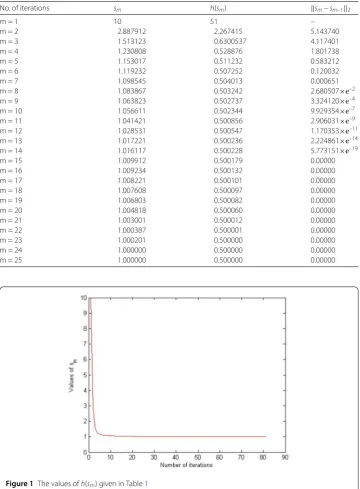
Table 1 Numerical values ofsmandsm–sm–12
No. of iterations sm h(sm) sm–sm–12
m = 1 10 51 –
m = 2 2.887912 2.267415 5.143740
m = 3 1.513123 0.6300537 4.117401
m = 4 1.230808 0.528876 1.801738
m = 5 1.153017 0.511232 0.583212
m = 6 1.119232 0.507252 0.120032
m = 7 1.098545 0.504013 0.000651
m = 8 1.083867 0.503242 2.680507×e–2
m = 9 1.063823 0.502737 3.324120×e–4
m = 10 1.056611 0.502344 9.929354×e–7
m = 11 1.041421 0.500856 2.906031×e–9
m = 12 1.028531 0.500547 1.170353×e–11
m = 13 1.017221 0.500236 2.224861×e–14
m = 14 1.016117 0.500228 5.773151×e–19
m = 15 1.009912 0.500179 0.00000
m = 16 1.009234 0.500132 0.00000
m = 17 1.008221 0.500101 0.00000
m = 18 1.007608 0.500097 0.00000
m = 19 1.006803 0.500082 0.00000
m = 20 1.004818 0.500060 0.00000
m = 21 1.003001 0.500012 0.00000
m = 22 1.000387 0.500001 0.00000
m = 23 1.000201 0.500000 0.00000
m = 24 1.000000 0.500000 0.00000
m = 25 1.000000 0.500000 0.00000
Figure 1The values ofh(sm) given in Table1
It is easy to check thatA,B,Care uniformly continuous and total asymptotically nonex-pansive mappings withG(A)∩G(B)∩G(C)∩G(T) ={1}andhis a proper convex and lower semi-continuous function.
Letam=3m6m–2,bm=711m–3m, andcm=1119mm–7, ands1= 10 is the initial value. Then we obtain numerical results with the error values in Table1.
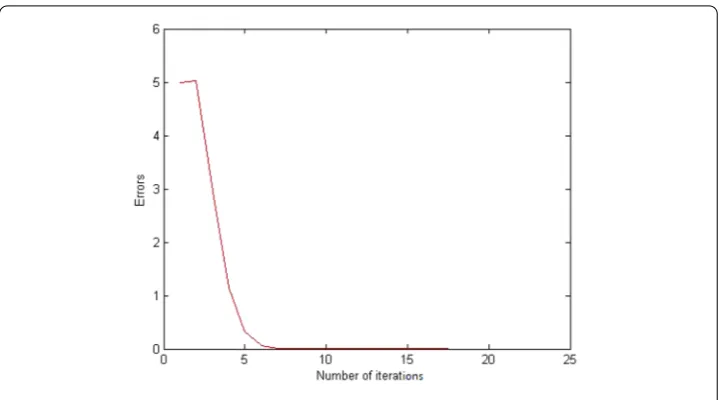
From Table1and Fig.1, we see that the sequence{sm}converges to 1 which is a common
Figure 2The values of errors given in Table1
5 Conclusion
In the above section, we prove the-convergence of a modified proximal point algorithm for common fixed points in a CAT(0) space for generalized nonexpansive mappings which includes a total asymptotically nonexpansive mapping, a multivalued mapping, and a min-imizer of a convex function. Moreover, we have illustrated our result by a numerical ex-ample which supports the-convergence of our proposed algorithm.
Acknowledgements
Not applicable.
Funding
Not applicable.
Abbreviations
Not applicable.
Availability of data and materials
Data sharing not applicable to this paper as no datasets were generated or analyzed during the current study.
Competing interests
The authors declare that they have no competing interests.
Authors’ contributions
Both authors contributed equally and significantly in writing this paper. Both authors read and approved the final manuscript.
Publisher’s Note
Springer Nature remains neutral with regard to jurisdictional claims in published maps and institutional affiliations.
Received: 6 October 2018 Accepted: 18 April 2019
References
1. Martinet, B.: Regularisation dineuations variationnelles par approximations successives. Rev. Fr. Inform. Rech. Oper.4, 154–158 (1970)
2. Rockafellar, R.T.: Monotone operators and the proximal point algorithm. SIAM J. Control Optim.14, 877–898 (1976) 3. Bacak, M.: The proximal point algorithm in metric spaces. Isr. J. Math.194, 689–701 (2013)
4. Ariza-Ruiz, D., Leustean, L., Lopez, G.: Firmly nonexpansive mappings in classes of geodesic spaces. Trans. Am. Math. Soc.366, 4299–4322 (2014)
5. Cholamjiak, P.: The modified proximal point algorithm in CAT(0) spaces. Optim. Lett.9, 1401–1410 (2015) 6. Cholamjiak, P., Abdou, A.A., Cho, Y.J.: Proximal point algorithms involving fixed points of nonexpansive mappings in
7. Cheng, S.S., Yao, J.C., Wang, L., Qin, L.J.: Some convergence theorems involving proximal point and common fixed points for asymptotically nonexpansive mappings in CAT(0) spaces. Fixed Point Theory Appl.2016, 68 (2016) 8. Kitkuan, D., Padcharoen, A.: Strong convergence of a modified SP-iteration process for generalized asymptotically
quasi-nonexpansive mappings in CAT(0) spaces. J. Nonlinear Sci. Appl.9, 2126–2135 (2016) 9. Markin, J.T.: Continuous dependence of fixed point sets. Proc. Am. Math. Soc.38, 545–547 (1973) 10. Nadler, S.B.: Multivalued contraction mappings. Pac. J. Math.30, 475–488 (1969)
11. Shimizu, T., Takahashi, W.: Fixed points of multivalued mappings in certain convex metric spaces. Topol. Methods Nonlinear Anal.8, 197–203 (1996)
12. Chang, S.S., Wang, L., Lee, H.W.J., Chan, C.K., Yang, L.: Demiclosed principle and-convergence theorems for total asymptotically nonexpansive mappings in CAT(0) spaces. Appl. Math. Comput.219, 2611–2617 (2012)
13. Ambrosio, L., Gigli, N., Savare, G.: Gradient Flows in Metric Spaces and in the Space of Probability Measures. Lectures in Mathematics ETH Zurich. Birkhäuser, Basel (2008)