IJPSR (2011), Vol. 2, Issue 9
(Review Article)
Received on 09 May, 2011; received in revised form 29 June, 2011; accepted 17 August, 2011
STIGMASTEROL: A COMPREHENSIVE REVIEW
Navpreet Kaur, Jasmine Chaudhary*, Akash Jain and Lalit Kishore
M. M. College of Pharmacy, M.M. University, Mullana, Ambala, Haryana- 133207, India
ABSTRACT
Extensive research has been carried out from last decades to discover
potential constituents from plant sources. Stigmasterol is an important
constituent and has been isolated from plants. It is involved in the synthesis
of many hormones like progesterone, androgens, estrogens and corticoids. In
addition to stigmasterol many of its derivatives like, spinasterol, fucosterol,
cyasterone, stigmasterol glucoside, fucosterol epoxide, stigma-4en-3one,
29-fluorostigmasterol etc. have been isolated and their pharmacological aspects
has been assessed. This comprehensive account provides information about
stigmasterol and its derivatives. The diversity in their pharmacological
reports reveals that this constituent is worth further investigation.
INTRODUCTION:
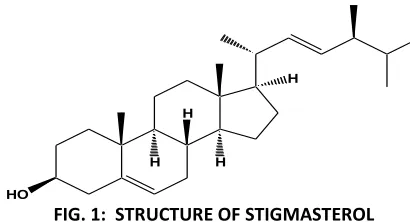
Stigmasterol,
also
known
as
Stigmasterin or Wulzen anti-stiffness factor (
Figure 1
),
an unsaturated plant sterol present in various
medicinal plants. Stigmasterol is utilized in a number of
chemical processes which are designed to yield
numerous synthetic and semi-synthetic compounds for
pharmaceutical industry. It acts as a precursor in the
synthesis of progesterone and acts as an intermediate
in the biosynthesis of androgens, estrogens, corticoids
1
and in the synthesis of vitamin D
32.
H
HO
H H
[image:1.612.55.260.588.699.2]H
FIG. 1: STRUCTURE OF STIGMASTEROL
It was first isolated in Calabarbohne in 1906 by Adolf
Wind Form and A. Hauth
3. Further, it has been
isolated from various medicinal herbs like
Croton
sublyratus
4,
Ficus hirta
5,
Eclipta alba
(L.)
Hassk
6,
Eclipta prostrate
7,
Parkia speciosa
8,
Gypsophila
oldhamiana
9,
Eucalyptus globules
10, Aralia cordata
11,
Emilia sonchifolia
12, Akebia quinata
13, Desmodium
styracifolium
14, Heracleum rapula
15etc.
Stigmasterol
has
been
investigated
for
its
pharmacological prospects such as antiosteoarthritic,
antihypercholestrolemic,
cytotoxicity,
antitumor,
hypoglycaemic, antimutagenic, antioxidant,
anti-inflammatory and CNS effects.
Chemistry:
Stigmasterol is chemically, (3S, 8S, 9S, 10R,
13R, 14S, 17R)-17-[(E, 2R,
5S)-5-ethyl-6-methylhept-3-en-2-yl]-10, 13-dimethyl-2, 3, 4, 7, 8, 9, 11, 12, 14, 15,
16, 17-dodecahydro-1Hcyclopenta[a]phenanthren-3-ol
has been isolated and its presence was confirmed by
performing some reactions like Salkowski and
Liebermann Burchard reaction
16and structure of
stigmasterol was elucidated by IR and NMR. As it is
non-polar in nature, it is isolated from various parts of
the plants by extracting with solvents which are higher
in the ellutropic series i.e., non-polar solvents only.
Keywords:Stigmasterol, Spinasterol,
Fucosterol, Cyasterone, Stigmasterol glucoside, Pharmacological aspects
Correspondence to Author:
Jasmine Chaudhary
It has been found in the petroleum ether extract of
aerial parts of
Ageratum conyzoides
(Asteraceae)
17,
Calotropis gigantean
18, root and aerial part of
Desmodium gangeticum
19, seeds of
Terminalia
chebula
20, petroleum ether extract of aerial parts of
Byrophyllum pinnatum
21, petroleum ether extract of
woody stem of
Abelmoschus manihot
22, hexane
extract of leaves of
Pandanus amaryllifolius
23.
Biosynthesis of phytosterol from mevalonate and
deoxy-xylulose pathway was investigated in the callus
culture of
Croton sublyratus
from the leaf explants. It
was found that biosynthesis was active during the
linear phase of the culture and both pathways
contribute equally.
Feeding of [1-
13C] glucose into the
callus culture at this growth phase showed that the
label from glucose was highly incorporated into both
phytosterols. Isolation of the labelled products
followed by
13C NMR analysis revealed that the
phytosterols had their
13C-labeling patterns consistent
with the acquisition of isoprene units via both the
mevalonate pathway and the deoxy-xylulose pathway
with relatively equal contribution. Since the
biosynthesis of phytosterol has so far been reported to
be mainly from the classical mevalonate pathway, this
study provides new evidence on the biosynthesis of
phytosterols via the novel deoxy-xylulose pathway
4.
Diagrammatic representation of the pathway is shown
in
Figure 2
.
FIG. 2: DIAGRAMMATIC REPRESENTATION OF BIOSYNTHETIC PATHWAY OF STIGMASTEROL IN CROTON SUBLYRATUS
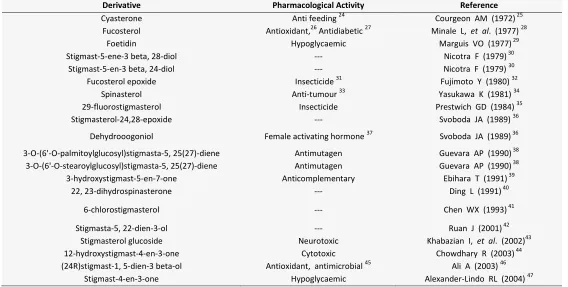
Apart from stigmasterol a number of its derivatives
have also been isolated from plants and their
pharmacological aspects evaluated. These derivatives
along with their pharmacological activities are listed in
[image:2.612.318.585.85.306.2]Table 1
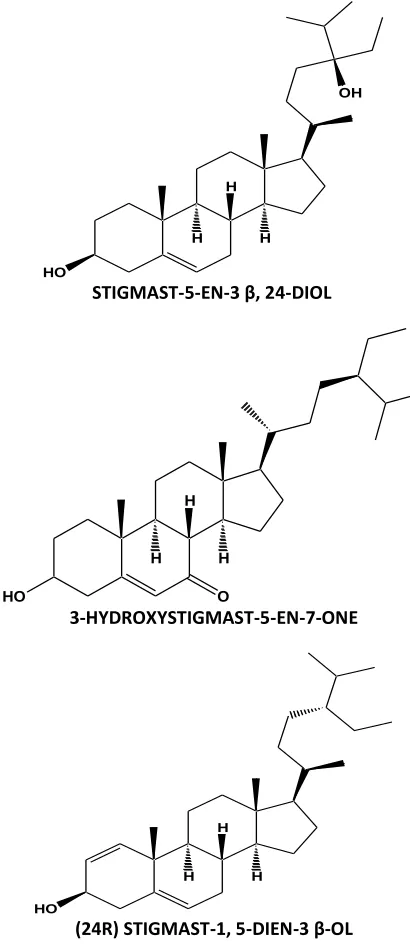
and their structures are shown in
Figure 3
.
TABLE 1: DERIVATIVES OF STIGMASTEROL AND THEIR PHARMACOLOGICAL ACTIVITIES
Derivative Pharmacological Activity Reference
Cyasterone Anti feeding 24 Courgeon AM (1972) 25
Fucosterol Antioxidant,26 Antidiabetic 27 Minale L, et al. (1977) 28
Foetidin Hypoglycaemic Marguis VO (1977) 29
Stigmast-5-ene-3 beta, 28-diol --- Nicotra F (1979) 30
Stigmast-5-en-3 beta, 24-diol --- Nicotra F (1979) 30
Fucosterol epoxide Insecticide 31 Fujimoto Y (1980) 32
Spinasterol Anti-tumour 33 Yasukawa K (1981) 34
29-fluorostigmasterol Insecticide Prestwich GD (1984) 35
Stigmasterol-24,28-epoxide --- Svoboda JA (1989) 36
Dehydrooogoniol Female activating hormone 37 Svoboda JA (1989) 36
3-O-(6'-O-palmitoylglucosyl)stigmasta-5, 25(27)-diene Antimutagen Guevara AP (1990) 38 3-O-(6'-O-stearoylglucosyl)stigmasta-5, 25(27)-diene Antimutagen Guevara AP (1990) 38
3-hydroxystigmast-5-en-7-one Anticomplementary Ebihara T (1991) 39
22, 23-dihydrospinasterone --- Ding L (1991) 40
6-chlorostigmasterol --- Chen WX (1993) 41
Stigmasta-5, 22-dien-3-ol --- Ruan J (2001) 42
Stigmasterol glucoside Neurotoxic Khabazian I, et al. (2002)43
12-hydroxystigmast-4-en-3-one Cytotoxic Chowdhary R (2003) 44
(24R)stigmast-1, 5-dien-3 beta-ol Antioxidant, antimicrobial 45 Ali A (2003) 46
[image:2.612.24.592.451.738.2]HO
H
H H
H
SPINASTEROL
HO
FUCOSTEROL
HO HO
H
O
O
O
H OH
HO H
OH
CYASTERONE
O
H H
H H
O
H OH HO
HO HO
STIGMASTEROL GLYCOSIDE
CH3
CH3
H H
H H3C
H
HO
O
CH3 i-Pr
FUCOSTEROL EPOXIDE
O
H H
H
STIGMASTAN-4EN-3ONE
CH3
CH3
H H3C
HO
F
H
H
H
H
H
29-FLUORO STIGMASTEROL
CH3
CH3
H H3C
H H
H
HO O
3-HYDROXYSTIGMAST-5-EN-7-ONE
CH3
CH3
H H3C
H H
H
O
12-HYDROXYSTIGMAST-4-EN-3-ONE
H
HO
H H
H
Cl
HO
OH
H H
H
STIGMAST-5-EN-3 β, 24-DIOL
O HO
H H
H
3-HYDROXYSTIGMAST-5-EN-7-ONE
HO
H H
H
[image:4.612.55.260.46.521.2](24R) STIGMAST-1, 5-DIEN-3 β-OL
Figure 3: Structures of derivatives of stigmasterol.
PHARMACOLOGICAL STUDIES OF STIGMASTEROL
Anti-osteoarthritic
activity:
Stigmasterol
was
investigated by Gabay O, for its antiosteoarthritic
activity. Newborn mouse chondrocytes and human
osteoarthritis chondrocytes were incubated for 18
hour with or without IL-1β. Then these cells were
incubated for 48 hour with stigmasterol and the results
were compared to the untreated cells. Expression of
various genes involved in the cartilage turn over,
MMP-3, MMP-13, and ADAMTS-4, was elevated after
treatment with IL-1beta for 18 hour and stigmasterol
significantly decrease this effect and hence produces
Anti-hypercholestrolemic activity:
It was found by
Chandler RF that stigmasterol has significant effect on
serum
cholesterol
comparable
with
the
antihypercholestrolemic activity of β-sitosterol. So, this
study concluded that saturation of the side chain, at
least at C22 is important for antihypercholestrolemic
activity
49. Further, Batta AK found that this plant sterol
has been found to compete with cholesterol for
intestinal absorption and thus lower the plasma
concentration of cholesterol. Stigmasterol was
reported to inhibit cholesterol biosynthesis via
inhibition of sterol ∆
24-reductase in human Caco-2 and
HL-60 cell lines thus suppressing hepatic cholesterol
50.
Cytotoxicity:
Stigmasterol, the active constituent of
Cacalia tangutica
, was found to be Cytotoxic to
Spodoptera litura
cells and its action was more marked
in comparison to the other active constituents of the
plant namely, friedelin and rotenone
51.
Gomez MA
stated that stigmasterol in the chloroform extract of
Achillea ageratum
and its cytostatic activity against
Hep-2 and McCoy cells was determined. It showed high
degree of inhibition when compared with 6-
Mercaptopurine against both cultures
52.
Anti-tumor:
Carthami flos
contained stigmasterol
which markedly inhibited the tumour promotion in the
two-stage carcinogenesis experiments
53.
Also Zhijie G
investigated the extracts of
Couepia polyandra
and
Edgeworthia gardneri
revealed the presence of
stigmasterol along with other constituents and
stigmasterol was found to inhibit the lyase activity of
DNA polymerase β and also potentiate the inhibitory
effect of the anti-cancer drug bleomycin in cultured
A549 cells. These actions were a result of an inhibition
of DNA repair synthesis
54.
Hypoglycemic activity and effect on thyroid:
that administration of stigmasterol to mice for 20 days
reduced serum triiodothyronine (T
3), thyroxin (T
4),
glucose concentration and the activity of hepatic
glucose-6-phosphate with a significant increase in
insulin
indicating
its
thyroid
inhibiting
and
hypoglycaemic property
56.
Antioxidant:
Stigmasterol present in bark of
Butea
monosperma
showed decrease in hepatic lipid
peroxidation and increase in the activities of catalase,
superoxide dismutase and glutathione thereby
suggesting its antioxidant property
56.
Antimutagenic activity:
Thorns of
Gleditsia sinensis
was investigated for their active constituents and their
antimutagenic activity. One terpenoid and four
steroids were isolated from the plant out of which
stigmasterol was the most active antimutagen showing
51.2% and 64.2% reduction of the induction factor
against the mutagen MNNG and NQO respectively, in
the SOS chromo test
57.
Anti-inflammatory activity:
Acetone extract of
Sideritis
foetens
was found to contain sterol fractions
composed
of
stigmasterol,
β-sitosterol
and
campesterol. These fractions were evaluated for their
anti-inflammatory activity and they were found to
reduce carrageenan induced paw oedema and also
inhibited
ear
oedema
induced
by
12-O-
tetradecanoylphorbol acetate (TPA) after topical
application
58.
Also, stigmasterol isolated from
Eryngium foetidum
(Apiaceae) was evaluated by Garcia
MD, focussing on auricular oedema induced by
12-O-tetradecanoylphorbol acetate (TPA), by single and
multiple application of phlogistic agent and was found
to reduce oedema. It also exerts a significant topical
anti-inflammatory action
59.
CNS activities:
The petroleum ether extract of aerial
parts of
Celesia coromandeliane
on preparative TLC
gave a fraction which upon IR study revealed that the
compound has structural similarity with stigmasterol
derivatives and this showed significant analgesic
activity as it significantly reduced the number of
writhes and stretches induced in mice by 1.2% acetic
acid solution. Pretreatment with these fractions
caused substantial protection against strychnine- and
leptazol- induced convulsions
60.
Likewise, leaf extract
of
Perilla frutescens
showed sedative activity as a
result of combined effect of stigmasterol and
perillaldehyde. Other combinations of the components
did not show the same results
61.
CONCLUSION:
From the above information it is clear
that stigmasterol and its derivatives are of utmost
importance and is therefore imperative to further
investigate these compounds. Out of numerous
valuable constituents found, stigmasterol is one of the
potential one and has been isolated from many plants
till date and evaluated for many pharmacological and
biological activities. It is jussive that more
pharmacological studies should be conducted to
evaluate the unexploited potential of this constituent.
REFERENCES:
1. Sundararaman P and Djerassi C: A convenient synthesis of progesterone from stigmasterol. J Org Chem 1977; 42 (22): 3633–3634.
2. Kametani T and Furuyama H: Synthesis of vitamin D3 and related compounds. Med Res Rev 1987; 7 (2): 147–171. 3. Wind from A and Hauth A: Over Stigmasterin, a new Phytoserin
from Calabar beans. In: Reports of the German chemical society 1907; 39: 4378-4384.
4. De-Eknamkul W and Potduang B: Biosynthesis of β-sitosterol and stigmasterol in Croton sublyratus proceeds via a mixed origin of isoprene units. Phytochemistry 2003; 62(3): 389-398. 5. Li C, Bu PB, Yue DK and Sun YF: Chemical constituents from
roots of Ficus hirta. Zhongguo Zhong Yao Za Zhi 2006; 31(2): 131-3.
6. Zhang M and Chen Y: Chemical constituents of Eclipta alba (L.) Hassk. Zhongguo Zhong Yao Za Zhi 1996; 21(8): 480-1, 510. 7. Han Y, Xia C, Cheng X, Xiang R, Liu H and Yan Q et al:
Preliminary studies on chemical constituents and pharmacological action of Eclipta prostrata L. Zhongguo Zhong Yao Za Zhi 1998; 23(11): 680-2, 703.
8. Jamaluddin F, Mohamed S and Lajis M: Hypoglycaemic effect of Parkia speciosa seeds due to the synergistic action of β-sitosterol and stigmasterol. Food Chemistry 1994; 49 (4): 339-345.
9. Yang S, Zhong Y, Luo H, Ding X and Zuo C: Studies on chemical constituents of the roots of Gypsophila oldhamiana Miq. Zhongguo Zhong Yao Za Zhi 1999; 24(11): 680-1, 703.
10. Yang XW and Guo QM: Studies on chemical constituents in fruits of Eucalyptus globules. Zhongguo Zhong Yao Za Zhi 2007; 32(6): 496-500.
11. Peng T, Dong X, Deng Y, Tu Y and Li X: Research on chemical ingredients of the root from cultivar Aralia cordata Thunb. Zhong Yao Cai 2005; 28(11): 996-8.
12. Gao JJ, Cheng DL and Liu XP: Chemical constituents of Emilia sonchifolia L. DC. Zhongguo Zhong Yao Za Zhi 1993; 18(2): 102-3, 127.
13. Liu G, Zheng J, Yu Z, Zhang J and Lin R: Study on sterols and triterpenes from the stems of Akebia quinata. Zhong Yao Cai 2005; 28(12): 1060-2.
15. Luu YY, Li L, Zhang C and Xiao YQ: Studies on chemical constituents in roots of Heracleum rapula. Zhongguo Zhong Yao Za Zhi 2006; 31(8): 667-8.
16. Harborne JB: Phytochemical Methods, A Guide to Modern Techniques of Plant Analysis. Chapman and Hall, London, Third Edition 1998, 302.
17. Kamboj A and Saluja AK: Isolation of stigmasterol and β-sitosterol from petroleum ether extract of aerial parts of Ageratum conyzoides (Asteraceae). Int J Pharm Pharm Sci 2011; 3(1): 94-96.
18. Habib MR, Nikkon F, Rahman M, Haque ME and Karim MR: Isolation of stigmasterol and β-sitosterol from methanolic extract of root bark of Calotropis gigantea (Linn). Pak. J. Biol. Sci 2007; 10(22), 2007, 4174-76.
19. Niranjan A and Tewari SK: Phytochemical composition and antioxidant potential of Desmodium gangeticum (Linn.) DC. Natural product radiance 2008; 7(1): 35-39.
20. Sharma A, Meena S and Rishi A: Quantitative estimation of β-sitosterol and stigmasterol in vivo and in vitro Terminalia chebula ritz. International research journal of pharmacy 2011; 2 (3): 115-116.
21. Kamboj A and Saluja AK: Isolation of Stigmasterol from petroleum ether extract of aerial parts of Bryophyllum pinnatum (Crassulaceae). Journal of Pharmacy Research 2010; 3(12): 2802-2803.
22. Jain PS, Bari SB and Surana SJ: Isolation of Stigmasterol and γ-sitosterol from petroleum ether extract of woody stem of Abelmoschus manihot. Asian journal of biological sciences 2009: 1-6.
23. Chong HZ, Asmah R, Abdah Md. A, Norjahan Banu MA, Fauziah O and Gwendoline Ee CL: Chemical analysis of pandan leaves (Pandanus amaryllifolius), IJNPPS 2010; 1(1): 7-10.
24. Xin-nian Z, Jian-feng F, Shan-xue Z and Jian-yong H: Effects of cyasterone on growth and development of diamondback moth, Plutella xylostella (L.) 2001; 8(3): 233-39.
25. Courgeon AM: Action of insect hormones at the cellular level. Morphological changes of a diploid cell line of Drosophila melanogaster, treated with ecdysone and several analogues in vitro. Exp Cell Res 1972; 74(2): 327-36.
26. Lee S, Lee SY, Jung HS, Kang SS and Shin KH: Anti-Oxidant Activities of Fucosterol from the Marine Algae Pelvetia siliquosa. Arch Pharm Res 2003; 26(9): 719-722.
27. Lee YS, Shin KH, Kim BK and Lee S: Anti-Diabetic activities of fucosterol from Pelvetia siliquosa. Arch Pharm Res 2004; 27(11): 1120-1122.
28. Minale L, Riccio R, Scalona O, Sodano G, Fattorusso E and Magno S et al: Metabolism in porifera. VII. Conversion of [7, 7-3H2]-fucosterol into calysterol by the sponge Calyx niceaensis. Experientia 1977; 33(12): 1550-2.
29. Marquis VO, Adanlawo TA and Olaniyi AA: The effect of foetidin from Momordica foetida on blood glucose level of albino rats. Planta Med 1977; 31(4): 367-74.
30. Nicotra F, Ronchetti F, Russo G and Toma L: Role of 24- and 28-hydroxylated intermediates in the metabolism of beta-sitosterol in the insect Tenebrio molitor. Biochem J 1979; 183(3): 495-9.
31. Prestwich GD, Angelastro M, De Palma A and Perino MA: Fucosterol epoxide lyase of insects: synthesis of labelled substrates and development of a partition assay. Anal Biochem 1985; 151(2): 315-26.
32. Fujimoto Y, Morisaki M and Ikekawa N: Stereochemical importance of fucosterol epoxide in the conversion of sitosterol into cholesterol in the silkworm Bombyx mori. Biochemistry
33. Gook-Che J, Myoung-Soon P, Do-Young Y, Chul-Ho S, Hong-Sig S and Soo-Jong U: Antitumor activity of spinasterol isolated from Pueraria roots. Experimental and Molecular Medicine 2005; 37(2): 111-120.
34. Yasukawa K, Yamanouchi S and Takido M: Studies on the constituents in the water extracts of crude drugs. III. On the roots of Stellaria dichotoma L. var. lanceolata Bge. (Author’s transl). Yakugaku Zasshi 1981; 101(1): 64-6.
35. Prestwich GD, Yamaoka R, Phirwa S and DePalma A: Isolation of 2-fluorocitrate produced by in vivo dealkylation of 29-fluorostigmasterol in an insect. J Biol Chem 1984; 259(17): 11022-6.
36. Svoboda JA, Rees HH, Thompson MJ and Hoggard N: Intermediates of stigmasterol metabolism in Spodoptera littoralis. Steroids 1989; 53(3-5): 329-43.
37. McMorris TC, Phu Huu L, Preus MW, Schow SR and Weihe GR: Synthesis of dehydrooogoniol, a female-activating hormone of Achlya. J. Org. Chem 1983; 48 (19): 3370–3372.
38. Guevara AP, Lim-Sylianco C, Dayrit F and Finch P. Antimutagens from Momordica charantia. Mutat Res 1990; 230(2): 121-6. 39. Ebihara T, Kawai T, Kuroyanagi M, Fukushima S and Ueno A:
Studies on the anticomplementary activity of Jozann, Anticomplementary activity of steroid derivatives. Yakugaku Zasshi 1991; 111(6): 299-305.
40. Ding L, Chen Y and Wu F: Constituents of the root of Berneuxia thibetica Decne. Zhongguo Zhong Yao Za Zhi 1991; 16(5): 289-90, 318.
41. Chen WX, Li PY, Wang S, Dong J and Li JZ: Serum cholesterol determined by liquid chromatography with 6-chlorostigmasterol as internal standard. Clin Chem 1993; 39(8): 1602-7.
42. Ruan J, Zhao X, Cassady JM and Stoner GD: Study on the constituents from freeze-dried power of blackberries (Rubus ursinus). Zhong Yao Cai 2001; 24(9): 645-7.
43. Khabazian I, Bains JS, Williams DE, Cheung J, Wilson JM and Pasqualotto BA, et al. Isolation of various forms of sterol beta-D-glucoside from the seed of Cycas circinalis: neurotoxicity and implications for ALS-parkinsonism dementia complex. J Neurochem 2002; 82(3): 516-28.
44. Chowdhury R, Rashid RB, Sohrab MH and Hasan CM: 12alpha-hydroxystigmast-4-en-3-one: a new bioactive steroid from Toona ciliata (Meliaceae). Pharmazie 2003; 58(4): 272-3. 45. Dumlu MU and Gürkan E: A new active compound from
Centaurea species. Z Naturforsch C 2006; 61(1-2): 44-6. 46. Ali A, Abdullah ST, Hammid H, Ali M and Alam MS: A new sterol
from the pseudobulb of Desmotrichum fimbriatum Blume. Pharmazie 2003; 58(5): 361-2.
47. Alexander-Lindo RL, Morrison EY and Nair MG: Hypoglycaemic effect of stigmast-4-en-3-one and its corresponding alcohol from the bark of Anacardium occidentale (cashew). Phytother Res 2004; 18(5): 403-7.
48. Gabay O, Sanchez C, Salvat C, Chevy F, Breton M and Nourissat G, et al: Stigmasterol: a phytosterol with potential anti-osteoarthritic properties. Osteoarthritis Cartilage 2010; 18(1): 106-16.
49. Chandler RF, Hooper SN and Ismail HA: Antihypercholesterolemic studies with sterols: beta-sitosterol and stigmasterol. J Pharm Sci 1979; 68(2): 245-7.
50. Batta AK, Xuab G, Honda A, Miyazaki T and Salen G: Stigmasterol reduces plasma cholesterol levels and inhibits hepatic synthesis and intestinal absorption in the rat. Journal of Pharmaceutical Sciences 2006; 55(3): 292-299.
Ingredients against Musca domestica and Aedes albopictus. Journal of Economic Entomology 2009; 102(4): 1444-1447. 52. Gómez MA, García MD and Sáenz MT: Cytostatic activity of
Achillea ageratum L. Phytotherapy Research 2001; 15(7): 633– 634.
53. Kasahara Y, Kumaki K, Katagiri S, Yasukawa K, Yamanouchi S and Takido M, et al: Carthami flos extract and its component, stigmasterol, inhibit tumour promotion in mouse skin two-stage carcinogenesis. Phytotherapy Research 1994; 8(6): 327-331.
54. Zhijie G, David JM, Larisa MD and Sidney M. Hecht: Inhibitors of DNA polymerase β: Activity and mechanism. Bioorganic & Medicinal Chemistry 2008; 16(8): 4331-4340.
55. Jamaluddin F, Mohamed S and Lajis MN: Hypoglycaemic effect of Parkia speciosa seeds due to the synergistic action of β-sitosterol and stigmasterol. Food Chemistry 1994; 49(4): 339-345.
56. Panda S, Jafri M, Kar A and Meheta BK: Thyroid inhibitory, antiperoxidative and hypoglycemic effects of stigmasterol isolated from Butea monosperma. Fitoterapia 2009; 80 (2): 123-126.
57. Jae-Chul L, Jong Hee P, Milos B, Alexander K, Yeong-Hwan H and Byung-Soo K, et al: Antimutagenic Constituents from the Thorns of Gleditsia sinensis. Chem. Pharm. Bull 2005; 53(5): 561-564.
58. Antonio N, Beatriz DLH and Angel V: Anti-Inflammatory and Immunomodulating Properties of a Sterol Fraction from Sideritis foetens CLEM. Biol. Pharm. Bull 2001; 24(5): 470-473. 59. García MD, Sáenz MT, Gómez MA and Fernández MA: Topical
antiinflammatory activity of phytosterols isolated from Eryngium foetidum on chronic and acute inflammation models. Phytotherapy Research 1999; 13(1): 78–80.
60. Pal DK and Nandi M: CNS activities of Celesia coromandeliane Vahl. in mice. Acta Poloniae Pharmaceutica n Drug Research 2005; 62 (5): 355 -361.
61. Walter BM, Maria CN, Bettina MRP and Nuno AP: Plant natural products active against snake bite- the molecular approach. Phytochemistry 2000; 55: 627-642.