The Thirty-Third AAAI Conference on Artificial Intelligence (AAAI-19)
Deep Reinforcement Learning for Syntactic Error Repair in Student Programs
Rahul Gupta, Aditya Kanade, Shirish Shevade
Department of Computer Science and AutomationIndian Institute of Science Bangalore, KA 560012, India {rahulg, kanade, shirish}@iisc.ac.in
Abstract
Novice programmers often struggle with the formal syntax of programming languages. In the traditional classroom setting, they can make progress with the help of real time feedback from their instructors which is often impossible to get in the massive open online course (MOOC) setting. Syntactic error repair techniques have huge potential to assist them at scale. Towards this, we design a novel programming language cor-rection framework amenable to reinforcement learning. The framework allows an agent to mimic human actions for text navigation and editing. We demonstrate that the agent can be trained through self-exploration directly from the raw in-put, that is, program text itself, without either supervision or any prior knowledge of the formal syntax of the pro-gramming language. We evaluate our technique on a publicly available dataset containing6975erroneous C programs with typographic errors, written by students during an introduc-tory programming course. Our technique fixes1699(24.4%) programs completely and1310(18.8%) program partially, outperforming DeepFix, a state-of-the-art syntactic error re-pair technique, which uses a fully supervised neural machine translation approach.
Introduction
Programming oriented massive open online courses have gained huge popularity in the last few years. Due to the large number of student enrollments in these courses, providing real time personalized feedback is infeasible for instructors. Addressing this issue, a number of automated feedback gen-eration techniques for programming assignments have been developed in recent years. However, most of the existing techniques focus on fixing semantic errors and work only for programs that compile successfully (Piech et al. 2009; Singh, Gulwani, and Solar-Lezama 2013; Kaleeswaran et al. 2016). These techniques require either SAT solving or test execution, both of which are not possible for the programs with syntactic errors.
Programmers rely on compilers to get feedback for syn-tactic errors. However, compiler error messages do not al-ways localize the errors accurately and are often difficult to understand (Traver 2010). This makes syntactic errors very time consuming to fix and a major learning hurdle for stu-dents of introductory programming courses.
Copyright c⃝2019, Association for the Advancement of Artificial Intelligence (www.aaai.org). All rights reserved.
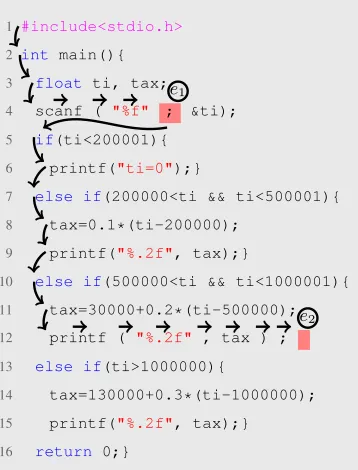
Figure 1 illustrates an erroneous programming submis-sion implementing a tax calculation algorithm in an intro-ductory course on C programming. It has two syntactic er-rors: (1) incorrect use of semicolon within thescanf func-tion call in line 4 and (2) a missing closing brace at the end of line 12. The Clang compiler generates the following error message for it:
ex.c:4:12: error: expected ’)’
scanf("%f"; &ti); ˆ
ex.c:4:7: note: to match this ’(’
scanf("%f"; &ti); ˆ
ex.c:4:17: error: extraneous ’)’ before ’;’
scanf("%f"; &ti); ˆ
ex.c:13:2: error: expected expression
else if(ti>1000000){
ˆ
ex.c:16:12: error: expected ’}’
return 0;}
ˆ
ex.c:2:11: note: to match this ’{’ int main(){
ˆ
4 errors generated.
Note that the above error message does not pinpoint either of the errors precisely1. While the error message may be suffi-ciently helpful for an expert programmer, a novice program-mer may even end up introducing more errors in the program by following the suggested fixes.
Our aim in this work is to develop a syntactic error re-pair technique that can assist novice programmers by auto-matically correcting common syntactic errors in programs. When faced with an error, a programmer navigates through the program text to arrive at a possible location of error and then performs an edit to fix the error. Intuitively, this is like playing a game, in which an agent starts with an incorrect program as initial state and takes navigation and edit actions to reach the goal state (error-free program).
Deep reinforcement learning has enjoyed great success in
1
1 #include<stdio.h>
2 int main(){
3 float ti, tax;
4 scanf ( "%f" ; &ti); e1
5 if(ti<200001){
6 printf("ti=0");}
7 else if(200000<ti && ti<500001){
8 tax=0.1*(ti-200000);
9 printf("%.2f", tax);}
10 else if(500000<ti && ti<1000001){
11 tax=30000+0.2*(ti-500000);
12 printf ( "%.2f" , tax ) ; e2
13 else if(ti>1000000){
14 tax=130000+0.3*(ti-1000000);
15 printf("%.2f", tax);}
16 return 0;}
Figure 1: An erroneous program and the sequence of actions taken by a trained agent to fix it: The error locations are highlighted in the red color. The arrows show how the agent navigates over the program text. The edit actions are marked bye1ande2.
training agents to play visual and text-based games at expert levels (Mnih et al. 2015; Narasimhan, Kulkarni, and Barzi-lay 2015; Wu and Tian 2016). Inspired by this, we approach this problem through deep reinforcement learning. We pro-pose a novel programming language correction framework, in which an agent can mimic these actions. While the agent can access and modify the program text, the compiler which checks syntactic validity of the program text is a black-box for the agent. As noted above, compilers usually do not pin-point error locations precisely. Hence, we do not rely on a compiler to aid in error localization or correction. Instead, we design a reward function using only thenumberof error messages generated by the compiler. The goal of the agent is to perform edits necessary for successful compilation of the program.
To see our framework in action, consider the example C program shown in Figure 1 again. This program is given to atrainedagent which has not seen it during training. The program is presented in a tokenized form to the agent and the cursor position of the agent is initialized to the first to-ken in the program. The navigation actions of the agent over the program text are shown by arrows. As shown by the se-quence of actions taken by the agent in Figure 1, the agent correctly localizes and fixes both the errors. First, the agent navigates to the error location at line 4 and replaces the in-correct semicolon with a comma (marked bye1). Next, it
navigates to the error location at line 12 and inserts the miss-ing closmiss-ing brace (marked bye2). After these edits, the
pro-gram compiles successfully and the agent stops. In
compari-son, a brute-force search will have to enumerate all possible edited versions of the program with up to two simultaneous edits and compile each of them to identify the right edits. This will be far more computationally expensive than using the agent. A video demonstration of this example is available at:https://youtu.be/kNtBT1fgJ-0
We represent the program text, augmented with the po-sition of the cursor as a sequence of tokens which is then embedded using a long short-term memory (LSTM) net-work (Hochreiter and Schmidhuber 1997). The agent is al-lowed a set of navigation and edit actions to fix the pro-gram. It receives a small reward for every edit action which fixes some compiler error and the maximum reward is given for reaching the goal state, which is a compiler error-free version of the program. The control policy of the agent is learned using the asynchronous advantage actor-critic (A3C) algorithm (Mnih et al. 2016).
Training an agent in this setting is non-trivial. As illus-trated by the example above, the agent needs to both localize the errors and make precise edits at the error locations to be able to fix a program. A wrong edit only makes the program worse by introducing more errors and consequently, makes the task even more difficult. To overcome this, we configure the environment to reject all the edits that do not reduce the number of compilation errors. This significantly prunes the state space that an agent is allowed to explore, allowing it to train in a reasonable amount of time. This also prevents an agent from performing arbitrary edits such as deleting erro-neous lines. We call our techniqueRLAssist.
DeepFix (Gupta et al. 2017) is a state-of-the-art, end-to-end syntactic error repair technique. We compare RLAs-sist with DeepFix on the task of fixing typographic er-rors in6975C programs from a publicly available dataset. These programs were written by students during an intro-ductory programming course and span 93 different pro-gramming problems (Gupta et al. 2017; Das et al. 2017). These programs use non-trivial constructs of the C lan-guage such as conditionals, switch statements, nested loops, multi-dimensional arrays, multiple procedures, and recur-sion. DeepFix uses a fully supervised neural machine trans-lation approach.
In contrast, RLAssist is a deep reinforcement learning based technique. We demonstrate that RLAssist outperforms DeepFix, although it is trained through self-exploration us-ing erroneous programs only, i.e., without any supervision. RLAssist fixes24.4%programs from the test set completely and resolves 35.1% error messages. Relative to DeepFix, this is an improvement of4.6%and13.8%respectively. We further show that we can accelerate the training of RLAssist by a factor of5by leveraging expert demonstrations for only one tenth of the training dataset. The main contributions of this work are as follows:
1. We design a novel framework for programming language correction amenable to reinforcement learning and train our agent using A3C.
of thousands of C programs.
3. We achieve more than5×training speedup for RLAssist using expert demonstrations for only one tenth of its train-ing data.
4. We provide the source code of RLAssist online at:https: //bitbucket.org/iiscseal/rlassist.
Background
Reinforcement Learning
In reinforcement learning, an agent interacts with its en-vironment over a number of discrete time steps. At each time stept, the environment presents a statest ∈ S to the agent. In response, the agent selects an actionatfrom the set of allowed actionsA. This selection is controlled by the agent’s policyπ(a|s) = P r{at = a|st = s}. The action is passed on to the environment and its execution may mod-ify the internal state of the environment. The agent then re-ceives the updated statest+1 and a scalar reward rt. This interaction, which is also called an episode, stops when the agent reaches a goal state. The objective of the agent is to maximize the expected sum of discounted future rewards Gtfrom each state st. For an episode terminating at time step T, Gt = ∑
T−t−1
k=0 γ
kr
t+k, where the discount rate γ∈(0,1](Sutton and Barto 1998).
Asynchronous Advantage Actor-Critic (A3C)
One of the many ways to solve an RL problem is to use policy gradient methods. These methods learn a parameter-ized policyπ(a|s;θ), whereθrepresents the parameters of a function approximator, such as a neural network. One ex-ample of policy gradient methods is the actor-critic meth-ods, which learn bothπ(a|s;θ), the ‘actor’, and the value functionV(s;w), the ‘critic’. Here,V(s;w)defines the ex-pected reward from states, withwbeing the parameters of a function approximator. The critic evaluates how advanta-geous is it to be in the new state reached by taking an ac-tionatsampled from the distribution given byπ(st). Based on this evaluation, the parameterized policy is updated us-ing an appropriate optimization technique such as gradient ascent (Sutton and Barto 1998).The A3C algorithm uses multiple asynchronous parallel actor-learner threads to update a shared model, stabilizing the learning process by reducing the correlation of an agent’s experience. It has also been observed to reduce training time by a factor that is roughly linear in the number of parallel actor-learners (Mnih et al. 2016). We use A3C in this work.
Technical Details
A Framework for Programming Language
Correction Tasks
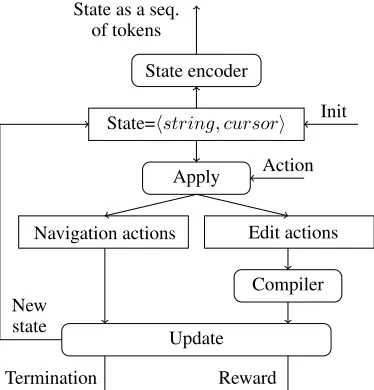
When faced with an error, a programmer navigates the pro-gram text to arrive at the location of error and then performs an edit operation to fix the error. In the presence of multiple errors, the programmer can repeat these steps. We present a programming language (PL) correction framework in which an agent can mimic these actions. Figure 2a shows the block
diagram of our PL correction framework. We now describe the components of this framework and their instantiation for our task of correcting syntax errors in C programs.
States A state is a pair ⟨string, cursor⟩, where string is the program text, and cursor ∈ {1, . . . , len(string)}, where len(string) denotes the number of tokens in the string. The environment also keeps track of the number of errors instring. These errors can either be determined from the ground truth whenever available or estimated using the error messages generated by a compiler upon compiling the string. For compilation, we use the GNU C compiler.
We encode the state into a sequence of tokens as follows. First, we convert the programstringinto a sequence of lex-emes. The lexemes are of different types, such as keywords, operators, types, functions, literals, and variables. In addi-tion, we also retain line-breaks as lexemes to allow two-dimensional navigation actions over the program text. We use a special token to representcursor, which is inserted in the sequence of lexemes right after the token whose index is held bycursor.
Next, we build a shared vocabulary across all pro-grams. Except some common functions such as printf
andscanf, all other function and variable identifiers are mapped to a special token ID. Similarly, all the literals are mapped to special tokens according to their type, e.g., num-bers to NUMand strings toSTR. All remaining tokens are retained without any modifications. This mapping reduces the size of the vocabulary seen by the agent.
Note that this encoding is only required for feeding the state to the agent. The actions predicted by the agent based on this encoding are executed by the environment on the original programstring.
Actions and Transitions The agent actions are divided into two categories, the first which update the cursorand the second which modify thestring. We refer to the first cat-egory of actions asnavigation actionsand the latter asedit actions. The navigation actions allow an agent to navigate through thestring. These actions only change thecursor of a state and not thestring. The edit actions on the other hand, are used for error correction. They only modify the string and not thecursor. Wrong edit actions introduce more errors in thestringrather than fixing them. An edit ac-tion is categorized as wrong if it does not reduce the number of error messages in the programstring. We configure the environment to reject all such edits to prune the state space from which fixing the program becomes even more difficult. This also prevents an agent from performing arbitrary edits such as deleting erroneous lines.
For our task, we allow only two navigation actions,
move rightandmove down. These set thecursorto the next token on the right or to the first token of the next line respec-tively. Themove right(respectively,move down) action has no effect if thecursor is already set to the last token of a line (respectively, any token of the last line). Note that the
State as a seq. of tokens
State encoder
State=⟨string, cursor⟩ Init
Action Apply
Navigation actions Edit actions
Compiler New
state
Update
Termination Reward
(a) PL correction framework.
Input state
x1 x2 xn
LSTM
y1 y2 yn
Mean pooling layer
State embedding
Linear layer1 Linear layer2
Softmax
Loss π(a|s) V(s)
Reward
(b) RLAssist agent.
Figure 2: Design of RLAssist.
navigation actions low.
Based on our study of common typographic errors that novice programmers make, we design three types of edit ac-tions. The first is a parameterizedinsert tokenaction which inserts the parametertoken immediately before thecursor position. The parameter can be any token from a fixed set of tokens which we callmutable tokens. The second is the
deleteaction, which deletes the token at thecursorposition. However, the token is deleted only if it is from the set of mu-table tokens. We restrict the set of mumu-table tokens to the fol-lowing five types of tokens: semicolon, parentheses, braces, period, and comma. The third edit action is a parameterized
replace token1 with token2action which replacestoken1at the cursor position withtoken2. We have the following four actions in this class: (1)replace ‘;’ with ‘,’, (2)replace ‘,’ with ‘;’, (3)replace ‘.’ with ‘;’, and (4)replace ‘;)’ with ‘);’. Although atomic replacement actions can be substi-tuted with a sequence of delete and insert actions, having them prevents the cases where the constituent delete and/or insert actions can be rejected by the environment.
Episode, Termination, and Rewards An episode starts with an erroneous program text asstring and thecurosr set to its first token. The goal state is reached when the edited program compiles successfully. An agent is allowed max episode len number of discrete time steps to reach the goal state in an episode after which the episode is ter-minated. Also, the agent is allowed only one pass over the program in an episode, i.e., once the agent navigates past the last token of a program, the episode is termi-nated. In each step, the agent is penalized with a small step penaltyin order to encourage it to learn to fix a pro-gram in the minimum number of steps. The agent is given maximum reward for reaching the goal state. Also, a smallintermediate rewardis given for taking an edit ac-tion that fixes at least one error.
Model
We use the A3C algorithm for the programming language correction task. Figure 2b shows the block diagram of our agent. Our model first uses a long short-term mem-ory (LSTM) (Hochreiter and Schmidhuber 1997) network for embedding the tokenized state into a real vector. The LSTM network maps each token xi of an input sequence (x1, . . . , xn)to a real vectoryi. The final state embedding is calculated by taking an element-wise mean over all the out-put vectors (y1, . . . , yn)following (Narasimhan, Kulkarni, and Barzilay 2015). Given this state embedding, we use two separate fully connected linear layers to produce the policy functionπ(a|s;θ), and the value functionV(s;w)outputs. Finally, before updating the network parameters, the gradi-ents are accumulated using the following rules:
dθ←dθ+∇θ′logπ(at|st;θ′)(R−V(st;w′))
+β∇θ′H(π(st;θ′))
dw←dw+∇w′(R−V(st;w′))2
whereR = ∑k−1
i=0γ
ir
t+i +γkV(st+k;w′),H is the en-tropy, andβis a hyperparameter to control the weight of the entropy regularization term;θ′andw′are the thread specific parameters corresponding toθandwrespectively (Mnih et al. 2016).
Experiments
Dataset
Dataset statistics Technique Results
Erroneous Error Avg. Completely Partially Error
programs msgs. tokens fixed fixed messages
programs programs resolved
DeepFix 1625(23.3%) 1129(16.2%) 5156(30.8%) 6975 16766 203 RLAssist 1699(24.4%) 1310(18.8%) 5884(35.1%) RLAssist+Demo 1854(26.6%) 1426(20.4%) 6652(39.7%)
Table 1: Summary of the test dataset and performance comparison of DeepFix, RLAssist, and RLAssist+Demo on it for typo-graphic errors. Note that we take the most recent version of the dataset and improved results for DeepFix from its webpage:
https://bitbucket.org/iiscseal/deepfix.
fold, the correct programs for the 4/5th of the programming problems are used to generate about 165K training exam-ples. Each correct programxis mutated to generate up to five training examples of the form(x′, y′), wherex′is the mutated program andy′is the required correction to it. The erroneous programs for the remaining 1/5th of the program-ming problems are used for testing without any modifica-tion. Summed across all the folds, the test set contains6975 erroneous programs with16766compilation error messages, as shown in Table 1. This experimental setup requires a learning algorithm to learn the syntactic validity as per the language syntax so that it can generalize to unseen program-ming problems.
For our experiments, we use the same experimental setup as DeepFix. However, we use only the incorrect pro-grams (x′) from the training dataset and discard the corre-sponding fixes (y′).
Experiment Configuration and Training
We implement our technique in Tensorflow (Abadi et al. 2016). We find a suitable configuration of the PL correction framework and the learning model for our task through ex-perimentation. In particular, the LSTM encoder in our model has two recurrent layers with128 cells each. Our vocabu-lary has91tokens, which are embedded into24-dimensional vectors. We set the discounting factorγ = 0.99, the maxi-mum number of exploration steps before a neural network parameter update is madetmax = 24, and entropy regular-ization factorβ= 0.01. The LSTM encoder for state embed-ding and the policy network are trained together in an end-to-end manner. We use32parallel agents, and a learning rate of0.0001for optimizing our model using the ADAM opti-mizer (Kingma and Ba 2014). We also use gradient clipping to prevent the gradients from exploding (Pascanu, Mikolov, and Bengio 2013). We configure the PL correction frame-work for our task by setting max episode len = 100, step penalty = −0.01, maximum reward = 1, and intermediate reward = 0.02. We train RLAssist for30 epochs (1 epoch ≈165K episodes), which takes 3 weeks on an Intel(R) Xeon(R) E5-2630 v4 machine, clocked at 2.20GHz with 32GB of RAM.
Evaluation
In this section, we first discuss the training performance of RLAssist. Next, we discuss how we can accelerate the
train-ing of RLAssist by leveragtrain-ing only a small amount of expert demonstrations. Later, we compare it with DeepFix on the test dataset described earlier.
Training Performance of RLAssist In order to evaluate the training performance of RLAssist, we use the following metrics: (1) the percentage of error messages resolved, (2) the average episode length, (3) the average number of edit actions, and (4) the average reward obtained by the agent as the training progresses. We report the training performance on one of the folds. For ease of plotting, the average reward shown in the figures is scaled by a factor of100. Figure 3a illustrates the training performance of RLAssist.
RLAssist learns to solve the task very well and is able to resolve about 90% of the error messages after training for about four million episodes. In the last epoch of train-ing, the agent reaches the goal state for79%of the episodes. Furthermore, it manages to resolve36% of the error mes-sages for the programs corresponding to the remaining21% episodes. At the same time, the average scaled reward also reaches the maximum of about 30 from−100, the scaled reward obtained at the beginning of the training. The maxi-mum scaled reward is almost always less than100because of the penalty that the agent incurs for navigating to the er-ror location. The average length of an episode comes down to54from the maximum allowed episode length of100 con-sisting about27navigation and28edit actions. This is much smaller than what a systematic brute-force search would re-quire in a combinatorial search space. For the79% of the programs that RLAssist fixes in the last epoch, the average number of rejected edit actions per episode is only about5. This shows that RLAssist not only learns to fix a program but it also learns to do so by taking reasonably precise navi-gation and edit actions.
Accelerating Training with Expert Demonstrations Re-inforcement learning tends to be slow for the tasks with large state spaces as the time required for gathering infor-mation by state exploration increases. One way to mitigate this problem is to guide the agent with expert demonstra-tions (Argall et al. 2009). Motivated by this, we further de-sign a scheme to enable the agent to take advantage of expert demonstrations.
ac-0 1 2 3 4 5
−100
−50 0 50 100
fix% reward epLen edits
(a) RLAssist
0 0.5 1 1.5
−100
−50 0 50 100
fix% reward epLen edits
(b) RLAssist+Demo
Figure 3: Training performance of RLAssist and RLAssist+Demo. The X-axis shows the number of training episodes in millions. epLen and fix% stand for episode length and the percentage of error messages resolved, respectively.
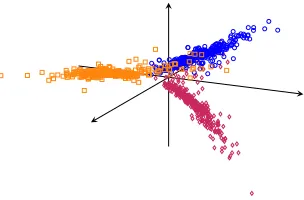
Figure 4: PCA projection of embeddings of350programs in three different states. The first, the second, and the third states (defined in the text) are shown by diamonds, squares, and circles, respectively.
tions provided, instead of sampling driven by the policy. The updates to the policy network parameters are made as if the predetermined action was sampled. For the rest of the episodes, the agent takes the actions sampled using the policy, following the standard A3C algorithm. We derive demonstrations forone tenthof training programs from their fixes. Additionally, we add a smalledit penaltyto discour-age the discour-agent from taking unnecessary edit actions. We refer to this configuration asRLAssist+Demo.
As shown in Figure 3b, RLAssist+Demo benefits im-mensely from the demonstrations and starts making visible progress after training for only0.2 million episodes com-pared to1.2million episodes for RLAssist. It resolves about 90%of the error messages after training for about a million episodes,3millions episodes earlier than RLAssist. The ad-ditionaledit penalty also helps in reducing the number of average edit actions per episode by a factor of3. Note that RLAssist fails to train withedit penaltyas it stops explor-ing edit actions very early in the trainexplor-ing due to more nega-tive reward.
This shows that while RLAssist is able to train with er-roneous programs alone, it can benefit when even a small amount of labeled data (i.e., erroneous programs and their fixes) is available. We train RLAssist+Demo for10epochs, which takes about 4 days on the same machine used for
Completely Partially Completely fixed fixed or partially programs programs fixed programs
DeepFix∗ 264 247 398
RLAssist∗ 335 428 650
Table 2: Comparison of DeepFix and RLAssist on the num-ber of programs fixed∗exclusivelyby each technique.
RLAssist, achieving more than 5 times speedup in train-ing time. In our experiments, we observed that ustrain-ing more demonstrations did not result in significant speedup in train-ing while reductrain-ing the demonstrations slowed it down.
Comparison with DeepFix In Table 1, we show the comparison of RLAssist and RLAssist+Demo with Deep-Fix (Gupta et al. 2017) on the test dataset. For this com-parison, we use the number of error messages resolved, and completely and partially fixed programs; the same metrics as reported in (Gupta et al. 2017). Further in Table 2, we also report the number of programs which are fixed exclusively by DeepFix or RLAssist.
As shown in Table 1, the test dataset has16766error mes-sages from 6975 erroneous programs out of which Deep-Fix resolves 5156 error messages, fixing 1625 programs completely and 1129partially. RLAssist resolves 5884 er-ror messages, fixing 1699 programs completely and 1310 partially. Thus RLAssist outperforms DeepFix by a relative margin of13.8%and4.6%in terms of error messages re-solved and completely fixed programs, respectively. Relative to DeepFix, the percentage of programs fixed partially by RLAssist is15.2%higher. At test time, both RLAssist and DeepFix take less than a second to fix a program. RLAs-sist+Demo performs even better and resolves 6652 error messages, fixing1854programs completely and1426 par-tially. It outperforms DeepFix by a relative margin of29% and 14.1%in terms of error messages resolved and com-pletely fixed programs, respectively. Relative to DeepFix, it fixes26.3%more programs partially.
it works at a finer token-level granularity compared to the coarser line-level granularity of DeepFix. RLAssist can edit an incorrect line in place, whereas DeepFix has to produce a complete replacement of the erroneous line. This requires it to copy the correct token subsequences from the input while simultaneously rectifying the erroneous tokens. Another rea-son is that DeepFix halts when it cannot fix a line, i.e., if it fails to fix an erroneous line, it cannot fix the subsequent erroneous lines. This limitation arises because of the iter-ative nature of DeepFix. If a fix suggested by DeepFix is accepted by the compiler, the fix is applied and the updated program is shown to DeepFix to identify the next fix. How-ever, if it is rejected, the iterative procedure stops. RLAssist, on the other hand, does not have this limitation. If the action taken by the agent is rejected by the environment, it takes the next highest probability action and continues to attempt other fixes.
Embedding Visualization We select 350 test programs containing only one error per program. Next, we get embed-dings corresponding to the following three states of each of these programs: (1) when the cursor is set to the first token of the line preceding the erroneous line, (2) when the cursor is set to the first token of the erroneous line, and (3) when the cursor is set to the error location and the program has been fixed. Figure 4 shows the first three principal components of these embeddings. It can be seen that the three states form three distinct clusters with almost no overlap. This shows that RLAssist’s encoder learns to capture not only the syn-tactic validity of the programs but also the location of the errors in them.
Related Work
Natural language correction is a well researched problem. Some of the earlier works in this area have focused on identifying and correcting specific types of grammatical er-rors such as misuse of verb forms, articles, and prepositions (Han, Chodorow, and Leacock 2006; Chodorow, Tetreault, and Han 2007; Rozovskaya and Roth 2010). The more re-cent works consider a broader range of error classes, often relying on language models, and machine translation (Ng et al. 2014; Rozovskaya et al. 2014). Although natural lan-guages and programming lanlan-guages are similar to some extent, the latter have procedural interpretation and richer structure.
Due to the huge popularity of programming oriented mas-sive open online courses (MOOCs), recent years have seen increasing interest in developing automated techniques for syntactic error repair in student programs. sk p (Pu et al. 2016) andSynFix(Bhatia, Kohli, and Singh 2018) learn syn-tactic error repair limited to a specific programming problem by training neural networks on the correct submissions of the same problem. Therefore, unlike RLAssist, these techniques cannot be used for real time feedback generation for novel programming problems as they need to train their model for each problem separately. TRACER (Ahmed et al. 2018) uses both hand designed abstractions and supervised learn-ing techniques for learnlearn-ing error correction models on ab-stract statements. It takes only an incorrect statement as its
input, and consequently fails to handle many frequent errors requiring global context such as opening/closing a missing brace. RLAssist, on the other hand, takes complete program as input and does not suffer from this limitation. While Syn-Fix and TRACER use compiler based heuristics, sk p per-forms a brute force, enumerative search for localizing errors. DeepFix (Gupta et al. 2017) is a state-of-the-art, end-to-end, supervised syntactic error repair technique. It is more general than the previous three techniques as it learns to predict both the error locations and the fixes without rely-ing on any heuristics. We propose a reinforcement learnrely-ing framework in which an agent can learn syntactic error repair directly from raw program text through self-exploration, i.e. without any supervision.
Syntactic error repair techniques for student programs are useful for not only students but also instructors. A recent study (Yi et al. 2017) noted that automated program repair techniques can be used by human graders to decrease the amount of grading time.GradeIT(Parihar et al. 2017) uses simple rewrite rule based syntactic error repair to grade sub-missions that do not compile. Integrating our technique can further improve the performance of such systems.
Through deep reinforcement learning, agents have been trained to play visual and text-based games at expert lev-els (Mnih et al. 2015; Narasimhan, Kulkarni, and Barzi-lay 2015; Wu and Tian 2016). At a high level, our prob-lem is similar to text-based games in which both the state space and cues for completing the quest are given in a tex-tual form (Narasimhan, Kulkarni, and Barzilay 2015). How-ever, the state space in these games is manually created by their developers and is of small size. Similarly, the transi-tions between states is also constrained. In contrast, the state space for our problem is combinatorial in the size of a given program. Training an agent is challenging in this large state space, which we overcome by constraining the agent to ex-plore only those states which take it closer to the goal state.
Learning from demonstration (LfD) approaches train an agent using expert demonstrations. Behavioral cloning (Ross, Gordon, and Bagnell 2011) is one particular class of LfD techniques to make the agent mimic expert demonstrations using supervised learning. We complement the self-exploration with expert demonstrations to accelerate the training. Inverse reinforcement learning is another class of LfD techniques. These use demonstrations to first infer a reward function which is then used to learn the pol-icy (Abbeel and Ng 2004). These methods have been used for the tasks where there is no obvious reward function, e.g., autonomous driving (Abbeel and Ng 2004) and acrobatic helicopter maneuvers (Abbeel et al. 2007). For our task, the rewards are well defined and can be calculated easily.
Conclusions and Future Work
train-ing. Moreover, we show that RLAssist trains much faster and converges to a better policy when expert demonstrations are available for as little as one tenth of its training data.
RLAssist is programming language agnostic and has been evaluated on C programs. In future, we will experiment with other programming languages as well. We plan to extend RLAssist to target more classes of errors, and devise RL algorithms that can learn and exploit deeper syntactic and semantic properties of programs.
Acknowledgments
We thank Sonata Software Ltd. for partially funding this work. We also thank the anonymous reviewers for their help-ful feedback.
References
Abadi, M.; Barham, P.; Chen, J.; Chen, Z.; Davis, A.; Dean, J.; Devin, M.; Ghemawat, S.; Irving, G.; Isard, M.; et al. 2016. Ten-sorflow: A system for large-scale machine learning. InProceedings of the 12th USENIX Symposium on Operating Systems Design and Implementation, volume 16, 265–283.
Abbeel, P., and Ng, A. Y. 2004. Apprenticeship learning via inverse reinforcement learning. InProceedings of the 21st International Conference on Machine Learning, 1.
Abbeel, P.; Coates, A.; Quigley, M.; and Ng, A. Y. 2007. An application of reinforcement learning to aerobatic helicopter flight. InAdvances in neural information processing systems, 1–8. Ahmed, U. Z.; Kumar, P.; Karkare, A.; Kar, P.; and Gulwani, S. 2018. Compilation error repair: for the student programs, from the student programs. InProceedings of the 40th International Con-ference on Software Engineering: Software Engineering Education and Training, 78–87.
Argall, B.; Chernova, S.; Veloso, M.; and Browning, B. 2009. A survey of robot learning from demonstration. Robotics and Au-tonomous Systems67:469–483.
Bhatia, S.; Kohli, P.; and Singh, R. 2018. Neuro-symbolic program corrector for introductory programming assignments. In Proceed-ings of the 40th International Conference on Software Engineering, 60–70.
Chodorow, M.; Tetreault, J. R.; and Han, N.-R. 2007. Detection of grammatical errors involving prepositions. InProceedings of the 4th ACL-SIGSEM workshop on prepositions, 25–30.
Das, R.; Ahmed, U. Z.; Karkare, A.; and Gulwani, S. 2017. Pru-tor: A system for tutoring cs1 and collecting student programs for analysis. https://www.cse.iitk.ac.in/users/karkare/prutor/.
Gupta, R.; Pal, S.; Kanade, A.; and Shevade, S. 2017. DeepFix: Fixing common c language errors by deep learning. InProceedings of the 31st AAAI Conference on Artificial Intelligence, 1345–1351. Han, N.-R.; Chodorow, M.; and Leacock, C. 2006. Detecting errors in English article usage by non-native speakers.Natural Language Engineering12(2):115–129.
Hochreiter, S., and Schmidhuber, J. 1997. Long short-term mem-ory.Neural computation9(8):1735–1780.
Kaleeswaran, S.; Santhiar, A.; Kanade, A.; and Gulwani, S. 2016. Semi-supervised verified feedback generation. InProceedings of the 24th ACM SIGSOFT International Symposium on Foundations of Software Engineering, 739–750.
Kingma, D. P., and Ba, J. 2014. Adam: A method for stochastic optimization.arXiv preprint arXiv:1412.6980.
Mnih, V.; Kavukcuoglu, K.; Silver, D.; Rusu, A. A.; Veness, J.; Bellemare, M. G.; Graves, A.; Riedmiller, M.; Fidjeland, A. K.; Ostrovski, G.; Petersen, S.; Beattie, C.; Sadik, A.; Antonoglou, I.; King, H.; Kumaran, D.; Wierstra, D.; Legg, S.; and Hassabis, D. 2015. Human-level control through deep reinforcement learning.
Nature518(7540):529–533.
Mnih, V.; Badia, A. P.; Mirza, M.; Graves, A.; Lillicrap, T.; Harley, T.; Silver, D.; and Kavukcuoglu, K. 2016. Asynchronous meth-ods for deep reinforcement learning. InProceedings of the 33rd International Conference on Machine Learning, 1928–1937. Narasimhan, K.; Kulkarni, T. D.; and Barzilay, R. 2015. Lan-guage understanding for text based games using deep reinforce-ment learning. InProceedings of the Conference on Empirical Methods in Natural Language Processing, 1–11.
Ng, H. T.; Wu, S. M.; Briscoe, T.; Hadiwinoto, C.; Susanto, R. H.; and Bryant, C. 2014. The CoNLL-2014 shared task on grammatical error correction. InCoNLL Shared Task, 1–14.
Parihar, S.; Dadachanji, Z.; Singh, P. K.; Das, R.; Karkare, A.; and Bhattacharya, A. 2017. Automatic grading and feedback using pro-gram repair for introductory propro-gramming courses. InProceedings of the ACM Conference on Innovation and Technology in Computer Science Education, 92–97.
Pascanu, R.; Mikolov, T.; and Bengio, Y. 2013. On the difficulty of training recurrent neural networks. InInternational Conference on Machine Learning, 1310–1318.
Piech, C.; Huang, J.; Phulsuksombati, M.; Sahami, M.; and Guibas, L. 2009. Learning program embeddings to propagate feedback on student code. InProceedings of the 26th Annual International Conference on Machine Learning, 961–968.
Pu, Y.; Narasimhan, K.; Solar-Lezama, A.; and Barzilay, R. 2016. sk p: a neural program corrector for moocs. InCompanion Pro-ceedings of the 2016 ACM SIGPLAN International Conference on Systems, Programming, Languages and Applications: Software for Humanity, 39–40.
Ross, S.; Gordon, G. J.; and Bagnell, D. 2011. A reduction of imita-tion learning and structured predicimita-tion to no-regret online learning. InProceedings of the 14th International Conference on Artificial Intelligence and Statistics, 627–635.
Rozovskaya, A., and Roth, D. 2010. Generating confusion sets for context-sensitive error correction. InProceedings of the conference on empirical methods in natural language processing, 961–970. Rozovskaya, A.; Chang, K.-W.; Sammons, M.; Roth, D.; and Habash, N. 2014. The illinois-columbia system in the CoNLL-2014 shared task. InCoNLL Shared Task, 34–42.
Singh, R.; Gulwani, S.; and Solar-Lezama, A. 2013. Automated feedback generation for introductory programming assignments.
ACM SIGPLAN Notices48(6):15–26.
Sutton, R. S., and Barto, A. G. 1998. Reinforcement learning: An introduction, volume 1. MIT press Cambridge.
Traver, V. J. 2010. On compiler error messages: What they say and what they mean. Advances in Human-Computer Interaction
2010:3:1–3:26.
Wu, Y., and Tian, Y. 2016. Training agent for first-person shooter game with actor-critic curriculum learning.