R E S E A R C H
Open Access
Investigation of the influence of effect-yarn
draw and effect-yarn overfeed on texturing
performance: comparison between air-jet
and steam-jet textured yarn
Ganemulle Lekamalage Dharmasri Wickramasinghe
1*and Peter William Foster
2* Correspondence:[email protected] 1
Department of Textile and Clothing Technology, University of Moratuwa, Moratuwa 10400, Sri Lanka
Full list of author information is available at the end of the article
Abstract
The objective of this research work was to investigate the use of steam as a substitute fluid for air in spun-like textured yarn manufacturing. The new substitute product holds the potential for competitive advantage, lower manufacturing costs and streamlined manufacturing capabilities. Generally high-pressure steam is known to be cheaper to produce than compressed air. An existing air-jet texturing machine was modified to supply either air or steam to the texturing nozzle. Using an identical nozzle, both air-jet and steam-jet textured yarns were manufactured. The influence of effect-yarn parameters on the steam-jet texturing performance has been studied. Furthermore, steam-jet texturing was compared with air-jet texturing in terms of the processing parameters and the textured yarn properties. The results show that spun-like textured yarn manufactured using steam has lower loop instability, lower loop density and higher tensile properties than air at comparable fluid pressures. SEM image analysis shows that the entangled structure of the steam-jet textured yarns is comparable to the air-jet textured yarns. To verify the commercial feasibility of the new product, sewing threads were manufactured using both steam-jet and air-jet textured yarns and tested for sewability under commercial specifications. Sewability results indicated that the steam-jet textured sewing threads can withstand sewing at high-speeds like air-jet textured threads and are therefore suitable for manufacture of sewing threads. Therefore, it can be concluded that steam can be used as an alternative fluid for air in making spun-like textured yarns.
Keywords:Air-jet texturing; Steam-jet texturing; Spun-like textured yarn; Effect-yarn overfeed; Effect-yarn draw; Sewing threads
Introduction
One of the significant texturing processes in current use, air-jet texturing, operates by mechanical interlocking and not by heat setting in the case of the other texturing techniques such as false-twist. It is a cold fluid texturing process that converts flat, continuous synthetic filament yarns into an entangled, convoluted, bulky, spun-like yarn. Air-jet texturing has three types based on the supply yarn. Single-end air-jet texturing denotes the situation whereby single filament yarn is overfed to the texturing nozzle, and the resultant textured yarn is withdrawn. In case of parallel air-jet
texturing, two or more filaments yarns are fed at the same overfeed into the nozzle so as to facilitate a blend of different types of supply material, or of the same material but with different filament linear densities or number of filaments, or different cross sectional shapes. In core-effect air-jet texturing two different filament yarns are fed under different overfeeds into the air-jet at the same time. In core-effect air-jet textur-ing, the lower overfeed yarn is called the core-yarn and the higher overfeed yarn is called the effect-yarn. The core-yarn overfeed determines the strength of the textured yarn. The effect-yarn overfeed determines the size of the protruded loops. It also has an indirect influence upon the number of loops per unit length and also on the linear density. Perhaps the most important influence of the effect-yarn overfeed is to be seen in the structure and appearance of the yarn. This is because loops are seen on the surface of the yarn in the same way that hairs are visible in a spun yarn. However, there is limited literature on core-effect air-jet texturing or the influence of the effect-yarn parameters on air-jet texturing performance. Researchers have not given adequate prominence in core-effect air-jet texturing and most of the research limited to single-end air-je texturing. Wickramasinghe (2003) has investigated the use of steam as an alternative fluid for air in spun-like textured yarn manufacturing and studied the performance of sewing threads manufactured using core-effect steam-jet textured yarns. He reported that steam could be used as an alternative fluid for air in manufac-turing core-effect spun-like textured sewing threads.
by Kothari et al. (1996) attempted to characterise the structure of air-jet textured yarns in terms of migration parameters. Since air-jet texturing process was developed to feed POY yarns, research were carried out by Sengupta et al. (1989) to understand the influence of drawing variables on the properties of air-jet textured yarns made from POY feeder yarns.
Theoretical investigation on nozzle parameters and air–flow on air-jet texturing was carried out by Acar et al. (1986a, 1986e); Bilgin et al. (1996); Demir et al. (1987), and Versteeg et al. (1994), but the actual behaviour of the filament during texturing in supersonic flow was not properly understood. Acar et al. (1986b) have attempted to understand the actual filament behaviour during texturing using high speed photog-raphy techniques. Acar & Wray (1986) and Kothari & Timble (1991) investigated the effect of processing parameters such as jet type, overfeed ratio, air-pressure, production speed, yarn wetting and baffle-ball on yarn properties in terms of tensile properties, liner density and instability. Effect of baffle geometry and baffle setting was studied by Kothari et al. (1995) and found baffle parameters are critical to texturing and textured yarn properties.
Researchers have attempted to investigate the application of air-textured yarn in industrial and technical applications. Koc et al. (2008) analysed the effect of air-texturing on adhesion behaviour to rubber and concluded that air-jet air-texturing increase the surface area of the yarn structure and higher adhesion of polyester fabric to rubber could be achieved by air-jet texturing. Research by Mahmood et al. (2013a, 2013b) used core-effect textured glass yarns for improving the bonding strength of laminated glass woven fabric composites and conclude that the air-jet texturing introduces bulk and loops in the yarn which provides more contact surface between the fibres and the resin.
Objectives
Since air-jet textured yarn has already been established within the industry, it is vital to improve the yarn quality while reducing the production cost. Since the production costs have already been reduced significantly by minimising compressed air consumption and using POY etc., attention is now needed at saving costs elsewhere. One option would be to find a cheaper substitute fluid for air as a texturing medium. There is no literature regarding this so far. The aim of this paper is to develop the use of high-pressure steam, as a substitute fluid for compressed air to produce spun-like textured yarn. The new product holds the potential for competitive advantage, lower manufacturing costs and streamlined manufacturing capabilities. The idea is to take the technology of air-jet textur-ing and to modify the process so that high-pressure steam can be used as the texturtextur-ing medium. Furthermore, study of the effect of effect-yarn draw ratio and overfeed percent-age is critical for the textile application perspectives since surface characteristic of the core-effect spun like textured yarn is mainly determined by the effect-yarn overfeed.
production machine design thus driving down cost further. The aim of this paper is to analyze and compare the properties of steam-jet textured yarns with air-jet textured yarns made under similar process conditions with varying effect-yarn draw ratio and overfeed. Furthermore, sewing threads were manufactured using both air-jet and steam-jet textured yarns and tested for sewability of the threads to check the feasibility of this yarns for sewing thread applications.
Methods
Texturing equipment
A single position commercial jet texturing machine was modified to make both air-jet and steam-air-jet textured yarns under similar processing parameters. The machine has two feed rollers where the effect yarn overfeed can be changed from 37.9% to 53.0%. The machine was designed originally to supply compressed air to the texturing nozzle. At the start of the steam-jet texturing research, the machine was modified to supply either compressed air or high-pressure steam for the texturing nozzle. The jet box seal was modified to prevent steam and condensate from escaping. This also reduced the noise level and improved the safety of the steam process. Following process parameters, which are based on commercial specification in making 120 ticket number (TKT) air-jet sewing thread, have been maintained constant in the study so as to eliminate the effects of other parameters on texturing.
Processing parameters
Fluid pressure: 8 bar (air and steam) Production speed: 275 m/min
Core yarn: Polyester 415dtex/ f48 POY
Core yarn draw ratio: 2.19 at 110°C draw pin temperature
Core yarn pre-heating temperature: 180°C / 10 wraps at Godet roller Core yarn overfeed: 5.5%
Effect yarn: Polyester 86dtex/ f36 POY
Effect yarn draw ratio: 1.65 to 1.82 at 70°C draw pin temperature Effect yarn overfeed: 37.9% to 53.0%
Baffle ball setting: 1.5 mm Core yarn wetting: ON
Measurement of yarn tension
Core-yarn and textured yarn tension measurements have been made using a Rothschild INTEG series 82 tension head. The data have been analysed using associated computer software. Average yarn tension values have been used in analysing the results from the texturing process.
Measurement of the loop instability
Measurement of loop density
Loop density is defined as the number of loops available on the surface of the textured yarn per unit length. Although the loop instability gives an indication of the level of texturing, it does not indicate the number of surface loops. A reliable method to identify the amount of surface loop is important. The author has attempted to visually count the number of loops per unit length on the yarn surface by using a video microscope. Such an evaluation was subjective, tedious and laborious. Therefore, as an alternative method, the SDL friction and hairiness tester was used to measure number of loops available on the surface. According to the SDL tester specifications for staple spun yarns, it is recommended that a 3 mm setting be used to measure fibre ends. The 3 mm setting measures number of fibres that are higher than 3 mm. However, the author has found that most of the loops that are available on the air-jet and steam-jet textured yarns are smaller than 3 mm; therefore a 3 mm setting does not indicate the actual amount of loops on the surface. If we could, it would be ideal to measure all the loops above the surface of the yarn. That means the setting has to be closer to 0 mm. However, by trial and error, the author has found that the minimum reliable setting that could be used in the hairiness tester is 1 mm and this value has subsequently been used. A length of 10 m with the yarn moving at a speed of 30 m/min was chosen. Ten samples have been tested and the average number of loops per 10 cm calculated. For convenience, the researcher has defined the results obtained by the hairiness tester as‘loop density’.
Measurement of tensile properties
Tensile properties of the core-yarns and textured yarns were measured with an Uster-Tensorapid automatic yarn-testing instrument. The instrument is a single yarn strength tester and operates at a constant rate of extension. Following BS EN ISO 2062:1995, with a sample length of 50 cm, the cross head moving speed has been adjusted to give a yarn failure time of 20 ± 3 seconds. Twenty tests have been carried out for each package and the average strength, tenacity and elongation results have been obtained from five pack-ages where possible.
Measurement of linear density
To measure linear density, 100 m length of yarns have been wound on a wrap reel with a 1 m circumference and were weighed on an electronic analytical balance, which had a sensitivity of 0.1 mg. Linear density in tex was calculated. Average linear density was taken from five samples.
Results and discussion
Effect-yarn draw ratio
Draw ratio affects the physical properties of effect-yarn, such as count, tenacity, elongation and flexibility etc. Generally, the effect-yarn draw ratio is maintained at a lower level than the core-yarn, so that one can later reduce the loop size by heat setting of the textured yarn. Poly-ester 86dtex/f36 POY yarns have been used as the effect-yarn in the study. The effect-yarn draw ratios have been changed between 1.65 and 1.82 using the appropriate change wheels.
Core-yarn tension (T1) and textured yarn tension (T2)
that effect-yarn draw ratio does not affect stability of the texturing process. T1and T2
values for the steam-jet texturing are higher than for the air-jet texturing for the effect-yarn draw ratios studied, apparently due to the effect of shrinkage.
Loop instability of textured yarns
Figure 2 shows that loop instability for both yarns decreases marginally when effect-yarn draw ratio is increased. This indicates that core and effect filaments are effectively entangled when the effect-yarn has a higher draw, although the trend is only small. At higher draw ratios, the yarn is finer and has lower flexural rigidity. Therefore, effect-yarn filaments may entangle more efficiently with the core-yarn filaments and lead to the lower loop instability. The loop instability of steam-jet is lower than the loop instability of air-jet textured yarns, which conforms with earlier results.
Loop density of textured yarns
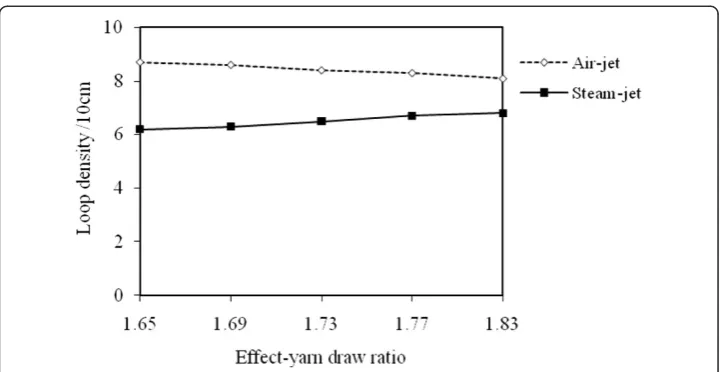
Figure 3 shows that loop density of steam-jet textured yarns increases and air-jet textured yarn decreases when effect-yarn draw ratio is increased. The decrease of loop density in the case of air-jet textured yarns may be due to smaller loops. It suggests that the increase of effect-yarn draw ratio increases the level of texturing and hence make smaller loops.
0 1 2 3 4 5 6 7 8 9 10
1.65 1.69 1.73 1.77 1.82
Tension (cN)
Effect-yarn draw ratio
T2 - steam-jet
T2 - air-jet
T1 - steam-jet
T1 - air-jet
Figure 1Effect of effect-yarn draw ratio on core yarn tension (T1) and textured yarn tension (T2).
The increase of loop density in the case of steam-jet textured yarns, could due to higher level of entanglement. The results conform to earlier results suggesting that more entangled yarns have more loops due to the smaller effect of shrinkage. The results are consistent with the earlier results that steam-jet textured yarns have lower loop density than air-jet textured yarns. It is believed that the steam shrinks the loops of yarn in texturing.
Physical properties of textured yarns
Figures 4, 5, 6 and 7 shows that strength, tenacity, elongation and linear density for both yarns decrease when effect-yarn draw ratio is increased. Effect-yarn tenacity increases when draw ratio is increased. Therefore, the tenacity of the textured yarn should increase when the effect yarn draw ratio is increased, if the level of texturing remains constant. On the other hand when the effect draw ratio is increased, the effect-yarn linear density decreases and hence the final linear density of the yarn decreases. The tenacity of the textured yarn increases when the linear density decreases. Therefore, decrease of tenacity and strength of the textured yarns shows that the level of texturing is increasing as the effect-yarn draw ratio is increased for both air-jet and steam-jet textured yarns.
Figure 3Effect of effect-yarn draw ratio on loop density of textured yarns.
5 6 7 8 9 10 11 12
1.65 1.69 1.73 1.77 1.82
Strength (N)
Effect-yarn draw ratio
Strength - Steam-jet Strength - Air-jet
Microscopic observations
Microscopic inspections show that there was no detectable visual difference in the structure of the textured yarns as the effect-yarn draw ratio was changed.
Effects of effect-yarn overfeed
In this study, polyester 86 dtex/f36 POY yarn has been used as the yarn. The effect-yarn overfeed has been controlled mechanically by varying the speed of effect-effect-yarn
20 24 28 32 36 40
1.65 1.69 1.73 1.77 1.82
Tenacity
cN/tex
Effect-yarn draw ratio
Tenacity - Steam-jet
Tenacity - Air-jet
Figure 5Effect of effect-yarn draw ratio on tenacity of textured yarns.
5 6 7 8 9 10 11 12
1.65 1.69 1.73 1.77 1.82
Elon
gation %
Effect-yarn draw ratio
Elongation - Steam-jet
Elongation - Air-jet
Figure 6Effect of effect-yarn draw ratio on elongation of textured yarns.
25 26 27 28 29 30
1.65 1.69 1.73 1.77 1.82
Linear density
(tex)
Effect-yarn draw ratio
Linear density
-Steam-jet
Linear density - Air-jet
feed roller relative to the given production speed. Using change wheels, the effect-yarn overfeed percentage has been changed between 37.9 percent and 53.0 percent.
Core-yarn tension (T1) and textured-yarn tension (T2)
Figure 8 shows the variation of T1and T2against effect-yarn overfeed. In both air-jet
and steam-jet texturing, T1and T2increase slightly when the effect-yarn overfeed is
increased. Due to low core-yarn overfeed (5.5 percent) relative to the higher effect-yarn overfeed, T1and T2is mainly controlled by the core yarn tension. Therefore, no
substantial variation of T1 and T2 with effect-yarn overfeed would be expected.
However, the results indicate that higher effect-yarn overfeed increases the level of core and effect filament entanglement and hence the overall texturing effect. When the air-jet and steam-jet texturing is concerned, it can be seen that T1 and T2 for
steam-jet texturing are higher than for air-jet texturing at relevant overfeed.
Loop instability of textured yarns
Figure 9 illustrates that there is a slight decrease in loop instability with increasing effect-yarn overfeeds in both air-jet and steam-jet texturing. The decrease of loop
0 1 2 3 4 5 6 7 8 9 10
37.9 41.5 45.2 49.1 53.0
Effect overfeed %
Ten
si
o
n
(cN)
T2 -steam-jet T2 - air-jet T1 - steam-jet T1 - air-jet
Figure 8Effect of effect-yarn overfeed on core yarn tension (T1) and textured yarn tension (T2).
0.8 0.9 1.0 1.1 1.2 1.3
37.9 41.5 45.2 49.1 53.0
Effect Yarn Overfeed %
In
st
ab
il
it
y
%
Air-jet Steam-jet
instability at higher effect overfeeds is probably due to more coherence in the core and effect filaments. Such coherence increases the friction and reduces the filament slippage. When the steam-jet and air-jet texturing is compared, steam-jet textured yarns give better results than air-jet textured yarns.
Loop density of textured yarns
Figure 10 shows that as expected, loop density increases in both steam-jet and air-jet tex-tured yarns, when effect-yarn overfeed is increased. At higher effect-yarn overfeeds, there is an extra length of effect-yarn filaments available for loop formation. Such extra fila-ments will increase either the number of loops or the size of loops or both. Loop density of steam-jet textured yarns is lower than that of air-jet textured yarns. This may be due to the effect of shrinkage that reduces the loop size in steam-jet texturing.
Boiling water shrinkage of textured yarns
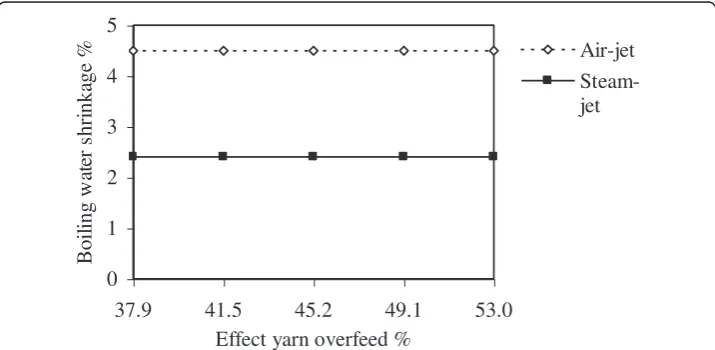
Figure 11 shows that there is no significant variation of boiling water shrinkage on changing the effect-yarn overfeed for both air-jet and steam-jet textured yarns. Boiling
0 2 4 6 8 10 12 14 16
37.9 41.5 45.2 49.1 53.0
Effect yarn overfeed %
L
o
op
de
ns
it
y /
10c
m
Air-jet Steam-jet
Figure 10Effect of effect-yarn overfeed on loop density of textured yarns.
0
1
2
3
4
5
37.9
41.5
45.2
49.1
53.0
Effect yarn overfeed %
B
o
il
ing w
at
er
s
h
ri
nka
ge
%
Air-jet
Steam-jet
water shrinkage of steam-jet textured yarn is lower than that of air-jet textured yarn as would be expected from earlier results. Therefore, shrinkage results complement with the previous assumption and results that the steam-jet textured yarn are shrinking during texturing.
Physical properties of textured yarns
Figures 12, 13, 14 and 15 show that strength, tenacity and elongation decrease and linear density increases with increasing effect-yarn overfeed in both air-jet and steam-jet textured yarns. The results confirm the earlier suggestions made in previous sections that the increase of effect-yarn overfeed increases the level of core and effect xfilament entanglements. It is obvious that linear density increases with increasing effect-yarn overfeed as more lengths of effect filaments entangle with the core filaments. The tenacity, strength, elongation and linear density of steam-jet textured
6 7 8 9 10 11 12
37.9 41.5 45.2 49.1 53.0
Str
eng
th (N)
Effect yarn overfeed %
Strength -steam-jet Strength -air-jet
Figure 12Effect of effect-yarn overfeed on strength of textured yarns.
25 27 29 31 33 35 37 39
37.9 41.5 45.2 49.1 53.0
T
enacity
(cN/tex)
Effect yarn overfeed %
Tenacity -steam-jet
Tenacity -air-jet
yarn are higher than air-jet textured yarn. However, compared with the other results, there is no evidence that the higher strength and tenacity of steam-jet textured yarn are mainly due to poor level of texturing. In fact, as far as sewing threads are con-cerned, if there is adequate texturing, higher strength and elongation would be an added advantage.
Microscopic observations
Microscopic inspection of the textured yarns has shown that both loop size and frequency increase when effect-yarn overfeed is increased. Figure 16 shows typical im-ages of air-jet and steam-jet textured yarns manufactured using different effect-yarn overfeeds.
5 6 7 8 9 10
37.9 41.5 45.2 49.1 53.0
Elong
ation %
Effect yarn overfeed %
Elongation -steam-jet Elongation -air-jet
Figure 14Effect of effect-yarn overfeed on elongation of textured yarns.
25 26 27 28 29 30
37.9 41.5 45.2 49.1 53.0
Linear Density
(tex)
Effect yarn overfeed %
Linear density -steam-jet Linear density -air-jet
Sewing thread trials
Both air-jet and steam-jet textured yarns were twisted, finished, lubricated and converted to sewing threads using industrial facilities. Commercial air-jet textured thread specifications for twisting, finishing, and lubrication were applied to all the samples. The yarns were twisted to a twist level of 400 turns per meter and made into single ply, Z twisted sewing threads.
Sewability tests were carried out according to the below specifications. Sewing speed: 5,500 stitches per minute.
Needle size: 70 metric (for 250dtex threads) Stitch density: 5 stitches per cm
Stitch type: FS 301 lock stitch Fabric type: Cotton / two plies Weight of Fabric: 115 ± 10 g/m2
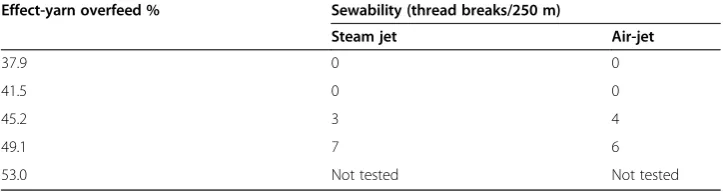
As per the results shown in Table 1, it can be concluded that effect yarn over-feeds up to 41.5 percent is suitable for 120 TKT spun-like textured sewing threads. Loop density of both the air-jet and the steam-jet textured yarns were increased when the effect-yarn overfeed was increased. Higher loop density will increase the surface friction as well as unevenness of the sewing thread surface. Further, standard effect-yarn overfeed for 120 TKT air-jet textured sewing thread is 37.9 percent. Therefore, sewability results confirm that the steam-jet textured
Steam-jet : overfeed at 37.9% Air-jet : overfeed at 37.9%
Steam-jet : overfeed at 53.0% Air-jet : overfeed at 53.0%
yarn is capable of manufacturing sewing threads at similar draw and overfeeds as air-jet textured yarns.
Conclusion
Increasing effect-yarn draw and effect-yarn overfeed increases the level of textur-ing and reduces strength, elongation and tenacity in both steam-jet and air-jet textured yarn. When the steam-jet textured yarn is considered, it can be con-cluded that spun-like textured yarn can be made satisfactorily using steam as an alternative fluid to air. Steam-jet textured yarn has a similar filament entangle-ment structure to air-jet textured yarn. Steam-jet textured yarn has a stronger and more compact structure than air-jet textured yarn where the steam-jet yarn loops are shrunken due the effect of heat setting. Furthermore, steam-jet textured yarn has less shrinkage and therefore post intermingled heat setting could be eliminated and the production cost of the spun-like textured yarn using steam could further be reduced. Increasing effect-yarn overfeed increases the loop dens-ity of textured yarns and therefore have more protruding loops in the textured yarn structure. However, higher effect-yarn overfeed increase the effect-yarn con-sumption and increase the linear density of the textured yarn. This would in-crease the production cost per unit length of yarn.
However, the loop density results and the microscopic inspections show that the textured yarn produced by higher effect-yarn overfeeds have bigger and more frequent loops. As found by Koc et al. (2008) this may be an advantage due to higher adhesion properties in the case of technical and industrial textile appli-cations where fibre based composites such as tires, conveyer belts, hoses etc. are made.
When the sewability results of the sewing threads are concerned, it can be con-cluded that steam-jet textured sewing thread is as good as air-jet sewing thread. Furthermore, effect-yarn overfeed of approximately 37.9% which is the standard level of overfeed used by commercial 120TKT air-jet textured sewing threads. It seems the same effect-yarn overfeed level is suitable for steam-jet textured 120TKT sewing threads as well.
In general, steam generation cost is comparatively lower than compressed air generation cost. If the identical jets are used, steam consumption is less than air consumption in terms of Kg/hour. Therefore, when the steam-jet and air-jet textured yarns are compared, it can be concluded that steam-jet textured yarn Table 1 Sewability results
Effect-yarn overfeed % Sewability (thread breaks/250 m)
Steam jet Air-jet
37.9 0 0
41.5 0 0
45.2 3 4
49.1 7 6
is more economical to produce than air-jet textured yarn. Furthermore, environ-mental friendly alternative fluids such as biomass could be used to produce steam.
Competing interests
The authors declare that they have no competing interests.
Authors’contribution
GLDW and PWF conceived and designed the experiments. GLD Wickramasinghe performed the experiments, analyzed the data and wrote the manuscript. Both authors read and approved the final manuscript.
Author details
1Department of Textile and Clothing Technology, University of Moratuwa, Moratuwa 10400, Sri Lanka.2University of Manchester, Manchester, UK.
Received: 21 February 2014 Accepted: 15 April 2014
References
Acar, M. (1988). Factors governing the choice of supply yarns suitable for air-jet texturing.Man-made Fibre Yearbook
(CTI), 1988, 90–95.
Acar, M. (1991). Trends in air-jet texturing.Man-made Fibre Yearbook (CTI), 1991, 94–96.
Acar, M, & Demir, A. (1987).Air-jet texturing present and future, international conference. University of: Loughborough, UK.
Explanation of how and why yarn wetting improves the air-jet texturing process.
Acar, M, & Wray, GR. (1986). An analysis of the air-jet yarn texturing process.A brief history of development in the process,
Journal of the Textile Institute, 77(1), 28–43.
Acar, M, Turton, RK, & Wray, GR. (1986a). An analysis of the air-jet yarn texturing process, part II: an experimental investigation of the air-flow.Journal of the Textile Institute, 77(1), 28–43.
Acar, M, Turton, RK, & Wray, GR. (1986b). An analysis of the air-jet yarn texturing process, part III, filament behaviour during texturing.Journal of the Textile Institute, 77(4), 235–246.
Acar, M, Turton, RK, & Wray, GR. (1986c). An analysis of the air-jet yarn texturing process, part IV: fluid forces acting on the filaments and the effect of filament cross sectional area and shape.Journal of the Textile Institute, 77(4), 247–254.
Acar, M, Turton, RK, & Wray, GR. (1986d). An analysis of the air-jet yarn texturing process, part V, the effect of wetting the yarns.Journal of the Textile Institute, 77(6), 359–370.
Acar, M, Turton, RK, & Wray, GR. (1986e). An analysis of the air-jet yarn texturing process.Part VI, the mechanism of loop
formation, Journal of the Textile Institute, 77(6), 371–376.
Acar, M, Bilgin, S, Versteeg, HK, Dani, N, & Oxenham, W. (2006). The mechanism of the air-jet texturing: the role of wetting, spin finish and friction in forming and fixing loops.Textile Research Journal, 76(2), 116–125.
Bilgin, S, Versteeg, HK, & Acar, M. (1996). Effect of nozzle geometry on air-jet texturing performance.Textile Research
Journal, 66(2), 83–90.
Demir, A, Acar, M, & Turton, RK. (1987).A basic understanding of the air-flow in texturing nozzles(pp. 59–66). Present and Future, Loughborough, UK: International Conference on Air-jet Texturing.
Demir, A, Acar, M, & Wray, GR. (1988). Air-jet textured yarns: the effect of process and supply yarn parameters on the properties of textured yarns.Textile Research Journal, 58(6), 318–328.
Fisher, KE, & Wilson, DK. (1982).Proceedings of the 66thtextile institute annual conference. Lucerne: Switzerland.Air-jet
texturing–an alternative to spun yarn production.
Koc, SK, Hockenberger, AS, & Wei, Q. (2008). Effect of air-jet texturing on adhesion behaviour of polyester yarns to rubber.Applied Surface Science, 254, 7049–7055. doi:10.1016/j.apsusc.2008.05.310.
Kothari, VK, & Timble, NB. (1991). Air-jet texturing: effect of jet type and some process parameters on properties of air-jet textured yarns.Indian journal of fibre & textile research, 16, 29–38.
Kothari, VK, Sengupta, AK, & Sensarama, JK. (1995). Effecct of baffle geometry and baffle setting on nep frequency, bulk and instability of air-jet textured yarns.Chemical fibers International (CFI), 45(April 1995), 140–142.
Kothari, VK, Chattopadhyay, R, & Agrawal, P. (1996). Studies on filament migration in air-jet textured yarns and relationship between migration parameters and properties.Journal of the textile institute, 87(2), 335–348. Mahmood, AH, Gong, RH, & Porat, I. (2013a). Development of air-textured core-and-effect glass yarns for improving the
bonding strength of laminated composites.Fibres and Polymers, 14(2), 271–276.
Mahmood, AH, Gong, RH, & Porat, I. (2013b). Improvement in the fracture toughness (mode1) of glass fabric composites through air-jet texturing.Fibres and Polymers, 14(4), 591–596.
Rangasamy, RS, Kothari, VK, & Sengupta, AK. (1990). Effect of specific characteristic on structural and properties of air-jet textured yarns, part 1: effect of filament fineness.Melliand Textilber, 71(9), E 301–302. 655–659.
Sengupta, AK, Kothari, VK, & Alagirusamy, R. (1989). Influence of drawing variables on the properties of air-jet textured yarns made from POY polyester feeder yarns.Man-made Fibre Year book (CTI), 1989, 80–83.
Simmen, C. (1987). New developments in air-jet texturing of fine filament yarns.Chemiefasern/Textilindustrie, 37/89(10), 989–993. E126-E128.
Sivakumar, VR. (1975).The mechanism of bulking of air-textured yarns”Ph.D. Manchester: Thesis, university of Manchester. Versteeg, HK, Bilgin, S, & Acar, M. (1994). Effects of geometry on the flow characteristics and texturing performance of
Wickramasinghe, GLD. (2003).Steam-jet intermingled sewing threads. University of Manchester, U.K.: Unpublished doctoral dissertation.
Wray, GR, & Entwistle, JH. (1968). An investigation of the air-jet bulking process.Journal of the Textile Institute, 59, 122–136.
Wray, GR, & Entwistle, JH. (1969). The modification of a taslan jet to operate at low air-pressure.Journal of the Textile
Institute, 60, 411–419.
doi:10.1186/s40691-014-0005-6
Cite this article as:Wickramasinghe and Foster:Investigation of the influence of effect-yarn draw and effect-yarn
overfeed on texturing performance: comparison between air-jet and steam-jet textured yarn.Fashion and Textiles
20141:5.
Submit your manuscript to a
journal and benefi t from:
7 Convenient online submission
7 Rigorous peer review
7 Immediate publication on acceptance
7 Open access: articles freely available online
7 High visibility within the fi eld
7 Retaining the copyright to your article