Open Access
Research article
Nurse-led implementation of an insulin-infusion protocol in a
general intensive care unit: improved glycaemic control with
increased costs and risk of hypoglycaemia signals need for algorithm
revision
Kristin Alm-Kruse, Eva M Bull and Jon H Laake*
Address: Department of Anaesthesia and Intensive Care Medicine, Rikshospitalet Medical Centre, 0027 Oslo, Norway
Email: Kristin Alm-Kruse - [email protected]; Eva M Bull - [email protected]; Jon H Laake* - [email protected] * Corresponding author
Abstract
Background: Strict glycaemic control (SGC) has become a contentious issue in modern intensive care. Physicians and nurses are concerned about the increased workload due to SGC as well as causing harm through hypoglycaemia. The objective of our study was to evaluate our existing degree of glycaemic control, and to implement SGC safely in our ICU through a nurse-led implementation of an algorithm for intensive insulin-therapy.
Methods: The study took place in the adult general intensive care unit (11 beds) of a 44-bed department of intensive care at a tertiary care university hospital. All patients admitted during the 32 months of the study were enrolled. We retrospectively analysed all arterial blood glucose (BG) results from samples that were obtained over a period of 20 months prior to the implementation of SGC. We then introduced an algorithm for intensive insulin therapy; aiming for arterial blood-glucose at 4.4 – 6.1 mmol/L. Doctors and nurses were trained in the principles and potential benefits and risks of SGC. Consecutive statistical analyses of blood samples over a period of 12 months were used to assess performance, provide feedback and uncover incidences of hypoglycaemia.
Results: Median BG level was 6.6 mmol/L (interquartile range 5.6 to 7.7 mmol/L) during the period prior to implementation of SGC (494 patients), and fell to 5.9 (IQR 5.1 to 7.0) mmol/L following introduction of the new algorithm (448 patients). The percentage of BG samples > 8 mmol/L was reduced from 19.2 % to 13.1 %. Before implementation of SGC, 33 % of samples were between 4.4 to 6.1 mmol/L and 12 patients (2.4 %) had one or more episodes of severe hypoglycaemia (< 2.2 mmol/L). Following implementation of SGC, 45.8 % of samples were between 4.4 to 6.1 mmol/L and 40 patients (8.9 %) had one or more episodes of severe hypoglycaemia. Of theses, ten patients died while still hospitalised (all causes).
Conclusion: The retrospective part of the study indicated ample room for improvement. Through the implementation of SGC the fraction of samples within the new target range increased from 33% to 45.8%. There was also a significant increase in severe hypoglycaemic episodes. There continues to be potential for improved glycaemic control within our ICU. This might be achieved through an improved algorithm and continued efforts to increase nurses' confidence and skills in achieving SGC.
Published: 18 January 2008
BMC Nursing 2008, 7:1 doi:10.1186/1472-6955-7-1
Received: 10 July 2007 Accepted: 18 January 2008
This article is available from: http://www.biomedcentral.com/1472-6955/7/1
© 2008 Alm-Kruse et al; licensee BioMed Central Ltd.
Background
Hyperglycaemia, defined as blood glucose > 6.1 mmol/L [1], and insulin resistance are common in surgical and critically ill patients. These phenomena occur without pre-vious diabetes, as a consequence of stress [1,2]. Elevated blood glucose is related to higher short and long-term morbidity and mortality rates, dependence on mechanical ventilation and hospital length of stay [1-5].
Previously, insulin-therapy in our ICU was utilised prima-rily when blood glucose was persistently above 12 mmol/ L. However, the publication of papers by van den Berghe [1] describing reduced mortality, morbidity and length of stay in surgical patients subjected to intensive insulin-therapy, as well as by Finney [3], demonstrating an asso-ciation of hyperglycaemia with adverse outcomes in gen-eral intensive care, led most doctors at our institution to prescribe insulin to our ICU-patients with a therapeutic target set at a BG level of 4 to 8 mmol/L. Equipped with a standard infusion solution of 2 IU/ml of rapidly acting insulin it was left to nurses to titrate treatment to achieve these targets. Without any protocol to guide treatment we became concerned that therapeutic targets were infre-quently met and that both hyper- and hypoglycaemia might occur due to lack of commitment from both nurses and doctors.
van den Berghe and co-workers reported the results of a study of intensive insulin therapy in medical ICU-patients [6]. As in their previous study they found that patients who remained in the ICU for several days profited from SGC. Also, two studies from mixed ICU settings supported the notion that both medical and surgical patients may profit from improved glycaemic control [7,8]. These stud-ies convinced us that we should both narrow our thera-peutic target to that of normoglycaemia (4.4 to 6.1 mmol/ L) and implement more rigid guidelines to achieve this goal.
SGC introduces a risk of severe hypoglycaemia (SHG) [1,9]. Pittas et al found that ICU-patients treated with insulin therapy had a threefold risk increase of developing hypoglycaemia compared with the control group. How-ever, no adverse outcomes were reported after these inci-dents [2]. Another study explored the short-term consequences of SHG in the ICU. Out of 156 patients with SHG, there were three possible comas or seizures, and no increase in mortality [10]. On the other hand, in a case-control study Krinsley et al found severe hypoglycaemia to be independently associated with mortality in an adult ICU [11]. The incidence of SHG varies greatly in different studies with rates from 0.5 to 18.7 % [12]. Two projects led by nurses reported an 0.9 % incidence of SHG [13,14]. However, it is unclear whether these numbers refer to the percentage of blood glucose samples or of patients.
Another challenge for ICUs that would like to implement SGC is the increased workload for nurses: A blood glucose target of 4.4 to 6.1 mmol/L is a narrow corridor to operate within [13-16]. This will increase the need for monitoring and adjustment of insulin and nutrients. Thus, the moti-vation, acceptance, involvement and commitment of nurses are of importance for successful implementation of SGC [13-17]. It is known that to change the behaviour of a large group demands much more time and effort than simply passing on new knowledge. It is also important that those who are responsible are available for discus-sions and questions during implementation of new proce-dures [18]. Thus it was decided to assign joint leadership over this project to two ICU-nurses whose task it would be to develop and implement an algorithm for SGC in our ICU. A physician served as reference.
Methods
EthicsThe regional ethics committee waived the need for informed consent and classified our study as a "quality improvement" project. Permission for data collection was deferred to the hospital's data inspector who formally approved the study.
Setting
Our hospital has a 44-bed department of mixed medical and surgical intensive care on a single floor. This study was limited to the 11-bed section of general intensive care for adults (the other three sections being paediatric, cardi-othoracic surgical and general postoperative). The ICU attends to several national functions. The majority of patients in the section described are admitted after neuro-surgery, abdominal- and bone marrow transplants, as well as with complications following acute cardiac conditions and other medical disease. The nurse: patient ratio is 1:1. The patients surveyed had a median age of 56 years, stayed for a median of 2.0 days, and were mechanically venti-lated 77.6 % of the time.
Risk scoring was performed upon discharge or death using simplified acute physiology score II (SAPS II) with data obtained during the first 24 hours after admission. Only patients who either died in the ICU during the first 24 hours or had LOS > 24 hours were scored (Table 1).
Design
This was a combined retrospective analysis and prospec-tive evaluation of glucose control in a single ICU with the purpose of implementing SGC in a safe manner.
virtu-ally all patients in the retrospective dataset received insu-lin (for data on insuinsu-lin consumption, see "costs" in Results section). Data were retrieved from the laboratory database at the Department of clinical biochemistry. We analysed BG values from 15009 samples from 494 patients obtained during the 20 months before introduc-tion of the algorithm, constituting a mean of 750 samples per month.
The prospective study (2006) included six steps to safely implement SGC:
1. To obtain nurse commitment and a sense of "owner-ship" in the project, two nurses (KAK and EMB) were given daily leadership for the implementation of SGC. A physician (JHL) served as reference.
2. A blood glucose algorithm was developed (Fig 1). This was based on the Leuven- protocol [1], and adapted through discussions between ICU nurses and ICU physi-cians. Experiences from other ICUs in Norway were
con-sidered in the discussions. It was imperative that the algorithm should be easy to use and in pocketsize format. A graphic designer was consulted in designing the algo-rithm.
3. Lectures were provided for all physicians and nurses in the ICU. These lectures focussed both on original research on SGC, statistical results from our retrospective study and information about the algorithm.
4. Key literature was made easily accessible in the ICU.
5. Blood glucose statistics were analysed consecutively to assess performance and uncover incidences of hypogly-caemia. We analysed BG values from 24459 samples obtained from 448 patients over 12 months (2038 sam-ples per month).
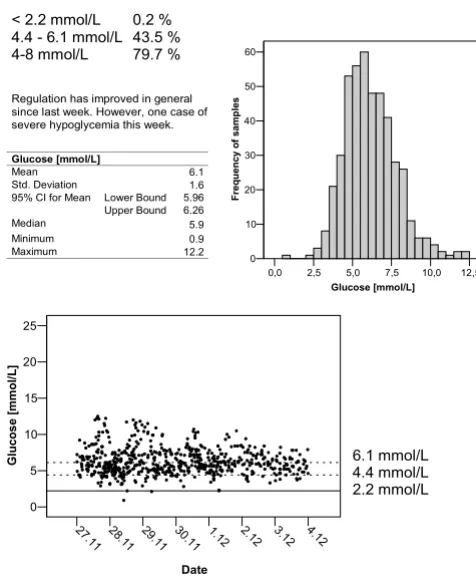
6. Feedback to nurses and doctors in the form of posters with simple descriptive statistics illustrated by coloured graphics were suspended on the main door to the rest area the ICU (Fig 2). Periodic summaries were e-mailed to the ICU staff. These analyses also functioned as a safety check
Example of feedback to ICU-nurses Figure 2
Example of feedback to ICU-nurses. Descriptive statistics were presented on posters in the ICU and in e-mails to individual nurses.
! "# $% & '(()
! "#$%# "& ''"#$ ( ) * ) * ) + ,!- )./&+ #0! 10! +! + +2
Table 1: Patient charcteristics
2004–5 2006
N 494 448
Age [IQR]* 56 [39–64] 55 [42–66]
Male Sex (%) 53.4 58.4
LOS [IQR]* 2.0 [0.7–6.4] 1.9 [0.8–5.8] LOS > 72 h, n (%) 210 (42.5) 206 (46.0) SAPS II [IQR]* 42 [28–54] 40 [30–54] SAPS II completeness, n (%)‡ 329 (67) 259 (58)
*) Age, LOS and SAPS II are given as median values [interquartile range].
‡) Frequency (%) of patients who received a SAPS II score. Eligible
patients either died < 24 hours after admission or had LOS > 24 hours.
Glucose-infusion algorithm used in the study Figure 1
Glucose-infusion algorithm used in the study.
Rikshospitalet
Universitetsklinikk
© Rikshospitalet Medical Centre
>11.1 mmol/L 11,1 - 6,1 mmol/L <6,1 mmol/L
Start insulin at 2-4 U/hr Start insulin at 1-2 U/hr Do not start insulin
Sudden decrease (>50%) 3,3 - 4,4 mol/L
Halve the Insulin dose Reduce Insulin dose Stop Insulin, check glucose infusion lines, pumps and bags MEASURE BG WITHIN ONE HOUR
2,2-3,3 mmol/L
<2,2 mmol/L
Close to target? 4,4 - 6,1 mmol/L
MEASURE BG EVERY 4TH HOUR Adjust Insulin by 0.2 – 0.6 U/hr No action
MEASURE BG EVERY 1 – 2 HOUR, UNTIL 4.4 – 6.1 MMOL/L
Increase Insulin by 1 – 2 U/hr 6,1 - 7,8 mmol/L
>7,8 mmol/L
Increase Insulin by 0.4 – 1 U/hr
BLOOD GLUCOSE (BG) ON ARRIVAL IN ICU ALGORITHM FOR STRICT GLUCOSE
CONTROL
• Consult physician if BG >20 mmol/L or <2.2 mmol/L or if you have to divert from the algorithm
• Beware fluctuations in insulin demands as patient medical status improves or deteriorates.
• Stop Insulin when nutrition is interrupted (e.g. tracheotomy, CAT-scan etc)
• Beware medications that may affect your patients BG, e.g. beta-blockers, steroids, ACE- inhibitors and thyroid hormones.
• BG 11mmol/L without insulin is accepted when admitting your patient to the ward.
This is a guide; Insulin administration must always be guided by common sense and adjusted according to the patients individual condition.
for the project group as incidents of hypoglycaemia were quickly identified. The project nurses gave individual bed-side feedback to the ICU nurses, and they were available for discussions and questions.
Nutrition and insulin
Physicians in the ICU ordered nutrients and insulin per respective algorithms (see below). Glucose infusion was initiated at admission to ICU (normally 100 g per day in adults) and was usually discontinued when mixed enteral or parenteral nutrition commenced. Patients were fed according to our nutritional support algorithm [19]: This requires physicians to set a feeding target (normally 25–35 kcal/kg/day) and allows for use of standard mix-tures of enteral and/or parenteral nutrition depending on gastrointestinal function (energy composition protein/ amino acids ~15 %, fat/lipids ~35 %, carbohydrates/glu-cose ~50 %). With this algorithm 75% of our patients receives mixed nutritional support, including 150–300 g glucose, during the first day after admission, although full caloric support may not be achieved for several days [19].
Rapidly acting insulin (2 U/ml) was administered intrave-nously as a continuous infusion as described in the algo-rithm (Fig 1). The goal of the insulin treatment was to normalise high levels of BG as soon as possible or to maintain normoglycaemia. Virtually all patients received insulin. The hospital pharmacy provided information on yearly consumption of insulin by our ICU (see "costs" in Results section).
Analysis
All patients admitted during the study period were included, regardless of length of stay and unless a physi-cian specifically gave a written order that SGC was not to be initiated. The blood glucose measurements were arte-rial whole blood samples. We used four different blood gas analysers (Radiometer Copenhagen ABL 700) located in the ICU, which are regularly calibrated against a refer-ence instrument at the Department of Clinical Biochemis-try. The results of these analyses are automatically registered at the central laboratory database. Statistical
analysis was performed with Statistical Package of Social Sciences (SPSS), version 13. For analysis of blood-glucose values we used both non-parametric statistics (Mann-Whitney's test) as well as "mixed model analysis" in which pre- and post implementation periods and length of stay in the ICU were treated as fixed factors and individ-ual patients as random factors. Proportions were analysed with Chi-Square with Yates' correction.
Costs
We calculated the incremental costs of insulin, an increased number of blood-gas analyses (syringes, chemi-cals), but excluding staff-expenditures (since manpower was not increased) as well as loss due to depreciation.
Results
Retrospective analysis (2004–5)
The retrospective analysis served as a reference to existing conditions, allowing us to evaluate the effect of the imple-mentation of SGC. We obtained 15009 BG samples from 494 patients of whom 210 had a length of stay (LOS) in excess of 72 hours (Table 1). The median BG level was 6.6 mmol/L [IQR 5.6–7.7] (Table 2); 77.5 % of the BG meas-urements were within the then existing limits of 4–8 mmol/L and 33% of samples were within the "optimal" range of SGC, i.e. 4.4 to 6.1 mmol/L. Fourteen samples (0.1 %) from twelve patients (2.8 %) were defined as severely hypoglycaemic (< 2.2 mmol/L) (Table 3). Of these, two patients died while hospitalised at our institu-tion and by 2007, 5 deaths were registered (all causes, Table 3). The median time interval from the first hypogly-caemic episode till death was 9 days. Hypoglyhypogly-caemic patients had a median SAPS II score of 54 (mean score 55) while those hypoglycaemic patients who died had a median SAPS II score of 61 (mean score 60). We did not assess our patients for minor brain dysfunction after hypoglycaemia.
Introduction of strict glycaemic control (2006)
Following lectures, dissemination of literature and the new algorithm at the end of 2005, strict glycaemic control was swiftly introduced at the beginning of 2006 and met
Table 2: Median arterial blood glucose
All samples median (IQR)
≤12 hours in ICU median (IQR)
> 12 hours in ICU median (IQR)
Before algorithm (2004–5) 6.6 (5.6 – 7.7) n = 15009
7.1 (5.9 – 8.8) n = 1591
6.5 (5.6 – 7.6) n = 13418 After algorithm (2006) 5.9 (5.1 – 7.0)
n = 24459
6.9 (5.4 – 8.6) n = 2928
5.9 (5.0 – 6.8) n = 21531
with little opposition. Only a handful of patients were deemed unsuitable for SGC by the attending physician (pancreas transplant recipients with their own BG regime), and our nurses enthusiastically embraced this therapy. Feedback regarding the algorithm was mainly positive. The nurses liked the design, and found it easy to understand and follow. The pocket size was appreciated. Inexperienced nurses tended to embrace it to a larger extent than experienced nurses. Nevertheless, some con-cern was raised about the algorithm, which did not pre-vent all hypoglycaemias (Table 3, see Additional file 1). This was evident especially where the BG level was declin-ing rapidly, but due to the frequent measurements, fell outside the definition of 50 % decrease and was therefore not identified as a potential threat. In our experience, 4 hours between each sample when the previous test was within the normal limit, proved to be too long.
Feedback and bedside follow-up
Posters with statistics and graphs received mixed interest. Due to technical reasons beyond our control the collec-tion of data was in periods impeded, and this caused feed-back to be less regular than we would have preferred. On the other hand periodic e-mails with similar content but also with comments on performance generated construc-tive discussions among the ICU staff as well as between the ICU staff and the project group. Also, bedside follow-up by the project nurses to guide colleagues in how to use the algorithm proved to be helpful.
Glycaemic control
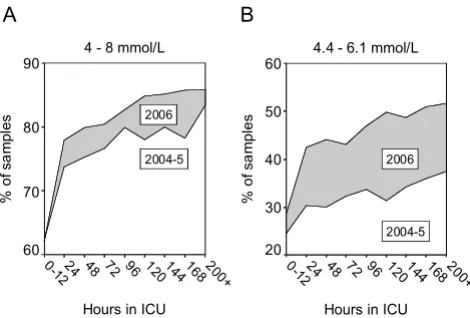
Following introduction of SGC we obtained 24459 BG samples from 448 patients, of whom 206 had LOS > 72 hours (Table 1). The median BG level was 5.9 mmol/L [IQR 5.1–7.0]. Thus, the difference before and after imple-mentation of SGC was 0.7 mmol and highly significant (p < 00.1, Table 2). Glycaemic control improved with length of stay in the ICU and was consistent after approximately 12 hours following ICU admission (Fig 3). We found that
80.9 % of the samples were within the previously defined limits of 4–8 mmol/L, while samples within the narrower range of 4.4–6.1 mmol/l had increased from 33 % in 2004–5 to 45.9 % in 2006, a relative increase of 39 % (Fig 4). The fraction of normoglycaemic samples improved with length of stay and the frequency of hyperglycaemic samples (> 8 mmol/L) fell from 19.2 % to 13.1 %, a rela-tive decrease of 32 %. There was an increase in the inci-dence of severe hypoglycaemia; 40 patients (8.9 %) experienced one or more episodes of BG < 2.2 mmol/L
Boxplots represent median, quartiles, and extreme values of p-glucose samples [mmol/L] as a function of length of stay and year of admittance
Figure 3
Boxplots represent median, quartiles, and extreme values of p-glucose samples [mmol/L] as a function of length of stay and year of admittance.
Hours in ICU
200+ 168 144 120 96 72 48 24 0-12
G
luc
os
e [
m
m
ol
/L]
16
14
12
10
8
6
4
2
0
2004 - 5
2006
Table 3: Hypoglycaemia (arterial blood glucose < 2.2 mmol/L)
2004 – 5 2006
Frequency of samples, n/N (%)1 14/15009 (0.09) 62/24459 (0.25)
Frequency of patients, n/N (%)1 12/494 (2.4) 40/448 (8.9)
Arterial blood glucose 2 1.8 mmol/L (1.3 – 2.1) 1.8 mmol/L (0.9 – 2.1)
30-day mortality (%) 3 3/12 (25) 12/40 (30)
Interval till death (days) 4 9 (0 – 533) 4 (0 – 53)
SAPS II score (deceased vs. survivors) 5 61 (39 – 86) vs 54 (26 – 75) 53 (31 – 96) vs 33 (15 – 60)
Footnotes:
1. P < 0.001 (Chi Square)
2. Median (range) of blood glucose values < 2.2 mmol/L
3. 30-day mortality among hypoglycaemic patients. In-hospital mortality was 2/12 (17%) vs. (10/40 (25 %), not significant. 4. Median number of days from first hypoglycaemic episode till time of death (range)
(62 samples, 0.25 %). Of these, 10 patients died while hospitalised at our institution (25 %) and by 2007, 15 deaths were registered (all causes, Table 3, Additional file 1). The median time interval from the first hypoglycaemic episode till death was 4 days. Most hypoglycaemic inci-dents occurred during the first days after admission (Fig 5). Hypoglycaemic patients had a median SAPS II score of 39 (mean score 45) while those hypoglycaemic patients who died had a median SAPS II score of 53 (mean score
60). We did not assess our patients for minor brain dys-function after hypoglycaemia.
Effect on mortality was not formally assessed. However, in 2004–5 and 2006 ICU-mortality was 17.5 % and 13.8 %, respectively (all admissions). For patients who remained in the ICU for more than 24 hours or died within the first 24 hours after admission, ICU- and 30-day mortality was 24.9 % and 32.6 % in 2004–5. In 2006 ICU- and 30-day mortality was 19.7 % and 28.6 %. The median SAPS II scores in 2005 and 2006 were 42 and 40, respectively (Table 1).
Costs
The workload expanded from 750 blood-gas samples per month to 2038 samples per month. Insulin consumption was 303 000 IU per year in 2004, 379 000 IU per year in 2005 and 415 000 IU per year in 2006. This led to an increase in material costs (insulin, syringes, chemicals), from € 1561/month to € 3550/month, equating a 127 % rise in expenses, not considering personnel costs (since manpower was not increased) and loss due to deprecia-tion.
Discussion
Responses to the introduction of SGC
Both education and the possibility to discuss experiences have been pointed out as success-criteria when imple-menting new protocols [13]. When teaching the ICU staff about the principles and practice of SGC, the main focus was on practicalities for the nurses and the benefits for the patients. During these sessions discussion was encour-aged. We received few objections to the increased work-load. The 1:1 nurse: patient ratio in our ICU may have contributed to the positive attitude. The staff already had experience in managing insulin infusions, albeit less strictly, when the BG target range was 4 to 8 mmol/L. The main reactions from both the nursing staff and physicians were interest, support and satisfaction. Such positive responses are described in the literature to be related to understanding the protocols rationale and benefits [13,20]. With very few exceptions doctors prescribed BG targets according to the new algorithm. From time to time it was necessary to curb enthusiasm from wards that wanted to participate in the study, and physicians who wanted to use the algorithm outside the ICU.
Written feedback
Contrary to our expectations, posters with performance statistics generated little interest. On the other hand, e-mails with the same information caused discussions and proved valuable. It seems that e-mails allowed our co-workers to assess the feedback at their own pace and when it did not interfere with other obligations. We find this Hypoglycaemic episodes (BG < 2.2 mmol/L) plotted against
length of stay. Reference lines are placed at 12 and 72 hours Figure 5
Hypoglycaemic episodes (BG < 2.2 mmol/L) plotted against length of stay. Reference lines are placed at 12 and 72 hours. Twenty-two episodes that occurred > one week after admis-sion to ICU have been omitted from the figure.
16 8 144 120 96 72 48 24 0
Hours in ICU
2.2
2.0
1.8
1.6
1.4
1.2
1.0
0.8
G
luc
os
e [m
m
o
l/L
]
2004-5 2006 Percentage of samples with p-glucose between 4–8 mmol/L (A) and 4.4 – 6.1 mmol/L (B) as a function of length of stay and year of admittance
Figure 4
Percentage of samples with p-glucose between 4–8 mmol/L (A) and 4.4 – 6.1 mmol/L (B) as a function of length of stay and year of admittance.
4 - 8 mmol/L
Hours in ICU 200+ 168 144 120 96 72 48 24 0-12
% o
f s
am
pl
es
90
80
70
60
2006
2004-5
4.4 - 6.1 mmol/L
Hours in ICU 200+ 168 144 120 96 72 48 24 0-12
% o
f s
am
pl
es
60
50
40
30
20
2006
2004-5
A B
experience useful with respect to future quality enhance-ment projects.
Glycaemic control
During 2004–5, 77.5 % of blood-glucose samples were within the target-range specified at that time, i.e. 4–8 mmol/L. The number of cases of severe hypoglycaemias was low. Thus, nurses were able to reach set targets even with no algorithm to guide therapy. The statistics indicate that nurses conservatively preferred to keep the BG levels in the higher end of the target range. This finding was con-firmed in discussions with the nurses. The nurses' ration-ale was to avoid SHG. Several experienced nurses expressed uncertainty with the use of an algorithm to con-trol the BG level instead of the 'good old way' of intuition and experience. However, following introduction of new therapeutic targets, an algorithm to guide therapy and extensive teaching and feedback, glycaemic control improved significantly, albeit at the cost of increased expenditure and more frequent hypoglycaemia. Was the reduction in median BG from 6.6 mmol/L to 5.9 mmol/L important enough to justify these risks? It is evident from Figs 3 and 4 that a downward shift of all BG values was the result of our project. Thus, the frequency of samples with BG > 8 mmol/L was reduced by 32 %. Finney et al found a strong association between higher level of BG and risk of death and suggested an upper tolerance limit of 8 mmol/ L [3]. We are convinced that this can not be achieved unless one aims for a narrower range, i.e. normoglycae-mia.
The studies by van den Berghe et al. [1,6] indicated that primarily patients who remained in the ICU for several days profited from SGC. This has resulted in suggestions that SGC be withheld until patients have remained in the ICU for three days. In our study 210 and 206 patients had LOS > 3 days in the periods before and after implementa-tion of SGC, i.e. 44 %. Does this mean that the remaining patients were exposed to an unnecessary risk? Our inter-pretation of the results of the randomised trials is that any benefit of SGC accumulates with increasing LOS. As it is extremely difficult to predict LOS for patients who are admitted to the ICU, we believe it to be a sensible strategy to initiate SGC as early as possible. Routines must be developed, however, to avoid hypoglycaemia (see below).
Glycaemic control improved for the majority of our patients. These results may be partially explained by the bedside follow-up and continuous attention to the ration-ale for SGC by the project-nurses. Also, the 1:1 nurse: patient ratio ensured that nurses attended to only one patient at a time. Furthermore, almost all our ICU patients were fed using enteral nutrition, possibly another contrib-uting factor to achieving SGC [17]. Our continued goal is that our nurses become comfortable with BG levels in the
middle range of normal, thus avoiding hyperglycaemia that would otherwise occur because they are "playing it safe".
Hypoglycaemia
The number of patients who experienced severe hypogly-caemia increased from 12 (2.4 %) to 40 (8.9 %) following implementation of SGC. This compares well with pub-lished results [1,6,12] but is nevertheless a cause for con-cern. It is difficult to establish causality, if any, between episodes of hypoglycaemia and subsequent deaths and to avoid bias we have consulted with independent expert who is now evaluating the cause of death in patients who were hypoglycaemic. The death rate among hypoglycae-mic patients did not exceed expected mortality rate as assessed by SAPS II score. Also, patients who died after hypoglycaemia were at higher baseline risk of death than survivors (Table 3, Additional file 1). In a recent review, Cryer refers to laboratory work in non-human primates that demonstrated a need for prolonged (i.e. several hours) of severe hypoglycaemia (< 1.0 mmol/L) to relia-bly produce brain damage [21]. The situation may well be different in critically ill patients, in particular those whose metabolic demands are only marginally met due to their illness [11]. On the other hand, hyperglycaemia has con-sistently been shown to be associated with severity of brain damage in head injured patients or those with anoxic coma [22,23]. Kanji et al (2004) claims that to eliminate the incidence of hypoglycaemia completely is unrealistic since ICU patients have significant fluctuations in metabolic and endocrine demands [16].
Although mortality was not formally assessed, ICU- and 30-day mortality in 2005 and 2006 do not raise cause for alarm.
Need for algorithm revision?
together with an experienced coach and it is therefore unlikely that hypoglycaemia occurred as a result of errors made by inexperienced nurses.
On the other hand our algorithm is not dose defining and allows for some variability in how aggressively nurses may treat blood-glucose aberrations. A number of different protocols used achieve SGC were reviewed by Meijering et al who concluded that dynamic scale protocols, similar to ours, yielded the best results [17]. More recently pub-lished protocols are often dose defining and computer guided, and claim superiority over less rigorous protocols, such as ours, particularly with respect to avoiding hypoglycaemia. However, the numbers of patients included in many of these most recent studies are often small, typically ranging from twenty or less [14,24-27] to 50–60 patients [28-30] (but see below). In our study only a small fraction of blood samples were hypoglycaemic (0.25 %), but this nevertheless affected 8.9 % of patients following introduction of SGC (Table 3). This may indi-cate that a fairly large number of patients should be included before superiority of any particular protocol is claimed.
A good example of a dose defining insulin infusion proto-col was recently published by Braithwaite et al. who reported the results in 24 trauma patients [31]. The proto-col was arranged as a table with six proto-columns containing detailed instructions on insulin infusion rates depending on BG. The patient was assigned a particular treatment column depending on his or her response to therapy. BG was controlled hourly until stable and thereafter every 2 hours. Target (blood-glucose < 6.1 mmol/L) was reached at a median time of 11 hours and BG thereafter fluctuated very little. The authors observed no cases of severe hypoglycaemia. If similar safety and efficacy can be dem-onstrated in a large patient sample this protocol is an attractive alternative to our algorithm, especially because it lends itself to computerization.
Thomas et al used a web-based insulin dose calculator to achieve tight glycaemic control in a 16-bed ICU [32]. A total of 601 patients were subjected to this protocol, which was amended after 502 patients to allow for a higher insulin dose. Only 19 episodes of severe hypoglyc-amia were noted throughout this implementation (3.1 %), but the frequency seemed to increase after the amend-ment. Also, Davidson and coworkers reported experiences with a computer-directed intravenous insulin system that resulted in rapid glycaemic control and a low incidence (2.6 %) of hypoglycaemia in a large patient cohort [33]. These authors contrast the use of a computer-directed sys-tem with that of van den Berghe [1], which depends on trained nurses. However, in a smaller study Shulman et al reported that computerised decision-supported intensive
insulin therapy did not result in tight glycaemic control and that 10 % of patients became hypoglycaemic [30]. To us it seems only reasonable that nurse-commitment and skill will contribute to success in obtaining glycaemic con-trol in the ICU, whether they are assisted by computerised protocols or not.
Conclusion
A nurse-led implementation of an algorithm for strict gly-caemic control was well received by the staff in our ICU. The data showed significant improvement in the regula-tion of BG in our patients, but there was an increase in cases of severe hypoglycaemia indicating a need for algo-rithm revision. We will continue to encourage nurses to feel confident in working to obtain normoglycaemia by focussing on the benefits and rationale of strict glycaemic control.
Key messages
• To achieve strict glycaemic control in our ICU we selected two nurses to lead the implementation of a new insulin infusion algorithm
• All nurses in our ICU underwent training to obtain knowledge about the benefits and potential dangers of strict glycaemic control Nurses' confidence in using an insulin infusion algorithm was strengthened through daily feedback at the bedside and weekly statistics and graphs describing results
• This strategy led to a significant improvement in glycae-mic control in our ICU, but also increased the number of patients who had an hypoglycaemic episode and high-lighted a need for protocol revision
• Involving nurses in the implementation of new thera-pies results in commitment, confidence and a "sense of ownership" that improves performance
List of abbreviations
BG – Arterial blood glucoseICU – Intensive care unit
IQR – Interquartile range
LOS – Length of stay
SGC – Strict glycaemic control (arterial blood glucose 4.4 – 6.1 mmol/L)
Competing interests
The author(s) declare that they have no competing inter-ests.
Authors' contributions
KAK, EMB and JHL planned and designed the study, and analysed the retrospective data. KAK and EMB conducted the execution of the project (introduction of algorithm, follow-up and statistical feedback to nurses) and collected data during the prospective part of the study. KAK and JHL analysed the prospective data and wrote the paper. All authors have read and approved the final manuscript
Additional material
Acknowledgements
We thank the following for their support and important contributions: Lise Tuset Gustad, Ann Sissel Wiik, Jo Røislien, Harald Breivik, Ida Torunn Bjørk and Hilde Wøien. EMB received a salary from Centre for Shared Decision Making and Nursing Research, University of Oslo. KAK and JHL are employed by the hospital. There was no other funding.
References
1. van den Berghe G, Wouters P, Weekers F, Verwaest C, Bruyninckx F, Schetz M, Vlasselaers D, Ferdinande P, Lauwers P, Bouillon R:
Intensive insulin therapy in the critically ill patients. N Engl J
Med 2001, 345(19):1359-1367.
2. Pittas AG, Siegel RD, Lau J: Insulin therapy for critically ill hospi-talized patients: a meta-analysis of randomized controlled
trials. Arch Intern Med 2004, 164(18):2005-2011.
3. Finney SJ, Zekveld C, Elia A, Evans TW: Glucose control and
mor-tality in critically ill patients. Jama 2003, 290(15):2041-2047.
4. Khoury W, Klausner JM, Ben-Abraham R, Szold O: Glucose control
by insulin for critically ill surgical patients. J Trauma 2004,
57(5):1132-1138.
5. Jeremitsky E, Omert LA, Dunham CM, Wilberger J, Rodriguez A: The impact of hyperglycemia on patients with severe brain
injury. J Trauma 2005, 58(1):47-50.
6. van den Berghe G, Wilmer A, Hermans G, Meersseman W, Wouters PJ, Milants I, Van Wijngaerden E, Bobbaers H, Bouillon R: Intensive
insulin therapy in the medical ICU. N Engl J Med 2006,
354(5):449-461.
7. Krinsley JS: Effect of an intensive glucose management
proto-col on the mortality of critically ill adult patients. Mayo Clin
Proc 2004, 79(8):992-1000.
8. Gabbanelli V, Pantanetti S, Donati A, Principi T, Pelaia P: Correlation between hyperglycemia and mortality in a medical and
sur-gical intensive care unit. Minerva Anestesiol 2005, 71(11):717-725.
9. Devos P, Preiser JC: Tight blood glucose control: a
recommen-dation applicable to any critically ill patient? Crit Care 2004,
8(6):427-429.
10. Vriesendorp TM, DeVries JH, van Santen S, Moeniralam HS, de Jonge E, Roos YB, Schultz MJ, Rosendaal FR, Hoekstra JB: Evaluation of short-term consequences of hypoglycemia in an intensive
care unit. Crit Care Med 2006, 34(11):2714-2718.
11. Krinsley JS, Grover A: Severe hypoglycemia in critically ill
patients: Risk factors and outcomes*. Crit Care Med 2007.
12. Schultz MJ, Royakkers AA, Levi M, Moeniralam HS, Spronk PE: Inten-sive Insulin Therapy in IntenInten-sive Care: An Example of the
Struggle to Implement Evidence-Based Medicine. PLoS Med
2006, 3(12):e456.
13. Gerard SO, Neary V, Apuzzo D, Giles ME, Krinsley J: Implementing an intensive glucose management initiative: strategies for
success. Crit Care Nurs Clin North Am 2006, 18(4):531-543.
14. Osburne RC, Cook CB, Stockton L, Baird M, Harmon V, Keddo A, Pounds T, Lowey L, Reid J, McGowan KA, Davidson PC: Improving hyperglycemia management in the intensive care unit: pre-liminary report of a nurse-driven quality improvement
project using a redesigned insulin infusion algorithm. Diabetes
Educ 2006, 32(3):394-403.
15. Devos P, Preiser JC: Is it time for implementation of tight
gly-caemia control by intensive insulin therapy in every ICU? Crit
Care 2006, 10(2):130.
16. Kanji S, Singh A, Tierney M, Meggison H, McIntyre L, Hebert PC:
Standardization of intravenous insulin therapy improves the efficiency and safety of blood glucose control in critically ill
adults. Intensive Care Med 2004, 30(5):804-810.
17. Meijering S, Corstjens AM, Tulleken JE, Meertens JH, Zijlstra JG, Ligtenberg JJ: Towards a feasible algorithm for tight glycaemic control in critically ill patients: a systematic review of the
lit-erature. Crit Care 2006, 10(1):R19.
18. Perkins C: Improving glycaemic control in a metabolically
stressed patient in ICU. Br J Nurs 2004, 13(11):652-657.
19. Wøien H, Bjørk IT: Nutrition of the critically ill patient and effects of implementing a nutritional support algorithm in ICU. J Clin Nurs 2006, 15(2):168-177.
20. Goldberg PA, Siegel MD, Sherwin RS, Halickman JI, Lee M, Bailey VA, Lee SL, Dziura JD, Inzucchi SE: Implementation of a safe and effective insulin infusion protocol in a medical intensive care
unit. Diabetes Care 2004, 27(2):461-467.
21. Cryer PE: Hypoglycemia, functional brain failure, and brain
death. J Clin Invest 2007, 117(4):868-870.
22. Lam AM, Winn HR, Cullen BF, Sundling N: Hyperglycemia and
neurological outcome in patients with head injury. J Neurosurg
1991, 75(4):545-551.
23. Li PA, Siesjo BK: Role of hyperglycaemia-related acidosis in
ischaemic brain damage. Acta Physiol Scand 1997,
161(4):567-580.
24. Lonergan T, Compte AL, Willacy M, Chase JG, Shaw GM, Hann CE, Lotz T, Lin J, Wong XW: A pilot study of the SPRINT protocol
for tight glycemic control in critically Ill patients. Diabetes
Technol Ther 2006, 8(4):449-462.
25. McMullin J, Brozek J, McDonald E, Clarke F, Jaeschke R, Heels-Ansdell D, Leppert R, Foss A, Cook D: Lowering of glucose in critical
care: a randomized pilot trial. J Crit Care 2007, 22(2):112-8;
dis-cussion 118-9.
26. Wintergerst KA, Deiss D, Buckingham B, Cantwell M, Kache S, Agar-wal S, Wilson DM, Steil G: Glucose control in pediatric intensive
care unit patients using an insulin-glucose algorithm. Diabetes
Technol Ther 2007, 9(3):211-222.
27. Wong XW, Singh-Levett I, Hollingsworth LJ, Shaw GM, Hann CE, Lotz T, Lin J, Wong OS, Chase JG: A novel, model-based insulin and nutrition delivery controller for glycemic regulation in
critically ill patients. Diabetes Technol Ther 2006, 8(2):174-190.
28. Kortgen A, Niederprum P, Bauer M: Implementation of an evi-dence-based "standard operating procedure" and outcome
in septic shock. Crit Care Med 2006, 34(4):943-949.
29. Plank J, Blaha J, Cordingley J, Wilinska ME, Chassin LJ, Morgan C, Squire S, Haluzik M, Kremen J, Svacina S, Toller W, Plasnik A, Ellmerer M, Hovorka R, Pieber TR: Multicentric, randomized, controlled trial to evaluate blood glucose control by the model predic-tive control algorithm versus routine glucose management
protocols in intensive care unit patients. Diabetes Care 2006,
29(2):271-276.
30. Shulman R, Finney SJ, O'Sullivan C, Glynne PA, Greene R: Tight gly-caemic control: a prospective observational study of a com-puterised decision-supported intensive insulin therapy
protocol. Crit Care 2007, 11(4):R75.
31. Braithwaite SS, Edkins R, Macgregor KL, Sredzienski ES, Houston M, Zarzaur B, Rich PB, Benedetto B, Rutherford EJ: Performance of a dose-defining insulin infusion protocol among trauma
serv-Additional file 1
Detailed description of patients with severe hypoglycaemia who ultimately died. The file contains clinical descriptions of those patients who suffered one or more incidences of severe hypoglycaemia and who ultimately died.
Click here for file
Publish with BioMed Central and every scientist can read your work free of charge
"BioMed Central will be the most significant development for disseminating the results of biomedical researc h in our lifetime."
Sir Paul Nurse, Cancer Research UK
Your research papers will be:
available free of charge to the entire biomedical community
peer reviewed and published immediately upon acceptance
cited in PubMed and archived on PubMed Central
yours — you keep the copyright
Submit your manuscript here:
http://www.biomedcentral.com/info/publishing_adv.asp
BioMedcentral
ice intensive care unit admissions. Diabetes Technol Ther 2006,
8(4):476-488.
32. Thomas AN, Marchant AE, Ogden MC, Collin S: Implementation of a tight glycaemic control protocol using a web-based
insu-lin dose calculator. Anaesthesia 2005, 60(11):1093-1100.
33. Davidson PC, Steed RD, Bode BW: Glucommander: a computer-directed intravenous insulin system shown to be safe, simple,
and effective in 120,618 h of operation. Diabetes Care 2005,
28(10):2418-2423.
Pre-publication history
The pre-publication history for this paper can be accessed here: