© 2017, IRJET | Impact Factor value: 5.181 | ISO 9001:2008 Certified Journal | Page 2526
DESIGN AND IMPLEMENTATION OF INTERNET BASED HOME HEALTH
PLATFORM
MEENU V RAJU
1, ARCHANA S
2, MEENU ELZA EAPEN
3, ELMA BABU
4, RAGESH G K
51,2,3,4
Final year students, Department of Electronics and Communication Engineering, Saintgits College of
Engineering, Kerala, India
5
Associate professor, Department of Electronics and Communication Engineering, Saintgits College of Engineering,
Kerala, India
---***---Abstract - The proposed framework displays the design and
set up of an e-health platform. The system is meant to avoid delays in the entry of patients' therapeutic data to the medical services providers, especially in critical circumstances and helps to reduce manual information entering. This framework will actualize a sensor interface with arduino Uno and physiological sensors such as heart rate sensor, temperature sensor, air flow sensor, pressure sensor and electromyography sensor .The proposed framework plans a medical services observing framework which is associated with medical server through the web. Our framework achieves this through the accompanying advances: Wearable sensors to detect and record crucial signs into an electronic patient record database. This significantly enhances the present tedious procedure of physically recording fundamental signs onto printed version pre healing facility mind reports and after that changing over the reports into electronic configuration, Pre-healing centre patient care programming with calculations to ceaselessly screen patients' imperative signs and caution the specialists on call of basic changes, A web-based interface that permits validated clients to team up and share continuous patient data. The utilization of e Health advances in society enhances the nature of wellbeing administrations outfitted to patients. The utilization of these innovations assists doctors and other experts with pursuing early recognition of anomalous status on patients' wellbeing. Body sensor systems are a kind of remote sensor systems expected to be conveyed on people with a specific end goal to gather physiological parameters for social insurance observing purposes So, patients will have a top notch administrations in light of the fact that the e-heath framework underpins therapeutic staff by giving continuous information gathering, wiping out manual information accumulation, empowering the observing large number of patients.
Key Words:Arduino, wearable sensors, web interface,
cloud, real time monitoring, Wi-Fi
1.INTRODUCTION
Health services centers in provincial regions don't have any electronic frameworks and keep on operating on paper based frameworks and patients need to keep their medical
records manually. In village areas the doctor may not be accessible in such case patients need to confront many challenges. If there should be an occurrence of abnormal condition it might likewise lead to the demise of patient. Wireless communication tending to change the current framework in rural areas.
© 2017, IRJET | Impact Factor value: 5.181 | ISO 9001:2008 Certified Journal | Page 2527
2. RELATED WORKS
AMON or the advanced care and alert portable telemedical monitor was a venture financed by the EU FP5 IST program,[6] .It brought about a wristworn device, which is fit for measuring blood pressure, skin temperature, blood oxygen saturation, What's more a you quit offering on that one lead ECG. The development of the amok wearable health monitoring gadget meant at high hazard cardiac/respiratory patients who might make limited of the healing center or their homes. The Media Laboratory of MIT, Cambridge, created LiveNet, an adaptable dispersed mobile platform going for long haul health monitoring applications with continuous information processing and streaming and context classification portrayed, [7] . LiveNet includes a 3-D accelerometer, electrocardiogram (ECG), electromyogram (EMG), and galvanic skin conductance sensors, and which permits interfacing with an extensive variety of monetarily accessible sensors. Lifeguard is a multiparameter wearable health monitoring system for space and earthly applications, whose major component is a crew physiologic observation device (CPOD), which is equipped for measuring two ECG drives, breath rate by means of impedance plethysmography, pulse rate, oxygen saturation, body temperature, blood pressure, and body movement,[8]. MagIC is a washable sensors embedded vest including completely textile material sensors for monitoring ECG and breath rate electronic board, which assesses the patient's movement level and is in charge of signal preprocessing and information transmission through Bluetooth to a local PC or PDA [9] .
CodeBlue , a medical sensor network for multipatient monitoring on the basis of the ZigBee compliant MicaZ and Telos bits, including specially designed biosensor boards for pulse oximetry, three lead ECG, EMG, and movement action ,[10].The fundamental idea depends on the utilization of minor conductive wires sewed like typical textile yarns. Two techniques for the automated detection of sleep apnea events is proposed in Health Gear from Microsoft, [12].The first works in the time domain and detects apnea events after statistically assessing limits for the oxygen saturation level, while the second one works in the frequency domain attempting to identify peaks in a filtered oximetry signal. VivoMetrics has created LifeShirt [13], a lightweight vest that incorporates respiratory rate sensors, one-lead ECG for heart rate estimation and an accelerometer for movement observing. Smart Vest, a wearable physiological observing framework that comprises of a vest, which utilizes an assortment of sensors coordinated on the piece of clothing's texture to at the same time gather a few biosignals in a noninvasive and inconspicuous way, [14]. This system measures ECG, photoplethysmography (PPG), heart rate, pulse, body temperature, and galvanic skin reaction (GSR). Different items incorporate the Bioharness screen from Zephyr, Inc. [15], a trunk belt that screens ECG, breath rate, skin temperature and movement, and is remotely empowered, and the SpO2, ECG, and glucose remote sensors from Alive Technologies .A wearable framework for
programmed recording of the primary physiological parameters of the human body: body temperature, galvanic skin reaction, breath rate, circulatory strain, beat, blood oxygen content, blood glucose content, electrocardiogram (ECG), electromyography(EMG) and understanding position,[16]. The information from sensors are exchanged to a PC, utilizing serial correspondence port of Arduino stage and an interchanges shield. The entire procedure of wellbeing evaluation is authorized by a program created by us in the Python programming dialect. The program gives programmed recording of the previously mentioned parameters in a foreordained grouping, or just certain parameters are enlisted.
3. ARCHITECTURE OF HOME HEALTH PLATFORM
[image:2.595.310.556.563.693.2]The system architecture is three-level including (1) a patient interface, that is, wearable biosensors' level, (2) personal server ,that is ,Android phone or laptop, and (3) medical server ,a web-based interface as appeared in Figure 1. The first level of the framework is patient's interface which comprises of various wearable sensors used to gather physiological data of the patient. This level transmits ongoing information remotely from wearable gadgets worn by the patient to second level of the framework by means of Wi-Fi, [2,3]. The second level comprises of an Android cell phone used to gather patient's data from wearable sensors. Android cell phone/ personal laptop with inbuilt remote systems administration with online interface by means of GPRS, 3G, or other Wi-Fi systems. In third level, online interface transfers information from SQLite interior information base and exchanges information to online MySQL by means of Wi-Fi. Web-based interface is a stage that gets the information of numerous patients wearing wearable sensors and shows them on web interface, otherwise called specialist's interface, alongside area and individual data for identification, [4,9].
Fig -1: Architecture of real time health monitoring system
© 2017, IRJET | Impact Factor value: 5.181 | ISO 9001:2008 Certified Journal | Page 2528 interfaced to standard remote framework arranges that give
computational, stockpiling, and correspondence abilities. The sensor level is represented in figure2. Various physiological sensors can share a single remote framework center point [10, 11]. More physiological sensors can be interfaced with an astute sensor board that gives on-sensor taking care of capacity and interface with a standard remote framework organize through serial interfaces. The remote sensor center points should satisfy the going with necessities: little weight, low-control operation to permit deferred persevering checking, reliable fuse into a WBAN, standard based interface traditions, and patient-specific conformity, tuning, and customization. Each sensor center point gets acquaintance summons and responds with request from the individual server. These sensor hubs unendingly accumulate and handle rough information, store them locally, and send arranged event notices to the individual server. Sensors at times transmit their status and events. Right when the data is abnormal or shows and emergency situation, the upper level in the dynamic framework can issue a request to trade services to the following level of the system,[5].
Fig -2: Sensor platform
The second level is the personal server that interfaces WBAN sensor hubs, gives the Graphical User Interface (GUI), and speaks with administrations at the top level. The individual server is commonly executed on a laptop or a mobile phone. This is especially helpful for in-home checking of elderly patients. The individual server interfaces the WBAN hubs through Wi-Fi. To convey to the medical server, the individual server utilizes WLANs to achieve Internet. The interface to the WBAN incorporates the system arrangement and administration. The system setup envelops the accompanying errands: sensor hub enrollment (sort and number of sensors), instatement (e.g., indicate examining recurrence and method of operation), customization (e.g., run user specific alignment or client particular flag handling strategy transfer), and setup of a protected correspondence (key trade). When the sensors are active, the personal server oversees the system, dealing with channel sharing, time synchronization, information recovery and handling, and combination of the information. In light of data from different sensors the personal server application ought to decide the client's state and his or her wellbeing status and give input through a userfriendly and instinctive graphical UI
[27,28]. On the off chance that the correspondence channel to the medical server is accessible, the personal server builds up a safe correspondence to the medical server and sends reports that can be coordinated into the client's medical record. In any case, if a connection between the personal server and the medical server is not accessible, the personal server ought to have the capacity to store the information locally and start information transfers when a connection ends up noticeably accessible ,[18]. This association permits full portability of patients and close ongoing wellbeing data transfers.
The telemedical framework traverses a system that interface through the Internet to a medical server level. The top level, focused on a medical server, here every client wears various sensors. The essential elements of these sensors are to collect physiological data and exchange the significant information to a personal server via Wi-Fi. The personal server, sets up and controls the WBAN (Wireless body area network), gives graphical interface to the client, and exchanges the data about patient to the medicinal server through Wi-Fi. The medicinal server keeps electronic medical records of patients and gives different administrations to the clients, healthcare services, and emergency alerts. It is the obligation of the medical server to validate clients, acknowledge wellbeing checking session transfers, organization and embed this session information into comparing medical records, examine the information designs, perceive genuine wellbeing oddities with a specific end goal to contact crisis parental figures, and forward new guidelines to the clients, for example, doctor recommended works out,[19]. The patient's doctor can get to the information from his/her office through the Internet guarantee that the patient is reacting to a given treatment or that a patient has been following it. A server specialist may investigate the transferred information and make an alarm in the instance of a critical condition. Combination of the gathered information into research databases and quantitative examination of conditions and examples could demonstrate important to analysts attempting to connection side effects and findings with recorded changes in wellbeing status, physiological information [20,21].
4. IMPLEMENTATION PROCESS AND RESULT
© 2017, IRJET | Impact Factor value: 5.181 | ISO 9001:2008 Certified Journal | Page 2529 in the event of any emergency. Three level framework
architecture utilize five sensors at the personal level, a persistent server that is a PC at the patients’ house and a medicinal server which is the checking server situated at health care center or a doctor’s personal laptop.
[image:4.595.362.514.264.403.2]Whenever the patient uses a heartbeat sensor, the remote care server consistently procures the cardiac patient’s heart rate (HR) to figure out whether the patient experiences arrhythmias or heart rate variation (HRV) and so forth. At whatever point the patient's condition gets to be distinctly basic, the care server will consequently alarm the care supplier. The condition of framework use is appeared in Fig.3. Whenever the patient wears the module, the remote care server routinely gets blood pressure of the patient. While the patient feels uncomfortable, the patient can on the meter so that the pressure is observed and subsequently progresses the ready message to tell the care supplier if there should be an occurrence of any unusual condition [29,30]. Fig. 4 demonstrates how the system works. The temperature sensor is an incorporated circuit sensor that can be utilized to quantify temperature with an electrical yield relative to the temperature. Wide range, low power temperature sensor yields a simple voltage that is relative to the surrounding temperature [23,24]. This sensor creates a higher yield voltage than thermocouples and may not require that the yield voltage be increased. Electromyography (EMG) is a method for assessing and recording the electrical movement delivered by muscles .The signals are analyzed to sight medical abnormalities, activation level, and achievement order or to research the biomechanics of human movement. This sensing element can live the filtered and corrected electrical activity of a muscle, relying the quantity of activity within the chosen muscle [6].
Fig -3: Flow diagram of heart rate sensor
Fig -4: Flow diagram of blood pressure
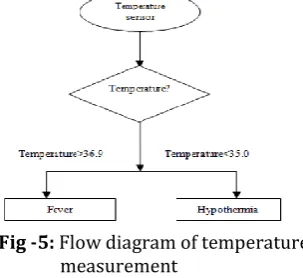
Fig -5: Flow diagram of temperature measurement
[image:4.595.74.223.503.616.2]© 2017, IRJET | Impact Factor value: 5.181 | ISO 9001:2008 Certified Journal | Page 2530
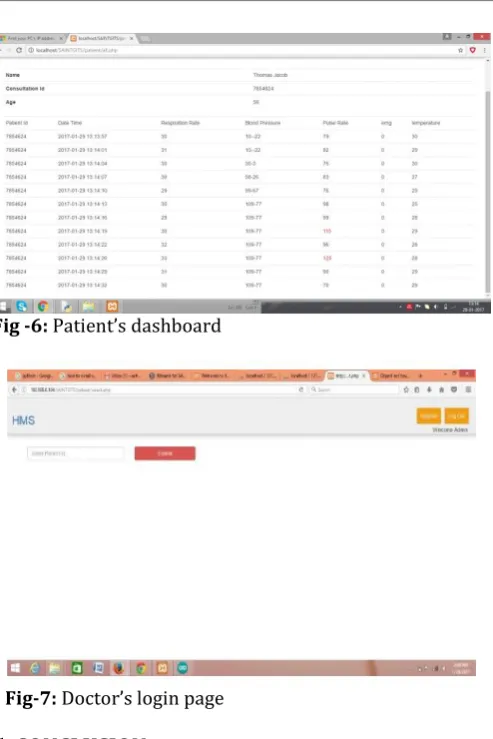
Fig -6: Patient’s dashboard
Fig-7: Doctor’s login page
5. CONCLUSION
The system presented in this paper gives choices in light of patients' recorded information, constant information get together, and in this manner dispensing with manual information accumulation. The contributions of this paper are: a framework of integrating multiple sensors and internet, an implementation using sensors and the arduino and applying data mining technique to extract an appropriate decision based on patient’s condition and historical data. The proposed arrangement can be actualized in home; as a remote and proceeds with home observing or in healing facility; as purpose of care. In this paper, the actualized framework model can be redesigned by including elements of other ceaseless illnesses such diabetes with a specific end goal to accomplish the checking of coordinated multi physiological parameter measures and the motivation behind care giving. It can possibly give a superior and less costly option for recovery human services and may give profit to patients, doctors, and society through consistent observing in the mobile setting, early location of strange conditions, managed restoration, and potential learning disclosure through information mining of all accumulated data. Also, wandering observing will permit patients to take part in typical exercises of day by day life, as opposed to remaining at home or near to particular restorative administrations. To wrap things up, consideration of
ceaseless checking information into medical databases will permit coordinated examination of all information to improve individualized care and give learning disclosure through incorporated information mining.. They will be connected as skin patches, flawlessly coordinated into an individual checking framework, and worn for expanded timeframes. For future work, we want to upgrade the usefulness of the framework by including more sensors and utilizing it to gather information from a bigger specimen size of patients.
REFERENCES
[1] Istepanian RSH, Jovanov E, Zhang YT: Guest Editorial Introduction to the Special Section on M Health: Beyond Seamless Mobility and Global Wireless Health-Care Connectivity. IEEE Transactions on Information Technology in Biomedicine 2004, 8(4):405-414.
[2] Chris Otto, Aleksandar Milenković, Corey Sanders, Emil Jovanov: System architecture of a wireless body area sensor network for ubiquitous health monitoring. Journal of Mobile Multimedia, Vol. 1, No.4 (2006) 307 326.
[3] G. Acampora, D. J. Cook, P. Rashidi, and A. V. Vasilakos, "A Survey on Ambient Intelligence in Healthcare," Proceedings of the IEEE vol. 101, no. 12, pp. 2470-2494, 2013.
[4]Jovanov, E., Milenkovic, A., Otto, C., and de Groen, P.C., A Wireless Body Area Network of Intelligent Motion Sensors for
Computer Assisted Physical Rehabilitation: Journal of
NeuroEngineering and Rehabilitation, 2 (6). March 2005 [5] Priyanka Kakria,N. K. Tripathi, and Peerapong Kitipawang: A Real-Time Health Monitoring System for Remote Cardiac Patients Using Smartphone and Wearable
Sensors: International Journal of Telemedicine and
Applications ,Volume 2015.
[6] U. Anliker, J. A. Ward, P. Lukowicz, G. Troster, F. Dolveck, M. Baer,¨ F. Keita, E. B. Schenker, F. Catarsi, L. Coluccini, A. Belardinelli, D. Shklarski, M. Alon, E. Hirt, R. Scmid, and M. Vuskovic, “AMON: A wearable multiparameter medical monitoring and alert system,” IEEE Trans. Inf. Technol. Biomed., vol. 8, no. 4, pp. 415–427, Dec. 2004
[7] M. Sung, C. Marci, and A. Pentland, “Wearable feedback systems for rehabilitation,” J. NeuroEng. Rehabil., vol. 2, p. 17, Jun. 2005.
[8] C. W. Mundt, K. N. Montgomery, U. E. Udoh, V. N. Barker, G. C. Thonier, A. M. Tellier,R. D. Ricks, R. B. Darling, Y. D. Cagle, N. A. Cabrol, S. J. Ruoss, J. L. Swain, J. W. Hines,and G. T. A. Kovacs, “A multiparameter wearable physiological monitoring system for spaceand terrestrial applications,” IEEE Trans. Inf. Technol. Biomed., vol. 9, no. 3, pp. 382– 391,Sep. 2005
[9] M. Di Rienzo, F. Rizzo, G. Parati, G. Brambilla, M. Ferratini, and P. Castiglioni, "MagIC System: a New Textile-Based
Wearable Device for Biological Signal Monitoring.
© 2017, IRJET | Impact Factor value: 5.181 | ISO 9001:2008 Certified Journal | Page 2531 [10] V. Shnayder, B.-R. Chen, K. Lorincz, T. R. F. Fulford-Jones,
and M. Welsh, "Sensor Networks for Medical Care," Harvard University 2005.
[11] J. Luprano, J. Sola, S. Dasen, J.-M. Koller, and O. Chetelat, "Combination of body sensor networks and on-body signal processing algorithms: the practical case of MyHeart project," International Workshop on Wearable and Implantable Body Sensor Networks (BSN), 3-5 April 2006, pp. 79-82.
[12] N. Oliver and F. Flores-Mangas, "HealthGear: a real-time wearable system for monitoring and analyzing physiological
signals," International Workshop on Wearable and
Implantable Body Sensor Networks (BSN), 3-5 April 2006, pp. 64-67.
[13] K. J. Heilman and S. W. Porges, “Accuracy of the LifeshirtR (Vivometrics) in the detection of cardiac rhythms,” Biol. Psychol., vol. 3, pp. 300–3005, Apr. 2007
[14] P. S. Pandian, K. Mohanavelu, K. P. Safeer et al., “Smart Vest: wearable multi-parameter remote physiological monitoring system,” Medical Engineering & Physics, vol. 30, no. 4, pp. 466–477, 2008.
[15] Zephyr Inc. (2009, Jun. 15). [Online]. Available: http://www.zephyrtech. co.nz
[16] Orha, S. Oniga, ’’ Wearable sensors network for health monitoring using e-Health platform”, Carpathian Journal of Electronic and Computer Engineering 7/1 (2014) 25-29. [17] Mary M. Rodgers, Vinay M. Pai, and Richard S. Conroy,’’Recent Advances in Wearable Sensors for Health Monitoring’’, IEEE SensorsJ, vol. 15, no. 6, june 2015. [18] G. Lopez, V. Custodio, and J. I. Moreno, “LOBIN: E-textile and ´wireless-sensor-network-based platform for healthcare monitoring in future hospital environments,” IEEE Transactions on Information Technology in Biomedicine, vol. 14, no. 6, pp. 1446–1458, 2010
[19] G. Konvalina and H. Haick, “Sensors for breath testing: From nanomaterials to comprehensive disease detection,” Accounts Chem. Res., vol. 47, no. 1, pp. 66–76, Jan. 2014. [20]Alexandros Pantelopoulos and Nikolaos G. Bourbakis,’’ A Survey on Wearable Sensor-Based Systems for Health Monitoring and Prognosis’’, IEEE Transactions on Systems, Man, and Cybernetics—Part C: Applications and Reviews, Vol. 40, No. 1, January 2010
[21] L. Gatzoulis and I. Iakovidis, “Wearable and portable ehealth systems,” IEEE Eng. Med. Biol. Mag., vol. 26, no. 5, pp. 51–56, Sep.–Oct. 2007.
[22] R. G. Lee, K. C. Chen, C. C. Hsiao, and C. L. Tseng, “A mobile care system with alert mechanism,” IEEE Trans. Inf. Technol. Biomed., vol. 11, no. 5,pp. 507–517, Nov. 2007. [23] Iuliana Chiuchisan and Oana Geman,’’ Trends in Embedded Systems for e-Health and Biomedical Applications’’, 2016 International Conference and Exposition on Electrical and Power Engineering (EPE 2016), 20-22 October, Iasi, Romania.
[24] Subhas Chandra Mukhopadhyay,’’ Wearable Sensors for Human Activity Monitoring: A Review’’ , IEEE Sensors Journal, Vol. 15, No. 3, March 2015.
[25] Iuliana Chiuchisan, Iulian Chiuchisan and M. Dimian, “Internet of Things for e-Health: An approach to medical
applications”, 2015 International Workshop on
Computational Intelligence for Multimedia Understanding (IWCIM), 2015, pp. 1-5.
[26] Chen Chen, Alois Knoll, H.-Erich Wichmann, Alexander Horsch” A Review of Three-Layer Wireless Body Sensor Network Systems in Healthcare for Continuous Monitoring” Journal of Modern Internet of Things,MIOT Vol. 2, Iss. 3 Aug. 2013 PP. 24-34
[27] Liu Jing, Li Ming, Yuan Bin, Liu Wenlong "Novel Energy Efficient MAC Protocol for Wireless Body Area Network",Volume:12 Issue:2 February 2015, pp11-20 [28] Borwornlak Thaduangta, Pawit Choomjit and Sudhatai Mongkolveswith,’’ Smart Healthcare: Basic Health Check-Up
Monitoring System For Elderly’’, 2016 International
Computer Science and Engineering Conference (ICSEC). [29] Andriy Temko,’’ Accurate Wearable Heart Rate
Monitoring During Physical Exercises Using PPG ’’, IEEE
Transactions on Biomedical Engineering ,Volume: Pp, Issue: 99