R E S E A R C H A R T I C L E
Open Access
Remote ischemic preconditioning to reduce
contrast-induced acute kidney injury in
chronic kidney disease: a randomized
controlled trial
Ali Ghaemian
1*, Jamshid Yazdani
2, Soheil Azizi
3, Ali A. Farsavian
1, Maryam Nabati
1, Alireza Malekrah
1,
Mozhdeh Dabirian
1, Fatemeh Espahbodi
4, Bahareh Mirjani
1, Hossein Mohsenipouya
5and Javad Heshmatian
1Abstract
Background:The impact of contrast-induced acute kidney injury (CI-AKI) on patients with chronic renal disease is well-known. Remote ischemic preconditioning (RIPC) is a non-invasive method that can reduce the risk of CI-AKI, but studies on RIPC have had different results. The aim of the present study was to assess the potential impact of RIPC on CI-AKI.
Methods:In a randomized, double blinded, controlled trial, 132 patients with chronic renal dysfunction (glomerular filtration rate < 60 mL/min/m2) who underwent coronary angiography or angioplasty received adequate hydration. RIPC was performed in 66 patients by applying an upper arm blood pressure cuff. The cuff was inflated four times for 5 min to 50 mmHg above the systolic blood pressure, followed by deflation for 5 min. In the control group, the blood pressure cuff was inflated only to 10 mmHg below the patient’s diastolic blood pressure. The primary endpoint was an increase in serum cystatin C≥10% from baseline to 48–72 h after exposure to the contrast. Results: The primary endpoint was achieved in 48 (36.4%) patients (24 in each group). RIPC did not show any significant effect on the occurrence of the primary endpoint (P= 1). In addition, when the results were analyzed based on the Mehran risk score for subgroups of patients, RIPC did not reduce the occurrence of the primary endpoint (P= 0.97). Conclusions:In patients at moderate-to-high risk of developing CI-AKI when an adequate hydration protocol is performed, RIPC does not have an additive effect to prevent the occurrence of CI-AKI.
Trial registration:The clinical trial was registered on (Identification numberIRCT2016050222935N2, on December 19, 2016 as a retrospective IRCT).
Keywords:Remote ischemic preconditioning, Acute kidney injury, Contrast-induced nephropathy, Coronary angiography
Background
Diagnostic coronary angiography (CA) and percutaneous coronary intervention (PCI) are routinely performed in patients with coronary artery disease (CAD). Contrast-induced acute kidney injury (CI-AKI) increases mortality and morbidity, and it is one of the most important ad-verse effects of contrast medium (CM), particularly in patients with pre-existing renal dysfunction [1,2]. Based
on the Kidney Disease Improving Global Outcome guidelines, AKI is defined as a 30% rise or 0.3 mg/dl in-crease in serum creatinine level [3] The European Soci-ety of Urogenital Radiology defined contrast-induced nephropathy (CIN) as an increase of the serum cre-atinine level≥0.5 mg/dL or > 25% of the baseline value 48–72 h after CM administration [4]. Cystatin C has been suggested to be more sensitive than serum creatinine to detect acute changes in renal function [5,6]. In addition, Briguori et al. demonstrated that a serum cystatin C in-crease≥10% from that at baseline was the best marker to identify patients at risk of developing CIN [7]. Remote
* Correspondence:[email protected]
1Department of Cardiology, Cardiovascular Research Center, Mazandaran
Heart Center, Artesh BLVD, Sari, Iran
Full list of author information is available at the end of the article
ischemic preconditioning (RIPC) has been shown to have protective effects on the remote organs by alternating is-chemia and reperfusion and releasing mediators in the body [8,9]. Recently, RIPC has been evaluated to prevent CI-AKI [10–12]. Although RIPC showed protective effects on urinary liver-type fatty acid-binding protein levels in patients with CI-AKI at low and moderate risks of devel-oping CIN, the serum creatinine levels in the RIPC and control groups did not show significant differences [10]. On the other hand, a pilot study reported by Er et al. showed a reduced incidence of CIN in high-risk patients, based on serum creatinine levels measured 48–72 h after CM administration [12].
Given the lack of enough data regarding the protective effects of RIPC in patients at moderate-to-high risk of developing CIN and the different effects of RIPC on serum creatinine and cystatin C levels in various reports, we performed a double-blind, randomized, controlled trial to assess the impact of RIPC after CM administra-tion to protect renal funcadministra-tion.
Methods
We performed a prospective, randomized, single-center, double-blinded, sham-controlled trial between December 2016 and August 2017 at Mazandaran Heart Center, Mazandaran University of Medical Sciences, Sari, Iran. All patients gave written informed consent and the study is registered athttp://www.irct.ir/IRCT2016050222935N2.
Subjects
Patients with stable CAD who were admitted to the hos-pital for PCI were selected if the estimated glomerular fil-tration rate (eGFR) was< 60 ml/min/1.73 m2, according to the Modification of Diet in Renal Disease formula [13,14]. Among patients who were admitted to the hospital for CA, those with an eGFR< 60 ml/min/1.73 m2 were se-lected if their estimated CM consumption was> 100 mL. Patients in whom the contrast volume was < 100 mL or > 5 × body weight (kg)/serum creatinine (mg/dL) mL were excluded [15].
Patients on hemodialysis or peritoneal dialysis, those < 20 years old, those with any abnormality or problem in their arms, and those who did not provide informed con-sent were also excluded. Finally, 140 patients out of 222 patients with an eGFR< 60 mL/min/1.73 m2were included in our study. For random allocation of patients into con-trol or RIPC group, we used random number table and simple randomization was performed. For randomization, we used sealed envelopes for patients to receive either sham preconditioning (control) or RIPC in a 1:1 ratio.
Study protocol
Nephrotoxic drugs such as metformin, non-steroidal anti-inflammatory drugs, and aminoglycosides were
discontinued. In our department, to treat patients with renal dysfunction, we routinely use N-acetylcysteine 600 mg twice orally and hydrate patients with an intravenous infusion of saline 0.9% solution at a dose of 1 ml/kg/h for 12 h before through 12 h after CA or PCI. We per-formed this protocol for all study patients.
In the study group, we applied a standard blood pres-sure cuff to the patients’ upper arms. RIPC was per-formed with four cycles of 5-min inflation, followed by 5-min deflation of the cuff at 50 mmHg above the pa-tient’s systolic blood pressure.
In the control group, the four cycles of 5-min inflation and deflation of the blood pressure cuff were performed, but only at10 mmHg below the patient’s diastolic pres-sure. The diagnostic or therapeutic procedure was per-formed within 40 min of performing RIPC or the sham intervention. Both the patients and the interventional cardiologist were blinded to the inflation pressure inter-ventions that were performed before the procedure.
The primary endpoint was the increase of serum cysta-tin C≥10% from baseline to 48–72 h after CM adminis-tration. The secondary endpoints were the incidence of CI-AKI (defined as a rise of the serum creatinine level≥ 0.3 mg/dL) and the level and change in serum creatinine and cystatin C levels within 48–72 h after CM exposure. Hemodialysis, readmission, and mortality within 2 months of contrast administration were our clinical endpoints.
We used Ultravist 300 (Iopromide; 300 mg iodine/mL; Bayer Pharmaceutical, Germany) isoosmolar CM for all patients. Blood samples were taken at baseline before the procedure and 48–72 h after contrast administration.
Statistical analysis
We calculated the sample size on the basis of the pilot study by Er et al. [12]. On that study the mean peak change from baseline of cystatin C in control group was 121.43% ± 22% vs 106.7% ± 6% in RIPC group. We consid-ered the significant level and power of the study to be 5 and 90%, respectively. In addition, considering 20% sample loss, the calculated number of intervention and control group were 60 patients. In this study, all continuous vari-ables were tested for normal distribution using the Kolmogorov-Smirnov test. Variables with normal distribu-tion are presented as a mean ± standard deviadistribu-tion. For variables that were not normally distributed, we used the median and first and third quartiles (Q1-Q3). Normally
Results
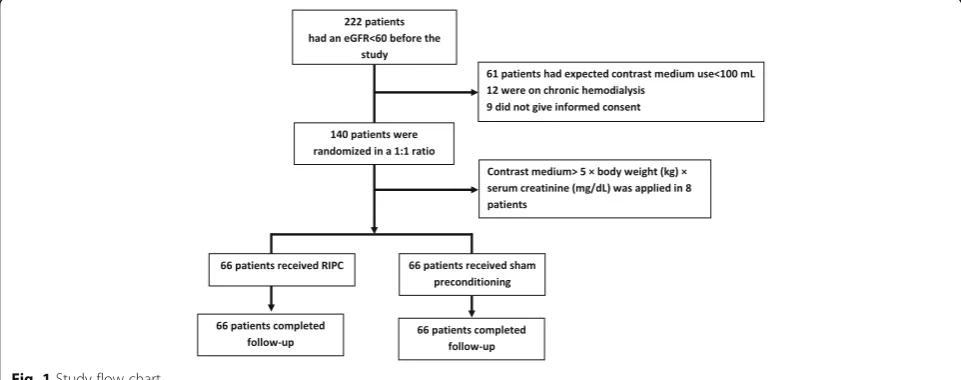
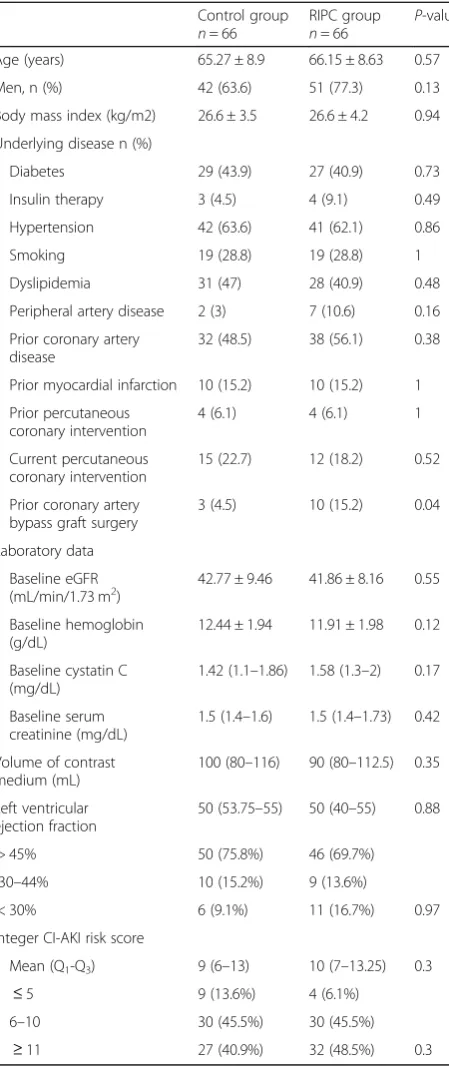
During the study period, we assessed 222 patients with a baseline eGFR< 60 mL/min/1.73 m2for potential recruit-ment (Fig. 1). In 61 patients, the expected contrast medium use was< 100 mL, 12 were on chronic hemodialysis, and 9 did not agree to enroll in the study. A total of 140 patients were included for randomization to receive either RIPC or sham preconditioning in a 1:1 ratio. After randomization, 8 patients were excluded be-cause their CM use was> 5 × body weight (kg)/serum creatinine (mg/dL) [7].Finally, 132 patients, (66 in the RIPC group and 66 in the control group) were included in the study, and all of them completed the study proto-col and follow-up procedures. The demographic and other clinical baseline characteristics of the two groups did not show significant differences, except the RIPC group had a higher frequency of coronary artery bypass graft (CABG) surgery than the control group did; 10(15.2%) participants in the RIPC group vs 3(4.5%) in the control group (P= 0.04) (Table1).
The baseline laboratory data, including serum cystatin C, serum creatinine, eGFR, and serum hemoglobin levels, were also similar between the two groups. The baseline data showed that all 132 patients had an eGFR< 60 mL/ min/1.73 m2, and 125 patients (61 in the control group and 64 in the RIPC group) had a serum creatinine level > 1.4 mg/dL (P= 0.44). The frequency of current and previ-ous PCI, volume of CM use, and probability of developing CI-AKI according to the Mehran risk score [16] were similar between the two groups. Different components of the Mehran risk score were also similar between two groups (Table2). Most of the patients in both groups were categorized as having a moderate or high risk of develop-ing CI-AKI. We also used the National Cardiovascular Data Registry (NCDR) risk score model [17] for predicting acute kidney injury in our patients and interestingly the
risk of acute kidney injury and dialysis were not statisti-cally different between the two groups (Table 3). In addition, the cardiovascular medications were also similar between the two groups (Table4).
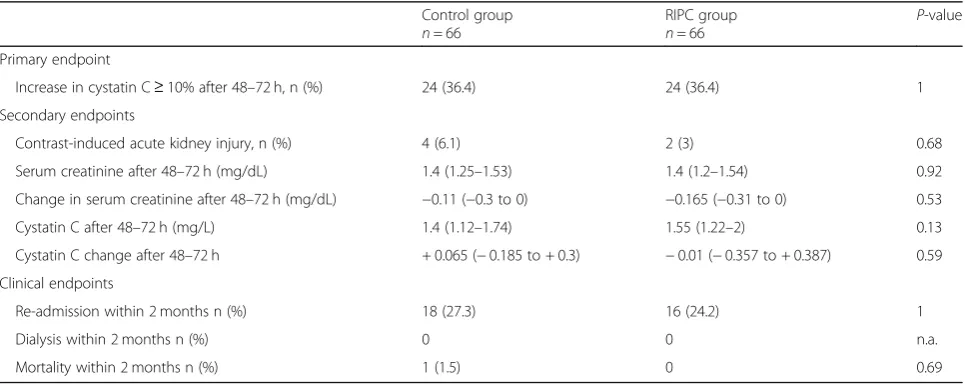
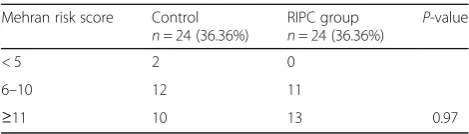
The primary endpoint of the study (increase in cystatic C level≥10% 48–72 h after CM administration relative to its baseline value) was achieved in 48 (36.36%) out of 132 patients; interestingly, its frequency was exactly the same in the two groups (24 participants in each group) (Table5). Deterministic sensivity analysis was performed including 8 patients whom were excluded based on con-trast dose. Observed odds ratio was 1 and the extended adjusted odds ratio and bias percent were 1.019 and 1.9%, respectively. The Mehran risk score-based sub-group analysis showed that there was no significant dif-ference between the groups in the increase in cystatin C level≥10% (P= 0.97) (Table 6). CI-AKI occurred in 4 (6.1%) participants in the control group and 2 (3%) in the RIPC group, and this difference was not significant (P= 0.68). The Mehran score in 4 of these 6 patients was ≥11, and the scores of the other 2 patients were 5 and 6. There was no statistically significant difference between the two groups in serum cystatin C and serum creatinine levels and their changes 48–72 h after the pro-cedure (Table5).
Dialysis was not required for any patient, and only one patient in the control group died after CABG surgery due to wound infection during the follow-up period. Thirty-four patients (18 [27.3%] in the control group and 16 [24.2%] in the RIPC group) were readmitted to the hospital (P= 0.69). None of the patients had any ad-verse effects due to the preconditioning protocol.
Discussion
In this study, RIPC, which induces a short duration of ischemia in the upper arm before exposure to CM in
diagnostic and therapeutic coronary procedures, did not demonstrate a protective effect to reduce CI-AKI in pa-tients with chronic renal impairment who were at moderate-to-high risk of developing CIN. In addition, RIPC did not reduce adverse clinical outcomes including mortality, hemodialysis, and re-hospitalization.
Excretion of creatinine in urine is the result of glomeru-lar filtration and tubuglomeru-lar secretion [18]. Thus, its changes may underestimate the eGFR. Furthermore, the levels of serum creatinine depend on non-renal factors such as muscle mass and hydration status [19]. On the other hand, serum cystatin C does not undergo tubular secre-tion, and its serum concentration is determined by glom-erular filtration [20, 21] and therefore it can reliably represent impairment of renal function [6,22]. Briguori et al. studied 410 patients with renal dysfunction (eGFR< 60 mL/min/1.73 m2) who underwent coronary or periph-eral procedures and showed that a cystatin C increase
≥10% compared with baseline was the best cut-off value to identify patients at risk of developing CIN [7]. In the same study, while the rate of CI-AKI based on serum cre-atinine rise≥0.3 mg/dL was 8.2%, a serum cystatin C in-crease of≥10% occurred in 21.2% of the patients.
Our study’s results are similar to and different from those of previous randomized trials involving RIPC to prevent CIN. First of all, similar to the study by Menting et al. [14] (72 patients) and Igarashi et al. [13] (60 pa-tients), our study showed that RIPC did not significantly affect the change in serum creatinine 48–72 h after CM exposure. Furthermore, the change in serum cystatin C in both our study and that in the study by Igarashi et al. were not significantly different between the RIPC and control groups. Most patients in these two previous studies were at mild-to-moderate risk of developing CIN. However, in contrast to our study, Menting et al. found that the creatinine change in patients at high to very high risk of developing CI-AKI was significantly
Table 1Baseline characteristics
Control group
n= 66
RIPC group
n= 66 P
-value
Age (years) 65.27 ± 8.9 66.15 ± 8.63 0.57
Men, n (%) 42 (63.6) 51 (77.3) 0.13
Body mass index (kg/m2) 26.6 ± 3.5 26.6 ± 4.2 0.94
Underlying disease n (%)
Diabetes 29 (43.9) 27 (40.9) 0.73
Insulin therapy 3 (4.5) 4 (9.1) 0.49
Hypertension 42 (63.6) 41 (62.1) 0.86
Smoking 19 (28.8) 19 (28.8) 1
Dyslipidemia 31 (47) 28 (40.9) 0.48
Peripheral artery disease 2 (3) 7 (10.6) 0.16
Prior coronary artery disease
32 (48.5) 38 (56.1) 0.38
Prior myocardial infarction 10 (15.2) 10 (15.2) 1
Prior percutaneous coronary intervention
4 (6.1) 4 (6.1) 1
Current percutaneous coronary intervention
15 (22.7) 12 (18.2) 0.52
Prior coronary artery bypass graft surgery
3 (4.5) 10 (15.2) 0.04
Laboratory data
Baseline eGFR (mL/min/1.73 m2)
42.77 ± 9.46 41.86 ± 8.16 0.55
Baseline hemoglobin (g/dL)
12.44 ± 1.94 11.91 ± 1.98 0.12
Baseline cystatin C (mg/dL)
1.42 (1.1–1.86) 1.58 (1.3–2) 0.17
Baseline serum creatinine (mg/dL)
1.5 (1.4–1.6) 1.5 (1.4–1.73) 0.42
Volume of contrast medium (mL)
100 (80–116) 90 (80–112.5) 0.35
Left ventricular ejection fraction
50 (53.75–55) 50 (40–55) 0.88
> 45% 50 (75.8%) 46 (69.7%)
30–44% 10 (15.2%) 9 (13.6%)
< 30% 6 (9.1%) 11 (16.7%) 0.97
Integer CI-AKI risk score
Mean (Q1-Q3) 9 (6–13) 10 (7–13.25) 0.3
≤5 9 (13.6%) 4 (6.1%)
6–10 30 (45.5%) 30 (45.5%) ≥11 27 (40.9%) 32 (48.5%) 0.3 RIPCremote ischemic preconditioning,eGFRestimate glomerular filtration rate, CI-AKIcontract-induced acute kidney injury
Table 2Components of the Mehran Risk Score
Risk Factors Risk score
Control group RIPC group P-value
eGFR < 60 ml/min/1.73 m2 2.26 2.28 0.95
Serum Creatinin > 1.5 mg/dl 0.93 0.65 0.27
Diabetes 1.3 1.48 0.49
CHF 1.93 2.04 0.78
Anemia 1.83 2.03 0.4
Contrast media volume 1.36 1.42 0.59
Age > 75 years 0.52 0.68 0.53
CHFcongestive heart failure,eGFRestimate glomerular filtration rate
Table 3NCDR AKI and Dialysis Risk after PCI
Control group
n= 66
RIPC group
n= 66 P
-value
AKI score 24 (17–43) 30 (21.5–43) 0.35
Risk of AKI 6.7 (4.9–21.7) 16.5 (6.7–21.7) 0.35
AKI requiring dialysis score 3 (2–6) 4 (2–6) 0.69
lower in the RIPC group compared with those in the control group. However, only 11 (15.3%) of their patients (6 in the RIPC group and 5 in the control group) had a Mehran risk score≥11, while in our study 59 (44.7%) patients (27 in the control and 32 in the RIPC group) had a risk score≥11. Moreover, Menting et al. did not measure the cystatin C level in their study.
On the other hand, the investigation by Er et al. [12], which included 100 patients (50 in each group), found that in patients with chronic kidney disease and a high risk of developing CI-AKI, RIPC reduced the incidence of CIN, defined as an increase in serum creatinine ≥0.5 mg/dL within 48–72 h after CM exposure. Although 59% of the patients in the study by Er et al. were at a high or very high risk of developing CI-AKI, the inci-dence of CIN in the control group was as high as 40%, whereas in our study, only 4 (6%) participants in the control group and 2 (3%) in the RIPC group had an
increase in serum creatinine ≥0.3 mg within 48–72 after CM exposure.
Unfortunately, Er et al. did not report the incidence of cystatin C increase in their study; however they reported the protective effect of RIPC on the rise in serum cysta-tin C level [12]. Furthermore, the incidence of CI-AKI reported by Er et al. is much higher than that from an-other investigation with a comparable baseline eGFR [23]. Nonetheless, the authors suggested that this dis-crepancy may be the result of a high prevalence of heart failure and diabetes in their study cohort [12]. Finally, in contrast to the study by Er et al., in our study, RIPC did not affect the rates of re-hospitalization, death, or hemodialysis. As far as we know, no other investigation has reported that RIPC has a protective effect on the clinical adverse effects of CI-AKI in humans.
This study has some strengths. First, it was performed in a tertiary referral heart hospital, and the patients were initially included in the study based on their renal dys-function, so the protocol represents the routine daily practice in our hospital. This is why more study cohort patients had a moderate or high risk of developing CIN. Second, this randomized controlled trial included more patients than previous similar studies did. Third, all pa-tients were adequately hydrated according to the routine of our department 12 h before to 12 h after CM applica-tion. Thus, even though the incidence of the increase in serum creatinine was not high, the increase in cystatin C≥10% was a more sensitive marker than serum cre-atinine, and it was sufficiently high to be comparable be-tween the two groups. Finally, this study was completely double-blinded in order to reduce the risk of bias.
Nonetheless, the study has some limitations. First, the incidence of the increase in serum creatinine was low.
Table 4Baseline Cardiovascular Medications
Control group
n= 66
RIPC group
n= 66 P
-value
ß-blocker n (%) 42 (62.12) 44 (66.67) 0.72
Calcium channel blocker n (%)
14 (21.21) 12 (18.19) 0.66
Angiotensin-converting enzyme inhibitor n (%)
16 (24.24) 11 (16.67) 0.73
Angiotensin II receptor blocker n (%)
35 (53.03) 33 (50) 0.28
Loop diuretics n (%) 35 (53.03) 38 (57.57) 0.6
Thiazide diuretics n (%) 11 (16.67) 9 (13.6) 0.63
Spironolacton n (%) 5 (7.57) 7 (10.6) 0.55
Table 5Trial outcomes
Control group
n= 66
RIPC group
n= 66 P
-value
Primary endpoint
Increase in cystatin C≥10% after 48–72 h, n (%) 24 (36.4) 24 (36.4) 1
Secondary endpoints
Contrast-induced acute kidney injury, n (%) 4 (6.1) 2 (3) 0.68
Serum creatinine after 48–72 h (mg/dL) 1.4 (1.25–1.53) 1.4 (1.2–1.54) 0.92
Change in serum creatinine after 48–72 h (mg/dL) −0.11 (−0.3 to 0) −0.165 (−0.31 to 0) 0.53
Cystatin C after 48–72 h (mg/L) 1.4 (1.12–1.74) 1.55 (1.22–2) 0.13
Cystatin C change after 48–72 h + 0.065 (−0.185 to + 0.3) −0.01 (−0.357 to + 0.387) 0.59
Clinical endpoints
Re-admission within 2 months n (%) 18 (27.3) 16 (24.2) 1
Dialysis within 2 months n (%) 0 0 n.a.
Mortality within 2 months n (%) 1 (1.5) 0 0.69
However, all patients were hydrated based on a long schedule protocol. The incidence of CIN with adequate hydration has varied between 2 and 13% [24–26]. Sec-ond, the follow-up period of this study was only 2 months. An increase in serum cystatin C≥10% was re-ported to predict the occurrence of major adverse events, defined as death and further deterioration of renal function requiring chronic dialysis at one year [7]. However, the purpose of this study was only to define the effect of RIPC on AKI induced by CM. Third, we did not examine creatinine clearance and urinary neutrophil gelatinase-associated lipocalin levels. Both of these markers are helpful to detect CI-AKI.
Finally, in this study patients received three prophylac-tic measures in the study group vs two in the control arm. In this way, the effect of RIPC for CI-AKI may be diluted. However, hydration of such patients was per-formed based on current guidelines and we could not deprive them from such prophylactic measures.
Conclusions
The results of this study show that in patients at moderate-to-high risk of developing CI-AKI who are ad-equately hydrated, RIPC does not have further beneficial effects. Since there is no signal of actual benefit of RIPC on preventing AKI it seems that it is time to abandon it as a prophylactic measure for preventing CI-AKI. How-ever, a large study only in high-risk patients (eGFR < 30 ml/min) should be performed to assess the effect of RIPC as an adjunct to hydration to provide additional protection in this high risk group.
Abbreviations
CA:Coronary angiography; CABG: Coronary artery bypass graft; CI-AKI: Contrast-induced acute kidney injury; CIN: Contrast-induced nephropathy; eGFR: Estimated glomerular filtration rate; PCI: Percutaneous coronary intervention; RIPC: Remote ischemic preconditioning
Acknowledgements
We thank Mojtaba Shokri for his full time cooperation for performing the study and preparing the manuscript.
Funding
This study was financially supported by Vice Chancellor for Research Technology, Mazandaran University of Medical Sciences. The funding body did not have any role in the design of the study and collection, analysis, and interpretation of the data and in writing the manuscript.
Availability of data and materials
The datasets used and/or analyzed during the current study will be available from the corresponding author on reasonable request.
Authors’contributions
AG is the coordinating investigator, JH, MN, AF, AM, BM, MD, FE, SA, HMP are investigators/subinvestigators in the study center and JY performed the statistical analysis of the study. AG drafted the manuscript, and all co-authors reviewed and revised the article. All authors read and approved the final manuscript.
Ethics approval and consent to participate
The ethical committee review board of Mazandaran University of Medical Sciences who approved our study are: Dr. Abbas Moosavi, Dr. Majid Saeedi, Dr. Afzali, Dr. Ali Mohammadpour, Dr. Farhang Babamahmoudi, Mr. Mojtaba Oraei, Dr. Alireza Rafiee, Dr. Mehran Zarghami, Drs. Zahra Kashi, Mr. Korosh Yousefi.
All patients gave written informed consent.
Consent for publication
Not applicable.
Competing interests
The authors declare that they have no competing interests.
Publisher’s Note
Springer Nature remains neutral with regard to jurisdictional claims in published maps and institutional affiliations.
Author details
1Department of Cardiology, Cardiovascular Research Center, Mazandaran
Heart Center, Artesh BLVD, Sari, Iran.2Faculty of Health Sciences, Mazandaran University of Medical Sciences, Sari, Iran.3Department of Pathology,
Mazandaran University of Medical Sciences, Sari, Iran.4Department of Internal Medicine and Nephrology, Mazandaran University of Medical Sciences, Sari, Iran.5Cardiovascular Research Center, Mazandaran Heart Center, Artesh BLVD, Sari, Iran.
Received: 13 November 2017 Accepted: 3 December 2018
References
1. Nash K, Hafeez A, Hou S. Hospital-acquired renal insufficiency. Am J Kidney Dis. 2002;39(5):930–6.
2. Best PJM, Lennon R, Ting HH, et al. The impact of renal insufficiency on clinical outcomes in patients undergoing percutaneous coronary interventions. J Am Coll Cardiol. 2002;39(7):1113–9.
3. KDIGO Clinical Practice Guideline for Acute Kidney Injury. Kidney Disease Improving Global Outcomes, cited January 2014.http://kdigo.org/home/ guidelines/acute-kidney-injury.
4. van der Molen AJ, Reimer P, Dekkers IA, Bongartz G, Bellin M-F, Bertolotto M, et al. Post-contrast acute kidney injury–part 1: definition, clinical features, incidence, role of contrast medium and risk factors. Eur Radiol. 2018;28(7):2845–55.
5. Dharnidharka VR, Kwon C, Stevens G. Serum cystatin C is superior to serum creatinine as a marker of kidney function: a meta-analysis. Am J Kidney Dis. 2002;40(2):221–6.
6. Sjostrom P, Tidman M, Jones I. The shorter T1/2 of cystatin C explains the earlier change of its serum level compared to serum creatinine. Clin Nephrol. 2004;62(3):241–2.
7. Briguori C, Visconti G, Rivera NV, et al. Cystatin C and contrast-induced acute kidney injury. Circulation. 2010;121(19):2117–22.
8. Cheung MM, Kharbanda RK, Konstantinov IE, et al. Randomized controlled trial of the effects of remote ischemic preconditioning on children undergoing cardiac surgery: first clinical application in humans. J Am Coll Cardiol. 2006;47(11):2277–82.
9. Hausenloy DJ, Mwamure PK, Venugopal V, et al. Effect of remote ischaemic preconditioning on myocardial injury in patients undergoing coronary artery bypass graft surgery: a randomised controlled trial. Lancet. 2007; 370(9587):575–9.
Table 6Mehran risk score, based on an increase in cystatin C≥ 10%
Mehran risk score Control
n= 24 (36.36%)
RIPC group
n= 24 (36.36%)
P-value
< 5 2 0
6–10 12 11
≥11 10 13 0.97
10. Igarashi G, Iino K, Watanabe H, Ito H. Remote ischemic pre-conditioning alleviates contrastinduced acute kidney injury in patients with moderate chronic kidney disease. Circ J. 2013;77(12):3037–44.
11. Menting TP, Sterenborg TB, de Waal Y, et al. Remote ischemic preconditioning to reduce contrast-induced nephropathy: a randomized controlled trial. Eur J Vasc Endovasc Surg. 2015;50(4):527–32.
12. Er F, Nia AM, Dopp H, et al. Ischemic preconditioning for prevention of contrast-medium-induced nephropathy: randomized pilot RenPro-trial (renal protection trial). Circulation. 2012;126(3):296–303.
13. Contrast induced nephropathy: updated ESUR Contrast Media Safety Committee guidelines. Radiology ESoU, Vienna. 2012.
14. Levey AS, Coresh J, Greene T, et al. Using standardized serum creatinine values in the modification of diet in renal disease study equation for estimating glomerular filtration rate. Ann Intern Med. 2006;145(4):247–54. 15. Cigarroa RG, Lange RA, Williams RH, Hillis LD. Dosing of contrast material to
prevent contrast nephropathy in patients with renal disease. Am J Med. 1989;86(6):649–52.
16. Mehran R, Aymong ED, Nikolsky E. A simple risk score for prediction of contrast-induced nephropathy after percutaneous coronary intervention: development and initial validation. J Am Coll Cardiol. 2004;44(7):1393–9. 17. Tsai TT, Patel UD, Chang TI, et al. Validated contemporary risk model of
acute kidney injury in patients undergoing percutaneous coronary interventions: insights from the National Cardiovascular Data Registry Cath PCI registry. J Am Heart Assoc. 2014;3(6):e001380.
18. Hatano M. Clinical study of tubular creatinine secretion in renal dysfunction. Nihon Jinzo Gakkai Shi. 1991;33(11):1097–104.
19. Sudarsky D, Nikolsky E. Contrast-induced nephropathy in interventional cardiology. Int J Nephrol Renov Dis. 2011;4:85–99.
20. Newman DJ, Thakkar H, Edwards RG, et al. Serum cystatin C measured by automated immunoassay: a more sensitive marker of changes in GFR than serum creatinine. Kidney Int. 1995;47(1):312–8.
21. Kyhse-Andersen J, Schmidt C, Nordin G, et al. Serum cystatin C, determined by a rapid, automated particle-enhanced turbidimetric method, is a better marker than serum creatinine for glomerular filtration rate. Clin Chem. 1994; 40(10):1921–6.
22. Rickli H, Benou K, Ammann P, et al. Time course of serial cystatin C levels in comparison with serum creatinine after application of radiocontrast media. Clin Nephrol. 2004;61(2):98–102.
23. Maioli M, Toso A, Leoncini M, et al. Sodium bicarbonate versus saline for the prevention of contrast-induced nephropathy in patients with renal dysfunction undergoing coronary angiography or intervention. J Am Coll Cardiol. 2008;52(8):599–604.
24. McCullough PA. Contrast-induced acute kidney injury. J Am Coll Cardiol. 2008;51(15):1419–28.
25. Mitchell AM, Jones AE, Tumlin JA, Kline JA. Incidence of contrast-induced nephropathy after contrast-enhanced computed tomography in the outpatient setting. Clin J Am Soc Nephrol. 2010;5(1):4–9.