Chapter 1
Contents
1.1
Units
1.2
Measurement of Length
1.3
Measurement of Volume
1.4
Measuring Mass and Weight
1.5
Measuring Density
Chapter 1
At the end of this chapter you should be able to:
• use and describe how to use rulers, micrometers, vernier scales and
callipers to determine lengths
• use and describe how to use a measuring cylinder to measure
a volume
• use and describe how to use clocks and other devices for
measuring an interval of time including the period of a pendulum
• demonstrate an understanding that mass is a measure of the amount of
substance in a body
Chapter 1
At the end of this chapter you should be able to:
• describe, and use the concept of, weight as the effect of a
gravitational field on a mass
• demonstrate understanding that two weights, and therefore
masses, may be compared using a balance
• use appropriate balances to measure mass and weight
• describe experiments to determine the density of a liquid, of a regularly
Unit 1.1
SI Units
Unit 1.1
Physical Quantity SI Unit Symbol
m
Mass
second
A
Temperature Kelvin
Amount of substance Mole mol
Luminous intensity Candela cd
Length
Time
Electric Current
metre
kilogram kg
s
ampere
Unit 1.1
Prefixes
• Used to express physical quantities that are very big or
very small.
• Although metres are the SI unit for length we use other
units based on the metre.
Unit 1.1
Prefix Meaning Symbol
Micro 1,000,000 m Milli 1,000 m
Centi 100 c
Deci 10 d
Kilo 1,000 k
Unit 1.1
Examples
1. What is 23.4 centimetres in metres?
Write down the relationship between metres and centimetres.
100 cm = 1 m
1 cm = 1 / 100 m
1 cm x 23.4 = (1 / 100) m x 23.4
Unit 1.1
Examples
2. Express the speed of 5600 m/s in km/h.
5600 m/s = 5600 m / 1 s
Unit 1.1
Exercise
1. Converting the following values from the units given:
a) 1.5 m = __________ cm
b) 0.23 mm = __________ m
c) 200 g = __________ kg
d) 15.7 cm = 157 _____
e) 0.37 km = 370 _____
Unit 1.1
Exercise
2. Converting the following values from one unit to another:
a) 0.75 hour = __________ min
b) 2 m² = ________ cm²
c) 200 cm³ = __________ dm³
Chapter 1
Contents
1.1
Units
(Completed)
1.2
Measurement of Length
1.3
Measurement of Volume
1.4
Measuring Mass and Weight
1.5
Measuring Density
Unit 1.2
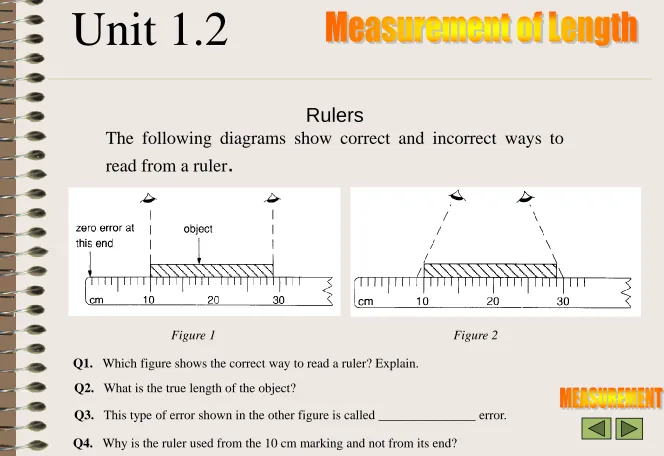
Rulers
[image:13.720.32.696.47.503.2]The following diagrams show correct and incorrect ways to
read from a ruler
.
Figure 1 Figure 2
Q1. Which figure shows the correct way to read a ruler? Explain.
Q2. What is the true length of the object?
Q3. This type of error shown in the other figure is called _______________ error.
Unit 1.2
Different measuring instruments are used for measuring different lengths.
This will determine the accuracy of the value we obtain.
Instrument Length to be measured Accuracy
Tape Measure Greater than 1 m 1 cm
Metre Rule 10 cm to 1 m 1 mm
Vernier Callipers ~2 cm to ~10 cm 0.1 mm
Unit 1.2
Vernier Callipers
Q1. Give two advantages of using vernier callipers rather than a ruler?
Unit 1.2
Q2. What readings are shown on the following scales?
0 cm
1
2
3
4
10 0 Main scale: Vernier scale: Reading: _________________
0 cm
1
2
3
4
Unit 1.2
Q2. What readings are shown on the following scales?
0 cm
1
2
3
4
10 0 Main scale: Vernier scale: Reading: _________________
0 cm
1
2
3
4
Unit 1.2
Micrometer Screw Gauge
Q1. What is the advantage of using a micrometer screw gauge rather than vernier callipers?
Unit 1.2
Q3. Write down the readings shown on each of the following micrometer screw gauges.
0
40
35
0
25
20
1. Sleeve:
Thimble:
Reading: ___________
2.
Sleeve:
Thimble:
Unit 1.2
Unit 1.2
Q3. Write down the readings shown on each of the following micrometer screw gauges.
0
0
45
5.
Sleeve: Thimble:
Unit 1.2
Zero Error
Before using a micrometer we must check for a zero error.
Close the micrometer so that the spindle touches the anvil.
Unit 1.2
1.
Unit 1.2
2.
Unit 1.2
Exercise
40
35
0
What would be the true length being measured above if the micrometer had
i) a zero reading of 0.00 mm. _______________________________
ii) a zero reading of 0.02 mm. _______________________________
Chapter 1
Contents
1.1
Units
(Completed)
1.2
Measurement of Length
(Completed)
1.3
Measurement of Volume
1.4
Measuring Mass and Weight
1.5
Measuring Density
Unit 1.3
Liquids
Volume of a liquid
Q1. Which of the above are used to find the volume of a small volume of liquid?
Unit 1.3
Precautions
Always take the following precautions when reading the volume of a liquid:
1. Place the container on a flat horizontal surface.
2. The eye must be positioned perpendicularly at the mark of the scale. This is to avoid errors in measurement due to parallax.
Q. What are the readings on the following measuring cylinders? (Scales in cm³.)
10
15
35
40
Unit 1.3
Regular Solids
Volumes can be calculated by taking measurements then using formulae.
2 cm
3 cm
2 cm
2 m
3 cm
2 cm
Volume of rectangular block =
Volume of sphere =
Unit 1.3
Irregular Solids
1. Volume of a small irregular solid that sinks
Irregular Solids
Unit 1.3
Irregular Solids
Chapter 1
Contents
1.1
Units
(Completed)
1.2
Measurement of Length
(Completed)
1.3
Measurement of Volume
(Completed)
1.4
Measuring Mass and Weight
1.5
Measuring Density
Unit 1.4
In everyday conversation we use the words mass and weight interchangeably.
In Physics they have two very different meanings.
Mass
Definition:
Mass is defined as the amount of matter in a body.
SI Unit:
The mass of a body is constant and does not change.
Mass has only a magnitude.
Other units used for mass are the gram (g) and the tonne.
Unit 1.4
Measurement of Mass
To measure mass we can use one of two instruments:
Unit 1.4
Inertia
The two people shown below put on roller-skates! Who
would be
1.
easy to push?
2.
hardest to stop if coming towards you?
Thin Man Fat Man
Unit 1.4
Inertia
Definition:
Inertia is defined as the reluctance of an object to change its state of rest or
uniform motion in a straight line.
Unit 1.4
Weight
Definition:
Weight is defined as the force of earth’s gravitational pull on a body.
SI Unit:
Newton (N)
Unit 1.4
Unit 1.4
Measurement of Weight
To measure weight we can use one of two instruments:
Spring Balance Compression Balance
Exercise
Unit 1.4
Unit 1.4
Mass and Weight
The following table summarises the differences between mass and weight:
Mass Weight Definition: Units:
Does It Have Direction?
Is Location Important?
Measured Using: Spring Balance,
Compression Balance Mass is defined as
the amount of matter in a body.
Weight is defined as the force of earth’s gravitational pull on
a body.
kg N
No Yes
No Yes
Chapter 1
Contents
1.1
Units
(Completed)
1.2
Measurement of Length
(Completed)
1.3
Measurement of Volume
(Completed)
1.4
Measuring Mass and Weight
(Completed)
1.5
Measuring Density
Unit 1.5
Different objects of the same size and shape often have a different weight.
We then say that their densities are different.
Definition:
Density is defined as the mass per unit volume.
SI Unit:
kg/m
3or kg m
-3Unit 1.5
Density can be calculated from the equation:
Density = Mass / Volume
Or we can write this in symbols as:
r
= m / V
Unit 1.5
Measurement of Density
Method:
1.
Volume of the object is calculated using one of the methods listed in
Unit 1.3
.
2.
The mass is measured using a sliding mass balance or an electronic balance.
3.
Density calculated using the above equation.
Precaution:
Unit 1.5
Density of Water
One important density for you to know is that of water.
Exercise:
Unit 1.5
Density of Water
One important density for you to know is that of water.
Exercise:
Q1.
A 2 litre coke bottle is filled with pure water and is found to have a mass of 2000 g
(excluding the mass of the bottle). What is the density of pure water?
Solution:
m = 2000 g , V = 2000 cm
3Thus,
r
= m / V = 2000 g / 2000 cm
3= 1 g/cm
3or
m = 2 kg, V = ( 2000 / 1000000 ) m
3= 0.002 m
3Unit 1.5
Floating and Sinking
When placed in water some objects will float and others will sink.
Q1. Which of the following objects will float when placed in water?
Object Density Float / Sink
Wood (oak) 650 kg/m³
Iron 2700 kg/m³
Gold 19000 kg/m³
Oil 850 kg/m³
Unit 1.5
Q2.
Use your results to complete the following.
Q3.
If the density of an object is less than that of water it will _______________.
Q4.
If the density of an object is more than that of water it will ______________.
Q5.
Write the densities of gold and oak in g/cm³.
Gold, Oak
Chapter 1
Contents
1.1
Units
(Completed)
1.2
Measurement of Length
(Completed)
1.3
Measurement of Volume
(Completed)
1.4
Measuring Mass and Weight
(Completed)
1.5
Measuring Density
(Completed)
Unit 1.6
SI Unit:
second
Other common units for measuring time are:
minute, hour
All clocks measure time by counting the number of times something vibrates, or moves,
back and forth.
This type of repeated movement is called an
oscillation
.
The time taken to make one complete oscillation is called the
period
of the oscillation.
There are several different devices that can be used to measure time intervals.
These will depend on:
Unit 1.6
Pendulum
A pendulum in the simplest type of clock. It consists of a bob (small weight) swinging back and
forth on a string.
Unit 1.6
Pendulum
A pendulum in the simplest type of clock. It consists of a bob (small weight) swinging back and
forth on a string.
Front ViewThe length of the string, from clamp to centre of the bob, is
l
.
The distance from A to B is called the amplitude of the oscillation,
A
.
The period is the time taken,
T
, to swing from
A
to
C
Unit 1.6
Q1.
What happens to the period,
T
, if we change the mass of the bob?
Q2.
What happens to the period,
T
, if we change the amplitude,
A
?
Unit 1.6
Q1.
What happens to the period,
T
, if we change the mass of the bob?
The period
T remains
unchanged
when the mass of the bob is changed.
Q2.
What happens to the period,
T
, if we change the amplitude,
A
?
The period
T
remains unchanged
when the amplitude A is changed.
Q3.
What happens to the period,
T
, if we change the length of the string,
l
?
Chapter 1
Contents
1.1
Units
(Completed)
1.2
Measurement of Length
(Completed)
1.3
Measurement of Volume
(Completed)
1.4
Measuring Mass and Weight
(Completed)
1.5
Measuring Density
(Completed)
Chapter 1
Contents
1.1 Units(Completed)
1.2 Measurement of Length(Completed)
1.3 Measurement of Volume(Completed)
1.4 Measuring Mass and Weight(Completed)
1.5 Measuring Density(Completed)
1.6 Measurement of Time(Completed)