Research Article
July
2017
Computer Science and Software Engineering
ISSN: 2277-128X (Volume-7, Issue-7)
An Advanced Tree Based Energy Routing Protocol
Sonam Ashok Kamble
ME Student, Dept. of Computer, Rajiv Gandhi Institute of Technology, Mumbai University, Maharashtra, India
Prof. Dilip S. Kale
Assistant Professor, Dept. of Computer, Rajiv Gandhi Institute of Technology, Mumbai University, Maharashtra, India
DOI: 10.23956/ijarcsse/V7I7/0207
Abstract— A wireless sensor network (WSN) consists of hundreds to thousands of sensor nodes, working in any physical environment, and having sensing, computation and communication capabilities. Each sensor node in WSN is capable of communicating with each other and the base station (BS) for the purpose of data integration and dissemination. As the battery replacement is not easy for WSN with thousands of physically embedded nodes, energy conservation becomes one of the most important challenges in WSNs. And hence there is a need for energy efficient routing protocol to offer a long-life work time.In this paper, we propose an Advanced Tree Based Energy Routing Protocol. In this protocol for each round BS assigns a root node and broadcasts this selection to all sensor nodes. And then each node selects its parent by considering itself and its neighbour’s information, thus making it a dynamic protocol. It is a hierarchical protocol of WSN which increases the lifetime of network by using the energy of the network by using the energy of the network in an efficient way.
Keywords— Wireless Sensor Network, Base station, Network lifetime, Energy-balance, routing protocol
I. INTRODUCTION
A. WSN Introduction
A wireless sensor network (WSN) consists of hundreds to thousands of low-power multi-functional sensor nodes, operating in an unattended environment, and having sensing, computation and communication capabilities. Each sensor node in WSN is capable of communicating with each other and the base station (BS) for the purpose of data integration and dissemination. The sensor nodes have limited memory along with limited battery power and are typically deployed in difficult to access locations, a sensor node is deployed for wireless communication to transfer the data to the Base Station (BS). Battery is the primary and main power source of the sensors. Secondary power supply can be harvested from the environment such as inverters or solar panels may be added to the node depending on the strictness of the environment where the sensor will be deployed. Actuators may be incorporated in the sensor nodes depending on the application and type of the sensors used in the network.
B. Clustering
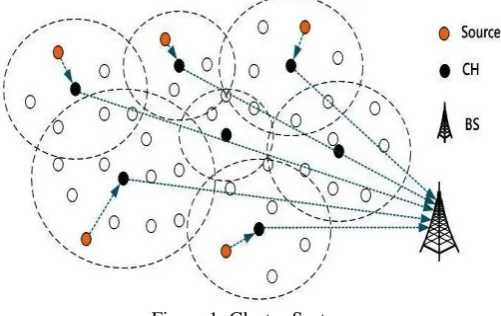
In order to reduce the energy consumption a clustering and node redundancy approach has been extensively studied. In Clustering approach, sensor nodes are divided into clusters. Each cluster has a leader which is called cluster head (CH) aggregate all the data received by members of cluster and sends aggregated data to Base Station (BS). Clustering allows aggregation of data. It helps in removing the redundant data and combining the useful data. It limits the data transmission. The cluster system gives an impression of a small and very stable network. It also improves the network lifetime by reducing the network traffic.
Figure 1: Cluster System
II. RELATED WORK
ISSN(E): 2277-128X, ISSN(P): 2277-6451, DOI: 10.23956/ijarcsse/V7I7/0207, pp. 231-235
a clustering mechanism to select CHs using optimal probability. The protocol works on periodic randomized rotations of the CH within the cluster range between zero and one. If the random number is less than the pre-determined threshold value, the node becomes a CH for the current round. The authors have succeeded to achieve a reduction in energy dissipation compared to direct communication and transmission protocols. However, since in the protocol the number of clusters is predefined, LEACH cannot guarantee an acceptable CH distribution. Additionally, due to lack of support in deploying network with a large number of sensor nodes, the protocol cannot be used in a large region. Moreover, LEACH suffers from significant energy consumption when there is no CH selected in some rounds.
In [5], the authors have proposed a hybrid, energy-efficient, distributed clustering algorithm (HEED). HEED is an improvement of LEACH on the manner of CH choosing. In HEED CHs are selected based on the residual energy of each node and secondary parameter considered is nodes proximity to their neighbours. By iterations and competition, only one CH is ensured by HEED within a certain range, so that uniform CHs distribution can be achieved across the network. HEED effectively prolongs network lifetime as compared to LEACH and is suitable for situations such as where each node has different initial energy.
LEACH and HEED consume energy heavily in the head nodes, which results in head nodes dying quickly. S. Lindsey et al. proposed an algorithm related to LEACH, and it is called PEGASIS [7]. PEGASIS uses GREEDY algorithm to make all the sensor nodes in the network form a chain, its nearly optimal power efficient protocol. In PEGASIS, the (i mod N)th node is chosen to be a leader. The leader is the only node which needs to communicate with BS in round i. N is the total number of nodes. Data collection begins from both endpoints of the chain, and then transmitted along the chain. The data is fused each time it transmits from one node to the next until it reaches the leader. This is how PEGASIS reduces the total amount of data for long-distance transmission and achieves a better performance than LEACH in terms of network lifetime.
Tree-Based Clustering (TBC) [4] is also an improved protocol of LEACH. It forms several clusters in the same way as LEACH, and each cluster has a cluster-head (CH). The nodes within a cluster construct a routing tree where the cluster-head is the root of it. For tree configuration, the cluster-head uses the distance information between the member nodes and itself. Each node is location-aware, it can estimate the distance between the root and itself. Every cluster is divided into some levels. The distance of a node to the root is the basis for determining its level in the cluster. The cluster-head is at level-0(root) and a node in level L(i) will choose the node in L(i)-1 and nearest to itself as its parent node. Data transfer simultaneously happens between the nodes in two neighbouring levels, and each node fuses the received data and transmits it to its parent. TBC is an excellent protocol in which each node records the information of its neighbour‟s and builds topography through computing, which is similar to GSTEB. But some cluster-heads in the network consume more energy than other nodes when BS is located far away.
PEDAP [8] is a tree-based routing protocol. In PEDAP all the nodes form a minimum spanning tree, costing minimum energy for data transmission. In PEDAP-PA energy is slightly increased for data transmission but balances energy consumption per node. PEDAP has the same network assumptions as PEGASIS and uses data fusion. However, both PEDAP and PEDAP-PA are protocols that need BS to build the topography which will cause a large amount of energy waste. This is because if the network needs BS to build the topography, BS has to send a lot of information to the sensor nodes, including what time is the Time Division Multiple Access(TDMA) slot, who are their child nodes and who are their parent nodes. . This kind of information exchanging will cause a lot of energy to be wasted or will cause a long delay.
III. PROPOSED WORK
The main aim of protocol is to achieve a longer network lifetime for different applications. In each round, BS assigns a root node and broadcasts its ID and its coordinates to all sensor nodes. The path is computed by the network either by transmitting the path information from BS to sensor nodes or by having the same tree structure being dynamically and individually built by each node.
A. Proposed Methodology
The operation of the protocol is divided into following phases: 1) Initialization
2) Selection of a Root node 3) Selection of a Parent node 4) Transmission of Data 5) Exchanging Information
1. Initialization
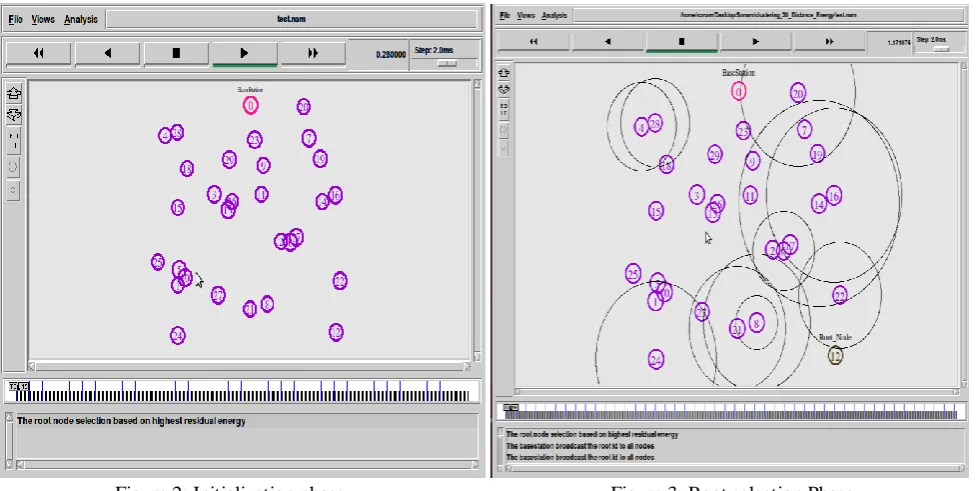
In the Initialization Phase we consider nodes randomly place in a network field. The nodes are allocated energy randomly and the Base Station is allocated 100J energy. The Base Station is fixed and the remaining nodes are heterogeneous in nature with a mobility functionality. The co-ordinates of the nodes must be stored for further distance calculation. In this phase we consider that 30 nodes are randomly placed in a network field of 600m x 600m. Only the Base Station (BS) is allocated with the 100J energy while all the other nodes are allocated energy randomly. Only the Base Station is fixed and all the remaining nodes have mobility functionality.
Step 1:
ISSN(E): 2277-128X, ISSN(P): 2277-6451, DOI: 10.23956/ijarcsse/V7I7/0207, pp. 231-235
Step 2:
Once the nodes receive the packet from BS they will start calculating their own energy level using function:
EL is a parameter for load balance, and it is an estimated energy value, i is the ID of each node, and α is a constant which reflects the minimum energy unit and can be changed depending on our demands (we have considered α=10). Step 3:
After step 2, every node will send a packet containing co-ordinates and EL of that node in a circle of radius Rc during its own time slot. After step 3, each node will have information of all its neighbours in their memory.
Step 4:
Once the step 3 is over, each node starts sending packet which contains their entire neighbour‟s information during its own time slot. Once the step 4 gets over every node will have information about its neighbours and its neighbour‟s neighbours in the memory.
2. Selection of Root Node
The node which has the highest energy among all the other nodes will be selected as a Root Node by the BS. Once BS selects the Root node it will broadcasts the ID of the root node to all the nodes in the network field. Only the root will forward data afterwards to the BS.
3. Selection of Parent Node
In this phase, each node searches for neighbours in the range of 250m. Each neighbour count of the node is stored and processed. The node will select the Parent from its neighbours having highest residual energy. The parent node which is selected will in turn forward to the root node.
4. Transmission of Data
While transmitting data we will consider few conditions. If a node wants to send data it will first calculate the distance between parent and the node itself as well as the distance between root and the node itself. Based on these two distances we will consider two cases:
Case 1: Distance (Root Node) < Distance (Parent Node)
If the distance of a sender node from its root node is shorter than the distance from its parent node then the node will send data directly to the root node instead of sending it to the parent node. And root node will send that data to the BS. Case 2: Distance (Root Node) > Distance (Parent Node)
If the distance of a sender node from its root node is larger than the distance from its parent node then the node will do the following tasks.
Every node will calculate its distance with the all other neighbouring nodes. Now use these distances as weights in Dijkstra‟s algorithm for calculating shortest path. If there is any other shorter path present then sender will use that path instead of directly sending data to the parent node.
5. Exchanging Information
If a node is getting exhausted with energy it will inform to the respective parent. The threshold to consider a node dead is 1J. If the energy is less than 1J the node is considered dead.
IV. RESULTS
The comparative results show the performance analysis of the existing GSTEB and proposed protocol in terms of PDR i.e. packet delivery ratio, throughput, packet drop and routing load.
ISSN(E): 2277-128X, ISSN(P): 2277-6451, DOI: 10.23956/ijarcsse/V7I7/0207, pp. 231-235
Figure 3: Parent Selection Phase Figure 4: Data Transmission Phase
Results of quality of Service parameters such as packet delivery ratio, routing load, packet drop and throughput are shown below:
Figure 5: Packet Delivery Ratio Figure 6: Throughput
ISSN(E): 2277-128X, ISSN(P): 2277-6451, DOI: 10.23956/ijarcsse/V7I7/0207, pp. 231-235
V. CONCLUSIONS
In this research a new protocol has been presented. We simulate the protocol using Network Simulator-2 (NS-2). In WSN, along with the minimization of total energy consumption we also need to balance the WSN load.
The main objective behind the protocol is to try to extend the lifetime of the sensor network without compromising data delivery. Sender node tries to find the shortest path for sending data to the receiver node which in turn result in minimizing energy usage. Only the root node is allowed to send data to BS which minimizes the traffic in the network. When any node in network dies other nodes are informed and the communication stops which doesn‟t let data to get wasted.
REFERENCES
[1] H. O. Tan and I. Korpeoglu, “Power efficient data gathering and aggregation in wireless sensor networks,” SIGMOD Rec., vol. 32, no. 4, pp. 66–71, 2003.
[2] J. H. Chang and L. Tassiulas, “Energy conserving routing in wireless ad hoc networks,” in Proc. IEEE INFOCOM, 2000, vol. 1, pp. 2–31.
[3] K. Akkaya and M. Younis, “A survey of routing protocols in wireless sensor networks,” Elsevier Ad Hoc Network J., vol. 3/3, pp. 325–349, 2005.
[4] K. T. Kim and H. Y. Youn, “Tree-Based Clustering (TBC) for energy efficient wireless sensor networks,” in
Proc. AINA 2010, 2010, pp. 680–685.
[5] O. Younis and S. Fahmy, “HEED: A hybrid, energy-efficient, distributed clustering approach for ad hoc sensor
networks,” IEEE Trans. Mobile Computing, vol. 3, no. 4, pp. 660–669, 2004.
[6] R. Szewczyk, J. Polastre, A.Mainwaring, and D. Culler, “Lessons from sensor network expedition,” in Proc. 1st
European Workshop on Wireless Sensor Networks EWSN „04, Germany, Jan. 19-21, 2004.
[7] S. Lindsey and C. Raghavendra, “Pegasis: Power-efficient gathering in sensor information systems,” in Proc. IEEE Aerospace Conf., 2002, vol. 3, pp. 1125–1130.
[8] W. R. Heinzelman, A. Chandrakasan, and H. Balakrishnan, “Energyefficient communication protocol for
wireless micro sensor networks,” in Proc. 33rd Annu. Hawaii Int. Conf. Syst. Sci., vol. 2, Jan. 2010, pp. 10–15.
[9] W. B. Heinzelman, A. Chandrakasan, and H. Balakrishanan, “An application-specific protocol architecture for