IPA
International Journalof Psychology Vol. 6, No. 1, Winter & Spring 2012
PP. 61-77
Iranian Psychological Association
The Study of the Effectiveness of Cognitive Hope
Enhancing Training on Reduction
of Academic Procrastination
Hossein Salimy, MA Department of Education
Urmia university Ali Issazadegan, PhD
Department of Education Urmia University
Farzaneh Michaeli Manee, PhD Department of Education
Urmia university
The main purpose of this research was to study the effectiveness of cognitive hope enhancing training on reduction of academic procrastination in students. The research method was experimental with pre, post tests and control group. The statistical population was students of boarding school in Bookan city. The sample comprised 32 students who were randomly selected and randomly assigned to two groups (16 students to the experimental group and 16 students to the control group). The experimental group participated in 8 sessions (each 90 min) 1 session per week. The data were obtained using Lay’s General Procrastination Scale, and Snyder's Cognitive Model of Hope. Results showed that cognitive hope enhancing training (CHET) was effective in reducing the academic procrastination in the post test (p<.05). The results of this research indicate that cognitive hope enhancing training could reduce the total academic procrastination. It can be concluded that cognitive hope enhancing training can be applied as an effective training to increase hope and reduce academic procrastination in students.
Keywords: cognitive hope enhancing training (CHET), academic
procrastination, students,
can be defined as deferring action and putting off doing things and from a psychological point of view it is delaying an intended course of action, an undesirable and unfavorable behavior that gradually becomes a habit (Ellis & Knaus, 1997). It is a way to run away from living in the present time. The essence of this psychological disorder is delay, deferment, postponement, and insouciance in doing tasks. Insouciance has both individual and social meanings, thus there is a tacit concept of lax in all these interpretations (Steel, 2007). Procrastination can become evident either in academic or non-academic forms. Academic procrastination refers to the postponement of academic performance and appears in issues such as preparation for examinations, doing homework, and writing academic papers; and non-academic procrastination in issues such as payment of electricity and water bills, washing dishes, and answering the phone or emails. There has been a correlation coefficient of 0.65 between these two (Milgram, Srolof, &Rosenbaum, 1998). Other researchers have also shown that academic procrastination has many negative consequences such as losing time, increased stress, poor grades, decreased health level, weaker long-term learning, and lower self confidence (Hoover, 2005). For instance, students usually procrastinate to study for exams, or write a paper or finish a research work. In long-term, this type of behavior may lead to one’s backwardness (Pintrich & Shank, 2002).
maladaptive life style, resulting in serious personal and social effects which reinforce feelings of lack of personal competence (Brownlow& Reasinger, 2000; Burka & Yuen, 1983; Ferrari, Johnson & McCown 1995); besides this it is known that the prolonged exposure to stress can increase the risk of serious illness. Obviously, when it turns to our students’ lives, procrastination can also cause delay in studying behaviors (Rothblum, Solomon, &Murakami, 1986; Tice & Baumeister, 1997), in drafting works or reports, missing deadlines to hand in papers, and putting off administrative tasks related to academic life, such as returning library books, registering for an exam, and so forth. (Scher & Ferrari, 2000; Rothblum et al., 1986). Skipping classes or delaying in handing in works are also consequences of academic procrastination (Scher & Osterman, 2002), as well as engaging in conflicts with parents or friends (Ferrari, Harriott, & Zimmerman, 1999).
There have been many techniques presented in the study of the ways to overcome procrastination. We will point out two: "Making objectives clear, planning before doing things, categorizing the issues, self-talking, prayers and solitude with God, time management, eliminating words and expressions: “if, I would, may be, I hope, I wish, etc."(Bless 2005). Positive Psychology merely believes that measurable positive traits can be considered as mediators, protecting people against negative anxieties and hazardous factors, such as stressful life events (Matson & Coatsworth, 1998; Ruter, 1994). Scholars have also probed into the role of hope and hope training as a confronting strategy against academic procrastination (Elizabeth & Antony, 2007).
pathways (planning of ways to meet goals). Agency represents the motivational component of hope theory, and provides the mental energy to start and maintain the use of a particular pathway through all stages of goal pursuit (Snyder, 2002). The pathways component of hope provides a measure of an individual’s ability to be flexible in the face of obstacles, and their ability to see and produce alternative routes to desired goals (Snyder, 2002). High hope scores in school-age students correlated with positive social interactions, self-esteem, optimism, and academic achievement. The results support the notion that high hope serves as a psychological strength in adolescence in some contexts (Valle, Huebner & Suido, 2006). People who are high in hope have both the will and the ways to achieve their goals, hope emphasizes the self belief that one will initiate and continue goal-directed action. Agentic thinking reflects the cognitive momentum that translates into a “can do” attitude relating to peoples confidence in their abilities to attain valued goals. The ability to generate multiple pathways can help students when they encounter impediments in their academic goal pursuits. Hope therapy proposes that goals themselves do not produce behavior, but rather, people’s views of themselves as being agents capable of initiating (agency) and implementing (pathways) sections to pursue valued personal goals produce the helpless or mastery-oriented responses. Success at challenging tasks, particularly in the academic domain, often requires being able to generate multiple pathways to goals.
college levels. Specifically, low levels of hope have been found to predict high levels of anxiety among graduate students taking statistics courses, as well as maladaptive studying and examination-taking coping strategies. Indeed, low-hope students appear to use more avoidance coping strategies, when facing stressful academic situations. Despite the fact that procrastination occurs in all kinds of daily tasks, academic procrastination is highly frequent in students and regarded as detrimental to academic progress and success, thus justifying its study. Adolescents spend a lot of their time either at school or involved in school activities, and the school setting is characterized by limited times in which to perform tasks, investigation work, and exams. In an investigation with adolescents, almost 25% of the individuals interviewed considered that procrastination was a moderate or severe problem and that the tendency to put off tasks interfered negatively not only with their academic achievement but also with their quality of life. We propose that students’ levels of hope lead them to choose learning or performance goals, perceiving the likelihood of positive outcomes. These students focus on success and, therefore, experience less distress and greater positive affect. Hope pathways may lead to learning goals, favor deep-level strategic processing, which leads to increased academic achievement. In hope theory, cognitions come first and lead to the goals that people choose which then lead to achievement.
In regard to these findings, and considering the importance of administration of training courses (including cognitive hope enhancing training) in order to improve or reduce academic procrastination, the current research was designed to study the effectiveness of cognitive hope enhancing training on the reduction of academic procrastination in students of the boarding school in Bookan city.
Method
census of Bookan’s Office of Training and Education were 168 students. The sampling method was random selection. 32 pupils were randomly selected and assigned to the control (n=16) and the experimental (n=16) groups. The sample completed the Lay’s General Procrastination and Hope questionnaire.
Instruments
Lay’s General Procrastination Scale (LGPS). Academic procrastination was measured by Lay’s General Procrastination Scale, developed by Lay (1986, Quoted by Sirois, 2007). This inventory is a paper and pencil self-report measure that includes 20 items. Items are rated on a 5-point likert scale from 1 (not at all) to 5 (very much). Hosseinzadeh (2009) has reported a reliability coefficient of .729 for this measure by using the Spearman split half test. The validity of this measure is presented by Lay. He has reported an Internal Consistency of .82, using Alpha Coefficient. Also, Sirois (2007) has reported an internal consistency of .90 for a sample of 254 people. In this study, the internal consistency of Lay’s General Procrastination Scale (20 items) was Cronbach's α=.75.
sentiment. Also, Alaeddini, Kajbaf, & Molavi (2008) have used the questionnaire on 60 students of Isfahan University in order to analyze its preliminary validity. In this study, the internal consistency of the Hope scale (12 items) was Cronbach's α=.68
Procedure
After selecting the participants and assigning them to the experimental and control groups randomly, the LGPS were administered as the pretest. The experimental group was presented with the CHET sessions. The control group received no intervention. After the sessions, both experimental and control groups completed the LGPS again as the post test. The CHET included 8 sessions of 90-min each, presented once a week, under the leadership of the supervising professor.
Education
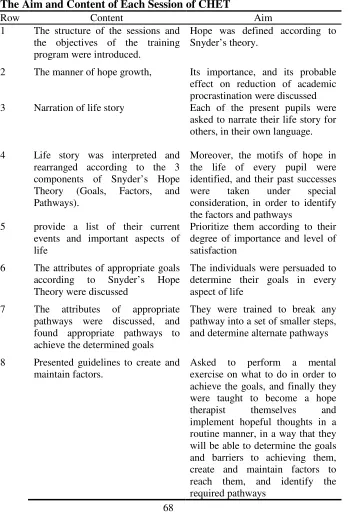
Figure 1
The Aim and Content of Each Session of CHET
Row Content Aim
1 The structure of the sessions and the objectives of the training program were introduced.
Hope was defined according to Snyder’s theory.
2 The manner of hope growth, Its importance, and its probable effect on reduction of academic procrastinationwere discussed 3 Narration of life story Each of the present pupils were
asked to narrate their life story for others, in their own language.
4 Life story was interpreted and rearranged according to the 3 components of Snyder’s Hope Theory (Goals, Factors, and Pathways).
Moreover, the motifs of hope in the life of every pupil were identified, and their past successes were taken under special consideration, in order to identify the factors and pathways
5 provide a list of their current events and important aspects of life
Prioritize them according to their degree of importance and level of satisfaction
6 The attributes of appropriate goals according to Snyder’s Hope Theory were discussed
The individuals were persuaded to determine their goals in every aspect of life
7 The attributes of appropriate pathways were discussed, and found appropriate pathways to achieve the determined goals
They were trained to break any pathway into a set of smaller steps, and determine alternate pathways
8 Presented guidelines to create and maintain factors.
Results
Means and standard deviations for academic procrastination in pre-post tests are presented in Table 1.
Table1
Means and Standard Deviations of Academic Procrastination in Pre and Post Tests
Scale Group Mean(Std.)
Pre test Post test Academic procrastination Experiment 58.75(8.07) 48.31(5.8)
control 59.94(5.06) 59.69(5.02)
Table 1 shows the means and standard deviations for academic procrastination in experimental and control groups. Data in Table 1 indicate that the mean value for experimental group was reduced after intervention. Since we used a pre-test, post-test design with a control group, the analysis of the data was performed using the ANCOVA analysis to control the effect of the pre-test as an auxiliary random variable. There are some presumptions when using the analysis of covariance, amongst which we examined the homogeneity of variances and homogeneity of regressions.
Table2
The Results of ANCOVA Analysis for the Effect of Cognitive Hope Enhancing Training on Academic Procrastination
Source Sum of Squares df Mean Square F Sig Eta2 Exponent
Pre-test 274.05 1 274.05 12.84 .001 .307 .93 Group 932.72 1 932.72 43.71 .001 .601 1
The results show that considering the pre-test scores as auxiliary variable, the obtained F-value at the level p<.05 is significant, thus we can conclude that the intervention of cognitive hope enhancing training according to Snyder’s theory of hope, has resulted in a significant difference between the experimental and control groups. The amount of this effect is 60%, in other words, 60 percent of the post-test variance, is caused by the intervention of cognitive hope enhancing training. Based on the results, we can express that there is a significant difference between the adjusted mean of experimental and control groups, with (F=43.71, p=.001). Also, the statistical exponent is equal to 1, indicating the adequacy of sample size.
Discussion
Education and Training at the University of South Florida, and analyzed the role of hope and its components in relation to academic procrastination. The results of this study indicated that students with higher levels of hope are less lax. These scholars addressed the role of both aspects of hope (agency aspect and pathway aspect) in predicting the level of procrastination, and the fear of failure, whereas, this predictive role was not evident in the issue of disliking the task. In other words, students of higher grades, showed less procrastination and fear of failure, in both agency and pathway aspects. They finally expressed that increasing the level of hope is an important factor in reduction of academic procrastination, and the cause of this reduction can be the fact that hopeful people experience less fear of failure.
Also, Shahni Yeylaq et al. (2006), studied 2000 high school students in Ahvaz, and analyzed the prevalence of procrastination and the effect of cognitive-behavioral therapy methods and behavior modification on the reduction of procrastination. In this study, the students whose grades were one standard deviation above the Mean were considered as procrastinators, 15.4% of which with delay complication (14% of females, 17% of males). Then they studied the effectiveness of cognitive-behavioral therapy methods and behavior modificationt on reduction of academic procrastination. The results showed that both therapy methods have been effective in the reduction of academic procrastination. There was no significant difference in the effectiveness of the two methods of cognitive-behavioral therapy and behavior modification. Totally, according to the results of the research, we can probably conclude that cognitive hope enhancing training as a positive intervention would reduce academic procrastination in students.
Conclusion
opposed to its effects. Hope is useful in helping produce positive appraisals of the stressful situations, and may play a unique role in shaping positive appraisals of adversity. The adaptive value of hope, however, has been articulated as helping one to deal with situations in which needs or goals are not met. Future time orientation plays a central role in a wide range of conceptualizations of hope. Future time perspective may be a productive avenue of inquiry to help further explain the relationship between hope and procrastination. To explain this, one can express that in this training program, pupils are taught to determine important, achievable, and measurable goals, and consider a set of pathways in achieving them. Thus, having a goal and a hope for achieving it, gives a meaning to human life, and puts him/her in a distinct way.
Feldman & Snyder (2005) believe that there is a relation between hope and the meaning of life, such that they consider hope as one component of the meaning. Behavioral strategies are also a way of activating people and help them to actively follow the determined goals, and this can be effective in the reduction of academic procrastination.
Limitations and Suggestions
research and determine the stability of its effects, to extend the program, in case it has the required effectiveness.
References
Alaeddini, Z., Kajbaf, M., & Molavi, H. (2008). A study of hope therapy on the level of hope and mental health. Quarterly Journal of Research on Psychological Health, 4, 67-76.
Barry, R. A., Lakey, B., & Orehek, E. (2007). Links among attachment dimensions, affect, the self, and perceived support for broadly generalized attachment styles and specific Bonds. Personality and Social Psychology Bulletin, 33, 340-353.
Beck, T. A. (1976). Cognitive therapy and emotional disorders. New York: International Universities Press.
Bless, A. (2005). A new step by step method for reduction of delays, Translated by Mehdi Qarachedaqi, Dayereh Press, Tehran.
Brownlow, S., & Reasinger, R. (2000). Putting off until tomorrow what is better done today: Academic procrastination as a function of motivation toward college work. Journal of Social Behaviour and Personality, 15, 15-34.
Burka, J., & Yuen, L. (1983). Procrastination: Why you do it, what to do about it. Cambridge: Da Capo.
Delongis, A., Coyne, J., Dakof, G., Folkman, S., & Lazarus, R. (1982). Relationship of daily hassles, uplifts and major lifeevents on health status. Health Psychology, 1, 119-136.
Elizabeth, S. A., & Anthony, J. (2007). Academic procrastination and the role of hope as a coping strategy, Personality and Individual Differences, 42, 1301–1310.
Ellis, A., & Knaus, W. J. (1977). Overcoming procrastination. New York: Institute for Rational Living.
Ferrari, J. R., & Emmons, R. (1995). Methods of procrastination and their relation to self-control and self reinforcement. Journal of Social Behavior and Personality, 10, 135-142.
Ferrari, J. R., Harriott, J., & Zimmerman M. (1999). The social support networks of procrastinators: Friends or family in timesof trouble? Personality and Individual Differences, 26, 321-331.
Ferrari, J. R., Johnson, J., & McCown, W. (1995). Procrastination and task avoidance: Theory, research and practice. New York: Plenum Press.
Flett, G., Hewitt, P., & Martin, T. (1995). Dimensions of perfectionism and procrastination. In J. R. Ferrari, J. Johnson, & W. McCown, (Eds.), Procrastination and task avoidance: Theory, research and practice, (pp. 113-136). New York: Plenum Press
Feldman, B. D., & Snyder, C. R. (2005). Hope and the meaningful life: theoretical and empirical associations between goal-directed thinking and life meaning. Journal of Social and Clinical Psychology, 24, 3, 401-421.
Hoover, E. (2005, December 9). Tomorrow I Love Ya!.Chronicle of Higher Education, 52 (16), A30-A32. Retrieved December 9, 2008, from Academic Search Complete database.
Hosseinzadeh, M. (2009). Analyzing the relation among academic procrastination, and perfectionism, anxiety, and methods of coping with stress, amongst the students of Azad-e-Eslami University of Mashhad. Urmia: Urmia university. A master degree thesis.
Kashdan, T. B., Pelham, W. E., Lang, A. R., Hoza, B., Jacob, R. G., Jennings, J. R., Blumenthal, J. D., & Gnagy, E. M. (2002 ). Hope and optimism as human strengths in parents of children with externalizing disorders stress is in the eye of the beholder. Journal of Social and Clinical Psychology, 21, 4 , 441-468.
Milgram, N., Srolof, B., & Rosenbaum, M. (1988). The Procrastination of everyday life. Journal of Research in Personality, 22, 197–212.
Pintrich, P. R., & Schunk., D, H. (2002). Motivation in Education: Theory, Research, & Applications. New Jersey: Johnston.
Rutter, M. (1994). Resilience: Some conceptual considerations. ContemporaryPediatrics, 11, 36–48.
Rosario, P., Costa, H., Nunez, J. C., Carlos Nunez, J., Gonzalez-Pienda, J., Solano, P., & Valle, A. (2009). Academic procrastination: Association with personal, school, and family variables. The Spanish Journal of Psychology, 2, 1, 118-127.
Rothblum, E., Solomon, L., & Murakami, J. (1986). Affective, cognitive, and behavioral differences between high and low procrastinators. Journal of Counseling Psychology, 33, 387-394
Scher, S., & Ferrari, J. (2000). The recall of completed and noncompleted tasks through daily logs to measure procrastination. Journal of Social Behaviour and Personality, 15, 255-265.
Scher, S., & Osterman, N. (2002). Procrastination, conscientiousness, anxiety, and goals: Exploring the measurement and correlates of procrastination among school-aged children. Psychology in the Schools, 39, 385-398.
Scheier, M. F., Carver, C. S., & Bridges, M. W. (2001). Optimism, pessimism, and psychological well-being. In E. C. Chang (Ed.), optimism and pessimism (pp. 189-216). Washington, Dc: American Psychological Association.
Shahni Yeylaq, M. Salamati, S. Mehrabizadeh Honarmand, M., & Haqiqi, J. (2006). Analyzing the prevalence of procrastination and the effect of cognitive-behavioral therapy methods and behavior management on reduction of procrastination in high-school students of Ahwaz, Journal of Educational Sciences and Psychology,13, 3, 1-30.
Snyder, C. R. (2000). The past and possible futures of hope. Journal of Social and Clinical psychology. Special Issue: Classical Sources of Human Strength: A Psychological Analysis, 19 (1), 11–28.
Snyder, C. R., Harris, C., Anderson, J. R., Holleran, S. A., Irving, L. M., & Sigmon, S. T., (1991). The will and the ways: Development and validation of an individual differences measure of hope. Journal of Personality and Social Psychology, 60, 570–585.
Snyder, C. R., Lopez, S. J., & Shorey, H. S. (2003). Hope theory, measurements, and applications to school psychology. School Psychology Quarterly, 18, 122–139.
Snyder, C. R., Shorey, H. S., Cheavens, J., Pulvers, K. M., Adams, V. H., & Wiklund, C. (2002). Hope and academic success in college. Journal of Educational Psychology, 94, 820–826.
Steel, P. (2007). The nature of procrastination. A meta-analytic and theoretical review of quintessential self-regulatory failure.Psychological Bulletin, 133 (1), 65-94.
Senécal, C., Koestner, R., & Vallerand, R. (1995). Self-regulation and academic procrastination. The Journal of Social Psychology 135, 607-619.
Tice, D., & Baumeister, R. (1997). Longitudinal study of procrastination, performance, stress, and health: The costs and benefits of dawdling. Psychological Science, 8, 454-458.
Van Eerde, W. (2003). A meta-analytically derived nomological network of procrastination. Personality and Individual Differences, 35, 1401-1418.
Valle, M. F., Huebner, E. S., & Suido, S. M. (2006). An analysis of hope as a psychological strength. Journal of School Psychology, 44 (5), 393-406.
Wells, L. E., & Marwell, G. (1976). Self-esteem: Its conceptualization and measurement, Sage Publications, Beverly Hills, Calif, 290p.
Whang, F, M. (2002). Structural equation modeling, Inc., Taipet, Wunan. Whitner, E. M. (1997). The impact of human resource activities on
employee trust. Human Resource Management Review, 7, 389-404.