0 INTRODUCTION
The grinding process is characterized by a great number of response variables: economic (production rate, net costs), dynamic (cutting forces and power rate), and manufacturing (grinding wheel lifetime and cutting ability, roughness and accuracy of the machined surface). It has been found that these variables depend both on the cutting conditions during grinding and on the micro- and macro-geometry of the grinding wheel cutting surface formed during dressing
[1] to [4].
The dressing process and its effect on the grinding response variables were studied in several
publications. Cebalq [5] found that the different
combinations between the dressing mode, dressing conditions, and the grinding wheel specification lead to different inter-grit spacing between the abrasive grits of the grinding-wheel cutting surface and, as a
result, different response variables of the grinding process (equivalent grinding thickness, specific metal removal rate, roughness of the grinding-wheel cutting surface, roughness of the ground surface, etc.). Baseri et al. [6] and [7] and Baseri [8], Wegener et al.
[9] and Palmer et al. [10] proved that the
grinding-wheel topography and the conditions under which it is prepared have a profound influence upon the grinding performance, defined by the grinding forces, the power consumption, the cutting zone temperature, the radial wear of the wheel and also the surface finish of the workpiece. Chen et al. [11] found that a satisfied and stable grinding process can be controlled in real-time by means of utilizing the combination of optimal parameters, such as spindle speed, effective pack density, and the cutting space of abrasive grits. A similar conclusion is also drawn in the publications of other authors [12] to [15].
Multi-Objective Optimization of the Dressing Parameters
in Fine Cylindrical Grinding
Aleksandrova, I.S. Irina Stefanova Aleksandrova Technical University of Gabrovo, Bulgaria
The optimum conditions for dressing grinding wheels determined and recommended in the literature are valid only for particular types and tools of dressing and grinding. In this paper, an attempt has been made to optimize the dressing process parameters in fine cylindrical grinding. To define the optimum values of the dressing process variables (radial feed rate of diamond roller dresser frd , dressing speed ratio qd, dress-out time td , diamond roller dresser grit size/grinding wheel grit size ratio qg , type of synthetic diamonds and direction of dressing), a multi-objective optimization has been performed based on a genetic algorithm. In the capacity of the optimization parameter, a generalized geometric-mean utility function has been chosen, which appears to be a complex indicator characterizing the roughness and accuracy of the ground surface, the grinding wheel lifetime and the manufacturing net costs of the grinding operation. The optimization problem has been solved in the following sequence: 1) a model of the generalized utility function has been created reflecting the complex effect of the dressing system parameters; 2) the optimum conditions of uni-directional and counter-directional dressing of aluminium oxide grinding wheels by
experimental diamond roller dressers of synthetic diamonds of АС32 and АС80 types and different grit size at which the generalized utility function has a maximum have been determined; 3) a Pareto optimum solution has been found (frd = 0.2 mm/min; qd = 0.8; td = 4.65 s; qg = 2.56), which guarantees the best combination between the roughness and the deviation from cylindricity of the ground surface, the grinding wheel lifetime and the manufacturing net costs of the grinding operation.
Keywords: fine cylindrical grinding, dressing parameters, diamond roller dressers, multi-objective optimization Highlights
• A new multi-objective optimization approach based on a genetic algorithm and a generalized utility function to define the optimum values of the dressing system parameters in fine cylindrical grinding has been performed.
• Regression models for the response variables of the fine grinding process depending on the dressing system parameters have been built.
• Theoretical-experimental models have been created for determining the generalized utility function as a complex indicator characterizing the response variables of the fine grinding process.
• The optimum conditions of the uni-directional and counter-directional dressing of aluminium oxide grinding wheels by
diamond roller dressers of synthetic diamonds of АС32 and АС80 types have been determined.
Despite the significant influence of the dressing process on the response variables of the grinding process, its setup is often done based on the experience of the qualified staff or with the help of data handbooks
[5], [8] and [16]. However, the dressing conditions selected by such practice are usually standard and they cannot satisfy certain economic criteria. Therefore, recently, some researchers [17] to [22] have applied, during cylindrical grinding, various techniques to optimize the grinding process parameters (grinding wheel speed, workpiece speed, depth of dressing, lead of dressing, contact area, grinding fluid, etc.) using a multi-objective function model with a weighted approach. The production costs, the production rate and the surface quality have been evaluated for the optimal grinding conditions, subject to constraints of thermal damage, wheel-wear parameters, and
machine-tool stiffness. Amitay et al. [23] describes
a technique for grinding and dressing optimization so that the maximum workpiece removal rate is ensured subject to constraints on workpiece burn and surface finish in an adaptive control grinding system. In his study, Baseri [8] used а feed-forward
back-propagation neural network and a simulated annealing algorithm for the simultaneous minimization of the tangential cutting force and the surface roughness. During the experimental procedure, the grinding conditions were constant while the dressing conditions varied. The dressing parameters considered during the experiments were the dressing speed ratio, the dressing depth, and the dressing cross-feed. Klancnik
et al. [24] presented a new and effective method of
multi-criterion optimisation based on the evolutionary approach. This method can be introduced into the process of automatic programming of machine tools, including grinding machines. The analysis of
the results provided by some authors in [8] and [17]
to [22] shows that the optimization of the grinding
process, depending on the dressing conditions, is a complicated non-linear optimization problem with constraints and multi-modal characteristics. The optimization problems have been solved under specific conditions of grinding and dressing. The defined optimum dressing parameters depend on the dressing method and dressing tool used. Further difficulties during optimization are associated with the fact that no comprehensive grinding models exist relating the dressing conditions to all response variables of the grinding process. At present, there is no comprehensive mathematical model that encompasses all aspects of grinding. In addition, the objective of optimization can vary depending on its application. All this shows that the optimization of the
dressing conditions during cylindrical grinding should be performed considering the particular grinding and dressing conditions.
In a previous study [25],the results of
multi-objective optimization of dressing grinding wheels made of aluminium oxide by using diamond roller dressers with medium- and high-strength synthetic
diamonds of АС32 and АС80 types with different grit
size during rough cylindrical grinding were presented. The generalized utility function was chosen in the capacity of the optimization parameter. The defined optimum dressing system parameters (dressing speed ratio, radial feed rate of the diamond roller dresser, dress-out time, diamond roller dresser grit size/grinding wheel grit size ratio, type of synthetic diamonds and direction of dressing) guarantee the maximum lifetime and maximum cutting ability coefficient of grinding wheels, the minimum tangential cutting force, and the maximum production rate of the grinding process. Taking into account the fact that grinding is widely used as a finishing process, it is necessary to define the dressing system parameters providing minimum roughness and maximum accuracy of the ground surfaces, together with maximum lifetime of the grinding wheel and minimum manufacturing net costs.
The objective of this paper is to determine the optimum dressing system parameters for grinding wheels made of aluminium oxide with experimental diamond roller dressers of medium- and high-strength
synthetic diamonds of АС32 and АС80 types with
different grit size during fine cylindrical grinding.
1 STUDY AND MODELLING OF FINE GRINDING RESPONSE VARIABLES
1.1 Equipment, Materials, and Methods
The task of this study is to find the correlations between the fine cylindrical grinding response variables and the parameters of uni-directional and counter-directional dressing of grinding wheels by employing diamond roller dressers, which have a layer of medium- and high-strength synthetic diamonds. The dressing speed ratio qd , the radial feed rate frd
[mm/min], the dress-out time td [s] and the ratio qg
between the grit sizes of the diamond roller dresser and grinding wheel are selected as control factors.
The experimental studies have been carried out
on a KUF 250/500 cylindrical grinder (Fig. 1) under
the following grinding conditions: grinding wheels:
Factory – Berkovitsa, Bulgaria [26]; material to be
machined – hardened steel 150Cr14 with hardness of 64 HRC in the shape of cylindrical workpieces with
diameter dw = 30 mm and length Lw = 150 mm; method
of grinding – plunge grinding; cutting speed vc = 30 m/s;
cutting depth ae = 0.1 mm; speed ratio q = 60; radial
in-feed fr = 0.01 mm/rev; coolant lubricant – sulfofresol (emulsion with 5 % concentration, which is fed
through a free-falling jet through an open nozzle,
the flow rate being approximately 1 m/s, and the consumption – approximately 9 l/min).
Fig. 1. Experimental setup; 1. Cylindrical grinder KUF 250/500; 2. Special attachment; 3. Grinding wheel;
4. Diamond roller dresser; 5. Workpiece
The grinding wheels are dressed using diamond
roller dressers with a diameter of 92 mm produced
by electroplating, with a layer of medium- and
high-strength synthetic diamonds of АС32 and АС80 types by the Russian State Standard 9206-80 and the Ukrainian State Standard 3292-95 with grit sizes D426, D251 and D107 (Table 1) [27] to [29]. АС32 and АС80 are brands of synthetic diamond grinding powders of varying strength manufactured by the V.
Bakul Institute for Superhard Materials.
The different grit sizes of the diamond roller dressers and grinding wheels provide values of the control factor qg = 1.2 to 2.56.
In order to perform dressing with diamond roller dressers by using the plunge grinding method, a special attachment [30] has been designed. It is fixed on the
grinding saddle of cylindrical grinder KUF 250/500.
The control system of the attachment makes possible uni-directional and counter-directional dressing as well as variation of the control factors (radial feed rate frd , dressing speed ratio qd and dress-out time td) within the following limits: frd= 0.2 mm/min to 1.4
mm/min, qd = 0.2 to 0.8, td = 1 s to 9 s. These conditions
guarantee the quality of the machined surfaces and the lifetime of the dressing tool and dressed tool [25], [30], and [31].
The studied response variables are: the roughness
Raw,ih [µm] and accuracy δw,ih [µm] of the ground
surface, the grinding wheel lifetime Ts,ih [min] and
the manufacturing net costs of the grinding operation
Cih [€/pc] (ih is the combination of the code of the
synthetic diamond brand and the type of dressing, see
Table 2).
The ground surface roughness, evaluated by the arithmetic mean deviation of the profile, is measured
with Mitutoyo SJ-201 profilometer. The accuracy of
the ground surface shape is evaluated by the complex indicator: deviation from cylindricity, employing an apparatus for measuring deviation from roundness and
cylindricity Roundtest RA-114/116 of the Mitutoyo
company.
Table 2. Code of the combination: brand of synthetic diamonds, dressing method’
Dressing method, h Brand of synthetic diamonds, i AC32 (i = 1) AC80 (i = 2) Uni-directional (h = 1) 11 21 Counter-directional (h = 2) 12 22
The grinding wheel lifetime corresponds to the tool operation time between two dressing events. The criterion showing the necessity of dressing is the roughness occurring on the ground surface
Raw = 2.5 µm. Table 1. Diamond grit properties [27] to [29]
Grit size
Brand of synthetic diamonds
AC 32 AC80
Static compressive strength [N]
Arithmetic mean of the compressive strength for all grit sizes [N]
Static compressive strength [N]
Arithmetic mean of the compressive strength for all grit sizes [N] D107 (100/80) 18.4
32
40
80
D251 (250/200) 23.5 78
The manufacturing net costs of the grinding operation is defined as the sum of labour costs and variable additional costs including grinding wheel dressing costs, grinding wheels costs, and electric power costs. The relative shares of the manufacturing net costs components depend on the manufacturing conditions and they are not identical. The electric power costs are very rarely significant (e.g., for intensive grinding), and the grinding wheel costs are high only when the tool price is high or during operation in self-grinding mode. Therefore, it could be assumed with sufficient accuracy that the manufacturing net costs of the grinding operation is defined by the relationship:
Cih=Cm ih, +Cd ih, , (1)
where the labour costs Cm,ih and the dressing costs
Cd,ihare defined by the following formulae:
Cm ih, =C tm⋅ m ih, , (2)
C C t S W S T
T t
d ih m d s s d d ih
s ih m ih
, , , , / ,
= ⋅ 0+ ⋅ + ⋅
(3)
where: Cm [€/min] is average labour costs; tm,ih [min]
is grinding time: tm,ih = Ww / Qw,ih (Ww [mm3] is the
volume of cut layer removed during grinding; Ww =
const at constant cutting conditions during grinding;
Qw,ih [mm3/min] is the production rate of grinding
process determined in [25]); td0 [min] is dressing time:
td0 = ad / frd + td (ad = 0.03 mm is a depth of dressing); Ss
[€/mm3] is the cost per unit volume of the grinding
wheel; Ws [mm3] is the volume of abrasive layer
removed during dressing; Sd [€] is the price of diamond
roller dressers; Td,ih is the diamond roller dresser
lifetime evaluated by the number of working runs carried out up to reaching the permissible deviation of the grinding wheel profile after dressing δw = 0.02 mm
(they are counted by a mechanical counter comprised into the control system of the dressing attachment).
On the basis of preliminary experimental studies conducted [30], it is assumed that the general form of the model describing the relation between the chosen response variables of fine cylindrical grinding Yj and
the group of independent variables are the control factors frd (X1), qd (X2), td (X3) and qg (X4), is:
Yj =E Xj⋅ bj⋅Xbj⋅Xbj⋅Xbj
1 2 3 4
1 2 3 4
, (4)
where Y1 = Raw,ih; Y2 = δw,ih; Y3 = Ts,ih; Y4 = Cih; b1j, b2j, b3j, b4j are exponents that determine the magnitude
and the type of effect of control factors on the studied response variable Yj of the grinding process; Ej is a
coefficient accounting for the effect of the control
factors (kinematic cutting parameters in grinding, physical-mechanical properties of the material to be machined, shape and size of the grinding wheel, type and quantity of the coolant lubricant, etc.).
In order to build the model in Eq. (4), it is
linearized by a logarithmic transformation, as follows:
ln ln ln ln
ln ln .
Y E b X b X b X b X
j j j j
j j
= + +
+ +
1 1 2 2
3 3 4 4 (5)
Taking into account the interactions between the
control factors, Eq. (5) can be written in this form:
Y b b A b A A
b A A
j j p j p
p p pt j p
p t
t
ptl j p p
p t l
' , , , , = + + + = = < = < <
∑
∑
∑
0 1 4 1 4 1 4tt lA b A A A A+ 1234 1 2 3 4, (6)
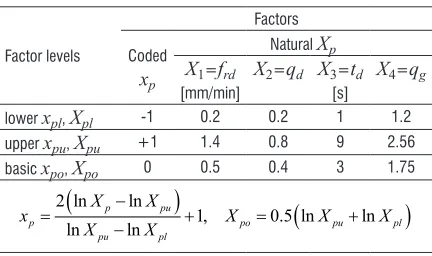
where Y'j = ln Yj, b0j = ln Ej, A1 = ln X1= ln frd, A2 = ln X2= ln qd, A3 = ln X3= ln td, A4 = ln X4= ln qg. Table 3. Factor levels in the experimental design
Factor levels
Factors Coded
xp
Natural Xp
X1=frd X2=qd X3=td X4=qg [mm/min] [s]
lower xpl, Xpl -1 0.2 0.2 1 1.2 upper xpu, Xpu +1 1.4 0.8 9 2.56 basic xpo, Xpo 0 0.5 0.4 3 1.75
x X X
X X X X X
p
p pu
pu pl po pu pl
=
(
−)
− + =
(
+)
2
1 0 5
ln ln
ln ln , . ln ln
To build model in Eq. (6), the first order design
of experiment is applied, in particular a full factorial design of experiments is used. The minimum number
for the levels of factor variation is two (Table 3),
and the required number of runs is N = 2p = 24 = 16
(p = 4 is the number of the control factors). The
design of the experiments and the processing of the experimental results have been performed following
the methodology presented in[32]. The models of
grinding wheel lifetime Ts,ih , roughness Raw,ih and
accuracy δw,ih of the ground surface are synthesized
values calculated according to Eq. (1). The coefficient
of multiple correlation Rj , the standard quadric
mean deviation and the regression coefficients are determined by means of linear regression analysis. To check the significance of the regression coefficients, the model adequacy and the process description quality, the basic level (radial feed rate frd = 0.5
mm/min; speed ratio qd = 0.4; dress-out time td = 5 s;
ratio between the grit sizes of the diamond roller dresser and the grinding wheel qg = 1.85, Table 3) has
been selected as the most informative point, where
four observations have been performed (n = 4).
1.2 Experimental Results and Modelling
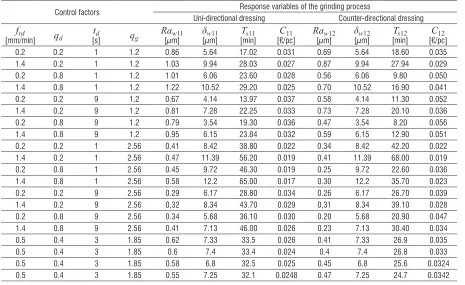
The designs of the experiments with the values of the response variables of the fine cylindrical grinding
process are presented in Tables 4 and 5.
After statistical analysis of the experimental results and transformation of the independent variables
from coded to natural type (Table 3),
theoretical-experimental models of roughness and accuracy of the ground surface, grinding wheel lifetime and the manufacturing net costs have been built and their general form is the following:
Yj=Ej ih, ⋅frdbj ih⋅qdbj ih⋅tbdj ih⋅qbgj ih
, , , ,
,
1 2 3 4 (7)
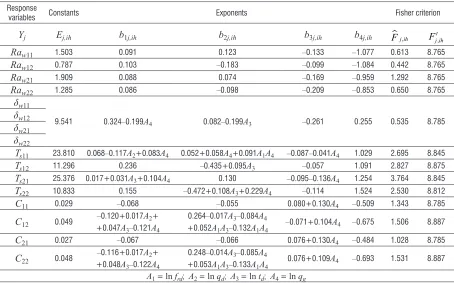
The determined values of the constants Ej,ih and
exponents b1,ih , b2,ih , b3,ih , b4,ih in the regression models in Eq. (7) are given in Table 6. The values of
the standard deviation for each of the experiments carried out, characterizing the repeatability of the experimental results and used for determining the empirical values of the Fisher criterion Fj ih, and the
multiple correlation coefficient Rj ih, , are SRj ih,
2 =
0.0004 to 0.0045. They have been determined on the
basis of the four observations performed for each of the response variables of the fine grinding process at a combination of the main levels of the control factors (frd = 0.5 mm/min; qd = 0.4; td = 5 s; qg = 1.85), Tables 4 and 5. The constructed models are adequate, which is
proved by comparing the empirical Fj ih, and tabular
Fj iht
, values of the Fisher criterion (Fj ih, <Fj iht, , Table 6). They describe with high accuracy the
dependencies between the response variables and the control factors (the values of the coefficient of multiple correlation are Rj ih, = 0.981 to 0.998).
Table 4. Design of the experiment and response variables of the grinding process (in dressing with diamond roller dressers of synthetic
diamonds АС32)
Control factors Response variables of the grinding process
Uni-directional dressing Counter-directional dressing frd
Table 5. Design of the experiment and response variables of the grinding process (in dressing with diamond roller dressers of synthetic
diamonds АС80)
Control factors Response variables of the grinding process
Uni-directional dressing Counter-directional dressing frd
[mm/min] qd [s]td qg Ra[µm]w21 δ[µm]w21 [min]Ts21 [€/pc]C21 Ra[µm]w22 δ[µm]w22 [min]Ts22 [€/pc]C22 0.2 0.2 1 1.2 1.21 5.64 24.06 0.031 1.08 5.64 23.70 0.035 1.4 0.2 1 1.2 1.44 9.94 25.70 0.027 1.28 9.94 25.10 0.029 0.2 0.8 1 1.2 1.31 6.06 26.80 0.029 0.95 6.06 11.80 0.050 1.4 0.8 1 1.2 1.54 10.52 31.50 0.026 1.13 10.52 16.20 0.041 0.2 0.2 9 1.2 0.88 4.14 16.50 0.039 0.73 4.14 10.80 0.052 1.4 0.2 9 1.2 1.05 7.28 20.00 0.033 0.86 7.28 17.80 0.037 0.2 0.8 9 1.2 0.97 3.54 20.30 0.037 0.64 3.54 8.30 0.055 1.4 0.8 9 1.2 1.12 6.15 22.90 0.033 0.76 6.15 12.80 0.051 0.2 0.2 1 2.56 0.64 8.42 58.00 0.022 0.62 8.42 52.50 0.022 1.4 0.2 1 2.56 0.72 11.39 67.00 0.019 0.68 11.39 75.00 0.019 0.2 0.8 1 2.56 0.68 9.72 63.00 0.019 0.56 9.72 36.40 0.035 1.4 0.8 1 2.56 0.77 12.2 78.00 0.017 0.61 12.2 50.00 0.022 0.2 0.2 9 2.56 0.36 6.17 29.10 0.034 0.35 6.17 26.90 0.039 1.4 0.2 9 2.56 0,48 8.34 39.30 0.029 0.46 8.34 35.90 0.028 0.2 0.8 9 2.56 0.46 5.68 34.70 0.030 0.30 5.68 29.10 0.046 1.4 0.8 9 2.56 0.55 7.13 57.00 0.027 0.37 7.13 33.30 0.034 0.5 0.4 3 1.85 0.89 7.33 41.7 0.026 0.7 7.33 26.4 0.035 0.5 0.4 3 1.85 0.8 7.4 40.1 0.024 0.68 7.4 29.3 0.033 0.5 0.4 3 1.85 0.81 6.8 38.8 0.025 0.65 6.8 29.5 0.032 0.5 0.4 3 1.85 0.85 7.25 38 0.0245 0.6 7.25 26.5 0.034
Table 6. Values of constants and exponents in the theoretical-experimental models, Eq. (7) Response
variables Constants Exponents Fisher criterion
Yj Ej,ih b1j,ih b2j,ih b3j,ih b4j,ih Fj ih, Fj iht, Raw11 1.503 0.091 0.123 –0.133 –1.077 0.613 8.765
Raw12 0.787 0.103 –0.183 –0.099 –1.084 0.442 8.765
Raw21 1.909 0.088 0.074 –0.169 –0.959 1.292 8.765
Raw22 1.285 0.086 –0.098 –0.209 –0.853 0.650 8.765
δw11
9.541 0.324–0.199A4 0.082–0.199A3 –0.261 0.255 0.535 8.785 δw12
δw21
δw22
Ts11 23.810 0.068–0.117A2+0.083A4 0.052+0.058A4+0.091A1A4 –0.087–0.041A4 1.029 2.695 8.845
Ts12 11.296 0.236 –0.435+0.095A3 –0.057 1.091 2.827 8.875
Ts21 25.376 0.017+0.031A3+0.104A4 0.130 –0.095–0.136A4 1.254 3.764 8.845
Ts22 10.833 0.155 –0.472+0.108A3+0.229A4 –0.114 1.524 2.530 8.812
C11 0.029 –0.068 –0.055 0.080+0.130A4 –0.509 1.343 8.785
C12 0.049 +0.047–0.120+0.017A A2+
3–0.121A4
0.264–0.017A3–0.084A4
+0.052A1A3–0.132A1A4 –0.071+0.104A4 –0.675 1.506 8.887
C21 0.027 –0.067 –0.066 0.076+0.130A4 –0.484 1.028 8.785
C22 0.048 +0.048–0.116+0.017A A2+
3–0.122A4
0.248–0.014A3–0.085A4
+0.053A1A3–0.133A1A4 0.076+0.109A4 –0.693 1.531 8.887
1.3 Analysis of the Experimental Results
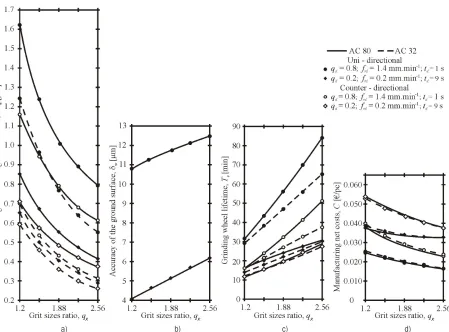
The analysis of the theoretical-experimental models in
Eq. (7) and the graphics plotted on the basis of them (Fig. 2) allows the following conclusions to be drawn: (1) The studied response variables of the fine
grinding process greatly depend on the diamond roller dresser grit size/the grinding wheel grit size ratio.
(1.1) When qg increases within the studied range (2.1
times), the grinding wheel lifetime increases (by
1.8 to 3 times). The impact of qg depends on the
types of synthetic diamonds in the working layer of the diamond roller dressers, the conditions and direction of dressing, and it is most strongly marked in counter-directional dressing with diamond roller dressers with a working layer of
synthetic diamonds АС80.
(1.2) The roughness of the ground surface decreases (by 1.9 to 2.3 times) when qg increases. The
impact of qg is more strongly marked in
counter-directional dressing with diamond roller dressers
of synthetic diamonds АС32. The decrease in
the ground surface roughness with an increase in
qg is related to an improvement of the grinding
wheel cutting ability, as well as to a decrease in forces and temperature load in the cutting zone in grinding.
(1.3) The manufacturing net costs of the grinding operation decrease (by 1.1 to 1.7 times) with an
increase in the grit ratio qg. The impact of qg is
the greatest in counter-directional dressing with diamond roller dressers with a working layer of
synthetic diamonds АС80 and it increases when
dress-out time td decreases.
(1.4) When the grit ratio qg increases, the ground
surface accuracy decreases (deviation from
cylindricity rises by 1.15 to 1.55 times), and the
impact is identical in uni-directional and counter-directional dressing with diamond roller dressers of medium- and high-strength synthetic diamonds
АС32 and АС80. The impact of qg decreases
with an increase in radial feed rate. The relatively small impact of qg on the ground surface accuracy
is determined by the impact of this factor, different in character and rate, on the grinding wheel macro-geometry and on the normal cutting force in grinding, and by their key role for the ground surface accuracy, established in [30].
(2) The direction of dressing has different influence
on the response variables of the fine grinding process.
(2.1) The uni-directional dressing ensures longer lifetime of the grinding wheels (up to 2.5 times)
compared to counter-directional dressing. The difference in the lifetimes of the grinding wheels dressed uni-directionally and counter-directionally grows with an increase in radial feed rate frd and in dressing speed ratio qd, and with a
decrease in the grit ratio qg. Тhis tendency is valid
for dressing with diamond roller dressers with a
working layer of synthetic diamonds АС32 and АС80 and it is related to the greater “roughness”
of the cutting surface of the grinding wheels after their uni-directional dressing [30], [33] and [34] as well as with the destruction of the wheel structure as an additional consideration [35] and [36].
(2.2) The roughness of the machined surface after
grinding with grinding wheels dressed
counter-directionally is smaller (up to 1.9 times) compared
to the roughness after grinding with grinding
wheels dressed uni-directionally. Тhis tendency can be explained by the lower “roughness“ of the
cutting surface of the grinding wheels dressed counter-directionally [30], [33] and [34] and it is more strongly marked in dressing with diamond
roller dressers of synthetic diamonds АС32. (2.3) Тhe accuracy of the ground surface does not
depend on the direction of dressing and the type of synthetic diamonds in the working layer of the diamond roller dressers. This is related to the fact that the grinding wheel macro-geometry affects directly the ground surface accuracy, as the experimentally measured values of radial run-out of grinding wheels of different specifications after uni-directional and counter-directional dressing with diamond roller dressers with a working layer of medium- and high-strength synthetic diamonds
АС32 and АС80 differ by not more than 5 % [30].
(2.4) Тhe manufacturing net costs of grinding with
grinding wheels dressed uni-directionally are
lower (up to 1.8 times) than the costs in grinding
with tools dressed counter-directionally. The difference in manufacturing net costs values rises with an increase in speed ratio qd and with
a decrease in grit ratio qg and it does not depend
on the type of synthetic diamonds in the working layer of the diamond roller dressers.
(3) The dressing conditions have an effect different
(3.1.) The increase in radial feed rate in dressing leads
to a respective increase in the grinding wheels
lifetime (up to 1.6 times) and in the ground surface roughness (up to 1.3 times) and to a
decrease in the manufacturing net costs (up to
1.5 times). The influence of frd is most strongly
marked in counter-directional dressing with diamond roller dressers with a working layer of
synthetic diamonds АС32.
With an increase in radial feed rate in dressing the
ground surface accuracy decreases (by 30 % to 74 %) depending on the grit ratio qg. The impact of frd rises with a decrease in qg. Тhis character of
change is explained by an increase in the area of the removed abrasive layer, as well as an increase in the forces and heat which results in quality deterioration of the grinding wheel profiled surface and in a decrease in ground surface accuracy, respectively [10] and [30].
(3.2) The speed ratio impact in dressing on the
grinding wheel lifetime is most strongly
pronounced in counter-directional dressing with diamond roller dressers with a working layer
of synthetic diamonds АС32, as a decrease in qd leads to a respective increase in the grinding wheel lifetime (up to 83 %). Тhe tendency has an
opposite character in uni-directional dressing of grinding wheels.
The speed ratio qd has a different impact on
the roughness of the ground surface and the manufacturing net costs of the grinding operation depending on the method of dressing. In
uni-directional dressing, when qd increases, the
ground surface roughness increases, and the manufacturing net costs decrease. In
counter-directional dressing, the increase in qd leads
to a respective decrease in roughness and an increase in manufacturing net costs. The speed ratio impact is most strongly marked in counter-directional dressing with diamond roller dressers
of synthetic diamonds АС32, and in the studied
variation range of qd the decrease in roughness is
a) b) c) d)
up to 23 %, and the increase in manufacturing net costs is up to 67 %.
Of all dressing conditions the speed ratio qd
has the least influence on the ground surface
accuracy. When qd increases, the deviation from
cylindricity increases or decreases (up to 12 %)
depending on the dress-out time td.
(3.3) With a decrease in dress-out time td the grinding wheels lifetime rises (up to 88 %). The impact of td is most strongly marked in counter-directional
dressing with diamond roller dressers of synthetic
diamonds АС80.
Of all dressing conditions the dress-out time has the greatest effect on the roughness of the ground surface and the manufacturing net costs of the grinding operation, which is related to the mechanisms in the generation of grinding wheel topography by dressing and the occurrence of structure damage from dressing [35] and [36]. With an increase in td within the studied range roughness decreases (up to 37 %), and the manufacturing net costs increase (up to 57 %). Тhe tendency is
valid for uni-directional and counter-directional dressing of grinding wheels with diamond roller dressers of medium- and high-strength synthetic
diamonds. The influence of td on the roughness
of the ground surface is the strongest in counter-directional dressing with diamond roller dressers
of synthetic diamonds АС80. The variation rate
of manufacturing net costs depending on the dress-out time is most strongly pronounced in uni-directional dressing with diamond roller dressers
of synthetic diamonds АС80 and rises with an
increase in the grit ratio qg.
With an increase in the dress-out time td the
accuracy of the machined surface improves (the
deviation from cylindricity decreases by 1.36 to 1.71 times). The impact of td rises with an
increase in the speed ratio qd.
2 OPTIMIZATION OF THE DRESSING SYSTEM PARAMETERS IN FINE CYLINDRICAL GRINDING
2.1 A Method for Optimization
Each of the studied response variables of the fine grinding process is of certain importance but it is not sufficient for the optimum process control. The optimum values of the various response variables will be obtained by different combinations of values of the control factors (dressing conditions, type, and specification of the dressing tool), provided the cutting conditions in grinding are constant and have
been assumed in the capacity of constant factors. Therefore, optimization by one response variable is not advisable. The multi-objective optimization offers a larger amount of information in order to make a well-founded decision about choosing optimum
dressing system parameters. Various algorithms
for carrying out optimization exist which differ in type and number of response variables as well as in the method of finding the optimum solution
[37] to [39]. The existing approaches to the
multi-objective optimization can be classified into three main categories [40] to [43]. The first group comprises approaches which employ the most important response variable as an objective function, and the remaining response variables are considered constraints. The major disadvantage of these approaches is that they do not implement the principal idea of multi-objective optimization, namely: all response variables to be considered simultaneously. The proposed procedures of this category would generally result in unrealistic solutions, especially when conflicting objectives are presented. In addition, the selection of one of the response variables as an objective function may not be easy in many cases. When applying the methods of the second group a region of interest is formed in which the various response variables meet certain requirements.
Тhis approach works well when there is a small number of control factors (2 or 3) and response variables (up to three). Тhe third group consists of approaches that
combine the multiple response variables into a single generalized objective function, and the multi-objective optimization problem is solved as a single-objective one. The most popular of these approaches are defined as: utility function, desirability function, loss function, distance function, and proportion of conformance.
To determine the optimum dressing system parameters in fine cylindrical grinding, the method of generalized utility function has been chosen. It is one of the most frequently used in industry methods for multi-objective optimization [42] to [44]. It is based on the idea that the quality of a product or a process that has multiple response variables is completely unacceptable if one of the response variables lies
beyond the utility limits. Тhis method determines
since it allows some of the response variables to be maximized and, at the same time, others to be minimized.
The generalized utility function is a complex indicator characterizing the response variables of fine grinding (roughness Raw,ih and accuracy δw,ih of
the ground surface, grinding wheel lifetime Ts,ih and
manufacturing net costs of the grinding operation
Cih). It can be defined as geometric mean ΦG,ih or
arithmetic mean ΦA,ih value of the utility coefficients
ηj,ih, obtained by transforming the response variables
of the fine grinding process into dimensionless
quantities [32] and [40]. To solve the specific
optimization problem the geometric-mean generalized utility function ΦG,ih has been chosen in the capacity
of optimizing parameter, since if one of the response variables of the fine grinding process does not meet the requirements for utility limits, ΦG,ih = 0. In this
case, the arithmetic-mean generalized utility function ΦA,ih ≠ 0, and it can have a maximum value, but the
dressing conditions, under which this value of ΦA,ih
has been obtained, are not optimal.
The solution to the optimization problem is reduced to determining a combination between the type of dressing (uni-directional or counter-directional), the dressing conditions (radial feed rate
frd, dressing speed ratio qd, dress-out time td), and
the specifications of the diamond roller dresser and the grinding wheel (type of synthetic diamonds and
grit sizes ratio qg), for which the geometric-mean
generalized utility function has a maximum.
2.2 Modelling of the Generalized Utility Function
In order to solve the optimization problem, mathematical models have been built for defining the geometric-mean generalized utility function depending on the control factors of the dressing process. The general form of the models, based on the performed analysis of the impact of the dressing system parameters on the response variables of the fine grinding process, is:
ΦG ih ih p ih p
p p pp ih p
pt ih p t
p p t
D D X D X
D X X
, , , , , = + + + = = = <
∑
∑
∑
0 1 4 2 1 4 1 4 ++ + = < <∑
D X X XD X X X X
ptl ih p t l
p p t l
ih
,
, .
1 4
1234 1 2 3 4 (8)
The models, Eq. (8), under the conditions of
uni-directional and counter-directional dressing with diamond roller dressers of medium- and high-strength
synthetic diamonds АС32 and АС80 have been
created on the basis of the results from the conducted experiments following an optimum plan with the number of experiments N = 2p + 2p + 1 = 24 + 2·4 + 1 = 25
(p = 4 is the number of control factors), Table 7.
In each experiment, the generalized utility function is determined as geometric-mean ΦG,ih value
of the particular utility functions ηj,ih according to the
relationship [32] and [40]:
ΦG ih j ih
j
j j ih ju
j j
k Y Y Y , , , , = =
(
−)
= =∏
η∏
1 4 4 1 4 4 ∆ (9)where j = 1 to 4 is the number of response variables of
the fine grinding process; kj is the utility coefficient; kj = +1, when the increase in the response variable Yj
is useful; kj = –1, when the decrease in Yj is useful; Yju
is the most useless result of the response variable Yj,
obtained within the limits of the permissible space;
ΔYj = Yjmax – Yjmin; Yjmax and Yjmin are utility limits (maximum and minimum values of the response variable Yj).
The values of the most useless result and of the utility limits of the response variables of fine grinding are determined according to the equalities:
Ra Ra T T
C C
w w ih w w ih s s ih
u ih
u =
(
)
u =( )
u =( )
=
( )
, max , max , min
max
;δ δ ; ;
;; ;
;
, max , min
, max , min
∆
∆ ∆
Raw Raw ih Raw ih
w w ih w ih
=
(
)
−(
)
=
( )
−( )
δ δ δ TT T T
C C C Ra
s s ih s ih
s ih ih w i
=
( )
−( )
=( )
−( )
, max , min
max min ,
;
;
∆ where hh
w ih s ih s ih ih ih
Ra T T C C
(
)
(
) ( ) ( )
( ) ( )
min
, max , min , max min ma
,
, , , , xx
are respectively the minimum and maximum values of the studied response variables of the fine grinding process (roughness, accuracy, grinding wheel lifetime and manufacturing net costs of the grinding operation),
determined by the regression models, Eq. (7).
On the basis of the determined values of the
generalized utility function (Table 7), applying the
regression analysis method and the software product QstatLab [45], the models in Eq. (8) of the generalized
utility function have been built.
The coefficients D0,ih, Dp,ih, Dpp,ih, Dpt,ih, Dptl,ih,
and D1234,ih in the regression equations, Eq. (8), for
ΦG,ih, the calculated Fih and tabular Fiht= Fih(α, ν1, ν2)
values of the Fisher criterion (α = 0.05 is the significance
level; ν1 = k – 1 and ν2 = N – k are degrees of freedom; k
is the number of coefficients in the model), as well as the values of the determination coefficient Rih
2
are
presented in Table 8. The regression models are
with a confidence level of 95 %. To determine the
effect of the control factors on the generalized utility
function, analysis of variance (ANOVA) has been
conducted.
It has been found that of all studied factors the influence of the grit ratio is the strongest and with an increase in qg the function ΦG,ih increases. The impact
of qg depends upon the type of synthetic diamonds
in the working layer of the diamond roller dressers, the direction and the conditions of dressing. It is most strongly pronounced in uni-directional dressing with diamond roller dressers with synthetic diamonds
АС80 and grows with an increase in the speed ratio qd
and the dress-out time td and a decrease in the radial
feed rate frd (Figs. 3 and 4).
The dressing conditions have an impact different in character and rate on the geometric-mean generalized utility function, which depends on the type of synthetic diamonds in the working layer of the
diamond roller dressers and the dressing method (Figs.
3 and 4). The greatest impact is with the speed ratio in
uni-directional dressing with diamond roller dressers
of synthetic diamonds АС80; with an increase in qd,
the generalized utility function decreases.
2.3 Determination of Optimum Dressing System Parameters
The optimization task has been solved during uni-directional and counter-uni-directional dressing of grinding wheels of aluminium oxide with diamond roller dressers with working layer of medium- and
high-strength synthetic diamonds АС32 and АС80 by
applying genetic algorithm [46] and using the software product QStatLab [45].
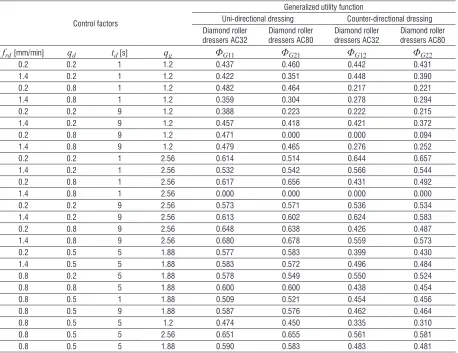
The determined optimum dressing system parameters (type of dressing, radial feed rate of diamond roller dresser frd, dressing speed ratio qd, Table 7. Design of the experiment and generalized utility function during uni-directional and counter-directional dressing with diamond roller
dressers with a working layer of synthetic diamonds АС32 and АС80
Control factors
Generalized utility function
Uni-directional dressing Counter-directional dressing Diamond roller
dressers AC32 dressers AC80Diamond roller dressers AC32Diamond roller Diamond roller dressers AC80 frd[mm/min] qd td [s] qg ΦG11 ΦG21 ΦG12 ΦG22
0.2 0.2 1 1.2 0.437 0.460 0.442 0.431
1.4 0.2 1 1.2 0.422 0.351 0.448 0.390
0.2 0.8 1 1.2 0.482 0.464 0.217 0.221
1.4 0.8 1 1.2 0.359 0.304 0.278 0.294
0.2 0.2 9 1.2 0.388 0.223 0.222 0.215
1.4 0.2 9 1.2 0.457 0.418 0.421 0.372
0.2 0.8 9 1.2 0.471 0.000 0.000 0.094
1.4 0.8 9 1.2 0.479 0.465 0.276 0.252
0.2 0.2 1 2.56 0.614 0.514 0.644 0.657
1.4 0.2 1 2.56 0.532 0.542 0.566 0.544
0.2 0.8 1 2.56 0.617 0.656 0.431 0.492
1.4 0.8 1 2.56 0.000 0.000 0.000 0.000
0.2 0.2 9 2.56 0.573 0.571 0.536 0.534
1.4 0.2 9 2.56 0.613 0.602 0.624 0.583
0.2 0.8 9 2.56 0.648 0.638 0.426 0.487
1.4 0.8 9 2.56 0.680 0.678 0.559 0.573
0.2 0.5 5 1.88 0.577 0.583 0.399 0.430
1.4 0.5 5 1.88 0.583 0.572 0.496 0.484
0.8 0.2 5 1.88 0.578 0.549 0.550 0.524
0.8 0.8 5 1.88 0.600 0.600 0.438 0.454
0.8 0.5 1 1.88 0.509 0.521 0.454 0.456
0.8 0.5 9 1.88 0.587 0.576 0.462 0.464
0.8 0.5 5 1.2 0.474 0.450 0.335 0.310
0.8 0.5 5 2.56 0.651 0.655 0.561 0.581
dress-out time td, diamond roller dresser grit size/
grinding wheel grit size ratio qg and type of synthetic
diamonds), whereat the generalized utility function ΦG,ih has a maximum, are presented in Table 9.
Under the predicted optimum dressing system parameters, confirmation run experiments have been performed, in which the roughness and accuracy of the ground surface, the grinding wheel lifetime and the manufacturing net costs of the grinding operation have been determined. A comparison between the experimental and the predicted according to the
models, Eq. (7), values of the grinding process response variables (see Table 10) has been made.
The results show that the error percentage is within the permissible limits (≤5 %), and it is as follows: 0.65 % to 5 % for the roughness of the ground surface; 1.24 % to 4.65 % for the accuracy of the ground surface; 1.83 % to 3.91 % for the grinding wheel lifetime; 0.37 % to 5 % for the manufacturing net
costs of the grinding operation. These results prove that the recommended dressing system parameters are optimum and correct.
The analysis of the obtained results shows that during uni-directional and counter-directional dressing with diamond roller dressers of synthetic
diamonds АС32 and АС80 the maximum values
of the generalized utility function are obtained for different combinations of speed ratio qd, radial feed Table 8. Regression coefficients and statistical analysis of
regression models, Eq. (8)
Regression coefficients
Generalized utility function ΦG,ih
ΦG11 ΦG21 ΦG12 ΦG22
D0,ih –0.110 0.182 –0.582 –0.222 D1,ih +0.060 - - -D2,ih +0.146 - +0.287 -D3,ih +0.029 - - -D4,ih +0.514 +0.190 +1.142 +0.641
D11,ih - - -
-D22,ih - –0.297 - –0.231 D33,ih –0.004 –0.004 - –0.002 D44,ih –0.097 - -0.271 –0.109 D12,ih +0.245 +0.501 - +0.565 D13,ih - +0.034 - -D23,ih - - –0.159 -D34,ih - +0.010 - -D123,ih –0.031 –0.062 +0.091 –0.046 D124,ih –0.398 –0.394 –0.286 –0.440 D134,ih - –0.012 - -D234,ih - - –0.286 -D1234,ih +0.044 +0.053 - +0.049 Determination
coefficient Rih
2 0.973 0.965 0.918 0.953
Fisher criterion Fih
50.740 38.981 27.367 40.344
Fiht 2.602 2.602 2.614 2.591
Table 9. Optimum dressing system parameters
Synthetic
diamonds Dressing method
Dressing conditions
Grit sizes ratio qg
Generalized utility function
ΦG,ih Radial feed rate
frd [mm/min]
Dressing speed ratio qd
Dress-out time td [s]
AC32 Uni-directional 0.2 0.8 5.7 2.53 0.6984
Counter-directional 0.2 0.2 3.5 2.56 0.6873
AC80 Uni-directional 1.4 0.8 9 2.21 0.7534
Counter-directional 0.2 0.2 1 2.56 0.6736
Тable 10. Comparison of experimental and predicted values of the grinding process response variables
Optimum dressing system parameters
Roughness of the ground
surface Raw[µm]
Accuracy of the ground surface
δw[µm]
Grinding wheel lifetime Ts[min]
Net costs of grinding
operation C [€/pc] Synthetic
diamonds Dressing method [mm/min]frd qd [s]td qg EV PV EV PV EV PV EV PV AC32 Uni-directional 0.2 0.8 5.7 2.53 0.38 0.369 6.81 6.507 39.6 38.05 0.03 0.0289
Counter-directional 0.2 0.2 3.5 2.56 0.3 0.285 9.35 9.182 34.7 33.36 0.024 0.0229 AC80 Counter-directional 1.4 0.8 9 2.21 0.62 0.624 7.2 7.535 44.0 45.15 0.027 0.0271 Uni-directional 0.2 0.2 1 2.56 0.61 0.588 8.42 8.524 52.5 53.46 0.022 0.0209
a) qd = 0.5, td = 5 s b) qd = 0.5, frd = 0.8 mm/min c) qg = 1.88, frd = 0.8 mm/min
d) qg =1.88, td = 5 s e) qg = 1.88, frd = 0.8 mm/min f) qg = 1.88, qd = 0.5 Fig. 3. Generalized utility function during uni-directional dressing with a, b, c, d) diamond roller dressers AC80, and e, f) AC32
a) qd = 0.5, td = 5 s b) qd = 0.5, frd = 0.8 mm/min c) qg = 1.88, frd = 0.8 mm/min
rate frd, dressing time td and grit sizes ratio qg. With
regard to this, by applying genetic algorithm and employing the software product QStatLab Pareto-optimum solutions to the four objective functions: ΦG11, ΦG12, ΦG21, ΦG22, are found, whose maximums
are at different points of the studied factor space. From the found Pareto-front the following combination has
been chosen as an optimum solution: frd = 0.2 mm/
min, qd = 0.75, td = 4.65 s, qg = 2.56. It combines in
an optimum way the largest values of the objective functions, as follows: ΦG11 = 0.6907, ΦG12 = 0.5077,
ΦG21 = 6507, ΦG22 = 0.5073. The determined
optimum dressing system parameters provide the best combination between the roughness and accuracy of the machined surface, the grinding wheel lifetime and the manufacturing net costs of the grinding operation, as follows:
- in uni-directional dressing with diamond
roller dressers of synthetic diamonds АС32: Raw11 = 0.37 μm, δw11 = 4.3 μm, Ts11 = 39.03 min,
C11 = 0.028 €/pc;
- in counter-directional dressing with diamond
roller dressers of synthetic diamonds АС32: Raw12 = 0.22 μm, δw12 = 6.9 μm, Ts12 = 21.45 min,
C12 = 0.04 €/pc;
- in uni-directional dressing with diamond
roller dressers of synthetic diamonds АС80: Raw21 = 0.51 μm, δw21 = 6.9 μm, Ts21 = 34.21 min,
C21 = 0.027 €/pc;
- in counter-directional dressing with diamond
roller dressers of synthetic diamonds АС80: Raw22 = 0.37 μm, δw22 = 6.9 μm, Ts22 = 30.47 min,
C22 = 0.04 €/pc.
3 CONCLUSIONS
As a result of the conducted experimental studies, modelling and multi-objective optimization of dressing grinding wheels of aluminium oxide with diamond roller dressers of medium- and high-strength
synthetic diamonds АС32 and АС80 in fine cylindrical
grinding, the following results have been achieved:
(1) Adequate regression models for the response
variables of the fine grinding process (roughness and accuracy of the ground surface, grinding wheel lifetime, and manufacturing net costs) depending on the dressing system parameters (radial feed rate of diamond roller dresser, dressing speed ratio, dress-out time, diamond roller dresser grit size/grinding wheel grit size ratio, type of synthetic diamonds and direction of dressing).
(2) Theoretical-experimental models have been
created for determining the generalized utility function as a complex indicator characterizing the response variables of the fine grinding process. The models have been constructed for uni-directional and counter-uni-directional dressing with diamond roller dressers of synthetic diamonds
АС32 and АС80, and they reflect the complex
impact of the dressing system parameters.
(3) With the method of the generalized utility
function, the optimum dressing system parameters of uni-directional and counter-directional dressing with diamond roller dressers
of synthetic diamonds АС32 and АС80 have been determined (Table 9). On the basis of
the obtained results, it can be recommended to perform dressing of grinding wheels in fine cylindrical grinding under the conditions at which the maximum value of the generalized utility function is obtained, namely: uni-directional dressing with diamond roller dressers with working layer of high-strength synthetic
diamonds АС80; diamond roller dresser grit size/
grinding wheel grit size ratio qg = 2.21; radial
feed rate of diamond roller dresser frd = 1.4 mm/
min; dressing speed ratio qd = 0.8; dress-out time td = 9 s. The grinding wheels dressing under these
conditions ensures: roughness of the ground
surface 0.62 µm, accuracy of the ground surface shape 7.2 µm, grinding wheel lifetime 44 min and
manufacturing net costs of the grinding operation
0.027 €/pc (Table 10).
(4) With the Pareto method and by applying a
genetic algorithm, the optimum dressing system parameters have been determined, valid for uni-directional and counter-uni-directional dressing with diamond roller dressers of synthetic diamonds
АС32 and АС80, as follows: radial feed rate of
diamond roller dresser frd = 0.2 mm/min; dressing
speed ratio qd = 0.75; dress-out time td = 4.65 s
and diamond roller dresser grit size/grinding wheel grit size ratio qg = 2.56. The credibility of
the determined optimum parameters has been proven by an experimental study of the response variables of the fine grinding process. It has been found that they guarantee the best combination
between the roughness (Raw ≤ 0.51 μm ) and the
accuracy (δw ≤ 6.9 μm) of the ground surface, the
grinding wheel lifetime (Ts ≥ 21.45 min) and the
manufacturing net costs of the grinding operation (C21 ≤ 0.04 €/pc). The results obtained provide
dressing system parameters and they can be used in all machine-building companies.
4 ACKNOWLEDGEMENTS
This work was supported by the Bulgarian Ministry of Education and Science and the Technical University
of Gabrovo under contract No 1713M.
5 REFERENCES
[1] Maksoud, T.M.A., Atia, M.R. (2004). Review of intelligent
grinding and dressing operations. Machining Science and
Technology, vol. 8, no. 2, p. 263-276, DOI:10.1081/MST-200028748.
[2] Malkin, S. (2008). Grinding Technology: Theory and
Application of Machining with Abrasives. Industrial Press, New York.
[3] Puerto, P., Fernández, R., Madariaga, J., Arana, J., Gallego, I. (2013). Evolution of surface roughness in grinding and its relationship with the dressing parameters and the radial wear.
Procedia Engineering, vol. 63, p. 174-182, DOI:10.1016/j. proeng.2013.08.181.
[4] Ostaševičius, V., Jūrėnas, V., Vilkauskas, A., Balevičius, G., Senkus, A., Jotautienė, E. (2017). A novel excitation approach
to ultrasonically-assisted cylindrical grinding. Strojniški vestnik – Journal of Mechanical Engineering, vol. 63, no. 12, p. 696-704, DOI:10.5545/sv-jme.2016.4196.
[5] Cebalq, R. (1988). Optimization of the creep-feed grinding
process. International Journal of Production Research, vol. 26,
no. 10, p. 1665-1670, DOI:10.1080/00207548808947980.
[6] Baseri, H., Rezaei, S.M., Rahimi, A., Saadat, M. (2008).
Analysis of the disc dressing effects on grinding performance - part 1: Simulation of the disc dressed wheel surface.
Machining Science and Technology, vol. 12, no. 2, p.
183-196, DOI:10.1080/10910340802067395.
[7] Baseri, H., Rezaei, S.M., Rahimi, A., Saadat, M. (2008).
Analysis of the disc dressing effects on grinding performance – part 2: Effects of the wheel topographical parameters on the specific energy and workpiece surface roughness.
Machining Science and Technology, vol. 12, no. 2, p. 197-213, DOI:10.1080/10910340802067429.
[8] Baseri, H. (2012). Simulated annealing based optimization of dressing conditions for increasing the grinding performance.
International Journal of Advanced Manufacturing Technology, vol. 59, no. 5-8, p. 531-538, DOI:10.1007/s00170-011-3518-9.
[9] Wegener, K, Hoffmeister, H.-W., Karpuschewski, B., Kuster,
F., Hahmann, W.-C., Rabiey, M. (2011) Conditioning and monitoring of grinding wheels. CIRP Annals, vol. 60, no. 2, p. 757-777, DOI:10.1016/j.cirp.2011.05.003.
[10] Palmer, J., Ghadbeigi, H., Novovic, D., Curtis, D. (2018). An
experimental study of the effects of dressing parameters
on the topography of grinding wheels during roller dressing.
Journal of Manufacturing Processes, vol. 31, p. 348-355, DOI:10.1016/j.jmapro.2017.11.025.
[11] Chen, Y., Chen, X., Xu, X., Yu, G. (2018). Effect of energy consumption in the contact zone on machining condition
optimization in precision surface grinding. Strojniški vestnik - Journal of Mechanical Engineering, vol. 64, no. 4, p. 233-244, DOI:10.5545/sv-jme.2017.4995.
[12] Jiang, J.L., Ge, P.Q., Bi, W.B., Zhang, L., Wang, D.X., Zhang, Y. (2013). 2D/3D ground surface topography modeling considering dressing and wear effects in grinding process.
International Journal of Machine Tools and Manufacture, vol. 74, p. 29-40, DOI:10.1016/j.ijmachtools.2013.07.002. [13] Saad, A., Bauer, R., Warkentin, A. (2010). Investigation of
single-point dressing overlap ratio and diamond-roll dressing interference angle on surface roughness in grinding.
Transactions of the Canadian Society for Mechanical Engineering, vol. 34, no. 2, p. 295-308, DOI:10.1139/ tcsme-2010-0018.
[14] Lefebvre, A., Sinot, O., Torrance, A. (2013). Optimization of dressing conditions for a resin-bonded diamond wheel by topography analysis. Machining Science and Technology, vol.
17, no. 2, p. 312–324, DOI:10.1080/10910344.2013.781364.
[15] Zylka, L., Burek, J., Mazur, D. (2017). Diagnostic of peripheral longitudinal grinding by using acoustic emission signal.
Advances in Production Engineering & Management, vol. 12, no. 3, p. 221-232, DOI:10.14743/apem2017.3.253.
[16] Linke, B. (2008). Dressing process model for vitrified bonded
grinding wheels. CIRP Annals, vol. 57, no. 1, p. 345-348,
DOI:10.1016/j.cirp.2008.03.083.
[17] Lee, K.-M., Hsu, M.-R., Chou, J.-H., Guo, C.-Y. (2011). Improved differential evolution approach for optimization of surface grinding process. Expert Systems with Applications, vol. 38, no. 5, p. 5680-5686, DOI:10.1016/j.eswa.2010.10.067. [18] Slowik, A., Slowik, J. (2008). Multi-objective optimization
of surface grinding process with the use of evolutionary algorithm with remembered Pareto set. International Journal of Advanced Manufacturing Technology, vol. 37, no. 7-8, p.
657-669, DOI:10.1007/s00170-007-1013-0.
[19] Saravanan, R., Sachithanandam, M. (2001). Genetic algorithm (GA) for multivariable surface grinding process optimisation using a multi-objective function model. International Journal of Advanced Manufacturing Technology, vol. 17, no. 5, p.
330-338, DOI:10.1007/s001700170167.
[20] Zhang, G., Liu, M., Li, J., Ming, W.Y., Shao, X.Y., Huang, Y. (2014). Multi-objective optimization for surface grinding process using a hybrid particle swarm optimization algorithm.
International Journal of Advanced Manufacturing Technology,
vol. 71, no. 9-12, p. 1861-1872,
DOI:10.1007/s00170-013-5571-z.
[21] Krishna, A., Rao, K. (2006). Multi-objective optimization of surface grinding operations using scatter search approach.
International Journal of Advanced Manufacturing Technology, vol. 29, no. 5-6, p. 475-480, DOI:10.1007/BF02729099. [22] Baskar, N., Saravanan, R., Asokan, P., Prabhaharan, G.
(2004). Ants colony algorithm approach for multi-objective optimisation of surface grinding operations. International Journal of Advanced Manufacturing Technology, vol. 23, no. 5-6, p. 311-317, DOI:10.1007/s00170-002-1533-6.
[24] Klancnik, S., Brezocnik, M., Balic, J. (2016). Intelligent CAD/CAM system for programming of CNC machine tools.
International Journal of Simulation Modelling, vol. 15, no. 1, p.
109-120, DOI:10.2507/IJSIMM15(1)9.330.
[25] Aleksandrova, I. (2016). Optimization of the dressing parameters in cylindrical grinding based on a generalized utility function. Chinese Journal of Mechanical Engineering, vol. 29, no. 1, p. 63-73, DOI:10.3901/CJME.2015.1103.130. [26] Catalogue of the Abrasive Tools Factory – Berkovitsa (2018).
from https://0501.nccdn.net/4_
2/000/000/084/3b1/ZAI-2018.pdf, accessed on 2018-10-30.
[27] GOST 9206-80 (1980). Diamond powders. Technical Conditions. USSR State Committee for Standard. Moscow. (in Russian)
[28] DSTU 3292-95 (1995). Synthetic Diamond Powders. General Technical Conditions. State Standard of Ucraine, Kiev. (in Russian)
[29] Industrial Diamond Association of America, Inc. A
Review of Diamond Sizing and Standards, from http://
www.nationalresearchcompany.com/wp-content/
uploads/2015/05/Diamond_Sizing_and_Standards.pdf, accessed on 2018-12-07.
[30] Aleksandrova, I. (1995). Optimization of Dressing Process of Abrasive Tools with Diamond Profiling Rollers. PhD thesis, Technical University of Gabrovo, Gabrovo. (in Bulgarian) [31] Аleksandrova, I. (2010). Methodology of modeling,
identification and control of grinding process. Inzhenerni nauki, no. 1, p. 60-72. (in Bulgarian)
[32] Aleksandrov, A., Aleksandrova, I. (2012). Theory of Experiment.
Express, Gabrovo. (in Bulgarian)
[33] Schmitt, R. (1968) Abrichten von Schleifscheiben mit diamantbestückten Rollen. PhD thesis, TU Braunschweig. (in German)
[34] Daneshi, A., Jandaghi, N., Tawakoli, T. (2014). Effect of dressing on internal cylindrical grinding. Procedia CIRP, vol. 14, p. 37-41, DOI:10.1016/j.procir.2014.03.064.
[35] Klocke, F., Linke, B. (2008). Mechanisms in the generation
of grinding wheel topography by dressing. Production
Engineering, vol. 2, no 2, p. 157-163, DOI:10.1007/s11740-008-0101-9.
[36] Klocke, F., Thiermann, J., Mattfeld, P. (2015). Influence of
the dressing process on grinding wheel wear. Production
Engineering, vol. 9, no 5-6, p. 563-568, DOI:10.1007/s11740-015-0606-y.
[37] Vishnupad, P., Shin, Y.C. (1998). Intelligent optimization
of grinding processes using fuzzy logic. Proceedings of
the Institution of Mechanical Engineers, Part B: Journal of Engineering Manufacture, vol. 212, no. 8, p. 647-660, DOI:10.1243/0954405981515914.
[38] Mukherjee, I., Ray, P.K. (2006). A review of optimization techniques in metal cutting processes. Computers & Industrial Engineering, vol. 50, no. 1-2, p. 15-34, DOI:10.1016/j. cie.2005.10.001.
[39] Yusup, N., Zain, A.M., Hashim, S.Z.M. (2012). Evolutionary techniques in optimizing machining parameters: Review
and recent applications (2007–2011). Expert Systems with
Applications, vol. 39, no. 10, p. 9909-9927, DOI:10.1016/j. eswa.2012.02.109.
[40] Stoyanov, S. (1993). Optimization of Manufacturing Processes.
Tehnika, Sofia. (in Bulgarian)
[41] Mukherjee, I., Ray, P.K. (2008). Optimal process design of two-stage multiple responses grinding processes using desirability functions and metaheuristic technique. Applied Soft Computing, vol. 8, no. 1, p. 402-421, DOI:10.1016/j. asoc.2007.02.005.
[42] Dzebo, S., Morehouse, J.B., Melkote, S.N. (2012). A methodology for economic optimization of process parameters in centerless grinding. Machining Science and Technology, vol. 16, no. 3, p. 355-379, DOI:10.1080/10910344.2012.698958. [43] Salmasnia, A., Kazemzadeh, R.B., Niaki, S.T.A. (2012). An
approach to optimize correlated multiple responses using principal component analysis and desirability function.
International Journal of Advanced Manufacturing Technology,
vol. 62, no. 5-8, p. 835-846,
DOI:10.1007/s00170-011-3824-2.
[44] Raissi, S., Farsani, R. (2009). Statistical process optimization
through multi-response surface methodology. International
Scholarly and Scientific Research & Innovation, vol. 3, no. 3, p. 247-251.
[45] Vuchkov, I.N., Vuchkov, I.I. (2009). Statistical Methods of Quality Control, Robust Engineering, Planning, Modeling and Optimization, QStatLab, v 5.3. (in Bulgarian)
![Table 1. Diamond grit properties [27] to [29]](https://thumb-us.123doks.com/thumbv2/123dok_us/8948215.1857583/3.598.75.539.99.180/table-diamond-grit-properties.webp)