Ideological constructions in column titles by two age
groups in the Philippines: Implications in language
teaching and learning
Guinto, Nicanor
Southern Luzon State University, Philippines ([email protected])
Received: 28 February 2013 Revised: 22 August 2013 Accepted: 23 August 2013
Available Online: 24 October 2013 DOI: 10.5861/ijrsll.2013.372
ISSN: 2243-7754 Online ISSN: 2243-7762
OPEN ACCESS
Abstract
This paper is an exploratory research which sought to discover ideological constructions in
column titles by contributors of Philippine Daily Inquirer’s (PDI) Youngblood and Highblood
columns. By unveiling ideological constructs in the title, certain pedagogical implications
were reviewed on the premise that samples of these columns may have found their way in the
education system as models of quality personal essay. Analysis was done through the
examination of process types and lexicalization. Fairclaugh’s Critical Discourse Analysis and
Halliday’s Process Types and lexicalization served as the theoretical foundations of the study.
Data used in the analysis were those published in PDI’s website from October, 2011- October
2012. It was found that young and old contributors write about experiences pertaining to
concrete actions, contradicting earlier studies on Filipino youth and the elderly. Moreover,
lexical choices of young contributors point to themselves as being goal-oriented,
adventure-driven, and assertive, yet weak, frustrated and dependent. Consequently, the elderly
contributors portray themselves as energetic, politically- and socially-aware, wise, yet
nostalgic, sickly, and age-conscious. Out of these results, implications to language teaching
and learning are underscored.
Keywords:
ideological constructions; column titles; Filipino youth; Filipino elderly; language
Ideological constructions in column titles by two age groups in the Philippines:
Implications in language teaching and learning
1. Introduction
The mass media are one of the important legitimizing institutions of certain beliefs that society holds. As such, the sphere of influence of media far reaches other social institutions specifically and perhaps more importantly, that of the academe (Hobbs, n.d.). In the Philippines, educational institutions have adopted the precepts of Communicative Language Teaching (CLT) approach in the teaching of English and local vernaculars. CLT promotes the utilization of “authentic” classroom materials in the attempt to “contextualize” language learning (Savignon, 2006; Kramsch, 2008). Since authentic language learning materials are oftentimes derived from mass media (Brinton, 2006), there is no wonder that the ideological constructs that media institutions consistently create through their releases greatly influence the perceptions, identity construction, and expectations of the citizenry. Hence, a critical analysis of ideological construction of media institutions could, in one way or another, offer an idea of the kind of image that the academe may have unconsciously legitimized through the aid of authentic classroom materials derived from mass media.
Two of the many media content that gained prestige in the country over time, the Youngblood columns and Highblood columns, have been identified with a distinct mark of excellence when it comes to quality personal essays. As such, educational institutions have adopted samples of the column to serve as models in teaching personal essays (e.g.- Guinto & Villaverde, 2012), among others.
Youngblood and Highblood are brainchild of the Philippine Daily Inquirer (PDI), the nation’s leading broadsheet in terms of readership (4A’s Media Factbook, 2004 cited by Dayag, 2009). Youngblood is a column published three times a week in the opinion page and in the website of PDI. The column invites “twenty-something and below” to write about what they are thinking of as well as what their thoughts are on current issues. Meanwhile, Highblood seeks for the same, but this time, from the “sixty-something”. The said column, however, is not published as regular as its counterpart.
The age groups have been perceived to have an inferior position in society when it comes to societal affairs (United Nations, 2000; Hamilton, 2001). PDI offered such column spaces to the two opposite age groups in 1994, apparently to contradict stereotypical beliefs with the two age groups, such as oblivion to societal issues, and their incapacity to act, reflect, or comment on such issues due mainly to their age. Through the years, there is no doubt that contributors of the columns have constructed, if not continuously constructing, an ideological image of the two polar age brackets through the Youngblood and Highblood columns. The ideological image may have unconsciously been integrated in the teaching and learning process in the Philippines, further legitimizing an identity of their group in the process.
Kuhi, Tofigh, and Babaie (2013) claimed that writers project a personal identity in their writing. They continued that “writers cannot avoid projecting an impression of themselves and how they stand in relation to their arguments, their community and their readers” (p. 36). By examining language use, Jou (2013) said that particular identities of the discourse community in question can be explored and uncovered. Hence, this paper aims to discover the ideological image(s) generally constructed in the titles of PDI’s Youngblood and Highblood columns in order to reflect its implications in the country’s language education system. It specifically sought to answer the following questions:
1) What process type is dominant in the column titles?
3) What ideologies about being “old” and being “young” in the Philippines seem to underlie in the process types and lexical choices?
2. Related Literature and Framework
2.1 Media and its Power
The influence of media far reaches expectations nowadays especially with the boost of new media technology around the world. As a response to the ever-growing preference of people around the world to click through pages rather than turn them, media institutions have exploited the potential of the internet to reach greater number of audience without the hassle of traditional broadcasting and publishing practices. The extent of impact mass media generates out of these potentials makes it a prime subject of intellectual scrutiny (Guinto, 2012). Van Dijk (2001) claims that media ideologically sustains and reproduces public opinion. They “do not just reflect or represent social entities and relations, [but] they also construct and constitute them” (Fairclough, 1993: p. 3).
In addition, Tinio (2003) notes that journalists, editors and contributors “are free to use words and expressions, language style and linguistic structures” in their articles. This is similarly and more importantly manifested in article titles, technically termed as headlines. It is through headlines that readers normally find interest in reading a particular newspaper content. Tinio further explains:
Newspaper headlines are able to reach much more readers than the articles because those who buy newspapers would generally glance at the headlines first before they decide whether a particular issue is worth reading to them or not (p. 53)
However, now that almost all media firms have also tapped the potential of the internet, gaining loyal readership has significantly been a challenge among them. Despite this, the academe will always be its loyal reader because of its treasury of content that enriches classroom learning experience (Brinton, 2006).
Even before the advent of Communicative Language Teaching approach, academic institutions have consistently utilized mass media content either as teaching aid or model of quality output. This is why Hobbs (n.d.) articulated the need for the critical analysis of the uses and misuses of television and other mass media tools in the classroom, the impact of media on youth, and their knowledge of media literacy education. As a response to this need, this paper broadly adopts the analysis framework of critical discourse analysts.
2.2. Critical Discourse Analysis
Critical discourse analysis (CDA) is a discourse analytical research method that primarily focuses on understanding, exposing and resisting social inequality (Van Dijk, 2001; Mahboob & Paltridge, 2013). Fairclaugh (2001 cited in Jahedi and Abdulla, 2012) identified three corresponding stages of critical discourse analysis: description of text, interpretation of the relationship; and explanation of the relationship between interaction and social context. The stage of description accounts for the formal and linguistic properties of the text that shows traces of the process of production. The stage of interpretation delves on the associations between text and interaction. Finally, the stage of explanation presents the relationship between the process of production and interpretation, and the social context. In addition, Fairclough (2003) acknowledges M.A.K. Halliday’s Systemic Functional Linguistics (SFL) as a tool in carrying out analysis in CDA.
“SFL is profoundly concerned with the relationship between language and other elements and aspects of social life…, making it a valuable resource in critical discourse analysis” (p. 5).
2.3. Halliday’s Process Types and Lexicalization
who gives information or offers goods and services. Dubbed as a Functional-Semantic approach to linguistics, SFL explores language as “meaning potential” (Halliday, 1975), realized through a tripartite semantic structure of language, which he termed “Metafunctions”.
Halliday distinguished three metafunctions of adult human language: ideational (language as experience), interpersonal (language as interaction), and textual (language as message) which show how simultaneous strands of meanings are expressed in clause structures. The concern of the present study is on the ideational metafunction of language since “systematic selection of particular process type may be ideologically significant” (Fairclough,1993, p. 27). The ideational metafunction, which expresses experiential meaning in a communication situation, is grammaticalized through the system of transitivity or process type.
“Experiential meaning is expressed through the system of transitivity or process type, with the choice of process implicating associated participant roles and configurations” (Eggins, 2004, p. 206).
Halliday identified five process types namely: material, mental, behavioral, verbal and relational.
The material process describes the process of doing, usually concrete, tangible actions. “The basic meaning of material processes is that some entity does something, undertakes some action” (Eggins, 2004, p. 215). The mental process describes the process of thinking or feeling. “We find we are not asking about actions or doings in a tangible, physical sense, but about mental reactions: about thoughts, feelings, perceptions” (p. 225). The verbal process accounts for “verbal actions” (p. 235). “Saying and all its many synonyms, including symbolic exchanges of meaning” (p. 235) are the verbs that signal the verbal process.
Moreover, the behavioral process serves as a borderline between the material and mental process, which follows the notion that humans are conscious being. “They are in part about action, but it is action that has to be experienced by a conscious being. Behaviorals are typically processes of physiological and psychological behavior” (p. 233).
The final set of process types encodes meanings about states of being and show how “being” is expressed in the utterance. It is classified as existential and relational process types, often taken under the label of the latter. It assigns attributes or identities to “being” positing that there was or is something (i.e., existential process types) and those they are seated to exist with other things (i.e., relational process types).
Meanwhile, another concern of this paper is to unveil significant connections between particular lexical items in the titles. In consideration of Halliday’s point about language as system of choices, lexical choices made by the contributors are presumed to have profound reference to characteristics that define the discourse community the contributor represents. Hence, analysis of their lexical choices was done with the concept of “Lexicalization” in mind. Van Dijk (2000 as cited by Jahedi and Abdulla, 2012) posits that lexicalization pertains to the expressive value of words in creating an ideology. Fairclough (1993) points out that lexicalization can show alternative wordings at which particular ideological significance is attached. Jahedi and Abdulla maintain that the focus of lexicalization is on word meanings and metaphors that provide insight into ideological representations.
3. Methodology
This section of the paper discusses the research approaches and methods adopted to carry out the study. It also explains the samples used and procedures in gathering the data as well as the detailed steps taken by the researcher to carry out the analysis.
3.1 Research design
qualitative as it used the tools of textual analysis to uncover significant features and patterns in the column titles. It is also quantitative since it used simple statistical treatment such as frequency and percentage analysis in order to find out regularity in the use of specific process types and ideological concepts in the titles. This paper adopted as a guide the procedures applied by Jahedi and Abdulla (2012) in their study in order to determine the ideological images constructed by Youngblood and Highblood contributors as reflected in the column titles.
3.2 Description of samples and sampling procedure
Samples used in this study were primarily retrieved from the website of Philippine Daily Inquirer, particularly in the following URL:
Youngblood: http://www.opinion.inquirer.net/column/young_blood
Highblood: http://www.opinion.inquirer.net/column/high_blood
The news organization publishes the columns both in print and online, with the online version a day earlier (or perhaps, hours earlier) the print version. The researcher decided to gather the samples from the online version as it is readily available to anyone who wishes to read content which he/she may have missed to read on a particular day in the print edition. Aside from this, a Youngblood or Highblood column published in a particular day was observed to have been retrievable in the URLs stated above for almost a year by any online surfers before PDI’s online content editor reclassifies it and places it into another category in the website.
Usually, what avid Youngblood or Highblood readers do is to go to http://www.inquirer.net and click on the link “columnist” to be redirected to a list of PDI’s columnists. They would eventually click on Youngblood or Highblood and they would see the most recently-published article, including close to a year’s worth of published columns. Because of this, the researcher decided to limit the scope of the study into those columns which are still accessible in the URLs mentioned from October 2011 to October 2012. This time frame was chosen with the purpose of establishing a “contemporary” picture of the topic being studied.
As a result, forty one (41) Youngblood column titles and (23) Highblood titles were identified and purposively selected. It must be noted, however, that a few of the articles have already been reclassified by the online content editor during the time the data was gathered. Furthermore, it must be mentioned that in a survey the researcher conducted prior to this study, it was found that 1 out of 10 column titles have been altered by PDI editors in part or in full from the originally-submitted one by the contributor, which means that the majority of titles are still the contributors’ way and preference of expressing a particular ideology to the world, that when analyzed collectively sheds light on the ideologically-constructed image of the discourse community where they belong.
3.3 Procedures employed in analysis
Textual analysis of the samples was carried out through the aid of Faiclough’s stages in undertaking CDA, which is discussed in the Theoretical Framework in this paper. The analysis proper however, is detailed in the succeeding paragraphs. These steps were undertaken after data were identified and gathered.
i. Description of text
kind of ideological image constructed by the terms in the title in the readers’ mind.
ii. Interpretation of the relationships
After the verbs were properly labeled with the corresponding process type, the number of occurrence of a process type on the list was counted, from which percentage from the total number of verbs in the list was computed. Meanwhile, after the other list was completed, ideological concepts that could represent the group of words were identified. At this point, the researcher does not claim exhaustiveness of the ideological concepts identified. The concepts identified are those that a reader may instantly think about once exposed to a group of related terms in the context of the Philippines.
iii. Explanation of the relationships
The process type with the highest frequency count and percentage in each set of column titles would give characteristic information on each discourse communities being studied, based on the characteristics entailed by the said process on account of Halliday’s definitions of them. Consequently, the ideological concepts which were identified in the lexicalization analysis could be regarded as the defining image the particular discourse community collectively portrays. In the end, a comparative analysis of the results of the first two objectives, yielded to the results of the third objective. Studies about youth and the elderly in and outside the Philippines were also cited to serve as support to the assumptions. From these, implications to language teaching and learning are underscored.
4. Results and Discussion
The section that follows presents the results of the analysis of Youngblood and Highblood column titles, highlighting process type analysis, lexicalization analysis, and the ideological image/s unique to each discourse community.
4.1 Process types
The process types are good indicators of a speaker/ writers’ kind of “experience”. It can be an action (material), realization (mental), conscious act (behavioral), acknowledgement of existence of something (existential) or attribute of someone/something (relational). The most common process types identified in the titles of the two columns are discussed in this part. Table 1 shows the frequency and percentage distribution of process types in the Youngblood column.
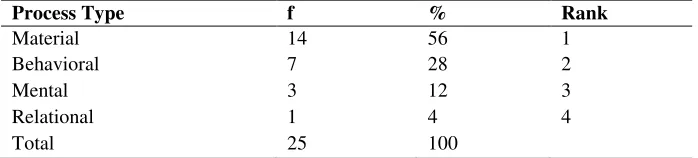
Table 1
Process types in Youngblood column titles
Process Type f % Rank
Material 14 56 1
Behavioral 7 28 2
Mental 3 12 3
Relational 1 4 4
Total 25 100
The table shows that the majority of verbs and other terms from which a verb can be derived in the column titles are material process types as it received a frequency of 14 or 56 %, ranking first among the four process types observed in the data at hand. Following the material process type, with half the frequency (7 or 28%) of the first one is behavioral process type. Least common in the titles were mental and relation process types which only received a frequency of 3 or 12% and 1 or 4%, respectively.
“doing”. In certain cases, they choose to express their experience through processes that not only involves the act of “doing”, but simultaneously requires some level of thinking in the process. This means that the kind of experience that they usually want to tell the world is something that pertains to tangible action.
The tendency of young contributors to represent experience of material nature is contrary to PDI’s invitation addressed to potential contributors. The all for contribution specifically states that PDI wants to know what the youth is “thinking about” as well as their “thoughts” on current issues. These could be well manifested through the use of mental process, or behavioral processes perhaps, but instead, they prefer to tell the world about what they do rather that what they have in mind. The succeeding table meanwhile, presents the frequency and percentage distribution of process types in the Highblood column.
Table 2
Process types in Highblood column titles
Process Type f % Rank
Material 10 71.43 1
Behavioral 2 14.29 2
Relational 2 14.29 2
Mental 0 0
Total 14 100
Table 2 reports that 71.43% (f=10) of the terms identified as verbs or has verb derivatives in the titles of Highblood contributors are material process types, ranking first among the three (3) process types observed. Barely catching up with the frequency and percentage of the material process types are behavioral and relational ones, both having two (2) as frequency or 14.29%. The result indicates that Highblood contributors prefer to tell the world that just like the youth, despite their age, they could still “do” a lot of things, contrary to the stereotypes of old age.
4.2 Lexicalization
The choice of terms in the titles significantly reflects the ideologies that a writer wants to portray. When taken collectively, such as in the succeeding discussions, it could profoundly provide important information about the ideological concepts that are unconsciously shaped by each discourse community in this study. The ideological concepts have been stated in adjective form to clearly show that it is a quality derived from a set of terms grouped without reference to the content of the article, or its grammatical category, but to the context the title proposes in general. The classification/ grouping were made in reference to connotative meanings that may be attached to the term/s. Table 3 presents the ideological concepts in Youngblood column titles identified out of a set of words that can be seen in the “examples” column.
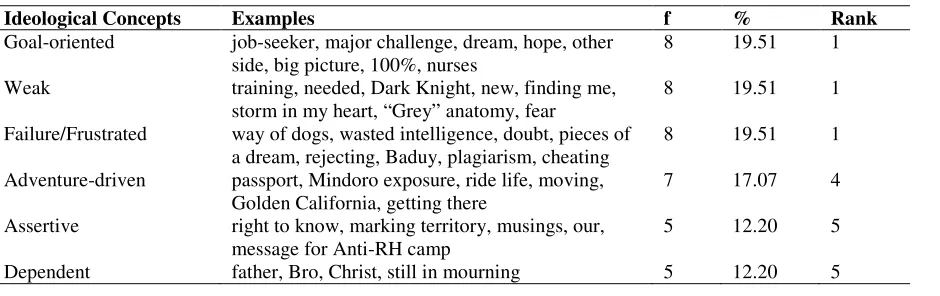
Table 3
Ideological concepts in Youngblood column titles
Ideological Concepts Examples f % Rank
Goal-oriented job-seeker, major challenge, dream, hope, other side, big picture, 100%, nurses
8 19.51 1
Weak training, needed, Dark Knight, new, finding me, storm in my heart, “Grey” anatomy, fear
8 19.51 1
Failure/Frustrated way of dogs, wasted intelligence, doubt, pieces of a dream, rejecting, Baduy, plagiarism, cheating
8 19.51 1
Adventure-driven passport, Mindoro exposure, ride life, moving, Golden California, getting there
7 17.07 4
Assertive right to know, marking territory, musings, our, message for Anti-RH camp
5 12.20 5
The table indicates that “goal-oriented”, “weak” and “failure or frustrated” all received similar frequency count of 8 or 19.51%. Following the three are qualities such as “adventure-driven” with 7 or 17.07% and “assertive” and “dependent”, both with the frequency of 5 or 12.20%. The result significantly notes that young column writers portray themselves positively as goal-oriented, adventure-driven, and assertive and negatively as weak, frustrated, and dependent. Meanwhile, the next table points out the ideological concepts identified in the Highblood columns.
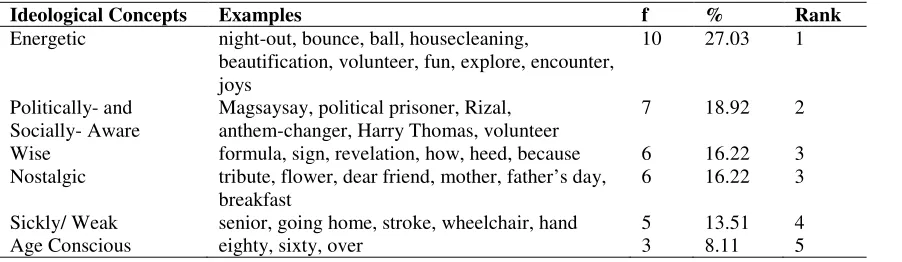
Table 4
Ideological concepts in Highblood column titles
Ideological Concepts Examples f % Rank
Energetic night-out, bounce, ball, housecleaning,
beautification, volunteer, fun, explore, encounter, joys
10 27.03 1
Politically- and Socially- Aware
Magsaysay, political prisoner, Rizal, anthem-changer, Harry Thomas, volunteer
7 18.92 2
Wise formula, sign, revelation, how, heed, because 6 16.22 3 Nostalgic tribute, flower, dear friend, mother, father’s day,
breakfast
6 16.22 3
Sickly/ Weak senior, going home, stroke, wheelchair, hand 5 13.51 4
Age Conscious eighty, sixty, over 3 8.11 5
Table 4 shows that the greatest count of lexical items in the title of Highblood columns mostly portray the contributors to be “energetic” with a frequency of 10 or 27.03%. In addition, the quality of being “politically- and socially-aware” received a frequency of 7 or 19.92%. With similar word counts, “wise” and “nostalgic” were ranked third as it received a frequency of 6 or 16.22%. Finally, the least number of frequency count, which is ranked last among the ones identified is “age conscious” with a frequency of 3 or 8.11%.
The results point out that contrary to stereotypical belief of frailty that comes with old age, writers of Highblood present themselves among their readers as somebody who still have the energy to do things which people around them may not expect for the elderly to be capable of doing. Along with these are ideas of being mindful about societal affairs and issues. The result is also reflective of the cliché “with old age comes wisdom”, wisdom, which according to psychologists the elderly attempts to transfer to someone younger, as a form of their personal legacy.
Similarly, nostalgia, weakness, and age consciousness – three terms which are normally attached to the concept of being old have been manifested as well in the lexical choices, defining these qualities as those which the older contributors wish the public to read and learn from.
4.3 Young vs. Old: Constructed Ideological Images
Results gathered from the analysis of process types and lexicalization show distinct ideological images unique to a discourse community. As results in the present study are compared and contrasted in this part of the discussion, the two discourse communities underscored herein would eventually be labeled with defining features that spring out of the kind of image they unconsciously yet collectively portrayed just by their individual lexical choices in the title of their articles.
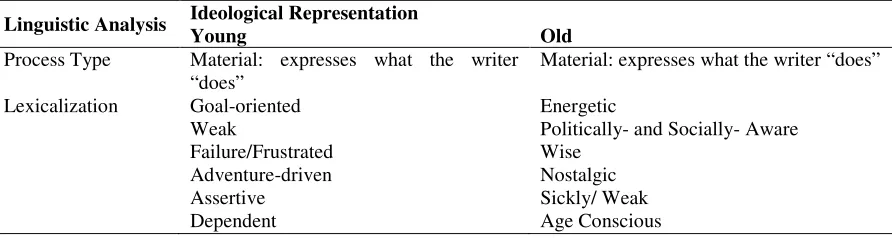
Table 5
Summary of ideological representations derived from linguistic analysis
Linguistic Analysis Ideological Representation
Young Old
Process Type Material: expresses what the writer “does”
Material: expresses what the writer “does”
Lexicalization Goal-oriented Weak
Failure/Frustrated Adventure-driven Assertive Dependent
Energetic
Politically- and Socially- Aware Wise
Nostalgic Sickly/ Weak Age Conscious
It can be noted in the table that both young and old contributors in the columns share a similar choice of process types in their column titles, which is indicative of their attempt to express a kind of experience which narrates “concrete, real, and tangible actions” (Eggins, 2004, p. 215). This simply means that the two discourse groups are engaged in physical activities that may require physiological stability and/or over-all physical fitness.
Interestingly, the result about the image older writers portray in their column titles contradicts the study of Cruz (1999) which noted that the elderly’s “withdrawal from the productive sector and other economic opportunities [is a] result of… age restrictions… as well as health factors” (p. 51). Contributors in the High Blood column thus seem to tell the public that despite their old age, they could still be part of the productive movements and moments in society contrary to the stereotyped images of them as being frail and sickly.
Similarly, in a study conducted by Sandoval, Mangahas, and Guerrero (1998) in 1996 about the Filipino youth, they discovered that “only one in twenty of the Filipino youth participate in sports, do athletic work or exercise daily” (par. 23) because they are more engrossed in doing passive activities such as listening to the radio, or watching television. This is in contrast with what contemporary young writers portray themselves in their lexical choices in the column titles for they seem to tell their readers and the world that their experiences now comprise that of physical activities, rather than what the younger generation were mostly engaged in back in the 1990’s.
Moreover, the two discourse communities’ lexical choices in their titles contributed more explanations about their self-constructed ideological image that process types fail to account for. Their lexical choices proved the findings in process type analysis because some terms they chose to construct their titles fell under some ideological concepts that indeed point out to them doing physical activities.
The majority of lexical choices of young contributors present the ideological concept of them being goal-oriented, adventure-driven and assertive. These qualities which they attach themselves in, based on their column titles, can be attributed to the Filipino youth’s self-confidence and satisfaction with the kind of education they receive, as reported by Sandoval, Mangahas, and Guerrero. The education the Filipino youth receives provides them with a sense of expectation, urging them to keep particular goals in mind. The level of confidence they possess likewise results in their assertiveness on issues that confront them.
In the case of older contributors, despite empirical evidence of health-related incapacities due to age restrictions, their lexical choices point out to the claim that they are still energetic to do activities. Compared to their youth counterparts, they are more politically- and socially-aware which can be seen as attributable to the sense of responsibility they developed through the years. As a result, this awareness, including their wealth of experience, leads them to confidently use lexical items that expressly tell about their wisdom.
Hamilton (2001) cites Boden and Bielby’s (1981) assumption that old age wisdom is expressed through comparisons between “the way it was” and “the way it is”. This in turn, supports another ideological concept – nostalgia - perceived from the samples’ lexical choices. Much of their stories, as Hamilton notes, mostly delve on their longing for “the way it was”.
Apart from this, Hamilton points out that in most elderly critical discourse research, the elderly was perceived to disclose painful information about self – their immobility, sickness, and chronological age, which in turn supports the remaining ideological concepts identified – that they are sickly or weak and are now age conscious, as they perch in the final stage of their life.
In summary, the two discourse communities underscored in this paper portray ideological images, constructed through their column titles, which both deny and affirm societal stereotypes and empirical research conducted among their age group.
5. Conclusions
This exploratory study generally aimed to uncover ideological images constructed in column titles by contributors of PDI’s Youngblood and Highblood columns. It specifically analyzed common process types and lexicalization in the titles by means of Fairclaugh’s Critical Discourse Analysis, with the help functional-semantic theories such as Halliday’s Process Types and lexicalization. Data used in the analysis were those published from October, 2011- October 2012, retrievable from the website of Philippine Daily Inquirer.
In the light of the findings, it was concluded that both Youngblood and Highblood contributors write about an experience which mostly pertain to a concrete, tangible action, disputing two national surveys (Sandoval, Mangahas, and Guerrero, 1998; Cruz, 1999) about the Filipino youth and the Filipino elderly.
In addition, lexical choices in young contributors’ titles point to the ideological construction of themselves as goal-oriented, adventure-driven, and assertive, yet weak, frustrated at their age and still dependent. Consequently, the elderly contributors portray themselves as energetic, politically- and socially- aware, wise, yet nostalgic, sickly or weak, and age conscious.
Together, through the analysis of the two linguistic devices in the column titles, the Youngblood and Highblood contributors both deny and affirm societal stereotypes and empirical research conducted among their age group.
6. Implications in language teaching and learning
The fact that media industry is a powerful legitimizing entity in society is a matter that is maximally recognizable and exponentially reinforced in the academe. As Brinton (2006) articulated, the academe will always be its loyal reader because of its treasury of content that enriches classroom learning experience. Authentic classroom materials in language learning are given more value in present pedagogical approaches than those which are deliberately created for classroom use because of the advocacy of contemporary language teaching approaches to make language learning a functional enterprise rather than a purely linguistic endeavor (Kramsch, 2008; Richards, 2006; Savignon, 2006).
Through their contributions in a national newspaper, whose “power” and unquestionable influence reaches the education sector, there is no doubt that they are uniquely reshaping their societal image from being passive age groups to dynamic and informed citizens of the country. Through their contributions that project their constructed ideologies and that which are used in language classes as epitomes of quality essay, language learners are unconsciously taught of preferred ideal images of the two age groups.
At this point, there is no doubt that in the long run, society will see the two age groups represented by young and old column contributors, not anymore as burdens to social mobilization, but in fact, prime movers of social development despite supposed constraints brought about by their age. It is therefore imperative for language teachers to reinforce positive ideological constructs found in this study and consciously mask those deemed negative in the process of language teaching and learning thereby empowering the age groups in the process.
Acknowledgement
I wish to extend my heartfelt gratitude to the help offered by the people behind the completion of this paper. To Dr. Rosalina Bumatay-Cruz and Dr. Maria Corazon S.A. Castro of the University of the Philippines-Diliman whose encouragements and motivation led the researcher to pursue this topic. To Prof. Carmelita C. Placino, Prof. Shiela M. Manzanilla, and Dr. Marissa L. Cadao of Southern Luzon State University for always being supportive in my research endeavors. To Dr. Cecilia N. Gascon, President of Southern Luzon State University, for approving the scholarship grant, without which, I wouldn’t have written this paper. And to the editor, readers and reviewers who provided valuable feedback for the improvement of this paper, your priceless support and kindness will forever be etched in my heart.
7. References:
Brinton, D. (2006). The use of media in language teaching. In M. Cerce-Murcia (Ed.), Teaching English as a second or foreign language (pp. 459-476). Singapore: Heinle & Heinle.
Cruz, G. T. (1999). Economic well-being of the Filipino elderly. Philippine Social Sciences Review, 56(1-4). 41-70.
Dayag, D.T. (2009). English-language media in the Philippines: Description and research. In M. S. Bautista & K. Bolton (Eds.), Philippine English: Linguistic and literary perspectives (pp. 49-66). Hong Kong: Hong Kong University Press.
Eggins, S. (2004). An introduction to systemic functional grammar, 2nd Ed. New York, USA: Continuum. Fairclough, N. (1993). Discourse and social change. Cambridge, USA: Polity Press.
Fairclough, N. (2003). Textual analysis for social research. London, UK: Routlege.
Guinto, N. (2012 April 26-28). Language of Young Blood: The discourse practice of young column writers in the Philippines. Paper presented at the 2nd Asian Conference in Language Learning, Osaka, Japan.
Guinto, N., & Villaverde, B. (2012). Functional English in a global society 2 [Module]. Lucban, Quezon: Department of Languages, Literature and Humanities, Southern Luzon State University.
Halliday, M.A.K. (1975). Learning how to mean: Explorations in the development of language. London: UK: Edward Arnold.
Halliday, M.A.K. (1994). An introduction to Functional Grammar (2nd Ed.). UK: Arnold.
Hamilton, H. (2001). Discourse and aging. In D. Schriffin, D. Tannen, & H. Hamilton(Eds.) The handbook of discourse analysis (pp. 568-589). MA, USA: Blackwell.
Hobbs, R. (n.d.). The uses (and misuses) of mass media resources in secondary schools”. Media literacy review. Retrieved March 10, 2013. http://jcp.proscenia.net/publications/articles_mlr/hobbs/uses.html
Jahedi, M., & Abdulla, F. (2012). The ideological construction of Iran in the NYT. Australian Journal of Linguistics, 32(3), 361-381. http://dx.doi.org/10.1080/07268602.2012.705579
Kramsch, C. (2008). Applied linguistic theory and second/ foreign language education. In V. Deusen-Scholl, & N. Hornberger (Eds.), Encyclopedia of language and education (pp. 3-16). NY: Springer.
http://dx.doi.org/10.1007/978-0-387-30424-3_85
Kuhi, D., Tofigh, M., & Babaie, R. (2013). Writers’ self-representation in academic writing: The case of computer engineering research articles by English versus Iranian writers. International Journal of Research Studies in Language Learning, 2(3), 35-48. http://dx.doi.org/10.5861/ijrsll.2012.164 Mahboob, A., & Paltridge, B. (2013). Critical discourse analysis and critical applied linguistics. In C. Chapelle
(Ed.), The encyclopedia of applied linguistics. USA: Blackwell.
Ogena, N. (1999). How are the Filipino youth changing? The shifting lifestyles of our nation’s young, 1970s to 1990s. In Philippine Social Sciences Review, 56(1-4), 41-70.
Richards, J. (2006). Communicative language teaching today. New York, USA: Cambridge University Press. Sandoval, G., Mangahas, M., & Guerrero, L. (1998 July 26-August 1). The situation of Filipino youth: A national
survey. Paper presented at the 14th World Congress of Sociology, Working Group 3 / Sociology of Childhood, Montreal, Canada. Retrieved October 17, 2012, http://www.sws.org.ph/youth.htm
Savignon, S. (2006). Communicative language teaching for the twenty-first century. In M. Cerce-Murcia (Ed.), Teaching English as a second or foreign language (pp. 13-28). Singapore: Heinle & Heinle.
Tinio, N. (2003 June). An Analysis on Syntactic and Semantic Factors Found in Newspaper Headlines. Jurusan Sastra Ingris, 5(1), 49-61.
United Nations. (2000). Youth in the Philippines: A review of youth situation and national policies and programmes. Retrieved February 20, 2012,
http://www.unescap.org/esid/hds/youth/youth_philippines.pdf