DEMOGRAPHIC RESEARCH
VOLUME 30, ARTICLE 6, PAGES 187-226
PUBLISHED 22 JANUARY 2014
http://www.demographic-research.org/Volumes/Vol30/6/ DOI: 10.4054/DemRes.2014.30.6
Research Article
Pathways to marriage and cohabitation in
Central America
Kathryn Grace
Stuart Sweeney
c
2014 Kathryn Grace & Stuart Sweeney.
2 Approach and context 189
2.1 Life course approach 189
2.2 Nuptiality among young adults in Central America 190
3 Methods 191
3.1 Data sources 192
3.2 Measures 194
3.3 Statistical analysis 197
4 Results 201
4.1 Description of union formation 201
4.2 Regression analysis 205
4.3 Transition probabilities 209
5 Discussion 211
6 Conclusion 213
7 Acknowledgements 214
References 215
Appendices 220
A Regression functions 220
Pathways to marriage and cohabitation in Central America
Kathryn Grace1
Stuart Sweeney2
Abstract
BACKGROUND
The notion that increasing prevalence of cohabitation relative to marriage, and increasing age at first marriage are part of a broader shift in societal norms – asecond demographic
transition– is now well supported by studies focused on US and European populations.
Recent research points to the similarly high prevalence of cohabitation in Latin America as perhaps signaling the diffusion of modern ideals and norms about union formation. In Central America this is unlikely to be the case given the long history and enduring acceptance of cohabitation that is unrelated to modern ideals. While there are studies that have documented this history and current prevalence, there is no research examining the intersecting life course pathways from adolescence through early adulthood that lead to marriage or cohabitation. This is not surprising given that available data for Central American countries are not ideally suited to studying the process.
METHODS
We use retrospective questions from large, nationally representative Central American surveys (Guatemala, Honduras, and Nicaragua) to establish the timing of marriage or co-habitation and events that are closely tied to union formation. We utilize additive cause-specific hazard models, and predicted transition probabilities based on selected covariate pathways, to study the competing risks of exiting from the status ofnever in union.
RESULTS
Our results identify sexual activity and pregnancy as the primary drivers of union forma-tion and indicate that educaforma-tion serves as a protective factor against union formaforma-tion. We also find distinct differences among countries and a strong indication that cohabitations are less stable unions.
1Department of Geography, University of Utah, Salt Lake City, UT 84112-9155, USA.
2Department of Geography, University of California, Santa Barbara, CA 93106-4060 and Institute for Social,
1.
Introduction
In Latin America it is, and has been, common for couples to form non-marital cohabita-tions (informal unions) instead of formal marriages. The decades long US and European (relevant to some countries) trend of increasing prevalence of cohabitation relative to mar-riage has been interpreted as signaling a shift in societal norms with associated long-term and short-term impacts on childbearing and contraception, household income, and stabil-ity (see Lesthaeghe and van de Kaa 1986; Liefbroer 1991; Lesthaeghe 1995; Raley 2001; Liefbroer and Dourleijn 2006). Research has documented not only the trends, but also the life course processes leading to cohabitation or marriage, as well as the subsequent impact on life course processes following cohabitation or marriage. While there is now a broad and conclusive literature focused on US/ European populations, there is a dearth of research on Latin America, where cohabitation has much deeper history. De Vos (2000) suggests that inadequate nuptiality data and the perceived complexity of Latin American union behavior may explain the gap in research. Recent descriptive results suggest that Latin American cohabitation trends reflect underlying cultural or economic changes sim-ilar to those driving demographic change in Europe and the US (Esteve, Lesthaeghe, and Lopez-Gay 2012; Quilodrán 1999). The trends, however, provide only indirect evidence of the underlying union formation processes at work. Further investigation of the inter-action of life events, or pathways, that lead to the formation of marriage or cohabitation are needed to provide insight into the decision-making process or sequence of events that leads to the formation of a specific type of union.
While DeVos’ (2000) comment about data limitations is true – there are no longitu-dinal data archives similar to those supporting US and European research – the structure of the Demographic and Health Surveys (DHS) and Reproductive Health Surveys (RHS) provides enough information on timing of key events to support an analysis of life course processes leading to cohabitation or marriage during the formative early adolescent (age 12) to young adult (age 24) period. In this study we focus on women from three Central American countries – Guatemala, Honduras and Nicaragua – that have recent DHS or RHS data. We focus on key pathways to union formation with a minimal specification that incorporates socio-economic proxies (education, rural, and ethnicity) and life events (first intercourse and pregnancy) that should be strongly related to union formation. We focus on two research questions: 1) Does age at first intercourse and pregnancy increase the risk of forming a cohabiting union and decrease the risk of formally marrying? and 2) Do the magnitude and timing of transitions to cohabitation and marriage differ systemat-ically in terms of geographic, ethnic, and socio-economic strata (particularly in terms of education)?
data. The results of our study also contribute to the discussion of contemporary adoles-cent pathways specifically filling an extant gap in scientific understanding of contempo-rary union formation in Central America.
2.
Approach and context
Unlike other examinations of cohabitation versus marriage in Central and Latin America, we examine aspects of the life courseprocesses during adolescence that lead from the
never in unionstatus to formation of either type of union. In the following sub-sections we
briefly describe the life course framework and provide some country-relevant contextual information relating to the Central American adolescent life course.
2.1 Life course approach
no legal or religious binds and relationship dissolution is therefore “easier”, cohabiting couples may provide a less stable family-setting (Castro Martín 2002; García and Rojas 2002; Cleland and Ali 2009; De Vos 2000; Desai 1992; Goldman 1981).3 Additionally, Central American cohabiting couples tend to have larger numbers of children and lower educational attainment compared to households where the couple is formally married. To combine these features results in the image of large groups of children growing up in poor (less-educated) and unstable families. But educational attainment, childbearing, and union formation are relatively proximate events in terms of the typical life course pathway in Central America and perhaps their link to union-type can be traced to adolescence. In other words, the roots of these less advantaged families may be found in an examination of the paths that lead to different types of union formation.
Despite differences in outcomes attributed to union type and the potentially valuable insight provided by the life course perspective, no research explicitly examines the path-ways to non-marital cohabitation and marriage formation among Central Americans. Un-derstanding the process underlying the transition to either type of union in Central Amer-ica is pivotal to understanding trends in family formation. With this perspective we can begin to understand the impacts of significant adolescent life course events in the long-term. Without this information researchers possess only an incomplete understanding of Central American unions and families.
2.2 Nuptiality among young adults in Central America
When European colonizers settled in Central America they began cohabiting with indige-nous women. These cohabiting unions existed alongside formal unions and served as a way for Europeans to form sexual unions with local women (Sánchez-Albornoz 1974; Soler-Hampejsek 2008). Children of cohabitants were not necessarily endowed with the same social position as children from formal marriages (in terms of inheritance), but child-bearing within a cohabiting union was not strongly stigmatized (Quilodrán 1985; García and Rojas 2001; Castro Martín 2002). Subsequent generations, in many cases the chil-dren from these ethnically-mixed cohabiting unions, maintained the practice of forming cohabiting unions instead of formal marriages and bearing children within these. Two primary constraints may have served as the predominant barriers to marrying: a) cost – the elaborate Catholic wedding traditions were cost prohibitive for many economically disadvantaged couples, and b) geography – in many rural areas there were no religious officials (Catholic) to perform formal church weddings (Castro Martín 2002).
Contemporary Central America is very different, however, than colonial Central Amer-ica. Moving from predominantly rural, subsistence populations through the middle of the
last century, the past quarter century in Central America has been marked by significant development/urbanization and associated lifestyle changes that interact with union forma-tion through life course processes. Specifically, major expansion of educaforma-tional opportu-nities during the 1990s resulted in adolescent girls spending more time in school (García and Rojas 2002). Contraceptive acceptance and use increased, allowing for a decoupling of sexual activity and childbearing (Samandari and Speizer 2010; PRB 2007; Grace 2010). Additionally, more Central American women than ever before are currently employed in wage-earning occupations, possibly indicating a greater amount of autonomy in a histor-ically male-dominated culture (García and Rojas 2002). As a result, fertility levels and the rate of unwanted births declined and contraceptive use and demand increased (Stupp, Daniels, and Ruiz 2007).
These shifts in education, contraception, and women’s economic roles – changes that should have removed the barriers to formal marriage for many couples – seem to have had little impact on patterns of union formation (Fussell and Palloni 2004; Esteve, López-Ruiz, and Spijker 2013). Women continue to form their first union (either cohabitation or marriage) at young ages, and aggregate cohabitation rates in Honduras and Nicaragua remain as high as they were half a century ago (Castro Martín 2002; Heaton, Forste, and Otterstrom 2002; Stupp, Daniels, and Ruiz 2007). While the “dual-nuptiality regime” that was established in colonial times seems to persist at the macro-level in much of Central America, we hypothesis that this persistence may be due to eithermismeasurement– ag-gregate rates based on current union type mask changes that would be revealed using life histories to capture the timing and duration of nuptiality dynamics – or perhaps the factors that constrain and motivate individuals to form a particular type of union may themselves have changed. In other words, the reasons underlying the high rate of cohabitation now may differ from those reasons for forming cohabitations in the past, specifically in terms of cohabitation providing a means for poor, rural couples to form unions. However, be-cause no research has examined contemporary union formation pathways of young adults in Central America, specific pathways and variations in these pathways according to the major structural and compositional changes in the region have not been identified. There-fore, while identifying the sequence of events leading to specific outcomes remains the primary goal of this analysis, a secondary result shall be a baseline profile of contempo-rary first union formation in Central America.
3.
Methods
three largest countries of the region – Nicaragua, Honduras, and Guatemala. Shared his-tories of colonialism, union formation patterns, and similar trends in recent economic and educational development facilitate the comparison of contemporary trends. We model the retrospective data using event-history methods and incorporate factors that we suspect are strongly linked to union formation in these contexts – education, urban/rural, ethnic-ity, age at intercourse and pre-union pregnancy/childbearing. The following subsections describe the data sets, methods, and measures that are used.
3.1 Data sources
Data for this analysis come from the most recent Guatemalan (2008–09) Reproductive Health Survey (RHS) and the Nicaraguan (2001) and Honduran (2005-06) Demographic and Health Surveys (DHS). Multilingual interviewers (particularly relevant in multilin-gual Guatemala, where nearly half the population speaks Mayan-based languages) col-lected the survey data throughout rural and urban areas of the countries.
The key pieces of timing information we use in the DHS/RHS are the woman’s birth date, the date of first union, the birth date of each child, educational attainment and the year of first sex. The first three elements – birth date, first union date, and children’s birth dates – are measured on a monthly scale. From children’s birth dates we can also determine the month of conception. The DHS/RHS also includes retrospective calendar data covering pregnancy/birth/contraceptive use. The calendars only cover the five years prior to the interview date. We use the calendar to check and validate the children’s birth dates, to capture any pregnancies that do not result in live births, and to calculate the month of conception for women who are pregnant at the interview date.4
Information about union type – cohabitation or marriage – is restricted to the current union. For those women who are single because of union dissolution, we use information relevant to the prior union. Due to the nature of the information on union formation found in the DHS/RHS, we must restrict our study population to women who have been involved in no more than one union to ensure that we have information relating to both type of union and date when the union began. This restriction allows us to interpret the “union date" as the date when cohabitation began or when the marriage began. Furthermore, because we are interested in contemporary first union formation and since the average age of first union formation among women 15-45 hovers near 20 for all three countries, we focus on women aged 15-24.
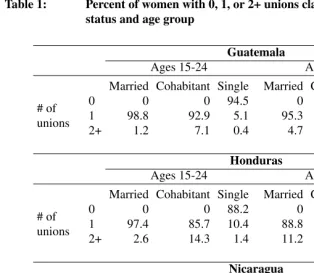
The impact of restricting the sample to those with single unions is evident in Table 1. For the women aged 15-24, the exclusion of women who have formed more than
4While not widely used, the retrospective calendar data has been used in other studies to create birth, union, and
one union has a negligible impact on the size of the married population. Cohabitations, however, appear to be less stable, and up to 18% of women age 15-24 who are currently cohabiting have had one or more prior unions. The structure of the data does not al-low for identification of the types of those prior unions but the survey does cover the prior union type for those currently single. Because the cohabitations are less stable, the 5% (Guatemala), 10.4% (Honduras), and 13.6% (Nicaragua) of the single population are dominantly composed of former cohabitants. Incorporating this additional information means the overall share of unclassifiable first union cohabitants drops from 7.1% to 5.9% for Guatemala, from 18.3% to 13.6% for Nicaragua, and from 14.3% to 11.6% for Hon-duras. Since the women with two or more unions form their first unions at younger ages5 our sample restriction will result in an upward bias in the timing of first unions, and that impact will be more acute for cohabitations in Nicaragua and Honduras.6
While the data have important limitations, they provide a suitably large sample to support analysis of the differential forces of marriage and cohabitation on the never-in-union population. We are aware that a complete understanding of the never-in-union dynamics process will require multistate models with sojourns through all possible union status/type states. The analysis will be far more complicated given the partially classified nature of the underlying data and we look forward to exploring these issues in future work.
5Tabular results for this are not shown, but on average the age at first union is a full year younger for women
with two or more unions compared to those with only one union.
6We could simply assume that current union type is always the same as former union type, or we could use a
Table 1: Percent of women with 0, 1, or 2+ unions classified by current union status and age group
Guatemala
Ages 15-24 Ages 25-49
Married Cohabitant Single Married Cohabitant Single # of
unions
0 0 0 94.5 0 0 45.9
1 98.8 92.9 5.1 95.3 74.6 42.9
2+ 1.2 7.1 0.4 4.7 25.4 11.2
Honduras
Ages 15-24 Ages 25-49
Married Cohabitant Single Married Cohabitant Single # of
unions
0 0 0 88.2 0 0 29.5
1 97.4 85.7 10.4 88.8 61.7 45.3
2+ 2.6 14.3 1.4 11.2 38.3 25.2
Nicaragua
Ages 15-24 Ages 25-49
Married Cohabitant Single Married Cohabitant Single # of
unions
0 0 0 83.3 0 0 21.1
1 96.3 81.7 13.6 84.5 52.7 43.8
2+ 3.7 18.3 3.1 15.5 47.3 35.0
Notes: Author’s calculations based on weighted counts from the 2008-09 Reproductive Health Survey (Guatemala), 2001 Demographic and Health Survey (Nicaragua), and the 2005-06 Demographic and Health Survey (Hon-duras).
3.2 Measures
that DHS data report marriage rates that are generally consistent with census records of marriage/cohabitation so it is expected that misreporting bias is relatively small (Castro Martín 2002). Additionally, because our analysis focuses only on countries in Central America with similar histories of colonization, similar social norms, and comparable lev-els of development, we do not anticipate notable differences in the terminology used to describe unions.
Recall from the introduction that we address two research questions: 1) Do age at first intercourse and pregnancy increase the risk of forming a cohabiting union and de-crease the risk of formally marrying? 2) Do the magnitude and timing of transitions to cohabitation and marriage differ systematically in terms of geographic, ethnic, and socio-economic strata? The variables included in the analysis support those questions.
The aim of the first research question is to address the impact of common Central American adolescent experiences – age at first intercourse and pregnancy – on first union. Similar to other life course studies, we anticipate that when women experience events outside of the normative sequencing (in terms of timing or ordering of events) they are more likely to deal with negative repercussions – in this case, a less stable union – which, in Central America, has been identified as cohabitation (Castro Martín 2002). Our pri-mary point of comparison is to the hypothesized Central American normative adolescent life course pathway identified in related research – first intercourse (age 18) then union formation (age 19) then pregnancy/childbearing (age 20) (Heaton, Forste, and Otterstrom 2002). We focus on the sequencing and timing of these events (relative to the age of the individual) and therefore incorporate these variables into the model as time-varying. Employing these measures as time-varying enables us to evaluate the sequence of fam-ily formation events in the lives of adolescents, specifically focusing on their impact on union formation. We return to consider the exact measurement of first intercourse and pregnancy after introducing the statistical methods.
The second research question aims to disaggregate adolescent union formation through the use of context-relevant strata. Therefore, in addition to constructing separate models for each country, we include type of place of residence (urban or rural) to capture vari-ations in behavior due to place. Urban versus rural differences in the normative ages of first intercourse and union formation are observed in cross-sectional tabulations (Stupp, Daniels, and Ruiz 2007). By including this variable we can determine if differences in union formation pathways exist between urban and rural Central American adolescents.
(Heaton, Forste, and Otterstrom 2002; Soler-Hampejsek 2008). Education may also serve to increase a woman’s bargaining power thus increasing her status in the relationship (Castro Martín 2002) and facilitating the formation of a marriage instead of a less stable cohabiting relationship. We therefore anticipate that higher educated adolescents will be more likely to form a formal marriage than a cohabiting union.
Education is encoded as a time-varying covariate. Based on knowledge of when chil-dren commence formal schooling in each country, the completed grade level and the age an individual reports in the survey, we reconstruct individual education histories assuming normal progression through grade levels.7 While the schooling history could be incorpo-rated into our models to capture the marginal effect of an additional year of education, we felt that it was more important to capture the broad education level achieved along with the timing of exit from formal schooling. Towards this end, education is categorized into three levels – no education, at least some primary education, or at least some sec-ondary education. We suspect that a person’s motivation for leaving school – and thus the consequent entry into the labor market and freedom to enter into unions – is equally as important in understanding the union formation process as the education level alone. Including education as a time-varying variable allows us to examine this dynamic process. Finally, ethnicity is included for Guatemala because of its important history of ethnic-based division and persecution. Nearly half the Guatemalan population wears traditional Mayan clothing, speaks Spanish as a second language (or not at all), and maintains other aspects of the Indigenous Mayan culture. Perhaps more than any other country in Latin America, Guatemala’s indigenous population is severely marginalized resulting in widespread deprivation of basic health and education services. Differences in the ed-ucational attainment, fertility levels, and contraceptive use of Guatemala’s indigenous versusLadino(the term used to describe the Spanish speaking, mixed-heritage portion of the population) adolescents have been documented and explored elsewhere (see, for ex-ample Grace (2010); Bertrand, Seiber, and Escudero (2001); Seiber and Bertrand (2002)). Given the vast differences in culture and lifestyle between the two groups, we anticipate different family formation norms and patterns of behavior. Specifically, because the in-digenous population retains conservative attitudes towards marriage as a pre-requisite for childbearing and because their contraceptive use rates are low, we anticipate that mar-riages are more likely among the indigenous population.
The set of socio-economic controls included in the models is notably minimal. While there are many other variables in the DHS/RHS that might be related to union forma-tion, they are only available as a cross-section at the end-of-period. Using end-of-period
7We are aware that all individuals are unlikely to progress normally through grades and that cultural norms and
measures in event history models introduces real complications to the interpretation of resulting estimates. This is especially the case when the variable could have taken other values during the period that the woman is at risk of forming a union.
3.3 Statistical analysis
To answer the research questions we pose above, we need to assess the differential ef-fects of covariates on the formation of cohabitations and marriages, and to summarize country-level differences in these processes. We employ statistical models designed for event history analysis of competing risks that are capable of incorporating fixed and time-varying covariates. After fitting the models we use the parameter estimates to summarize the effects of a particular life course path – implemented as a covariate history – in the form of transition probabilities. The transition probabilities are particularly useful at sum-marizing the overall effects of covariate patterns on the relative timing and magnitude of the transition to either marriage or cohabitation among young adults. Details of event history models and their translation to transition probabilities are described below.
The statistical framework we use is based on counting processes. In our case we ob-serve two different types of counts,N0h,i(t), whereh={1,2}indicates whether a
mar-riage or cohabitation has occurred for individuali. The leading0is included to indicate transitions are from the never-in-union population of women. In the overall population, the transition from single to ‘in union’ can only end in one of the two mutually exclusive events. In the three country samples, we start tracking women at age 10 and we follow them until they are either censored (that is, they remain single at the date of the DHS/RHS interview) or they transition to one of the two union events. When we analyze marriages (cohabitations), any women who form cohabiting (marital) unions are treated as censored. This is a standard approach in the competing risk framework.
Details of the statistical theory linking counting processes to hazard models is fully covered elsewhere (Aalen 1989; Aalen, Borgan, and Gjessing 2008; Martinussen and Scheike 2006), but we provide a summary of the approach here since the methods have not been widely adopted in demographic research. At a basic level, the counting process is assumed to have an underlying intensity,λ(t), that determines the probability of an event occurring during a small increment of time, [t, t+dt). The evolution of the counting process through time can then be decomposed into two parts,dN(t) =λ(t)dt+dM(t)
where the leadingdindicates an increment of change with the time interval small enough that only a single event can occur. Similar to other regression frameworks,N(t)is ob-servable, λ(t)is the predictable component of the process that will be captured using covariates, andM(t)is the error process. In this dynamic setting the error process is a martingale8 and serves as the basis for inferential tests and model diagnostics. The
gression framework is based on recognizing that at any moment in time, the intensity can be expressed as the population at risk,Y(t), times the hazard rate,α(t).
We focus on cause-specific hazards,α0h(t); the instantaneous rate of transition at age
tfrom single to married or single to cohabitant, conditional on having remained single until aget. Regression models are developed by letting a baseline hazard rate depend on covariates either multiplicatively (yielding a relative risk model) or additively (yielding Aalen’s additive model).9 The additive cause-specific hazard model with covariates is
α0h,i(t|xi1, . . . , xip) =β0h,0(t) +β0h,1(t)xi1+· · ·+β0h,p(t)xip. (1)
The estimated regression functions,βˆ0h,j(t), have a very natural interpretation: forj= 0
it is an estimate of the baseline hazard for the subpopulation defined by all covariates set at 0, and forj ∈ {1, . . . , p}the estimate is the additional rate of union formation of type
hat agetwhen covariatexjtakes the value 1 (all of our covariates are binary). Effects of
either fixed or time-varying covariates can change with time.
Dropping cause-specificity for notational simplicity, estimation of the covariate effects is based on the more stable cumulative regression functions, B(t) = Rt
0β(u)du. The estimator forB(t)is
ˆ
B(t) =
Z t
0
J(u)X−(u)dN(u) = X
Tj≤t
J(Tj)X−(Tj)∆N(Tj) (2)
whereXis an×(p+1)matrix withithrowY
i, Yi(t)xi1(t), . . . , Yi(t)xip(t), the function
J()is an indicator thatXis full rank, andX−= (X(t)TX(t))−1X(t)T.10Recalling that
din the counting process is chosen small enough to contain only one event, the trailing term∆N(Tj)is a vector with 1 for the individual having the event and otherwise 0. Note
(F), the expected value of the next observation is equal to the prior observation;E(M(t)|Fs) =M(s)for all t > s. The text by Aalen, Borgan, and Gjessing (2008) provides an intuitive discussion of the counting process formulation and underlying stochastic process theory. The connection to the error process is based on defining the mean zero martingaleM(t) =N(t)−Rt
0λ(s)ds. The term
Rt
0λ(s)dsis a predictable non-decreasing
counting process (or submartingale) and M(t) constitutes the random unpredictable jumps in the process. In the application to event history modeling the jumps in the error process have expectation zero.
9One of the most popular methods of event history regression modeling is the Cox proportional hazard model; a
type of relative risk model. Aalen, Borgan, and Gjessing (2008) provides a thorough discussion of the strengths and limitation of Cox models, and convincing arguments as to why additive models should be used more widely. In our case, our interest is not only in magnitude of effects but also timing. By allowing covariate effects to be time dependent we can assess when effects commence during adolescence and relate the timing of maximal or minimal effect to natural junctures in the life course. As is shown in the results section, this is particularly the case for the timing of exit from schooling.
that regression effects update as the population remaining at risk changes through time. For a given covariate, the reasons for those changes can be complex and may include aging of the effect (for example, if the effect is fixed at the start of the study – as is true of ethnicity in our data) or from selection. In the case of selection, the women with a particular covariate pattern who are more prone to transition to union will be selected out earliest, and the group remaining may be less likely to transition for some unmeasured characteristics. In the results section we display the cumulative regression functions.11
Now that the cause-specific hazard Aalen models have been introduced, it will be helpful to return briefly to consider how the covariates introduced in the previous section relate to the regression models. Our models include time-varying covariates – sexually ac-tive, pregnant, and education – and two time-fixed covariates, ethnicity (Guatemala only) and urban/rural. The time-varying covariates update and can change their value as we follow a woman through time. For example, sexually active is coded as 0 (not active) for all women at t=0 (age 10). As the respondents age, we follow them through time and the encoding changes to the value 1 (active) for women who become sexually active (the en-coding remains 1 for all periods thereafter). The DHS/RHS data clearly indicates whether a woman had her first sexual experience after forming a union, and for those women their coding remains 0 (not active) in the month until the union is formed. Thus, the estimated effect size at time t (Bˆ(t)) will reflect the additional rate of union formation for sexually active women at time t (equivalent age in months of 120+t) among women who are still at risk of union formation (e.g. they are still single). The same updating is true for pregnancy except that we encode two binary covariates through time: at time (month) t, pregnant(1) takes the value 0 if not pregnant and the value 1 if the woman is in her first month of pregnancy, pregnant(7) takes the value 0 if not pregnant and the value 1 if the woman is in her second through eighth month of pregnancy. The encoding of the data combined with the model formulation takes care of the complication at each month, t, that a woman’s covariate status may have changed and that the population at risk has changed. When we speak of a woman’s covariate path, it is exactly because the covariate value updates each month to reflect any changes in the time-varying covariates. For time-fixed variables (eth-nicity and rural), the estimated effectsizeis still time-dependent because even while the covariates are not changing at each point t, the size of the population at risk is changing.
While the additive hazard models yield interesting results and allow us to assess the significance, magnitude, and direction of different covariates, it is not directly apparent how the cumulative effects of a particular set of life choices will impact the transition to marriage or cohabitation. Transition probabilities are a natural way to summarize a pattern of life choices expressed as a covariate patternxo. Our primary interest is in the probabil-11Smoothed versions of the underlying regression functions using a kernel bandwidth of 2 are provided in the
ity of transitioning from single at age 10 to married at aget,P01(0, t|x0)or cohabiting at aget,P02(0, t|x0)conditional on the covariate path. The(0, t]probabilities also have the useful equivalent interpretation as the proportion of the never-in-union population that have formed a marital or cohabiting union at timet. To get to those probabilities we also need to estimate the probability of remaining single/never-in-union. Estimation of these probabilities requires several steps. First we develop estimates of the cumulative intensities,
ˆ
A0h(t|x0) = Z t
0
ˇ x(u)TdBˆ
0h for h={1,2}
and
ˆ
A00(t|x0) =−( ˆA01+ ˆA02).
The term ˇx indicates that the 1 in the first column of the design matrix is present in addition to the observed covariates inx. The probability of remaining single is then found using an analog of the Kaplan-Meier estimator,
ˆ
P00(0, t|x0) = Y
Tj≤t
(1−∆ ˆA00(Tj|X0)),
and then the transition probabilities of interest are calculated using
ˆ
P0h(0, t|x0) = X
Tj≤t
ˆ
P00(0, Tj|x0)∆ ˆA0h(Tj|x0).
Confidence bands for the transition probabilities require an estimate of the variance that is derived in Aalen, Borgan, and Gjessing (2008). The estimate of variance is
ˆ
varPˆ0h(0, t|x0) = X
Tj≤t
[ ˆP00(0, Tj|x0) ˆP0h(Tj, t|x0)]2∆ˆσ02.(Tj|x0)
+X
Tj≤t
ˆ
P00(0, Tj|x0)2[1−2 ˆP0h(Tj, t|x0)]∆ˆσ20h(Tj|x0).
The termˆσ2
0h(u|x0) =R
u
0 ˇx0,0h(v)
TX−
0h(v)diag(dN0h(v))X
− 0h
T
ˇ x0,0h(v).
hazards are linked using a common random effects term and the associated covariance structure of the errors. That approach imposes what we feel are fairly heavy assumptions – proportional hazards and time-fixed random effects. Estimation of those models also requires non-trivial identification constraints. While the models have proved useful using rich longitudinal data from Europe and the U.S., and for study populations where theories such as the second demographic transition already have strong support, both our data con-straints and focus on Central American cultures support our use of methods that impose few assumptions and yield more exploratory and descriptive results. That being noted, the endogeneity issue is not trivial and we did explore possible model specifications that account for it. A relatively recent extension of Aalen’s additive models has been towards dynamic path analysis (Fosen et al. 2006a,b; Aalen, Borgan, and Gjessing 2008). Simi-lar to LilSimi-lard’s (1993) approach, the dynamic path models can be used in disentangling the potentially endogenous relationship embedded in the cause-specific hazard models. In our analysis, the most obvious potential dynamic path would exist between sexual activity and pregnancy. We performed that analysis and while there was a small but measurable indirect effect, we do not present the analysis in the paper because it simply complicates the presentation and distracts from the overall message of our paper. We plan to pursue dynamic models and multistate models in future work.
4.
Results
4.1 Description of union formation
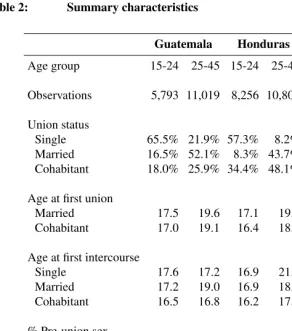
relatively stable across the region, there is a hint that the timing of first sexual activity may face different constraints and levels of social acceptance in the three countries. Overall, the patterns reflect the importance of timing in selecting particular types of unions in the life course and differences in how those play out in the three countries.
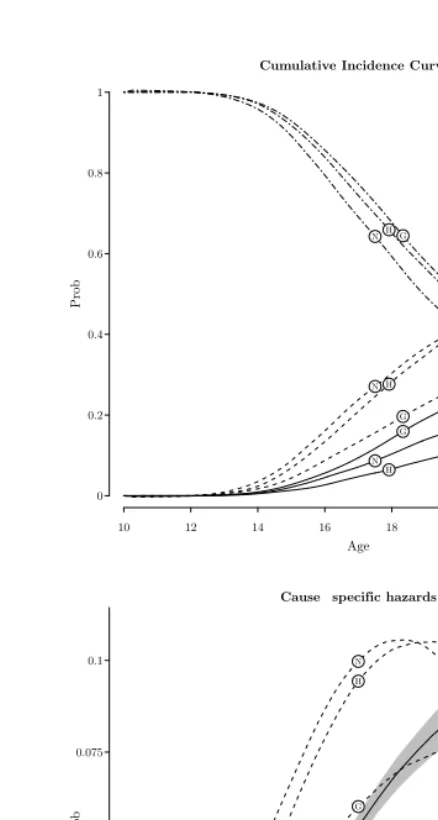
The information in Table 2 contains a static description of the population at the time of the survey. Our goal is to focus on processes as they unfold through time. As a basic de-scription of the union formationprocesswe provide estimates of the cumulative incidence probabilities and the cause-specific hazards for each country (see Figure 1). Cumulative incidence probabilities pertain to transitions from single to married (s → m), single to cohabitant (s → c), or remaining single (s → s). Figure 1 reveals that in Guatemala the transition probabilities for cohabitation or marriage are similar in pattern and mag-nitude, with the only real distinction being that entry into cohabitation commences at a younger age. In Honduras and Nicaragua, however, adolescents are far more likely to form a cohabiting union than a formal marriage; and while the probability of union for-mation increases with age, the fact remains that cohabitation is far more likely to occur than formal marriage. The same pattern is evident in the second plot of cause-specific hazards where, again, it reflects the leftward shift in timing of cohabitation in Guatemala but with otherwise very similar shapes. Significant differences among the probabilities relevant to both Honduran and Nicaraguan adolescents, however, remain.
In addition to differences in the probabilities of forming a union, the overall rate of union formation (of either type) is highest in Nicaragua where we observe the earliest pattern of entry into cohabitation. Guatemala and Honduras have broadly similar patterns for overall transitions into unions but the timing of the two types of union formation are completely different for the two countries.
Table 2: Summary characteristics
Guatemala Honduras Nicaragua
Age group 15-24 25-45 15-24 25-45 15-24 25-45 Observations 5,793 11,019 8,256 10,802 5,386 6,655 Union status
Single 65.5% 21.9% 57.3% 8.2% 54.1% 6.7% Married 16.5% 52.1% 8.3% 43.7% 12.7% 49.1% Cohabitant 18.0% 25.9% 34.4% 48.1% 33.2% 44.1% Age at first union
Married 17.5 19.6 17.1 19.1 16.7 18.4
Cohabitant 17.0 19.1 16.4 18.5 16.0 18.0 Age at first intercourse
Single 17.6 17.2 16.9 21.0 16.5 19.8
Married 17.2 19.0 16.9 18.6 16.6 18.1
Cohabitant 16.5 16.8 16.2 17.7 15.8 17.4 % Pre-union sex
Married 18.7% 12.2% 17.7% 23.8% 17.2% 20.6% Cohabitant 22.4% 32.1% 22.3% 30.5% 19.7% 25.4% Dissolution rate
Married 4.3 14.4 10.3
Cohabitant 13.6 18.3 26.9
Figure 1: Cumulative incidence probabilities and cause-specific hazards
G
G G H
H H N
N N
10 12 14 16 18 20 22 24
0 0.2 0.4 0.6 0.8 1
Cumulative Incidence Curves
Age
Prob
G G
H H
N N
10 12 14 16 18 20 22 24
0 0.025 0.05 0.075 0.1
Cause−specific hazards
Age
Prob
4.2 Regression analysis
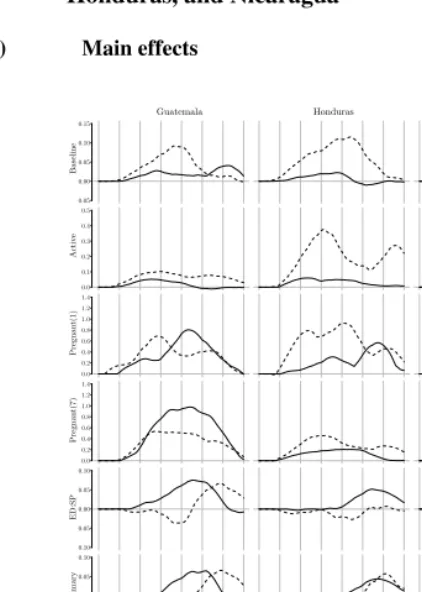
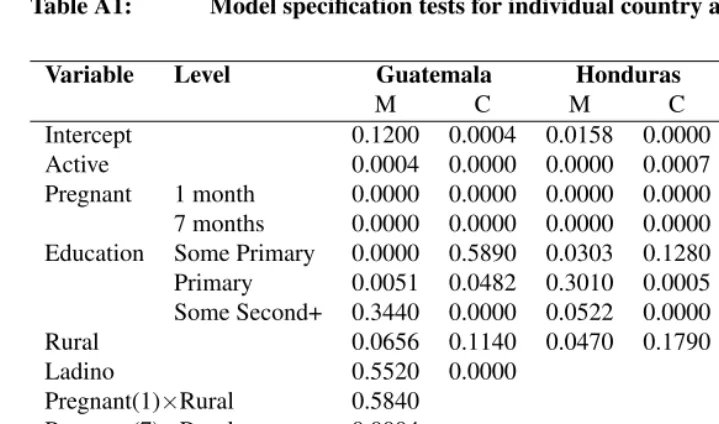
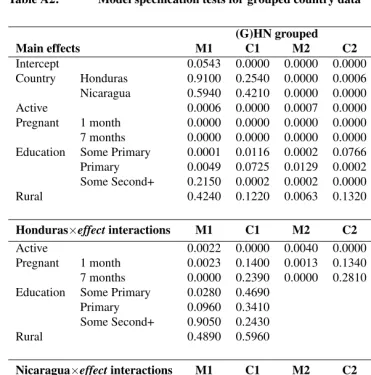
Additive regression models of the form (1) were defined, and estimated using (2) (Scheike and Zhang 2011). Standard tests based on martingale residuals were used to evaluate al-ternative model specifications and led to the inclusion of interaction effects for Guatemala and Honduras. A complete discussion of model specification testing is provided in Ap-pendix II. Estimates from the final model specification for each country are presented graphically in Figure 2 with main effects in panel (a) and interaction effects in panel (b). Ethnicity is only reported for Guatemala and is therefore unique to that model. All the covariates are binary (0/1) variables and therefore effect sizes can be compared across variables and between countries. Also note that the vertical axes used to interpret effect sizes in the figure are not the same for all variables but they are held constant across countries.
The models allow us to condition the marriage-specific hazards and cohabition-specific hazards, at each point in time, on the covariates discussed in Section 3.2. This allows us to test whether observed differences at the country level can be systematically decomposed into differences in timing and magnitude with respect to other life course events – initi-ation of sexual activity, pregnancy, and educiniti-ation. From a socio-cultural process level, we can identify whether there are broad patterns of similarity resulting from other life course events (e.g. pregnancy, stopping school) and on which aspects they depart. The models also provide the primary means of directly answering the questions posed in the introduction.
First Intercourse: The graphical presentation of regression effects in Figure 2 is more
challenging to read than a typical table of regression slope estimates and significance tests. Consider the second row of Figure 2a, the main effect for timing of first intercourse. The solid lines indicate the cumulative effect on the hazard of marriage at agex, comparing women who are sexually active rather to those not active. The dashed lines have the same interpretation except that they pertain to the cumulative effect on the hazard of cohabita-tion. In each case the effect is positive but has a much larger effect on cohabitation than marriage and has the largest effect size in Nicaragua. The effect size is comparable for Honduras but negligible for Guatemala. The grey shading indicates the 90% confidence enveloped and allows for a visual assessment of significance of the effect (6= 0) at each age. Since figures are for the cumulative regression functions,Bˆ(t)from (2), the addi-tional rate of union formation,βˆ0h,j(t)from (1), at a particular age is the slope of the
cumulative function at that age.12
Figure 2: Aalen additive hazard model specifications: Guatemala, Honduras, and Nicaragua
(a) Main effects
−0.10 0.15 0.40 0.65 0.90 −0.1 0.4 0.9 1.4 1.9 2.4 2.9 −0.1 0.9 1.9 2.9 3.9 4.9 5.9 6.9 7.9 −0.1 0.9 1.9 2.9 3.9 4.9 5.9 6.9 7.9 −0.50 −0.25 0.00 0.25 0.50 −0.50 −0.25 0.00 0.25 0.50 −0.50 −0.25 0.00 0.25 0.50 −0.50 −0.25 0.00 0.25 0.50
10 12 14 16 18 20 22 24 10 12 14 16 18 20 22 24
−0.10 0.15 0.40 0.65 0.90 −0.1 0.4 0.9 1.4 1.9 2.4 2.9 −0.1 0.9 1.9 2.9 3.9 4.9 5.9 6.9 7.9 −0.1 0.9 1.9 2.9 3.9 4.9 5.9 6.9 7.9 −0.50 −0.25 0.00 0.25 0.50 −0.50 −0.25 0.00 0.25 0.50 −0.50 −0.25 0.00 0.25 0.50 −0.50 −0.25 0.00 0.25 0.50
10 12 14 16 18 20 22 24
Guatemala Honduras Nicaragua
Baseline Activ e Pregnan t(1) Pregnan t(7) ED:SP ED:Primary ED:SS+ Rural
Age Age Age
Figure 2: Aalen additive hazard model specifications: Guatemala, Honduras, and Nicaragua
(b) Interaction effects
−0.50 −0.25 0.00 0.25 0.50 −0.50 −0.25 0.00 0.25 0.50 0.75 1.00 1.25 1.50 −3.5 −3.0 −2.5 −2.0 −1.5 −1.0 −0.5 0.0 0.5 1.0 1.5 2.0 −3.5 −3.0 −2.5 −2.0 −1.5 −1.0 −0.5 0.0 0.5 1.0 1.5 2.0 −1.5 −1.0 −0.5 0.0 0.5 1.0 1.5 2.0 −1.5 −1.0 −0.5 0.0 0.5 1.0 1.5 2.0 −1.5 −1.0 −0.5 0.0 0.5 1.0 1.5 2.0
Guatemala Honduras Nicaragua
A few other aspects of the results are worth noting. The effect pattern for Honduras and Nicaragua is similar with the additional complication of an interaction between ur-ban/rural and age at first sex in the model for Honduras. In rural Honduras the hazard of marriage increases after first intercourse. In Nicaragua first intercourse increases the hazard of marriage, but that effect is less than half of the increase for cohabitation. The dominance of the selection towards cohabitation over marriage of sexually active ado-lescents peaks at age 16, beyond which point the transitions to cohabitation still exceed those to marriage, but the patterns start to converge. This change in union formation type is consistent with the idea that early (outside of the norm) first intercourse may lead toward cohabitation. After the adolescents who experience early first intercourse are selected out of the sample (relatively early), the hazard starts to drop.
Pregnancy: The largest single effect across the three countries is pre-union
preg-nancy.13 Country-specific effects of pregnancy however, are very different. In Guatemala the first month of pregnancy has equal magnitude of impact on transition to both marriage and cohabitation. However, after the second month of pregnancy there is a very large increase in the hazard towards marriage. This result suggests that in Guatemala out-of-marriage late pregnancy, or eventual birth, may not be as acceptable as those events within marriage. In Honduras and Nicaragua there is a much stronger increase in the hazard of transition to cohabitation than to marriage, even after controlling for the general tendency towards cohabiting. This relationship indicates that pregnancy motivates the formation of a union but not the more stable marital union.
Education: The effects of level of education and the timing of exit from formal
ed-ucation are smaller, by almost an order of magnitude, than the influence of age at first intercourse and pregnancy. Yet, they are still significantly different from zero. In all three countries, only having some primary school increases the hazard of transition to marriage while the effect on transition to cohabitation is negligible (for Honduras) or insignificant (for Guatemala). The impact of completing primary school decreases the hazard of tran-sition to cohabitation prior to age 16 or 18, and in Guatemala completing primary school additionally increases the hazard of marriage after age 16. The protective effects of re-maining in primary school, and a consequential decrease in hazard of cohabitation are also noticeable but smaller in Nicaragua and Honduras. Completing education through some secondary school accentuates the effects that are present from completing primary school. The decreased risk of cohabitation is larger and reaches a nadir between age 16 (Nicaragua) and 18 (Guatemala and Honduras). There is also a small but significant
de-13We separate the influence of pregnancy just prior to union (1 month prior) because we suspect this may
crease in the risk of marriage over the same period. Note also in the regression functions, that after age 16 (18) completion of secondary education has a small positive effect on the hazard of marriage. To a large degree these results support the interpretation that furthering education facilitates access to marriage relative to cohabitation.
The remaining effects are very small in magnitude. There are measurable differences in Guatemala forLadinoversus indigenous, whereLadinostend more towards cohabita-tion than the indigenous. Addicohabita-tionally, the effect of rural locacohabita-tion is barely measurable except when interacted with other variables (intercourse or pregnancy). In Guatemala, the increase in hazard toward marriage in rural areas is smaller than the increase in hazard in urban areas. In Honduras the increase in hazard to cohabitation from first intercourse shifts towards younger ages in rural areas.
4.3 Transition probabilities
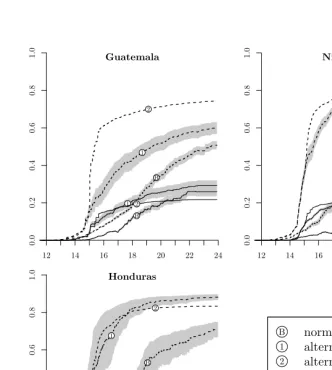
To interpret the model results at a scale relevant to the individual we construct transition probabilities, see Figure 3. These estimated probabilities allow us to construct poten-tial pathways and compare the resulting risks of cohabiting versus the risks of marriage. Transformation of covariate paths into transition probabilities is also pursued because transition probabilities (cumulative incidence curves) measure the probability of being married (cohabiting) at timet conditional on the cohabitation (marriage) process up to timetand covariates up to timet. The resulting predicted cumulative incidences of each type of union formation accounts for the other.
Figure 3: Predicted transition probabilities
12 14 16 18 20 22 24
0.0
0.2
0.4
0.6
0.8
1.0
B B
1 1
2 2
Guatemala
12 14 16 18 20 22 24
0.0
0.2
0.4
0.6
0.8
1.0
B B
1 1
2 2
Nicaragua
12 14 16 18 20 22 24
0.0
0.2
0.4
0.6
0.8
1.0
B B
1 1
2 2
Honduras
B 1 2
normal pathway alternative pathway 1 alternative pathway 2
marriage cohabitation
If we further alter the pathway by adding a pre-union pregnancy (or birth) at age 15 and focusing on a rural setting (“alternative pathway 2”) we see distinct increases, primar-ily in Guatemala, in the transitions to cohabitation and marriage, whereas the impacts in Honduras and Nicaragua are much smaller in magnitude. We observe a statistically sig-nificant difference in prediction pathway, comparing alternative pathways 1 and 2, only for cohabitation in Guatemala. These results suggest that early, in terms of normative behavior, pregnancy leads to cohabitation. In analyses not shown here, age at pregnancy was increased to 17 while keeping fixed the other factors of pathway 2. In this case, the likelihood of marriage significantly increased and the likelihood of cohabitation was not statistically different than in pathway 1. This impact of pregnancy was only seen in the case of Guatemala and likely reflects cultural norms that restrict childbearing to marriage in Guatemala but only in some cases. If the pregnancy happens “early" then the adoles-cent more often forms a cohabiting union. In Honduras and Nicaragua cultural norms seem to either act to suppress early pregnancy or there is less social pressure to form a marriage in those countries. It is also noteworthy that in all three countries, the uncertainty in the shifts observed for “alternative pathway 2” suggest that these types of transitions are indeed rare or that the response to these outcomes is highly variable.
As a final note, recall that the process modeled here is the transition from never-married / never-cohabiting to either never-married or cohabitant. Transition probabilities have the equivalent interpretation of being the share of individuals occupying a given state at a particular time. In the predictions shown, this is true relative to the never-in-union population, but the results will overstate the share of the population married on cohabiting as we are not accounting here for decrements due to union dissolutions. This is not a weakness of our models, as we set out from the onset to focus only on the first union process for adolescent and early adulthood. The models and predicted pathways above are true to that population and sub-process.
5.
Discussion
marriage, our results underscore the importance of differentiating union type in studies of family formation and reproductive health.
Sexual activity and childbearing appear to be strongly associated with union, accord-ing to the behaviors of the young adults in our sample. However, our results do reveal variation in union formation pathways within Central America. In Guatemala both co-habiting and marital unions are likely to be formed upon an adolescent girl becoming sexually active with a greater tendency towards forming cohabiting unions. Early age at first intercourse does not appear to have a negative impact on the formation of a marital union, however. Age at first sex at a relatively early age increases the probability of a girl marrying rather than if she had delayed the onset of sexual behavior. Therefore, after an adolescent Guatemalan girl has entered into a sexual relationship she is much more likely to form a marriage regardless of her age. Marriage is even more likely in the event of a pregnancy if the girl is at least 17 years old, whereas cohabitation is more likely if the girl is around 15 years old (several years younger than normal). These results do not suggest that acting outside of the norm, in terms of age at first intercourse, results in cohabitation, theorized as the less ideal type of union. However, if a pregnancy occurs at an age earlier than some cultural norm, cohabitation is more likely - perhaps indicating that pregnancies belong in marriageunlessthey are too young. More study of the factors leading to early pregnancy and of the family culture and attitude regarding early pregnancy need to be conducted to explore this finding.
Despite the historical presence of cohabiting unions in Guatemala, our results reveal a strong coupling of sexual activity and marriage rather than cohabitation. This cou-pling suggests that contemporary adolescent Guatemalans entering into unions are favor-ing marriage over cohabitation in ways that are different from neighborfavor-ing countries in Central America. Explanations for this may be related to the recent changes (1998) to Guatemala’s marriage laws. Laws now protect women’s rights in formal marriages, per-haps making marriages more safe for women than they have ever been in the past (Center for Reproductive Rights 2006). The shift in the law may reflect greater support of mar-riage among the population or even that formal marmar-riage reflects a more modern lifestyle; future research should examine social attitudes towards marriage in Guatemala to deter-mine if this is indeed the case. Similar changes in laws or statutes have not been observed in Honduras and Nicaragua, however. The political differences (which may reflect social support of marriage) may explain the differences observed when comparing Guatemala to Honduras and Nicaragua. In Honduras and Nicaragua early onset of sexual activity leads to a dramatic increase in the likelihood of cohabiting with little impact on the like-lihood of marrying. Here, pregnancy has little impact on the type of union formed or the likelihood of union formation.
cohabi-tation in each of the three countries. This negative cohabicohabi-tation/education gradient has been observed in other settings in Latin America (see Esteve, Lesthaeghe, and Lopez-Gay (2012)) and is therefore unsurprising here. The relationship between education and type of union formed also suggests that the cohabiting relationships seen in these countries do not representmodernrelationships characteristic of Second Demographic Transition theories (Quilodrán 1999), but instead reflecttraditionalCentral American relationships where cohabitations are more common among the less advantaged portion of the popula-tion. These results may support the hypotheses that cohabitation is an institution of “last resort” (Landale and Oropesa 2007; García and Rojas 2001).
The descriptive results highlighting the impermanence of cohabiting unions (Tables 1 and 2) provide further support of our assertion that cohabitations represent less optimal relationships rather than women’s increased ability to self-actualize. Therefore, as in the past, marriage may be more likely when girls are more highly educated because they are either from wealthier families who can afford to educate their daughters and can therefore afford a formal marriage ceremony (and the accompanying costly festivities) or alterna-tively it may be that contemporary young adults in Central America are opting to stay in school and are rejecting unions entirely until later ages. The pathways that we constructed indicate that by remaining in school longer girls delay union formation, sexual relation-ships and potential pregnancy which are so tightly coupled in Central America. Because education serves as a measure of socio-economic status, girls from wealthier families are more likely to refrain from sexual activity and are more like to form formal marriages in later years. However, based on the significance of age at first intercourse in terms of motivating union formation we hypothesize that the significance of the negative impact on education may be particularly important in terms of delaying sexual activity. In any case, our results suggest that when adolescents stay in school longer, they are more likely to form marital unions, regardless of other related factors. Because educational attainment is strongly related to parent’s educational attainment, information not available in this data, further research on parental attitudes towards sexual activity, union-type and education would provide important insight into these patterns.
6.
Conclusion
While our results are not intended to be interpreted as causal, they highlight the likely importance of sexual activity as a precursor to union formation. It is possible that sexual activity may only be initiated when the formation of a union seems inevitable or there may be pressure on the couple to form some type of union upon the initiation of sexual relationship. While the data and methods we use preserve the timing of first intercourse relative to the start of a union, and carefully exclude first intercourse within union, we remain cautious in our interpretation of the model results on first intercourse. Indeed, our data do not allow for the disentangling of unionintentionsfrom the initiation of sexual behavior and therefore we are unable to determine if sexual activity motivates union for-mation or if the prospect of union forfor-mation allows for the initiation of sexual activity. Future research examining the motivations and expectations of leaving school at an early age or engaging in sexual activity as an adolescent, particularly qualitative research, will surely provide important insights into why so many Central Americans form unions well before they reach their twenties.
The results and interpretations we provide in this paper are necessarily limited by the structure of the RHS/DHS data. Certainly, the retrospective questions we rely on here do not provide as robust a basis for the process under study as we would have using longitudinal data. But longitudinal data is notoriously expensive to collect and as a result the major data sets used to support research on the rapid emergence of cohabitation as an alternative to marriage have been restricted in focus to Europe and the US. The results we report here suggest that the union formation process up to early adulthood is very different from what has been observed in the US and Europe. We certainly support longitudinal data collection for the region but realize that this may be unrealistic. However, minor changes to the DHS and RHS surveys could go far towards supporting a more complete analysis.
7.
Acknowledgements
References
Aalen, O.O. (1989). A linear regression model for the analysis of life times. Statistics in
Medicine8(8): 907–925.doi:10.1002/sim.4780080803.
Aalen, O.O., Borgan, Ø., and Gjessing, H.K. (2008).Survival and Event History Analysis:
A Process Point of View. New York: Springer Verlag.doi:10.1007/978-0-387-68560-1.
Adams, B. (2004). Families and family study in international perspective. Journal of
Marriage and Family66(5): 1076–1088.doi:10.1111/j.0022-2445.2004.00079.x.
Ali, M.M., Cleland, J., and Shah, I.H. (2003). Trends in reproductive behavior among young single women in Colombia and Peru: 1985-1999.Demography40(4): 659–673.
doi:10.1353/dem.2003.0031.
Amato, P., Landale, N., Havasevich-Brooks, T., Booth, A., Eggebeen, D., Schoen, R., and McHale, S. (2008). Precursors of young women’s family formation pathways.Journal
of Marriage and Family70(5): 1271–1286. doi:10.1111/j.1741-3737.2008.00565.x.
Baizán, P., Aassve, A., and Billari, F.C. (2003). Cohabitation, marriage, and first birth: The interrelationship of family formation events in Spain.
Euro-pean Journal of Population/Revue européenne de Démographie 19(2): 147–169.
doi:10.1023/a:1023343001627.
Bertrand, J., Seiber, E., and Escudero, G. (2001). Contraceptive dynamics in Guatemala: 1978-1998. International Family Planning Perspectives 27(3): 112–118, 136.
doi:10.2307/2673832.
Camisa, Z.C. (1978). La nupcialidad de las mujeres solteras en la América Latina. Notas
Poblacion6(18): 9–75.
Castro Martín, T. (2002). Consensual unions in Latin America: Persistance of a dual nuptiality system. Journal of Comparative Family Studies33(1): 35–55.
Castro Martín, T. and Juárez, F. (1995). The impact of women’s education on fertility in Latin America: Searching for explanations. International Family Planning
Perspec-tives21(2): 52–80. doi:10.2307/2133523.
Center for Reproductive Rights (2006). Gaining Ground: A Tool for Advancing
Repro-ductive Rights Law Reform. New York: Center for Reproductive Rights.
Centers for Disease Control and Prevention (1999). Achievements in public health, 1900-1999: Family planning. 1073–1080. (MMWR No. 48).
Santé de la Reproduction au Nord et au Sud: de la Connaissance à l’Action. Presses universitaires de Louvain: 43–60.
Cook, A.R. and Teo, S.W. (2011). The communicability of graphical alternatives to tabular displays of statistical simulation studies. PloS one 6(11): e27974.
doi:10.1371/journal.pone.0027974.
Curtis, S.L. (1997). Using Calendar Data to Study contraceptive use dynamics. Pa-per presented at the IUSSP/EVALUATION project seminar on methods for evaluating family planning program impact, Costa Rica, 1997.
De Vos, S. (2000). Nuptiality in latin america: The view of a sociologist and family demographer. University of Wisconsin-Madison: University of Wisconsin-Madison. Desai, S. (1992). Children at risk: The role of family structure in Latin America and West
Africa.Population and Development Review18(4): 689–717.doi:10.2307/1973760. Elder, G.H. (1998). The life course as developmental theory. Child Development69(1):
1–12.doi:10.2307/1132065.
Esteve, A., Lesthaeghe, R., and Lopez-Gay, A. (2012). The Latin American co-habitation boom, 1970-2007. Population and Development Review 38(1): 55–81.
doi:10.1111/j.1728-4457.2012.00472.x.
Esteve, A., López-Ruiz, L.Á., and Spijker, J. (2013). Disentangling how educational expansion did not increase women’s age at union formation in latin america from 1970 to 2000.Demographic Research28(3): 63–76. doi:10.4054/DemRes.2013.28.3. Feinberg, R.A. and Wainer, H. (2011). Extracting sunbeams from cucumbers.Journal of
Computational and Graphical Statistics20(4).doi:10.1198/jcgs.2011.204a.
Fosen, J., Borgan, Ø., Weedon-Fekjær, H., and Aalen, O.O. (2006a). Dynamic analysis of recurrent event data using the additive hazard model. Biometrical Journal48(3): 381–398.doi:10.1002/bimj.200510217.
Fosen, J., Ferkingstad, E., Borgan, Ø., and Aalen, O.O. (2006b). Dynamic path analysis -a new -appro-ach to -an-alyzing time-dependent cov-ari-ates. Lifetime data analysis12(2): 143–167.doi:10.1007/s10985-006-9004-2.
Fussell, E. and Palloni, A. (2004). Persistent marriage regimes in changing times.Journal
of Marriage and Family66(5): 1201–1213.doi:10.1111/j.0022-2445.2004.00087.x.
García, B. and Rojas, O. (2002). Los hogares latinoamericanos durante la segunda mitad del siglo XX: Una perspectiva sociodemográfica. Estudios Demográficos y Urbanos
17(2): 261–288. doi:10.2307/40315116.
Gelman, A. (2011a). Rejoinder.Journal of Computational and Graphical Statistics20(1): 36–40.doi:10.1198/jcgs.2011.09166rej.
Gelman, A. (2011b). Why tables are really much better than graphs (with discussion). Journal of Computational and Graphical Statistics 20(1): 3–7.
doi:10.1198/jcgs.2011.09166.
Gelman, A., Pasarica, C., and Dodhia, R. (2002). Let’s practice what we preach: turning tables into graphs. The American Statistician 56(2): 121–130.
doi:10.1198/000313002317572790.
Gibson-Davis, C.M., Edin, K., and McLanahan, S. (2005). High hopes but even higher expectations: The retreat from marriage among low-income couples. Journal of
Mar-riage and Family67(5): 1301–1312. doi:10.1111/j.1741-3737.2005.00218.x.
Goldman, N. (1981). Dissolution of first unions in colombia, panama, and peru.
Demog-raphy18(4): 659–679. doi:10.2307/2060954.
Grace, K. (2010). Contraceptive use and intent in Guatemala. Demographic Research
23(12): 335–364.doi:10.4054/DemRes.2010.23.12.
Heaton, T.B., Forste, R., and Otterstrom, S.M. (2002). Family transitions in Latin Amer-ica: First intercourse, first union and first birth. International Journal of Population
Geography8(1): 1–15.doi:10.1002/ijpg.234.
Kastellec, J.P. and Leoni, E.L. (2007). Using graphs instead of tables in political science.
Perspectives on Politics5(04): 755–771.doi:10.1017/S1537592707072209.
Landale, N.S. and Oropesa, R.S. (2007). Hispanic families: Stability and change.Annual
Review Sociology33: 381–405.doi:10.1146/annurev.soc.33.040406.131655.
Leone, T. and Hinde, A. (2007). Fertility and union dissolution in Brazil: An example of multi-process modelling using the Demographic and Health Survey calendar data.
Demographic Research17(7): 157–180. doi:10.4054/DemRes.2007.17.7.
Lesthaeghe, R. (1995). The second demographic transition in western countries: An interpretation. In: Mason, K. and Jensen, A.M. (eds.).Gender and family change in
industrialized countries. Clarendon Press Oxford: 17–62.
Slaterus: 9–24.
Liefbroer, A.C. (1991). The choice between a married or unmarried first union by young adults.European Journal of Population/Revue Européenne de Démographie7(3): 273– 298.doi:10.2307/20164585.
Liefbroer, A.C. and Dourleijn, E. (2006). Unmarried cohabitation and union stability: Testing the role of diffusion using data from 16 european countries. Demography
43(2): 203–221.doi:10.2307/4137194.
Lillard, L.A. (1993). Simultaneous equations for hazards: Marriage duration and fertility timing.Journal of Econometrics56(1-2): 189–217. doi:10.1016/0304-4076(93)90106-F.
Manning, W. (2001). Childbearing in cohabiting unions: Racial and ethnic differences.
Family Planning Perspectives33(5): 217–223. doi:10.2307/2673785.
Martin, J.A., Hamilton, B.E., Ventura, S.J., Menack, F., and Park, M.N. (2002). Births: Final data for 2000.National Vital Statisics Reports50(5): 1–101.
Martinussen, T. and Scheike, T.H. (2006).Dynamic Regression Models for Survival Data. New York: Springer Verlag.
McKeague, I.W. and Sasieni, P.D. (1994). A partly parametric additive risk model.
Biometrika81(3): 501–514.doi:10.1093/biomet/81.3.501.
Musick, K. (2002). Planned and unplanned childbearing among unmarried women.
Jour-nal of Marriage and Family64(4): 915–929.doi:10.1111/j.1741-3737.2002.00915.x.
Perelli-Harris, B. and Gerber, T.P. (2011). Nonmarital childbearing in Russia: Second demographic transition or pattern of disadvantage? Demography 48(1): 317–342.
doi:10.1007/s13524-010-0001-4.
Perelli-Harris, B., Sigle-Rushton, W., Kreyenfeld, M., Lappegård, T., Keizer, R., and Berghammer, C. (2010). The educational gradient of childbearing within cohabitation in Europe.Population and Development Review36(4): 775–801. doi:10.1111/j.1728-4457.2010.00357.x.
Pocock, S.J., Travison, T.G., and Wruck, L.M. (2008). Research methodology: How to interpret figures in reports of clinical trials. British Medical Journal336(7654): 1166.
doi:10.1136/bmj.39561.548924.94.
PRB (2007). World population data sheet 2007. Population Reference Bureau.
Quilodrán, J. (1999). Quand l’union libre n’est pas un phénomène nouveau [When conju-gal unions are not a new phenomenon]. Cahiers Québécois de Démographie28(1-2): 53–80.doi:10.7202/010259ar.
Raley, R.K. (2001). Increasing fertility in cohabiting unions: Evidence for the sec-ond demographic transition in the united states? Demography 38(1): 59–66.
doi:10.1353/dem.2001.0008.
Samandari, G. and Speizer, I.S. (2010). Adolescent sexual behavior and reproductive outcomes in Central America: Trends over the past two decades. International
Per-spectives on Sexual and Reproductive Health36(1): 26–35. doi:10.1363/3602610.
Sánchez-Albornoz, N. (1974).The population of Latin America: A history. University of California Press.
Scheike, T.H. (2002). The additive nonparametric and semiparametric aalen model as the rate function for a counting process. Lifetime Data Analysis 8(3): 247–262.
doi:10.1023/A:1015849821021.
Scheike, T.H. and Zhang, M.J. (2011). Analyzing competing risk data using the R timereg package.Journal of Statistical Software38(2): 1–15.
Seiber, E. and Bertrand, J. (2002). Access as a factor in differential contraceptive use between Mayans and ladinos in Guatemala. Health Policy and Planning17(2): 167– 177. doi:10.1093/heapol/17.2.167.
Soler-Hampejsek, E. (2008). Schooling, gender, and marriage in guatemala. University of Pennsylvania. (Dissertations available from ProQuest. Paper AAI3328653.). Stupp, P., Daniels, D., and Ruiz, A. (2007). Reproductive, Maternal and Child Health in
Central America. Atlanta, GA: Centers for Disease Control and Prevention.
Zollinger, G. and Elder, G.H. (1998). Methods of Life Course Research: Qualitative and
Appendix
A
Regression functions
Figure 4: Aalen additive hazard model specifications: Guatemala, Honduras, and Nicaragua
(a) Main effects
−0.05 0.00 0.05 0.10 0.15 0.0 0.1 0.2 0.3 0.4 0.5 0.0 0.2 0.4 0.6 0.8 1.0 1.2 1.4 0.0 0.2 0.4 0.6 0.8 1.0 1.2 1.4 −0.10 −0.05 0.00 0.05 0.10 −0.10 −0.05 0.00 0.05 0.10 −0.10 −0.05 0.00 0.05 0.10 −0.05 −0.02 0.00 0.03 0.05
10 12 14 16 18 20 22 2410 12 14 16 18 20 22 24
−0.05 0.00 0.05 0.10 0.15 0.0 0.1 0.2 0.3 0.4 0.5 0.0 0.2 0.4 0.6 0.8 1.0 1.2 1.4 0.0 0.2 0.4 0.6 0.8 1.0 1.2 1.4 −0.10 −0.05 0.00 0.05 0.10 −0.10 −0.05 0.00 0.05 0.10 −0.10 −0.05 0.00 0.05 0.10 −0.05 −0.02 0.00 0.03 0.05
10 12 14 16 18 20 22 24 Guatemala Honduras Nicaragua
Baseline Activ e Pregnan t(1) Pregnan t(7) ED:SP ED:Primary ED:SS+ Rural
Age Age Age
Figure 4: Aalen additive hazard model specifications: Guatemala, Honduras, and Nicaragua
(b) Interaction effects
−0.04 −0.02 0.00 0.02 0.04 −0.05 0.00 0.05 0.10 0.15 0.20 0.25 0.30 −0.8 −0.6 −0.4 −0.2 0.0 0.2 0.4 0.6 0.8 1.0 −0.8 −0.6 −0.4 −0.2 0.0 0.2 0.4 0.6 0.8 1.0 −0.4 −0.2 0.0 0.2 0.4 −0.4 −0.2 0.0 0.2 0.4 −0.4 −0.2 0.0 0.2 0.4
10 12 14 16 18 20 22 24 10 12 14 16 18 20 22 24
Guatemala Honduras Nicaragua
Ladino Activ e x Rural Pregnan t(1) x Rural Pregnan t(7) x Rural Activ e x ED:SP Activ e x ED:Primary Activ e x ED:SS+