Reza Khany2
Received: 05/03/2016 Accepted: 05/11/2016
Abstract
One of the main concerns of scholars working in the field of EAP over the last 2 decades has been raising the awareness of EAP students and publishers of genre conventions in academic journals. In line with the above concern, many studies have aimed at exploring the general characteristics of research articles (RAs) in the field. Among these features, it seems that the generic moves and textuality have drawn the attention of researchers. Therefore, the purpose of this study was twofold: (1) to compare and contrast the Iranian local ESP journals with their international counterparts in terms of the given features by drawing upon existing research, and (2) to develop a more inclusive model for the analysis of moves and lexical cohesion patterns (LCPs) in the Discussion sections of ESP RAs. Results showed that the Discussion sections in the international ESP RAs tended to have a more cyclical evaluative move mechanism compared with their Iranian local counterparts. Findings also revealed that the organizational patterning and use of the LCPs in consolidating the Results sections of the RAs have a dual intrinsic relationship. Translation of such findings provides a better chance for nonnative EAP writers to publish in international journals.
Keywords: Move Analysis; Organizational Patterning; Lexical Cohesion Patterns (LCPs); EAP Articles
1. Introduction
A host of research has been done on the organizational patterning of academic RAs in the past few decades (e.g., Hirano, 2009; Hopkins & Dudley-Evans, 1988; 2004; Kanoksilapatham, 2005, 2007; Nwogu, 1991, 1997; Swales, 1990, Tahririan & Jalilifar, 2004). These studies “discuss the global features, that is, the rhetorical components or ‘moves’ of different sections of RAs, along with some of their associated rhetorical and linguistic features” (Bonn & Swales, 2007, p. 94) such as modality, first person pronoun, hedging, and so on. Flowerdew and Wan
1Please cite this paper as follows:
Khany, R. (2017). Textuality in EAP research articles: A genre analysis. Journal of Research in Applied Linguistics, 8(1), 165-189.
(2009) suggest that the underpinning motivation for genre analysis for the researchers was the goal of developing pedagogic materials for nonnative speakers (NNSs) of English. Yang and Allison (2003) justify the increase of attention to the analysis of organizational patterning by echoing its importance for the pedagogic purposes in many contexts. Similarly, Bhatia (2002) emphasizes that, “whatever the focus of generic research may be, it cannot afford to undermine the complex and dynamic realities of the world of discourse. It is more convenient to focus on generic descriptions suitable for the language classroom” (p. 5).
The importance of the evaluation of generic structure, that is, move analysis of RAs, has been emphasized by many scholars such as Flowerdew and Wan (2009). They believe that move analysis is very important for pedagogical purposes and teaching writing ability. Kwan (2006) argues that to identify the move structure of a genre, the analyst needs to know the function of the text group and to determine the contribution of move to the fulfillment of that function. The identification of moves and steps, as Yang and Allison (2003) note, enables the categorization of chunks of discourse based on their primary communicative purposes. The concept of move “captures the function and purpose of a segment of text at a more general level, while Step spells out more specifically the rhetorical means of realizing the function of Move” (Yang & Allison, 2003, p. 370); in fact, “the set of Steps for a Move is the set of rhetorical choices most commonly available to RA authors to realize a certain purpose” (p. 370). Therefore, it can be implied that the most highlighted contributions of move analysis to the researchers, particularly novices, are (1) familiarizing them with the standard and permissible structure of academic writing and (2) diagnosing the appropriateness of writing for each social situation. Burrough-Boenisch (2003) states that NNSs of English who aspire to be members of the international academic discourse community should be sensitized to the standard conventions acceptable in different manuals. Similarly, Flowerdew and Wan (2009) notes that writers “besides having a proficient grasp of the English language, which the reports are written in, need to be able to read the social situations that indicate what kind of writing is appropriate” (p. 13). Flowerdew (2001) stresses that one of the main problems that NNSs have, in comparison to the native speakers (NSs), is the inappropriate structure of Discussion sections of their research articles (RAs).
communication which have led to the deprivation of some Iranian researchers from active participation in published academic discourse. They suggest that, in order to fill this gap, and to contribute the writers/researchers to participate actively in academic communication, “an explicit description of the way in which academic texts are organized will be helpful for the prospective member/researcher of this discourse community” (Keshavarz et al., 2007, p. 17).
Whereas genre studies have provided us with a preliminary understanding of the generic structure of RAs, they have not analyzed the plausible variations that exist in the Discussion sections of ESP RAs. Swales (1990) and Hyland (1999) note that rhetorical structures vary according to academic disciplines. Samraj (2002) suggests that even between related genres such as Wildlife Behavior and Conservation Biology we can find structural variation. However, the variations regarding the structure of the Discussion section of the ESP RAs have not been duly attended to. Therefore, this study reports on a study of ESP RAs from a cross-disciplinary perspective using textual data. The findings from such a study can be utilized in EAP courses to facilitate the production of this genre by the students, researchers, and nonnative writers (Samraj, 2008). Also, Fallahi Moghimi and Mobasher (2007) believe that genre analysis has the merits of providing students with beneficial frameworks within which they can progress their writing ability.
as CR and items sharing the same morphemes with minimum alternations such as plural nouns, verbs making 3rd person singular, simple past and past participle, as
well as gerund verbs are labeled as SR. The second category of repetition, synonymy, involves the simple or partial paraphrase of the idea represented by a given lexical item, rather than its form. Simple paraphrase is the substitution of lexical items in different contexts without any change in meaning. On the other hand, partial paraphrase is the substitution of lexical items that are derived from two different word classes. Instances of both are sedating, drugging and sedating tranquilized, respectively. Antonym, as the third category of repetition, involves the repetition of the concept of a given item by means of an antonymous term which is either part of the same or different word class. Examples of ACP can be violent, peaceable, or cause and effect, and also happy, unhappy. Superordinate and hyponymic, as the other categories of repetition, account for cases when two items are interpreted as having identical referents. Superordinate repetition involves a general term which may be said to designate a relationship with another word, where the first word is a member of the latter one, antibiotic and drug as an example. Conversely, Hyponymic repetition involves a specific term which is said to be the member of the earlier item forming the link, for example, animal and bear. In common with superordinate and hyponymic repetition, coreference, as a context-dependent link, involves items sharing the same referent. An example of a coreference is weed seed: food resource.
Most studies that have already investigated the role of lexical cohesion, in general, and LCPs, in particular, focused on the different types of texts such as narrative (Fox, 1987) expository (Britton, 1994), persuasive (Berzlánovich et al., 2008), and dialogic texts (Buitkiené, 2005). The findings of these studies show that texts of different genres serve distinctive LCPs that need to be addressed in teaching writing. However, study of communicative moves of academic writing and their interactions with the LCPs centralized within such moves have not as yet been conducted. Hence, further research is still needed to determine the actual interaction of rhetorical moves associated with LCPs found in particular academic texts. Therefore, the second purpose of this study was to examine the relationships between LCPs and the moves of Discussion section in which they are centralized.
2. Discussion Sections in RAs
(Bhatia, 2001) which has been studied quite extensively (Amirian et al., 2008; Biria & Tahririan, 1997; Holmes, 1997; Kanoksilapatham, 2007; Samraj, 2008; Swales, 1990; Yang & Allison, 2003). These studies attest to the importance of this academic genre within various disciplines and cultures. Many researchers such as Wilkinson (1991) and Swales and Feak (1994) noted that the writing of the Discussion section is a difficult job for academic writers. Swales and Feak (1994) commented that giving general suggestion on how to write a Discussion section is neither easy nor productive because two factors (i.e., different types of questions and statement of the problems as well as the position of the Discussion section) lead to the considerable variation in writing of this section. Swales (1990) confirms that there is “much variation in the extent to which Results sections simply describe results and the extent to which Discussion sections redescribe the results” (p. 170). That is why various analytical frameworks for this section have been proposed. Belanger (1982, cited in Swales, 1990) analyzed 10 Discussion sections of RAs in the field of neuroscience. Based on the data, he proposed that the structure of Discussion sections is closely correlated with the order of the research questions posed in the Introduction sections. Yang and Allison (2003), based on an analysis of different sections of 20 RAs in applied linguistics, proposed four different models for Results, Discussion, Conclusion, and Pedagogical Implications sections. The model they suggested for the Discussion section consists of 7 moves and 10 steps. They found that “reporting results” occurred in all the Discussion sections but one, so it can be considered as quasi-obligatory. This finding amply supports the (reasonable) expectation that in the Discussion section the communicative focus is on “commenting on results” (Yang & Allison, 2003).
Methodology, and Results sections to a more general view of how the information should be interpreted. Reviewing the aforementioned genre studies which incorporated a variety of frameworks used to analyze Discussion sections, one can find lots of variations in the structure of this section. The differences are essentially rooted in the frameworks of analysis (Yang & Allison, 2003). They accounted for this claim by comparing their proposed framework for the Discussion section with the ones given by Hopkins and Dudley-Evans (1988) and Holmes (1997). They found that similarities and differences can be found across the frameworks. Yang and Allison (2003) also argued that it is possible to capture the general trends and specific rhetorical organizations in an insightful way. The discrepancies of the findings for the rhetorical structure of the Discussion section and the variability of the frameworks proposed for this section justify further research. Therefore, in this study, two models given by Nwogu (1991) and Kanoksilapatham (2007) posited for the analysis of the schematic structure of the Discussion section of ESP RAs were applied in order to identify the communicative purposes of the Discussion section as expressed through their move structure.
3. This Study
This study sought answers to the following questions:
1. What rhetorical patterns for RA Discussion sections are preferred by international and Iranian local journals in ESP RAs?
2. Do the findings match Kanoksilapatham’s (2007), and Nwogu’s (1991) models?
3. How do local and international journals employ different LCPs within the moves of Discussion sections in ESP RAs?
3.1. The Corpus
prestigious journals available in Sciencedirect database. The other criteria for the selection of the journals were their easy accessibility and their publication in major fields of ESP. The RAs derived from the international and ILJs followed the IMRD (i.e., Introduction, Methodology, Results, and Discussion) structure. All of the RAs were culled from the e-versions of the published papers of ESP journals. For the sake of consistency of the results, the selected RAs were published between 2005 and 2010.
3.2. Analytical Framework and Data Analysis Procedure
The present study used a bottom-up approach to identify the moves and steps based on the function or content of the text in the articles. In the top-down stage, Nwogu’s (1991) and Kanoksilapatham’s (2007) models were drawn upon to analyze the schematic structure of the Discussion sections of RAs. The proposed models identify the typical sequence of moves and steps that form the structural organization of RAs in ESP areas of study. The main criteria for the identification of moves and steps were the Swales’ (1990) lexicogrammatical signals. Swales (1990) suggested that each move and step has its own lexicogrammatical features which repeatedly occur in various RAs. For instance, phrases such as A gender difference was observed in the functions . . . , the findings of this study support . . ., therefore, it can be claimed . . ., and as the following example indicates . . . were used to show the presence of different steps of move 1 in Kanoksilapatham’s (2007) model.
In the second stage, a bottom-up procedure for move analysis was adopted. All the moves and steps, irrespective of the examined models employed by the writers, were coded and their frequency and rate were counted. Those moves and steps which were not presented in the models were labeled as new moves and steps. The index for the stability of the moves and steps was based on the Swales’ (1990) model: the occurrence of a move in more than 50% of the corpus. In such cases, the move is obligatory; otherwise, it is optional. The frequency and variation of the moves (if any) and their steps across the corpora were subjected to chi-square to determine the significance of the results.
4. Results and Discussion
4.1 Structure of Discussion Sections
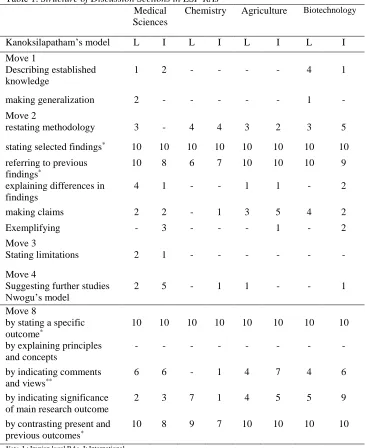
The overall structure of the ESP Discussion sections, according to Nwogu (1991) and Kanoksilapatham (2007), is given in Table 1:
Table 1. Structure of Discussion Sections in ESP RAs Medical
Sciences
Chemistry Agriculture Biotechnology
Kanoksilapatham’s model L I L I L I L I
Move 1
Describing established knowledge
1 2 - - - - 4 1
making generalization 2 - - - 1 -
Move 2
restating methodology 3 - 4 4 3 2 3 5
stating selected findings* 10 10 10 10 10 10 10 10
referring to previous findings*
10 8 6 7 10 10 10 9
explaining differences in findings
4 1 - - 1 1 - 2
making claims 2 2 - 1 3 5 4 2
Exemplifying - 3 - - - 1 - 2
Move 3
Stating limitations 2 1 - - - -
Move 4
Suggesting further studies Nwogu’s model
2 5 - 1 1 - - 1
Move 8
by stating a specific outcome*
10 10 10 10 10 10 10 10
by explaining principles and concepts
- - - -
by indicating comments and views**
6 6 - 1 4 7 4 6
by indicating significance of main research outcome
2 3 7 1 4 5 5 9
by contrasting present and previous outcomes*
10 8 9 7 10 10 10 10
Note. L: Iranian local RAs, I: International
Table 1 displays the frequency of steps in the four disciplines of ESP across the two international and Iranian local RAs. On the basis of the obtained data, the Discussion sections in ESP RAs consist of two obligatory steps: “stating selected findings” and “contrasting the findings with previous ones.” The findings are in line with Hopkins and Dudley-Evans (1988), Swales (1990) and Yang and Allison (2003). Hopkins and Dudley-Evans (1988), in their 11-move scheme, reported that the “statement of results” is an obligatory move in the Discussion section. The eight moves in Swales (1990) and those in Holmes (1997) largely followed this scheme and remained similar. Swales (1990) claims that if there is one quasi-obligatory move in Discussion sections, it is “statement of results,” whereas Holmes (1997) finds that there is no completely obligatory move in social sciences RA Discussion sections. Yang and Allison’s (2003) study supports the view that the move “reporting results” (comparable to “statement of results”) is quasi-obligatory. In all of these studies, in contrast with the current study, contrasting the findings with previous research was an optional step. Nevertheless, there are two other steps (i.e., “indicating comments and views” and “indicating significance of the study”) which occurred in high frequency. The former step is a combination of explanation, exemplification, and making claims by the researcher. Its occurrence was 20 and 14 across the international and Iranian local Discussions (ILDs), respectively. Therefore, this step is obligatory in the international Discussion sections. Yang and Allison (2003) found that “commenting on results” was an obligatory move in the Discussion sections. Indicating significance of the study was present equally in 18 RAs across the two corpora. Although its frequency is lower than half of the total number of Discussion sections, ESP writers have strong tendency to state the significance of their findings in various parts of the Discussion section.
Looking at the data in Table 1, one can find frequency discrepancies across the two corpora. However, the chi-square findings revealed significant differences in the fourth step in Nwogu’s (1991) model, “indicating significance of the study” (X2
rigorous in commenting on the (un)expected results, suggesting reasons for a surprising result, giving examples for supporting an explanation, making claims about the generalizability of the results, and finally justifying the obtained data based on the suggested hypothesis. It should be noted that these findings are derived from the analysis of the total number of RAs across the two corpora. Samraj (2002) believes that related genres can have variant structures. Hence, it seems that the differences between two corpora could be more salient if each discipline is discussed independently. In so doing, the organization of the Discussion sections in medical sciences, chemistry, agriculture, and biotechnology across the two international and Iranian local contexts is discussed in turn below.
4.2Medical Sciences Discussion Sections
According to Kanoksilapatham (2007), Discussion sections open with contextualizing the study by reference to the established knowledge in the field or making topic generalization. Two international Discussion sections and three Discussion sections of the Iranian local RAs had this initial move. Therefore, it seems that the RAs investigated began this section with the move or steps not distinguished by Kanoksilapatham (2007). The ILJs used some strategies such as restating the definition and hypothesis of the study, giving background, presenting a brief review of literature, and restating the gap and purpose to open their Discussion sections. However, none of them occurred in more than five Discussion sections; hence, all were optional steps. Three of the Discussion sections commenced with stating the selected findings—what Yang and Allison (2003) call “statement of the results.” The international journals utilized the strategies such as giving a brief review of literature and restating the problem and purposes of the research to initialize their Discussion sections. One of them stated the limitations of the study; three presented the main findings, and one of them indicated the significance of the research outcomes as the opening strategies in their Discussion sections.
absent across two corpora. The third step, indicating comments and views, as it was discussed above, involves the explanation, making claims, and exemplifying steps given by Kanoksilapatham (2007). Moreover, evaluation of the findings (occurred in four international Discussion sections), as a new step, was also used to be covered under the realm of this step. As a result, indicating comments and views was present in all of the international Discussion sections, but in six Iranian local ones. Hence, this move is quasi-obligatory across the international Discussion sections within the field of Medical Sciences. Similar to the general analysis of the structure of Discussion section across international and Iranian local ESP RAs (section 4.1), the main differences between two groups were found to be present in this move. The findings of the analysis of medical sciences Discussion sections support the general conclusion. “Indicating significance of the study” was present in two Iranian local and three international Discussion sections. This step was observed to be used cyclically after presenting the main findings. The closing steps in two ILDs were “stating limitations” and “suggesting further research.” Other Discussion sections were closed with comparing the findings with previous ones or commenting on them. The international Discussion sections were more eager to suggest the more exploratory research (5) and evaluate the findings (5), as the closing steps rather than stating the limitation of their study.
4.3 Chemistry Discussion Sections
The notable feature of the chemistry RAs which distinguished them from other ESP RAs is the combinations of Results and Discussion sections. This is a common characteristic across two international and Iranian local discourse communities. Because the focus of the current study was on the Discussion section, the moves and steps which were conventionally attributed to this section were identified and explained.
In contrast, the ILDs consisted of more steps. The chemistry researchers presented the Discussion sections in the following way: giving a brief review of literature (2), restating purposes (2), restating methodology (4), presenting main findings (10), comparing and contrasting the findings with previous outcomes (6), evaluating the findings (3), and indicating the significance of the study (7). Though various steps have been identified in the Discussion sections, the obligatory steps were the following: “stating main findings, referring to previous findings” and “indicating the significance of the study.” Similar to the international Discussion sections, presenting main findings is a quasi-obligatory step in the ILDs. However, the main difference is attributed to the evaluation of the findings. Instead of evaluating the results, the significance of the findings was preferred to be used in the ILDs. These findings are consistent with the general results obtained in the medical sciences Discussion sections.
4.4 Agriculture Discussion Sections
As it was found in the analysis of the chemistry Discussion sections, the first move (contextualizing the study) was absent in the structure of the agriculture Discussion sections across both corpora. Instead, the ILDs used giving a brief literature review and restating the gap to initiate their Discussion sections. Similarly, in the international RAsgiving a brief review of literature and restating the gap were used at the beginning of this section. Other Discussion sections in the Iranian local RAs began with restating methodology (2) and stating main findings (5). But the remaining Discussion sections of the international RAs started with stating main findings (8). The following steps used in the international Discussion sections were contrasting the results with previous outcomes (10), commenting on the results (9) which consists of explaining differences in findings (1), making claims (5), exemplifying (1), and evaluation of the results (2). The last step that they used was indicating the significance of the study (5). On the other hand, in the ILDs, after stating main findings (10) and contrasting those findings with previous ones (10), commenting on the findings (6) by explaining differences in findings (1), making claims (3), and evaluation of the results (2) were used. Following this step, similar to the international Discussion sections in the ILDs the significance of the study has been indicated (4). Although discrepancies in the use of commenting on the findings have been observed between the two corpora, a considerable harmony can be found in the structure of the Discussion sections across the two groups.
4.5 Biotechnology Discussion Sections
a brief review of literature in which the gap and purpose of the study were restated. In one of the Discussion sections, giving a brief review of literature was used to open the section. The Iranian biotechnology researchers proceed from the opening strategies to restating methodology (3), stating main findings (10), referring to previous findings (10), making claims (4), and indicating significance of the study (5). No explanation, exemplification, and evaluation were found in the ILDs. Based on the data, the quasi-obligatory steps in the biotechnology Discussion sections were stating main findings and referring to previous results. In addition to these obligatory steps, it seems that, in the ILDs, it is preferred to indicate the significance of the findings instead of evaluating or commenting on them.
Among the international Discussion sections, in one Discussion section, the established knowledge in the field, as the opening strategy, was discussed. The remaining nine Discussion sections began with restating purpose (1), giving a brief review of literature (3), restating methodology (1), and stating main findings (4). Following these opening strategies, stating main findings (10), comparing them with previous outcomes (9), and commenting on the findings (9) by explaining differences in findings (2), making claims (2), giving examples (2), and evaluating the results (8) were observed. They continued these steps by indicating significance of main findings (9). As the data showed, the main differences between the international and Iranian local biotechnology Discussion sections are remarkable in evaluating the results and indicating significance of the study. In nine international Discussion sections, the writers used these steps as the main strategies in presenting their study.
given by Hopkins and Dudley-Evans (1988) and Yang and Allison (2003). However, in their models, this move is single-layer, whereas in the present model, this move consists of four steps. The second move is the same as what Kanoksilapatham (2007) included in his model. The third move presented in proposed model is the same as the fourth move in Yang and Allison (2003); however, the steps that manifest this move are different except for evaluation step. Indicating significance of the study is the fourth move in the proposed model in Nwogu (1991). The last two moves are the same as the final moves in Kanoksilapatham’s (2007) model. One of the advantages of the proposed model is its two-layer scheme. Yang and Allison (2003) believe that the hierarchical (two-layer) scheme of analysis is preferable to the single-level scheme of analysis. The reason for this is the advantage of distinguishing the communicative purposes from the rhetorical techniques realizing the purposes, hence capturing more fully the structure of the Discussion section. Another merit of the model is that the model is derived from a combination of two datasets in different discourse communities and disciplines. Thus, it can be a generalizable model, though it requires more exploratory studies to examine its applicability and generalizability. Examples for each step are given in Table 2 in the proposed model for the structure of Discussion sections in ESP RAs:
Table 2. Proposed Model for Structure of Discussion Sections in ESP RAs
Move 1: Giving background
By giving a brief review of literature By restating the purpose or gap By describing established knowledge By making generalization
Move 2: Consolidating results
By restating methodology By stating selected findings
Move 3: Indicating comments and views
By explaining differences in (un)expected findings
By making claims By evaluating the results By giving examples
Move 4: Indicating significance of the study
Move 5: Stating limitations
Move 6: Suggesting further studies
Move 1 (M1): Giving background
o Step 1: Giving a brief review of literature: Host plant availability and quality may play a role in . . . . In the case of DBM, few life table studies as regards its various host plants have been published and only a few studies have examined the effect of . . . . the overall performance of this species. Gap} {Host plant has different effects on development . . . (Wakisaka et al., 1992 . . .). Life history of DBM can vary considerably depending upon such various factors . . . (Ooi, 1986 . . .). (ILJs, Agriculture Discussion section)
o Step 2: Restating the purpose or gap: At one of the aims of our research was developing green chemistry by using water as reaction medium or by performing organic transformations under solvent-free conditions [11, 12]. (ILJs, chemistry Discussion section)
o Step 3: Describing established knowledge: Strong differences of seed predation rates between weed species have been frequently reported (e.g., Kollmann and Bassin, 2001 . . .). (IJs, agriculture Discussion section)
Move 2 (M2): Consolidating results
o Step 1: Restating methodology: In order to investigate the effects of the Schiff base substitutions on the oxidation potential of [VOL], voltammetric experiments were carried out in DMF solution at room temperature, taking into consideration . . . . (ILJs, chemistry Discussion section)
o Step 2: Stating selected findings: The association between lactase persistence and CD incidence observed in the correlation analysis appeared to be strong and was confirmed by the multiple regression analysis . . . . (IJs, medical sciences Discussion section)
o Step 3: Comparing and contrasting present and previous outcomes: This result is an additional negative relationship previously detected between effects of farmland intensification and birds (Krebs et al., 1999; Donald et al., 2001) and for particular species or specific types of farmland (Verhulst et al., 2004). (IJs, agriculture Discussion section).
Move 3 (M3): Indicating comments and views
o Step 1: By explaining differences in (un)expected findings: These data differ from those reported previously by other groups (2.58 and 3.73 nM for nonpregnant women) [22,24]. The difference could be related to the physiological state or the timing of processing of their biological samples. (IJs, chemistry Discussion section)
o Step 2: By making claims: Therefore, differences in the number of fruits lost due to pest attacks are likely because of the initial differences in rates of fruit wilt. Hence, achieving a decrease in fruit wilt only may not lead to increased yields. (IJs, agriculture Discussion section)
o Step 3: Evaluating the results: The selectivity of the optimized conditions for converting porphyrin to porphyrinogen implies that further hydrogenation to disrupt the aromaticity of the pyrrole rings and to reduce the carbonyls requires more stringent conditions. (IJs, biotechnology Discussion section)
In the forthcoming sections, the LCPs that were identified in four moves of the Discussion section are described, and special attention is drawn to the differences that emerged from this study between the international and Iranian local RAs in terms of frequency and use of LCPs. It should be noted that for the move-related LCPs analysis, the basic move model was Kanoksilapatham (2007). However, the new identified steps as well as the significance of the study and stating comments and views, as the steps in Nwogu (1991), were added to the second move of the model.
6. Move-Related LCPs in ESP Discussion Sections
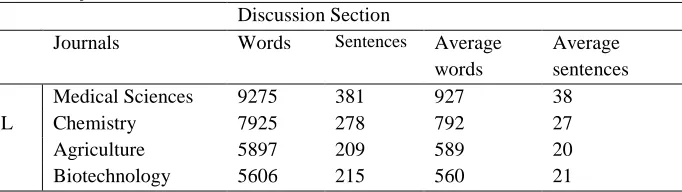
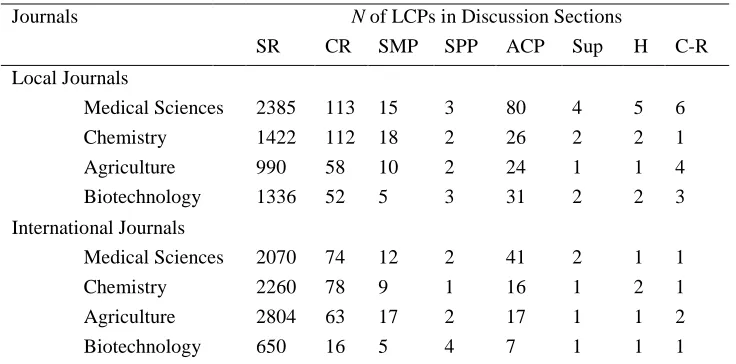
To find answers related to the relationships between communicative moves of ESP RAs with the LCPs centralized within such moves, first of all, the length of the Discussion sections of these RAs were counted (see Table 3). According to this Table, the longest ILDs belonged to the medical sciences RAs (927 average words for each section), whereas the longest IJs were found in the agriculture RAs (1,181 average words for each section). Coxhead (1998) and Stubbs (2001) found that longer texts allow for more frequency of occurrence as well as variety of vocabulary. Therefore, it is hypothesized that more LCPs can be found in the abovementioned Discussion sections. The results of the application of Hoey’s (1991) model supported this hypothesis (see Table 4). The application of Hoey’s (1991) LCPs model in the Discussion sections of the international and Iranian local RAs revealed that SR and CR had the highest frequency amongst the whole LCPs (Example 1). The data suggested that these two LCPs, among others, had the most important role in the coherence of the RAs of the different disciplines. This conclusion is in line with Hoey (1991) who found that lexical repetition is the major factor in the relatedness of a whole text.
Example 1: The silkworm lines which show substantial variation in their qualitative and quantitative traits . . . with many other ethological traits are used to differentiate varieties and selection of parental strains. (ILJs, biotechnology Discussion section).
Table 3. Frequency and Distribution of Words and Sentences in Discussion Sections of ESP RAs
Discussion Section
Journals Words Sentences Average words
Average sentences
L
Medical Sciences 9275 381 927 38
Chemistry 7925 278 792 27
Agriculture 5897 209 589 20
I
Medical Sciences 8390 306 839 30
Chemistry 8444 324 844 32
Agriculture 11810 429 1181 42
Biotechnology 5152 198 515 19
Note. L: ILJs, I: International journals
Hoey (1991) also believes that LCPs from SR to the C-R are ranked in decreasing order of importance. However, results of this investigation slightly supported this conjecture because, for instance, ACP (Example 2) had higher frequency than SPP in both international and Iranian local ESP Discussion sections (see Table 4).
Table 4. Number of LCPs in Introduction and Discussion Sections of Local and International Journals
Journals N of LCPs in Discussion Sections
SR CR SMP SPP ACP Sup H C-R
Local Journals
Medical Sciences 2385 113 15 3 80 4 5 6
Chemistry 1422 112 18 2 26 2 2 1
Agriculture 990 58 10 2 24 1 1 4
Biotechnology 1336 52 5 3 31 2 2 3
International Journals
Medical Sciences 2070 74 12 2 41 2 1 1
Chemistry 2260 78 9 1 16 1 2 1
Agriculture 2804 63 17 2 17 1 1 2
Biotechnology 650 16 5 4 7 1 1 1
Note. SR: Simple Repetition, CR: Complex Repetition, SMP: Simple Mutual paraphrase, SPP: Simple Partial Paraphrase, Sup: Superordinate, ACP: Antonymous complex paraphrase, H: Hyponymy, C-R: Coreferences
ESP RAs, regarding the use of LCPs, indicating that the writing conventions as well as the manipulation of lexicon in the ESP texts have been accepted.
Example 2: Actually, these results are in contradiction with another study where no association was found between lactose intolerance and inflammatory bowel disease in Germany [31]. This discrepancy could probably be caused by the lower level of genetic variability within a country than among different countries. On the other hand, the results of the principal component analysis . . . could be the ruminant population required for production of both milk and meat. This would be consistent with the findings of Abubakar et al. [12]. (IJs, medical sciences Discussion section)
Table 5. Number of LCPs in Moves of Discussion Sections of International and ILJs Journals LCPs N of LCPs in Moves of
International Discussion Sections
N of LCPs in Moves of ILDs
Me
d
ical
Scien
ce
s
M1 M2 M3 M4 M1 M2 M3 M4
SR - 2070 - - - 2385 - -
CR - 74 - - - 113 - -
SMP - 12 - - - 15 - -
SPP - 2 - - - 3 - -
ACP - 41 - - - 80 - -
SUP - 2 - - - 4 - -
H - 1 - - - 5 - -
C-R - 1 - - - 6 - -
C
h
em
is
tr
y
SR - 2245 - - 18 1404 - -
CR - 78 - - 2 110 - -
SMP - 9 - - - 18 - -
SPP - 1 - - - 2 - -
ACP - 16 - - - 26 - -
SUP - 1 - - - 2 - -
C-R - 1 - - - 1 - -
Ag
ricu
ltu
re
SR - 2802 - - - 990 - -
CR - 63 - - - 58 - -
SMP - 17 - - - 10 - -
SPP - 2 - - - 2 - -
ACP - 17 - - - 24 - -
SUP - 1 - - - 1 - -
H - 1 - - - 1 - -
C-R - 2 - - - 4 - -
B
io
tech
n
o
lo
g
y
SR 10 611 8 21 10 1296 10 20
CR - 16 - - - 52 - -
SMP - 5 - - - 5 - -
SPP - 4 - - - 3 - -
ACP - 7 2 - - 29 - -
SUP - 1 - - - 2 - -
H - 1 - - - 2 - -
C-R - 1 - - - 3 - -
Note. SR: Simple Repetition, CR: Complex Repetition, SMP: Simple Mutual paraphrase, SPP: Simple Partial Paraphrase, Sup: Superordinate, ACP: Antonymous complex paraphrase, H: Hyponymy, C-R: Coreferences
be aware of the norms in writing of academic texts, they were not well-mastered in the use of LCPs to attach the sentences of the text creating a meaningful whole.
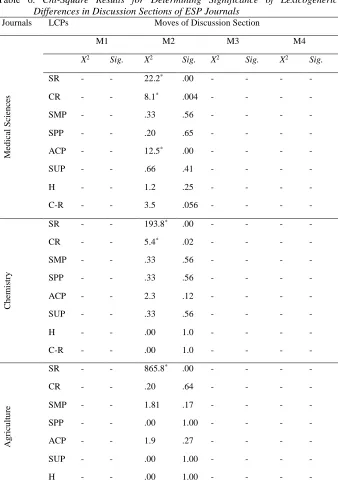
Table 6. Chi-Square Results for Determining Significance of Lexicogeneric Differences in Discussion Sections of ESP Journals
Journals LCPs Moves of Discussion Section
M
ed
ica
l
S
cien
ce
s
M1 M2 M3 M4
X2 Sig. X2 Sig. X2 Sig. X2 Sig.
SR - - 22.2* .00 - - - -
CR - - 8.1* .004 - - - -
SMP - - .33 .56 - - - -
SPP - - .20 .65 - - - -
ACP - - 12.5* .00 - - - -
SUP - - .66 .41 - - - -
H - - 1.2 .25 - - - -
C-R - - 3.5 .056 - - - -
Ch
em
istry
SR - - 193.8* .00 - - - -
CR - - 5.4* .02 - - - -
SMP - - .33 .56 - - - -
SPP - - .33 .56 - - - -
ACP - - 2.3 .12 - - - -
SUP - - .33 .56 - - - -
H - - .00 1.0 - - - -
C-R - - .00 1.0 - - - -
Ag
ricu
lt
u
re
SR - - 865.8* .00 - - - -
CR - - .20 .64 - - - -
SMP - - 1.81 .17 - - - -
SPP - - .00 1.00 - - - -
ACP - - 1.9 .27 - - - -
SUP - - .00 1.00 - - - -
C-R - - .66 .41 - - - -
Bio
tec
h
n
o
lo
g
y
SR .00 1.00 246.0* .00 .22 .63 .02 .87
CR - - 19.0* .00 - - - -
SMP - - .00 1.00 - - - -
SPP - - .14 .70 - - - -
ACP - - 13.4* .00 - - - -
SUP - - .33 .56 - - - -
H - - .33 .56 - - - -
C-R - - 1.0 .31 - - - -
Note. SR: Simple Repetition, CR: Complex Repetition, SMP: Simple Mutual Paraphrase, SPP: Simple Partial Paraphrase, Sup: Superordinate, ACP: Antonymous complex paraphrase, H: Hyponymy, C-R: Coreferences, X2:
Chi-square, *p < .05
7. Concluding Remarks
Kwan (2006) contends that the increasing amount of research into various aspects of academic texts has contributed significantly to our understanding of the genre and its composing process. However, it seems that, more important than the genre consciousness is the way we translate the findings for pedagogical purposes. This is a common concern among genre analysts. Although findings of the genre analysis can be influential and effective in teaching writing, “it is less clear how— and when—these research findings can best be carried over into effective pedagogical practice” (Lee & Swales, 2006, p. 57). Undoubtedly, ESP students and researchers need considerable help at the structural, syntactical, and lexical levels in writing their own papers. This need is more salient among NNSs of English (Flowerdew & Wan, 2009; Lee & Swales, 2006) and those who have not experienced the research-based education. Therefore, it is highly recommended to make practical the findings of such genre studies in order to create a background for these students, on the one hand, and to provide a chance for them to publish in international journals, on the other.
References
Amirian, Z., Kassaian, Z., & Tavakoli, M. (2008). Genre analysis: An investigation of the discussion sections of applied linguistics RAs. The Asian ESP Journal, 4(1), 39-63.
Bhatia, V. K. (2002). Applied genre analysis: A multiperspective model. IBÉRICA, 4, 3-19.
Bonn, S., & Swales, J. M. (2007). English and French journal abstracts in the language sciences: Three exploratory studies. Journal of English for Academic Purposes,6, 93-108.
Britton, K. B. (1994). Understanding expository text: Building mental structures to induce insights. In M. A. Gernsbacher (Ed.), Handbook of psycholinguistics (pp. 641-674). San Diego: Academic Press.
Buitkiené, J. (2005). Variability of cohesive devices across registers. Studies About Languages (Kalb-Studijos), 7, 17-20.
Burrough-Boenisch, J. (2003). Examining present tense conventions in scientific writing in the light of reader reactions to three Dutch-authored discussions. English for Specific Purposes, 22(1), 5-24.
Bublitz, W. (1996). I've bought a freezer—You’ve bought a freezer—they’ve bought a freezer: Repetition as a text-building device. In C. Bazzanella (Ed.), Repetition in dialogue (pp. 16-28) . Tübingen: Niemeyer.
Fallahi, M. M., & Erzi, M. (2003). Genre analysis in language teaching: An investigation of the structure of the Discussion section of language-teaching-journal articles. IJAL, 6(1), 69-81.
Fallahi Moghimi, M., & Mobasher, F. (2007). Genre analysis of introduction section of English and Persian articles in Mechanics. TELL, 1(2), 59-73.
Flowerdew, J., & Wan, A. (2009). The linguistic and the contextual in applied genre analysis: The case of the company audit report. English for Specific Purposes, 29, 78-93.
Fox, B.A. (1987). Discourse structure and anaphora: Written and conversational English. Cambridge: Cambridge University Press.
Habibi, P. (2008). Genre analysis of research article introductions across ESP, Psycholinguistics, and Sociolinguistics. IJAL, 11(2), 87-111.
Hirano, E. (2009). Research article introductions in English for specific purposes: A comparison between Brazilian Portuguese and English. English for Specific Purposes, 28, 240-250.
Hoey, M. (1991). Patterns of lexis in text. Oxford: Oxford University Press.
Hopkins, A., & Dudley-Evans, A. (1988). A genre-based investigation of the discussion sections in articles and dissertations. English for SpecificPurposes, 7, 113-122.
Hyland, K. (2000). Disciplinary discourses: Social interactions in academic writing. Harlow: Longman.
Jalilifar, A. R., Hayati, A. M., & Namdari, N. (2012). A comparative study of research article discussion sections of local and international applied linguistics journals. Journal of Asia TEFL, 9(1), 1-29.
Johnstone, B. (1987). Perspectives on repetition. Text, 7(3), 205-214.
Kanoksilapatham, B. (2007). Rhetorical moves in biochemistry research articles. In D. Biber, U. Connor, & T. A. Upton (Eds.). Discourse on the move: Using corpus analysis to describe discourse structure (pp. 73-119). Amsterdam: John Benjamins.
Kanoksilapatham, B. (2005). Rhetorical structure of biochemistry research articles. English for Specific Purposes, 24, 269-292.
Keshavarz, M. H, Atai, M. A., & Barzegar, V. (2007). A contrastive study of generic of RA introductions organization written by Iranian and non-Iranian writers in applied linguistics. TELL, 1(2), 14-33.
Klebanov, B. B., & Eli Shamir, E. (2007). Reader-based exploration of lexical cohesion. Lang Resources & Evaluation, 41, 27-44.
Kwan, B. (2006). The schematic structure of literature reviews in doctoral theses of applied linguistics. English for Specific Purposes, 25, 30-55.
Lee, D., & Swales, J. (2006). A corpus-based EAP course for NNS doctoral students: Moving from available specialized corpora to self-compiled corpora. English for Specific Purposes, 25, 56-75.
Nwogu, K. N. (1991). Structure of science popularizations: A genre-based analysis approach to the schema of popularized medical texts. English for Specific Purposes, 10, 111-123.
Nwogu, K. N. (1997). The medical research paper: Structure and function. English for Specific Purposes, 16(2), 119-138.
Salahshoor, F. (1999). Genre-based approaches to EFL academic literacy: The case of Iran. Unpublished doctoral dissertation, University of Essex, United Kingdom.
Samraj, B. (2008). A discourse analysis of master’s theses across disciplines with a focus on introductions. English for Academic Purposes, 7, 55-67.
Suhardja, I. (2006). Scientific news as a genre: A linguistic account of distortion of scientific information. Retrieved January 20, 2016 from the World Wide Web: www.ling.ed.ac.uk/~pgc /archive /2006/ programme.html
Swales, J. M. (1990). Genre analysis: English in academic and research settings. Cambridge: Cambridge University Press.
Swales, J. M. (2004) Research genres: Explorations and applications. Cambridge: Cambridge University Press.
Tahririan, M. H., & Jalilifar, A. R. (2004). Generic analysis of theses and dissertation abstracts: Variation across cultures. IJAL, 7(2), 121-143.
Teich, E., & Fankhauser, P. (2005). Exploring lexical patterns in text: Lexical cohesion analysis with word net. Interdisciplinary Studies on Information Structure, 2, 129-145.
Widdowson, H. G. (1979). Explorations in applied linguistics. Oxford: Oxford University Press.