Globalization and Financial Development in Nigeria
Joseph Ayoola Omojolaibi1, Ekundayo Peter Mesagan*2,
Nsofor Chinedu Stanley3
Received: 2016/06/22 Accepted: 2016/07/19
Abstract
lobalization is a worldwide phenomenon. The concept globalization is a very recent term only establishing its current meaning in the 1970s, which emerged from the intersection of four inter related sets of communities of practice, academics, journalists, publishers. This paper models the channels through which globalization affects financial sector development in Nigeria. To this end this study examines the data for these variables used in this study for the period (1987-2014). The results obtained in this study have established that globalization has a significant effect on financial sector development in Nigeria. Higher pace of globalization is found to be associated with a good financial system in Nigeria and it also serves as a stimulant for the economy. The study calls for an enabling environment for the financial system as well as interest rate targeting to encourage more financial in-flow.
Keywords: Globalization, Financial Development, Error Correction, Nigeria.
JER Classification: F6, O1, P34.
1. Introduction
Globalization can be described as a process of international integration arising from the exchange of world ideas, products views and innovations. Nigeria with a population of over 170 million and a land area of 9,323,768km is characterized with abundant resources such as petroleum and other resources like steel, gold, limestone, etc. However, globalization has had both dynamic impacts on the different sectors. Historically, trade flows increased by sixteen fold in the last
1. Department of Economics, University of Lagos, Lagos, Nigeria.
2.Department of Economics, University of Lagos, Lagos, Nigeria (Corresponding Author). 3. Department of Economics, University of Lagos, Lagos, Nigeria.
fifty years as a result of the removal of trade barriers in Nigeria (Ajayi, 2001). Through globalization the Nigerian economy has been sustained through the different sectors in the economy comprising the oil and gas sector, the telecommunication sector, and the agricultural sector. This has however led to capital flows and investment. In Nigeria, the term ‘globalization’ became pronounced through the adoption of the Structural Adjustment Programme (SAP) in 1986. The primary aim of SAP was to restructure and diversify the productive base of the economy. In addition, the SAP was designed to establish a realistic and sustainable exchange rate for the naira through trade and payment liberalization, tariff reforms and commercialization and privatization of public enterprises. An appraisal of SAP shows that it could not achieve its expected results (Ikpeze, 1994). Also, daily activities such as shopping, entertainment, banking, manufacturing, office work, education have become increasingly dependent on information and communication networks through globalization. Indeed, through globalization Information and Communication Technology (ICT) networks have now made it possible for countries like Nigeria to participate in the global economy which have also enable the country to access latest innovations and technology.
includes; banks, stock exchanges, and insurers, to credit unions, microfinance institutions and money lenders. Thus, financial globalization is referred to as the increasing global linkages created through cross-border financial flows.
The financial sector is a very key to any economy as it constitutes the bulk of liquid flow and how money is being generated. It also comprises the foreign exchange market which determines how strong a country’s currency is in comparison to the currencies of other countries and the monetary policies used by the Central bank of any economy. Furthermore, the impact of globalization on financial sector development is seen in the case of foreign owned institutions within a country. Thus globalization has enabled the Nigerian economy to enjoy foreign direct investment into the country and since most of the previous studies did not focus on financial globalization, it becomes expedient for this present study to fill this noticeable gap. To this end, the study attempts to determine if globalization has significantly affected financial sector development in Nigeria with the aim of estimating the impact of foreign private investment on financial sector development, assessing the relationship between gross capital formation and financial sector development and determine the effect of exchange rate on financial sector development in Nigeria. In recent years, a number of studies (see Abubakar, 2001; Aluko et al, 2004; Loto, 2011) focused on globalization and economic growth in Nigeria, while others (Orbeta, 2002; Olayinka, 2006; Paterson and Okafor, 2006) analyzed the relationship between globalization and employment in Nigeria, but the potential relationship between globalization and financial sector development remains largely unexplored in the Nigerian context with the only close study being Mobolaji & Ndako (2008). However, this present study deviates from Mobolaji & Ndako (2008) by employing the growth rate of foreign portfolio investment as a proxy of globalization.
2. Literature Review
2.1 Theoretical Review
and the Porter’s theory.
2.1.1The Solow Model and the Harrod-Domar (HD) Model
The Solow model is used basically to analyze the long run economic growth of any economy. This model relaxed some of the unrealistic assumptions of the HD model. The HD model rooted on only one factor, and the factors that account for growth in this model to ensure globalized economy include increase in capital stock through savings and investment and increase in the quality of labour and quantity through education and population growth. The striking contribution of Solow’s ideas was to encourage the government of each country to focus on the development of education and research which is a means of improving the various financial sectors of the economy and the thrust of this model is evident in the global world in the contemporary days. The theoretical underpinning of the model is deeply articulated in the Hecksher-Ohlin-Samuelson-Stolper (HOSS) framework that leans on the sartorial and factorial impacts of increased cross-border trade on the structure of input and output of a country. It is adjudged based on the theory that greater interrelationship can be accomplished via trade openness.
2.1.2 The Hecksher-Ohlin Model
very high cost compare to other countries. The relevance of such a theory is to assist countries gain advantage in the globalized market via the interrelationship between the global markets and the movement of output across borders. This theory also seeks to promote global productivity and the development of the various sectors of the economy as citizens of different countries would have access to improved employment opportunities and better benefits/income.
2.1.3 The Porter’s Theory
The relevance of Porter’s theory hinges on the fact that there should always be a strategy to compare the competitiveness of firms domestically and internationally to boost a nation’s competitive advantage. Any country that integrates with the global environment should also possess the ability to absorb any negative tendencies that may emanate from such integration. The implication of this is that such negative impacts would not be evident in the receiving country. The theory is deeply rooted in the system of determinants, which comprises of the endowment of a nation with factor inputs. These determinants are considerably influenced by other factors like the chance and the governmental policy. All these determinants are dependent on one another. Porter proposed that countries are adjudged successful where the national resource is the most preferable economic interest. The more complex and dynamic the economic environment of the country is, the more like is some companies to fail if they cannot capitalize in productive way to fit into the environment. Hence, Porter divided the production factors into four: (I) human resources; (II) natural resources; (III) knowledge resources and; (IV) capital resources & infrastructure. In conclusion, the theory of Porter gave birth to a new foundation for both industrial and commercial policy purposes.
2.2 Empirical Review
was the interest rates which were driven below their equilibrium levels. Such distortions usually result into the encouragement of financial disintermediation, capital flight, acquisition of inflation hedges and excessive aggregate demand. All these distortions conspire to reduce economic growth rates. Aina (1996), Abubakar (2001) clearly uncovered the consequences of globalization and free-trade on Nigeria in particular, and Africa in general. Both studies also unraveled the negative relationship between Economic globalization and the development of the various sectors of the Nigerian economy.
Loto (2011) examined the effect of globalization on Nigeria’s growth process using the mundel-fleming model of open macroeconomics, the study was able to discover that the Nigerian economy has not benefitted immensely from globalization as trade openness insignificantly impact economic growth. It therefore called for the diversification of the Nigerian economy to guarantee trade improvement relationship with the rest of the world in order to benefit from globalization.
Modolaji & Ndako (2008) researched into the role globalization plays in Nigeria’s financial sector. It was observed in the study that globalization has enhanced Nigeria’s growth process and has offered several benefits to the economy. It therefore suggested that for the country to reap more benefits of globalization, a minimum threshold of development of necessary institutions is required. Mishkin (2009) looked into how globalization impact financial development in developing countries. The study suggests that plays a prominent role in inspiring institutional reforms in less developed countries with well-developed financial structure and growth. The study believe that developed economies can assist in promoting financial development and economic growth by allowing products and services from emerging economies to enter their economies without much restriction.
Basco (2014) developed an empirical dot-com model in analyzing the relationship between globalization and financial development. It was observed that as globalization increases, the tendency for a financially developed country to have bubbles also increases. The reason given is that under autarky, rational bubbles can only surface in the presence of assets shortage which is only associated with a financially constrained country and that with an integrated economy, excess demand for assets at the global level can also trigger rational bubbles. In conclusion, the study suggests that globalization enables highly financially underdeveloped countries to access international capital markets thereby making the global economy financially constrained and stimulating the prospects for rational bubbles.
De Nicolo & Juvenal (2014) focused on the effects that measures of financial integration as well as globalization has on real activities in some advanced and emerging economies between 1985 and 2008. The study which employed a dynamic panel analysis and focusing on three dimensions of real activity which include measures of macroeconomic instability, growth volatility and growth itself observed that globalization and financial integration are associated with lower growth volatility, higher growth and lower possibilities of declines in real activity. It did not however find any evidence of a trade-off among globalization, macroeconomic stability, growth and financial integration.
2.3 Stylized Facts
Figure 1: FSD and Interest Rate Figure 2: NFPCF and Annual Change
Resource: CBN Statistical Bulletin (2014)
using ((Money supply as a % of GDP) and interest rate over the years. Interest rate reached its peak at 11.0642% in the year 2010 as a result of efforts by CBN in reducing the rising inflation rate in the economy. In figure 2, it is evident that the volume of NFPCF has been on the increase over the years. The average annual volume of NFPCF in the democracy era was N28, 241.53m as compared to N14, 192.47 before the democracy regime. This shows that the rate of increase in the volume of NFPCF is higher during the Democracy regime than during the military era. However, the rate of increase has been fluctuating over the years. In 2008 and 2009 there was a decrease of 8.49% and 16.23% respectively, which could be attributable to the global economic changes.
Figure 3: FSD and Gross Capital Formation Figure 4: FSD and Exchange Rate
Resource: CBN Statistical Bulletin (2014)
Figure 5: FSD and Foreign Portfolio Investment Figure 6: FSD and Liquidity Ratio
Resource: CBN Statistical Bulletin (2014)
Figure 5 shows the trend between Financial sector development using ((Money supply as a % of GDP) and foreign portfolio investment over the years. This shows the fluctuations in movements over the years. The highest value for the growth rate of Foreign Portfolio Investment (FPI) was 49.29% which was attained in the year 2000 as result of the financial liberalization policy in Nigeria in the mid 2000 which abrogated the exchange control Act of 1962 which now allowed foreigners to participate in the Nigerian stock exchange bringing about increasing inflows. In figure 6, the trend between Financial sector development using ((Money supply as a % of GDP) and foreign Liquidity ratio over the years revealed that there are fluctuations in movements over the years. The highest figure for the Liquidity ratio was witnessed in the year 2000 at 64.1%.
3. Theoretical Framework and Methodology
The theoretical construct for this study is rooted in the theory of financial repression hypothesis by Mckinnon and Shaw (1973). Financial repression hypothesis is a situation where a set of government laws and regulations as well as other non-market restrictions hamper the efficient functioning of the financial intermediaries in an economy. Financial repression can be caused by capital controls, liquidity ratio requirements, interest rate ceilings, restrictions of entry into the financial sector, high bank reserve requirements, credit restrictions, government ownership of banks and indirections of credit allocation. It has often been argued that that financial repression retards economic growth by inhibiting the efficient allocation of capital.
Financial repression was first expounded by McKinnon and Shaw (1973). While theoretically an efficient allocation of capital can spur an economy with a sound financial system to attain growth and development, McKinnon and Shaw submit that, several countries, both developing and some developed, have inhibited competition to a large extent in the financial sector with government regulations and interventions. According to the study, once a financial sector is repressed, it discourages investment and saving by lowering the rate of return below the competitive market’s rate of return. The implication of this is that, financial intermediaries will not be able to function optimally and thus unable to efficiently channel saving into investment in such a system, thereby weakening the overall development of the entire economic system. A good example of such financially repressive policy is capital controls, because they restrict the inflows and outflows of capital. Moreover, the use of capital controls can involve some costs. This is borne out of their uncompetitive nature which makes capital control to increase cost of accumulating capital through the creation of financial autarky. It also restricts the ability of local and foreign investors in diversifying their portfolios and helping weak financial institutions to survive.
Hence from the above theory it can be deduced that:
FSD = f(FPI, GCF, LR, INT, EXC) (1)
Where FSD is Financial sector development (which uses a financial deepening indicator, Money supply as a % of GDP as a proxy), FPI is Foreign portfolio investment (proxy for foreign financial investment), GCF is Gross capital formation (proxy for domestic investment), LR is Liquidity ratio, INT is Interest rate, EXC is Exchange rate.
The estimation regression equation based on the above functional relation is:
FSDt= β0 +β1FPIt+ β2GCFt+ β3LRt + β4INTt +β5EXCt +µt (2)
According to the economic priori of the signs of parameters, it is expected that β1> 0, β2> 0, β3> 0, β4 >/< 0 and β5 >/< 0 .
4. Empirical Result
This section gives the data presentation of our empirical analysis on the impact of globalization on the financial sector development of Nigeria making use of both descriptive and econometric analysis with a further discussion and comparison of the result with previous findings. The study made use of a financial deepening indicator (Money supply as a % of GDP (M2GDP)) as a proxy for the level of financial depth or financial sector development in Nigeria while globalization was proxied by the growth rate of foreign portfolio investment (FPI).
4.1 Pre-Diagnostics Tests
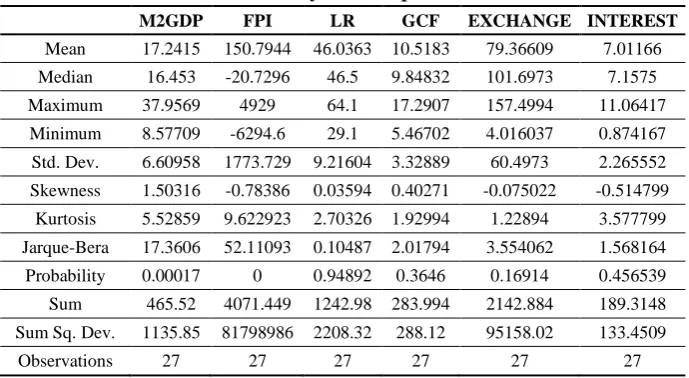
Table 1: Summary of Descriptive Statistics
M2GDP FPI LR GCF EXCHANGE INTEREST
Mean 17.2415 150.7944 46.0363 10.5183 79.36609 7.01166
Median 16.453 -20.7296 46.5 9.84832 101.6973 7.1575
Maximum 37.9569 4929 64.1 17.2907 157.4994 11.06417
Minimum 8.57709 -6294.6 29.1 5.46702 4.016037 0.874167
Std. Dev. 6.60958 1773.729 9.21604 3.32889 60.4973 2.265552
Skewness 1.50316 -0.78386 0.03594 0.40271 -0.075022 -0.514799
Kurtosis 5.52859 9.622923 2.70326 1.92994 1.22894 3.577799
Jarque-Bera 17.3606 52.11093 0.10487 2.01794 3.554062 1.568164
Probability 0.00017 0 0.94892 0.3646 0.16914 0.456539
Sum 465.52 4071.449 1242.98 283.994 2142.884 189.3148
Sum Sq. Dev. 1135.85 81798986 2208.32 288.12 95158.02 133.4509
Observations 27 27 27 27 27 27
Resource: Authors’ computation
Portfolio Investment (FPI) was 4929% which was attained in the year 2000 as result of the financial liberalization policy in Nigeria in the mid 2000 which abrogated the exchange control Act of 1962 which now allowed foreigners to participate in the Nigerian stock exchange bringing about increasing inflows of foreign portfolio investment into the Nigeria economy through the capital market while its lowest value of -6294.6% took place in the year 1992 as a result of regulation of the capital market that characterized earlier periods of the post-SAP era (Baghebo & Apere, 2014).
The highest liquidity ratio recorded at 64.1% in the year 2000 was observed to have coincided with the highest level of growth rate attained by foreign portfolio investment; which means that the ability of the Nigerian financial sector to adequately meet its short term debt obligations was instrumental in attracting investment in equities and shares from abroad. Meanwhile, the lowest liquidity ratio was recorded at 29.1% in the year 1992; the same year that foreign portfolio investment growth rate was also least; which means financial distress of the early 1990s which resulted in poor liquidity performance of the country was deterrent in attracting financial investments from abroad.Furthermore, it was noticed that gross fixed capital formation reached its maximum in the year 2010 at 17.2907% as a result of rising public expenditure to finance domestic investment in the country coupled with increasing private investment while the lowest gross fixed capital formation was attained in the year 2005 at 5.4670% as a result of low domestic investment in the economy.
the variables were shown to be positively skewed except for foreign portfolio investment (-0.78386), exchange rate (-0.075022) and interest rate (-0.514799) which were negatively skewed away from the normal distribution point. The kurtosis values of Money supply as a % of GDP (5.52859), FPI (9.622923) and interest rate (3.577799) which have their values to be above the normal distribution point of 3, indicates that variables are leptokurtic. Also, the Jarque-Bera probability of both Money supply as a % of GDP (M2GDP) and FPI which are all less than the 5% level of significance (P < 0.05) further reveals a statistically significant deviation of these variables from normality.
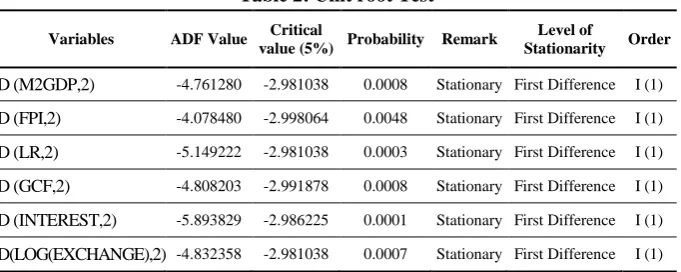
Table 2: Unit root Test
Variables ADF Value Critical
value (5%) Probability Remark
Level of
Stationarity Order
D (M2GDP,2) -4.761280 -2.981038 0.0008 Stationary First Difference I (1)
D (FPI,2) -4.078480 -2.998064 0.0048 Stationary First Difference I (1)
D (LR,2) -5.149222 -2.981038 0.0003 Stationary First Difference I (1)
D (GCF,2) -4.808203 -2.991878 0.0008 Stationary First Difference I (1)
D (INTEREST,2) -5.893829 -2.986225 0.0001 Stationary First Difference I (1)
D(LOG(EXCHANGE),2) -4.832358 -2.981038 0.0007 Stationary First Difference I (1)
Resource: Authors’ computation
Table 3: Johansen Co-Integration Test
Hypothesized
No. of CE(s) Eigenvalue
Trace Statistic
0.05
Critical Value Prob.**
None * 0.669626 90.25753 95.75366 0.0000
At most 1 * 0.471126 60.12096 69.81889 0.0010
At most 2 0.245262 50.08444 37.85613 0.2910
At most 3 0.213946 38.16600 29.79707 0.3152
At most 4 0.200009 30.39008 15.49471 0.4397
At most 5 0.188480 27.07074 13.41466 0.5029
In table 3, the result shows that at 5% critical value, two co-integrating vectors exist among the economic fundamentals. By this finding, we reject the null hypothesis of no co-integration amongst the time series. Hence, the variables are interrelated with each other in the long run, that is, they could move together on the long run growth path, and their existing relationships are not spurious.
4.2 Parsimonious Error Correction Model (ECM) Regression Result
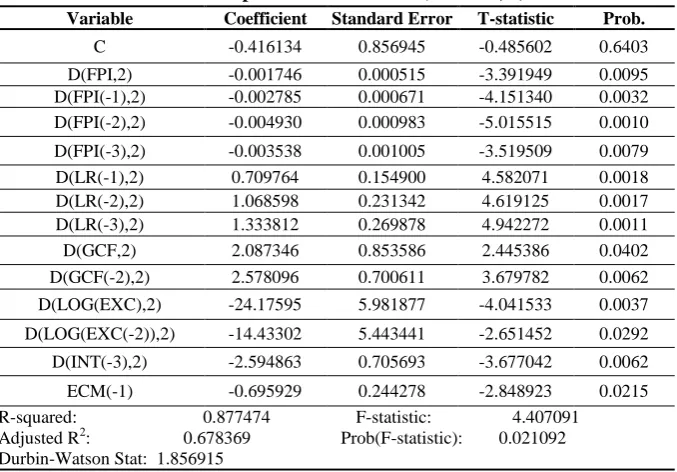
Table 4: Dependent Variable: D (M2GDP, 2)
Variable Coefficient Standard Error T-statistic Prob.
C -0.416134 0.856945 -0.485602 0.6403
D(FPI,2) -0.001746 0.000515 -3.391949 0.0095 D(FPI(-1),2) -0.002785 0.000671 -4.151340 0.0032 D(FPI(-2),2) -0.004930 0.000983 -5.015515 0.0010
D(FPI(-3),2) -0.003538 0.001005 -3.519509 0.0079 D(LR(-1),2) 0.709764 0.154900 4.582071 0.0018 D(LR(-2),2) 1.068598 0.231342 4.619125 0.0017 D(LR(-3),2) 1.333812 0.269878 4.942272 0.0011 D(GCF,2) 2.087346 0.853586 2.445386 0.0402 D(GCF(-2),2) 2.578096 0.700611 3.679782 0.0062
D(LOG(EXC),2) -24.17595 5.981877 -4.041533 0.0037
D(LOG(EXC(-2)),2) -14.43302 5.443441 -2.651452 0.0292
D(INT(-3),2) -2.594863 0.705693 -3.677042 0.0062
ECM(-1) -0.695929 0.244278 -2.848923 0.0215 R-squared: 0.877474 F-statistic: 4.407091
Adjusted R2: 0.678369 Prob(F-statistic): 0.021092 Durbin-Watson Stat: 1.856915
Resource: Authors’ Computation from Eviews
order to ascertain the relationship between financial sector development (which is the dependent variable) and globalization. In table 4, M2GDP is Money supply as a % of GDP (proxy for Financial sector development), FPI is growth rate in foreign portfolio investment (proxy for globalization), LR is liquidity ratio, GCF is gross capital formation as a % of GDP (proxy for domestic investment), EXC is exchange rate and INT is interest rate. In terms of
a priori expectation, it was observed that all the variables of the study
were in conformity, except for Foreign Portfolio Investment which happened to be negatively related with financial sector development. It was noted that all the explanatory variables used for the study were shown to be significantly related with the explained variable.
The coefficients of FPIs which are negatively related with D(M2GDP,2), indicates that for every one-unit increase in current year’s, one-year lag, two years lag and three years lag in Foreign Portfolio Investment respectively, there is a corresponding decrease in the level of financial sector development by 0.001746 units, 0.002785 units, 0.004930 units and 0.003538units. This implies that foreign inflow of capital in to the Nigerian economy has not yielded the desired positive impact on Nigeria’s financial sector development. This is a reflection of the fact that the Nigerian capital market is still relatively underdeveloped when compared with other advanced and emerging economies. This can be attributed to government policy inconsistencies and high uncertainties militating against the Nigeria business environment. However, it was observed that Liquidity ratio had a positive and significant impact on the level of financial sector development. This means that every one-unit increase in the one year’s lag, two year’s lag and three year’s lag Liquidity ratio respectively brings about 0.709764 units, 1.068598 units and 1.333812 units increases to the development of the financial sector in Nigeria. This is an indication of rising level of liquidity which can be attributed to the liquidity injection by the CBN in 2005 as part of its consolidation of the banking sector.
Nigerian economy increases by 2.087346units and 2.578096 units respectively. The impact of domestic investment on the level of financial sector development can be attributed to rise in the number of listed equities. Meanwhile, the coefficients of exchange rate indicate a negative and significant impact on financial sector development. Similarly, the impact of interest rate was negative and significant indicating that for every one-unit increase in three years lag in interest rate while keeping other variables constant, financial sector development falls by 2.594863 units. The negative impact of exchange rate on financial sector development can attributed to the fact that recent monetary policy tightening by the CBN targeted at curbing rising inflation rates and exchange rate appreciation have resulted in additional inflow of foreign capital into the domestic economy (given that higher interest differentials are signals for higher returns) and thereby putting further pressure on the exchange rate.
The coefficient of determination shows that approximately 88% of the total changes in financial sector development is explained in the model and this drops to approximately 68% after adjusting for degree of freedom which is still high. The Durbin-Watson statistic of approximately 1.86 shows the absence of positive serial autocorrelation meaning that there is independence of observation in the error terms. The F-statistic reported in the lower panel of the table 4.3 gives the indication that the model is fit. The F-statistic is approximately 4.41 with a Probability value of 0.02 implies that the data used in the estimation fitted well into the regression equation, hence the model is adequate in explaining the impact of the independent variables on the financial sector development in Nigeria i.e. independent variables jointly have a significant influence on financial sector development. The estimated coefficient of ECM(-1) is between 0 and 1and is statistically significant (at the 5% significance level) and with the appropriate (negative) sign, while the estimated value of the coefficient of ECM(-1) indicates that the system adjusts to its previous period’s level of disequilibrium by about 69 percent which is quite high.
5. Conclusion
Nigeria, FDI has contributed largely to the development of the Nigerian economy but has decreased over the years due to the poor maintenance of infrastructure in Nigeria, the Nigerian financial sector has been the backbone of the economy for quite a number of years and that in the long run with effective policies put in place and measures; globalization has increased the standard of living of people in the economy. The co-integration results show that a long run relationship is seen to exist in relation to the variables used in this study. Although, the Nigerian economy has really been impacted significantly by globalization, but more still needs to be done in a quest for further develop the financial sector. Hence the policy recommendations emanating from this study includes the creation of an enabling environment for financial institutions to operate, small and medium scale institutions should be encouraged as this will further increase the standard of living of people living in the economy, the depreciation of the naira vis-à-vis other foreign currencies should be critically looked into in order to enhance the performance of the financial sector and a target should be set on interest rates by the central bank to stimulate domestic investment and encourage the flow of more foreign investment.
References
Abubakar, D. (2001). Globalization and Nigeria in the 21st Century.
Nigerian Social Sciences, 4(1), 15-19.
Aina, T. A. (1996). Globalization and Social Policy in Africa: Issues and Research Directions. CODESRIA Working Paper, 6/96.
Ajayi, S. I. (2001). What Africa Needs to Do to Benefit from Globalization. Finance and Development,38(4), 6-8.
Aluko, M. A. O., Akinola, G. O., & Fatokun, S. (2004). Globalization and the Manufacturing Sector: A Study of Some Selected Textiles Firms in Nigeria. Journal of Social Science,9(2), 122-127.
Baghebo, M., & Apere, T. (2014). Foreign Portfolio Investment and Economic Growth in Nigeria. International Journal of Business and
Basco, S. (2014). Globalization and Financial Development: A Model of the Dot-Com and the Housing Bubbles. Journal of International
Economics, 92, 78–94.
De Nicolo, G., & Juvenal, L. (2014). Financial Integration,
Globalization and Real Activity. Journal of Financial Stability, 10,
65–75.
Garcia, E. D. T. (2012). Financial Globalization and Financial
Development in Transition Countries. Economia Teoria Y Practica
Nueva Epoca, 36, 155-178.
Ikpeze, N. (1994). Elements of Structural Adjustment Programme in Nigeria: Liberalization and Deregulation. NJESS, 35, 1, 2& 3, 153-167.
Loto, M. A. (2011). Globalization and Economic Development: The
Nigerian Experience and Prospects. Journal of Emerging Trends in
Economics and Management Sciences, 2)3(, 160-167.
Mishkin, F. S. (2009). Globalization and Financial Development.
Journal of Development Economics,89, 164–169.
Mobolaji, H. I., & Ndako, U. B. (2008). Financial Development and Globalization in Nigeria. The IUP Journal of Financial Economics,
6(1), 29-45.
Olayinka, K. I. (2006). Globalization and Employment in Developing Economies: The Nigerian Experience. Employment Generation in
Nigeria-Selected Papers for the 2006 Annual Conference, Nigerian
Economic Society, University of Ibadan, Nigeria.
Onah, F. E. (2007). The Impact of Economic Globalization on Nigeria’s Industrial Sector. Nigerian Journal of Social Sciences
(NJSS), 4)1(, 35-46.
Orbeta, A. C. J. (2002). Globalization and Employment: The Impact of Trade on Employment Level and Structure in the Philippines.
Discussion Paper, 2002-04, Retrieved from