The Effects of Foreign Trade, Energy Consumption
and Human Capital on GDP in Several Candidate
Developed Countries and Developing Countries
Vida Varahrami1, Maryam Sarfaraz*2
Received: 2016, October 3 Accepted: 2017, January 4
Abstract
his paper attempted to examine the effects of foreign trade, energy consumption, human capital and physical capital on GDP in 8 candidate developing countries and 8 candidate developed countries during 2002-2014.In this study, the effects of variables were estimated through panel cointegration technique and dynamic ordinary least squares (DOLS).The results of regression test indicated that all variables had significantly positive effects on the production process. Further details about the results were obtained by evaluating foreign trade in general (exports and imports combined), in addition to separately evaluating export and import, where there were significantly positive correlations evident over the period. In the candidate developed countries, the role of exports was more prominent than imports and total trade. In the candidate developing countries, the role of imports was more
prominent than exports and total trade.
Keywords: Foreign Trade, Energy Consumption, GDP, Panel Cointegration.
JEL Classification: C33, D2, Q43, F10. 1. Introduction
Production function is a purely physical concept, simply depicting the relationship between outputs and inputs of production. In fact, product function reflects the maximum volume of a product obtained from dif-ferent combinations of inputs. Intrinsically, production function is an integral component of economic planning and development. Estima-tion of producEstima-tion funcEstima-tion provides the possibility to specify the role
1. Factuality of Economics, Shahid Beheshti University, Tehran, Iran ([email protected]). 2. Tabriz Branch, Islamic Azad University, Tabriz, Iran (Corresponding Author: [email protected]).
and significance of each production input separately. Thus, any deci-sion and policy made on the application of inputs will be realized through calculation of total and partial productivity levels of inputs, pricing of inputs and generally production planning and development of strategies (Hu and Mcaleer, 2005).
Over the last two decades, energy has been regarded as an im-portant production factor, playing a decisive role in the national econ-omies along with other production factors such as labor, capital and raw material plays. Nowadays, studies conducted worldwide have demonstrated that the rapid economic and industrial development in countries is largely correlated with the consumption rate of energy carriers, since energy has accounted for the largest share in interna-tional trade and economic activity (Yavari and Ahmadzadeh, 2010).
In this respect, foreign trade has been discussed as one of the most controversial elements of any economy. Most economists consider foreign trade as the engine of economic growth. As the trade flows in a few countries intensified owing to oil, countries around the world joined the World Trade Organization to break down boundaries (Sa-dorsky, 2011).
This study intended to evaluate the effects of several variables, in-cluding foreign trade, energy consumption, human capital and physi-cal capital, on production rate in 8 candidate developing countries and eight candidate developed countries during 2002-2014 through panel cointegration and Dynamic Ordinary Least Squares (DOLS).Further details about the results were obtained by evaluating foreign trade in general (exports and imports combined), in addition to separately evaluating export and import, where a number of hypotheses were formulated and tested as follows:
1) Trade affects GDP in the candidate developed countries and de-veloping countries.
2) Energy consumption affects GDP in the candidate developed countries and developing countries.
3) Human capital affects GDP in the candidate developed coun-tries and developing councoun-tries.
4) Physical capital affects GDP in the candidate developed coun-tries and developing councoun-tries.
deals with empirical studies, while the fourth section proposes the new model. The fifth and sixth section provide the, experimental re-sults/conclusions and policy recommendations, respectively.
2. Literature Review
2.1 Role of Trade in Production
Most economists believe that trade is the engine of growth and devel-opment in today's world. They assert that international trade facilitates the utilization of potential economic capacities given the relative ad-vantages readily available, leaving optimistic signs for investment in competitive economic projects at the global arena. Moreover, interna-tional trade affects economic growth through access to foreign mar-kets, technology and resources (Lopez, 2003).
In experimental studies (Feder, 1982 and Edward, 1998), it has been argued that international transfer of technology is correlated with the stream of commerce. The more sectors of the economy are ex-posed to international competition, the greater the modern technology and pressure to adopt technology for keeping competitive edge (ibid).
Foreign trade modifies the allocation of resources from low-productivity sectors and industries to high-low-productivity industries, while directing resources to activities with most efficiency. With the expansion of foreign trade, business administration and economy are encouraged toward new discoveries in economic management, techno-logical improvement and better methods of production. Hence, the previously-overlooked opportunities become the primary sources for economic growth and development. Moreover, the expansion of for-eign trade provides the domestic industry owners with numerous input resources at low costs. This enables industries to deliver the finished products, thus gaining competitiveness in both domestic and interna-tional markets. Such implication of internainterna-tional trade can improve the productivity of factors, enhance growth and ultimately the process of economic development (ibid).In the process of production, imports and exports together can better explain the process of economic growth and development.
have been provided for the validity of export-led growth hypothesis from the standpoint of economic theory. Firstly, export growth reflects greater demand for the country's products, thereby helping to expand the production rate. Secondly, exports expansion can lead to speciali-zation in the production of export goods, thereby to boost the produc-tivity level and multiply expertise in the exports sector. In the next phase, such trend can modify the allocation of resources, directing re-sources from relatively inefficient non-export sectors toward those with higher efficiency. This effect became well-known as Word Duran Law after P. J. Word Duran (1949) who proposed the idea back in 1949.The outward-oriented trade policies improved the access to ad-vanced technologies, in-service learning and management practices, which ultimately bough about more efficiency (Cavel, 1980).Thirdly, the increase in exports could reduce foreign exchange restrictions, while facilitating the import of production inputs and expansion of production (Mckinaon, 1964). Fourthly, outward trade orientation fa-cilitated the utilization of foreign capital for economic development without suffering foreign debt repayments. It also eliminated controls leading to excessive valuation of domestic currency. Fifthly, the ex-panded export of specific goods according to the country’s compara-tive advantage can realize economies of scale and thereby increase economic growth and development. According to proponents of this theory, domestic markets are too small to achieve optimal scale of production. Increased production could be possible through access to domestic markets, and finally, export-led growth can be viewed as part of business-industry life cycle hypothesis (Carnwall, 1977). Ac-cordingly, the theory of economic development is considered a cycle initiated with exports of goods and raw materials. Over time, econom-ic growth and knowledge modify the structure of domesteconom-ic economy (including consumer demand) leading to change and ultimately export of industrial commodities through utilization of high-end technical knowledge.
the domestic and foreign markets, promote the domestic economy to produce highly diverse products and pave the way for larger exports rates and eventually active involvement in the international arena (Tayebi and Tavakoli, 2000).
In general, developing countries have common features in terms of economic structure, such as type of production covering mostly agri-cultural and traditional products. For transition from traditional pro-duction to industrial propro-duction through economic development, the imports of capital, industrial, intermediate and technological goods can smooth the process of industrial and social evolution. If infrastruc-ture is provided for localization of knowledge and technology through the import of capital and industrial goods in the country, this trend can lead to technological overflow from the trading partners and thus transfer skills, managerial talents and employers, which ultimately af-fect the economic growth and development (Hosseininasab et al., 2007).
In transitional stages of economic development, developing coun-tries need to establish capital infrastructure where imports of industrial and capital goods play a very important role. If developing nations lack the resources and factors of production, materials and equipment due to natural and technical reasons, they still can import them to overcome the production bottlenecks, facilitate the production of es-sential goods and expand production efficiency. Certainly, a non-breakable link is established in between the pattern of production, ex-port and imex-port over the course of economic transformation. In total, the main purpose of importing capital and industrial goods in develop-ing countries is to empower a strong backward and forward linkage in the process of production (Farjadi and Lali, 1997).
2.2 Role of Energy Consumption in Production
re-sources. In this regard, there will be greater demand for skilled man-power, capital and capital equipment and consumption of raw materi-als and energy. If it is impossible to further exploit any of these re-sources in parallel with the production growth, production will face a bottleneck (Sadorsky, 2011: 739).Therefore, the relationship between the growths of national economy or consumption of various energy carriers has recently grabbed the attention of many economic analysts. The relationship between economy and energy is explained in several ways, each representing its specific theoretical background and analyt-ical approach.
According to ecological economists such as Ayras and Nayer, en-ergy is the only primary factor of production, while capital and labor are mediating factors requiring energy for operation (Daly, 1997).In modern theories of growth, energy is also deemed a key production factor in macro-economic debates, playing a dramatic role in econom-ic growth as the outcome of all economeconom-ic activities in a society, Hence, production is a function of labor, capital, energy and raw mate-rials. In other words, we have:
Q = f (K, L, E)
Where Q represents product, K represents capital, L represents la-bor, and E represents energy. As an input, E can be supplied by a combination of factors such as oil, gas, power, coal, etc. known as en-ergy carriers. Hence, all three inputs of capital, labor and enen-ergy lead to changes in production rates. It is assumed that there is a direct rela-tionship between the application of these inputs and production rate, i.e. the higher each input the higher the production rate. Mathematical-ly, it can be formulated:
𝜕𝑄 𝜕𝐾> 0,
𝜕𝑄 𝜕𝐿 > 0,
𝜕𝑄 𝜕𝐸> 0
2.3 Role of Human Capital in Production
In economic debates, labor is regarded as a factor contributing to pro-duction and economic growth. The discussion mainly revolves around quality of labor, rather than quantity. Quality of labor is so important that certain development economists such as Kuznets believe the dif-ference between the levels of economic growths in countries can be justified by the difference in their education spending and quality of labor.
Simon Kuznets believed that the main capital in a developed coun-try is not the industrial equipment but the technical capacity and ex-pertise of its workforce (i.e. educated and skilled labor).In confirma-tion of Kuznets’ opinions, the example of Germany and Japan after World War II is often raised, since a major portion of physical capital in the two countries were destroyed while a remarkable portion of la-bor remained. That is why the two countries managed to push their economies back to ideal within less than two decades.
In fact, trained individuals today play a key role in organizational growth and development. An overview of today's growth rate of labor and development of modern organization would prove the same fact. In principle, the qualitative characteristics of human are capital, since they can facilitate economic growth through increased productivity, production, higher levels of income and welfare.
Although technical skills of the workforce constitute one of the de-sirable characteristics of labor, the quality of labor does not only in-volve technical knowledge but also covers concepts such as interest in the product, spirit of teamwork, willingness to save costs, labor disci-pline, labor mobility and desire to earn more income. In other words, desirable labor has a set of characteristics outlined above. That is why, according to the above, shortage of skilled workers is not the only bot-tleneck in developing countries (Vaziri, 1978).
contribu-tion of educacontribu-tion includes the disseminacontribu-tion of knowledge in all forms whether skills training or cognitive power. The contribution of educa-tion in produceduca-tion efficiency and productivity can be divided into three different factors or three effects:
1) Labor: It refers to the abilities fostered as a result of education in the workforce. This ability helps the labor to faster carry out the as-signed tasks at better quality.
2) Allocation: It refers to the ability to choose the best and most appropriate paths. This ability requires cognitive, knowledge, skill and judgment abilities such capabilities are fostered only through formal training and in-service training.
3) Innovation: Without a doubt, innovation can increase productivi-ty effectively. Judgment, knowledge and skills acquired through edu-cation can enhance the power of initiative, creativity and confidence in labor (Shishvani, 2012).
3. Empirical Studies 3.1 Domestic Studies
Azamzadeh Shoraki et al. (2011) estimated the production function in the agricultural sector using ARDL's method. This study explored and tested the effect of energy along with two inputs of capital and labor during 1974-2004. The results showed that in the agricultural sector, there is a long-term relationship between production and inputs of la-bor, capital and energy.
In their study, Al-e Imran and Al-e Imran (2012) evaluated the effi-cacy of enhancing human capital on economic growth in candidate OPEC countries during 1998-2007. In this study, the effects were es-timate through least squares panel data. The results suggested the positive impact of human capital on economic growth over that peri-od.
for-mation and employment had significantly positive effects on GDP. Damankeshideh et al. (2013) examined the relationship between energy consumption and economic growth. This study was conducted on candidate countries for 20-Year Vision during 1990-2009 through panel data and ordinary least squares (OLS). The regression analysis demonstrated a significantly positive relationship during the period.
Inan article, Sadeghi et al. (2014) explored the causal relationship between energy consumption and GDP. This study focused on coun-tries in the MENA region during 1980-2009, relying on GMM tech-nique. The results of model estimation suggested that there is a unilat-eral causal relationship from energy consumption to gross domestic product.
3.2 Foreign Studies
Apergis & Payne (2010) investigated the cointegration and causality relationships through Granger’s technique between energy consump-tion and economic growth in 9 South American countries during 1980-2005 using panel cointegration and error correction model. They found that based on the Pedroni’s heterogeneous integration test; there is a long-term relationship between real GDP, energy, labor and real gross fixed capital formation. Moreover, the coefficients of variables were positive and statistically significant.
In an article, Halicioglu (2011) examined the dynamic causal link between total production, energy consumption, export, capital and la-bor in Turkey using time series data during 1968-2008. The results of Granger test showed that in the long-term the causality flow of labor, capital, export and energy consumption progresses toward total pro-duction. In the short term, there is a bilateral causal link between en-ergy consumption and total production on the one hand, and total ex-ports and production on the other hand.
there is evidence of a causal link between trade (exports or imports) and energy consumption.
Fitzová & Žídek (2015) examined the effect of trade on economic growth in Czech Republic and Slovak Republic. Carried out during 1996-2014 (based on quarterly data), this study utilized the VAR method. Finally, the regression analysis indicated that exports and im-ports (especially the former) played a significant role in promoting economic growth in the mentioned countries.
Madadkhah (2016) investigated the effects of indices related to for-eign trade, physical capital, human capital and energy consumption on economic development. To this end, seven candidate developing countries were evaluated through panel cointegration and generalized least squares approach (GLS) during 1990-2011. The results of esti-mation demonstrated that all indices over that period had a significant-ly positive effect on the trend of economic development.
Given that previous empirical studies in connection with the impact of foreign trade and energy consumption on production for candidate devel-oped and developing countries never adopted panel cointegration and Dynamic Ordinary Least Squares (DOLS), the current study attempted to explore the effect of foreign trade and energy consumption on production for candidate developed and developing countries through Panel Cointe-gration and Dynamic Ordinary Least Squares (DOLS).
4. Overview of the New Model
In this article, the effects of foreign trade, energy consumption, human capital and physical capital on production were investigated for 8 candi-date developing countries1 and 8 candidate developed countries2 during 2002-20143. (These specific countries were selected because developing and developed countries can yield contrasting results to relevant litera-ture. Hence, simultaneous results from both categories of countries can propose more practical policy recommendations.) The effects of variables were estimated through panel cointegration and dynamic ordinary least
1. Colombia, Costa Rica, Ukraine, Romania, Iran, Mexico, Bulgaria and Turkey. 2. UK, Denmark, Finland, France, USA, Netherlands, Sweden and Luxembourg.
squares method (DOLS).The DOLS estimator yields more satisfactory results than OLS and FMLOS estimators. On advantage of DOLS over the other two estimators lies in its application for small samples, preven-tion from simultaneous bias while providing normal asymptotical distri-bution. In addition, DOLS is a parametric technique for estimation of var-iables, resolving the correlation between the explanatory variables and disturbance terms by including the priori and a posteriori interrupted ex-planatory and dependent variables .In this procedure, the optimal inter-ruption of interrupted explanatory and dependent variables was deter-mined through Akaike’s test and Schwarz’s Bayesian statistic. The im-portant point is that the dynamic least squares also provide the possibility to estimate the cointegration vector where the integration degrees vary (Kao & Chiang, 2000).The new model in this paper was similarly based on theoretical and empirical principles as explained below in the follow-ing three equations, where Models (2) and (3) serve to find out more de-tails:
LnYit= α0 + α1LnOit + α2LnEit + α3LnHit + α4LnKit + εit (1)
LnYit= α0 + α1LnXit + α2LnEit + α3LnHit + α4LnKit + εit (2)
LnYit= α0 + α1LnMit + α2LnEit + α3LnHit + α4LnKit + εit (3)
Y: Represents real GDP according to base year of 2010.
E: represents energy consumption according to base year of 2010 that is combination of renewable energy (as nuclear energy and elec-tricity) and no-renewable energy (as fossil fuels coal, petroleum and natural gas)
O: presents total trade (sum of import and export) according to base year of 2010.
X: presents real export according to base year of 2010. M: presents real import according to base year of 2010.
H: presents human capital index that labor is one of the most im-portant indexes of model.
K: presents physical capital index that real gross fixed capital for-mation according to base year of 2010 is used as its index.
Ln: It is the symbol of natural logarithm1. ε: It denotes random error.
Data of total trade, export, import, human capital, physical capital, consumer price index, GDP are extracted from World Bank. Energy consumption data are extracted from British Petroleum web site. CPI is used to realize the nominal variables. All analyses were conducted in Eviews 9.
5. Data Analysis 5.1 Stability Test
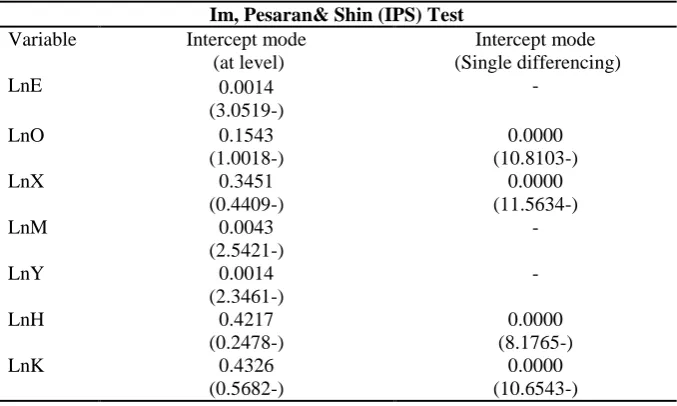
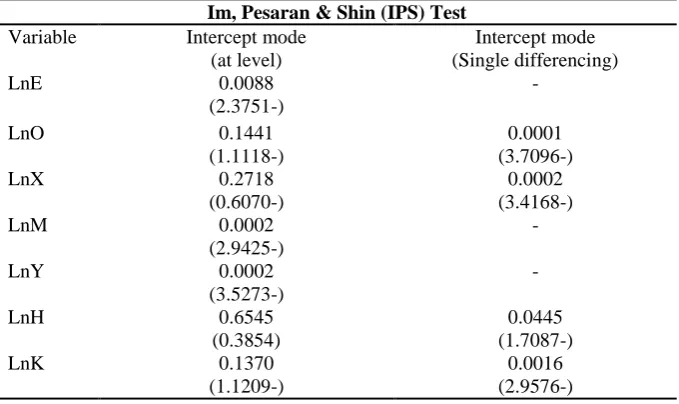
The stability of variables was examined through Im, Pesaran& Shin (IPS) test. The IPS is one of the important unit root tests in panel data. In this test, the null hypothesis suggests there is a unit root. The results of this test have been summarized in Table (1).
According to the results in Tables (1) and (2), energy consumption, imports and GDP are stable at level (I(0)), while total trade (exports and imports combined), exports, human capital and physical capital are not stable and can be stabilized through a single differencing (I(1)).Generally speaking, however, all variables are stable at I(1). Given that the variable have been stabilized through a single differ-encing, it is essential to examine the cointegration of variables.
Table 1: Results of Stability Test for Developing Countries Im, Pesaran& Shin (IPS) Test
Intercept mode (Single differencing) Intercept mode
(at level) Variable
- 0.0014
(3.0519-) LnE
0.0000 (10.8103-) 0.1543
(1.0018-) LnO
0.0000 (11.5634-) 0.3451
(0.4409-) LnX
- 0.0043
(2.5421-) LnM
- 0.0014
(2.3461-) LnY
0.0000 (8.1765-) 0.4217
(0.2478-) LnH
0.0000 (10.6543-) 0.4326
(0.5682-) LnK
Table 2: Results of Cointegration Test for Developing Countries Im, Pesaran & Shin (IPS) Test
Intercept mode (Single differencing) Intercept mode
(at level) Variable
- 0.0088
(2.3751-) LnE
0.0001 (3.7096-) 0.1441
(1.1118-) LnO
0.0002 (3.4168-) 0.2718
(0.6070-) LnX
- 0.0002
(2.9425-) LnM
- 0.0002
(3.5273-) LnY
0.0445 (1.7087-) 0.6545
(0.3854) LnH
0.0016 (2.9576-) 0.1370
(1.1209-) LnK
Resource: Research Calculations 5.2 Cointegration Analysis
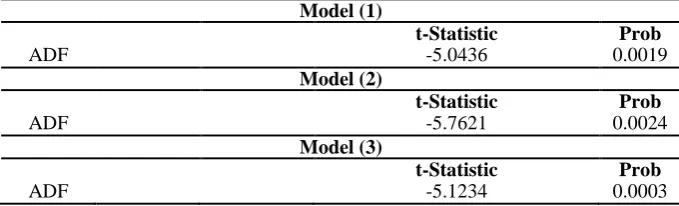
It is highly crucial to examine whether there is cointegration in the combined data. Cointegration can help avoid the occurrence of spuri-ous regression and determine the long-term relationship between vari-ables. Kao test was used to assess the cointegration of varivari-ables.
In particular, the results in Tables (3) and (4) indicate a long-term relationship between:1) total trade (exports and imports combined), energy consumption, human capital and physical capital, and GDP, 2)exports, energy consumption, human capital, physical capital and GDP, and 3) imports, energy consumption, human capital, physical capital and GDP. According to the results of Kao test, it can be argued that although the variables are stable at level (1)I, they are at zero cointegration level (Kao & Chiang, 1999).
Table 3: Results of Cointegration Test for Developing Countries Model (1)
t-Statistic Prob
ADF 4.0356- 0.0007
Model (2)
t-Statistic Prob
ADF 4.0095- 0.0006
Model (3)
t-Statistic Prob
ADF 4.0336- 0.0023
Table 4: Results of Cointegration Test for Developing Countries Model (1)
t-Statistic Prob
ADF -5.0436 0.0019
Model (2)
t-Statistic Prob
ADF -5.7621 0.0024
Model (3)
t-Statistic Prob
ADF -5.1234 0.0003
Resource: Research calculations 5.3 Model Estimation
After the unit root and cointegration tests, it is necessary to conduct the diagnostic tests to determine the type of estimation model.In order to ensure the members of sample group are significant; the group significance test was used. For this purpose, the fixed effects test was employed. If the calculated F-statistic is greater than the F in table, Ho
(equal intercepts) is rejected, and different intercepts should be insert-ed into model estimation. As a result, the panel method can be usinsert-ed for estimation. At the next stage, Huasman Test was performed to specify whether the difference in intercepts of cross-sectional units are constant or random functions can explain more clearly the difference between the units. Hausman test focuses on Ho based on consistency
of random effect estimates versus H1 based on inconsistency of
ran-dom effect estimates. If Ho is rejected, the constant effect method is
employed for estimation. Otherwise, estimation will involve the ran-dom effects method. The following section will elaborate each of the above estimates through the corresponding diagnostic tests.
4.3.1 Model Estimation for Developing Countries
Based on the results in Table (5), in all developing countries, Ho is
rejected and different intercepts should be inserted in the estimation. As a result, the panel method can be used for estimation.
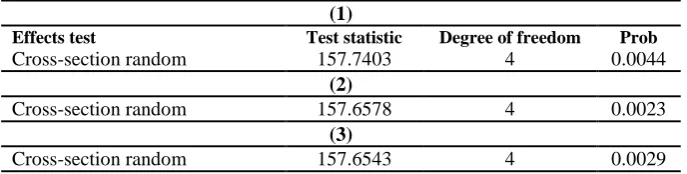
At this point, the type of estimation method with respect to fixed or random effects was examined through Hausman test. The results of Hausman test in Table (6) suggested that Ho was rejected about the
Table 5: Results of Fixed Effects Test for Developing Countries (1)
Prob Degree of freedom
Test statistic Effects test
0.0000 (92, 7)
69.6861 Section F- Cross
0.0000 7 191.4536 Cross-section Chi-square (2) 0.0000 (92, 7) 69.6541 Section F- Cross
0.0000 7 191.6531 Cross-section Chi-square (3) 0.0000 (92, 7) 69.8751 Section F- Cross
0.0000 7
191.8731 Cross-section Chi-square
Resource: Research Calculations
Table 6: Hausman Test for Developing Countries (1)
Prob Degree of freedom
Test statistic Effects test 0.0000 4 187.3161 Cross-section random (2) 0.0000 4 187.6531 Cross-section random (3) 0.0000 4 187.8952 Cross-section random
Resource: Research Calculations
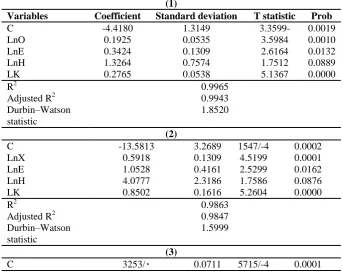
Table 7: Results of Model Estimation for Developed Countries (1) Prob T statistic Standard deviation Coefficient Variables 0.0019 3.3599- 1.3149 -4.4180 C 0.0010 3.5984 0.0535 0.1925 LnO 0.0132 2.6164 0.1309 0.3424 LnE 0.0889 1.7512 0.7574 1.3264 LnH 0.0000 5.1367 0.0538 0.2765 LK 0.9965 R2 0.9943 Adjusted R2
1.8520 Durbin–Watson statistic (2) 0.0002 1547/-4 3.2689 -13.5813 C 0.0001 4.5199 0.1309 0.5918 LnX 0.0162 2.5299 0.4161 1.0528 LnE 0.0876 1.7586 2.3186 4.0777 LnH 0.0000 5.2604 0.1616 0.8502 LK 0.9863 R2 0.9847 Adjusted R2
0.0000 5.1367
0.0538 0.2765
LnM
0.0132 2.6164
0.1309 0.3424
LnE
0.0889 1.7512
0.7574 1.3264
LnH
0.0010 3.5984
0.0535 0.1925
LK
0.9861 R2
0.9843 Adjusted R2
1.8828 Durbin–Watson
statistic
Resource: Research Calculations
The results of model estimation in Table (7) have been summarized as follows:
- Total trade has a positive effect on GDP by about 0.19 at a signif-icance level of 1%.
- Export has a positive effect on GDP by about 0.59 at a signifi-cance level of 1%.
- Import has a positive effect on GDP by about 0.27 at a signifi-cance level of 1%.
- It can be argued that in the candidate developed countries, the role of exports was more prominent than imports and total trade.
- Energy consumption has a positive effect on GDP at a signifi-cance level of 5%.
- Coefficient of energy consumption in the candidate developed countries for Equations (1), (2) and (3) are 0.34, 1.05 and 0.34, respec-tively.
- Human capital has a positive effect on GDP at a significance level of 10%.
- Coefficients of human capital in the candidate developed countries for Equations (1), (2) and (3) are 1.32, 4.07 and 1.32, respectively.
- Physical capital has a positive effect on GDP at a significance level of 1%.
- Coefficients of physical capital in the candidate developed coun-tries for Equations (1), (2) and (3) are 0.27, 0.85 and 019, respectively.
- Based on Durbin-Watson value, there is no autocorrelation problem in the models.
4.3.2 Model Estimation for Developing Countries
Based on the results in Table (8), in all developing countries, Ho is
rejected and different intercepts should be inserted in the estimation. As a result, the panel method can be used for estimation.
Table 8: Results of Fixed Effects Test for Developing Countries (1)
Prob Degree of freedom
Test statistic Effects test
0.0000 (85, 7)
48.0598 Section F- Cross
0.0000 7
160.2838 Cross-section Chi-square
(2)
0.0000 (85, 7)
48.0986 Section F- Cross
0.0000 7
160.4321 Cross-section Chi-square
(3)
0.0000 (85, 7)
48.1287 Section F- Cross
0.0000 7
160.6543 Cross-section Chi-square
Resource: Research calculations
At this point, the type of estimation method with respect to fixed or random effects was examined through Hausman test. The results of Hausman test in Table (9) suggested that Ho was rejected about the
consistency of random effect estimates in all countries under study, and fixed effect estimation should be employed.
Table 9: Hausman Test for Developing Countries (1)
Prob Degree of freedom
Test statistic Effects test
0.0044 4
157.7403 Cross-section random
(2)
0.0023 4
157.6578 Cross-section random
(3)
0.0029 4
157.6543 Cross-section random
Resource: Research calculations
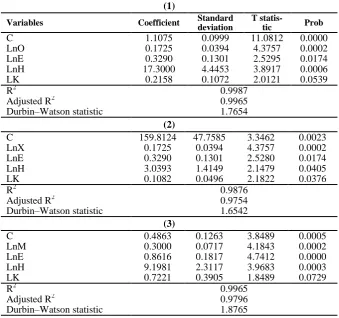
The results of model estimation in Table (10) have been summa-rized as follows:
- Total trade has a positive effect on GDP by about 0.17 at a signif-icance level of 1%.
- Exports have a positive effect on GDP by about 0.17 at a signifi-cance level of 1%.
signifi-cance level of 1%.
- It can be argued that in the candidate developing countries, the role of imports was more prominent than exports and total trade.
- Energy consumption has a positive effect on GDP at significance levels of 5% and 1%, respectively.
Table 10: Results of Model Estimation for Developing Countries (1) Prob T statis-tic Standard deviation Coefficient Variables 0.0000 11.0812 0.0999 1.1075 C 0.0002 4.3757 0.0394 0.1725 LnO 0.0174 2.5295 0.1301 0.3290 LnE 0.0006 3.8917 4.4453 17.3000 LnH 0.0539 2.0121 0.1072 0.2158 LK 0.9987 R2 0.9965 Adjusted R2
1.7654 Durbin–Watson statistic (2) 0.0023 3.3462 47.7585 159.8124 C 0.0002 4.3757 0.0394 0.1725 LnX 0.0174 2.5280 0.1301 0.3290 LnE 0.0405 2.1479 1.4149 3.0393 LnH 0.0376 2.1822 0.0496 0.1082 LK 0.9876 R2 0.9754 Adjusted R2
1.6542 Durbin–Watson statistic (3) 0.0005 3.8489 0.1263 0.4863 C 0.0002 4.1843 0.0717 0.3000 LnM 0.0000 4.7412 0.1817 0.8616 LnE 0.0003 3.9683 2.3117 9.1981 LnH 0.0729 1.8489 0.3905 0.7221 LK 0.9965 R2 0.9796 Adjusted R2
1.8765 Durbin–Watson statistic
Resource: Research calculations
- Coefficient of energy consumption in the candidate developing coun-tries for Equations (1), (2) and (3) are 0.32, 0.32 and 0.87, respectively.
- Human capital has a positive effect on GDP at significance levels of 1%, 5% and 1%, respectively.
- Coefficients of human capital in the candidate developing countries for Equations (1), (2) and (3) are 17.30, 3.03 and 9.19, respectively.
- Coefficient of physical capital in the candidate developing coun-tries for Equations (1), (2) and (3) are 0.21, 0.10 and 0.72, respectively.
- Based on Durbin-Watson value, there is no autocorrelation problem in the models.
- According to values of R2 and adjusted R2, it can be stated that energy consumption, total trade, export, import, human capital and physical capital desirably responded to variations of gross domestic production as the dependent variable.
6. Conclusions and Policy Recommendations
This study attempted to investigate the effect of foreign trade, energy consumption, human capital and physical capital on production rates in 8 candidate developing countries and 8 candidate developed coun-tries between 2002 and 2014.The new extended models were evaluat-ed through theoretical and empirical principles, panel cointegration and dynamic ordinary least squares (DOLS).The results were exam-ined in more detail based on foreign trade as a whole (exports and im-ports combined), in addition to exploring export and import separate-ly. In this regard, the ISP test was conducted to evaluate the unit root of model variables. The results of unit root test confirmed the stability of panel data at level I(1). Then, the cointegration analysis was per-formed using Kao method. The results of Kao test suggested that siduals were cointegrated at level I(0), which confirmed the false re-gressions as well as a long-term strong correlation between: 1) total trade (exports and imports combined), energy consumption, human capital and physical capital, and GDP, 2)exports, energy consumption, human capital, physical capital and GDP, and 3) imports, energy con-sumption, human capital, physical capital and GDP. Finally, the re-sults of estimates showed that GDP was affected by total trade (exports and imports combined), exports, imports, energy con-sumption, human capital and physical capital in the countries under study. The results have been provided in more detail as follows:
and (3) are 0.32, 0.32 and 0.87, respectively.
- This positive relationship can be associated with large share of energy in production. In fact, production accounts for the largest ener-gy consumer in any economy. In other words, the process of produc-tion and economic growth is impossible without energy.
2) Total trade index (exports and imports combined), import and export separately have a positive significantly positive effect on pro-duction (Hypothesis 1 proven), i.e. exports plays a more prominent role than imports in developed countries. In the candidate developing countries, the role of imports was more prominent than exports and total trade. This can be justified by large volume of exports of capital goods from developed countries and large volume of import of capital goods and raw materials in developing countries. Based on available business statistics, developing countries have become importing coun-tries, whereas developed countries have become exporting countries.
- According to the theories of economic growth, trade leads to ex-pansion of production and economic growth through improved re-source allocation, access to better technology and intermediate goods, adopting economies of scale, and increased domestic competition.
3) Physical capital has a significantly positive effect on production (Hypothesis 4 proven).Coefficients of physical capital in the candidate developed countries for Equations (1), (2) and (3) are 0.27, 0.85 and 019, respectively. Similarly, coefficient of physical capital in the can-didate developing countries for Equations (1), (2) and (3) are 0.21, 0.10 and 0.72, respectively.
- The reason behind the significant positive correlation is obvious. Investment is regarded as a major component of production, economic growth and development in any economy. In fact, it is considered one of the basic necessities of production and economic progress, so that lack of financing will lead to sluggish production and economic growth and extravagant costs.
- The reason for this positive correlation is obvious. Nowadays, in-dividuals play a key role in the growth and development of organiza-tions. An overview of today's growth rate of labor and development of modern organization would prove the same fact. In fact, the qualita-tive characteristics of humans can provide a type of capital, because these characteristics can enhance productivity.
- Given the results, several recommendations are made as follows: 1) Given the positive correlation between energy consumption and production, governments need to take major steps in management of en-ergy consumption. The enen-ergy sector is so vital that authorities cannot be indifferent to overconsumption patterns; otherwise there will be detri-mental consequences against the energy reserves. Given that the produc-tion process is impractical without energy consumpproduc-tion and the fact that energy reserves are limited, the government need to design and imple-ment reasonable economic policies and take major steps in the field of energy management and expand production and economic growth. In-stances of such policies involve the security of energy supply according to each specific economy, enhancing energy efficiency, utilization of re-newable energy and adoption of punitive and encouraging policies. In other words, an optimal combination of renewable and non-renewable energy resources has been selected to as much as possible minimize the consumption of non-renewable energy, no matter how expensive the uti-lization of renewable energy is. Put simple, it is critical to build capacities for production of renewable energy, thus paving the way for consumption of non-fossil energy carriers in the production sector. In fact, fossil fuels need to be replaced by clean energy resources, thereby to facilitate the growth of added value in various economic spheres. Nevertheless, the prices energy carriers are high and their production capacity is limited against non-renewable energy.
de-velopment in the countries under study, restricting the opportunity to promote production particularly in developing countries such as Iran.
3) Given the positive relationship between human capital and pro-duction, it is recommended to expand investment in human resources. Governments should devise a well-calculated plan to train the work-force, while implementing desirable policies in management of human resources. Additionally, it is vital to focus on quality and quantity of labor in an integrated perspective.
As the opportunities are provided, the labor will actualize its capa-bilities and skills in more fitting job positions and various economic sectors in terms of expertise. Moreover, the human capital index will more effectively contribute to the production process.
4) Given the positive relationship between fixed capital and pro-duction, it can be asserted that expansion of investment in various production sectors can facilitate the development of production and economic growth.
References
Aleomran, R., & Aleomran, A. (2012). Impact Assessment Human Capital Promotion on Economic Growth of Selected OPEC Countries. Professional Magazine of Parks and Development Centers, 32, 41-53.
Apergis, N., & Payne, J. E. (2010). Energy Consumption and Growth in South America: Evidence from a Panel Error Correction Model. Energy Economics, 32, 1421-1426.
Azamzadeh, M., Khalilian, S., & Mortazavi, A. (2011). Selection of Production Function and Estimation of Energy Importance Ratio. Ag-riculture and Development Economy, 76, 205-230.
British Petroleum Statistical Review of World Energy. (2016). Retrieved from http://www.bp.com/statisticalreview.
Carnwall, D. (1977). Economic Growth in East Asia. NBER Working Paper, 8330, Retrieved from
Cavel, Y. (1980). Recurrent Devaluation and Speculative Attacks on Mexico Peso. Journal of Political Economy, 5, 148-66.
Damankeshide, M., Abbasi, A., Arabi, H., & Ahmadi, H. (2013). Studding Relations of Energy Consumption and Economic Growth in Selected Countries of Iran’s Twenty Outlooks. Macro Strategic Policies Magazine, 2, 61-97.
Daly, H. (1997). Georgescu–Roegen versus Solow/Stiglitz. Ecological Economics, 22, 261- 266.
Farjadi, G. R., & Lali, M. R. (1997). Impact of Capital Goods and Intermediate Imports on Economic Growth in Iran. Commercial Bulletin, 4, 31-53.
Fitzová, H., & Žídek, L. (2015). Impact of Trade on Economic Growth in the Czech and Slovak Republics. Economics and Sociology, 2, 36-50.
Halicioglu, F. (2011). A Dynamic Econometric Study of Income, Energy and Exports in Turkey. Energy, 36, 3348-3354.
Heidari, H., & Saeedpoor, L. (2011). Dynamic Econometric Analysis of the Relationship between GDP, Energy Consumption, Iran's Non-Oil Exports. Energy Economic Research’s Magazine, 33, 53-83.
Hoseininasab, E., & Ghuchi, R. (2007). Foreign Trade and Productivi-ty Growth in Manufacturing Industries of Iran. Economic Research’s Magazine,1, 75-92.
Hu, B., & Mcaleer, M. J. (2005). Estimation of Chinese Agricultural Production Efficiencies with Panel Data. Mathematics and Computers in Simulation, 68, 474-483.
Lopez, E., & Serrano, G. (2003). Complementarily Between Human Capital and Trade in Regional Technological Progress. Regional Quantities Analysis Research Group. Retrieved from
HTTP://citeseerx.ist.psu.edu/viewdoc/download?doi=10.1.1.531.9749&rep= rep1.
Myrdal, G. (1970). Circular Cumulative Causation Contributed to the Development of Modern Non-Equilibrium Economics. Retrieved from https://books.google.com/books?isbn=1135256438.
Sadegi, K., Gamari, N., Feshari, M. (2013). Studding Causality Relation between Energy Consumption and GDP in MENA Region. Macroeconomic Bulletin, 8, 121- 140.
Sadorsky, P. (2012). Energy Consumption, Output and Trade in South America. Energy Economics, 34, 476-488.
--- (2011). Trade and Energy Consumption in the Middle East. Energy Economics, 33, 739-749.
Shishevani, M. (2011). Studding Direct and Indirect Effects of Human Capital on Economic Growth in Iran during 1976-2006 (Unpublished Master's Thesis). University of Science and Research, Tehran.
Stern, D. (2004). Economic Growth and Energy. Encyclopedia of Energy, 2, 35–51.
Tayyebi, K., & Tavakkoli, A. (2000). An Analytical Framework of Interaction between Intermediate Imports - Capital and Non-oil Exports in the Industrial Sector of the Iranian Economy. Commercial Bulletin, 8)15(, 1-24.
Vaziri, J. (1978). Economics of Education (Trans. by Mohammad Borhanmanesh). Tehran: University of Tehran Publication.
World Bank. (2016). Retrieved from
http://www.worldbank.org/data/onlinedatabases.html.