Print ISSN 2383-451X Online ISSN: 2383-4501 Web Page: https://jpoll.ut.ac.ir, Email: [email protected]
Determination of nitrate utilization efficiency of selective strain of
Bacillus
sp. isolated from Eutrophic Lake, Theerthamkara,
Kasaragod, Kerala
Usharani, K.1,2*, Sruthilaya, K.1 and Divya, K.1
1. Department of Environmental Science, School of Energy, Environment and Earth Sciences, Central University of Kerala, India
2. Division of Environmental Microbiology, Department of Environmental Sciences, Bharathiar University, TN, India
Received: Accepted:
ABSTRACT: Nitrate pollutants increase the growth of algal bloom, resulting in fresh water eutrophication. The high nitrogen level in wastewater has become a growing concern, which has risen the necessity to develop efficient nitrogen removal techniques. Biological denitrification, which is the reduction of oxidized nitrogen compounds like nitrate or nitrite to gaseous nitrogen compounds, is the most important and widely used method to treat nitrate wastes as it enables the transformation of nitrogen compounds into harmless nitrogen gas. As such, this study collected samples from Eutrophic Lake, picking isolates of bacterial strain with good growth rates in the nitrate medium. The selected bacterial strains were cultured on media 1and 2 and by means of UV-visible spectrophotometer, the nitrate removal efficiency and growth were detected at 410 nm and 600 nm OD respectively. After comparing three bacterial strains, it was found that RN1 had a higher efficiency in nitrate removal at 1000ppm nitrate concentration. At an optimum temperature of 37°C, pH of 7, and agitation of 121 rpm, after 432 hrs of the treatment, RN1 showed an optimum growth, equal to 0.1859 OD in 1000ppm nitrate solution with dextrose. Also the spectral analysis of RN1 strain showed 85% removal efficiency, thus making this strain the best one. Confirmed and identified as Bacillus
species, it can be recommended for the bioremoval process of nitrate from wastewater.
Keywords: Bacillus sp., bioremoval process, eutrophic water, nitrate.
INTRODUCTION
Pollution of water resources by excessive presence of nitrogen compounds such as nitrate, nitrite, and ammonium, is a real health-related and environmental threat. Unrestrained utilization of artificial fertilizers as well as uncontrolled discharge
Corresponding author E-mail: [email protected];
of raw have been known to cause large amounts of nitrate and phosphate permeate ground and surface waters (Peavy et al., 1985; Lin and Wu, 1996; Shrimali and Singh, 2001; Bogardi and Kuzelka, 1991). The discharge of nitrogen components into the environment is hazardous for not only human but animal health also, and nitrate pollution and remediation is at the same time a global issue and challenge.
Nitrate excess in the drinking water may cause blue disease in babies, called methemoglobinemia in new-born infants along with other illnesses (Ozturk and Bektas, 2004). The most important environmental problems, caused by nitrogen and phosphorus compounds, are eutrophication of water supplies and infectious disease (Barber and Stuckey, 2000). Nitrate pollutants increase the growth of algal bloom, leading to fresh water eutrophication. These components are involved in the eutrophication of surface waters as well as high levels of nitrate and nitrite ions in drinking water, entails a substantial risk for human health (Jorgensen, 2001; Viessman and Hammer, 2005; Chiban et al., 2012; WHO, 1984).
In addition, excessive levels of nitrate ions in drinking water may cause health problems, especially for infants under six months of age and pregnant women (Seidel et al., 2008). The Maximum Acceptable Concentration (MAC) for nitrate-nitrogen in Canadian drinking water has been established as 10 mg N-NO3-/L (Health Canada, 2003; WHO, 2007). Moreover, in 1990 Environmental Protection Agency (EPA) indicated that 250,000 water supply sources had Maximum Contaminant Levels (MCL) for nitrate. In 2004, the World Health Organization (WHO) found that 30% of the 2,000 sources, surveyed in the world, had more than 24 mg N-NO3-/L (Archna et al., 2012). Inside body, once nitrate is converted to nitrite, the oxygen-carrying capacity in blood is reduced, resulting in a condition called "methaemoglobinaemia", also known as "blue baby syndrome" (WHO, 1984). Moreover, the reaction between nitrite and secondary or tertiary amine in acidic organs such as in the human stomach could lead to the formation of Nitroso compounds (NOC), which are known to be carcinogenic, teratogenic, and mutagenic (Pontius, 1993; Mikuska and Vecera,
2003;). After a while, NOC might cause stomach and bladder cancer.
Microorganism-based bioremediation is one of the biological wastewater-treatment methods or processes to eliminate nitrate contaminants from aquatic system; therefore, removal of nitrate and nitrite from water is of high account for environment and health. Nowadays, many traditional methods have been applied to remove nitrate from wastewater. They include biological de-nitrification processes (Abe et al., 2002; Schipper et al., 2005; Bougard et al., 2006), chemical processes (Hu et al., 2001; Bae et al., 2002; Cengeloglu et al., 2006), and physical operation (Elmidaoui et al., 2001). However, they are expensive, produce increased volumes of sludge, and require complex and strict control of the operating conditions (Chatterjee and Woo, 2009; Chatterjee et al., 2009). Recently, nitrate removal via adsorption methods has attracted much attention; however, these adsorbents exhibit low adsorption capacity, due to limited surface area. Furthermore, bacteria with a marked resistance to high salinity are generally employed when treating polluted seawater; and strains, isolated from critically polluted environments, are used for the treatment of special industrial wastewater.
MATERIALS AND METHODS Sample collection
The study included three sample types, collected from different places in and around Central University of Kerala (the riverside transit campus) in order to isolate the nitrate-utilizing bacteria. Water samples such as Eutrophic pond water from the Theerthamkara pond were taken to laboratory under sterile conditions.
Serial dilution of water sample
The sample, collected from the Eutrophic Lake, was serially diluted by adding 9 to 10 ml distilled water to 1ml of the sample, which was also added to the petriplates from each dilution, being incubated at 37c for 24 hrs. The number of cells was counted and in order to isolate the pure single colony, streak plate method was utilized.
Isolation and Identification of nitrate removing bacteria
The bacteria were isolated from collected samples on Nutrient Agar Media (NAM) from the numerous colonies, obtained from the NAM plates. The colony with special characteristics was picked out and streaked on media 1 and 2. Afterwards pure isolated colony was taken from the plates in order to be cultured. (Media1: MgCl 2-1.4 g/l; Potassium sulphate-10g/l; Agar-15g/l; pH-7 and Media 2: Peptone casein -10g/l; Protease peptone -10 g/l; Dipotassium phosphate-1.5g/l; MgSo4 1.5g/l; Agar -15g/l; pH -7).
Bacterial degradation of nitrate
Determination of bacterial growth in nitrate solution using UV-vis spectrophotometer
One ml of the sample was inoculated into different concentrations of nitrate solution with 0.5% dextrose (pH=6.7) as well as the control, without any culture, which was taken in a 250 ml conical flask, containing 200 ml of the solution, placed in the shaking incubator. Bacterium growth was
measured by taking the optical density (O.D) reading at 600 nm from 0 hrs to 432 hrs at regular intervals against deionised water as blank, using UV-visible spectrophotometer. The experiments were repeated three times and their mean values were used for the result analysis.
Bacterial culture inoculation and nitrate treatment
Preparation of stock solution
Stock solution was prepared using potassium nitrate: 1g potassium nitrate was weighed and poured into a standard flask, making an amount of 1000ml in a standard flask using deionised water. From that stock solution of nitrate solutions, the desired ones were prepared with different concentrations (500 ppm and 1000 ppm).
Culture inoculation in nitrate solution One ml of the sample was inoculated in different concentrations of nitrate solution with 0.5% dextrose (pH=6.7) as well as the control, without any culture, taken in a 250-ml conical flask, containing 200250-ml solution, placed in the shaking incubator. The nitrate level in the synthetic solution was estimated every 24 hrs by centrifuging the sample. The nitrate level in the synthetic solution was estimated at different time intervals by Salicylic acid method (i.e. Chromotropic acid method-ammoniacal nitrogen in water; APHA, 1998) at 410 nm via a spectrophotometer. Control experiments were also repeated with the same nitrate solution concentrations, yet without any inoculum. They were repeated three times and their mean values were taken into consideration during the result analysis.
Spectrophotometric analysis
measured via a pipette with a 50-ml beaker. Added to that, was 0.8 ml of 5% (w/v) salicylic acid in conc. H2SO4. After 20 minutes 19 ml NaOH was added, to increase the pH above 12. Then the sample was allowed to cool down, its absorbance measured in terms of optical density (OD) at 410 nm, via a UV-visible spectrophotometer. The relevant calibration graph consists of an absorbance plot against the concentration for a series of standard solutions, the concentrations of which are accurately known. The experiments were repeated three times; their mean values, used for the result analysis.
pH change
The change in the pH of the bacterial strain, inoculating samples with varying concentrations at different time intervals, was estimated using digital pH meter (Scientific Tech Advanced pH meter, mode ST-200).
Morphological and biochemical characterization
Gram staining revealed the morphological characteristics of the isolated bacterial strains, whereas spore staining showed whether the organism produced any spore or not. Motility test was able to determine the organism which is motile or non-motile. Catalase test was performed to check the ability of the isolated strains to degrade Hydrogen Peroxide and Oxidase test to detect the existence of cytochrome oxidase enzyme. IMViC test, however, was performed to identify the organisms and carbohydrate utilization tests revealed the ability of isolated strains in fermentation of sugars like glucose, lactose, sucrose, and mannitol. The identification occurred on the basis of morphological and biochemical characteristics as per Bergeys Manual of Systemic Bacteriology (Holt et al., 1994).
RESULTS AND DISCUSSION
Nitrate is a common pollutant to be found in water. Its removal is an important
process to reduce environmental problems and social impact. Thus, this study used different bacterial strains to remove the nitrates with the effective one being selected. The high nitrogen level in wastewater has become a growing concern, which has increased the necessity to develop efficient N-removal techniques. High nitrate wastes (>1000 ppm NO3-N) are usually generated by fertilizer, metal finishing, and nuclear industry (Glass and Silverstein, 1998 and 1999). Dealing with such wastes has posed a challenge for these industries. When such wastewaters are released into water streams, they cause various negative effects, like methehemoglobinemia, on infants, also being suspected to cause cancer (Forman et al., 1991). In USA the permissible level for nitrate in drinking water is 10 ppm NO3-N (USEPA, 1987).
Biological denitrification, i.e. the reduction of oxidized nitrogen compounds like nitrate or nitrite to gaseous nitrogen compounds, is the most important and widely used method to treat nitrate wastes as it enables the transformation of nitrogen compounds into harmless nitrogen gas. It happens by various chemorganotrophic, lithoautotrophic, and phototrophic bacteria as well as some fungi (Shoun and Tanimoto, 1991; Zumft, 1997), especially under oxygen-reduced or anoxic conditions (Focht and Chang, 1975). Denitrifiers can be naturally found in sediments, surface waters, and soils, not to mention municipal and industrial wastes. The universality and common distribution of denitrifies is related to the complexity of their species and differing physiological requirements.
Isolation and selection of nitrate utilizing bacteria from the sample
dilution, itself carried out by pour plate technique that used nutrient agar medium. Table 1 and Table 2 represent the serial dilution of two samples (soil and water). Results showed that the number of colonies, forming a unit, dropped when dilution ascended.
A sum of three bacterial isolates was screened for their growth on nitrate-containing media. Three of them showed the best growth on nutrient agar plates. The selected bacterial strains showed rich
growth in nitrate-containing selective media, thus they were chosen for further study (Figs. 1 and 2). Here the study started with three strains (EW1, EW2, and RN1). Thanks to spectral analysis, the efficiency of different bacterial strains was observed, among which RN1 showed the highest efficiency in nitrate removal. Further identification processes, including biochemical tests and grams staining procedure, were performed on that strain.
Table 1. Average Colony Forming Unit (CFU/µl) from Eutrophic Lake
Sample Dilution Dilution factor Number of colonies
Average colony forming unit (CFU/µl)
1 10¯¹ 10¹ 40x4 160x10 CFU/µl
2 10¯² 10² 23x4 92x10² CFU/µl
3 10¯³ 10³ 17x4 68x10³ CFU/µl
4 10¯⁴ 10⁴ 15x4 60x10⁴ CFU/µl
5 10¯⁵ 10⁵ 12x4 48x10⁵ CFU/µl
Table 2. Average Colony Forming Unit (CFU/µl) from soil sludge
Sample Dilution Dilution factor Number of colonies
Average colony forming unit (CFU/µl)
1 10¯¹ 10¹ 100x4 400x10 CFU/µl
2 10¯² 10² 80x4 320x10² CFU/µl
3 10¯³ 10³ 67x4 260x10³ CFU/µl
4 10¯⁴ 10⁴ 45x4 180x10⁴ CFU/µl
5 10¯⁵ 10⁵ 32x4 128x10⁵ CFU/µl
Fig. 1. Experimental study of nitrate bioremoval by selective bacterial strains from Eutrophic Lake after 24 hrs (EW1, EW2, RN1 and Control)
EW1
Control 1 EW2
Fig. 2. (a) Growth of selective bacterial strain (Bacillus sp) on Nutrient agar with nitrate and (b) gram staining microscopic observation at 40X
Detection of nitrate removal
Bacterial growth using UV-visible spectrophotometr
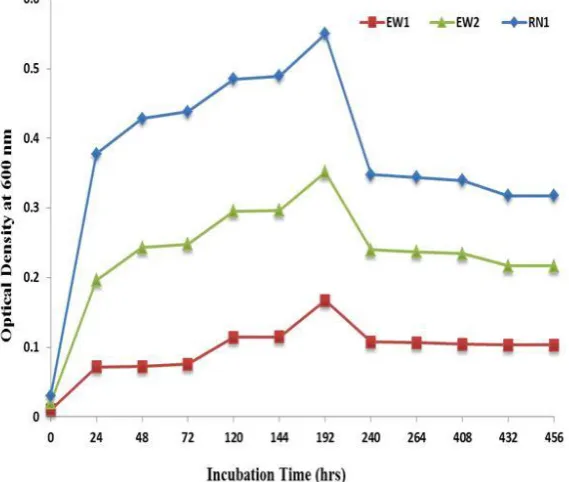
Figure 3 demonstrates the growth of three strains in 500 ppm. Compared to the control solution, the samples showed a large increase in their growth. The figure also includes the growth curve of three different bacterial strains in 500ppm nitrate concentration, showing the different phases (Log phase, Stationary phase) to be seen in the bacterial growth curve. The growth was
studied by monitoring the optical density for a period of 432 hrs, during which time an increase was observed in the growth rate for EW1, EW2, and RN1 (accounting to 0.072-0.1074, 0.1245-0.1132, and 0.1811-0.1011 respectively). During 192 hours of incubation, the maximum rates proved to be 0.1671 OD for EW1, 0.1843 OD for EW2, and 0.1985 OD for RN1. The culture reached stationary phase during 192 hrs of incubation and began its decline phase during 432 hrs of incubation.
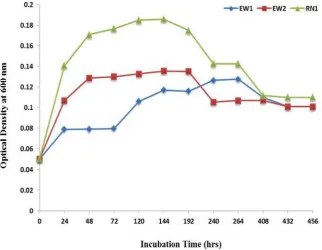
Figure 4 shows the growth of strains in 1000 ppm. Compared to the control solution, the samples show a large increase in their growth. The figure also includes the growth curve of three different bacterial strains in 1000 ppm nitrate concentration, showing the different phases (Log phase, Stationary phase), encountered in the bacterial growth curve. The growth was studied by monitoring the optical density for a period of 432 hours. The
growth rate indicated an increase (i.e. 0.05-0.101OD, 0.05-0.101OD, and 0.05-0.11OD) for EW1, EW2, and RN1 respectively. Maximum rates were 0.1276 OD for EW1 during 264 hrs, 0.1069 OD for EW2 during 264 hrs, and 0.1859OD for RN1 during 144 hrs of incubation. The culture reached stationary phase after 408 hrs and 432 hrs of incubation, then to reach its decline phase after the latter time period.
Fig. 4. Time course of growth for bacterial strains cultured in nitrate solution at 1000 ppm
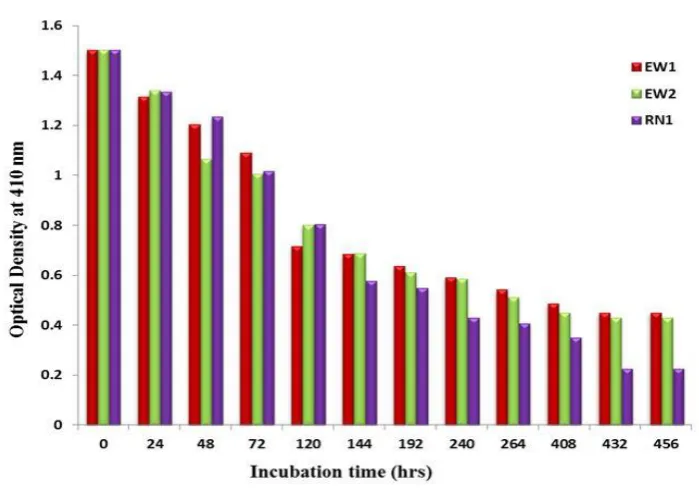
Nitrate removal in terms of Optical Density (OD) value at 410 nm by selective isolate using UV-vis spectrophotometr Based on Figures 5 and 6 which concern the nitrate removal efficiency of bacterial strains at 500 ppm nitrate concentration, it can be seen that the nitrate concentration of the three bacterial strains plummet in terms of OD value at 410nm. Comparing the three strains, RN1 showed the highest nitrate removal efficiency, decreasing the concentration from initial OD of 0.7 to 0.133 OD at 500 ppm and from initial OD of 1.5 to 0.227 OD at 1000 ppm.
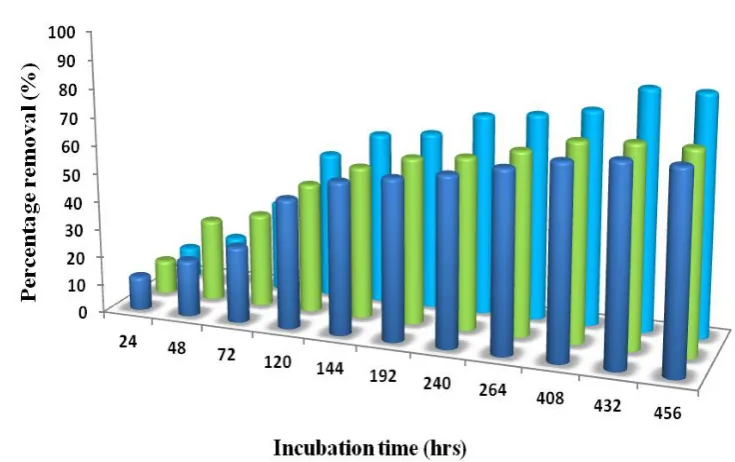
Figures 7 and 8 represent the percentage of nitrate removal efficiency at 500 ppm
bacterial strains, RN1 showed the highest nitrate removal efficiency in both 500 and 1000 ppm. These strains showed optimal growth at 37°C, pH=7, agitation of 121 rpm, and time period of 432 hrs. Nair et al. (2007) reported that the rate of nitrate removal was due to the two enzymes of
nitrate reductase (NaR) and nitrite reductase (NiR). This, as a result, gives an insight to understanding the metabolic activity during the whole process of denitrification by the isolate, which was not complete with the nitrate and nitrite degradation profiles.
Fig. 5. Nitrate bioremoval of bacterial strains at 500ppm nitrate
Fig. 7. Nitrate bioremoval efficiency of selective bacterial strains at 500ppm
Fig. 8. Nitrate bioremoval efficiency of selective bacterial strains at 1000 ppm
pH change
Figure 9 shows pH variations in nitrate solution during the incubation period. There is a large increase in the pH from 6 to 7. Optimal pH for denitrification is usually within neutral range (Wang et al., 1995; Casey, 1997). Nitrate removal at the investigated pH levels during 5.5 hrs occurred in a range between 75% and
Fig. 9. pH variations in nitrate solutions inoculated with selective bacterial strains after 432 hours of treatment
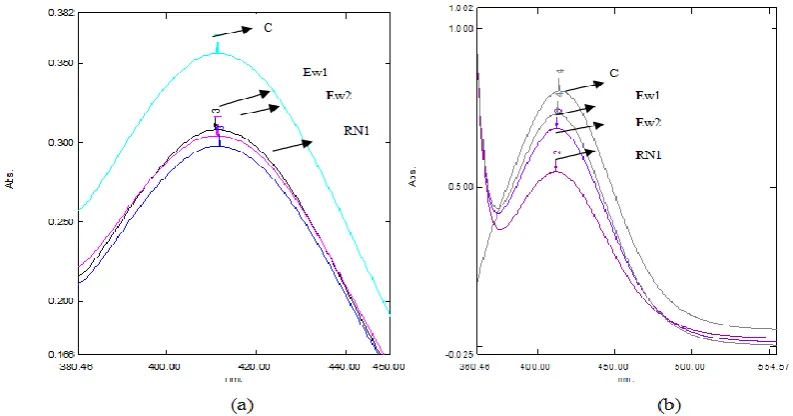
Spectral analysis of nitrate solution The preparation of the samples decreed taking an aliquot of nitrate solution, mixing it with concentrated H₂S04. NaOH was added to raise the pH above 12. Then, the samples were subjected to spectral analysis. The amount of nitrate in the samples was detected by UV Spectrophotometer. Figure 10 shows the spectral analysis of nitrate reduction by different bacterial strains in different concentration of nitrate solution (500 and 1000 ppm). The entire graph
demonstrates OD values at 410 nm of different strains, compared to the control solution. Unlike the control, it showed a huge difference in OD value, which prior to the treatment was 0.7 and 1.5 for 500 and 1000 ppm, respectively. However, after 432 hrs of incubation OD plummeted to 0.133 and 0.227 for 500 and 1000 ppm respectively, which means that the value of nitrate concentration descended after every day of incubation.
Morphology and biochemical characterization
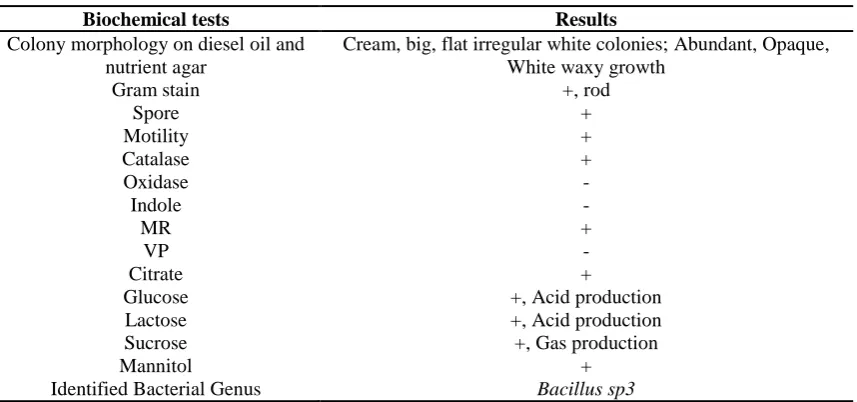
In this study, samples were collected from Eutrophic Lake. From the collected samples, the isolates of the bacterial strain, showing good growth in nitrate medium, were then selected. They got cultured in media 1 and 2. Morphology and biochemical studies proved to be positive. The nitrate removal study from the three selective bacterial strains showed that the bacterial strain, RN1, was a potential one. It was identified taxonomically, using morphological and biochemical tests (Table 3). The colony morphology of the selected potential bacterial strain, namely
RN1, was white in colour and irregular in shape. It was found to be gram positive with rod shaped bacterium (Fig. 2).
The optimum growth of RN1 and RN10 took place in 0.1985OD in 500 ppm and.1859 OD in 1000 ppm at an optimum temperature (37°C), pH (7), and agitation (121 rpm) after 432 hrs of the treatment period. Both the nitrate removal efficiency and the OD value were decreased during the first hour (the 0th one) to 432 hrs. The spectrophotometric analysis for nitrate removal showed that RN1 enjoyed an 81% removal efficiency at 500 ppm and an 85% one at 1000 ppm.
Table 3. Biochemical Characterization of selective bacterial strain
Biochemical tests Results
Colony morphology on diesel oil and nutrient agar
Cream, big, flat irregular white colonies; Abundant, Opaque, White waxy growth
Gram stain +, rod
Spore +
Motility +
Catalase +
Oxidase -
Indole -
MR +
VP -
Citrate +
Glucose +, Acid production
Lactose +, Acid production
Sucrose +, Gas production
Mannitol +
Identified Bacterial Genus Bacillus sp3
CONCLUSION
All told, the best bacterial strain proved to be RN1, confirmed and identified at genus level by several biochemical tests along with gram staining. Also, the identified bacterial strain was found to be Bacillus species. In conclusion, among the bacterial isolates Bacillus strain was observed to have maximum nitrate utilizing ability (81% in 500 and 85% in1000 ppm). The strain showed optimal growth at 37°C with pH=7, agitation of 121 rpm, and the time period lasting for 432 hrs. Result found that the obtained bacterial strain was capable of using nitrate at higher
concentrations (1000 ppm). The strain Bacillus sp. played a key role in nitrate utilization. Through this experiment, it can be said that nitrate nutrient removal load in wastewater can be reduced through this selective potential strain of Bacillus sp., thus avoiding the formation of Eutrophication. The strain reduced the load of nitrate from nitrate-rich wastewaters. The treated wastewater can be used for various purposes, including agriculture and other aquaculture activities.
ACKNOWLEDGEMENTS
Central University of Kerala and Bharathiar University, South India. He also wishes to extend her sincere gratitude to editor and reviewers.
Conflict of interest
The authors declare that there are no conflicts of interests regarding the publication of this manuscript.
REFERENCE
Abe, K., Imamaki, A. and Hirano, M. (2002). Removal of nitrate, nitrite, ammonium and phosphate ions from water by the aerial microalga Trentepohlia aurea. J. Appl. Phycol., 14, 129–134.
APHA (1998). American Public Health Association, American Water Works Association, Water Environment Federation. Standard Methods for the Examination of Water and Wastewater.
Archna, Sharma, S. K. and Sobti, R.C. (2012). Nitrate Removal from Ground Water: A Review. E- J. Chem., 9, 1667–1675.
Bae, B.U., Jung, Y.H., Han, W.W. and Shin, H.S. (2002). Improved brine recycling during nitrate removal using ion exchange. Water Res., 36, 3330-3340.
Barber, W.P. and Stuckey, D.C. (2000). Nitrogen removal in a modified anaerobic baffled reactor (ABR): 1, Denitrification. Water Res., 34, 2413– 2422.
Bogardi, I. and Kuzelka, R.D. (1991). Nitrate Contamination: Exposure consequence and control. Springer, Berlin.
Bougard, D., Bernet, N., Chèneby, D. and Delgenès, J.P. (2006). Nitrification of a High-Strength Wastewater in an Inverse Turbulent Bed Reactor: Effect of temperature on nitrite accumulation. Process Biochem., 41(1), 106-113.
Cengeloglu, Y., Tor, A., Ersoz, M. and Arslan, G. (2006). Removal of nitrate from aqueous solution by using red mud. Sep. Purif. Technol., 51, 374– 378.
Chatterjee, S. and Woo, S.H. (2009). The removal of nitrate from aqueous solutions by chitosan hydrogel beads. J. Hazard. Mater., 164, 1012-1018.
Chatterjee S., Lee, D.S., Lee, M.W. and Woo, S.H. (2009). Nitrate removal from aqueous solutions by cross-linked chitosan beads conditioned with sodium bisulfate. J. Hazard. Mater. 166(1), 508-513.
Chiban, M., Soudani, A. and Sinan F. (2012). Removal of nitrate ions by using low-cost adsorbents:
Equilibrium isotherm, kinetics and thermodynamic study. Nova Science Publishers. 31-48.
Elmidaoui, A., Elhannouni, F., Sahli, M.A.M., Chay, L., Elabbassi, H., Hafsi, M. and Largeteau, D. (2001). Desalination 136, 325.
Focht, D.D and Chang, A.C. (1975). Nitrification and denitrification process related to waste water treatment. Adv. Appl. Microbiol., 19, 153-186.
Forman, D. (1991). Nitrate exposure and human cancer. In: Bogardi, I., Kuzelka, R. (Eds.), Nitrate Contamination, RD NATO ASI Series,vol. G 30. Springer-Verlag.
Glass, C. and Silverstein, J. (1999). Denitrification of high nitrate, high salinity wastewater. Water Resour., 33, 223-229.
Glass, C. and Silverstein, J. (1998). Denitrification kinetics of high nitrate concentration water: pH effect on inhibition and nitrite accumulation. Water Resour., 32, 831-839.
Health Canada. Canadian Perinatal Health Report (2003). Ottawa: Minister of Public Works and Government Services Canada.
Holt, J.G., Krieg, N.R., Sneath, P.H.A., Staley, J.T. and Williams, S.T. (1994). Bergey’s Manual of Determinative Systematic Bacteriology. Lippincott Williams and Wilkins, A Wolters Kluwer Company, Philadelphia.
Hu, H.Y., Goto, N.H. and Fujie, K. (2001). Effect of pH on the reduction of nitrite by metallic iron. Water Res., 35, 2789–2793.
Jorgensen, S.E. (2001). Water quality: The impact of eutrophication. UN Environment Programme.
Lin, S.H. and Wu, C.L. (1996). Removal of nitrogenous compounds from aqueous solution by ozonation and ion exchange. Water Res., 30, 1851-1857.
Mikuska, P., and Vecera, Z. (2003). Simultaneous Determination of Nitrite and Nitrate in Water by Chemiluminescent Flow-injection Analysis. Analytica Chimica Acta., 495(1-2), 225-232.
Nair, R.R., Dhamole, P.B., Lele, S.S. and D’Souza, S.F. (2007). Biological denitrification of high strength nitrate waste using pre adapted denitrifying sludge. Chemosphere. 67, 1612-1617.
Ozturk, N. and Bektas, T.E. (2004). Nitrate removal from aqueous solution by adsorption onto various materials. J. Hazard. Mater, 112, 155-162.
Pollution is licensed under a "Creative Commons Attribution 4.0 International (CC-BY 4.0)"
Pontius, F.W. (1993). Nitrate and Cancer: Is there A Link?. Journal AWWA., 85(4), 12-14.
Schipper, L.A., Barkle, G.F. and Vojvodic-Vukovic, M. (2005). Maximum rates of nitrate removal in a denitrification wall. J. Environ. Qual., 34, 1270–1276.
Seidel, C., Gorman, C. and Werner, K. (2008). Nitrate reduction by sulphur modified iron: pilot study results. Presentation at the American Water Works Association Inorganic Contaminants Workshop. American Water Works Association, Denver, Colorado.
Shoun, H. and Tanimoto, T. (1991). Denitrification by the fungus Fusarium oxysporum and involvement of cytochrome P-450 in the respiratory nitrite reduction. J. Biol.Chem., 25, 1527-1536.
Shrimali, M. and Singh, K.P. (2001). New methods of nitrate removal from water. Environ. Pollut., 112, 351-359.
Timmermans, P. and Van Haute, A. (1983). Denitrification with methanol. Water Resour., 17, 1249-1255.
U.S. EPA (U.S. Environmental Protection Agency) (1987). Nitrate/Nitrite: Health Advisory. Washington, DC: Office of Drinking Water.
Viessman, Jr W. and Hammer, M.J. (2005). Water supply and pollution control, seventh ed., Pearson Prentice Hall, Upper Saddle River, NJ.
Wang, J.H., Baltzis, B.C. and Lewandowski, G.A. (1995). Fundamental denitrification kinetic studies with Pseudomonas denitrificans. Biotechnol. Bioengg., 47, 26-41.
WHO (2007). Nitrate and nitrite in drinking-water. Background document for development of WHO Guidelines for Drinking-water Quality. World
Health Organization, Geneva
(WHO/SDE/WSH/07.01/16).
WHO, (1984). Drinking Water Quality Control in Small Community Supplies. In : Guidelines for Drinking Water Quality (vol 3), WHO, Geneva, Switzerland.