R E S E A R C H
Open Access
Automatic detection and resolution of
measurement-unit conflicts in aggregated data
Soroush Samadian
1, Bruce McManus
1, Mark D Wilkinson
2*From
The 3rd Annual Translational Bioinformatics Conference (TBC/ISCB-Asia 2013)
Seoul, Korea. 2-4 October 2013
Abstract
Background:Measurement-unit conflicts are a perennial problem in integrative research domains such as clinical meta-analysis. As multi-national collaborations grow, as new measurement instruments appear, and as Linked Open Data infrastructures become increasingly pervasive, the number of such conflicts will similarly increase.
Methods:We propose a generic approach to the problem of (a) encoding measurement units in datasets in a machine-readable manner, (b) detecting when a dataset contained mixtures of measurement units, and (c) automatically converting any conflicting units into a desired unit, as defined for a given study.
Results:We utilized existing ontologies and standards for scientific data representation, measurement unit definition, and data manipulation to build a simple and flexible Semantic Web Service-based approach to
measurement-unit harmonization. A cardiovascular patient cohort in which clinical measurements were recorded in a number of different units (e.g., mmHg and cmHg for blood pressure) was automatically classified into a number of clinical phenotypes, semantically defined using different measurement units.
Conclusions:We demonstrate that through a combination of semantic standards and frameworks, unit integration problems can be automatically detected and resolved.
Background
Integration, comparison and interpretation of quantita-tive data require, as a first step, that all measurements are represented in the same units. Discordance in units is common in integrative research, is difficult to detect, and has severe consequences when not managed effec-tively. Even NASA has made serious and expensive errors by failing to detect and account for measure-ment-unit conflicts[1].
This problem is well-recognized in clinical research, due to its complex, multi-dimensional and heteroge-neous nature, and where highly disparate datasets, often from non-coordinating groups, need to be brought together. This work, therefore, is contextualized within a clinically-oriented study in which we would be required to gather clinical data from a number of participating
groups, and attempt to automatically categorize indivi-dual patients over existing health-risk guidelines using semantic technologies[2]. Prior to undertaking the study, we became aware of the potential for measure-ment unit conflicts in these integrated datasets. Rather than creating anad hocsolution, we attempted to define a lightweight, standards-compliant, and semantics-based solution that could be re-used by other bio/medical research projects.
It should be noted that, in the current work, it was not our intention to propose novel epistemic theories of qualities and measurements as it is both beyond the scope of our present work, and not necessarily required to achieve our major objectives in the current study which was to focus on providing practical and opera-tional solution for clinicians and other health research-ers using existing standards and theoretical frameworks. The reader more interested in detailed core theoretical foundations on which this study (and many existing
* Correspondence: [email protected] 2
Centro de Biotecnología y Genómica de Plantas, Universidad Politécnica de Madrid, Madrid, España
Full list of author information is available at the end of the article
ontologies such as DOLCE) is based, is referred to (among others) [3-5].
The rest of this paper is organized as follows. We will explain the challenges associated with formal measure-ment-unit representation and integration in the Seman-tic Web, and discuss related tools and resources. We describe possible design-choices for modeling units, and the problems or benefits of these alternatives. We then discuss our proposed framework, and justify the core design and representation choices through presentation of a case study of patient phenotype classification within the cardiovascular domain. Finally, concluding remarks together with future extensions will be presented.
Related work
Various standards exist for unit representation, the most notable of which (in the Western world) is the Interna-tional System of Standards (SI), now adopted in all areas of science[6]. Nevertheless, the choice of units, even within this system, is sufficiently broad that reliable automated integration of quantitative measurements remains problematic [7], and as a result, a consistent methodology to interpret and integrate the units within and between datasets remains to be established.
Recently, semantic solutions in the form of measure-ment unit ontologies have emerged as a potential path towards a solution. These ontologies generally use the Resource Description Framework (RDF) [8] for data encoding and Web Ontology Language(OWL)[9] to encode axioms that can be used for automated inference over the data. However, while defining standards for the representation of numerical/quantitative data, the RDF standard does not inherently define an approach to representing the measurement units associated with that data [10]. Additionally, these ontologies are often domain-specific, and therefore have limited coverage of the full range of measurement units - focusing only on units relevant to that domain of investigation - and lack informative relationships between related units. For instance, the GALEN conceptMilligramPerDeciLiter, is defined as a subclass of the conceptsConcentrationUnit, however it lacks any indication that this unit is com-posed of combination of two base units (gram and liter) and two prefixes (milli and deci).
Recently, ontologies have been developed to more generically address formalizations of unit representation and integration. Prominent examples of such ontologies are the Measurement Unit Ontology (MUO)[10], Ontol-ogy for Engineering Mathematics(EngMath)[11], Quanti-ties, Units, Dimensions and Types (QUDT)[12], and the Ontology of Units of Measure (OM) [13]. Their salient features are (for a more comprehensive review please refer to the [14]):
MUO: In MUO, complex measurement units can be derived from the base ones in a modular fashion. MUO proposes a convenient framework for defining new units of measurements in terms of existing ones. However, while MUO defines metric prefixes (e.g., centi- and kilo-), which could be used to automate automated conversion for SI-based measurements, it lacks quantitative or formula-based definitions for converting between SI units and similar qualities in other unit-systems (e.g., inch and cm).
Ontology for Engineering Mathematics(EngMath):
EngMath is an ontology for mathematical modelling in engineering, written in Ontolingua[15]. It provides concep-tual foundations for representing mathematical and physi-cal entities such as sphysi-calars, vectors, tensors, physiphysi-cal quantities, physical dimensions and units explicitly designed for knowledge sharing applications in engineering [11].
Regarding the unit representation problem, the main feature in EngMath (absent from MUO) is the compo-nent“physical dimensions”. The physical dimension of a quantity is an abstraction of a quantity ignoring magni-tude, sign and direction aspects[13]. The dimension of a quantity can be thought of as independent set of base dimensions[13]. For instance the quantity Body Mass Index (BMI) has the dimension that can be decomposed into base dimensions massandlength: ML−2. The base
dimensions in SI systems are length (L), mass (M), time (T), electric current (I), temperature (K), amount of sub-stance (N) and luminous intensity (J).
EngMath (as opposed to MUO and UO) provides the enough semantic information to convert many unit-pairs of the same dimension that are either defined as basic units or composed from the basic units[16]. The key limitation of EngMath for our purposes is that it is not available in OWL. This problem is addressed in two more recent ontologies QUDT and OM that use a simi-lar conceptual framework.
QUDT: QUDT defines “quantity dimensions” which allows for automatic consistency checking of different quantities. QUDT also includes several major unit-sys-tems such as the CSG system of Units, SI and others [17], but relates all other unit systems back to SI using two data properties - “conversion offset“, “conversion multiplier“ - that could enable automated conversion between any non-SI-based unit and its SI-based equiva-lent. In terms of coverage for base units QUDT is fairly comprehensive; however it lacks a number of derived units (e.g., the centimeters of mercury column com-monly used for clinical measurements of blood pres-sure); however it provides the framework within which these units could be created.
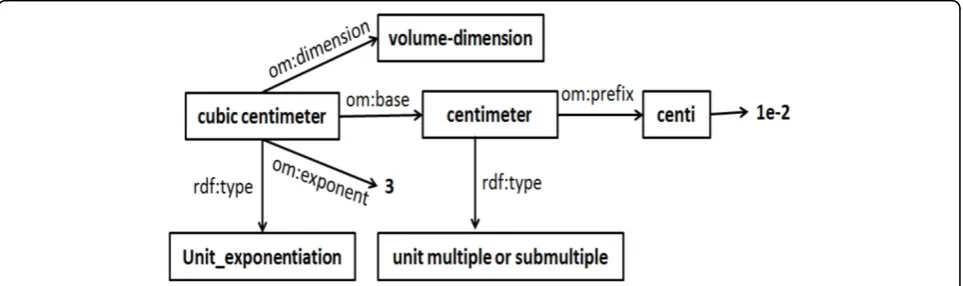
differences. One notable difference, is that OM defines “Quantity kinds” (e.g., acceleration and absorption) as OWL classes, which facilitates logical reasoning [13]. Another advantage of OM -over QUDT- is that it uses the SI prefixes to relate submultiples (e.g.,deci) and multiples (e.g.,deca) of units. Additionally, OM defines the relation-ship between compound units (e.g., kilogram per cubic meter) and their individual constituents (kilogram and cubic meter). Moreover,“compound units” is further divided into“unit division”(e.g., meter per second),“unit exponentiation”(e.g., meter squared) and“unit multiplica-tion” (e.g., meter kilogram). For instance, for the unit “millimole per cubic centimeter”(mmol/cm3), the nomi-nator and denominomi-nator are defined as“millimole” and “cubic centimeter”, respectively, where millimole is related to mole by Prefix milli (om:factor = 1e-3) while“cubic centimeter”is an instance of“unit exponentiation”. This additional feature in OM allows for the automated calcula-tions of dimensions for new units in based on their consti-tuents. Figure 1 shows the model for“cubic centimeter”, revealing the relationship between OM classes that enable automated reasoning and unit inter-conversion.
In addition to above advantages, OM provides Web Services that can be used programmatically to incorpo-rate knowledge in OM in other applications making it suitable for our study.
Methods
Dataset and data collection
The dataset used for these investigations included the clin-ical records of a cardiovascular patient cohort collected from a referral hospital in Nebraska, USA, between 1986 and 1989, including 536 unique patients. Table 1 shows some columns from two rows of the dataset used in this study. The intended meaning of acronyms for each col-umn header (e.g., SBP forSystolic Blood Pressure) was
confirmed with the clinician who had originally collected the dataset. In the last four columns“1”represents“high risk”and“0”represents a“low risk”for the condition listed in the header.
As shown in the table, this dataset exhibited several features that presented significant challenges to auto-mated integration and annotation and that are common with legacy (and even contemporary) clinical data, including:
1) The measurement-units were not represented explicitly.
2) Different rows of the same data set were repre-sented in different measurement units shown in dif-ferent colors. For instance, HDL is represented in milligram/deciliter(Italic font) in the first row and inmmol/liter(Italic font) in the second row shown in different colors)
3) The system of units used, even in the same row, could change (e.g., height in SI and weight in Imper-ial units in the first row).
These observations highlight the need for a practical solution to ameliorate the problem of measurement-unit conflict resolution in health care.
Data transformation
Ontologies and standards used
OM:As stated, OM provides a rich conceptualization of the compound units common in clinical data, we selected OM as our preferred unit-ontology starting point.
GALEN:GALEN [18] is a rich compositional ontology of the medical domain, covering anatomy, function, dis-eases, symptoms, drugs, and procedures. Following an approach published previously[2] we re-factored and
extended a number of cardiovascular-relevant classes of GALEN such that they could be used for logical reason-ing and classification.
SADI and SHARE: SADI[19] is a set of standards-compliant design principles for exposing stateless Web Services on the Semantic Web. SADI Services consume and produce RDF data, where the input and output data properties are described by OWL classes. These classes are, similarly, utilized to discover Services of interest through their registration in the SADI Service registry. SHARE[19] is an enhanced SPARQL query engine which is capable of (a) decomposing OWL classes into their constituent property restrictions, and (b) discover-ing and invokdiscover-ing SADI Services based on the properties those Services consume/produce.
SIO:The SemanticScience Integrated Ontology (SIO) is an ontology that provides models for the representa-tion of the scientific data [20]. It includes design princi-ples that facilitate creation of flexible software and is extensively used by analytical tools exposed using SADI Semantic Web Services. Therefore our adoption of SIO in this work allows us to more easily take advantage of existing resources published using the SADI design pat-tern, as well as rapidly publish and integrate new tools as-needed.
Clinical data modeling
The GALEN ontology does not define the structure and properties of individuals who would be members of its
ontological classes, and therefore cannot easily be used to classify data. As such, we extended the concepts in GALEN using SIO and OM. For example, we extend the concept SystolicBloodPressure in GALEN as in OWL as follows:
measure:SystolicBloodPressure = galen:SystolicBloodPressureand
(“sio:has measurement value”some “sio:measurement”and
(“sio:has unit” some “om:unit of measure”)and
(“om:dimension” value“om :pres-sure dimension”)and
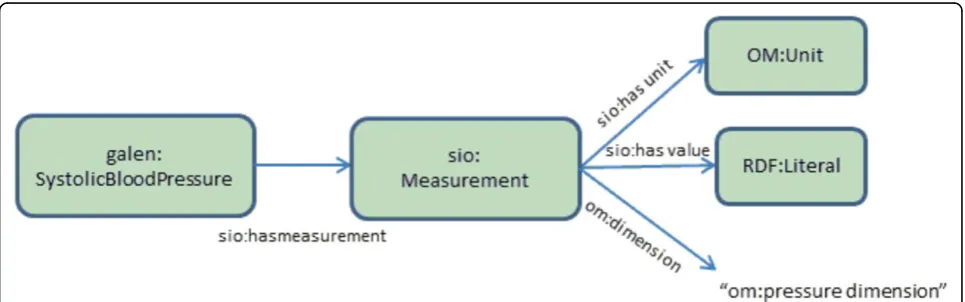
“sio:has value”somerdfs:Literal)) In the above, the measurement units are linked to OM’s“pressure dimension”. This guarantees dimension compatibility during logical reasoning; i.e., all pressure data in the clinical dataset are associated to“pressure dimension” by om:dimension relationship, and can therefore automatically be directed to pressure-dimen-sion-relevant conversion services. Figure 2 shows the schematic view of the data model for systolic blood pressure. The model provides a machine-processable mechanism for expressing semantics of measurement-units in the clinical domain.
We followed OM’s framework for defining new units in order to create several unit-types commonly used in clinical science, but missing from OM’s existing set. For instance the unit “centimeter_of_mercury_column“ (cmHg) which is often used for monitoring blood pres-sure does not exist in OM and was defined according to OM’s standards.
Semantic Web services
A single generic SADI-compliant Web Service was con-structed to manage conversions over the major quanti-ties (dimensions) of measurement most frequently used in clinical setting including Pressure, Concentration, Table 1 Snapshot of the Dataset.
ID HEIGHT WEIGHT SBP CHOL HDL BMI GR
SBP GR
CHOL GR
HDL GR pt1 1.82 177 128 227 55 0 0 1 0 pt2 179 196 13.4 5.9 1.7 1 0 1 0
The first two rows of the dataset used in the original format. In the last four columns“1”represents“high risk”and“0”represents a“low risk”for the condition listed in the header
Temperature, Length, and Mass. We first discuss the generic signature of the service and then describe an example use cases for pressure and concentration (with minor differences) in more details. The other dimen-sions follow similar principles.
The SADI service uses the semantics of the input data it receives to automatically configure itself to the correct type of conversion. The input and output of this service are as follows:
Input:
“sio:has measurement value”some
“sio:has unit”some “om: Unit of measure”
and“sio:has value”somerdfs:Literal Output:
“sio:has measurement value” some
“sio:has unit” some“om: Unit of measure”
and“sio:has value”somerdfs:Literal
and“om:has dimension” exactly 1om: Dimension
The following algorithmic steps are carried out auto-matically for each input data that meet the requirement:
1. Find the dimension of input data. If input data is not explicitly annotated with dimension, use the web service provided by OM to annotate the dimension of the input data unit.
2. Use the dimension information to automatically configure the service to the appropriate conversion (e.g.,Pressureconvertor service).
3. Use the dimension information as the input to find all the compatible units (units with the same dimension)
4. Iterate through compatible units frequently used in clinical settings (e.g., iterate through all units for Pressure) and apply the conversion for each (the lim-itations of this approach are discussed below) 5. Use the API to calculate “unit conversion offset” (-getConversionOffset) and “unit conversion factor” (-getConversionFactor) to convert the input data into selected compatible units. Attach the dimension and unit/value pairs to the output.
Results
Pressure
All patient data was converted into RDF format using a pattern similar to that shown in Figure 2. We then defined an ontological class“ High-Systolic-Blood-Pres-sure-Measurement”[21], as follows:
measure:SystolicBloodPressureand
sio:hasMeasurementsome
(sio:Measurement and("sio:has unit”
valueom:kilopascal)and
(sio:hasValue some double[>= “18.7"^^double])))
This model uses units (kilopascals) that differ from those in our dataset (mmHg and cmHg), which allows us to demonstrate the ability of the system to automati-cally detect and resolve unit conflicts. A SPARQL query is provided to the SHARE query client that searches for high blood pressure measurements, as follows:
SELECT ?record ?convertedvalue ?riskgrade FROM <./patient.rdf> WHERE
{
?record rdf:type measure: HighSystolicBloodPressure.
?record sio:hasMeasurement ?measurement. ?measurement sio:hasValue ?convertedvalue. ?record cardio:ExpertClassification ?riskgrade. }
In the above query SHARE examines the HighSystolic-BloodPressure class and discovers the “sio:has unit”
value om:kilopascal axiom, indicating that measure-ments of High Systolic Blood Pressure will need to be expressed in kilopascals. It compares this to the mea-surements in its dataset, and logically determines that they are discrepant in their units. It then queries the SADI registry to find a Service (the single Service described above) that provides conversions on the OM dimension of “Pressure” - i.e., a unit-conversion service with the input property of some “om:pressure dimen-sion”. It passes the measurement data to that service for unit-homogenization. For each individual incoming measurement, the unit is examined and the offset and coefficient parameters required to convert between source (input data) and target (required by the OWL class) unit are dynamically retrieved by the service using the OM REST interface. The conversion calculation is then synthesized and applied to the incoming data. Once all data have been processed, the result is a data-set with all pressure units harmonized as kilopascals. The resulting output data is integrated into the local knowledge-base, prior to undertaking logical reasoning using the Pellet reasoner, that classifies the patient data as being consistent or inconsistent with the HighSysto-licBloodPressure ontological definition.
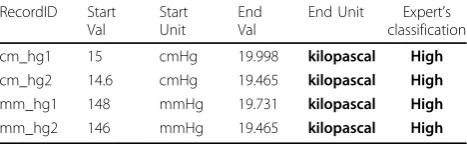
Table 2 shows a demonstrative sub-set of the result data corresponding to HighSystolicBloodPressure individuals, the showing a variety of pressure units being homogenized
Table 2 Units and values.
RecordID Start Val
Start Unit
End Val
End Unit Expert’s classification
cm_hg1 15 cmHg 19.998 kilopascal High
cm_hg2 14.6 cmHg 19.465 kilopascal High
mm_hg1 148 mmHg 19.731 kilopascal High
mm_hg2 146 mmHg 19.465 kilopascal High
the kilopascals in accordance with the OWL class defini-tion. Moreover, the system was able to identify all 134 individuals, classified by the expert as having high systolic blood pressure, with no false positives. It should be noted that though we did not find any misclassification, the pos-sibility of rounding errors introduced as a result of conver-sion cannot be ruled out; thus in future iterations it may be desirable to specifically engineer the conversion services to make“sensible”choices about rounding, based on advice from expert clinicians.
Concentration
The term concentration most frequently refers to amount of substance in a solution. There are two major types of units that are used to represent concentration in clinical settings usually used to denote the concentration of different chemicals in plasma (e.g., Hemoglobin). The first type represents the amount of substance per unit volume (e.g., gram per liter) and the second type repre-sents the number of moles per unit volume (e.g., mole per liter). Thus, we should note that, for concentration, both dimensions ofmole/m3(NL−3) andkg/m3(ML−3)
are used in practice. Molar-based units are routinely used in medicine and physiology. As a result 1) the“ conver-sion factor”between these different dimensions is not a dimensionless parameter and 2) the conversion factor between depends on the molar mass of the specific mole-cule for which the measurement has been made. For example to convertmmol/Ltomg/dLfor Triglyceride and HDL we need to multiply by 88.57 and 38.67, respec-tively. A comprehensive list of molar-based units for plasma concentration of different chemicals and their corresponding conversion factor can be found in [22].
To achieve conversions in this case, it is necessary to know the specific type of incoming measurement, based on its GALEN class; for example, if it is a Triglyceride measurement, the incoming measurement must be of rdf:type galen:tryglyceride, since the incoming units carry insufficient semantics in-and-of themselves to gen-erate the calculation parameters. Once the relevant compound is determined from the logical type of the incoming measurement, the conversion constants are calculated using the molecular mass of each molecule as per the look-up table in [22]. Here we only implemented the concentration molecule-types used most frequently in clinical sciences (see supplementary materials) for performance reasons; however the framework is extensi-ble by expanding the look-up taextensi-ble and the galen molecule type ontology.
Evaluations similar to those described for Systolic Blood Pressure were carried-out for Cholesterol and HDL classification, and the system was able to correctly convert and classify all records.
Complex risk classification (revisited)
As mentioned, in our previous study[2], we demon-strated that the combination of semantically-explicit data, logically rigorous models of clinical guidelines, and publicly-accessible Semantic Web Services, can be used to execute automated, rigorous and reproducible clinical classifications. However, in the previous study our unit conversion services were written separately for each quantity (one service for Pressure one service for Concentration and so on). In addition, the conversion formulas for conversion between different units were hard-coded within the Web Services. Additionally, using our previous framework the relation between a quantity and its dimension was coded manually. In the current experiment, we addressed these shortcomings and repeated the previous experiment. Not surprisingly, the results for binary classifications were consistent with previous experiment (see supplementary materials). In the following we will work through classification of patients based on their BMI value. The other risk classi-fications follow a similar pattern and are presented in the supplementary materials.
Modeling BMI risks is more complex than modelling concentration, since BMI is derived by algorithmic ana-lysis of other core measurements (Height and Weight). BMI is calculated using a person’s weight and height. BMI in SI is calculated using the following formula.
BMI= mass
kg (height(m))2 =
mass(lb)
(height(in))2 ×703
Once again, for evaluation purposes we intentionally defined BMI in a different unit than the one presented in the dataset. Due to reasons not discussed here (see [2]), the clinical researcher had used a different cut-off threshold than the ones suggested by American Heart Association (AHA) (26 kg/m2 was used instead of 25 kg/m2 to classify patient as“Overweight”).
Overweight = Patientand
(sio:hasAttributesome
(measure:BodyMassIndexand
sio:hasMeasurementsome(sio:Measurement and
(sio:hasUnitvalue om:pound-per-inch- squared)and
(sio:hasValue some double[>= 18278.0]))))
SELECT ?record ?convertedvalue ?riskgrade FROM <./patient.rdf> WHERE
{
?record rdf:type measure:Overweight. ?record sio:hasMeasurement ?measurement. ?measurement sio:hasValue ?convertedvalue. ?record cardio:ExpertClassification ?riskgrade. }
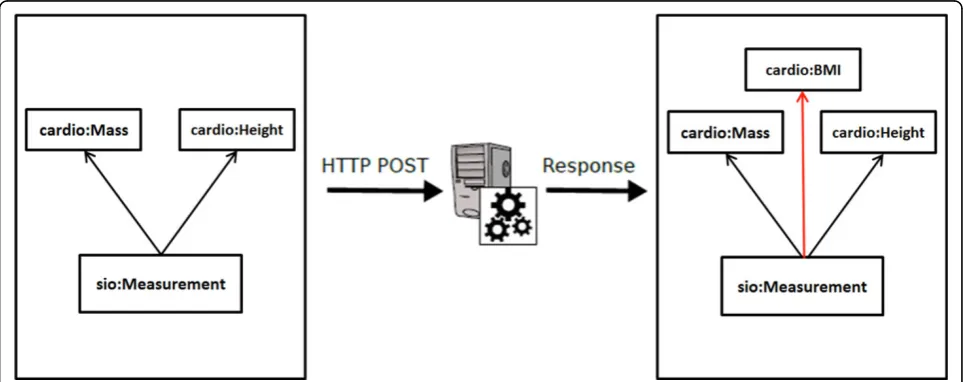
It should be noted that BMI value does not exist in the data prior to running the above query and it is cal-culated using the Semantic Web Service schematically shown in Figure 3 (sample data, and instructions on how to send this data to the SADI service, are provided in the supplementary materials)
Once we issue the SPARQL query above, the prop-erty-restriction imposed on the output, when detected by SHARE, triggers the discovery and invocation of the Service that attaches the BMI class with appropriate units and value properties attached to it (first the service calculates all the possible output units and then it selects the one required by the output; see below for limitations of the approach). Similar our previous experiment, using this approach we were able to build ontological models that mirror the expert’s classification of patients (based on BMI) of the individual clinical researcher with 100% accuracy.
Limitations of the approach
The approach described in the examples above could reasonably be criticized as being wasteful and/or ineffi-cient, since the unit-conversion Service converts any incoming unit into all possible output units (limited to those defined in a look-up table of the most common
units used in clinical practice). This can cause perfor-mance issues; for instance a typical query takes on aver-age 35 minutes to resolve on a single machine (4 core 3GHz machine with 8GB of memory) for the entire cohort. The problem is likely to exacerbate when dealing with large and complex and distributed datasets. Thus, the current performance of the system is not acceptable for a system designed to provide (close to) real-time sup-port. We can envision several ways by which perfor-mance improvement can be achieved. First, we note that the apparent wastefulness explained above is not necessa-rily a limitation of our Semantic approach to unit repre-sentation, but rather a limitation of the SHARE client’s interaction with the unit-conversion Service. The Service is capable of receiving a“desired unit”parameter during its invocation and, if present, it will use this information to configure itself to do conversions non-wastefully; con-verting only into that specific unit, rather than all possi-ble units. The SHARE application, however, is not capable of passing configuration parameters to a Service during service invocation. Therefore, the apparent waste-fulness of the computations is an artefact of our use of SHARE. Other SADI clients are currently under develop-ment, but were not available for this study. We reason-ably anticipate that by using such clients, significant performance improvement can be achieved.
There are several other areas other areas where signifi-cant improvements could be made. This includes differ-ent strategies for SPARQL query optimizations such as parallel (as opposed to sequential) processing of different services where possible, and development of strategies to avoid invocation of irrelevant services, by checking the input and output signature (currently all the services that
attach a certain property will be invoked regardless of the input and output datatype) of the services.
Conclusions
Unit conversion is a common and troublesome barrier to integration. Busy health researchers should not need to concern themselves this trivial, error-prone, but neces-sary exercise. Here we have utilized a combination of semantic standards and frameworks to demonstrate, with several unit-conversion exemplar cases, that these types of data integration problems can, and should, be dealt with by the machines themselves. By encoding data with semantic transparency, it becomes possible for machines to detect unit conflicts and use semantic systems such as SADI + SHARE to automatically resolve them.
We note that a large number of measurement units in clinical practice include more complex unit patterns than the ones we modeled. For instance the majority of units used for drug dosage and clearance include tem-poral elements (e.g., mg/kg/hour for the drug dosage) that are not modeled in this study. To the best of our knowledge such patterns have not been modeled in any existing ontologies. As such, we plan to extend our fra-mework to include more complex patterns together with temporal units and their conversion. Finally, we plan to extend our study to include different datasets from multiple centers and evaluate the usability of our approach in more complex biomedical scenarios.
Additional information
Supplementary materials, and working examples, are provided at: http://biordf.org/MeasurementUnitsDemo.
Competing interests
The authors declare that they have no competing interests.
Authors’contributions
SS and MW planned this work, and jointly wrote this manuscript. SS executed the data migration, ontology design and extension, web service deployment, and overall analysis. BM generated and initially analyzed the source clinical dataset, and discussed and validated our approach and choice of clinical standards. All authors have read, revised and approved this manuscript.
Declarations
Publication of this article has been funded by Special Initiatives Grant-in aid from the Heart and Stroke Foundation of British Columbia and Yukon, Microsoft Research and an Operating Grant from the Canadian Institutes of Health Research (CIHR). MDW is funded by the Isaac Peral/Marie Curie co-fund program at the Technical University of Madrid.
This article has been published as part ofBMC Medical GenomicsVolume 7 Supplement 1, 2014: Selected articles from the 3rd Translational Bioinformatics Conference (TBC/ISCB-Asia 2013). The full contents of the supplement are available online at http://www.biomedcentral.com/ bmcmedgenomics/supplements/7/S1.
Authors’details
1UBC James Hogg Research Center, Institute for Heart + Lung Health, Room 166 - 1081 Burrard Street, St. Paul’s Hospital Vancouver, BC, Canada, V6Z 1Y6.
2Centro de Biotecnología y Genómica de Plantas, Universidad Politécnica de Madrid, Madrid, España.
Published: 8 May 2014
References
1. Welch DL:Human error and human factors engineering in health care. Biomedical Instrumentation and Technology1997,31:627-31.
2. Samadian S, McManus B, Wilkinson MD:Extending and encoding existing biological terminologies and datasets for use in the reasoned semantic web.Journal of Biomedical Semantics2012,3:6.
3. Scheider S, Janowicz K, Kuhn W:Grounding geographic categories in the meaningful environment.Spatial Information Theory2009,2009:69-87. 4. Mari L:Epistemology of measurement.Measurement2003,34:17-30. 5. Frigerio A, Giordani A, Mari L:Outline of a general model of
measurement.Synthese2009,175:123-149.
6. Gkoutos GV, Schofield PN, Hoehndorf R:The Units Ontology: a tool for integrating units of measurement in science.The Journal of Biological Databases and Curation2012.
7. Schadow G, McDonald CJ, Suico JG, Föhring U, Tolxdorff T:Units of measure in clinical information systems.Journal of American Medical Informatics Associacion6(2):151-62.
8. RDF - Semantic Web Standards.[http://www.w3.org/RDF/]. 9. OWL Web Ontology Language Overview.
[http://www.w3.org/TR/owl-features/].
10. MUO: Measurement Units Ontology.[http://idi.fundacionctic.org/muo/ muo-vocab.html].
11. RUBER TG, LSEN GO:An ontology for engineering mathematics. Proceedings of Fourth International Conference on Principles of Knowledge Representation and Reasoning1994, 258-269.
12. QUDT - Quantities, Units, Dimensions and Types.[http://www.qudt.org/]. 13. Ontology of Units of Measure and Related Concepts.[http://www.
semantic-web-journal.net/content/ontology-units-measure-and-related-concepts].
14. Samadian S:Constructing and Applying Semantic Models of Clinical Phenotypes to Support Web-embedded Clinical Research.PhD Thesis 2013.
15. Ontolingua Home Page.[http://www.ksl.stanford.edu/software/ontolingua/ ].
16. Ontolingua Theory STANDARD-UNITS.[http://www-ksl.stanford.edu/ knowledge-sharing/ontologies/html/standard-units/index.html]. 17. Cardarelli FO:Encyclopaedia of Scientific Units, Weights and Measures:
Their Si Equivalences and Origins.Springer;, 1 2003, 848.
18. Rector A, Rogers J, Pole P:The GALEN High Level Ontology.Proceedings of MIE 961996, 174-178.
19. Wilkinson MD, Vandervalk B, McCarthy L:The Semantic Automated Discovery and Integration (SADI) Web service Design-Pattern, API and Reference Implementation.Journal of Biomedical Semantics2011,2:8. 20. Vandervalk B:The SHARE System: A Semantic Web Based Approach for
Evaluating Queries Across Distributed Bioinformatics Databases and Software.MSc Thesis2011.
21. Chobanian AV, Bakris GL, Black HR, Cushman WC, Green LA, Izzo JL, Jones DW, Materson BJ, Oparil S, Wright JT, Roccella EJ:The Seventh Report of the Joint National Committee on Prevention, Detection, Evaluation, and Treatment of High Blood Pressure: the JNC 7 report. JAMA2003,289:2560-72.
22. International System of Units.[http://www.questdiagnostics.com/dms/ Documents/test-center/si_units.pdf].
doi:10.1186/1755-8794-7-S1-S12