R E S E A R C H
Open Access
Brain-Computer Interface Controlled Functional
Electrical Stimulation System for Ankle Movement
An H Do
1,2*, Po T Wang
3, Christine E King
3, Ahmad Abiri
4and Zoran Nenadic
3,4*Abstract
Background:Many neurological conditions, such as stroke, spinal cord injury, and traumatic brain injury, can cause chronic gait function impairment due to foot-drop. Current physiotherapy techniques provide only a limited degree of motor function recovery in these individuals, and therefore novel therapies are needed. Brain-computer interface (BCI) is a relatively novel technology with a potential to restore, substitute, or augment lost motor behaviors in patients with neurological injuries. Here, we describe the first successful integration of a noninvasive electroencephalogram (EEG)-based BCI with a noninvasive functional electrical stimulation (FES) system that enables the direct brain control of foot dorsiflexion in able-bodied individuals.
Methods:A noninvasive EEG-based BCI system was integrated with a noninvasive FES system for foot dorsiflexion. Subjects underwent computer-cued epochs of repetitive foot dorsiflexion and idling while their EEG signals were recorded and stored for offline analysis. The analysis generated a prediction model that allowed EEG data to be analyzed and classified in real time during online BCI operation. The real-time online performance of the integrated BCI-FES system was tested in a group of five able-bodied subjects who used repetitive foot dorsiflexion to elicit BCI-FES mediated dorsiflexion of the contralateral foot.
Results:Five able-bodied subjects performed 10 alternations of idling and repetitive foot dorsifiexion to trigger BCI-FES mediated dorsifiexion of the contralateral foot. The epochs of BCI-FES mediated foot dorsifiexion were highly correlated with the epochs of voluntary foot dorsifiexion (correlation coefficient ranged between 0.59 and 0.77) with latencies ranging from 1.4 sec to 3.1 sec. In addition, all subjects achieved a 100% BCI-FES response (no omissions), and one subject had a single false alarm.
Conclusions:This study suggests that the integration of a noninvasive BCI with a lower-extremity FES system is feasible. With additional modifications, the proposed BCI-FES system may offer a novel and effective therapy in the neuro-rehabilitation of individuals with lower extremity paralysis due to neurological injuries.
Background
Many neurological conditions, such as stroke, spinal cord injury (SCI), and traumatic brain injury (TBI), can leave the affected individual with severe or complete paralysis. There are currently no biomedical treatments available that can reverse the loss of motor function after these neurological injuries [1], and physiotherapy typically provides only a limited degree of motor func-tion recovery [2-4]. Brain-computer interface (BCI) is a relatively novel technology with the potential to restore,
substitute, or augment lost motor behaviors in patients with devastating neurological conditions such as high-cervical SCI or amyotrophic lateral sclerosis [5-8]. For example, BCIs systems have enabled direct brain control of applications such as computer cursors [8], virtual keyboards [9,10], and movement within virtual reality environments [11-13]. Most notably, BCIs have enabled the direct brain control of limb prosthetic devices [7,14], and such BCI-controlled prostheses represent a promis-ing neuro-rehabilitative technology for motor function restoration in the neurologically injured. In the future, they may provide a permanent solution for restoration of lost motor functions, especially if no equivalent bio-medical treatment exists.
* Correspondence: [email protected]; [email protected]
1Department of Neurology, University of California, Irvine, CA 92697 USA
3
Department of Biomedical Engineering, University of California, Irvine, CA 92697 USA
Full list of author information is available at the end of the article
Generally, BCI control of a limb prosthesis is accom-plished by acquiring neurophysiological signals asso-ciated with a motor process, analyzing these signals in real time, and subsequently translating them into com-mands for a limb prosthesis. To date, this concept has been successfully applied to the control of robotic arms [15] and functional electrical stimulation (FES) devices of the upper extremities [7,14]. More specifically, Hoch-berg et al. [15] demonstrated how a subject with tetra-plegia due to SCI could use an invasive BCI to operate a robotic arm to perform a simple task of moving an object from one point to another and to open and close a robotic hand. Also, Pfurtscheller’s group [7,14] demonstrated how an individual affected by tetraplegia due to SCI was able to utilize a noninvasive electroence-phalogram (EEG)-based BCI to control hand grasping via FES to complete a goal-oriented task of grasping an object and moving it another location.
In spite of encouraging results achieved with upper extremity BCI-FES systems, the integration of BCI with lower extremity FES systems has received less attention. At the time of this publication, review of the literature revealed that no actual BCI-FES systems for the lower extremities have been reported on. This may be partly explained through historical reasons, as BCI system development has been primarily focused on individuals with severe paralysis, such as those with locked-in syn-drome or high cervical SCI [16]. These individuals would most likely benefit from using BCI technology that restores communication and upper extremity func-tion for interacfunc-tion with the environment. Meanwhile, wheeled mobility has generally been considered an effec-tive and robust method of substitution for ambulation in lower extremity paralysis. Finally, in the context of EEG-based BCIs, lower extremity movements, such as ambu-lation, may cause significant artifacts which in turn may require the use of specialized EEG systems (e.g. active or actively shielded electrodes), thus creating a research barrier for laboratories without this technology.
Focusing the development of BCI technology on indi-viduals with complete paralysis due to neurological injury significantly limits its application domain. Recently, BCI-FES systems are increasingly being explored as potential neuro-rehabilitation tools for improving partially impaired upper extremity function in individuals with stroke [17], thereby vastly broadening the potential target population. Given that an estimated 36% of stroke patients [4], 68% of SCI patients [18,19], and 61% of TBI patients [20] are affected by significant chronic gait impairment, there is a compelling need for the development of BCI-FES system for the lower extre-mities. Furthermore, the development of such a system may facilitate neural plasticity and repair mechanisms to improve impaired lower extremity and gait functions in
these patient populations. This will not only further broaden the application domain of BCI technology, but will also yield a novel neuro-rehabilitation approach to some of the most prevalent neurological injuries. As the initial step towards achieving this goal, we describe the first integration of a noninvasive EEG-based BCI with a noninvasive FES system that enables the direct brain control of foot dorsifiexion. The performance of the sys-tem was tested in a small group of able-bodied subjects who were able to use repetitive foot dorsifiexion to elicit BCI-FES mediated dorsifiexion of the contralateral foot.
Methods
Overview
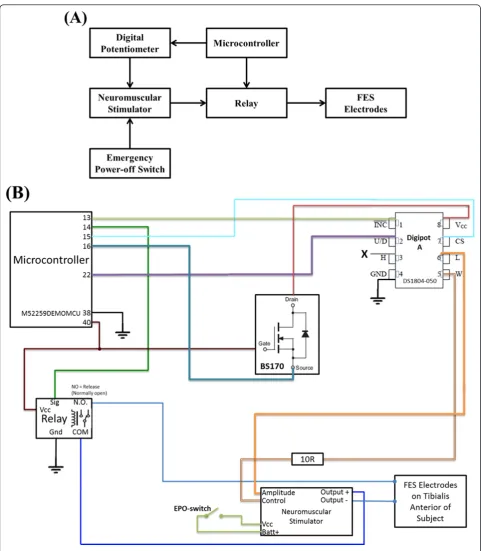
The goal of this study is to integrate a noninvasive EEG-based BCI system with a noninvasive FES system for the lower extremities. The schematic diagram of the overall system is shown in Figure 1A. The proposed system uti-lizes a contralaterally-controlled FES paradigm [21], wherein healthy subjects perform repetitive foot dorsi-fiexion, EEG patterns underlying this action are detected in real time, and this information is subsequently used to trigger FES of the tibialis anterior (TA) muscle of the contralateral foot so as to achieve its dorsifiexion. The study entails a training procedure, where preliminary EEG data is collected and a subject-specific prediction model is designed, followed by an online session, where the real-time performance of the integrated BCI-FES system is tested.
Recruitment
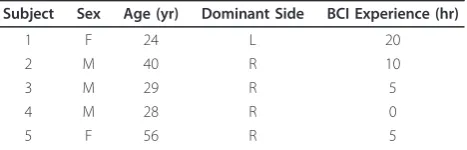
The study was approved by the Institutional Review Board of the University of California, Irvine. Since the present work represents a proof-of-principle study, it was aimed at able-bodied subjects who are generally healthy with no history of neurological conditions. Five subjects were recruited and provided their informed consent to participate in the study. Their demographic data are shown in Table 1.
Signal Acquisition
custom-made electrogoniometers [22] were mounted onto the anterior surface of each ankle and were used to measure foot dorsifiexion (see Figure 1B). The goni-ometer traces were acquired by a data acquisition system (MP150, Biopac Systems, Goleta, CA) with a sampling
rate of 4 kHz and a resolution of 16 bits. Both the data acquisition and experimental protocols were controlled by custom-made Matlab (Mathworks, Natick, MA) scripts. EEG data recorded during training procedures were saved for offline analysis, while those recorded
during online sessions were analyzed in real time (see below).
Training Procedure
To achieve BCI control of the FES device and in turn control foot dorsifiexion, the BCI system must be able to reliably decode EEG signals associated with either foot dorsifiexion or idling. To this end, a prediction model was synthesized by first recording EEG signals during alternating epochs of foot dorsifiexion and idling. More specifically, each subject was seated in a chair, approximately 0.8 to 1 m from a computer monitor, which displayed instructional cues during all experimen-tal procedures (see Figure 1B). Subjects were then instructed to alternate between 6-sec epochs of idling and repeated foot dorsifiexion. The frequency of dorsi-fiexion was determined by the subject and ranged between 6 and 9 dorsifiexion cycles per 6-sec epoch (1.0-1.5 Hz). A total of 200 epochs (100 epochs per class) were performed, with the procedure lasting approximately 20 min. Finally, the above training proce-dure was repeated using the opposite foot and the foot that yielded the prediction model with the highest clas-sification accuracy (see Offline Signal Analysis and Pre-diction Model Generation section below) was chosen to continue with the remainder of the study.
Offline Signal Analysis and Prediction Model Generation
Channels whose EEG signals were excessively contami-nated by electromyogram (EMG) artifacts were excluded from analysis. To this end, an iterative artifact rejection algorithm was used, where channels whose EEG ampli-tude exceeded an outlier voltage threshold in more than 25% of the total trials were removed. The outlier thresh-old was nominally set to 6 standard deviations (SD) from the mean, and was adaptively changed to keep the number of outlier trials below a pre-specified number (5% of all trials in the present study). The above proce-dure was repeated until no more channels could be removed. To minimize the effect of outliers on statistical estimates, robust (i.e. median-based) mean and standard deviation were used [23]. The above procedure typically
resulted in the exclusion of signals from circumferential
“hat band”electrodes which usually overlay the mastoid process, the forehead, the occiput, and the temporalis muscles. Upon artifact removal, a continuous 20-min EEG record was split into 100 idle and 100 dorsifiexion trials based on the corresponding electrogoniometer sig-nals recorded simultaneously with EEG during the train-ing procedure. Each EEG trial (~6 sec) was then transformed into the frequency domain using the Fast Fourier Transform (FFT), and its power spectral density was integrated in 2 Hz bins centered at 1, 3, 5, · · ·, 49 Hz. This resulted in 25 binned power spectral values per channel. A frequency search was then performed to find the best contiguous frequency range for classifica-tion. Initially, the full range of frequencies (0.01-50 Hz) was used, resulting in a 25 ×Cdimensional data matrix, where C is the number of retained EEG channels (C ranged between 44 and 46 across all subjects). To facili-tate subsequent classification, the dimension of input data was reduced using a combination of classwise prin-cipal component analysis (CPCA) [24,25] and approxi-mate information discriminant analysis (AIDA) [26]. This resulted in the extraction of one-dimensional (1D) spatio-spectral features:
f =TAC(d) (1)
wheredÎℝ25×Cis single-trial EEG data,FC:ℝ25×C®
ℝm is a piecewise linear mapping from the data space
into anm-dimensional CPCA-subspace, andTA: ℝm ®
ℝis an AIDA transformation matrix. A detailed descrip-tion of CPCA, AIDA, and a related informadescrip-tion-theoretic feature extraction technique can be found in [25-27], respectively. A linear Bayesian classifier:
P(I|f)
P(D|f)
I
> <
D
1 (2)
was then designed in the feature domain, whereP(I|f)
and P(D|f)are the posterior probabilities1of idling and dorsifiexion classes, respectively. Equation (2) is read as:
“classifyf⋆ as idling class if P(I|f)>P(D|f), and vice versa.” The performance of the Bayesian classifier (2), expressed as classification accuracy, was then assessed by performing 5 runs of a stratified 10-fold cross-validation [28].
The lower bound of the frequency range was then increased in 2-Hz steps, and the above procedure was repeated until the classifier performance stopped improving. This defined the optimal lower frequency bound,FL. Once FLwas found, the optimal higher fre-quency bound,FH, was found in a similar manner. The parameters of the prediction model, including the Table 1 Population Demographics
Subject Sex Age (yr) Dominant Side BCI Experience (hr)
1 F 24 L 20
2 M 40 R 10
3 M 29 R 5
4 M 28 R 0
5 F 56 R 5
optimal frequency range, the feature extraction mapping, and the classifier parameters, were then saved for real-time EEG analysis necessary for online BCI-FES opera-tion. Finally, the signal processing, feature extraction, and classification algorithms were implemented into the BCI software for real-time operation.
Online Signal Analysis
During online operation, 0.5 sec segments of EEG data were acquired in real time at a frequency of two non-overlapping segments per second. The EEG data seg-ments were then processed as described in the previous section. Briefly, the EEG signals were band-pass filtered and the data from the artifact prone channels were removed. The remaining data were transformed into the frequency domain by FFT, and the power spectral densi-ties (over the optimal frequency range) were calculated. The spectral data were then used as an input for the feature extraction algorithm, which resulted in the extraction of 1D spatio-spectral features. The posterior probabilities of idling and dorsifiexion classes given the observed EEG features, were then calculated as described in the previous section.
BCI-FES Integration
A low-cost, FDA-approved, constant-current neuromus-cular stimulator (LG-7000, LG Medical Supplies, Austin, TX) was used for functional electrical stimulation of the neuromuscular system consisting of the deep peroneal nerve and the TA muscle (see Figure 1B). To facilitate BCI-FES integration, the stimulator’s manually con-trolled “on/off” switch and analog potentiometer that adjusted the amplitude of the stimulating current had to be modified to allow computer control of the stimulator (see Figure 2). To this end, the FES device’s analog potentiometer was replaced with a digital potentiometer by utilizing a General Pin Input Output (GPIO) inter-face. Likewise, the switch function was emulated by using a digital relay that kept the stimulating circuit closed/open when electrical stimulation was/was not intended. Both the digital potentiometer and the relay were controlled by a microcontroller unit (Freescale M52259, Freescale Semiconductors, Austin, TX) in a master-slave configuration. More specifically, a custom-made C-language program was used to instruct the microcontroller unit (MCU) to listen for command requests from the BCI computer via a DB9 serial port, utilizing a universal asynchronous receiver/transmitter protocol. These requests carried the information on whether to turn the stimulator“on” or “off” (as deter-mined by the prediction model), and the intensity of electrical stimulation (as determined by the experimen-ter). Based on the current relay and potentiometer states, the MCU generated the appropriate signals
needed to achieve the desired result. For example, when real-time EEG data were classified as “dorsifiexion,”the BCI software sent a series of instructions to the MCU that commanded the relay to close the stimulation cir-cuit and the digital potentiometer to decrease its resis-tance, thereby initiating electrical stimulation. This continued until the real-time EEG data were decoded as
“idle,” upon which the BCI software sent a series of instructions to the MCU to open the relay, thereby opening the stimulation circuit and stopping the electri-cal stimulation. During operation, the BCI-FES system toggled between these two states.
Calibration
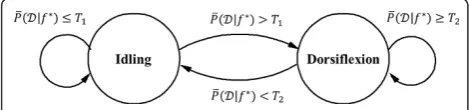
Prior to online BCI operation, a brief calibration proce-dure was performed to determine the posterior prob-ability thresholds for optimal online BCI-FES operation so that the number of false state transitions is mini-mized. Using the prediction model based on the training data, the BCI-FES system was set to run in the online mode without FES stimulation. Subjects were prompted to alternate between 20-sec epochs of idling and repeti-tive foot dorsifiexion for a total of 3 min. Meanwhile, real-time EEG signal analysis was performed, and the posterior probabilities of dorsifiexion and idling given data,P(D|f)andP(I|f), were calculated every 0.5 sec, as described in Online Signal Analysis section. The dis-tributions of the posterior probabilities,P(D|f∈I)and P(D|f∈D), were then empirically estimated as in Figure 3. Since the BCI-FES system is a binary state machine, two thresholds were chosen from the histo-grams–one to trigger the transitions from“idle”to“ dor-sifiexion”state(T1= medianP(D|f∈D)), and another for the transitions from “dorsifiexion” to “idle” state
(T2= medianP(D|f∈I)). During online BCI opera-tion, the posterior probabilities P(D|f)were averaged over a 1.5 sec period, and the average probabilities
¯
P(D|f)were compared to the thresholds T1 and T2. Depending on the present state, the transitions of the BCI-FES system were governed by the rules as illu-strated by the state-machine diagram in Figure 4.
Online BCI-FES Evaluation
Experimental Procedure
stimulation parameters, including current amplitude, pulse width, and frequency, were empirically determined to achieve the required foot dorsifiexion without causing discomfort to the subject.
To ascertain purposeful control of the BCI-FES sys-tem, subjects performed ten alternating 10-sec epochs of idling and repetitive dorsifiexion of the optimally chosen foot (see Training Procedure section) to induce BCI-FES mediated dorsifiexion of the contralateral foot. Since the present study focused on able-bodied subjects, an ipsi-laterally controlled FES paradigm was not used due to the inability to resolve voluntary and BCI-FES mediated dorsifiexion. Instructions to perform this task were shown as textual cues on the computer screen. Both voluntary and BCI-FES mediated foot dorsifiexion were measured by electrogoniometers.
Performance Analysis
The analysis of online BCI-FES operation was performed by comparing the epochs of voluntary and BCI-FES
mediated foot dorsifiexion. For this purpose, the read-ings from the two electrogoniometers (see Figure 1) were first smoothed by a 100-msec Gaussian window, and epochs of foot dorsifiexion and idling were deter-mined by a threshold crossing. A time series,x, describ-ing voluntary foot dorsifiexion was then defined as:
x[i] =
0, if i∈I
1, if i∈D (3)
wherei= 1, 2, · · ·,N, andNis the number of samples in the goniometer trace. A time series, y, describing BCI-FES mediated foot dorsifiexion, was defined in a similar manner. The normalized cross-covariance func-tion between the time seriesxandywas then calculated as:
ρ(m) =
N
i=1(x[i+m]− ¯x)(y[i]− ¯y) N
i=1(x[i]− ¯x) 2N
i=1(y[i]− ¯y)
2 (4)
where m Î [-N + 1, N - 1] is the lag between the sequencesxandy, andx¯and¯yare the sample means of the two sequences, respectively. The latency between voluntary and BCI-FES mediated foot dorsifiexion was then found as the lag with maximal cross-covariance, i.e. m⋆= arg max
mr(m). Subsequently, the temporal
corre-lation betweenx andy was found to be:r⋆=r(m⋆). In addition, the absence of a BCI-FES mediated foot dorsi-fiexion epoch initiated within the duration of any volun-tary foot dorsifiexion epoch was considered an omission. Finally, the initiation of a BCI-FES mediated foot dorsi-fiexion epoch within any idling epoch was considered a false alarm.
Results and Discussion
Results
Offline Performance
Each subject underwent training data collection as described in the Methods section. The EEG data asso-ciated with epochs of idling and repetitive foot dorsifiex-ion were analyzed and classified using the predictdorsifiex-ion model generated from this analysis. The input data for the prediction model were the powers of multi-channel EEG signals calculated in 2-Hz bins. The optimal sub-ject-specific EEG frequency bands (see Table 2) were found using the procedure described in the Methods section, and included the μ(8-13 Hz),b(13-30 Hz) and low-g(30-38 Hz) bands for Subject 1, high-b(22-30 Hz) and low-g(30-50 Hz) bands for Subject 2,μ,band low-g (30-50 Hz) bands for Subject 3, μ and b bands for Subject 4, and μ, b and low-g (30-50 Hz) bands for Subject 5.
The offline performance was evaluated by performing 10-fold cross-validation, and a classification accuracy
Figure 3Histograms of the posterior class probabilities for subject B. Based on the known underlying action (idling or dorsifiexion), the distributions of the posterior probabilities, P(D|f∈I)andP(D|f∈D), are empirically estimated as histograms. Dashed lines indicate the 25%, 50%, and 75% quartiles, where the 25% and 50% quartiles forP(D|f∈I)overlap. Note thatP(D|f∈I) = 1−P(I|f∈I).
ranging from 85.1% to 97.6% was achieved (see Table 2). These results are statistically significant, as the probabil-ity of achieving the performance≥ 85%, i.e. correctly classifying 170 or more trials (out of 200) by random chance, is only 3.0866 × 10⁻²⁵. Note that cross-validation provides a safeguard against prediction model overfitting by ensuring that classification accuracy observed offline generalizes to future online sessions.
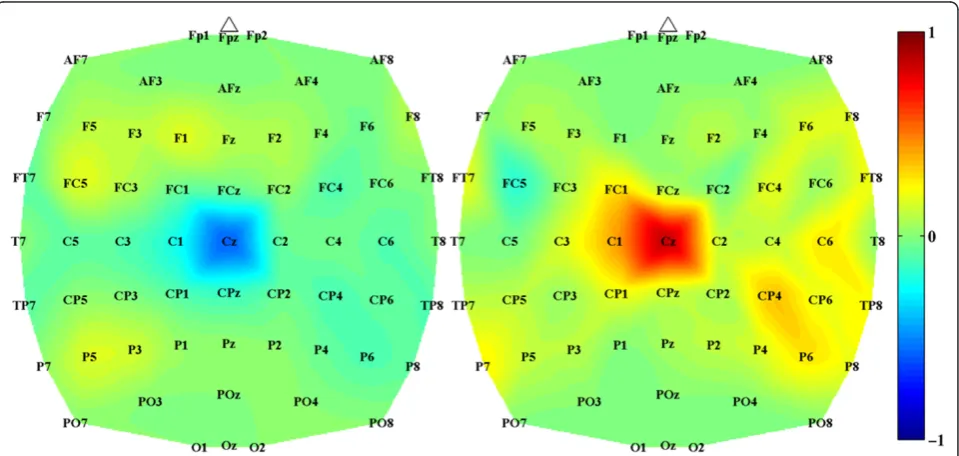
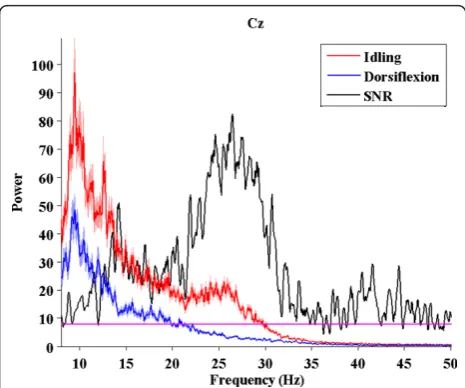
Analysis of subject-specific prediction models demon-strated that the EEG power changes in the b-band observed over mid-central areas (i.e. electrode Cz) were the most informative features for classification (see Figure 5). These findings were confirmed by examining the power spectrum of EEG signals at Cz under both idling and dorsifiexion conditions (see Figure 6), where a pro-minent event-related desynchronization (loss of power) was observed over a broad frequency band. These
observations are consistent with prior studies, where similar event-related desynchronization was observed upon initiation or imagination of movement [29-31].
Online BCI-FES Performance
Surface electrode placement for effective FES-induced dorsifiexion was confirmed prior to online BCI evalua-tion for all subjects. In general, stimulaevalua-tion parameters depend on skin impedance, muscle mass, and the sub-jects’electrical stimulation tolerance, and were therefore chosen empirically for each subject while ensuring that ~15°-20° of foot dorsifiexion was achieved. The subject-specific stimulation parameters are summarized in Table 2. In addition, prior to online BCI-FES evaluation, a test FES procedure was performed and no FES interference was visible on the EEG signals.
During online BCI-FES operation, each subject performed repetitive dorsifiexion of their optimally Table 2 Overall Performances
Subject Foot EEG-band (Hz) Classification Accuracy Current (mA) Pulse Width (μsec) Frequency (Hz) Lag (sec) r⋆ OM FA
1 R [8-38] 94.4% 100 140 20 3.1 0.67 0 0
2 L [22-50] 97.6% 100 200 30 1.4 0.72 0 0
3 L [8-50] 85.1% 90 200 30 2.7 0.59 0 1
4 R [8-30] 91.9% 88 200 20 3.0 0.62 0 0
5 R [10-50] 93.6% 100 120 20 2.9 0.77 0 0
The performances of five subjects. The columns list: the foot that was voluntarily dorsiflexed, the EEG frequency band that was used for classification, (offline) classification accuracy as established by 10-fold cross-validation, the stimulating current amplitude, its pulse width and frequency, (online) lag between voluntary and BCI-FES-mediated dorsifiexion epochs, temporal correlation between these epochs (r⋆) calculated at the corresponding lags, omissions (OM), and false alarms (FA).
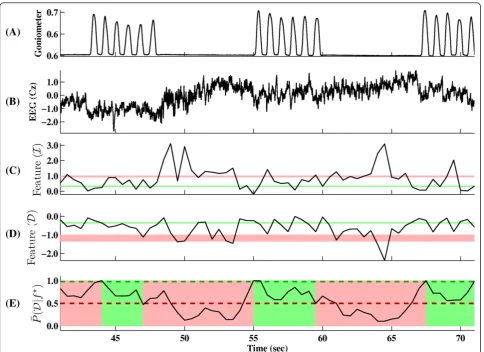
chosen foot to induce BCI-FES-mediated dorsifiexion of the contralateral foot. More specifically, each 0.5 sec segment of EEG data was acquired and analyzed as explained in the Methods section, and based on this analysis, the computer instructed the FES system to respond. The basic steps of this procedure applied to the training data are illustrated in Figure 7.
The online performances are quantified by four cri-teria: (i) lag between actual and BCI-FES-mediated dor-sifiexion epochs, (ii) temporal correlation (at the corresponding lag value) between these epochs, (iii) number of omissions, and (iv) number of false alarms. Figure 8 shows the best online session for Subject 2.
All subjects performed the task with no omissions (100% BCI-FES response). However, BCI-FES-mediated dorsifiexion epochs typically lag behind the actual dorsi-fiexion epochs, and the average values of this latency ranged from 1.4 sec to 3.1 sec across all subjects (see Table 2). Temporal correlations between the voluntary and BCI-FES-mediated dorsifiexion epochs ranged between 0.59 and 0.77, and are also shown in Table 2. The statistical significance of these results was con-firmed by running 10,000 Monte Carlo simulation trials with a chance level classification accuracy (50%). The
maximum correlation coefficient obtained from the simulation was 0.41, and therefore even the lowest correlation coefficient of 0.59 is significant with a p-value<10-4.
The correlation coefficient measures the temporal consistency between voluntary foot dorsifiexion and the corresponding BCI-FES-mediated dorsifiexion response. Note that its value is normalized between -1 and 1, and appears to correlate with offline accuracy. For example, Subjects 2 and 5, who achieved the highest offline classi-fication accuracy, also had the highest correlation coeffi-cients. Conversely, Subject 3 achieved the lowest classiffication accuracy and correlation coefficient. This drop in online performance may be attributed to a sin-gle false alarm (see Table 2). Subjects 1, 2, 4 and 5, on the other hand, had no false alarms.
Discussion
This study reports on the first successful integration of a noninvasive EEG-based BCI with a noninvasive FES sys-tem for the lower extremities. The performance of the integrated BCI-FES system was tested in a population of five able-bodied subjects, utilizing a contralaterally-con-trolled FES paradigm [21] where subjects performed repetitive dorsifiexion of their optimally chosen foot to trigger BCI-FES-mediated dorsifiexion of the contralateral foot. This paradigm was chosen since ipsilateral dorsifiex-ion and stimulatdorsifiex-ion in able-bodied subjects would pro-duce confounding results, as it would be difficult to resolve voluntary and BCI-FES-induced movements.
During the training procedures, the subjects were instructed to refrain from excessive face, mouth and eye movements. However, natural movements associated with normal seated behavior (eye blinks, swallowing, small eye and facial movements) were permitted. Note that these movements are not expected to cause any systematic error as long as they are not synchronized with either dorsifiexion or idling. To support this claim, Subject 4 was also fitted with electrooculogram (EOG) and EMG electrodes for simultaneous recording of eye and facial muscle movements during the training proce-dure. Analogous to EEG data, EMG/EOG data were used to design a prediction model. The performance of this classifier was 53%, which was not statistically differ-ent (p-value: 0.22) from the chance level performance (50%). In summary, since idling and dorsifiexion could not be predicted from EMG/EOG signals, it is thus extremely unlikely that EEG was contaminated by EOG/ EMG artifacts in a systematic manner. Finally, the active shielding feature of our EEG system minimized the elec-tromagnetic interference due to cable movements and mechanical vibrations.
Offline analysis of EEG signals corresponding to epochs of repetitive foot dorsifiexion and idling collected
Figure 6Power spectral density at electrode Cz. A broadband (8-50 Hz) desynchronization of EEG signals at electrode Cz for subject B. Red and blue traces denote the average (n= 100) power spectra of EEG signals under idling and foot dorsifiexion conditions, respectively. The shades represent ±1 SEM (standard error of mean) bounds. Black trace represents the signal-to-noise ratio (SNR),
defined as in [36]:SNR(f) =(μi(f)−μd(f))2
σ2 i(f)+σ
2 d(f)
, wherefis the
frequency,μi(f) andμd(f) are the average powers at the frequencyf under idling and dorsifiexion conditions, respectively, andσi2(f)
andσ2
during the training procedures revealed that the EEG power in the μ,band low-gbands were responsible for encoding the differences between idling and dorsifiexion states. The change in the signal power was mostly observed over the mid-central area, which likely corre-sponds to activity within the primary motor cortex’s foot representation area (located in the interhemispheric fissure of the brain) and/or supplementary motor area. This was further confirmed by examining the feature extraction maps of the prediction models (see Figure 5), which indicated that mid-central brain areas played a prominent role in classifying idling and dorsifiexion states. While these results are not surprising from a brain anatomy standpoint, it should be noted that our prediction model is entirely data driven, and so these observations underscore the physiological and
anatomical plausibility of our feature extraction map. It should also be noted that these spatio-spectral EEG sig-nal features are consistent with prior studies [29,30]. Consequently, idling and dorsifiexion epochs could be predicted from the underlying multi-channel EEG data with an accuracy as high as 97.6%, and all subjects achieved performances that were significantly above ran-dom chance.
The results achieved online demonstrate that BCI-FES-mediated foot dorsifiexion can be reliably controlled using a contralateral control paradigm in a small popu-lation of able-bodied individuals. In general, this study suggests that the integration of a noninvasive BCI with a lower-extremity FES system is feasible. In addition to achieving excellent performances, all subjects were able to assume immediate control of the interface, requiring
only a single, short 20 min training session to develop a prediction model, and a single 3 min calibration session (see Methods section). It should be noted that the high performances achieved offline generally transferred into robust online BCI-FES operation, indicating that our cross-validation procedure selected the correct predic-tion model without overfitting. It should also be noted that since the prediction model was designed based on data largely free of any systematic artifacts, activities such as teeth clenching, grimacing, and other forms of
“cheating”are likely to be ineffective in the online ses-sion, since the model was not designed to recognize them. Similarly, other electrophysiological artifacts of cortical origin (e.g. epileptic discharges) are unlikely to affect the system’s online performance. Finally, the FES-elicited movements during online operation did not interfere with the control of the BCI system. For exam-ple, upon cessation of voluntary foot dorsifiexion, it is
conceivable that EEG signals due to FES-elicited ments may be confused with those of voluntary move-ments, which may in turn confuse the classifier and cause the system to remain in the dorsifiexion state. This type of positive feedback, however, was not observed, perhaps because the EEG signals underlying these types of movements were sufficiently different and did not get misclassified. These differences may reflect spatial separation of cortical representations of FES-induced passive movements (likely localized to sensory cortex areas) and of voluntary movements (originating from more anterior brain motor areas).
Future Directions
This BCI-FES dorsifiexion system may be used in a future seated therapeutic exercise that can facilitate neural repair in stroke, SCI, or TBI patients who are affected by foot-drop. By pairing activation of motor
cortex associated with attempted, but impaired dorsi-fiexion, with electrical stimulation of foot dorsifiexion motor pools (via antidromic electrical stimulation of the deep peroneal nerve), it can be hypothesized that spared connections between the post injury motor cortex and the motor pools of foot dorsifiexion will be reinforced in a Hebbian manner. This hypothesized plasticity pro-cess associated with BCI-FES use may thereby translate into the improvement of unassisted dorsifiexion strength and gait function in this patient population. Since many patients with stroke, TBI, or SCI may have non-classical foot motor representation due to post-injury reorganiza-tion, the use of the data-driven method described in the current work to generate a“personalized” EEG predic-tion model for each subject will be of particular importance.
While the performance of the current system was tested in a contralaterally-controlled FES paradigm, its practical application in individuals with paralysis due to neurological injury will require utilization of an ipsilater-ally-controlled FES paradigm, whereby attempted move-ment of the paralyzed limb acts as the control strategy for its own BCI-FES mediated movement. Additional studies will need to be undertaken in individuals with foot-drop due to central neurological injury in order to assess the utility of this paradigm.
The hypothesized applicability towards neuro-rehabili-tation by utilizing an ipsilaterally-controlled FES para-digm to induce Hebbian neural recovery raises significant concerns about eliminating the latency between the onset of voluntary movement and BCI-FES mediated movement. The observed latency is partly caused by the averaging of posterior probability over 1.5 sec period (see Calibration section) during online opera-tion. Reducing the averaging window may help decrease this latency, although perhaps at the expense of lowering the online performance (higher false positive and omis-sion rates). Note that the observed latency is also consis-tent with a natural delay of maximal event-related desynchronization and synchronization of EEG sensori-motor rhythms [30,32], and it may be partially responsi-ble for the delay in the BCI-FES system response. A potential solution to this problem may be to use our data-driven algorithm to search for relevant time domain EEG features, such as readiness potentials [33]. These slow negative potential shifts may be observed as early as 1 sec before the initiation of a self-paced motor behavior [33], and they can potentially be used for early classification of dorsifiexion and idling. Also, a combina-tion of temporal and spectral features may be used in the future to eliminate the latency while ensuring high performance. However, further research is required, as changes in both the training paradigm and signal pro-cessing methodology will need to be implemented such
that novel EEG features associated with movement intentions can be reliably detected.
Finally, the ideal BCI-FES system should mimic foot dorsifiexion in a 1:1 temporal fashion, in which a single foot dorsifiexion cycle (as opposed to current repetitive dorsifiexion) translates into a single BCI-FES mediated dorsifiexion cycle. To achieve this, changes in both the training paradigm and signal processing methodology will need to be implemented such that transient EEG changes associated with foot dorsifiexion and relaxation can be reliably detected and utilized to govern the BCI-FES system’s state transitions. In summary, all of the above improvements and revisions would conceivably result in a more intuitive BCI neuroprosthesis and could lead to a seated therapeutic foot dorsifiexion exercise for individuals who suffer from foot-drop due to a cen-tral nervous system injury.
Conclusions
The present study demonstrates that the integration of a noninvasive EEG-based BCI system with a noninvasive FES system for the lower extremities is feasible. The integrated BCI-FES system shows that EEG signals can be used to enable direct brain control of foot dorsifiex-ion via FES. This further suggests that it may be feasible to utilize BCI-FES systems to restore lost motor func-tion of the lower extremities in patients with neurologi-cal injury. While the performance of the current system was tested in a contralaterally-controlled FES paradigm, its practical application in individuals with paralysis due to neurological injury will require the utilization of an ipsilaterally-controlled FES paradigm, whereby attempted movement of the paralyzed limb acts as the control strategy for its own BCI-FES mediated move-ment. Despite the presence of neurological injury (e.g. stroke, SCI, or TBI), and regardless of its extent and location, EEG spatio-spectral signal features discriminat-ing attempted foot dorsifiexion and restdiscriminat-ing states are still expected to be present [34,35] and exploitable for BCI control by using a data-driven method for generat-ing “personalized” prediction models. If the elimination of delay and the implementation of a 1:1 attempted ipsi-lateral-BCI-FES dorsifiexion paradigm are successful, BCI-FES systems will likely prove useful in the neuro-rehabilitation of individuals with lower extremity paraly-sis due to neurological injury.
Endnotes 1
probability of dorsifiexion class, P(D|f), is defined similarly.
Acknowledgements
This work was partially supported by the Roman Reed Spinal Cord Injury Research Fund of California (RR10-281).
The scientific review of the project described was supported by Grant Number UL1 RR031985 from the National Center for Research Resources (NCRR), a component of the National Institutes of Health (NIH), and the NIH Roadmap for Medical Research. Its contents are solely the responsibility of the authors and do not necessarily represent the official view of NCRR or NIH. Information on NCRR is available at http://www.ncrr.nih.gov/. Information on Reengineering the Clinical Research Enterprise can be obtained from http://nihroadmap.nih.gov.
Author details
1Department of Neurology, University of California, Irvine, CA 92697 USA.
2Department of Neurology, Long Beach Veterans Affairs Medical Center,
Long Beach, CA 90822 USA.3Department of Biomedical Engineering, University of California, Irvine, CA 92697 USA.4Department of Electrical Engineering and Computer Science, University of California, Irvine, CA 92697 USA.
Authors’contributions
AHD conceived the study and the design of the BCI-FES system, oversaw the experiments, and co-wrote the article. PTW and CEK carried out the experiments, collected and analyzed data, and proofread the article. PTW also programmed the brain-computer interface software. AA designed and implemented the hardware integration between the BCI computer and the FES system, and programmed the microcontroller. ZN designed the signal processing, pattern recognition, and classification algorithms, analyzed the online performance, and co-wrote the article. All authors read and approved the final manuscript.
Competing interests
The authors declare that they have no competing interests.
Received: 30 January 2011 Accepted: 26 August 2011 Published: 26 August 2011
References
1. Dombovy M:The Evolving Field of Neurorehabilitation.Neurorehabilitation in Continuum Lifelong Learning in Neurology2011,17(3):443-448.
2. Maynard FM, Reynolds GG, Fountain S, Wilmot C, Hamilton R:Neurological prognosis after traumatic quadriplegia. Three-year experience of California Regional Spinal Cord Injury Care System.J Neurosurg1979,
50(5):611-616.
3. Reding MJ, Potes E:Rehabilitation outcome following initial unilateral hemispheric stroke. Life table analysis approach.Stroke1988,
19(11):1354-1358.
4. Jorgensen HS, Nakayama H, Raaschou HO, Olsen TS:Recovery of walking function in stroke patients: the Copenhagen Stroke Study.Arch Phys Med Rehabil1995,76:27-32.
5. Birbaumer N:Breaking the silence: Brain-computer interfaces (BCI) for communication and motor control.Psychophysiology2006,43(6):517-532. 6. Townsend G, Graimann B, Pfurtscheller G:Continuous EEG classification
during motor imagery-simulation of an asynchronous BCI.IEEE Transactions on Neural Systems and Rehabilitation Engineering2004,
12(2):258-265.
7. Pfurtscheller G, Müller G, Pfurtscheller J, Gerner H, Rupp R:’Thought’ -control of functional electrical stimulation to restore hand grasp in a patient with tetraplegia.Neurosci Lett2003,351:33-36.
8. Wolpaw JR, McFarland DJ:Control of a two-dimensional movement signal by a noninvasive brain-computer interface in humans.Proceedings of the National Academy of Sciences of the United States of America2004,
101(51):17849-17854.
9. Birbaumer N, Ghanayim N, Hinterberger T, Iversen I, Kotchoubey B, Kübler A, Perelmouter J, Taub E, Flor H:A spelling device for the paralysed.Nature1999,398(6725):297-298.
10. Townsend G, LaPallo B, Boulay C, Krusienski D, Frye G, Hauser C, Schwartz N, Vaughan T, Wolpaw J, Sellers E:A novel P300-based brain-computer interface stimulus presentation paradigm: moving beyond rows and columns.Clin Neurophysiol2010,121(7):1109-1120.
11. Leeb R, Friedman D, Müller-Putz G, Scherer R, Slater M, Pfurtscheller G: Self-paced (asynchronous) BCI control of a wheelchair in virtual
environments: a case study with a tetraplegic.Comput Intell Neurosci 2007, 79642.
12. Scherer R, Lee F, Schlogl A, Leeb R, Bischof H, Pfurtscheller G:Toward self-paced brain-computer communication: navigation through virtual worlds.IEEE Trans Biomed Eng2008,55(2 Pt 1):675-682.
13. Nenadic Z, Wang PT, King CE, Do AH, Chui LA:Asynchronous brain-computer interface control of ambulation simulator.Soc Neurosci Abstr 2010,40:294.6.
14. Müller-Putz G, Scherer R, Pfurtscheller G, Rupp R:EEG-based neuroprosthesis control: a step towards clinical practice.Neurosci Lett 2005,382(1-2):169-174.
15. Hochberg LR, Serruya MD, Friehs GM, Mukand JA, Saleh M, Caplan AH, Branner A, Chen D, Penn RD, Donoghue JP:Neuronal ensemble control of prosthetic devices by a human with tetraplegia.Nature2006,
442(7099):164-171.
16. Wolpaw JR, Birbaumer N, McFarland DJ, Pfurtscheller G, Vaughan TM: Brain-computer interfaces for communication and control.Clin Neurophysiol 2002,113(6):767-791.
17. Daly JJ, Cheng R, Rogers J, Litinas K, Hrovat K, Dohring M:Feasibility of a new application of noninvasive Brain Computer Interface (BCI): a case study of training for recovery of volitional motor control after stroke.J Neurol Phys Ther2009,33(4):203-211.
18. Waters RL, Adkins RH, Yakura JS, Sie I:Motor and sensory recovery following incomplete tetraplegia.Arch Phys Med Rehabil1994,
75(3):306-311.
19. Krawetz P, Nance P:Gait analysis of spinal cord injured subjects: effects of injury level and spasticity.Arch Phys Med Rehabil1996,77(7):635-638. 20. Williams G, Morris ME, Schache A, McCrory PR:Incidence of gait
abnormalities after traumatic brain injury.Arch Phys Med Rehabil2009,
90(4):587-593.
21. Knutson J, Harley M, Hisel T, Chae J:Improving hand function in stroke survivors: a pilot study of contralaterally controlled functional electric stimulation in chronic hemiplegia.Arch Phys Med Rehabil2007,
88(4):513-520.
22. Wang PT, King CE, Do AH, Nenadic Z:A durable, low-cost
electrogoniometer for dynamic measurement of joint trajectories.Med Eng Phys2011,33(5):546-552.
23. Huber PJ:Robust StatisticsNew York: Wiley; 1981.
24. Das K, Osechinskiy S, Nenadic Z:A classwise PCA-based recognition of neural data for brain-computer interfaces.Conf Proc IEEE Eng Med Biol Soc 2007,2007:6519-6522.
25. Das K, Nenadic Z:An Efficient Discriminant-based Solution for Small Sample Size Problem.Pattern Recogn2009,42(5):857-866.
26. Das K, Nenadic Z:Approximate information discriminant analysis: A computationally simple heteroscedastic feature extraction technique. Pattern Recogn2008,41(5):1548-1557.
27. Nenadic Z:Information Discriminant Analysis: Feature Extraction with an Information-Theoretic Objective.IEEE Trans Pattern Anal Mach Intell2007,
29(8):1394-1407.
28. Kohavi R:A Study of Cross-Validation and Bootstrap for Accuracy Estimation and Model Selection.Int Joint C Art Int1995, 1137-1145. 29. Neuper C, Pfurtscheller G:Post-movement synchronization of beta
rhythms in the EEG over the cortical foot area in man.Neurosci Lett1996,
216:17-20.
30. Solis-Escalante T, Müller-Putz G, Pfurtscheller G:Overt foot movement detection in one single Laplacian EEG derivation.J Neurosci Methods 2008,175:148-153.
31. Kanoh S, Miyamoto K, Yoshinobu T:Development of Brain-Computer Interface (BCI) System for Bridging Brain and Computer.In13th International Conference on Biomedical Engineering, Volume 23 of IFMBE Proceedings.Edited by: Magjarevic R, Lim CT, Goh JCH. Springer Berlin Heidelberg; 2009:2264-2267.
33. Libet B, Gleason C, Wright E, Pearl D:Time of Conscious Intention to Act in Relation to Onset of Cerebral Activity (Readiness-Potential).Brain1983,
106:623-642.
34. Green JB, Bialy Y, Sora E, Ricamato A:High-resolution EEG in poststroke hemiparesis can identify ipsilateral generators during motor tasks.Stroke 1999,30(12):2659-2665.
35. Müller-Putz GR, Zimmermann D, Graimann B, Nestinger K, Korisek G, Pfurtscheller G:Event-related beta EEG-changes during passive and attempted foot movements in paraplegic patients.Brain Res2007,
1137:84-91.
36. Kay S:Fundamentals of Statistical Signal Processing. Detection Theory Englewood Cliffs, NJ: Prentice-Hall; 1998.
doi:10.1186/1743-0003-8-49
Cite this article as:Doet al.:Brain-Computer Interface Controlled
Functional Electrical Stimulation System for Ankle Movement.Journal of NeuroEngineering and Rehabilitation20118:49.
Submit your next manuscript to BioMed Central and take full advantage of:
• Convenient online submission
• Thorough peer review
• No space constraints or color figure charges
• Immediate publication on acceptance
• Inclusion in PubMed, CAS, Scopus and Google Scholar
• Research which is freely available for redistribution