R E S E A R C H
Open Access
Parallelization of enumerating tree-like chemical
compounds by breadth-first search order
Morihiro Hayashida
*, Jira Jindalertudomdee, Yang Zhao, Tatsuya Akutsu
From
The 4th Translational Bioinformatics Conference and the 8th International Conference on Systems
Biology (TBC/ISB 2014)
Qingdao, China. 24-27 October 2014
Abstract
Enumeration of chemical compounds greatly assists designing and finding new drugs, and determining chemical structures from mass spectrometry. In our previous study, we developed efficient algorithms,BfsSimEnumand BfsMulEnumfor enumerating tree-like chemical compounds without and with multiple bonds, respectively. For many instances, our previously proposed algorithms were able to enumerate chemical structures faster than other existing methods.
Latest processors consist of multiple processing cores, and are able to execute many tasks at the same time. In this paper, we develop three parallelized algorithmsBfsEnumP1-3by modifying BfsSimEnum in simple manners to further reduce execution time. BfsSimEnum constructs a family tree in which each vertex denotes a molecular tree. BfsEnumP1-3 divide a set of vertices with some given depth of the family tree into several subsets, each of which is assigned to each processor.
For evaluation, we perform experiments for several instances with varying the division depth and the number of processors, and show that BfsEnumP1-3 are useful to reduce the execution time for enumeration of tree-like chemical compounds. In addition, we show that BfsEnumP3 achieves more than 80% parallelization efficiency using up to 11 processors, and reduce the execution time using 12 processors to about 1/10 of that by BfsSimEnum.
Introduction
Enumerating chemical compounds assists designing drugs and determining chemical structures from mass spectrometry. Hence, algorithms and mathematical mod-els for the enumeration have been developed. A chemical compound is often represented as a molecular graph for the enumeration, which is defined as a connected graph with vertices labeled by atomic symbols and multi-edges labeled by chemical bonds. Here, the degree of a vertex means the valence of the atom and the multiplicity of a multiedge means the bond type. Given chemical formula and some restrictions, chemical structures desired for a biological system are enumerated by constructing all dis-tinct graph structures. MOLGEN has been developed over two decades [1,2], and becomes a popular
enumeration tool. EnuMol enumerates tree-like chemical compounds, or molecular tree graphs, by depth-first search (DFS) order [3-5]. In our previous study, we devel-oped efficient algorithmsBfsSimEnumandBfsMulEnum for enumeration of tree-like chemical compounds by breadth-first search (BFS) order [6]. For many instances, execution times by BfsSimEnum and BfsMulEnum were shorter than or comparable to those by the DFS-type method.
Latest processors consist of multiple cores even for personal use, and are able to execute many tasks at the same time. For further reducing execution time and pro-viding better enumeration tools using web servers and stand-alone systems, in this paper, we make use of par-allel computing and propose three parpar-allelized algo-rithmsBfsEnumP1-3 by modifying BfsSimEnum, which enumerates molecular tree graphs without addition of multi-edges. BfsMulEnum receives the output of BfsSi-mEnum, and enumerates chemical compounds with
* Correspondence: [email protected]
Bioinformatics Center, Institute for Chemical Research, Kyoto University, 611-0011, Uji, Japan Full list of author information is available at the end of the article
multiple bonds by changing single edges to multi-edges so that the restrictions are satisfied.
BfsSimEnum constructs a family tree in which each vertex corresponds to a molecular tree and is generated by DFS order. Several parallel algorithms for depth-first search have been developed [7,8]. Freeman introduced parallel algorithms and combined them with randomized algorithms for performing a depth-first search of a given graph [9]. Rao and Kumar developed parallel algorithms for depth-first search [10] and applied their algorithms to depth-first branch-and-bound and iterative-deepening A* (IDA*) [11], in which some cost function is defined and the algorithm tries to find optimal solutions. In the search, the parts not leading to an optimal solution are eliminated. Each processor has a stack that stores state space to be searched because it searches in a depth-first manner. In their algorithm, if a processor receives a request from another processor, then it splits its own stack into two sets of states and transfers one, where equally split, called 1
2-split, is considered to be ideal in the paper. These parallel algorithms, however, are still complicated and require extra communication between processors and extra processes for polling. Our proposed algorithms BfsEnumP1-3 are simple, each of which divides a set of vertices at some given depthdof a family tree into several subsets, and each subset is assigned to one processor. We assume thatdis large enough because the number of subtrees is more than the number of pro-cessors, that is, one processor executes the enumeration for at least one subtree. In addition, we assume thatdis not too large so that execution time of generating the vertices with up to depth d of a family tree can be ignored. However, the number of generated molecular trees in such a subtree of a family tree often varies a lot. Therefore, we develop three types of assignment methods in BfsEnumP1-3. BfsEnumP1 and BfsEnumP2 take static assignment methods, whereas BfsEnumP3 takes a dynamic assignment method depending on the computa-tional environment during execution. We perform com-putational experiments for C26H54, C16O4H34, and
C10N3O2H25with varying the division depthdand the
number of processors, and show that BfsEnumP1-3 are useful to reduce the execution time for enumeration of tree-like chemical compounds. In addition, we show that BfsEnumP3 achieves more than 80% parallelization effi-ciency using up to 11 processors, and reduce the execu-tion time using 12 processors to about 1/10 of that by BfsSimEnum.
Preliminaries
Enumeration problem
A molecular tree can be represented as a rooted ordered treeT(V, E) with a setVof vertices and a setEof sin-gle and multiple edges, where each vertex corresponds
to an atom, and each edge corresponds to a covalent bond. Let Σ= {l1, l2,...,ls} be a set of labels representing
distinct atoms. Let val(li) be the valence of the atom
corresponding toli. LetnumT(li) be the number of
ver-tices labeled asliinT . Letparent(v) denote the parent
vertex of v. Let l(v) and degree(v) be the label, and degree of vertex vin T, respectively. Then, we define the tree-like chemical compound enumeration problem as follows.
Problem 1Given a set Σ of labels, the valence val(li)
and number nliof each label li, enumerate all
molecu-lar trees T without any redundancy such that numT
(li) =nli for all li (∈Σ)and degree(v) =val(l(v))for all
v(∈T).
Family tree
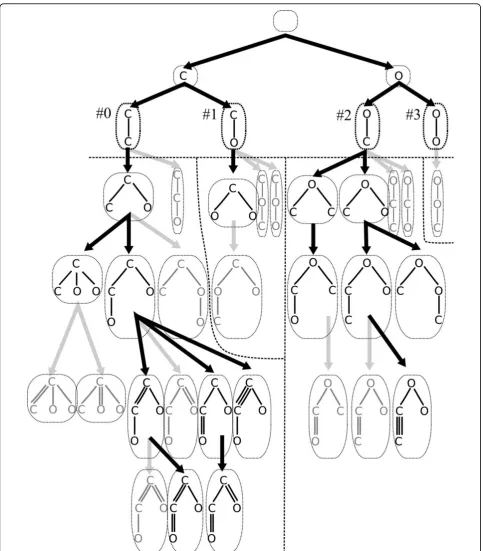
Our approach searches a special tree structure called family tree, in which each vertex corresponds to a mole-cular tree. The root is an empty tree. A family tree is grown by adding an atom to some vertex. Figure 1 shows a family tree for C2O2H2 by BfsSimEnum and
BfsMulEnum, where hydrogen atoms are added at the end of enumeration. In this example, BfsSimEnum con-structs the family tree up to depth 4 by adding atoms, and BfsMulEnum constructs the rest by adding multipli-city to edges.
In the previous study, to reduce the search space (i.e., the size of a family tree), we utilized two constraints for molecular trees, center-rooted, andleft-heavy [6]. Bfs-SimEnum outputs only center-rooted and left-heavy molecular trees. If a molecular tree that does not satisfy both properties of center-rooted and left-heavy is gener-ated in a family tree, it is elimingener-ated. Thus, the size of a family tree is reduced. We call a molecular tree center-rooted if its root is the center vertex or an endpoint of the center edge of a path with the maximum length, where the path does not include the same vertex more than once.
We introduce a total order toΣ, for example, C > N > O > H for Σ= {C, N, O, H}, and two inequalities >sand
>m for rooted and ordered trees. LetT (v) denote the
subtree rooted at vertex vin T . We call a molecular treeT left-heavyif for each vertexv(∈T ) and its chil-drenv1,...,vk, T (vi)≥mT(vi+1) holds for alli= 1,...,k−
1. We also say thatT (u) isheavier than T (v) for ver-ticesu andv if T(u) >s T (v) orT (u) >mT (v) holds.
Here, inequalities >s and >mare recursively defined as
follows. Let u1, u2,...,uhand v1, v2,..., vkbe the children
ofu andv, respectively. We defineT (u) >sT (v) if l(u)
> l(v) holds, or l(u) = l(v) and there exists i such that for all j≤i T(uj) = sT (vj), andi< min{h, k}, T(ui+1)
>sT (vi+1), ori =k < h. In particular, we recursively
defineT (u) =sT(v) if l(u) =l(v) and for all j≤h=k,
Let mul(e) be the multiplicity of edge e in T . We defineT (u)>m T(v) ifT(u)>sT (v) holds, or T(u) = sT(v) and there existsisuch that for allj≤i mul(ej) =
mul(e′j ) and mul(ei+1) > mul(e′i+1), where e1, e2,..., em
ande′1, e′2 ,...,e′m denote the edges in the BFS order in
T(u) andT(v), respectively. In particular, we define T (u) =mT(v) ifT(u) =sT(v) and for allj≤m, mul(ej) =
mul(e′j) hold.
Figure 1Example of a family tree by BfsSimEnum and BfsMulEnum for C2O2H2and its separation by BfsEnumP1-3 with division depth
Then, BfsSimEnum always generates left-heavy and center-rooted trees with labeled vertices to reduce the search space. Finally, a generated molecular tree is dis-carded if it is not in normal form [6]. We say that a molecular treeTis innormal formif Tis center-rooted and left-heavy, and the center ofTis a single vertex, or the center is an edge (r, v) andT (v) ≥m Tv(r) holds,
wherer is the root ofT , andTv(r) denotes the subtree
rooted atr obtained by subtracting T (v) fromT. It is proved that if two rooted and ordered trees are different in normal form, these trees represent distinct molecular trees. It should be noted that molecular trees themselves are generated by BFS order while a family tree having molecular trees as vertices is searched by DFS order.
Methods
We propose three parallelized algorithms BfsEnumP1-3 for enumeration of tree-like chemical compounds by modifying BfsSimEnum in simple manners. LetNbe the number of processors. In growing a family tree, BfsSi-mEnum adds an atom to a molecular tree by BFS order. BfsEnumP1-3 take a parameter d, grow a family tree up to depthdas BfsSimEnum does, and assign numbers to the vertices (molecular trees) in depthd by BFS order. Figure 1 shows an example of the family tree for C2O2H2 and numbers, #0, ..., #3, in depth 2. AllN
pro-cessors independently construct the family tree up to depthdand assign numbers one by one. Each vertex in depthd is assigned to exactly one processor, and the processor generates its descendants, the subtree rooted at the vertex of the family tree. However, we observe that the number of generated molecular trees in the descen-dants is often different. In the example of Figure 1, the number of generated molecular trees for vertex‘#0’is eight, and on the other hand, that for‘#1’is one. Hence, we develop three types of assignment methods in BfsE-numP1-3 for the sake of distributing the load equally to each processor. BfsEnumP1-2 take static assignment methods, and BfsEnumP3 takes a dynamic method depending on computational environment during execution.
By modifying the previous single algorithm BfsSimE-num, we propose the following parallelized algorithm.
Input: numbers nli of atoms for li (∈ Σ), division
depthd, processor identifierp, numberNof processors,
na:=
{li∈|val(li)>1}
nli,d<na
Output: all molecular trees in normal form
BfsEnumP(p, N)
c:= 0
foreachlj∈Σ such thatval(lj)>1, nlj > 0do
T:= a tree consisted of a root withlj
AddAtom(T , p, N)
end
AddAtom(T , p, N)
if|T| =nathen
if Tis in normal formthen BfsMulEnum(T)
else
flag:=true if |T| =dthen
flag:= IsAssigned(c, p, N) c:=c+ 1
if flagthen
vk:= the deepest rightmost vertex in T
vl:= the deepest leftmost vertex inT
ifvk and vl are included in the same subtree
then
ve:=vl−1
elseve:=vk
for eachvifromparent(vk) to vein BFS order
do
ifdegree(vi)< val(l(vi))then
foreachlj∈Σ such thatval(lj)>1do
ifnumT(lj) < nlj and
ljdoes not violate left-heavythen
T′:=T
add an atomljas the last child ofviinT′
AddAtom(T′, p, N) end
It should be noted that this pseudocode describes the common part of BfsEnumP1-3, and function‘IsAssigned’ provides an assignment method according to BfsE-numP1-3.cmeans the identifier number for each vertex in depthdof the family tree. All processors execute the same algorithm with distinct identifier number pamong Nprocessors, and BfsMulEnum(T) sequentially outputs molecular trees by adding multiplicity to edges of Tif needed. Thus,Nprocessors output all tree-like chemical compounds without redundancy.
BfsEnumP1
We define the assignment method of BfsEnumP1 as follows.
IsAssigned(c, p, N)
returnp=cmodN
end
‘IsAssigned’returns whether or not the processor with identifierpis assigned to vertexc. For instance, in the case of enumeration using 3 processors and division depthd= 2 for C2O2H2, vertices 0, 1, 2, 3 are assigned to processors
0, 1, 2, 0, respectively by BfsEnumP1 (see Figure 1).
BfsEnumP2
We define the assignment method of BfsEnumP2 as follows. First, we initialize weights wi = 0 fori = 0,...,
IsAssigned(T , p, {wi})
i:= argmini= 0,...,N−1wi
wi:=wi+cost(T)
returnp=i
end
In BfsEnumP2, the number of molecular trees gener-ated from T is estimated bycost(T), which is accumu-lated to wi. One processor having the minimum ofwiis
selected to execute the enumeration from T. It should be noted that any communication between processors does not occur during the construction of a family tree as well as BfsEnumP1, and wi is calculated
indepen-dently in each processor. In this paper, we define cost (T) by
vi∈{parent(vk),...,vk}
val(l(vi))−degree(vi)
+
li∈
cli(nli−numT(li)),
where vk denotes the deepest rightmost vertex inT,
andcliis a positive constant for li, (cC , cN , cO, cH) =
(1.4, 1.2, 1.0, 0.0). Here the valence of each atom is taken into account. cost(T ) is large if the number of positions that atoms bond and/or the number of remaining atoms are large.
BfsEnumP3
BfsEnumP3 requires an extra processor to manage the assignment, which receives requests from other proces-sors, and replies an assigned number to each processor. It should be noted that such a manager is not needed if we use shared memory. In this paper, we implement the algorithm using MPI (message passing interface) for avoiding inconsistency of cache memory. On the other hand, processor p receives an assigned number as r from the manager, and executes the enumeration from vertexr.
Finally, BfsEnumP3 in processorpsends an end-signal to the manager. Thus, we have the following pseudo-codes.
Manage(N)
globalc:= 0 ne:= 0
whilene< N
ifreceive a request from processorpthen sendglobalctop
globalc:=globalc+ 1
else if receive an end-signal frompthen
ne:=ne+ 1
end
IsAssigned(c, r, p) ifc>r then
send a request to the manager
receiveglobalc asr returnc=r
end
Here,ris initialized as some negative integer.
Results
For evaluation of our proposed methods, we employed a computer with two Xeon E5 processors under Linux operating system, where hyper-threading was enabled and each processor contains 12 logical processing cores. BfsEnumP1-3 were implemented in C++ using MPI library.
We first examined three instances (nC, nN, nO, nH) =
(26, 0, 0, 54), (16, 0, 4, 34), (10, 3, 2, 25), that is, C26H54,
C16O4H34, C10N3O2H25, each of which has only single
bonds, using multiple processors. The numbers of enumerated molecular trees for C26H54, C16O4H34, and
C10N3O2H25were 93839412, 278960984, and 29105924,
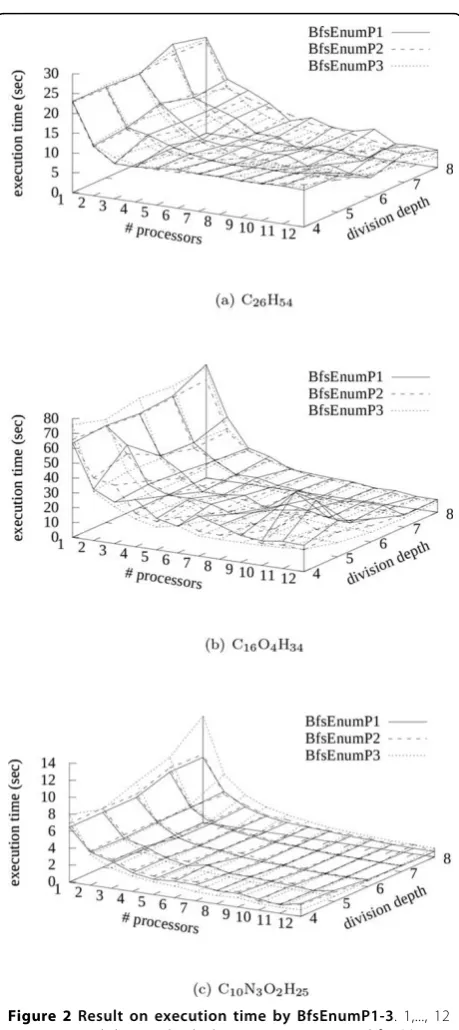
respectively. Figure 2 shows the results on execution times (seconds) by BfsEnumP1-3 with division depth d = 4,..., 8 using 1,..., 12 processors for the instances, C26H54, C16O4H34, and C10N3O2H25. We can see that in
all cases, the execution time decreased by using multiple processors. For C26H54, the execution time by
BfsE-numP3 with d = 8 using 12 processors was 2.54 sec-onds, which was about 11% of the execution time using one processor. For C16O4H34, the execution time by
BfsEnumP3 with d = 7 using 12 processors was 6.23 seconds, which was about 10% of the execution time using one processor. For C10N3O2H25, the execution
time by BfsEnumP3 withd= 5 using 12 processors was 0.60 seconds, which was about 9.3% of the execution time using one processor.
In the case of C26H54 with division depthd= 4, the
execution times using more than 3 processors were about 9 seconds, and were not reduced unlike in the cases of C16O4H34, and C10N3O2H25 (see Figure 2).
Hence, we investigated the number of vertices in depth dof a family tree.
Table 1 shows the numbers of vertices in depth d= 4,...,8 for C26H54, C16O4H34, and C10N3O2H25. The
number of vertices in depth 4 for C26H54 is only 4. It
means that if we use more than 4 processors, any task is not assigned toN−4 processors. Hence, we need divi-sion depth of more than 5 for 12 processors. Further-more, we can see from the figure that the execution time with larger division depth had tendency to be shorter for C26H54. On the other hand, the execution
time with division depth d = 5 was often shorter than others for C10N3O2H25. It may suggest that about 1000
= 8 for C10N3O2H25was longer than those by
BfsE-numP1-2 (see Figure 2(c)). It is considered that the overhead of communication between the manager and enumerating processors was large.
Table 2 shows the results on execution times (sec-onds) and parallelization efficiencies of BfsEnumP1-3
with division depth d = 8 for C26H54 using up to 12
processors, where one processor for the manager of BfsEnumP3 is excluded. The parallelization efficiency is defined as
T1
N·TN
,
whereTNdenotes the execution time byNprocessors.
The execution time by BfsEnumP2 was shorter than that by BfsEnumP1 except using 5, 7 processors. It means that the estimation of the number of generated molecular trees from a vertex worked well for C26H54.
The execution time by BfsEnumP3 was shorter than those by BfsEnumP1-2. Since BfsEnumP2 does not need any communication between processors during the con-struction of a family tree, BfsEnumP2 can be faster than BfsEnumP3. It, however, is difficult to accurately esti-mate the number of generated molecular trees. BfsE-numP3 using up to 11 processors achieved more than 80% parallelization efficiency. The parallelization effi-ciency of BfsEnumP3 decreased especially in using more than 10 processors. It implies that BfsEnumP1-3 using more processors may cause inconsistency of cache memory and decrease the parallelization efficiency. In
Figure 2Result on execution time by BfsEnumP1-3. 1,..., 12 processors and division depthd= 4,..., 8 were examined for (a) C26H54(b) C16O4H34(c) C10N3O2H25, where the number of processors for BfsEnumP3 does not include one processor running the manager.
Table 1. Number of vertices in division depthd= 4,...,8 of a family tree for C26H54, C16O4H34, and C10N3O2H25
d C26H54 C16O4H34 C10N3O2H25
4 4 48 282
5 6 138 1026
6 12 379 3844
7 23 1166 14265
8 50 3420 50522
Table 2. Result on execution time (seconds) and parallelization efficiency of BfsEnumP1-3 with division depthd= 8 for C26H54using 1,...,12 processors, where one processor for the manager of BfsEnumP3 is excluded
N BfsEnumP1 BfsEnumP2 BfsEnumP3
time efficiency time efficiency time efficiency
1 24.20 1.00 23.14 1.00 23.71 1.00 2 14.40 0.84 12.14 0.95 12.72 0.93 3 12.41 0.65 10.35 0.74 8.58 0.92
4 9.97 0.61 8.79 0.66 6.27 0.95
5 6.24 0.78 7.81 0.59 5.19 0.91
6 7.85 0.51 6.24 0.62 4.30 0.92
7 6.15 0.56 6.30 0.52 3.81 0.89
8 6.03 0.50 5.18 0.56 3.32 0.89
9 7.29 0.37 4.26 0.60 3.04 0.87
10 4.42 0.55 3.91 0.59 2.65 0.89
11 4.75 0.46 3.90 0.54 2.65 0.81
BfsEnumP1-3, distinct processors do not use the same region of memory. It is considered that if two processors use close regions of memory, inconsistency of cache memory may occur. More processors can decrease the efficiency because the probability of inconsistency increases.
In addition, we examined three other instances (nC ,
nN, nO, nH) = (20, 0, 0, 40), (12, 0, 4, 16), (11, 3, 2, 21),
that is, C20H40, C12O4H16, C11N3O2H21, each of which
includes several multiple bonds. The numbers of enum-erated molecular trees for C20H40, C12O4H16, and
C11N3O2H21 were 4224993, 282338151, and
7268812476, respectively. In almost all cases using divi-sion depthd= 4,..., 8 and 1,..., 12 processors, the execu-tion time by BfsEnumP3 was shorter than those by BfsEnumP1-2. For C20H40, C12O4H16, C11N3O2H21, the
execution times by BfsEnumP3 withd= 8 using 12 pro-cessors were 0.0606, 6.93, 83.2 seconds, and 11, 9.1, 9.3 % of the execution time using one processor, respec-tively. In our previous study, BfsSimEnum and BfsMulE-num were much faster than MOLGEN, and faster or comparable to Enu-Mol. The execution times by BfsSi-mEnum and BfsMulEnum for C26H54, C16O4H34,
C10N3O2H25, C20H40, C12O4H16, and C11N3O2H21were
22.48, 62.70, 6.61, 0.47, 77.33, and 924.10 seconds, respectively, which were close to those by BfsEnumP1-3 using one processor, and were much longer than those by BfsEnumP1-3 using two processors, respectively.
Conclusion
In this paper, we proposed three parallelized algorithms BfsEnumP1-3 for enumerating tree-like chemical com-pounds by modifying our previous method BfsSimEnum. We performed experiments for several instances with varying the parameter of division depth and the number of processors. The execution time by BfsEnumP3 was shorter than those by BfsEnumP1-2 in almost all cases. BfsEnumP3 achieved more than 80% parallelization effi-ciency using up to 11 processors. In addition, BfsE-numP3 reduced the execution time using 12 processors to about 10% of that by the previous algorithm BfsSimE-num. The results suggest that the division depth should be given so that the number of vertices in the depth is about 1000 for 10 processors.
BfsEnumP1-2 statically assign tasks to processors without communication between processors during the construction of a family tree, whereas BfsEnumP3 dyna-mically makes the assignment depending on computa-tional environment during execution. BfsEnumP2 can be faster than BfsEnumP3 by accurately estimating the number of generated molecular trees from a vertex in a family tree when we use more processors. The execution time by BfsEnumP2 was not always shorter than that by BfsEnumP1. It is needed to improve the cost function of
BfsEnumP2 under the condition that the function is cal-culated in a very quick way.
It is important to deal with more complex structures including cycles such as benzene and aromatic rings. Extensions toward enumerating general compounds and combination with biological properties should be another future work.
Competing interests
The authors declare that they have no competing interests.
Acknowledgements
This work was partially supported by Grants-in-Aid #26240034, #24500361, and #25-2920 from MEXT, Japan, and also by MEXT SPIRE
Supercomputational Life Science.
This article has been published as part ofBMC Medical GenomicsVolume 8 Supplement 2, 2015: Selected articles from the 4th Translational
Bioinformatics Conference and the 8th International Conference on Systems Biology (TBC/ISB 2014). The full contents of the supplement are available online at http://www.biomedcentral.com/bmcmedgenomics/ supplements/8/S2.
Declarations
Publication of this article has been funded by JSPS, Japan (Grant-in-Aid #26240034).
Published: 29 May 2015
References
1. Gugisch R, Kerber A, Kohnert A, Laue R, Meringer M, Rucker C, Wassermann A:MOLGEN 5.0, a Molecular Structure Generator.Bentham Science Publishers Ltd2012.
2. Faulon JL, DP Visco, Rose D:Enumerating molecules.Reviews in Computational Chemistry2005,21:209-286.
3. Ishida Y, Kato Y, Zhao L, Nagamochi H, Akutsu T:Branch-and-bound algorithms for enumerating treelike chemical graphs with given path frequency using detachment-cut.Journal of Chemical Information and Modeling2010,50(5):934-946.
4. Fujiwara H, Wang J, Zhao L, Nagamochi H, Akutsu T:Enumerating treelike chemical graphs with given path frequency.Journal of Chemical Information and Modeling2008,48(7):1345-1357.
5. Shimizu M, Nagamochi H, Akutsu T:Enumerating tree-like chemical graphs with given upper and lower bounds on path frequencies.BMC Bioinformatics2011,12(Suppl 14):1-9.
6. Zhao Y, Hayashida M, Jindalertudomdee J, Nagamochi H, Akutsu T: Breadth-first search approach to enumeration of tree-like chemical compounds.Journal of Bioinformatics and Computational Biology2013, 11:1343007.
7. Imai M, Yoshida Y, Fukumura T:A parallel searching scheme for multiprocessor systems and its application to combinatorial problems. Proceedings of International Joint Conference on Artificial Intelligence1979, 416-418.
8. Janakiram VK, Agrawal DP, Mehrotra R:Randomized parallel algorithms for prolog programs and backtracking applications.Proceedings of International Conference on Parallel Processing1987, 278-281. 9. Freeman J:Parallel algorithms for depth-first search.Technical Report,
University of Pennsylvania1991.
10. Rao V, Kumar V:Parallel depth first search, part I: implementation. International Journal of Parallel Programming1987,16(6):479-499. 11. Korf RE:Depth-first iterative-deepening: An optimal admissible tree
search.Artificial Intelligence1985,27:97-109.
doi:10.1186/1755-8794-8-S2-S15
Cite this article as:Hayashidaet al.:Parallelization of enumerating
tree-like chemical compounds by breadth-first search order.BMC Medical