APPLYING FMEA & FTA TECHNIQUE TO IDENTIFY KEY
RISK ELEMENTS ASSOCIATED WITH DISASTERS AND
THEIR INTER-RELATIONSHIP
Purnima Bajpai
1Assistant Professor, Northcap University, Sector 23 A, Gurgaon, Haryana.
1.
Introduction
Disaster Management & strategies for the reduction of the impact of these disasters are a combination of assessment of vulnerability of the existing population of the area and the risks associated with the most probable hazards and the detailed assessment of institutional & legislative framework existing in the area.
A risk associated with a hazard may be defined as the relative probability of any harmful consequence or loss ( loss of live, property, economy, or livelihood)resulting due to the interactions between any natural and manmade hazards along with the assessment of the coping up capacity of the people of the affected area.
A very critical factor which helps to determine the reliability of a Disaster risk assessment technique is the reliability of the historic data available and the precision with which the data is collected and also the accuracy with which the collected data is analyzed.
This paper mainly concentrated of the risks associated with natural disasters which may be defined as those disasters which are of sudden occurrence and have a widespread impact.
An effective disaster Management system should be designed in such a way that it works in consultation with the local, regional as well as National Authorities and also if found effective and beneficial shall be incorporated in Disaster Management framework of the Country.
2.
Research methodology
Disaster risk Management is a methodical procedure of utilizing the systematic decision making policies, optimizational procedures, operationability skills, implementation of policies and overall strategic development and providing assistance to the affected people in order to enhance their capabilities of the people for coping up with any kind of a disaster.
Abstract:
This paper mainly focuses on natural disasters which may be defined as any serious disruption to the functioning of a community or a society that is capable of causing a widespread human, economic or environment loss which is beyond the ability of the affected community or society to cope up with. It can also be defined as a function of the risk which results from the combination of hazards, increase in vulnerability and insufficient capacity or measures to reduce the potential negative consequences of risk.The main aim of the paper is to formulate a mechanism to help the Government Agencies to prepare a systematic process that integrates risk identification, mitigation and transfer, as well as disaster preparedness, emergency response and rehabilitation or reconstruction to lessen the impacts of hazards. There has been a rapid increase in the number of natural and manmade disasters and increase in the loss of human life & property due to the increased vulnerability of people and also substantial increase in risks associate with different types of hazards.
| Vol. 01 | Issue 07 | October 2015 | 10 |
For this purpose the Author has firstly tried to formulate a Disaster risk index (DRI) using the Failure Mode and evaluation analysis technique ( FMEA) which will help to compare the risks of mortality rates of different countries across the World.The key indicator in this DRI is the overall relative regional vulnerability which will help to indicate the total number of people who have died in a Country due to a disaster or a particular hazard with respect to the total number of people actually exposed to that particular disaster or hazard.
Putting in place the relative vulnerability concept and for calculating the disaster risk index which will be obtained after applying FMEA, the Author has identified twenty four critical risk parameters which have the potential to effect a large scale of population and adversely increase the vulnerability of the population of the area under consideration and also poses a great risk to the society & population. Further using the concept Failure Tree Analysis the author has analyze how these factors are inter related and what is the impact of these critical factor
Through this paper the Author has tried to formulate a risk and vulnerabilty analysis cycle which will help the Authorities to identify the acticities which form a major and most critical part of the risk and vulverabilty analysis.This will also help the Authorities to focus more on the continouus motinoring and updation of mitigation strategies
The paper shall also depict the interrelationship between the various parameters associated with the risk & vulnerability analysis of disasters. The first and the most critical parameter is the shall be applied to prioritize the risks based on their likelihood of occurrence, detection and their potential impact through application of FMEA technique to the identified risk factors.
After the application of FMEA Technique and identifying the top ten most critical risks, the risk reduction strategies for their risks needs to be formulated, however there is a continuous need for the tracking of these methodologies and improvising and modifying the mitigation strategies from time to time as with the type of disaster the risks associated with them also keep changing.
The FTA (Failure tree analysis)technique has been applied further on the ten critical parameters which will help to understand the interrelation and interdependency between the various critical risk parameters and help to get a clear picture of the risk drivers. Also it will clearly indicate the dependency of risks on other elements.
FIG1 RISK & VULNERABILITY ANALYSIS CYCLE
Identification of risk elements
Analysis of all the identified risk elements using FMEA Technique
Calculation of RPN to prioritize the risk elements
Formulate the disaster risks reduction plan
through FTA Tracking &
mitigation strategies development -forming risk reports
mitigation plans Establishing continous control &
revision & improvement cycle
The Fig 1 above depicts the interrelationship between the various parameters associated with the risk & vulnerability analysis of disasters. The first and the most critical parameter is the shall be applied to prioritize the risks based on their likelihood of occurrence, detection and their potential impact.
After the application of FMEA Technique and identifying the top ten most critical risks, the risk reduction strategies for their risks needs to be formulated, however there is a continuous need for the tracking of these methodologies and improvising and modifying the mitigation strategies from time to time as with the type of disaster the risks associated with them also keep changing.
The FTA technique helps us to understand the interrelation and interdependency between the various critical risk parameters and help to get a clear picture of the risk drivers.
Failure Mode Failure Causes Failure effects Likelihood of
occurrence
Likelihood
of detection Severity
Risk priority No. Poor Infrastructure Building Codes and specification not followed.
Additional work, loss
of life & property 4 8 7 224
Poor quality of materials
Additional work, loss
of life & property 6 7 7 294
Lack of public services
Loss of life &
property 7 7 6 294
No spatial planning & land
Management
Additional work, loss
of life & property 8 5 6 240
Climate/ Weather
Variations/fluctuati ons in Climate
Increased susceptibility to disaster, more impact, loss to life & property
9 5 9 405
Adverse Weather conditions
Increased susceptibility to disaster, more impact, loss to life & property
9 5 9 405
Poor environmental Management
Increased
vulnerability, more impact, loss to life & property
7 6 7 294
Population
Very large population
Increased
vulnerability, more impact, loss to life & property
8 7 9 504
Very large rural population
Less awareness, more stringent mind sets.
6 6 6 216
Racism/sex discrimination
Stringent mind sets of people, less involvement of people, more suseptible to impact
6 5 6 180
Poverty
Increased
vulnerability, more impact, loss to life & property
8 6 8 384
Less public involvement
Increased
| Vol. 01 | Issue 07 | October 2015 | 12 |
TABLE1. FAILURE MODE AND EFFECT ANALYSISproperty
Stringent Mind sets of people
No involvement leading to less awareness, increasing the vulnerability
8 7 8 448
Poor health facilities
Increased suseptibility to disaster, more impact,can lead to loss to life & property
7 7 7 343
Low GDP per capita
Increased suseptibility to disaster, more impact,can lead to loss to life & property
7 6 7 294
Development Low human development Index Increased suseptibility to disaster, more impact,can lead to loss to life & property
7 6 7 294
Lack of public awareness
Increased suseptibility to disaster, more impact,can lead to loss to life & property
8 8 9 576
Non developed early warning systems Increased suseptibility to disaster, more impact,can lead to loss to life & property
8 7 9 504
Lack of education & training
Increased suseptibility to disaster, more impact,can lead to loss to life & property
8 7 8 448
Legislation
No institutional framework
No accountability, no nodal point of contact for
emergency purposes
8 7 8 448
No legislation and & community support
No accountability, no nodal point of contact for
emergency purposes
7 7 9 441
Socio economic constraints
No accountability, no nodal point of contact for
emergency purposes
TABLE 2. 10 MOST CRITICAL RISKS ASSOCIATED TO ALMOST ALL TYPES OF DISASTERS (BASED ON FMEA)
Sr No Critical Risk Parameter
1. Lack of public awareness (LPA) 2. Very large population (VLP)
3. Non developed early warning systems(EWS) 4. Stringent Mind sets of people(SMS)
5. Lack of education & training (E&T)
6. No institutional framework (IF)
7. No legislation and & community support (L&C) 8. Adverse Weather conditions(WC)
9. Poverty (P)
10. Less public involvement (PI)
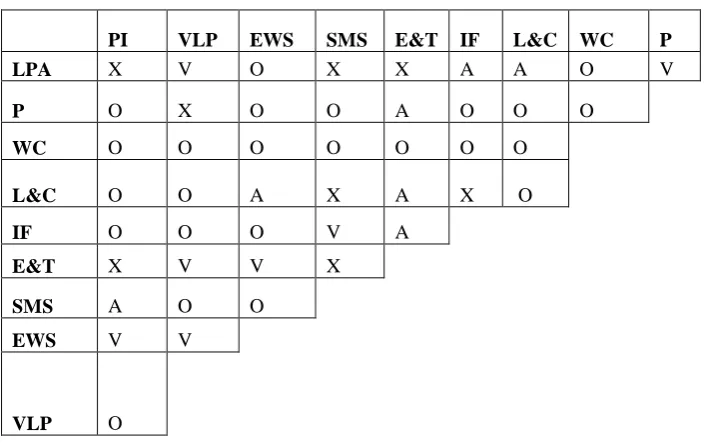
Table 3.STRUCTURAL SELF-INTERACTION MATRIX (SSIM)
PI VLP EWS SMS E&T IF L&C WC P
LPA X V O X X A A O V
P O X O O A O O O
WC O O O O O O O
L&C O O A X A X O
IF O O O V A
E&T X V V X
SMS A O O
EWS V V
VLP O
There are four symbols used to denote the direction of relationship between the enablers (i and j): A: enabler i will ameliorate enabler j;
V: enabler j will be ameliorated by enabler i; X: enabler i and j will ameliorate each other; and O: enablers i and j are unrelated
Based on the above study and analysis the following Failure tree has been developed by the Author. This FTA is carried out on the ten most critical risk parameters identified through the FMEA Analysis in order to formulate a logical inter relationship between different risk elements associated with a disaster.
| Vol. 01 | Issue 07 | October 2015 | 14 |
Lack of Public Awareness and
involvement
Development and growth
Weak legislative framework
Very large population growth
Stringent mind sets of people
Less public involvement
Lack of education & training
Poverty Poor health & sanitation facilities
No legislative
authority/body No
community support system
No
institutional framework
The Logic Symbols used in the FTA Analysis
Top Event-Representing the most undesirable Event
AND Gate-Produces a result if all other elements co exist
OR Gate-Produces a result if any one of the parameter coexists.
Basic Event-Initiating Fault or failure.
3.
Conclusion
Outcome of analysisFrom the above FTA the author has found that the lack of public awareness and public involvement are the key enabler causing the maximization of risks and is the major reason for increasing the vulnerability of the people. This situation may occur due to lack of constructive development in a country, slow growth rate in terms of education, training, early warning systems, stringent mind sets of people, poor health & sanitation facilities, poverty etc or due to a weak legislative framework in which there may be lack of an administrative governing body, lack of decision making authority etc.
This also clearly shows that the Governmental Authorities are lacking in Institutionalization, that there is a lack of a structure to which may be relied on to ensure a minimum impact of the disaster when struck, also they need to assign responsibilities and formulate a team who is ready to take accountability to enforce the set systems into place.
References
[1]. Zhong Jiangrong , Yu Shizhou & Zhao Zhendon “The Application of the Fault Tree Analysis Principle in the Seismic Secondary Fires Disaster of Storage Tanks 2009) vol 2
[2]. Sun Zhaoqiang, Zhao Lianhe, Zhen Xianbin.(2004). Fault tree analysis of oil tank fire and explosion. Natural Gas And Oil 22: 1,27-30.
[3]. Zhang Baohong, Chen Hongde,(1994). The investigation on earthquake fire.Journal of Natural Disasters 3:4,39-48
[4]. Satu Kumpulainen1 VULNERABILITY CONCEPTS IN HAZARD AND
[5]. RISK ASSESSMENT.
[6]. Action Aid 2008. The time is NOW: Lessons Learnt from farmers‟ adapting to climate change ADPC, 2002. Community Based Disaster Management (CBDM): Trainer‟s Guide. Asian Disaster Preparedness Center. Bangkok, Thailand .
[7]. Benedick, Richard (2000) „Human Population and Environmental Stresses in the Twentieth First Century‟, Environmental Change and Security Project Report, Woodrow Wilson Center, Issue No. 6. Summer.
| Vol. 01 | Issue 07 | October 2015 | 16 |
[9]. Byrne, Bridgit and Sally Baden, (1995) „Gender, emergencies and humanitarian assistance, BRIDGEBriefings on development and Gender, November.
[10]. Cannon, T., 1994. 'Vulnerability analysis and the explanation of 'natural' disasters' in Varley, A. (editor), Disasters, Development and Environment, John Wiley and Sons, New York.