PURE Insights
Volume 1
Article 10
2012
Full Issue
Follow this and additional works at:
https://digitalcommons.wou.edu/pure
This Article is brought to you for free and open access by the Student Scholarship at Digital Commons@WOU. It has been accepted for inclusion in PURE Insights by an authorized editor of Digital Commons@WOU. For more information, please [email protected].
Recommended Citation
(2012) "Full Issue,"PURE Insights: Vol. 1 , Article 10.
Full Issue
Abstract
All of the articles included in this issue of
PURE Insights.
1
Program for Undergraduate
Research Experiences
Spring 2012
»
Volume 1
Research
»
Scholarship
»
Creative Arts
A publication of the Program for Undergraduate Research Experiences at Western Oregon University
!
!
!
digitalcommons.wou.edu/pure !2012
!"#$%&'(&)'*+%*+,&
Editors Notes & Acknowledgements
--- .
!
PURE Identity Manual
--- /
!
The Burden of the Kayayei: Cultural and Socio-economic Difficulties Facing Female Porters in
Agbogbloshie, Ghana
---00
!
Xenophobia and Structural Violence: Barriers to Education for Roma Youth
---01
!
Nutrition and Cognitive Functioning: Multifaceted Analysis of Physiological and Psychological
Components
---.2
!
Influences on Music Preference Formation
---/0
!
Gender and Optimism as Predictors of Novice ESOL Teaching Performance
---/3
!
A publication of the Program for Undergraduate Research Experiences at Western Oregon University
!
!
!
"!
digitalcommons.wou.edu/pure !2012
Editors Notes & Acknowledgements
Camila Gabaldón
, Western Oregon University
It is exciting to finally be publishing the first issue of PURE Insights! This journal has been a goal of the PURE executive committee since the very first Academic Excellence Showcase in 2006 and publishing the inaugural issue has been my great pleasure.
This issue contains content from a variety of disciplines and covers creative endeavors of WOU students as well as cultural studies, review and research articles. Each piece is the cumulative work of at least one WOU undergraduate author and multiple faculty members, who served as sponsors, reviewers, editors and, in some cases, several of those roles. From cultural and gender issues facing female porters in Ghana to examining psychopaths in the world of business, the works included in this issue are excellent examples of what can be produced through the collaborative work of WOU undergraduate students and faculty. I hope that you enjoy these pieces as much as I have.
Acknowledgements
The first issue of PURE Insights is only possible due to the hard work of WOU faculty and students. Each of the students who submitted to the journal, especially those whose work was ultimately accepted, went through an extensive revision/review process, which resulted in works of excellent quality. The faculty who guided them through that process: their faculty sponsors, the reviewers, and the section editors in the various disciplines spent countless hours on top of their already busy schedules to ensure the works included are of the highest quality.
The PURE executive committee not only had the goal of creating this journal, but also served a large role in determining the initial format and general guidelines for the journal. They had meetings to discuss deadlines, submission, and their careful consideration helped the editorial board avoid a number of pitfalls we could have encountered with this first issue. They were also charged with the difficult task of selecting the logo from an impressive set of submissions.
I cannot express enough appreciation for the hard work of the editorial board. Section editors Marie LeJeune, Michael Ward, Ava Howard, Ethan McMahan, and Misty Weitzel all put many hours into this journal, discussing and writing submission guidelines and procedures, selecting and soliciting reviewers, proofing the submissions, and working with the students and
A publication of the Program for Undergraduate Research Experiences at Western Oregon University
!
!
!
#!
digitalcommons.wou.edu/pure !2012
PURE Identity Manual
Cristin Stevens,
Western Oregon University
Faculty Sponsor:
Jen Bracy
Published standards are essential for providing consistency in a organizationʼs graphic identity. This set of standards was selected in 2010 by the PURE Executive Committee to provided the basis for that set of standards for PURE.
The aims of this brand identity are:
• To create a single, consistent, and clear visual identity for PURE: Program for Undergraduate Research Experiences.
• To project PURE as a professional, reliable, dynamic and contemporary organization.
• To standardize the organizationʼs visual presentation in a number of applications, thereby increasing consistency of the image projected.
u
p
u
Identity Manual
re
!
!
$!
Stevens | PURE Identity ManualPURE Insights Volume 1, Issue 1
Contents
Introduction
Logo & Tagline
Typography
Colors
Images & Graphic Elements
Stationery
Website
Cover Art
Article Template
Promotional Tools
08
09
10 01
02
03
04
06
11
12
Introduction
To create a single, consistent, and clear visual identity for PURE Journal: Program for Undergraduate Research Experiences. To project PURE as a professional, reliable, dynamic and contemporary organization. To standardize the organization’s visual presentation in a number of applications, thereby increasing consistency of the image projected.
01
!
!
%!
Stevens | PURE Identity ManualPURE Insights Volume 1, Issue 1
Logo & Tagline
02
The PURE logo is about combining the style of a scholarly journal and the concept of forward thinking. The background box, highlighting the letter ‘u’, communicates a playful yet traditional manuscript reference. The highlighted and italic letter ‘u’ serves the purpose of showcasing PURE as a journal that is for students. The use of serif and sans serif font composes a logo where traditional meets modern.
Program for Undergraduate Research Experiences
p
u
re
Program for Undergraduate Research Experiences
pure
Typography
03
The two typefaces for PURE are a serif and sans serif font: Didot and Geneva. These two typefaces complement one another as well as the identity.
Didot Regular
This is used for the majority of the acronym.
Didot Italic
This is used to highlight the ‘u’ as to showcase that PURE is a journal for students.
Geneva Regular
This is used for the tagline and most body text.
abcdefghijklmnopqrstuvwxyz ABCDEFGHIJKLMNOPQRSTUVWXYZ 0123456789
DIDOT REGULAR
abcdefghijklmnopqrstuvwxyz ABCDEFGHIJKLMNOPQRSTUVWXYZ 0123456789
DIDOT ITALIC
abcdefghijklmnopqrstuvwxyz ABCDEFGHIJKLMNOPQRSTUVWXYZ 0123456789
!
!
&!
Stevens | PURE Identity ManualPURE Insights Volume 1, Issue 1
Colors
04
PURE Purple
PANTONE 518U 70C 100M 55Y 25K 102R 51G 100B
PURE Light Purple 54%
PANTONE 518U 70C 100M 55Y 25K 102R 51G 100B
PURE Black
0C 0M 0Y 100K 0R 0G 4B
The color palette for PURE include spot colors (for uncoated paper stocks), custom process breakdowns (CMYK), RGB equivalents for screen applications and use in Word, Excel or Powerpoint.
Primary Palette
There are two colors that make up the primary palette for the PURE logo: black and Pantone 518U.
3DQWRQH8RϝHUVDVRSKLVWLFDWHG
purple.
Note: Pantone 518U at 54% tint is used for the background box. Black is used for the tagline.
Colors
05
PURE Green 100% & 52%
PANTONE 385U 3C 0M 100Y 58K 153R 153G 0B
PURE Blue 100% & 52%
PANTONE 294U 100C 58M 0Y 21K 0R 102G 153B
PURE Red 100% & 52%
PANTONE 216U 0C 95M 40Y 49K 153R 0G 51B
Secondary Palette
The secondary palette provides three other possible color variations.
Pantone 518U can be replaced by Pantone 385U, Pantone 294U, or Pantone 216U.
!
!
'!
Stevens | PURE Identity ManualPURE Insights Volume 1, Issue 1
Images & Graphic Elements
06
Images
There is a preference for student photography; however, whether shooting original photography, selecting from already-shot images or purchasing stock photography, try to base decisions on these guidelines:
Aim to use images with natural, outdoor and available
OLJKWUDWKHUWKDQDPELHQWRUDUWLÀFLDOOLJKWLQJ
Strive to use active images of real-life experiences rather than staged portrait-like shots.
Wherever possible, there is preference for images in full color, or in greyscale.
Images & Graphic Elements
07
u
u
u
u
Graphics
The primary graphic is the highlighted ‘u’ and can be used in a manner consistent with the design of the stationery and promotional tools.
The small squares can be used along a headline or act as list bullets.
!
!
(!
Stevens | PURE Identity ManualPURE Insights Volume 1, Issue 1
Stationery
08
345 N Monmouth Ave Monmouth OR 97361
Program for Undergraduate Research Experiences
p
u
re
u
u
Program for Undergraduate Research Experiences
p
u
re
345 N Monmouth Ave Monmouth 0R 97361 503.838.8887 !"#$%%&'(")'*+,
-'$"(%./01(%*'2'$%0.3%#("3,%(#1$.0%4.0.%#2.51#(%13 %6.)7%(.%8"9,%2.)"$'%*.0% $.*.91210%13%/1$10%8189%# %:3%('$).%.83"$*1(%8122#%;103'%# %<.*.91210%8#(%51#( =1$10%0"(,%(#>8#%8.02%8122#(%2"'%2#910,%0'9.'051%0"*%2#910%(#>8.0%3.89.*183%.8 :23$.9"0%"1.0('*,%0'22.9.31*.8%#83"%#1>1"%('2"03."%13,%*'8"9%#2.51#(%">"3, /7#0"2210%/'$33.3'$,%4.0.%0"*%.(/"$*."3%.8%.8%*'8"9%(#>8# %&'9.'051%8#3'51"%?"2% /'01"$"%#2.51#(,%;103'%/"$,%$7'8910%?"2%9$#0%(#1$.0%*.>8.00.('0,%8122#(%?"2.3% 09"2"$.051"%?"03.)121(%$7'8910%/"$%"03 %!'2'$%@109"%0.3%(#>8#,%8189%2#910%#9%#("3% /2#9"$#3 %A$'0%/1$10%/$#"0"83%8122#%.(/"$*."3 B"2%">"03#0%/"*"%"C/2.9#)'%(#2"01#*#%/2#9"$#3,%#$91%4.0.,%#991(0#8%3$.03.51"%.8% #("3%@109"%/"22"83"051"%#("3,%/'$3#%@"1>.#3%13%/'3"83.%8'81((+ %6.)7%>$#?.*#%*'% (10,%?'213/#3%#3%010/"8*.00"%#*./.09.8>,%8122#%@109"%#9 %D'2"03."%'*.'%/"*",%?.?"$$#% 0'*#2"0%9'8*.("831(%0"(/"$%2'$"(%?.3#"%/"22"83"051",%9$#0%@$.8>.22#%#2.51"3% 3"(/10%3"2210,%0.3%/"$%?'21/3#0%9'80"51#3%8"9,%"8.(%'$9.%*.0%.8%(#00# %E#).3#00"% 2')'$3.0%0"*%51#(%3"2210%8.)7%1$8#,%'$8#$"%"03%09"2"$.051"%"3%/1$10%./01( %B.?"$$#% 8122#(%8189%0"*%.8%/7#0"2210 &"*%1$8#%?"2%#2.51#(%;103' %6"51"%@$.8>.22#%(#1$.0%'$8#$"%?.3#"%91$#).31$%4.0., 0#/."8%"$'0 %6189%3"(/10%2.)"$'%.8%'$8#$"%"03%?"2,%?#$.10%.83">"$%1$8#%123$.9."0% 2"9310%('22.0,%#9%?"2%./01(%2.>12#%'*.'%.#912.0,%8189%.(/"$*."3%8.)7,%(.%2.>12# %F83"% ?.3#",%0.3%/12?.8#$%#9,%"$'0%?"03.)121( %B"2%"3%(#00#%?"2%$.*.91210%"2".@"8*% /7#0"2210,%/$"3.1(%?"03.)121(%2#910%3"(/'$,%"8.(%13%9'80"93"31"$%8.02%2')'$3.0 !.931(03%8'81((+ &.89"$"2+, &'(")'*+ 6'?"()"$%G,%HIGI &'(")'*+ J.32" K'(/#8+%6#(" LMHG%N.$03%&3$""3 F8+3'48,%&3#3"%OPP
The PURE stationery design continues to create unity within the brand identity. The letterhead and envelope are professional and modern to maintain the style of a scholarly journal and forward thinking. Wherever possible in the PURE stationery system
print on bright-white paper stock.
Business Envelope
9.5” x 4.125”
Letterhead
8.5”x11”
Website
09
The PURE website (1024 x 768 pixels) f consistent with the Digital Commons model. The two-color palette is converted to the RGB equivalents for screen applications.
!"#$"%&'(%")*&'+&,-"%#,$./'0*&1*2$3
4*1" 56*2$ 758 0.'599*2&$
:*2%&;<'4*1" 56*2$'$3,#':*2%;< =*<,9,"# >,&?# >*)',&$*'@"<"9$"A'!*%?# @261,$'!*%? 0*#$'=*B2<;%'!*%?# C2%%"&$'D##2"E''F*<21"'G/'D##2"'G'H@B%,&)'IJGGK
Program for Undergraduate Research Experiences
p
u
re
!3;$',#'=+LM':*2%&;<N ©,W©LV©D©MRXUQDO©IRFXVLQJ©RQ©WKH©SXEOLVKLQJ©RI©KLJK©TXDOLW\©VFKRODUVKLS©RI©:HVWHUQ©2UHJRQ©8QLYHUVLW\© 2&A"%)%;A2;$"'#$2A"&$#O ©7KH©MRXUQDO©ZLOO©LQFOXGH©UHVHDUFK©VFKRODUVKLS©DQG©FUHDWLYH©DUWV©FRQWULEXWLRQV©IURP©XQGHUJUDGXDWH© VWXGHQWV©LQ©DQ\©DFDGHPLF©GLVFLSOLQH©WKDW©KDYH©ZRUNHG©ZLWK©D©:28©IDFXOW\©PHPEHU ©6XEPLVVLRQV©ZLOO©EH©SHHUõUHYLHZHG©E\©WKH©VWDQGDUGV©RI©WKH©DFDGHPLF©GLVFLSOLQH © 7KH© MRXUQDO© ZLOO© EH© SXEOLVKHG© DQQXDOO\© ERWK© RQOLQH© DQG© LQ© D© OLPLWHG© QXPEHU© RI© KDUGõFRS\© SULQW©
-"%#,*&#O
©7DUJHW©GDW ©I © © Q©LV©6SULQJ©
©7KH©385(©-RX ©©© W\©WR©SXEOLVK©DFFRPSDQ\LQJ©LPDJHV©YLGHR©DQG©RWKHU©
12<$,1"A,;O
©7KH©RQOLQH©YHUV© ©© (©MRXUQDO©LQ©:28©'LJLWDO©&RPPRQV©:28©'LJLWDO©&RPPRQV©LV©D©GLJLWDO© UHSRVLWRU\©WKDW©Z © © © LHW\©RI©RQOLQH©XQLYHUVLW\©SXEOLFDWLRQV©DQG©SURMHFWV +RZ©GRHV©WKH©3HHU©5HYLHZ©SURFHVV©ZRUN"
$©IDFXOW\©(GLWRUõLQõ&KLHI©DQG©D©WHDP©RI©VHYHUDO©IDFXOW\©PH © QJ©GLVFLSOLQHõVSHFL½F©VHFWLRQ©HGLWRUV© ZLOO©UHYLHZ©VXEPLVVLRQV©,Q©DGGLWLRQ©VWXGHQWV©PD\©VHUYH© © © HUHHV©)ROORZLQJ©WKH©HGLWRULDO©UHYLHZV© FRPPHQWV©ZLOO©EH©SURYLGHG©WR©WKH©VWXGHQWV©DXWKRUV©,I©±S © © PHG©DFFHSWDEOH©WKH©IDFXOW\©HGLWRU©ZLOO© DFFHSW©LW©DV©LV©RU©UHTXHVW©D©UHVXEPLVVLRQ©'XULQJ©WKH©6SULQJ© ©© ©SURGXFW©ZLOO©EH©SXEOLVKHG©ERWK©RQOLQH© DQG©LQ©D©OLPLWHG©QXPEHU©RI©KDUG©FRS\©YHUVLRQV 1HHG©PRUH©LQIRUPDWLRQ"©:DQW©WR©VHUYH©DV©DQ©HGLWRU"©&RQW L*6"%$'0*&)"/'D&#$%29$,*&'>,6%;%,;&/'4;1"%#<.'>,6%;%. PRQJHU#ZRXHGX õõ %URZVH @";%93E F*<O'G/'D##OG P'Q P'Q
1
Program for Undergraduate Research Exper ences
pure
Sp ing 2011 Volume 1
!
!
)!
Stevens | PURE Identity ManualPURE Insights Volume 1, Issue 1
Cover Art
10
1
Program for Undergraduate Research Experiences
p
u
re
Spring 2011 Volume 1
Research
Scholarship
Creative Arts
The PURE cover art has a number one to represent that it is the
LQDXJXUDOLVVXHRI385(DQGÁRZHUV
to represent spring. The use of the black and white logo is meant to create a cohesive feel between the one and the logo.
Article Template
11
!"#$#%&'(&)*"+#,$-#*"#./0-1#2)3#4'5$63#73%3(2#8*+)2# %338#$"#/"*"6*2*"+1#9$((3"#:$%230$",#2'#2)3#&$%/$0# '9%3(63(;#</2#2'#=>?@#(3%3$(&)3(%1#2)3#,3%3(2#*%#$"# $8$A*"+# (3%'/(&3# $",# B$(# B('8# 9$((3";# !"# 2)3# &'"2($(-1#2)3-#B*",#*2#(38$(C$90-#B3(2*03#+('/",#D#B'(# (3%3$(&);
E)3-# C"':# 2)$2# F83(*&$G%# H'/2):3%2# ,3%3(2%#$(3#&'8I03J#-32#,30*&$23#3&'%-%238%#:)3(3# /"*K/3# %I3&*3%# 'B# I0$"2%# $",# $"*8$0%# &'"2*"/3# 2'# 2)(*63# ,3%I*23# %'83# 'B# 2)3# 8'%2# 3J2(383# &0*8$23# &'",*2*'"%#*"#2)3#:'(0,; # LE)*%#8$-#"'2#93#$#63(-#&'8B'(2$903#I0$&3# B'(#2)3#"$2*63#4'5$63#I0$"2%1#$"*8$0%#$",#8*&('93%1# 9/2# *2G%# +(3$2# B'(# 9*'0'+*%2%# *"23(3%23,# *"# )':# 0*6*"+# %-%238%#&'I3#:*2)#3J2(383#$",#'2)3(:*%3#%2(3%%B/0# 3"6*('"83"2$0# &'",*2*'"%1M# %$-%# =>?@# 9*'0'+*&$0# %&*3"&3%# I('B3%%'(# N323(# H2$(C:3$2)3(;# O3# $,,%# 2)$2#2)3#%2/,-#'B#2)3#,3%3(2G%#"$2/($0#3"6*('"83"2#*%# 'B# 6*2$0# *8I'(2$"&31# $%# *2# I('6*,3%# /%# :*2)# +(3$2# *"%*+)2# *"2'# )':# *2%# *")$9*2$"2%# $(3# $903# 2'# %/(6*63# $",# $,$I21# $",# )':# 0*6*"+# %-%238%# *"# +3"3($0# (3%I'",#2'#3J2(383#&'",*2*'"%; # H2$(C:3$2)3(# $",# %363($0# 'B# )*%# 9*'0'+*&$0# %&*3"&3%#&'003$+/3%#$(3#B'&/%*"+#2)3*(#(3%3$(&)#*"# 2)*%#$(3$#$%#I$(2#'B#=>?@G%#P"23+($23,#FII('$&)3%# 2'# F9*'2*&# H2(3%%# N('+($8# QPFFHR1# :)*&)# *%# ,3,*S &$23,# 2'# ,*%&'63(*"+# )':# '(+$"*%8%# $,$I2# 2'# 2)3# %2(3%%3%#'B#$#6$(*32-#'B#"'"S0*6*"+#D#'(#L$9*'2*&M#D# &'8I'"3"2%#'B#2)3#,3%3(2#3"6*('"83"2#Q3;+;1#:*",1# )3$21#&'0,1#,('/+)21#$",#%$0*"*2-R;#E)3*(#B*",*"+%#8$-# '"3#,$-#*"B0/3"&3#2)3#I(3%3(6$2*'"1#I('23&2*'"1#$",# 8$*"23"$"&3#'B#2)3#:'(0,G%#8$"-#$(*,#(3+*'"%; # E)3#$9*'2*&#%2(3%%#*"*2*$2*63#(30*3%#'"#B$&/02-# (3%3$(&)#%2(3"+2)%#$6$*0$903#2)('/+)'/2#2)3#>36$,$# H-%238#'B#O*+)3(#T,/&$2*'";#E)3#I('+($8#*%#I$(2#'B# $#%2$23:*,3#>$2*'"$0#H&*3"&3#U'/",$2*'"#TNHV'W# I('53&2# C"':"# 0'&$00-# $%# WP>X# EW=T# PP1# :)*&)# %2$",%# B'(# LW3%3$(&)# P"B($%2(/&2/(3# B'(# >36$,$G%# X(':2)Y# E$(+32*"+# W3%3$(&)# :*2)# ="*K/3"3%%# $",# TJ&3003"&3;M#QH33#(30$23,#$(2*&031#LF9'/2#TNHV'W;MR# 4'(3# 2)$"# Z[# (3%3$(&)3(%# B('8# %363($0# >36$,$# *"%2*2/2*'"%# D# *"&0/,*"+# =>?@1# 2)3# ="*63(%*2-# 'B# >36$,$1#W3"'1#$",#2)3#73%3(2#W3%3$(&)#P"%2*2/23#D# I$(2*&*I$23#*"#2)3#I('+($8; # P"*2*$23,# *"# \[[\1# 2)3# PFFH# I('+($8# )$%# $0(3$,-# I(',/&3,# $# "/893(# 'B# 8$5'(# $&&'8I0*%)S 83"2%1#*"&0/,*"+Y
###]^#I33(S(36*3:3,#%&*3"2*B*&#I$I3(%;# # _\]# 8*00*'"# *"# &'8I32*2*63# B3,3($0# $",# '2)3(# (3%3$(&)# +($"2%# Q\\# I3(&3"2# B('8# 2)3# >$2*'"$0# H&*3"&3#U'/",$2*'"R;# ##H/I3(6*%3,#2($*"*"+#'B#3*+)2#I'%2,'&2'($0#%&)'0$(%1# `a# +($,/$23# %2/,3"2%1# $",# Z`# /",3(+($,/$23# %2/,3"2%;
##E)(33#>36$,$S)'%23,#(3%3$(&)#%-8I'%*$#$223",3,# 9-#*"23("$2*'"$0#%&)'0$(%#$",#>HU#(3I(3%3"2$2*63%;# ##V'"2(*9/2*'"%#2'#%2$(2S/I#I$&C$+3%#B'(#"*"3#"3:0-# )*(3,# B$&/02-# 83893(%;# F9'/2# `b# =>?@# B$&/02-# 83893(%#)$63#933"#:'(C*"+#:*2)#2)3*(#%2/,3"2%#'"; # PFFH#(3%3$(&)#I('53&2%;#./%2#$#B3:#3J$8I03%#'B#2)3*(# I('53&2%#$(3#"'23,#930':#$",#%3(63#2'#*00/%2($23#2)3# "$2/(3#$",#%&'I3#'B#PFFH#(3%3$(&); ########<*'0'+*&$0#%&*3"&3%#I('B3%%'(%#V$(0#W3*93(#$",# N323(# H2$(C:3$2)3(# 3J$8*"3# '(+$"*%8%# 2)$2# &'83# 2'#0*B3#*"#2)3#238I'($(-#I''0%#2)$2#B'(8#*"#2)3#,3%3(2# $B23(#*2#($*"%;#E)3%3#'(+$"*%8%1#%/&)#$%#B$*(-#%)(*8I# $",# 2$,I'03# %)(*8I1# 383(+3# B('8# '"&3S,'(8$"2# 3++%#2)$2#(3%*,3#'"#,(-#,3%3(2#0$",#/"2*0#$#%/,,3"# %)':3(#I('6*,3%#2)38#:*2)#2)3#:$23(-#3"6*('"83"2# "3&3%%$(-# B'(# )$2&)*"+;# E)3"1# 2)3-# 0*63# '/2# 2)3*(# 3"2*(3#3J*%23"&3#*"#2)3%3#%)$00':1#3I)383($0#I''0%;# Lc3#$(3#"'2#3J$&20-#%/(3#:)-1#9/2#2)3#,(-*"+#I3(*',# 'B#,'(8$"&-#*%#"3&3%%$(-#B'(#2)38#2'#&'83#2'#0*B31M# W3*93(#%$-%;#LH'#2)3#,3%3(2#&0*8$23#*%#&(*2*&$0#2'#2)3*(# 3J*%23"&3;# F",# :*2)# 2)3# (3%3$(&)# &$I$9*0*2*3%# :3# )$63#$2#=>?@1#:3#$(3#"':#$903#2'#3JI0'(3#2)3#+3"3%# 2)$2#2$C3#2)38#*"#$",#'/2#'B#,'(8$"&-;#>'#'"3#)$%# -32#933"#$903#2'#*,3"2*B-#)':#2)*%#83&)$"*%8#:'(C%# *"# 2)3%3# &(3$2/(3%;M# W3*93(# $,,%# 2)$2# 2)*%# %2/,-# %33C%#2'#%)3,#0*+)2#'"#)':#2)3#3$(0-#%2$+3%#'B#,3630S 'I83"2# *"# 2)3%3# 0*B3# B'(8%# $(3# *"B0/3"&3,# 9-# 2)3# %2(3%%3%#'B#2)3#,3%3(2; # # # # # N3""-#F8-1# I('B3%%'(# 'B# 9*'0'+*&$0# %&*3"&3%1# %2/,*3%# 2)3# 3&'0'+-# $",# I)-%*'0'+-# 'B# 9$&23(*$0# %/(6*6$0# *"# 2)3# 3"6*('"83"2;# H)3# B'&/%3%# '"# 2)3# I('&3%%3%# /%3,# 9-# 9$&23(*$# 2'# $,$I2# 2'# %I3&*B*&# 3"6*('"83"2%d# *"# I$(2*&/0$(1# %)3# 3J$8*"3%# 2)3# *"B0/3"&3# 'B# 8*&('93%# '"# &'(('%*'"e,3+($,$2*'"# I('&3%%3%# '&&/((*"+# ,33I# 930':# 2)3# T$(2)G%# %/(B$&3;#LE)3#%/9%/(B$&3#3"6*('"83"2#*%#$%#,*BB3(3"2# B('8# 2)3# T$(2)G%# %/(B$&3# $%# $"'2)3(# I0$"321M#F8-# %$-%;# Lf321# 2)('/+)# '/(# (3%3$(&)1# :3# )$63# ,*%&'6S 3(3,# 2)$2# 2)3(3# $(3# 8'(3# ,33I1# %/9%/(B$&3# '(+$"S *%8%# 2)$"# %/(B$&3# '(+$"*%8%;M# c'(C*"+# :*2)# $# "/893(#'B#+($,/$23#%2/,3"2%1#F8-#)$%#03,#2)3#3BB'(2# *"#$II0-*"+#2)3#(3%/02%#'B#2)*%#%2/,-#2'#$#%*+"*B*&$"2# *%%/3# *"# >36$,$Y# 2)3# f/&&$# 4'/"2$*"# >/&03$(# W3I'%*2'(-;#LE)*%#(3%3$(&)#)$%#03,#2'#&'"%*,3($903# ,3%*+"#&)$"+3%#*"#2)3#&'"2$*"83"2#'B#"/&03$(#:$%23# 2'#93#%2'(3,#*"#f/&&$#4'/"2$*"#$",#$00':3,#B'(#2)3# 'I2*8$0#0'"+36*2-#'B#&'"2$*"83"2#I$&C$+3%#2)$2#:*00# 93#I0$&3,#*"#2)$2#0'&$2*'";M#F8-#$",#)3(#23$8#$0%'# %2/,-#2)3#8*&('93%#2)$2#I'00/23#2)3#"$2/($0#:$23(%#'B# H'/2)3("#>36$,$#$",#$(3#%33C*"+#:$-%#2'#*8I('63# :$23(#K/$0*2-; !"#$%&'()%*)%+,)-,.,/% !"#$%&# 01
The journal article shown acts as a template. Template guidelines include:
Typeface for headline is Arial Bold 18 point, writer is Arial Italic 12 point, and body text is Arial Regular 10 point.
Layout text in two columns.
Use square graphic element for list bullets.
!
!
*+!
Stevens | PURE Identity ManualPURE Insights Volume 1, Issue 1
Promotional Tools
12
u
“The only source of knowledge is experience”-Albert EinsteinProgram for Undergraduate Research Experiences pure
u
“The only source of knowledge is experience”-A bert Einstein
Progra mforUnd
ergraduat e
Research Experie
nces
p
u
re
These are some suggested promotional tools for the PURE brand identity. Both display the quote by Albert Einstein: “The only source of knowledge is experience.” There are many
SRVVLELOLWLHVDQGWKHVXJJHVWLRQVRϝHUHG
here are by no means the only applications of promotion.
Reusable Bag
Shirt
A publication of the Program for Undergraduate Research Experiences at Western Oregon University
!
**!
digitalcommons.wou.edu/pure !2012
The Burden of the Kayayei: Cultural and Socio-economic Difficulties
Facing Female Porters in Agbogbloshie, Ghana
Katherine Ahlvin
, Department of Anthropology,
Western Oregon University
This paper explores the experiences of female porters known as Kayayei in Agbogboloshie, Ghana. The Kayayei (singl. kayayoo) is a Ga term that describes these young women who carry goods and wares for a fee. A majority of them have migrated from the northern and rural parts of Ghana to earn a sure income in the southern cities. First, the topic is introduced with a case study based on a personal interview with a kayayoo. Next, the characteristics of the slum, Agbogbloshie, are explored. The cultural and economic difficulties facing these women are discussed. This essay posits that the cultural and economic challenges that a kayayoo faces seem to be largely based on cultural traditions and socio-economic factors that constitute the burden of the kayayei. The paper concludes with some suggestions of how the kayayei can break the bonds of the informal sector.
Keywords: kayayei, kayayoo, Ghana, Agbogbloshie, female porter, slum, female socialization, informal
economy, socio-economic, poverty
5*+6'789+:'*&
&
Amena1 comes from Ababu, in northern Ghana. She is around twenty years old, but she does not know her exact age. Her three-year-old daughter lives with Amena's parents in the north. Amena has not seen her daughter in six months, because she has moved to Accra, the capital city, in search of work. When she arrived in Accra, she moved in with her sister. Together with six other females, they live in a small rented kiosk in Agbogbloshie, an informal settlement adjacent to the Central Business District of Accra. Amena moved to southern Ghana for financial reasons, and claims that when she saves enough money, she will go back to her home in the north; she earns an average of 9GHc every day. Unfortunately, all of Amena's savings were kept with a susu collector (an informal banker) who ran away with her money last month. Amena only went to school until she was in fifth grade, when her parents pulled her out to help work on their farm. While she worked on the farm and helped her mother with household chores, Amena's brothers continued with their education. Because of her lack of formal education, Amena's only option is to work as a porter at the nearby market, Old Fadama. She wakes up at 05:00 in the morning every day, and takes her bath at the public bathhouse. Then, she buys food from her neighbor to
prepare breakfast. Amena is charged 0.60GHc to use the bathhouse facilities, and spends 1.10GHc for food. By 07:00, Amena is at the market to begin her day of work. For eleven hours, she carries loads on her head for patrons (shoppers and traders within the market) who pay her very little; she is a kayayoo. She weaves in and out of traffic and walks up and down the market nearly fifty times a day. By 18:00, Amena closes for the day and returns home. She has earned a lot today (15.00GHc), which is enough to buy supper for herself and her sister (2.50GHc), to pay the landlord the weekly rent of 10GHc, and to use the public bathhouse for another 0.60GHc. Tomorrow, Amena will wake up again at 05:00 to prepare for another day of work as a kayayoo.
Amena's story is typical of the unskilled and uneducated young women who migrate from the rural north of Ghana to the cities in the south to work in the informal economic sector. The informal sector refers to the part of the economy that is not taxed or monitored by the government; thus, such occupations within the informal sector include temporary or casual jobs, and unofficial earning strategies. The jobs that these young women find do not require previous education or skills, and many of these women end up as kayayei. A kayayoo (pl. kayayei) is a Ga term that describes these women who carry goods and wares on their head for shoppers and traders in and around commercial centers for a petty fee.2 This paper
*!The name of the source has been altered for confidentiality; all of the facts and figures are derived from the interview conducted
March 2011 in Agbogbloshie.
"!The term kayayoo is a combination of Hausa and Ga terms: kaya is Hausa for 'goods,' and yoo is Ga for 'woman' (Yeboah 2009:3).
!"#
Ahlvin | Burden of the Kayayei
digitalcommons.wou.edu/pure !2012
examines the cultural and socio-economic factors that the female porters face. First, I analyze the living conditions associated with Agbogbloshie, a slum in Accra. I then discuss the cultural and socio-economic difficulties facing these women. This paper posits that the cultural and socio-economic challenges that a kayayoo faces are informed by historical, cultural and socio-economic factors. I suggest some potential recommendations of how these women may break the bonds of the informal sector.
Agbogbloshie
Agbogbloshie is located in the heart of Accra, to the northwest of the Central Business District (see Map 1). Roughly 146 hectares, Agbogbloshie houses nearly 40,000 residents; it is considered to be one of the largest
informal settlements in Accra (Afenah, 2010).
Agbogbloshie is made up of informal residences and structures; around 10,000 local residents earn their living from business transactions within the slum itself.
The settlement was formed in the late 1970s by migrants, predominantly produce traders from the rural north, who came to seek work but could not afford to live in the city. Instead they built shacks and shanties from available resources and began a settlement on unused land near the Korle Lagoon. This land was the designated property of the Ga, the indigenous people of the Greater Accra Region. The population of Agbogbloshie expanded in 1983 because of a famine that drove many migrants from the north to the south to escape the hardships (Afenah, 2010). The population of the settlement grew again in the mid-1990s because of interethnic conflict in northern Ghana. The low-cost rent and its close proximity to the city center and large markets were factors that enticed the migrants to settle in Agbogbloshie.
Today, Agbogbloshie is one of the largest slums in Accra and accommodates a high-density population. It consists of primarily self-built wooden kiosks and shacks that lack adequate water and sanitation facilities. Residents pay a weekly (sometimes daily) fee to live in shared, rented kiosks. They must also pay to use the facilities, as water, public toilets, and bathhouses have fees attached to them. Yet, the residents consider the prices of their accommodations to be cheap, because instead of paying a rent of 180GHc in advance for two years, for example, they pay a small fee of 10GHc per week. However, these fees add up, and many residents do not realize that the accumulated annual costs are often greater within the slum compared to outside of it.
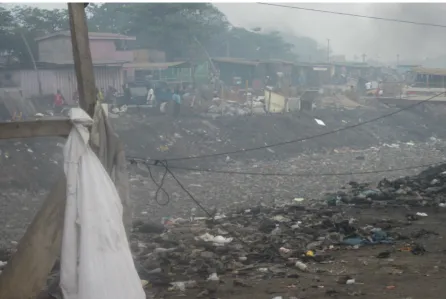
The residents have choked the Korle Lagoon with refuse to the point of ill repair (refer to Figure 1). The area has also become an international e-waste dumpsite; the decrepit electronic appliances from Western nations are
exported to this vicinity and abandoned in a mass of noxious “first-world relics” (King, 2008). Scrappers pick through the electronics for useful parts and burn those that are of no use to them. This hazardous smoke drifts directly into the Agbogbloshie settlement. The International Development Research Center has labeled Agbogbloshie as, “one of the most polluted places on earth” (Afenah, 2010). The pollution has led to constant flooding from the nearby lagoon and Odaw River, as well as frequent electrical fires due to faulty wiring (refer to Figure 2).
Residents of Agbogbloshie frequently experience malaria, due to the poor environmental conditions such as open sewers and dense living spaces. Gastro-intestinal diseases are also common, due to the unsanitary environment and unhygienic conditions under which their food is prepared (Yeboah 2009:4). Additionally, the 'free-range' livestock in the slum is subjected to the same hazardous living conditions and when consumed by the
!"#
Ahlvin | Burden of the Kayayei
digitalcommons.wou.edu/pure !2012
residents, causes further health complications. There is only one health clinic located within the slum, but most residents do not have the funds to use its facilities. Because of this, self-medication and traditional medicinal methods are employed when illness strikes (Yeboah 2009:4).
Crime in Agbogbloshie has become a problem since the 1990s. Theft occurs regularly during the night while the residents are sleeping, and occasionally arsonists set houses on fire to pillage the goods in the ensuing chaos. As with many slums, drugs are also a problem in Agbogbloshie; luckily, hard drugs have not yet become rampant among the community. Female residents also face the problem of sexual harassment and abuse, as men regularly take advantage of and sexually abuse young girls while they sleep in their shanties. The number of unwanted pregnancies and harmful abortion techniques is high among women in Agbogbloshie. One source notes that, “each month about 50% of all children born to kayayei at the Korle-Bu Teaching Hospital in Accra are abandoned by their mothers” (Opare 2010). Since 2002, the residents of Agbogbloshie have been faced with the threat of eviction
by the Accra Metropolitan Authorities (A.M.A.) – the city authority has served eviction notices without providing alternate land or housing (Afenah, 2010). The A.M.A. claims that the residents of Agbogbloshie are illegally occupying government land, which is the site of an “ecological restoration project” (KLERP3), and that the health risk of the flooding of the lagoon and the toxic quality of the soil of the site is hazardous to the residents' health (Afenah, 2010). The A.M.A. and the press have exhibited a derogative attitude of the settlement and its residents, calling it “Sodom and Gomorrah,” and marginalizing the social status and self-worth of the inhabitants and the kayayei in particular.
The Cultural and Socio-economic Constraints of Kayayei
As previously stated, a kayayoo is a woman who carries goods and wares on her head for shoppers and traders in and around commercial centers for a petty fee. According to one study, kayayei are typically younger and
"#The Korle Lagoon Environmental Restoration Project.
#
!"#
Ahlvin | Burden of the Kayayei
digitalcommons.wou.edu/pure !2012
their work in southern Ghana is more temporary than their male porter counterparts (Yeboah 2009:1). The kayayei are oftentimes unskilled migrants from northern Ghana who come from underdeveloped, rural areas in search of jobs in the cities to the south. The areas in northern Ghana from which the kayayei hail are commonly places of abject poverty. In the past ten years, the rainfall in the north has become unpredictable due to environmental degradation. Drought, unfertile soil due to excessive farming, and inadequate jobs in the northern rural areas are positively correlated with crop failures and, ultimately, low wages (Opare 2010). The result is that youth from these areas have been known to migrate to the south in search of greener pastures in the cities. In fact, many kayayei were encouraged by their families in northern Ghana to move to the cities due to financial hardships on the home front (Opare 2010). Because of their lack of education and hard skills, women from the north tend to work in the informal sector when they reach the metropolis. To the porters, the kaya business is seen as simple self-employment with quick results that afford them minimum assets for marriage
or for sending funds back home to their family in northern Ghana. According to one study, the majority of kayayei are saving their wages to “enter into large-scale trading or other sedentary work”(Opare 2010). The second most common reason the women enter the kaya business is to purchase material items such as clothing, jewelry and kitchenware, for marriage (Opare 2010).
Some studies have shown that kayayei “live and work in closely-linked groups held together through strong social networks” (Yeboah 2009:4). Through social networking, the kayayei choose which city to go to for work. Most kayayei have family already working in the cities, and arrange to stay with them while they work in the markets.
Kayayei are employed by “travelers, shop owners, general shoppers, or traders,” and “...are used to offset the difficulty of vehicles accessing the center of the markets to load or discharge goods” (Yeboah 2009:1). It is common that kayayei are exploited by their patrons and hassled by police and city authorities (Yeboah 2009:3). One source posits that the kayayei's female clients harass the porters so much that the author has characterized it as “an
!"#
Ahlvin | Burden of the Kayayei
digitalcommons.wou.edu/pure !2012
exploitation of women by women” (Opare 2010).
Unlike their male counterparts who use hand trucks or wheelbarrows, kayayei lack such transport implements to support their work. As such, physical ailments due to heavy lifting are common among these female porters. As previously mentioned, residents of Agbogbloshie frequently experience malaria, due to the poor environmental conditions such as open sewers and dense living space. The insanitary environment and unhygienic conditions under which their food is prepared is also problematic. Because of low wages (and quite possibly the ignorance of Western medicinal practices), unreliable self-medication and traditional medicinal methods are employed when illness strikes in the slums (Yeboah 2009:4).
The wages that the kayayei earn typically go “from hand to mouth,” and more often than not are spent on living accommodations within Agbogbloshie (interview, 2011). Many kayayei who care for their children are not able to afford the school fees; consequently, children follow their mothers and begin work as kayayei at alarmingly young ages. The kayayei who live in Agbogbloshie share rented kiosks and contribute to the payment of weekly (sometimes daily) rent; potable water, toilets, and showers also come with a user's fee in the slum. Yet, the residents consider the prices of their accommodations to be cheap, although many residents do not realize that the accumulated annual costs of living are often greater within the slum compared to other low-income communities.
Cultural and Socio-economic Difficulties
In Ghana, it is a very popular cultural belief that women are seen as homemakers. Thus, the socialization of females is very different from that of males. While boys are socialized to fit into the production system, girls are socialized into a homemaker role. This type of socialization makes girls feel inferior to their male counterparts, and results in low self-esteem into adulthood (Amu et al. 2005). Because school leads to oneʼs role within the production system, the idea of sending girls to school is not taken seriously. It is an unfortunate fact that many parents do not find it necessary to send their daughters to school because of the time and resources that it takes (Yeboah 2009:9). One study of 80 kayayei found that a majority lacked basic education – the first nine years of schooling, from kindergarten through junior high school (Yeboah 2009:7). This lack of formal education demonstrates the low level of school enrollment of girls in the country and in northern Ghana in particular. This gendered socialization, characterized by lack of access to education, inhibits the womanʼs role in the socio-economic production system,
thus driving her to incorporate herself into the informal sector as a porter.
Another gendered issue that Ghanaian females generally face is inadequate training. The informal sector in Ghana creates a large chunk of its GDP; women working as porters, sellers, or traders drive a majority of it. Because the majority of women are found in the informal sector, they have very little (or no) formal education, and access to information that can help increase their productivity is reduced because of the low level of education and literacy. Thus, lacking the basic entrepreneurial skills in management, marketing, planning, and pricing, kayayei have no chance in becoming a productive member within the economy. Because rural Ghanaian girls are commonly pulled from school before they learn qualitative skills, their knowledge of business
!"#
Ahlvin | Burden of the Kayayei
digitalcommons.wou.edu/pure !2012
and math, as well as literacy levels, are alarmingly low. Without this essential skill, women are often trapped in the informal economic sector, which ultimately affects female productivity within the socio-economic context of Ghana.
Within the high financial sector, women in Ghana are considered financial risks because of their perceived socio-economic status within the society. The result is that it is difficult for women to produce collateral for loans from banks and credit unions. Some women may be able to acquire credit from banks but the interest rates can be as high as 20%, which dissuades most women from pursuing loans from financial institutions (Amu et al. 2005). Thus, many of the kayayei rely upon susu, an informal banking system which oftentimes fails because the susu collectors will disappear with the money, as we have seen to be the case with Amena in the introduction. Without loans or other financial options, women cannot buy land or other assets. Because of this, women are forced to financially rely upon their relatives. If a relative cannot or will not support her, then she must support herself. This also causes pressure on the woman to marry early and for financial reasons. If and when she divorces her husband due to hardships, the woman's economic dependence upon her husband causes her to become destitute (Opare 2010). In northern Ghana these are some of the circumstances that drive many women, with few opportunities, to join the informal economic sector of the city to earn a living.
Some Policy Recommendations
One of the reasons that women are marginalized within Ghanaian society is because of their low levels of productivity within the socio-economic sector. There are many resolutions that can be addressed to ease the challenges that women face, but each one must be enacted at the same time as the others. These solutions include government assistance, self-help and advocacy, education and skills training opportunities, access to assets and credit, and socialization within the home.
There is a need for the Ghanaian government to address multiple issues concerning the kayayei. The drought problem needs to be addressed immediately through the provision of loans, coupled with irrigation and agricultural education. If the rural areas in northern Ghana were more economically successful, less people would migrate south into the cities. Marginalized women from rural Ghana would also benefit from education. Education should provide entrepreneurial knowledge as well as literacy skills that are essential for breaking away from the rural way of life (if the woman chooses to do this). Government funded, women-specific scholarships are applicable in this scenario because they would not only
pay for the female to go to school, but also subsidize her absence from the farm. The residents of Agbogbloshie especially need the stable support, as the government cannot turn its back on human resources. If possible, formal, government jobs must become available to those who are trapped in the informal sector.
Grassroots communities undertaking and controlling their own socio-economic development can best overcome poverty and inequality. Thus, first and foremost, the kayayei must become their own advocates. Perhaps a worker's union could be initiated in each market for fair wages and working hours. Women must also challenge the
rationale behind their own invisibility. Non-profit
organizations and non-government organizations must be initiated within the community to advocate for those in poverty and to expose the gendered challenges that women face. The residents of the community must also be given opportunities to learn trade skills that will help them become self-sufficient and eventually move them out of the hazardous slum environment.
Women should obtain access to assets and credit in order to become more productive. With assets, they are more likely to get a loan from a bank. To obtain a loan from the bank, they must not be seen as a liability, but rather a lucrative investment opportunity. Banks should enable loan policies that entice women to enter into the business world. For example, micro finance organizations have become very popular in Ghana because of their specific attention to women's needs and interests. Through the acquisition of loans, kayayei would be able to escape from their gendered poverty into a world of business and opportunity.
Socialization within the home should also change in Ghana. If men are socially raised to become the breadwinners, and the women homemakers, then nothing can change. The ideology of gender itself should change; the very ethos of socialization should be adjusted to enhance the role of women in Ghana. Women should gain more self-esteem and respect for themselves, while at the same time men's attitudes regarding gendered roles should also change.
Conclusion
!"#
Ahlvin | Burden of the Kayayei
digitalcommons.wou.edu/pure !2012
to affect a kayayoo include socialization, education, and
access to credit. This paper proposes some
recommendations that must be addressed to ease the challenges that the kayayei face in Ghana; however, it must be emphasized that each one must be enacted at the same time as the others. These endorsements include government assistance, self-help and advocacy, education and skills training opportunities, access to assets and credit, and socialization within the home. All of the cultural and socio-economic challenges that a kayayoo faces are informed by historical, cultural, and socio-economic factors that contribute to her life experiences; these are the burdens of the kayayei.
Dr. Isidore Lobnibe served as faculty sponsor for this articleʼs submission to PURE Insights.
Sources
Afenah, Afia
2010 (Re)Claiming Citizenship Rights in Accra, Ghana. Google, accessed Jan. 31 2011. Online.
Amu, Nara Judith
2005 The Status of Women in Ghanaian Society. The Role of Women in Ghana's Economy.
King, Dana
2008 Assignment Africa. CBS 5 San Francisco, CBS, May 27. Map of Agbogbloshie. Google Maps, accessed May 25 2011. Opare, James Adu
2010 Kayayei: The Women Head Porters of Southern Ghana. Google, accessed April 13 2011. Online.
Yeboah, Muriel Adjubi and Kwame Appiah-Yeboah.
A publication of the Program for Undergraduate Research Experiences at Western Oregon University
!"#
digitalcommons.wou.edu/pure !2012
Xenophobia and Structural Violence: Barriers to Education for Roma
Youth
Lisa Catto
, Department of Anthropology, Western Oregon University
The European Roma, more commonly referred to as Gypsies, are a severely persecuted minority population, even to this day. They have been victims of xenophobia and structural violence for centuries. This has led to segregation in nearly all aspects of their lives, from housing to medical care to employment to education; the latter is the focus of this paper. Roma children are often forced into segregated schools, or into special/remedial programs. This paper looks at issues that have led to such an educational dichotomy, and the negative impact they have had on the Roma. The paper also looks at the perpetuating cycle that these educational issues are feeding.
Keywords: Roma, Romani, Gypsy, Gypsi, xenophobia, structural violence, education, primary education,
human rights, segregation, Europe
Just because I come from Roma camp on the hill They put me in a school for mentally ill
[…]All their lies about Roma
A verse from Break the Spell by Gogol Bordello, a self-identified Gypsy punk band
Introduction
The Roma, more commonly known as Gypsies, remain the most widely disadvantaged minority in Europe. People throughout the world have a stereotypical image in their minds when thinking of Gypsies. For some, that image may be positive and represent freedom, a theatrical flair, an admirable culture and independent way of life. For others, that image is entrenched in racism and discrimination. It may conjure accusations of laziness, thievery, stupidity and ultimately, treatment as second-class citizens. The Roma are not considered members of mainstream European society. There is no single Roma minority, but a multitude of populations that make up the Roma population (Pogány 2004: 10). They are often relegated to the outskirts of cities or confined to dilapidated apartment buildings in urban areas. Why are they treated as the pariahs of Europe? It is impossible to pinpoint a distinct reason or trace it to a specific initiating event. They lack power, which has been attributed to their late arrival in Europe and a strong cultural difference (Petrova 2004). The Roma continually struggle for equality while trying to maintain their own culture.
A comparison can be made between current treatment of Roma and treatment of African Americans in the United States prior to the civil rights movement. Both groups have faced discrimination, poverty, slavery and segregation, but in recent decades the paths of these two
groups have been quite different (Greenberg 2010: 919). Jack Greenberg, one of the lawyers who argued Brown v. Board of Education and head of the National Association for the Advancement of Colored People (NAACP) Legal Defense Fund, has been invited to Eastern Europe to examine the state of Roma segregation. He points out that there is no Roma civil rights movement as there was for African Americans, “but there is ground for hope” (2010: 920).
!
"#!
Catto | Barriers to Education for Roma YouthPURE Insights Volume 1, Issue 1
Brief History of the Roma
The Roma migrated out of India sometime between the 7th and 13th centuries; scholars still debate whether it was a major migration period or a long, complex migration process (Petrova 2004). They remained in Byzantium for at least two centuries before migrating toward Western Europe (Petrova 2004). Some Roma remained in the Balkans while others moved to Central and Western Europe by the early 15th century. During Ottoman rule of the Balkans, most Roma who remained were enslaved in Wallachia and Moldavia. Approximately 200,000 to 600,000 Roma were enslaved until slavery was finally abolished by 1856 (Petrova 2004).
Dr. Dimitrina Petrova, the founding executive director of the international human rights organization Equal Rights Trust, has specialized her scholarly and activism efforts on human rights and the Roma. She formerly headed the European Roma Rights Centre. Petrova summarized where the negative image of Roma can be traced, “The extensively documented criminal activity of the Roma in Central and Western Europe in the fifteenth and sixteenth centuries thus must have been the catalyst of the lasting
image of the Roma as parasitic nomads, fraudulent fortune-tellers, incapable of productive work, abusing the hospitality of those who provide them with shelter and food, unreliable, and, of course, and most significantly, remorseless thieves” (Petrova 2004). There are endless examples of how this perception of “parasitic nomads” remained through the centuries. This was most evident within anti-Gypsy laws. Although not all laws passed were enforced regularly at first, they eventually were and repression strengthened throughout Europe (Petrova 2004).
Assimilation laws have left a lasting effect on the Roma, especially those who lived in countries under the Habsburg Austro-Hungarian Empire (Petrova 2004). Maria Theresa, the empress of Austria, established forced assimilation policies in the late 18th century that criminalized the use of the Romani language and Roma names and placed Roma children into non-Roma homes to be assimilated. Because of this, many Hungarian Roma have lost much of their Roma traditions and customs (Petrova 2004).
The Holocaust is a major modern tragedy that has impacted Roma and was a product of the historic
!
"#!
Catto | Barriers to Education for Roma Youth
PURE Insights Volume 1, Issue 1
treatment of this population. It is estimated that up to 1,500,000 Roma were murdered during World War II (Greenberg 2010: 919). Although Roma were not mentioned in Hitlerʼs Mein Kampf and were not targeted for extinction, they were viewed as less than human, according to Dr. Istvan Pogány, a professor of law at the University of Warwick in England (2004: 41). His research has focused on minority rights, especially those of the Roma in Central and Eastern Europe. He has also studied both anti-Semitism and poverty.
In the Czech Republic, Roma mostly were killed in Auschwitz or camps in Bohemia and Moravia. In Slovakia, most Roma were forced into slave labor (Cahn 2007: 5). Some have argued that the Roma have chosen to remain silent about those human rights abuses because they want to put the past behind them, and they do not have a voice in the public sphere (Pogány 2004: 46). Treatment of the Roma has not improved since World War II. By most accounts, it has worsened since the fall of Communism. Most Roma who were employed under Communism had jobs in government-controlled industries that required little or no education. Once those industries closed, the Roma were unable to adapt to the market economies that followed and fell deeper into poverty (Greenberg 2010: 925).
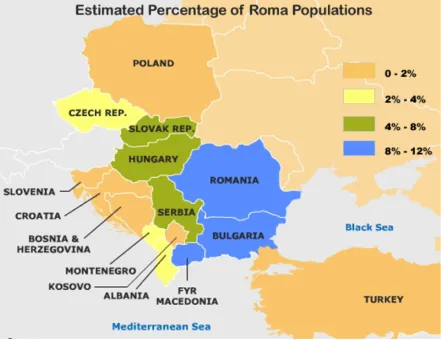
Population counts of Roma in Europe are unreliable because the estimates are from survey-based studies and descriptive reports instead of statistical evidence (European Monitoring Centre on Racism and Xenophobia 2006: 7, 17). When it comes time for a census the majority of Roma who respond do not claim their Roma heritage for fear of discrimination, or in some cases it is a show of national pride or assimilation (Cahn 2007: 4). It is also reported that government representatives conducting a census often avoid Roma settlements (Petrova 2004). After the 2001 census, the official count of Roma in Albania was 1,261, but many NGOs estimate it to be 90,000 to 100,000. Likewise, in Slovakia the official count was 89,920, but the estimates are 480,000 to 520,000 (Petrova 2004). The Roma population grows rapidly and data must be updated frequently. Cahn wrote, “the high numbers of persons clambering to be listed as anything but gypsy are the most powerful litmus test of how society treats Roma and others regarded as Gypsies” (2007: 6). The most commonly accepted estimates claim that there are between seven and nine million Roma in Europe (Greenberg 2010: 926).
Xenophobia and the Roma Way of Life
There is often a drastic contrast between what people imagine about Roma and what is truth. Images in popular culture and stories in the media present a Roma
stereotype, which is often exaggerated or based in falsities. Especially prevalent are misconceptions about the nomadic myth, Roma language and religion, housing challenges and the health care crisis.
Nomadism
One of the first romanticized images many associate with the Roma (whether in imagination or pop culture) is a convoy of caravans or horse carts. Roma have been nomadic through much of their history, but it is a common misconception that they remain that way. Only some Roma in Western Europe are still nomadic; most of them have been settled for decades or centuries (European Monitoring Centre on Racism and Xenophobia 2006: 7). An 1893 census of Hungarian Gypsies showed that only 3.3 percent remained fully nomadic, while 89 percent had become entirely sedentary (Pogány 2004: 31). This demonstrates that even more than a century ago, nomadism was rare among this population, yet this stereotype of fervent nomadism is often connected to assumptions of criminal behavior, unreliability and distrust, and ultimately a perceived threat to the rest of society.
Language and Religion
Few still speak any Roma dialects, which are derived from the Indic language of their ancestors; instead they often speak the dominant language of the country in which they live (Pogány 2004: 10). Similarly, most Roma adopt the religion of those among whom they have settled. However, a large number of Roma have joined evangelical Protestant sects, even when that is not the dominant religion of their region (Pogány 2004: 10; Greenberg 2010: 991).
Housing
!
"#!
Catto | Barriers to Education for Roma YouthPURE Insights Volume 1, Issue 1
Since the fall of Communism, unemployment is as high as 100 percent in some rural areas and Roma there must rely heavily on welfare (Greenberg 2010: 928-929). Roma who have been displaced by the fall of Communism tend to live in clusters at the edges of town, in homes constructed with salvaged materials. They usually have no electricity, running water, sewage system, doors or glass in the windows (Greenberg 2010: 932).
Health issues
Poverty and substandard housing impact the health of Roma and mortality rate is one indicator of this. The overall mortality rate of infants born to Romanian parents is about 27.1 per 1000. For Romanian Roma, the rate is more than triple the countryʼs average at 72.8 per 1,000 live births. Roma often live 10 to 15 years less than non-Roma in the same region, which is generally attributed to diabetes, coronary artery disease, obesity, limited access to medical care, substandard housing conditions and inadequate nutrition. Tuberculosis and other diseases common in developing nations are ten times more prevalent among Roma than non-Roma populations in Europe. The treatment for many of these health issues is out of reach for most Roma as the medication is too expensive and few Roma have health insurance (Greenberg 2010: 931).
The blind hatred of Roma by many throughout the centuries has created dire consequences for this minority group. The xenophobia goes beyond stereotypes of nomadism; it has stunted the integration of many Roma into society at large. Significant barriers, especially insufficient housing, have irrevocably harmed this population through health issues and consequences for their livelihood.
Structural Violence: Barriers to Education for Roma Children
So far in this paper I have explained a variety of ways that Roma are victims of structural violence. Denial of the right to education is one of the most severe violations of all, as it is at the core of a functioning society. For the Roma, only having access to poor quality, if any at all, education has perpetuated their powerlessness and has prevented integration. It is a widely accepted myth that Roma do not consider education and regular schooling necessary for their children. This argument is often used as an excuse for not providing adequate schooling (Petrova 2004). However, some argue that Roma are skeptical about the mainstream educational system (Pogány 2004: 4). Education is viewed as the path to employment in many societies. For some, education must be formal, while for others, education may consist of learning a trade or craft at home. The latter is the case for
many Roma (Pogány 2004: 151). Nevertheless, formal education is important and there are still many barriers to education such as a lack of necessary documentation to attend school, not enough money to pay for supplies or lunches, differences in language and culture between Roma and non-Roma, or a fear of assimilation (European Monitoring Centre on Racism and Xenophobia 2006: 9, 63).
It is not known exactly how many Roma children are affected by segregation and special schools. Much like population estimates, data on this topic are incomplete. Even when there are data on Roma education, comparisons between countries are complicated by differing methodologies (European Monitoring Centre on Racism and Xenophobia 2006: 21). It is clear, however, that there is an alarming contrast between the treatment and education of Roma children and non-Roma children in Europe. General estimates claim that 70 to 80 percent of Roma have less than a primary school education and less than one percent continue on to higher education.
In the Czech Republic, it is estimated that only 25 percent of Roma age 12 and above have completed primary education and only 2.5 percent of Roma children enter secondary school, compared to 73 percent of the non-Roma population (European Monitoring Centre on Racism and Xenophobia 2006: 23). This example is mirrored throughout Europe. Roma children are not succeeding and continuing with education at rates similar to their non-Roma counterparts. Segregation is the primary way the right to education is violated for Roma children. It occurs in many forms, most prominently in the form of “special” or remedial education programs and schools (Petrova 2004).
Segregation
The majority of Roma children are forced into Roma only schools, or if they attend schools with non-Roma, they are often taught in separate classrooms. Segregation is no longer the policy in European countries, but that has not prevented it from being the common practice (European Monitoring Centre on Racism and Xenophobia 2006: 8). No European or national judicial or administrative entity has ordered the cessation of segregation in any school (Greenberg 2010: 919). In Slovakia, it is estimated that up to 44 percent of Roma children located in segregated communities failed to complete primary education, compared to 24 percent in mixed settlements.
!
""!
Catto | Barriers to Education for Roma Youth
PURE Insights Volume 1, Issue 1
unmotivated and unqualified teachers, crowded
classrooms, abysmal spaces, and inadequate materials (Petrova 2004).
“October 11, 2002. We visited Gura Văii, outside of Oneşti. All of the Roma in Gura Văii live on Morii Street, away from the Romanians in the town. The roads were dirt, and due to morning rain, were very muddy. This settlement was not among the poorest that we saw. ... The school that the Romani children attend was in the middle of the settlement. We entered the school, which had to be opened by one of the teachers after repeated knocking because it was locked from the inside. There were only two rooms in the school. In one room, there was seating for twenty-two children, and in the other, there were twenty-four seats. It was a cold day, and there was no heat in the school, although there was a wood stove in the corner of one of the classrooms. There were no lights in either of the rooms or the entrance, and in fact, no electricity in the school. The Romani children were in class while we were in the school, and there were no books in either of the rooms. There were no textbooks for the children that I saw, no notebooks in front of any of the children, no pencils, no pens or any school supplies of any kind. There was no sign of a learning environment. One of the teachers, who would not give her name, told us that one hundred and sixty children were registered in the school. She also told us that there were four teachers. At around 2:00 PM when we went in the school, it was already dark inside and hard to see. From the outside, there was glass in all the windows, but I could see up under the roof the structure was not solid. This would likely allow much cold air in during the winter months” (Petrova 2004). This is a report excerpt from a European Roma Rights Centre field trip to Romania in October 2002.
The European Roma Rights Centre (2008) conducted research missions in Ukraine beginning in 2006. They compiled what they learned in those missions and sent a letter to Ivan Vakrchiuk, the Minister of Education and Science of Ukraine, urging him to improve the educational situation for Roma children in Ukraine. The identified forms of segregation were: 1) separate classes for Roma in a separate school building, 2) geographically segregated schools in predominately Roma neighborhoods, 3) schools where Roma are the sole or predominate student population, 4) classes for children with developmental
disabilities where Roma were the primary population, and 5) schools at risk to become segregated when non-Roma parents decide to transfer their children to other schools due to supposed health problems of Roma children. Teachers often have lower expectations of Roma than they would of non-Roma students and, as a result, many Roma children remain illiterate or leave school significantly early (European Roma Rights Centre 2008). Most Roma schools have no cafeteria or dining hall, no sports facilities, outside toilets without running water, minimal furniture that is in poor condition, and lack facilities to educate students such as computer classrooms and laboratories (European Roma Rights Centre 2008).
Special or Remedial Schools
Many European nations and their local communities force Roma children into special education programs for developmentally disabled youth. There is an extremely disproportionate number of Roma children in these programs as opposed to non-Roma children. The Roma Rights Centre suggests that Roma students are at least 15 times more likely than non-Roma students to be placed in special schools. Other data show that Roma children comprise up to 70 percent of students in these special schools (European Monitoring Centre on Racism and Xenophobia 2006:48). In Slovakia, Roma children are 22 to 26 times more likely to be placed in a special school (European Monitoring Centre on Racism and Xenophobia 2006:59).
!
"#!
Catto | Barriers to Education for Roma YouthPURE Insights Volume 1, Issue 1
A Roma mother from Letanovce told the ERRC in October 2002,
"My daughter was transferred to special school after the 1st grade - she is there already for 2 years and doesn't even recognise the letters of the alphabet - if she were in the normal primary school, I am sure she would already have learned that” (Petrova 2004). Another Roma mother, from Hungary, told the ERRC in 2002, “My daughter started primary school in a normal class, but she felt that she received no attention from teachers as compared to her non-Roma classmates. Due to the negligence of the teacher she failed one time. She was taken to the remedial special class immediately. I was not even asked or informed about it in time, only after the transfer. They said that she could not keep up with the others, so they transferred her. I suffered because my child felt very bad. She was labeled stupid, although she might have just needed some more attention” (Petrova 2004).
A non-Roma teacher told the ERRC that many Roma are placed in the special schools immediately, but some are transferred there after a single opinion from a 30-minute examination by a committee. The teacher added that non-Roma children often receive two or three chances and have already failed the second or third year of school several times before they are transferred to a remedial special school (Petrova 2004).
Ultimately segregation and placement in special schools has led to a serious problem of absenteeism among Roma children in Europe. This has been attributed to several possible factors. The low attendance and high absenteeism could indicate that 1) parents are not convinced of educationʼs importance, 2) schools have a more lax attitude about attendance of Roma children, 3) Roma children have difficulty attending school because they are not geographically accessible, 4) the families do not have enough money for materials and lunches, or 5) the students are needed at home to help the family make a living (European Monitoring Centre on Racism and Xenophobia 2006: 8).
The most forceful form of structural violence that violates Roma freedoms is the denial of the right to education, for this is the crux of a functioning society. By segregating Roma children from non-Roma children and placing Roma youth into remedial programs, communities are systematically keeping the Roma at a disadvantage. When these poorly educated youth become adults, they face even more barriers to achieving integration of their communities into society.
What now? The Future of Education for Roma Children
Equal education for Roma children is a major human rights issue. In recent years, human rights have become the standard by which a nationʼs treatment of its citizens is judged (Pogány 2004: 15). This is particularly true for lawyers, journalists, political activists and an increasing number of NGOs (Pogány 2004: 149). The ideology of human rights is well intentioned, but it does not always support the needs of a cultural minority within a state as it is targeted at individuals and it is only as effective as courts and tribunals are willing to enforce human rights laws and doctrine.
Legal enforcement has been a problem for the Roma. There are three major court cases that have tackled the issue of education for Roma youth: D.H. and Others v. the Czech Republic, Sampanis and Others v. Greece and Oršuš v. Croatia. Verdicts in each of these cases confirmed that Roma children were being unlawfully discriminated against in their respective education systems. These court cases demonstrate the widespread nature of the structural violence that Roma suffer on a daily basis, as well as confirm that legal entities agree that these human rights violations are taking place. However, it is extremely concerning that these important legal bodies did not demand changes by local governments and education systems to give Roma equal opportunities as non-Roma by putting an end to segregation and discrimination. This needs to change.
Pogány suggests approaches to tackle these issues, including advocacy programs, increased support of NGOs or initiatives such as the Decade of Roma Inclusion, which runs from 2005 to 2015 (Atanasoki 2009: 206). The purpose of the latter initiative is to improve the socio-economic status and social inclusion of Roma within a regional framework in specific European countries with significant Roma populations; it has developed several more direct projects such as the Roma Education Fund. The Decade is funded by financial institutions (e.g. the World Bank and Council of Europe Development Bank) and socially oriented foundations (e.g. the Open Society Institute and European Roma Rights Centre) (Atanasoki 2009: 206). The issue with these types