Journal of Applied Linguistics and Language Research Volume 2, Issue 7, 2015, pp. 60-79
Available online at www.jallr.ir ISSN: 2376-760X
* Correspondence: Ali Bahadoran Baghbaderani, Email: [email protected] © 2015 Journal of Applied Linguistics and Language Research
The Impact of Process-Oriented Syllabus on L2 Writing
Ability: Focusing on Young and Adult Iranian Intermediate
EFL Learners
Ali Bahadoran Baghbaderani *
MA in TEFL, Department of Foreign Languages, Isfahan (Khorasgan) branch, Islamic Azad University, Isfahan, Iran
Akbar Afghari
Associate Professor at English School of post-graduate studies, Department of Foreign Languages, Isfahan (Khorasgan) branch, Islamic Azad University, Isfahan, Iran
Abstract
The main objective addressed in this study was to investigate the effect of process (negotiated) syllabus on meaning-focused L2 writing in adult and young Iranian intermediate-level EFL learners. Using a stratified sampling method, a total of 104 intermediate EFL learners, 52 from each gender, with an age range of 12 to 28, were randomly assigned to four groups: two control groups and two experimental groups. In order to determine the effect of process-oriented syllabus on adult and young intermediate EFL learners’ productive competence, once the scores of the pretest and posttest were obtained, the descriptive and inferential statistics were implemented in data analysis procedure. The data were triangulated from both quantitative and qualitative perspectives. The statistical analysis of the data revealed that the experimental group outperformed the control group on the posttest of writing after receiving process (negotiated) syllabus. The results of this study also showed that adult experimental group outperformed those in the young experimental group on posttest of writing. The findings of this study can provide certain implications to educational policy makers, material developers, EFL teachers, and second language learners.
Keywords: process syllabus, meaning-focused output strand, pedagogical efficiency, syllabus design, negotiation instruction
INTRODUCTION
distinction between syllabus and curriculum. Syllabus design has been seen as a supplementary component of curriculum design. “Curriculum” is concerned with the planning, implementation, evaluation, management, and administration of education programs. “Syllabus”, on the other hand, focuses more narrowly on the selection and grading of content. (Nunan, 1988). In a distinction that is commonly drawn in Britain, ‘syllabus’ refers to the content or subject matter of an individual subject, whereas ‘curriculum’ stands for the totality of content to be taught and aims to be realized within one school or educational system.
In the curriculum design model presented by Nation and Macalister (2010), syllabus refers to the inner circles which consist of goals, format and presentation, content and sequencing, monitoring and assessment. The key to understand the question of syllabus design choice is to understand the relationship between the curriculum design and the goals of education.
Goals can be expressed in general terms and be given more detail when considering the content of the course. Having a clear statements of goals is important for determining the content of the course, for deciding on the focus in presentation, and in guiding assessment (Nation, 2007).
The format and presentation part of the inner circle represents the format of the lessons or units of the course, including the techniques and types of activities that will be used to help learning. This is the part of the course that the learners are most aware of. It is important that it be guided by the best available principles of teaching and learning, the environment in which the course will be used, and the needs of the learners (Nation & Macalister, 2010).
The monitoring and assessment part of the inner circle represents the need to give attention to observing learning, testing the results of learning, and providing feedback to the learners about their progress. It is often not a part of commercially designed course. It provides information that can lead to changes in most of the other parts of the curriculum design process (Breen & Candlin, 2001).
of learner in negotiated syllabus content, the implication of negotiation for the learner is that he should contribute as much as he gains, and thereby learn in an interdependent way. Negotiated syllabus are also called process syllabus (Breen, 1987). The word process in the term process syllabus indicates that the important feature of this type of syllabus is that it focuses on how the syllabus is made rather than what should be in it (Nation & Macalister, 2010).
Proponents of this innovation believe that the syllabus which comes out from the negotiation process is more flexible and relevant to learners’ needs and hence more motivating and allows learners to play a more informed and self-directive purpose in their learning (Bloor & Bloor, 1988; Boomer et al., 1992; Breen & Littlejohn, 2000; Nunan, 1988, 1992, 1999; Tudor, 1996). According to Nation and Macalister (2010), “a negotiated syllabus involves the teacher and the leaners working together to make decisions at many of the parts of curriculum design process” (p. 149).
It is generally agreed today that process (negotiated) syllabus plays a pivotal role in particular educational context in which humanism is of great importance. Clarke (1991) sees the importance in negotiated syllabuses arising from humanistic methodologies like Community Language Learning (CLL) which are very learner-centered, from need analysis which focuses on learners’ needs, from work in individualization and leaner autonomy, and from learner strategy research which sees the learner playing a central role in determining how the language is learned. The negotiated model is totally different from other syllabuses in that it allows full learner participation in selection of content, mode of working, route of working, assessment, and so on. In this way, learners might be allowed a degree of choice and self-expression, unavailable in most existing syllabus types.
An increasing number of accounts of the practicality of syllabus negotiation in EFL education has been reported (e.g., Boomer et al., 1992; Breen & Littlejohn, 2000; Huang, 2006; N. T. Nguyen, 2010; V. H. Nguyen, 2006). Studies have shown that classroom negotiation helps make the teaching program more responsive to learners’ needs and wants, increase learners’ motivation and involvement in learning, enhance their confidence and self-esteem, develop their responsibility and autonomy, improve learning effectiveness, build up a mutual understanding among the participants, and extend the teacher’s teaching strategies, among other things. These positive impacts suggest the high potential of collaborative forms of teaching in EFL education. Breen and Littlejohn (2000) list situations where a negotiated syllabus is almost unavoidable:
1. Where the teacher and students have different backgrounds. 2. Where time is short and the most useful choices must be made.
3. Where there is a very diverse group of students and there is a need to find common ground.
4. Where initial needs analysis is not possible.
It additionally offers a framework for decision-making for developing the curriculum of a particular classroom group by proposing the range of decisions open to negotiation, the steps in a negotiation cycle and the levels in a curriculum to which the cycle can be applied.
Over recent years, interest in the concept of negotiation has come in the language teaching. Negotiated syllabus means regularly involving the learners in decision making regarding the goals, content, presentation, and assessment of the course (Breen 1987; Clarke 1991).In this kind of syllabus, learners learn through democratic decision-making. In negotiation-based approaches, teacher and learners come to agreement on what to learn and how to learn (Tuan, 2011). Proponents of this innovation believe that the syllabus which comes out from the negotiation process is more flexible and relevant to learners‟ needs and hence more motivating and allows learners to play a more informed and self-directive purpose in their learning (Bloor & Bloor, 1988; Boomer et al., 1992; Breen & Littlejohn, 2000; Nunan, 1988, 1992, 1999; Tudor, 1996). Meanwhile, “negotiation provides a context in which opportunities exist for learner to articulate and, thereby, refine their prior understanding, purposes and intentions as reference points for new learning” (Breen & Littlejohn, 2000,p. 24) and allows for changing the perceptions in the learners, without specifying particular content, methodology, structure, or grammar.
In relation to writing domain, Lo and Hyland (2007) suggested that one way of enhancing students’ motivation and engagement to write is to provide opportunities for them to engage at a more meaningful level with the language through refocusing their writing classes to make them relevant to their social and cultural context as well as designing writing tasks which have meaning and interest to them and offer opportunities for social interaction and self-expression. On the contrary, Abbasian and Malardi (2013) in a study researched for the effect of negotiated syllabus on EFL learners’ writing ability and self-efficacy. In the study a sample of 62 Iranian EFL adult learners either male or female were selected from Iranian University of Applied Science. The results showed that in the area of writing there was not any significant difference between the mean scores of the experimental and control groups on the posttest of self-efficacy. Surprisingly, the results also indicated that there was not any significant difference between the mean scores of the experimental and control groups on the posttest PET. Thus, it can be claimed neither the general language proficiency nor the self-efficacy was significantly affected in light of the negotiation-based instruction. Whilst some research has been carried out on process syllabus, far too little attention has been paid to pedagogical efficiency of process syllabus for teaching writing skill to adult and young Iranian intermediate-level EFL learners.
negotiated syllabus for teaching writing ability to adult and young Iranian intermediate-level EFL learners.
In line with the aim stated, the following research questions and hypotheses were formulated:
Q1. Does the process syllabus have any significant effect on developing Iranian intermediate EFL learners’ L2 writing ability?
Q2. Does the effect of process syllabus on developing Iranian intermediate EFL learners’ L2 writing ability vary across different age groups (i.e., adult and young Iranian EFL learners)?
Based on the above questions, the following hypotheses were formulated:
H01- The process syllabus has not any significant effect on developing Iranian
intermediate EFL learners’ L2 writing ability.
H02- The effect of negotiated syllabus on developing Iranian intermediate EFL
learners’ L2 writing ability does not vary across different age groups (i.e., adult and young Iranian EFL learners).
METHOD
Design
The current study fell into favor of the experimental design. At the outset of the study, four groups were selected using a stratified sampling method from the population. They were randomly assigned to the experimental and the control groups. This study was also based on “qualitative-quantitative" approaches in research, given the nature of the trait. It means that besides the quantitative data, the researcher employed a written protocol whose data were collected and analyzed qualitatively. In this case, the process (negotiated) syllabus functioned as an independent variable and writing ability as a dependent variable. The variable which was hypothesized to change the effect of the independent variable on the dependent variable; that is, different age groups, was the moderate variable. The variable which was held constant, that is, language proficiency, was the control variable.
Participants
The participants in this study were a relatively large target population consisting of a number of samples. These samples were randomly selected by a stratified sampling method. In fact, the targeted samples included different individuals who served as respondents and belonged to different populations studying and/or working in various educational contexts.
language proficiency of the EFL learners and make up a homogeneous group, students were given the Preliminary English Test (PET). However, the researcher conducted the research on 104 adult and young intermediate EFL learners with an age range of 12 to 28.
Having administered the placement test, the 52 adult intermediate EFL learners (26 males and 26 females) aged between 22 and 28 were then randomly assigned to the control and the experimental group, that is, Group A or adult intermediate experimental group and Group B or adult intermediate control group. Likewise, the 52 young intermediate EFL learners, both male and female with an age range between 12 and 18, were then randomly assigned to the control and the experimental group, that is, Group C or young intermediate experimental group and Group D or young intermediate control group. The illuminative pieces of information on the targeted samples, gender, age, group, level of proficiency, and the number of the participants are demonstrated in Table 1.
Table 1. Summary of the participants
Gender Age Level Group Proficiency N
Male
Female Adult (A)Experimental Intermediate 26
Male
Female Adult (B)Control Intermediate 26
Male
Female Young (C)Experimental Intermediate 26
Male
Female Young (D)Control Intermediate 26
Total 104
Materials
For the purpose of the study three instruments including the Preliminary English Test (PET), writing tests, and the written protocol were utilized.
Preliminary English Test (PET)
At the outset of the study, the Preliminary English Test (PET) which was a standardized test developed by Cambridge University (2009) was utilized in this thesis to determine their level of proficiency and ensure that they were of near homogeneity. It is an exam for people who can use every day written and spoken English at an intermediate level. It measured four skills of reading, writing, listening, and speaking.
purpose of the present study was to evaluate learners’ level of writing ability and their gains after the treatment.
Writing Tests
Three writing tests were administered to the experimental group in the sessions 4, 6 and 8 for observing any changes in the learners’ writing achievement. The topics were selected through need analysis and negotiation between and among researcher and learnersand the evaluation was done by the researcher.
The Written Protocol
As a triangulating effort and in order to maximize the reliability of the data collected, qualitative approach was also pursued. Thus, a written protocol composed of eleven general, open-ended questions based on R.C. Gardner’s (2004) Attitude-Motivation Questionnaire was employed so that the participants could express their views about development of writing and process (negotiated) syllabus. The rationale behind the written protocols use was to enhance the reliability of the data. For convenience and ease of interpretation, however, all the data gathered through the written protocol were analyzed in terms of frequencies of the participants ' common views on each open-ended question.
Procedures
To unravel the effects of process (negotiated) syllabus on writing ability, the qualitative data quantified through operational definitions and measurement devices, and quantitative data were collected naturally and primarily in the vast province of Isfahan. Geographically speaking, Isfahan is located almost in the center of Iran between Tehran and Fars. From the institutes existing in the province of Isfahan, Iran, Pooyesh Language School was selected by a stratified sampling method.
In the third stage, the pretest (writing part of PET) was given to both the experimental groups and the control groups. The pretest was conducted to identify the ability of the students in writing before the treatment. The results of the test were collected and analyzed as the preliminary data about the students’ writing ability and three raters scored them.
Having received the pre-treatment instruments, both the experimental groups and the control groups attended an English language course which lasted for 16 sessions (1 hour and a half a day, two days a week) including administering pretest and posttest and pure treatment sessions. The control groups received conventional writing instruction as the teacher decided, but the experimental groups received the treatment, which was based on the process syllabus. The learners in the experimental groups were allowed to express their own ideas and goals about the course. The students were asked to comment on the learning program (including the activities and the way of assessment), their achievements and progress, the way of teaching and learning. The content of the materials and methodology were also negotiated. The teacher and learners came to an agreement on what to learn. The teacher’s main goal was to motivate learners to learn cooperatively and learners should be actively involved in this process.
Simultaneously, three writing tests were administered to the experimental groups in the sessions 4, 6 and 8 for observing any changes in the learners’ writing ability. The topics were selected through need analysis and negotiation and the evaluation was done by the researcher.
To examine the impact of employing process-oriented (negotiated) syllabus in EFL classroom, all participants in both the experimental and the control groups were taken a writing posttest.
As a triangulating strategy and in order to maximize the reliability of the data collected, qualitative approach was also pursued. Thus, a written protocol composed of eleven general, open-ended questions based on R.C. Gardner’s (2004) Attitude-Motivation Questionnaire was employed so that the participants could open-endedly express their views about development of writing, speaking, and negotiated (process) syllabus
At last, the posttest was given to both the experimental groups and the control groups to find out whether four groups make different results or not. The posttest was principally similar as the pretest. It was used to measure the effectiveness of process (negotiated) syllabus on improving students’ writing ability in the experimental groups. Data Analysis
same level of general language proficiency (i.e., intermediate level) prior to the administration of the process (negotiated) syllabus to the experimental groups. An independent t-test was applied to compare the mean scores of the experimental and the control groups on the meaning-focused output in order to investigate the effect of the process (negotiated) syllabus on the improvement of the writing skill of the experimental groups. An independent t-test was utilized to compare the mean scores of the experimental and the control groups on the PET as a posttest in order to prove the effect of the process syllabus on the improvement of the general proficiency of the experimental group. ANOVA was conducted to compare the mean scores of the three writing tests administered to the experimental group. The results will be discussed in the next section.
RESULTS
The First Null Hypothesis
Process syllabus has not any significant effect on developing Iranian intermediate-level EFL learners’ writing ability.
The rating scale used to rate the writing section of PET in this study was the one provided by Cambridge under the name of General Mark Schemes for Writing. The rating was done on the basis of the criteria stated in the rating scale including the rating scale of 0-5.
An independent t-test was run to compare the experimental and the control groups' mean scores on Writing Ability Pretest in order to prove that the two main groups enjoyed the same level of writing ability prior to the main experiment sessions. As displayed in Table 2 and Figure 1 the mean scores for the experimental and the control groups on Writing Ability Pretest were 14.79 and 14.71 respectively.
Table 2. Descriptive statistics of the writing ability pretest for the experimental and the control groups
Group N Mean Std. Deviation Std. Error Mean
Experimental 52 14.79 1.523 .345
Control 52 14.71 2.154 .341
Figure 1. Pretest of writing by the experimental and the control groups
Table 3. Independent t-test of the writing ability pretest for the experimental and the control groups
It should be noted that the assumption of homogeneity of variances is met (Levene’s F = 2.58, P = .10 > .05). That is why the first row of Table 3, i.e. "Equal variances assumed" is reported.
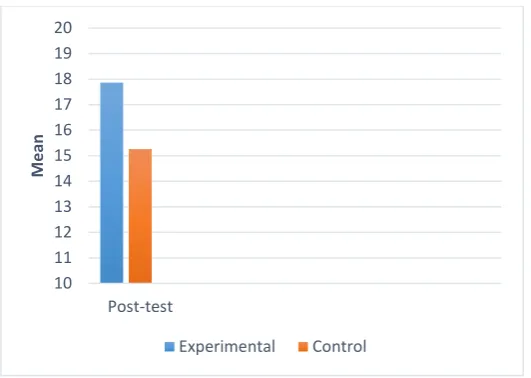
An independent t-test was applied to compare the experimental and the control groups' mean scores on posttest of writing in order to probe the effect of process (negotiated) syllabus on EFL learners’ writing ability. As displayed in Table 4 and Figure 2 the mean scores for the experimental and the control groups on posttest of writing ability were 17.90 and 15.26 respectively.
Table 4. Descriptive statistics of writing ability posttest for the experimental and the control groups
Group N Mean Std. Deviation Std. Error Mean
Experimental 52 17.87 1.223 .198
Control 52 15.26 2.454 .357
10 11 12 13 14 15 16 17 18 19 20
Pre-test
M
e
an
Experimental Control
Levene's Test for Equality of
Variances
t-test for Equality of Means
F Sig. t df
Sig. (2-tailed)
Mean
Difference Difference Std. Error
95% Confidence Interval of the
Difference Lower Upper Equal
variances
assumed 2.582 .109 .943 57 .332 .521 .557 -.576 1.544
Equal v. not
Figure 2. Posttest of writing by the experimental and the control groups
The results of the independent t-test [t (57) = 4.85, P = .000 < .05; R = .62 it represents a strong effect size] (Table 5) indicate that there is a significant difference between experimental and control groups' mean scores on the posttest of writing. This means that the experimental group after receiving process (negotiated) syllabus outperformed the control group on the posttest of writing.
Table 5. Independent t-test of the writing ability posttest for the experimental and the control groups
A two-way repeated-measures ANOVA was applied to compare the mean scores on the writing tests administered to the experimental group in the session 4, 6, and 8. The purpose was to see whether the participants’ performance on the three writing tests (with different prompts) differed significantly or not. The topics were selected through negotiation and the evaluation was done by the teacher. All the assumptions for using ANOVA including normality (based on kurtosis and skewness values and the normality test) and sphericity were checked to make sure that the use of parametric statistics was plausible. Sphericity assumption is automatically met when a variable has only 2 levels (Tabachnick & Fidell, 2007, p. 46), which was the case in this study. As displayed in
10 11 12 13 14 15 16 17 18 19 20
Post-test
M
e
an
Experimental Control
Levene's Test for Equality of
Variances t-test for Equality of Means
F Sig. t df Sig. (2-tailed) DiffereMean nce
Std. Error Differe nce
95% Confidence Interval of the
Difference Lower Upper Equal
variances
assumed 19.767 .000
4.85
4 57 .000 2.441 .507 1.446 3.449
Equal variances not
assumed
4.85 4
41.5
Table 6, the F-observed value for comparing the mean scores of the students on the three writing test, i.e. 1.26 is lower than the critical value of 3.25 at 2 and 36 degrees of freedom.
Table 6. Repeated measures ANOVA for writing ability in three tests
Source Session Sum of
Squares df Square Mean F Sig. Partial Eta Squared
Writing Linear 431.534 1 431.534 141.776 .000 .406
Linear 182.534 2 92.768 25.049 .000 .178
Error Linear 754.503 218 3.447
The repeated measures ANOVA indicated statistically significant difference between the three sessions, F (1, 218) =141.776, p = .000). The results of this analysis revealed a significant effect of process (negotiated) syllabus, suggesting that only instruction based on negotiation led to an improvement from pretest to posttest on writing ability. As displayed in Table 7 the mean scores for the three writing tests are 15.26, 16.09 and 17.18 respectively.
Table 7. Descriptive statistics for three writing tests
Tests Mean Std. Error Lower Bound Upper Bound 95% Confidence Interval
Writing test1 15.26 .524 15.265 16.325
Writing test2 16.09 .348 16.254 17.325
Writing test3 17.18 .697 16.235 17.158
The plot shown in Figure 3 illustrates how the experimental group progressed among the three writing tests. The gains for each session (Test 1–Test 3) were as follows: S4 = 15.26, S6 = 16.09, and S8 = 17.18.
Figure 3.Plot of interaction of the experimental group’s test scores
As a triangulating effort and in order to maximize the reliability of the data collected, a written protocol was applied. The participants answered five questions extracted from the Abbasian-Seyed-Hend’s (2011) checklist, addressing mainly:
10 11 12 13 14 15 16 17 18 19 20
4 6 8
M
e
an
Session
1. What is the effect of explicit negotiated syllabus on language learning? 2. What is the effect of explicit negotiated syllabus on different language skills? 3. What is the difference between explicit negotiated syllabus and other syllabuses? 4. What is the effect of explicit negotiated syllabus on self-confidence?
5. What is the pedagogical efficiency of explicit negotiated syllabus on learners' speaking and writing ability?
All the data gathered through the protocol were analyzed in terms of the frequencies and percentages of the participants' common views on each item.
The first item addressed the efficiency of explicit negotiated syllabus on language learning. As illustrated in Table 8, 81 percent of all participants believed that they could express their own ideas and goals about the course and learning.
Table 8. Descriptive statistics on the 1st question of the written protocol
Opinions Percentage of Item
More interaction between teacher and learner 81
Expressing their ideas 75
Motivation to Participate in collaborative conversations with diverse partners 72
Involvement in making decisions 68
As shown in Table 9, the second item addressed the effectiveness of explicit negotiated syllabus on different language skills. While 69 percent of participants believed that process syllabus has significant effect on listening, the majority of learners hold positive views toward the speaking and writing.
Table 9. Descriptive statistics on the 2nd question of the written protocol
Opinions Percentage of Item
Significant effect on speaking 82
Significant effect on writing 69
Positive effect on reading and vocabulary 66
Significant effect on listening 61
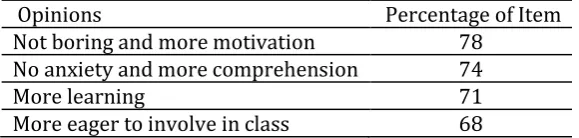
The third item addressed the discrepancy between explicit negotiated syllabus and other syllabuses. Views such as not boring and more motivation, no anxiety and more comprehension, more learning, and more eager to involve in class were the items which enjoyed the highest frequency. The findings are shown in Table 10.
Table 10. Descriptive statistics on the 3rd question of the written protocol
Opinions Percentage of Item
Not boring and more motivation 78
No anxiety and more comprehension 74
More learning 71
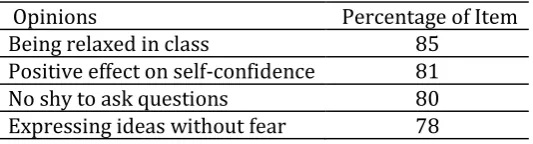
As it can be noticed in Table 11, the fourth item addressed the efficiency of explicit negotiated syllabus on self-confidence. Fortunately, like the previous questions, the majority of the participants hold positive view toward this aspect of the process syllabus.
Table 11. Descriptive statistics on the 4th question of the written protocol
Opinions Percentage of Item
Being relaxed in class 85
Positive effect on self-confidence 81
No shy to ask questions 80
Expressing ideas without fear 78
The fifth item addressed the pedagogical efficiency of explicit negotiated syllabus on learners' speaking and writing ability. It was surprising that almost all of the participants had a positive view toward the instructional fruitfulness of process (negotiated) syllabus in productive skills. The findings are illustrated in Table 12.
Table 12. Descriptive statistics on the 5th question of the written protocol
Opinions Percentage of Item
To improve speaking and to speak fluently 84
To improve writing and to write cohesively 82
Mutually interactive 79
No fear and anxiety to speak and to make mistake 78
The Second Null Hypothesis
The effect of negotiated syllabus on developing Iranian intermediate-level EFL learners’ writing ability does not vary across different age groups (i.e., adult and young Iranian EFL learners).
The first null hypothesis aimed to verify the efficacy of process (negotiated) syllabus on developing Iranian intermediate-level EFL learners’ writing ability. In order to figure out this process, an independent t-test was applied to compare the experimental and control groups' mean scores on writing tests in order to probe the effect of process (negotiated) syllabus on EFL learners’ writing ability. The second null hypothesis aims at answering the assumption that the negotiated syllabus on developing Iranian intermediate-level EFL learners’ writing ability does not vary across adult and young Iranian EFL learners.
Prior to the experiment and in order to make sure that no significant difference was found between the two groups, the writing ability pretest was administered to both the adult and the young experimental group.
Table 13. Descriptive statistics of the writing ability pretest for the adult and the young experimental groups
Group N Mean Std. Deviation Std. Error Mean
Adult Experimental 26 14.82 1.674 .336
Young Experimental 26 14.79 1.654 .364
Figure 4.The Adult and the Young Experimental Groups’ writing ability in the pretest The above table and figure are clear enough to inform us about the homogeneity of the mean scores learners got on their pretest of writing.
Table 14. Independent t-test of the writing ability pretest for the adult and the young experimental groups
The results of the independent t-test [t (57) = .95, P = .34 > .05; R = .12] (Table 14) revealed that the two groups did not differ significantly in their performance on the writing ability pretest.
10 12 14 16 18 20
Pre-test
M
e
an
Adult Experimental Young Experimental
Levene's Test for Equality of
Variances t-test for Equality of Means
F Sig. t df Sig. (2-tailed)
Mean Differe nce
Std. Error Differe nce
95% Confidence Interval of the
Difference
Lower Upper
Equal variances
assumed
2.578 .113 .952 57 .341 .532 .563 -.580 1.538
Equal variances not
assumed .952
51.3
After implementing the 16-session training program, all the participants in the two groups were given the writing ability posttest, the parallel test which had been administered as the pretest before starting the treatment. Descriptive statistics of the writing ability posttest are summarized in Table 15 and Figure 5.
Table 15. Descriptive statistics of writing ability posttest for the adult and the young experimental groups
Group N Mean Std. Deviation Std. Error Mean
Adult Experimental 26 18.02 1.343 .143
Young Experimental 26 16.31 1.218 .117
Figure 5. The Adult and the Young Experimental Groups’ writing ability in the posttest
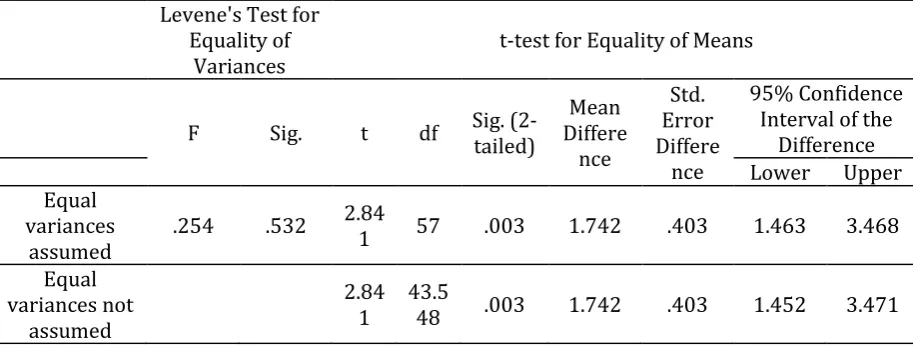
In order to see whether the treatment given to the experimental group vary across different age groups (i.e., adult and young Iranian EFL learners), an independent t-test was run between the scores of the writing ability posttest of both groups. The results obtained from this statistical test are laid out in Table 16.
Table 16.Independent t-test of the writing ability posttest for the adult and the young experimental groups
10 11 12 13 14 15 16 17 18 19 20
Post-test
M
e
an
Adult Experimental Young Experimental
Levene's Test for Equality of
Variances t-test for Equality of Means
F Sig. t df Sig. (2-tailed) DiffereMean nce
Std. Error Differe nce
95% Confidence Interval of the
Difference
Lower Upper
Equal variances
assumed .254 .532
2.84
1 57 .003 1.742 .403 1.463 3.468
Equal variances not
assumed
2.84 1
43.5
Table 16 manifests that independent t-test detected a statistically significant difference in writing scores between the two adult and young experimental groups, (t (57) = 2.84,
p = .003, p < .05, in which the t value, 2.84 exceeded the t critical, 2.00, and the p value, .003 was lower than the selected significant level for this study, .05. Clearly, the results revealed that the students in the adult experimental group outperformed those in the young experimental group (on posttest of Writing. As a result, the second null hypothesis as “the negotiated syllabus on developing Iranian intermediate-level EFL learners’ writing ability does not vary across adult and young Iranian EFL learners” is rejected here.
DISCUSSION
Regarding the first question of this study concerning the impact of process-oriented syllabus on improving Iranian intermediate-level EFL learners’ writing ability, the significance difference on the writing mean scores in negotiation instruction versus conventional syllabus was examined using an independent-sample t-test. Table 5 showed that process syllabus had a significant impact on writing ability. Sig=0.00<0.05 for the experimental as well as the control groups writing ability.
The results were in contrast with what the null hypothesis had claimed. The experimental groups were observed to outperform on writing part of PET as a posttest and writing tests in terms of their mean scores. Similarly, qualitative findings (a written protocol) have shown that classroom negotiation helps make the teaching program more perceptive to learners’ needs, attitude, motivation, and wants.
In consonance with this trend, the results of the analyses revealed that in the area of writing there is a significant relationship between negotiated syllabus and writing ability. The negotiated syllabus has significant effect on learner’s writing ability. This finding is consistent with the study done by Boomer et al. (1992), Breen and Littlejohn (2000), Candlin (2001), Hall (1999), Huang (2006), Neguyen (2011), and Nunan (2001) who place a significant premium on the role of negotiation instruction. On the other hand, the results of the present research contradict the findings of Abbasian and Malardi (2013) who, in this study, found that there was not any statistically significant difference between the mean scores of the experimental and control groups on the posttest PET.
CONCLUSION
Most studies concerning meaning-focused output strand have mostly focused on various factors influencing how productive skills are developed in different language learners. In other words, different aspects underlying cognitive representations related to writing and speaking skill have extensively been investigated. However, a limited number of studies have been conducted to examine the effectiveness of process-oriented syllabus on the meaning-focused output produced by adult and young Iranian EFL learners. On this basis, the purpose of the present study was to see whether writing ability is influenced by negotiation instruction and syllabus. Differently stated, is there any significant difference between the experimental and the control groups as far as the negotiation-based instruction is concerned? The crucial body of the study has been built upon utilizing two kinds of syllabus, namely process-oriented and conventional syllabus design to investigate the pedagogical efficacy of these two syllabus types in participants’ writing performance by taking into account the discrepancy between age groups.
It was also indispensable for the experimenter to scrutinize the fluctuations in the range of the meaning-focused writing of the adult and young targeted samples before and after receiving treatment. Using a stratified sampling method, the participants were divided into four-group design; the two control groups and the two experimental groups. All four groups which were assigned independently were merged and considered as two main control and experimental groups to answer research questions one and three mentioned earlier.
In practice, to achieve study goals, several steps were taken. First, given the study constraints, pilot study was carried out to ensure that the participants understood the instructions and could accordingly get maximum benefit from the classes. Another goal of holding pilot testing was to see if the scale items were clear enough. Prior to implementing the experimental manipulation, the writing section of PET test was administered to all participants in both the experimental and the control groups. Second, having administered pilot study and pretest, the targeted participants went through the conventional and experimental classes which lasted for 16 sessions (1 hour and a half a day, two days a week). The learners in the experimental groups were given the opportunities to verbalize their own views onthe learning program (including the activities and the way of assessment), their achievements, progress, as well as the way of teaching and learning, while their counterparts in the control groups adopt the traditional way to practice. Ultimately, the immediate posttest was given with the equivalent material of pretest. This test was given in order to calculate the effectiveness of process (negotiated) syllabus on improving students’ writing ability in the experimental groups. The whole process of process-oriented syllabus treatment along with pretests and posttests lasted for three and a half months.
justification for such results seems to be that syllabus negotiation adoption would facilitate language learning and that the type of syllabus design often depend on the purpose, the type of language modality (written or spoken), and the age group of learners.
The current study was tackled in an instructional setting. The substructure of the work was pedagogical due to the researcher intended to set some pedagogy to pave the way for better productive skills learning. The results obtained in this thesis may have pedagogical implications for developing English materials that fit into the language educational curriculum adequately. Some of the issues coming up from these results associate to curriculum design in general and material development in particular. As a case in point, curriculum designers can design language materials which are in accordance with interests and necessities of EFL learnersin the best possible ways to facilitate their learning ability. It is pivotal to recognize what components are essential to be included in the syllabus and what elements are unnecessary and demand to be excluded. Indeed, the results yielded an impressive assertion which can make material designers and language teachers more conscious of the determinants that can pledge the learners' expectations and demands.
REFERENCES
Abbasian, G., & Malardi, P. (2013). The effect of negotiated syllabus on EFL learners’ writing ability and self-efficacy. Theory and Practice in Language Studies, 3(8), 1399-1405.
Abbasian, G., & Seyed-Hendi, N. (2011). The effect of explicit negotiated syllabus on developing speaking ability and affective variables. Journal of Language and Translation, 2(1), 19-27.
Bloor, M. & Bloor, T. (1988). Syllabus negotiation: The basis for learner autonomy. In Brookes& P. Grundy (Eds.), Individualization and autonomy in language learning
(pp.62-74). London, England: Modern English Publications & the British Council. Boomer, G., Lester, N., Onore, C. & Cook, J. (1992). Negotiating the curriculum. Educating
for the twenty first century. London: Falmer.
Breen, M. P. (1987).Contemporary paradigms in syllabus design, part 1. Language Teaching, 20(2), 81-91.
Breen, M. P., & Candlin, C. (2001). The essentials of a communicative curriculum in language teaching. In D . Hall & A. Hewings (Eds.), Innovation in English language teaching: A reader (pp. 9-26). London: Routledge.
Breen, M. P. & Littlejohn, A. (2000). Classroom decision-making: Negotiation and process syllabuses in practice. Cambridge, England: Cambridge University Press.
Candlin, C. N. (2001). Afterword: Taking the curriculum to task. In M. Bygate, P. Skehan, and M. Swain (Eds.), Researching pedagogic tasks: Second language learning, teaching and testing (pp. 229-243). New York: Longman.
Clarke, D. F. (1991). The negotiated syllabus: What is it and how is it likely to work?
Gardner, R. C. (2004). Attitude/motivation test battery: International AMTB research project. Retrieved March 26, 2013, from The University of Western Ontario.
Hall, J. K. (1999). A prosaics of interaction: The development of interactional competence in another language. In E. Hinkel (Ed.), Culture in second language teaching and learning (pp. 137-151). New York: Cambridge University Press. Huang, J. (2006). Fostering learner autonomy within constraints: Negotiation and
mediation in an atmosphere of collegiality. Prospect: An Australian Journal of TESOL, 21(3), 38-57.
Lo, J., & Hyland, F. (2007). Enhancing students’ engagement and motivation in writing: The case of primary students in Hong Kong. Journal of Second Language Writing,
16(4), 219–237.
Nation, I. S. P. (2007). The four strands. Innovation in Language Learning and Teaching,
1(1), 1–12.
Nation, I. S. P., & Macalister, J. (2010). Language curriculum design. New York and London:
Routledge/Taylor & Francis.
Nguyen, V. H. (2006). Negotiating tasks with tertiary students: An approach for EFL speaking classes in Vietnam (Master’s thesis). La Trobe University, Melbourne, Australia.
Nguyen, N. T. (2010). Negotiating tasks in listening and speaking classes at DELL of USSH, HCM City (Master’s thesis). University of Social Sciences and Humanities, Ho Chi Minh City, Vietnam.
Nguyen, N.T. (2011). Syllabus negotiation: A case study in a tertiary EFL context in Vietnam. Language Education in Asia. 2(1), 71-91.Retrived March 20, 2013 from http://dx.doi.org/10.5746/LEiA/11/V2/I1/A06/Nguyen.
Nunan, D. (1988). The Learner-centered curriculum. Cambridge: Cambridge University Press.
Nunan D. (1992). Research methods in language learning. Cambridge, England: Cambridge University Press.
Nunan, D. (1999). Second language teaching and learning. Boston, MA: Heinle & Heinle. Nunan, D. (2001). Second language acquisition. In R. Carter & D. Nunan (Eds.), The
Cambridge guide to teaching English to speakers of other languages (pp. 87– 92).Cambridge: Cambridge University Press.
Preliminary English Test. (2009). Cambridge University Press.
Quintana, J. (2003). PET practice tests. Oxford University Press: Oxford.
Tabachnick, B. G., & Fidell, L. S. (2007). Using multivariate statistics (5th ed.). Boston: Pearson.
Tuan, L. T. (2011). EFL learners’ learning styles and their attributes. Mediterranean Journal of Social Sciences, 2(2), 299-320.