Natural Resources and History
Natural resourcesare the parts of nature that people can use. They include fish, land, trees, furs, water, oil, and minerals. Earlier in this book, you read about the ways that various First Nations used natural resources. After first contact, First Nations and newcomers used these resources to meet their needs.
Canada is rich in natural resources. Canadians cut down trees to make lumber. We drill for oil and gas to heat our homes and fuel our cars. We grow wheat to make bread. Our use of natural resources can harm the environment. However, our natural resources have created many jobs.
the West
Key
CONCEPT
▲
Natural Resources in Canada’s Story
Natural resources have played a big role in Canada’s story. They affected where people chose to live. For example, the First Nations on Canada’s northwest coast chose to live where they could fish for salmon.
Why did Europeans first come to Canada? They were searching for China. Why did they stay? Natural resources. First these visitors harvested fish off the Atlantic coast. Then they travelled inland for fur. These were important stages in Canada’s history. In part, the history of the Canadian people is the history of our natural resources.
How did Canada secure the West and prepare for a massive
influx of immigrants?
Chapter
1. a) Using the map above, list one important natural resource for each province. b) Extend your list by brainstorming ways
each resource is used today. c) Which of the resources on the map
would have drawn newcomers in the late 1800s?
2. Which Inuit or First Nations peoples lived in or near your community at the time of first contact? You can check on the map on
page 7. Speculate on what natural resources they used.
3. Imagine that an out-of-town visitor asks what your community is like. How you answer will depend partly on the ways that people use local resources. Name natural resources people develop in or near your community. Together, create an answer for your visitor.
Think
AHEAD
▲
The Importance of Land
The land itself is an important natural resource. It has value because it is the place where we live. It also has value because of what it provides. First Nations peoples made use of the water, plants, and animals on the land. Later, people used it to
produce other resources, such as cattle and grain. After Confederation, thousands of newcomers began arriving in the West. The vast majority wanted one thing: land.
In this chapter, you will learn how the government of Canada tried to gain control of this land for newcomers. You’ll learn how the
government built a railway so immigrants could travel into the West and farm the land.
Do you like stories? The Skill Check
feature in this chapter shows you
how to Read and Write Historical Fiction. This skill is
important to your studies because it will give you an enjoyable way to learn about history. The project at the end of the chapter
will ask you to write a story set in Canada shortly after Confederation.
Honing
Your Skills
H
ow can we get a feel for the exciting times in the West after 1867? Historical fiction can help us “experience” what it was like. In historical fiction, authors write about real places and real events, but they make up the details of the story. They often make up characters as well.Read the following excerpt. It comes from the historical fiction story White Jade Tiger. In it, author Julie Lawson shows us what conditions were like building a railway through the Rockies in the 1880s.
S
KILL
C
HECK
:
Read and Write
Historical Fiction
A tunnel was being dug into the mountain. Near the roof of the tunnel, a gang [a work group]of Chinese [men]was already at work. On galleried platforms at several different levels, they drilled blasting holes, inserted the dynamite, lit the fuses, and ran for cover. When the explosion settled, a gang armed with pick-axes smashed the rock into chunks and removed the debris.
Outside the tunnel, more rock had been drilled and blasted, then broken into fragments to fill up the roadbed. “That’s our job,” Keung said, handing Jasmine a shovel. “Load the loose rock into a wheelbarrow and dump it into the cuts and hollows. Once the roadbed’s finished, the tracks are laid.”
Pile after pile of shattered rock had to be moved. Soon every muscle in
[Jasmine’s]body was screaming. And she’d thought digging the
garden was back-breaking work. Bend, lift, bend, lift. Her body was one long, deep groan ... Read the White Jade
Tigerexcerpt. What do you learn from it
about opening
the West? Source: Julie Lawson, White Jade Tiger
(Victoria: Beach Holme Publishing, 1993), pp. 124–125.
Reading Historical Fiction
1. First, read historical fiction to enjoy it. 2. What facts did you learn?
3. How did the characters feel about their experiences?
4. What is the author trying to tell you?
Feeling inspired? Writing your own historical fiction is another way to have fun with history. This is how you do it.
Choose a Topic
Identify a period of history that you find exciting. You could choose an event from Canadian history, your community history, or your family history.
Research
Now become an expert on the historical period you’re going to write about. What happened? How did people dress? What did they do for fun? Interview people for facts and details. Explore archives and museums online or in your community. Use your local library. Read historical fiction. Take accurate notes.
Planning
• Decide on your story’s characters. • Create a plot to organize the events. • Consider the point of view. Will you tell it in first person or third person? • What tense will you write in?
Writing and Editing
A
country is not a country without land. Canada wanted to secure its claim to the land in the West before the Americans could occupy it. You have read that thegovernment of Canada bought Rupert’s Land from the Hudson’s Bay Company in 1869. This vast region came to be known as the North-West Territories. Many Canadians looked forward to the day when the North-West
Territories would be home to thousands of successful farm families.
First, though, the government had to gain control of the land. That is why it signed treaties with the First Nations. These agreements will be discussed in Chapter 12.
As you will learn in this section, the government also began to mark the Canada–US border. Then it sent in a new police force, the North West Mounted Police (NWMP). In the American West, homesteaders arrived before the law did.
Violence was common. Canada would do things differently. The police were intended to make the land safe for all the expected newcomers.
Marking the Border
The government could not give land to settlers until it knew exactly what land it had. The 49th parallel was the border west of the Great Lakes. In the early 1870s, with the help of Métis guides, American and British surveyors marked this boundary.
Surveyors carefully measured the land and marked the border. Every 1.6 kilometres (1 mile), they planted an iron post in the ground. About every 5 kilometres (3 miles), they built a low mound of earth. The markings showed the exact limit of Canadian territory.
Trouble in Whoop-Up
Country
The Cypress Hills rise up from the flat prairie in southern Saskatchewan and Alberta. For centuries, the Cree, Nakoda [na-KOH-dah], and Siksika [sik-SIK-uh] came here in winter. They hunted the game
animals. They cut pine trees to make poles for their lodges and tipis. Later, Métis hunters and traders also lived in the hills.
During the 1860s, the Cypress Hills became known as Whoop-Up Country. The area got this name because of whiskey traders, mainly from the United States.
Securing the Land
What role did the North West Mounted Police play in the development of Western Canada?
Focus
Figure 9.1 A party of surveyors building a boundary mound on the prairie. It is the summer of 1873. What benefits come from marking boundaries between countries?
These outlaws crossed into Canada to trade liquor for furs and buffalo robes. Selling liquor was illegal, but no one was around to enforce the law.
Americans also came to Whoop-Up Country to hunt wolves. When buffalo died, wolves would feed on their carcasses. The wolf hunters, called wolfers, put poison in the carcasses. The wolves would eat the poisoned meat and die. The wolfers would then collect the wolf pelts.
Wolves weren’t the only animals to eat the poisoned meat. Dogs belonging to the local First Nations people also died this way. Some First Nations people got back at the wolfers by taking their horses. The wolfers and First Nations people did not get along.
Creating a Police Force
The government was worried about the violent way of life in Whoop-Up Country. Prime Minister Macdonald decided that a new police force was needed. The North
West Mounted Police would
• show the United States that Canada controlled the territory
• shield the Aboriginal peoples from American outlaws
• help newcomers adjust to the frontier • keep the peace between First Nations and
the newcomers
A Massacre Spurs on a
Prime Minister
In the United States, the army had killed thousands of First Nations people to get their land. They had forced the rest off the best land. Prime Minister Macdonald wanted to avoid such violence in the
Canadian West. He hoped the NWMP would enforce the law and keep the peace.
Without it, Canadian occupation of the land would be difficult.
On 1 June 1873, an event took place that showed how much the West needed law and order. Nakoda people were camped near Farwell’s and Solomon’s Trading Posts in the Cypress Hills. A group of American wolfers thought that the Nakoda had stolen their horses. They hadn’t, but that didn’t matter to the wolfers. They ambushed the Nakoda camp. They murdered as many as 36 men, women, and children before the rest could escape. The event became known as the Cypress Hills Massacre.
Macdonald soon heard news of the massacre. He was outraged. He made it a priority to get the North West Mounted Police to the area as soon as possible.
The Great March West
Police recruits rushed to Manitoba for training. The next July, in 1874, 300 mounted police headed west in a caravan. There were ox carts, horses, and wagons.
This so-called Great March soon turned into a fiasco. Food supplies ran low. Horses
died for lack of water. The expedition even got lost. Local Métis guides had to rescue them.
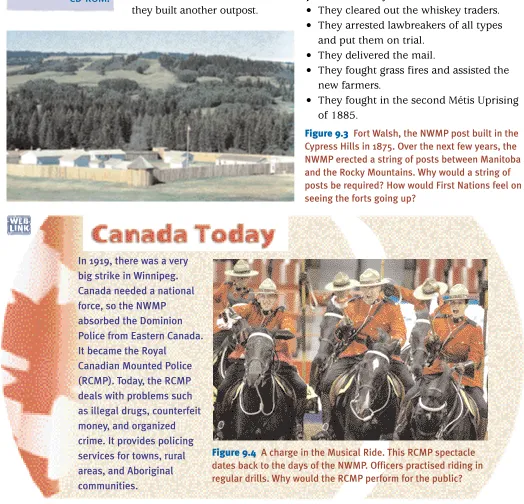
Finally, the police arrived safely. Part of the force went south. Here, they established Fort Macleod, west of present-day Lethbridge, and Fort Walsh, in the Cypress Hills. Another group went north to Fort Edmonton, where they built another outpost.
Calgary also began as a police fort, briefly known as Fort Brisebois.
The Role of the Mounted
Police
The North West Mounted Police had one major task: to make life in the territory peaceful. The officers made sure that people obeyed the law.
The mounted police were few, but they performed many tasks.
• They cleared out the whiskey traders. • They arrested lawbreakers of all types
and put them on trial. • They delivered the mail.
• They fought grass fires and assisted the new farmers.
• They fought in the second Métis Uprising of 1885.
In 1919, there was a very big strike in Winnipeg. Canada needed a national force, so the NWMP absorbed the Dominion Police from Eastern Canada. It became the Royal
Canadian Mounted Police (RCMP). Today, the RCMP deals with problems such as illegal drugs, counterfeit money, and organized crime. It provides policing services for towns, rural areas, and Aboriginal communities.
Figure 9.4 A charge in the Musical Ride. This RCMP spectacle dates back to the days of the NWMP. Officers practised riding in regular drills. Why would the RCMP perform for the public?
Figure 9.3 Fort Walsh, the NWMP post built in the Cypress Hills in 1875. Over the next few years, the NWMP erected a string of posts between Manitoba and the Rocky Mountains. Why would a string of posts be required? How would First Nations feel on seeing the forts going up?
CASE
STUDY
Tagging Along on the Great March
Can journalists avoid being biased when the government pays their way? Colonel G.A. French of the NWMP wanted people to know about the Great March West. So, he invited Henri Julien to come along. Julien was a Montréal artist with the newspaper Canada Illustrated News. (He painted The Battle of Châteauguayon page 133.) The government would pay for all expenses.
Julien accepted, although he didn’t really know what he was getting into. You can see this in the following excerpt from his diary:
July 10th It was in the neighbourhood of the Grande Coulee that we first [met]the hostility of the mosquitoes.
As soon as twilight deepens, they make their appearance on the horizon, in the shape of a cloud, which goes on increasing in density as it approaches to the encounter. At first, a faint hum is heard in the distance, then it swells into a roar as it comes nearer. The attack is simply dreadful. Your eyes, your nose, your ears are invaded.
If you open your mouth to curse at them, they troop into it .... And not one or a dozen, but millions at a time ....
Source: Henri Julien’s diary, http://www.ourheritage.net/julien_pages/Julien2.html.
Julien made many illustrations about what he saw. These were printed in his newspaper and made him famous. Look at the drawing on this page. Julien is presenting his opinion. What facts or arguments does Julien present to back up his opinion? What stereotypes does he use?
Develop Your Skill
Draw on your own experience to better understand what the NWMP went through on the Great March. You have probably had a day when the mosquitoes wouldn’t leave you alone. Jot down the facts of your experience: who, what, where, when, and why. Now write a short piece of historical fiction. Just make up a character who might have been with you on that day. Then write a funny scene as he or she fights off the mosquitoes.
The government paid all of Julien’s expenses. How might this have affected how Julien viewed and interpreted
what he saw?
Respond
Figure 9.5 An 1876 drawing by Henri Julien. He is
comparing the American West (top) with the Canadian West. How does he view each approach? How might these
Jerry Potts (1840–1896)
The NWMP could not do their job alone. They needed the help of local guides and interpreters. One of these was Jerry Potts.
Potts’s mother, Naamopia, was a Kainai [KY-ny] woman. His father was a Scottish trader who died when Potts was just a baby. Potts’s Kainai name was Ky-yo-kosi, meaning “Bear Child.” He grew up partly with his mother’s people and partly at a trading post in Montana. He worked as a guide and interpreter. He helped
the Kainai as a protector of the people. He was also a skilled hunter and trapper.
Potts was invaluable to the NWMP. He seemed to know every trail and coulee (deep, dry ravine) in the territory. He also gave excellent advice about the Plains First Nations. He took part in talks that led to the signing of treaties. Many scouts whom he trained went on to have long careers with the force. Potts worked for the NWMP all his life.
Biography
Biography
The NWMP came out to keep the Indians under control so they wouldn’t bother the White people … so they had a whole bunch of soldiers present when they signed the treaty—some people were scared.
—Helen Meguinis, a Tsuu T’ina [tsoo-TIN-uh] elder Source: Treaty 7 Elders et al., The True Spirit and Original Intent of Treaty 7(Montréal: McGill-Queen’s University Press, 1996), p. 135.
If the police had not come to the country, where would we all be now? Bad men and whiskey were killing us so fast that very few, indeed, would have been left today. The police have protected us as the feathers of the bird protect it from the frosts of winter.
—Isapo-Muxika (Crowfoot), Siksika chief Source: Alexander Morris, The Treaties of Canada with the Indians
(Toronto, 1880; reprinted Toronto: Coles Publishing Co., 1971), p. 272.
“
”
V
OICES
V
OICES
“
”
“
”
People did not always agree about the North West Mounted Police.
The Indians welcomed our residence among them, and looked upon us as their friends and deliverers from the many evils they had suffered at the hands of unprincipled white men.
—Cecil Denny, one of the first police officers in the West Source: Cecil Denny, The Law Marches West(Toronto: JM Dent, 1939), p. 72.
1. Imagine you work for the NWMP in 1874. Create a poster calling for recruits for the force. What qualities make a good recruit? What languages should a recruit speak? In your poster, describe the work the force is doing in the West. Show how it is helping
to develop Western Canada. Alternatively, write a speech for a recruitment officer.
2. Find out more about Canada’s mounted police by finding and reading a piece of historical fiction featuring a NWMP officer. Share it with a classmate.
Think It
Through
P
rime Minister Macdonald wanted a new policy for Canada. It was called the National Policy.A Three-Pronged
Policy
By 1878, the government had secured the land in the West. To use the land resource effectively, though, Canada needed three things: • a transportation system to reach the
resource
• a population to harvest the resource • an economyto nurture the new resource
industry
The National Policy was made to achieve these three things. It was like three policies in one:
• a transportation policy—to build a railway across the continent • an immigration policy—to
encourage farmers to populate Western Canada
• an economic policy—to build a strong national economy for Canadians
In this section, you will learn more about the first part of the National Policy: building the railway.
Finding a Route
In the 1870s, work began on the
transcontinental railway. By building it, Canada hoped to bring British Columbia into Confederation and keep the Americans out. Building the railway was a monumental task. Canada is a huge country, the second largest in the world (by land area). The railway had to cross thousands of kilometres of forested wilderness and prairie grassland. Swamps had to be filled. Rock had to be blasted out of the way. Bridges had to be built across raging rivers.
Before a railway could be built, surveyors had to find the best route. Surveyors first looked at a northerly route. It would go northwest from Winnipeg to Edmonton. Then it would cross the Rockies through the Yellowhead Pass. In the end, the route ran farther south. It crossed the prairie to Calgary. Then it crossed the Rockies through the Kicking Horse Pass. The southern route had several advantages. • The land was flatter and had fewer trees.
This made it easier to build the railroad. • Coal deposits near Lethbridge, Alberta,
could provide fuel for the steam engines. • The route was close to the border, so
most people would take the Canadian railway, not the American one.
Building the Iron Road
How did building the Canadian Pacific
Railway affect the growth of Canada?
Focus
V
OICES
V
OICES
“
On 7 March 1878, Prime Minister Macdonald proposed his National Policy in the House of Commons. How did he think it would benefit Canada?
The welfare of Canada requires the adoption of a National Policy, which … will benefit and foster the agricultural, the mining, the manufacturing and other interests in the Dominion; that such a policy will retain in Canada thousands of our fellow countrymen now forced to leave in search of jobs denied them at home, will restore prosperity to our struggling industries … [and] will encourage and develop trade between provinces.
Source: House of Commons debates, 7 March 1878, pp. 858–859.
”
The NationalFigure 9.6 The route followed by the Canadian Pacific Railway (CPR) across Canada. The grey dashed line shows the rejected northerly route. Towns tended to spring up where the railway passed. Towns located far from the track faded away. Speculate on why communities thrived close to the railway.
• In the south, the railway company controlled most of the land and would keep the profits from its sale.
• Scientists reported that the southern prairies were well suited for farming. (They were wrong, but no one knew that.) You can see both routes on the map below.
Building the Line
A private company built the railway in stages. It raised money from investors. The
government provided grants. The work crews faced different challenges in each section of the country. On average, one kilometre of track cost half a million dollars. (That’s in nineteenth-century dollars!)
During the heat of summer,
mosquitoes and flies buzzed around the workers’ heads. In the winter, bitter cold sliced through their clothes. Work crews lived together in dark, smoky bunkhouses. They slept in piles of hay infested with fleas and rats. Their meals were salt pork, corned beef, molasses, beans, and tea.
Impact of the Railway
The railway had a huge impact on the development of Canada. Over time it brought many newcomers. They changed the face of the prairies forever.
Building the CPR, 1880 to 1885
British Columbia
• Some workers laid track from Vancouver into the
mountains. Others worked from the Calgary foothills in the east.
• The line ran along steep canyon walls, across high passes, and through dark tunnels.
• Hundreds of workers died in rock slides, falls, and explosions.
Northern Ontario
• Workers blasted through the solid rock of the Canadian Shield.
• They filled in soggy muskeg. • Sometimes the rails simply
sank into the mud.
The Prairies
• Working night and day, crews laid up to 10 kilometres of track a day.
• Supplies were brought forward each day along the newly laid track.
Identity
Identity
Canada’s First Chinese Immigrants
Did Canada mistreat some of its first citizens? Faced with a shortage of workers, the CPR employed about 17 000 Chinese workers to help build the railway in the mountains between 1881 and 1885. The work here was so hard and so dangerous that no one else would do it.
The Conditions
Chinese labourers were paid about $1.50 per day. This was about half of what other workers received. They had to pay $4 per week for room and board. Even so, the tents were flimsy and the food was poor. Most Chinese were not prepared for the bitterly cold conditions.
The work assigned to the Chinese was brutal. They were the earth movers. Hanging from ropes, they chipped away at the rock faces with chisels and hammers. They laid the dynamite to blast a path through the rock. At least 700 of these workers died. They were
crushed in landslides, blown up by explosives, and lost in river torrents when bridges collapsed. Many simply died of scurvy or other diseases in the work camps.
Mary Chan’s grandfather came to Canada in 1879 on a sailing ship. She recalls his work on the railway:
Many people died during the construction of that railroad. They lived in tents along the track, and it was cold. Some people got arthritis. They were attacked by mosquitoes and blackflies, and some people eventually went blind. And then, after it was finished, there was no other work.
Source: Sound Heritage(Victoria: Provincial Archives of British Columbia), vol. VIII, nos. 1–2, http://collections.ic.gc.ca/time/galler05/frames/chinese.htm.
The Accomplishment
As John A. Macdonald said, “Without the Chinese, there would be no railway.” Without them, the railway would have been too expensive. Without the railway, Canada could not have been connected from west to east. Rock by rock, the Chinese workers shouldered their way through the Rocky Mountains. They earned an honourable place in Canada’s history. Many Chinese railway workers stayed and made Canada their home.
How did the Chinese railway workers contribute
to Canada? How was what they did an act of citizenship? How were they treated?
Why do you think they were treated this way?
Respond
Figure 9.7 James Pon in front of the Chinese Railway Workers Monument, which he lobbied to erect. It was made in 1989. Why would Pon want to immortalize the actions of people who lived so long ago? What would it have to do with citizenship?
Figure 9.9 A party of officials watching Donald Smith, head of the CPR. Smith hammers in the last spike at Craigellachie, BC. Think about how these officials must have felt about getting the railway finished.
Figure 9.10 A group of workers staging their own ceremony in Craigellachie. Why aren’t there any Chinese labourers in this photo? Speculate on what these workers thought about getting the railway finished.
Father Albert Lacombe (1827–1916)
Father Albert Lacombe is the most famous Catholic missionary in Alberta’s history. A Canadien, whose great-great-grandfather was Anishinabe, [a-nih-shih-NAH-bee] he devoted himself to helping the Métis, the Canadiens, and the First Nations in the west. The Cree gave Lacombe the name Kamiyoatchakwêt, “the noble soul.” The Siksika called him
Aahsosskitsipahpiwa, “the good heart.”
CPR employees began surveying the route of the CPR through the Siksika reserve. The Siksika got angry. Lacombe convinced Chief Isapo-Muxika (Crowfoot) to stop a dangerous confrontation and allow the track on the reserve. To thank him, the CPR made Lacombe president of the company for an hour and gave him a lifetime pass on the railway.
Biography
Biography
Figure 9.8 Crowfoot, Father Albert Lacombe, and Three Bulls, 1886.
To see the first locomotive to travel across the continent
Like a vision, I could see it driving my poor Indians before it, and spreading out behind it the farms, the towns, and cities …. No one who has not lived in the West since the Old-Times can realize what is due to that road—that CPR. It was magic.
—Albert Lacombe, missionary Source: Katharine Hughes, Father Lacombe: The Black-Robe
Voyageur(Toronto: William Briggs, 1914), p. 273.
The Canadian Pacific was built for the purpose of making money for the shareholders and for no other purpose under the sun.
—William Cornelius Van Horne Source: W. Kaye Lamb, History of the Canadian Pacific Railway(Toronto: Macmillan, 1977), p. 1.
Next summer, or at the latest next fall, the railway will be close to us, the whites will fill the country and they will dictate to us as they please. It is useless to dream that we can frighten them; that time has passed.
—Pitikwahanapiwiyin (Poundmaker), Cree chief, speaking to his people in 1882 Source: Pierre Berton, The Great Railway: Illustrated
(Toronto: McClelland and Stewart, 1972), pp. 224, 226.
If [Macdonald] had not found ways and means of constructing the railway when he did, Canada would almost certainly not extend today from sea to sea.
—W. Kaye Lamb, historian Source: W. Kaye Lamb, History of the Canadian Pacific Railway(Toronto: Macmillan, 1977), p. 436.
“
”
V
OICES
V
OICES
“
”
“
”
“
”
What does each of these opinions say about the purpose or impact of the railway?
• A British Columbian:The railway brought us into Confederation!
• A CPR Shareholder:Finally we can make some money from the land we got for making the railway. • An Ontario Farmer:Now we can move west. We
will grow crops and move them by rail to market. • A Manager for a Manufacturer in the East:Now
we’ll have a way to bring our products west. • A BC Logger:We’ll sell more lumber. They need
lumber to build houses in the new prairie towns. • A Prairie Miner:Trains need coal. We’ll have jobs!
• A Resident of the Prairies:It’s not fair: the railway company received so much land for free while we have to struggle.
• A Prairie Farmer: The CPR charges us far too much to ship our crops. And the government won’t let any other railway build lines into Western Canada. Without competition, the CPR can charge whatever it likes!
• A Cree:It is the railway that is bringing the flood of newcomers into our territories. If only it had never been built!
Figure 9.11 Opinions about the railway. Use each opinion to identify a way the railway affected the person’s life.
1. Divide your class into three groups. Imagine that each group is a survey party hired to find a route through one of three sections of the railway: Northern Ontario, the prairies, or BC.
a) Find out any problems that the railway will face building along your route. Check the text as well as an atlas. b) In point form, draw up a report. c) Present your findings to the class.
d) As a class, vote to decide which survey team faces the greatest challenge.
2. Imagine you are Sandford Fleming, Chief Engineer of the Intercolonial Railway. You need to convince the prime minister to give you more money for construction. Write a letter to him, or give a speech to Cabinet. Make a list of arguments and facts you will use. Why are costs so high? What benefits will the railway bring?
Think It
Through
▲
Y
ou will recall that the second part of the National Policy called forimmigration. The government needed to convince people to come and farm the land.
As you will learn in this section, it succeeded to a certain degree. New farming communities appeared. They became the
backbone of a new Canadian West. You will learn about the earliest immigrant groups. These people arrived in the 1870s and 1880s.
Land Policy in the West
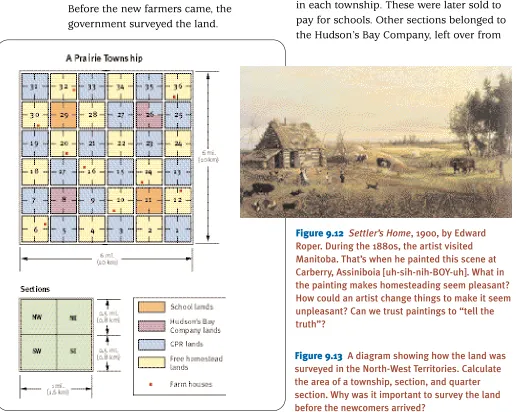
Before the new farmers came, the government surveyed the land.
• Surveyors divided the land up into large chunks. These were called townships. • Each township was divided into
36 squares called sections.
• Each section was divided into four quarter sections. Each quarter section was 64 hectares (160 acres).
The surveyors drove iron stakes into the ground to mark off each quarter section. The whole of the North-West Territories was measured in this way. The surveyors did not follow any of the established farm borders, which were patterned like farms in the seigneurial system.
The government set aside two sections in each township. These were later sold to pay for schools. Other sections belonged to the Hudson’s Bay Company, left over from
What role did agriculture play in the growth of Western Canada?
Focus
Figure 9.12 Settler’s Home, 1900, by Edward Roper. During the 1880s, the artist visited Manitoba. That’s when he painted this scene at Carberry, Assiniboia [uh-sih-nih-BOY-uh]. What in the painting makes homesteading seem pleasant? How could an artist change things to make it seem unpleasant? Can we trust paintings to “tell the truth”?
Farming the Frontier
the sale of Rupert’s Land. Still other
sections went to the CPR to pay for building the railway. The rest were open for new arrivals.
In 1872, the government passed the Dominion Lands Act. It said that any head of a family could apply for land. So could any male at least 21 years old. They each received a quarter section of land called a homestead. It cost only $10. After 1882, women could apply, too.
Each applicant had to promise three things: to live on the land for at least six months of the year, to build a house, and to start farming. After three years, the
homesteader got to keep the land if he or she had fulfilled these terms.
A Rough Life
The life of a homesteading family was difficult. Most of the new arrivals were poor. They could not buy seed, farm tools,
livestock, or the materials to build houses and barns. Nature often worked against them. Crops could be ruined by
grasshoppers, lack of rain, early frost, or hail. Many newcomers gave up in disgust.
Figure 9.14 The interior of a Canadian Pacific Railway car drawn by Melton Prior in 1888. Between 1867 and 1899, 1.5 million
immigrants came to Canada. Virtually all of them went west on rail cars like this. What do you think the people in this illustration might be thinking?
In 1886 we had 80 acres [32 hectares] under crop. Not a drop of rain fell from the time it went in until it was harvested. I sowed 124 bushels and threshed 54. In 1888 we began to think we could not grow wheat in this country. I had now 120 to 125 acres under cultivation. We put in 25 acres of wheat, 10 to 15 acres of oats, and let the rest go back into prairie. That year we got 35 bushels [of wheat] to the acre! So we went to work and ploughed up again. The next year wheat headed out two inches high. Not a drop of rain fell that whole season until fall. [In 1890] we had wheat standing to the chin but on the 8th July a hailstorm destroyed absolutely everything.
Source: Gerald Friesen, The Canadian Prairies: A History
(Toronto: University of Toronto Press, 1984), p. 222.
“
”
V
OICES
V
OICES
Compare this account with the painting by Edward Roper on the previous page. Which image of the West do you think the government wanted to show potential immigrants? Why?
Respond
Farming has always been a hard life in Canada. Every season, farmers face threats to their livelihood. For example, in 2003, inspectors discovered a sick cow. It was infected with Bovine Spongiform Encephalopathy (BSE), or mad cow disease. The United States stopped all imports of older cattle from Canada. Many farmers couldn’t sell their herds. They lost everything.
Figure 9.15 Farm hands at work on a modern Alberta farm. When disasters strike today, the government usually provides some help to farmers. What happened in the past?
The First Newcomers:
From Ontario
The government was eager to attract
newcomers to the North-West Territories, so it put on a campaign. It appointed agents to “sell” the West.
They began close to home. The earliest newcomers came from Ontario. That province had many people. Farmland was scarce there, whereas land in the West was plentiful. During
the 1870s, many Ontarians moved to Manitoba. It even got the nickname “New Ontario.”
Land was scarce in Québec as well. But no government agents tried to convince Canadiens to move West. Instead, the Canadiens travelled to New England for jobs.
The Arrival of the
Mennonites
Mennonites do not believe in fighting wars. The czar of Russia wanted them to serve in the army. What would they do?
A Canadian immigration agent visited Russia. He invited the Mennonites to move to Canada. They would be able to practise their religion. They would be able to farm collectively (all together on a big farm).
The first group took up land southeast of Winnipeg. In all, about 7000 Mennonites came. They brought a heavy plough that was effective at breaking the prairie sod. They proved that the Canadian prairie could be farmed with the proper tools. They started about 100 communities in the West.
From Iceland to Canada
Another early group of immigrant farmers came from Iceland. Iceland is an island in the North Atlantic Ocean. In March 1875, the Askja volcano in Iceland erupted. The falling volcanic ash poisoned the land. It killed the cattle.
Many refugees from the disaster fled to Canada. The government gave them nearly 800 square kilometres of land. They would have the freedom to speak their language and keep their customs. They would be able to make their own laws.
The first party of 235 arrived in 1875. They travelled to the shores of Lake
Winnipeg. They called their lands New Iceland. Their main community was Gimli, which means “paradise.”
New Iceland was no paradise for the newcomers. The climate was harsh. Floods forced colonists off their land. Some people starved to death. Others died in a horrible smallpox epidemic. Many people left, but the rest held on. In 1881, Manitoba
absorbed New Iceland. Some of those who left made their way to Alberta. They settled near Red Deer, in a community called Markerville.
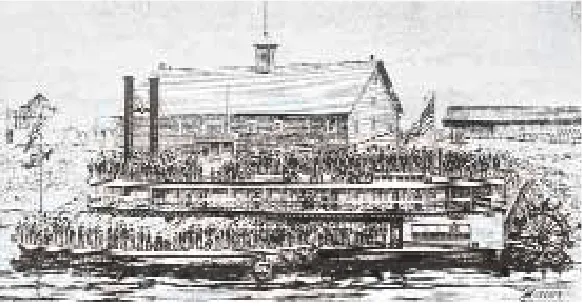
Figure 9.17 The Landing, painted by Arni Sigurdsson in 1950. It shows the Icelandic immigrants landing at Willow Point, Manitoba, in 1875. They had just finished a frightening and dangerous journey over Lake Winnipeg in wooden boats called scows. What mood does the painting create? How did the artist create that mood?
Figure 9.18 Two maps showing Canada in 1873 (left) and 1882 (right). List the changes that took place between those years. How does the 1882 map compare with a map of Canada today?
Canada, 1873
CASE
STUDY
Farming and the First Nations
Some First Nations were farmers, too. Did they have a fair chance to succeed? When the buffalo began to disappear, many First Nations people wanted to farm. They were not strangers to farming. At Red River, the Anishinabe had farms. Farther west, some Nakoda and Cree farmed.
When the First Nations signed treaties, the government agreed to help them become farmers. The treaties guaranteed the First Nations land. The First Nations would receive farm animals, tools, and seed. In some cases, these obligations were fulfilled. First Nations welcomed machinery that would help
them farm. They appreciated learning farming skills, such as making butter. However, many obligations went unfulfilled.
• Most land assigned to First Nations was not good for farming. • Much of the equipment they were owed did not appear. • Instructors were supposed to teach farming skills, but few
instructors arrived.
• First Nations farmers were often prevented from buying farm machinery.
• Those who did farm successfully had a hard time selling their crops. Many First Nations farmers gave up.
The government let the Mennonites farm collectively. It allowed the Icelanders to keep their own laws. It did not allow the First Nations to keep their own laws or farm collectively. Why did it not treat all citizens equally?
Respond
Figure 9.19 A pass for Big Prairie Head. On it, a government representative gives him permission to leave the Sarcee (Tsuu T’ina) Indian Reserve. What did Big Prairie Head get permission to do? First Nations people on some reserves needed signed passes like this to leave their reserve lands. How would this system make it easier or harder to sell produce?
1. Pretend you’re going to write a piece of historical fiction about an early immigrant group. In this activity, you will do just three preparation steps.
a) First, gather reasons why the three groups of newcomers described in this section moved to the West. Use a graphic organizer to collect your information. Alternatively, for each group, draw a picture to illustrate one reason for moving. Now choose one group.
b) Using the text and pictures in this section, make notes about this group. c) Speculate on what these people were
thinking about when they arrived.
2. a) The population grew in Western Canada in the late nineteenth century. By how much did it grow? (Hint: See page 208.) b) Did plentiful, inexpensive land help
populate Western Canada? Was it a key factor? Support your opinion with facts and arguments.
Think It
Through
T
he third part of the National Policy was to build a strong economy.Farming in the West was going to be crucial to the Canadian economy. So was
manufacturing in the East. The government wanted to build farming and other industries. This would create jobs for Canadians.
In this section, you will learn how the government tried to boost the economy. It used tariffs with some success. You will see that Canadians had mixed opinions about tariffs.
The Problem of
Competition
As you have learned, the colonies joined Confederation for many reasons. One of the reasons was to increase trade with one another. Creating the railway was one way of making this trade possible.
Canadian manufacturers in the East faced a huge problem, though. American businesses could produce goods in vast quantities. This kept their unit costs low. So, American goods sold at a lower price than Canadian goods. Canadian producers worried that Canadians would buy the less expensive US goods. They were right.
The Solution: Protective
Tariffs
For the third part of his National Policy, Macdonald put a tariff on goods coming into Canada. A protective tariffis a tax placed on a product crossing the border. This tax adds to the cost of the product. The product becomes more expensive. Macdonald knew that the tariff would make American goods more expensive than Canadian goods. Then Canadians would buy the goods made in Canada.
Helping Industry
How did the National Policy
strengthen the Canadian economy?
Focus
Figure 9.20 A diagram showing how a protective tariff works. How much more expensive is the American plough after the tariff? How would you feel about the tariff if you worked in a Canadian factory? If you were a Canadian farmer, which plough would you buy? How would you feel about the tariff? Explain your conclusions.
When you see a complicated diagram, first look it over. Then read the separate parts. You might find it helpful to draw your own version of the diagram.
The Scenario:
• The Massey Company is a Canadian company. It makes a plough that it sells for $110.
Figure 9.22 A poster dating from 1891. It gives one point of view about the impact of the National Policy. Compare the two panels of the poster. What does it say about life with and without the National Policy? What is the main message of the poster? Would a manufacturer agree with this poster? What about a Western farmer?
• New manufacturing industries created jobs. • Adding manufacturing made Canada’s economy
more diverse.
• Canada’s industries were young. They needed more help so they could grow.
• The high tariff kept foreign products out. People bought Canadian products instead.
• The tariff brought in a lot of money. It paid for programs that people wanted.
• Canadians paid more for many goods. The tariff made them more expensive.
• Farmers paid more for their tools and equipment. Nonetheless, they could only earn what buyers were willing to pay.
• Most industry was in Ontario and Québec. Westerners and Maritimers had few industries. They had to pay higher costs even though they got no benefits.
In Favour of the Tariff In Opposition to the Tariff
Figure 9.21 Imagine a meeting with an Ontario plough maker, a Western farmer, a worker from a Montréal clothing factory, and a Halifax fisher. What would each person think about the tariff? Which of the above arguments would each person use?
Slow but Steady Progress
The changes in the North-West Territories in the late nineteenth century were remarkable. New arrivals from Europe and Eastern Canada were farming the land. Grain began to replace furs as the region’s chief export. Ploughed fields covered the prairies where countless buffalo used to roam. The railway replaced the canoe and the Red River cart. Trading posts changed into bustling business centres for farms.
The First Nations and Métis faced many problems. The government neglected them. Many newcomers were unfriendly. Nonetheless, they did their best to adapt to the changes in their land.
By 1891, Manitoba and the North-West Territories had a population of 281 000. This was
more than double what it had been 10 years earlier. (This includes 30 000 First Nations people.) It was not quite the rapid growth that the
government had hoped for. Nonetheless, it was a start.
A diverse economy has many types of industry. If one industry is suffering, the others can keep the country healthy.
To compare this 1891 poster about free trade with another from that year, open Chapter 9 on your Voices and Visions
1. The National Policy had three parts: transportation, immigration, and
protective tariffs. The government hoped that each part would have certain effects. List what these were. Use the skill of distinguishing cause and effect that you practised in Chapter 4 (see page 76).
2. a) The National Policy had an impact on citizens all across Canada. It is important to think about different perspectives. Form small groups. Each member of your group should explain the impact on one of these groups: • Chinese railway workers
• Icelandic immigrant farmers • Siksika buffalo hunters • factory workers in Ontario
Think of other perspectives you could add to your group discussion.
b) Was the National Policy good for Canada?
• State your opinion on this question. • Collect facts and arguments to
support your opinion.
• Use your written list of facts and arguments in a class discussion.
3. How many Aboriginal people in Canada run their own businesses? Some of them got started with the help of band council grants or loans. How is this the same or different from the National Policy’s assistance to new immigrants in the nineteenth century?
4. How did Canada secure the West and prepare for a massive influx of immigrants?
Think It
Through
▲
The National Policy did not help Aboriginal industries or farmers. Nonetheless, many Aboriginal businesses have done well over the years. Dolly Watts is just one of more than 27 000 Aboriginal people who ran their own businesses in Canada in 2005. She is a member of the Gitksan [git-KSAHN] First Nation from northern British Columbia. In 1995, she opened the Liliget Feast House in Vancouver, BC. It brings in more than $400 000 every year.
People travel from as far away as Germany and Japan to taste her alder-grilled salmon, buffalo smokies, venison strips, oysters, duck breast with wild-berry sauce, mussels, and steamed fiddleheads. Watts’s Aboriginal staff cook these traditional foods over an alderwood grill. This makes the food taste just as Watts remembers it from her childhood.
Aboriginal women draw on their heritage to help them reach goals in the Canadian economy and in their personal lives. Read what Watts says about this important human resource.
Do Aboriginal women want to become warriors? Of course. Not for war, but as trail blazers for self and others. They're proving to be courageous, willing to take risks, empowered through improved self-esteem in the face of competitive forces all around. Armed with knowledge and skills, standing beside our helpers (resources) and our spirit helpers. I can say that many of us have become warriors, not for militancy, but for personal challenges.
I
n this chapter project, you have the chance to write a historical fiction story. While studying Canadian history, you have learned about events and individuals that helped mould our country. You’ve seen the great dramas that built the railroad and brought law and order. You’ve seen the lives of people turned upside down as they travelled to the West to start a new life. These are the kinds of events and people that inspire authors to write historical fiction.Focus
Scan through the chapter, looking at headings and pictures. What part of the chapter do you find most exciting? Does a particular event intrigue you? Choose an event that raises
difficult issues. Imagine what some of the people of that time period must have been
experiencing. This is your starting point.
Planning, Drafting, and
Writing
As an author, you should develop an authentic but original plot. Set your story in the time and
places featured in this chapter. Your story should be at least 500 words long. Use Skill Check: Read and Write Historical Fiction on page 196 to guide you through the process.
Revising
When revising your writing, ask these questions: • Did I hook the reader with a strong opening? • Did I make my characters believable?
• Did I choose words that made my writing interesting?
• Did I give the reader a clear picture of the setting and the historical events?
• Did I hold my reader’s attention with a strong plot?
Presenting
After you finish writing your story, publish and present it. Share your story with other students in the class. Describe what you found most difficult and most interesting about writing historical fiction.
1. What historical events did the other students write about? What did you learn from their stories?
2. Discuss how historical fiction can help form a country’s identity.
▲
Chapter 9
PROJECT
You Be the Author