JIEM, 2012 – 5(2): 518- 531 – Online ISSN: 2013-0953 – Print ISSN: 2013-8423 http://dx.doi.org/10.3926/jiem.560
- 518 -
Evaluating efficiency levels comparatively: data envelopment analysis
application for turkish textile and apparel industry
Canan Saricam, Nazan Erdumlu
Istanbul Technical University, Istanbul Technical University (Turkey)
[email protected]
,
[email protected]
Received: September 2012 Accepted: November 2012
Abstract:
Purpose:
The purpose of this study is to show the usage of DEA in efficiency measurement.
Design/methodology/approach:
The efficiencies of textile and apparel companies were
analyzed by input-oriented DEA model under variable return to scale assumption. The textile
and apparel companies quoted in Istanbul Stock Exchange for the period 2003 and 2008 were
evaluated in terms of efficiency level providing a framework for the calculation of input
excesses and output shortages.
Findings:
The
analysis revealed that the average efficiency scores of the apparel industry was
higher than the textile industry and two industries together. The companies in the apparel
industry should overcome the lack of insufficient level of exports whereas the textile industry
needs to increase gross value added in order to be more efficient.
Research limitations/implications:
Because of missing data, four companies from textile
industry and one company from apparel industry were ignored although they took place in the
records of Istanbul Stock Exchange.
Practical implications:
This study provided a framework for DEA application in
determination and comparison of efficiency performance in an industry level.
Originality/value:
Selecting the groups compared as textile industry, apparel industry and
the two industries in general allowed discussing the comparative efficiencies of two industries
eliminating the industry specific pitfalls.
- 519 -
1. Introduction
Textile and apparel industry, which is labor intensive and requires low level of investment, has great significance for countries especially in their early stages of development. Although, the share of the textile and apparel industry among the other industries decreases when economies of countries get better, developed countries continue to compete in this arena usually with higher value added garments and products. Flexibility in meeting the demands of the customers while minimizing the input and maximizing the output is a challenging issue (Lin, Kincade & Warfield, 1994). Flexibility can be developed via specialization and the computer and worker together can produce different products and change operations when needed (Zhang & Hathcote, 2008). Cost minimization at the same time is difficult however. The wage differences between countries enable global shifts to occur in apparel production due to the differences between countries in relative abundance of labor and capital (Loker, 2002). Thus, a challenging situation is raised by low cost producing countries especially in the periods of downturn. Within this respect, the countries acting in textile and apparel business should make introspection into their industry performance; increase their outputs but decrease their resource usage. The countries which have the experience, potential and huge investments in these fields, are strongly suggested to improve themselves in terms of producing in more productive and efficient manner if they aim to maintain high level of competitiveness.
The efficiency based performance evaluations are required to make a valid comparison among the industries as well as within the industry. This necessity can clearly be seen with an example of Turkey. In Turkey, 2 to 3 million people are employed in textile and apparel industry, whereas 2 million people are employed in these fields in European countries. Despite that large amount of employment, the total revenue of Turkish textile and apparel industry is between 25 to 45 billion dollars, whereas that value reaches about 250 billion dollars for European countries (BTSO). The profitability range in textile industry lies between 5 and 10% depending on the product market and customer whereas it is between 10 and 20% in the developed countries (Ayvaci, 2011). Within this regard, the profitability and efficiency should be measured in order to manage well.
- 520 -
The superiority of DEA method over the parametric models is that it does not require the specification of any functional relationship between inputs and outputs (Chandra, Cooper, Shanling, & Rahman, 1998) and a reference is not determined according to whom the efficiency is measured. DEA gathers all the partial efficiency measures together in order to carry out the overall efficiency measure (Tongzon, 2001). DEA ranks the DMUs into two as efficient and inefficient DMUs (Adler, Friedman & Stern, 2002). Besides, it can consider more than one output whereas it does not require the determination of the priority issues among the inputs and outputs (Tongzon, 2001). Moreover, DEA in efficiency measurement eliminates the problems that can lead to wrong results of the efficiency measurement in which only the separate production factors are isolated (Goncharuk, 2007). Cubbin and Tzanidakis (1998) reveal that DEA is good at identifying possible reasons for poor performances by providing a checklist for the management staff.
Considering the advantages of DEA method on efficiency measurement, a framework was established to show the application of DEA in efficiency evaluation and comparison, which provides a case for the industries having the same requirement of performance assessment. To this aim, DEA method was applied in Turkish textile and apparel industry for determining the performance of the companies which are quoted in Istanbul Stock Exchange. The overall performance of the textile and apparel industries were established and compared with each other to discover the problematic fields with an additional analysis of input excesses and output shortfalls as explanations of low performances.
2. Literature Review
The literature review is composed of three parts. In the first part, the definition and features of DEA procedure is given. In the second part, the use of DEA method in different field of applications is presented. In the third part, specific examples regarding textile and apparel industry were given with the introduction of the parameters used as inputs and outputs in the establishment of DEA.
- 521 -
Based on the mathematical programming theory, DEA is an efficiency evaluation method which creates an optimization for the individual observation by evaluating a discrete piece-wise frontier. Efficiency refers to the quotient from the division of the sum of all outputs by the sum of all inputs (Goncharuk, 2007). In data envelopment analysis, the frontier is found out by the set of Pareto efficient decision management units (Tongzon, 2001). The factors in DEA calculations are not subjected to rigid importance weights whereas in conventional techniques, the inputs are given weight in terms of creation only one output. DEA allows finding out the reference set which can act as benchmarks instead of finding one most efficient reference. DEA method is based on the fact that the efficiency of a DMU is determined by its ability to transform the inputs into desired outputs (Tongzon, 2001).
According to the study of Emrouznejad, Parker and Tavares (2008), DEA became in the concern of researchers over 30 years whereas the number of paper related with DEA increased to approximately 360 per year within the time period of 2004-2006 focusing specifically on the fields of banking, education (including higher education), health care, and hospital efficiency. The studies covered many applications established at a company or industry level. Laughlin and Kean (2002) used DEA for benchmarking in strategic planning. In this study, the data was obtained and analyzed for comparing teaching and research activities in textiles and clothing programs. Chandra et al. (1998) used DEA to evaluate the performance of 29 Canadian textile companies using the Cooper and Rodes model. Goncharuk (2007) investigated the impact of political changes on industrial efficiency. Tongzon (2001) used DEA procedure to calculate the selected port efficiencies in Australia for which the output measures were taken as cargo throughput and ship working rate. Gonzalez and Trujillo (2008) applied DEA analysis in order to measure the efficiency and productivity in the port industry. Taymaz and Saatci (1997) investigated the rate and direction of technical change in three industries which were textile, cement and motor vehicles by using the technical efficiency level which was described as the ratio of its actual output level to the maximum possible output that could be produced by inputs utilized by the plant in the same period. Alvarez and Crespi (2003) determined the factors that could explain the observed differences in technical efficiency and the factors lying beneath the differences such as experience of workers, modernization of physical capital and innovation in products. Jajri and Ismail (2006) analyzed the trends of technical efficiency, technological change and total factor productivity growth in the Malaysian manufacturing sector for which the data was taken from the Industrial Manufacturing Survey of 1985 to 2000 collected by the Department of Statistics Malaysia using Data Envelopment Analysis. Worthington (2001) measured inefficiency in education using DEA which was preferred to regression analysis that lacked the allowance for the tradeoff between different educational outcomes.
- 522 -
- 523 -
could lead to misleading results due to the different structures of the sectors. In other words, the companies being evaluated should be comparable in terms of business segment in order to perform benchmarking.
3. Method
In this study, the performances of the companies in the textile, apparel and leather industry quoted by Istanbul Stock Exchange for the period 2003-2008 were analyzed by input-oriented model under variable returns to scale assumption. In the input oriented BCC (Banker, Charnes and Cooper) model used in this study, the efficiency measure for Decision Making Unit (DMUo) was calculated by solving the following mathematical programming problem composed of Equations 1-4 in Excel Solver (Zhu, 2003):
subject to
where DMUo represents one of the n DMUs under evaluation, and xio and yro are the ith input and rth output for DMUo, respectively. θ* represents the efficiency score of DMUo.
In this study, net assets and the average number of employees were used as inputs, and gross value added, profit before tax and export revenues were used as the outputs. The input and output variables were selected by considering the fact that inputs and outputs should be independent in DEA in order to obtain reasonable results. Since the two outputs, gross value added and profit before tax could take negative values, sufficiently large positive constants were added to all the values in the output data sets including negative values. This required input oriented model under variable returns to scale assumption to be used in this study (Duzakin & Duzakin, 2007; Cook & Zhu, 2008). If the number of inputs is m, and the number of outputs is s, at least (m+s+1) DMUs is required in order to conduct DEA. Another constraint is that the number of DMUs must be at least 2*(m+s). In this study, the number of inputs is 2 and the number of output is 3. The minimum number of DMU required to conduct the analysis is (2+3+1) = 6 and 2*(2+3) = 10. Consequently, the number of DMUs in all three analysis included in this study fulfill this requirement (Tektufekci, 2010).
(1)
λj ≥ 0
(2)
(3)
- 524 -
The analysis was established for 10 companies from the apparel industry and 23 companies from the textile industry which were quoted in Istanbul Stock Exchange. One company from the apparel industry and one from the textile industry were eliminated as they were not doing export whereas four companies from textile industry and one company from apparel industry were ignored as they had missing data for the select period either because of going bankrupt or existing from the stock exchange. First, the apparel and textile industries were analyzed individually, and then a general analysis was performed for all of the 33 companies. The performances of the industries were evaluated on a yearly basis and the input excesses and shortfalls leading inefficiencies were determined.
4. Result
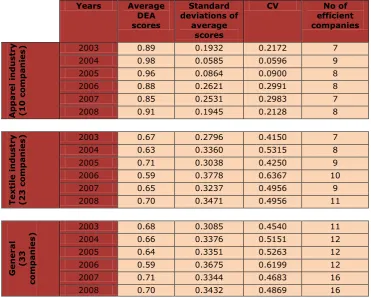
Table 1 shows the results of the efficiency analysis in the textile and apparel industry individually and two industries in general (textile and apparel together). It is seen that, the average efficiency scores of the apparel industry are higher than the textile industry and two industries in general. Besides, the standard deviations and CV values of the apparel industry are quite lower than those in the selected period.
Years Average DEA scores Standard deviations of average scores
CV No of efficient companies App a re l in du st ry (1 0 c o mp a n ie
s) 2003 0.89 0.1932 0.2172 7
2004 0.98 0.0585 0.0596 9
2005 0.96 0.0864 0.0900 8
2006 0.88 0.2621 0.2991 8
2007 0.85 0.2531 0.2983 7
2008 0.91 0.1945 0.2128 8
T e xt ile in du st ry (2 3 c o mp a n ie
s) 2003 0.67 0.2796 0.4150 7
2004 0.63 0.3360 0.5315 8
2005 0.71 0.3038 0.4250 9
2006 0.59 0.3778 0.6367 10
2007 0.65 0.3237 0.4956 9
2008 0.70 0.3471 0.4956 11
G e n e ra l (3 3 comp a n ie s)
2003 0.68 0.3085 0.4540 11
2004 0.66 0.3376 0.5151 12
2005 0.64 0.3351 0.5263 12
2006 0.59 0.3675 0.6199 12
2007 0.71 0.3344 0.4683 16
2008 0.70 0.3432 0.4869 16
Table 1.DEA Scores, Standard Deviations and CV Values for the Selected Period
- 525 -
sector in concern, 2004 is the best year for the apparel industry leaving only one company behind as an inefficient one. The textile industry and the two industries in general show an improving figure by increasing the number of efficient companies in recent years.
When the results of the textile industry are compared with the scores of two industries in general, it is quite difficult to say that one of them showed a better performance than the other as their dominance on each other change with the year. For instance, in 2005, the performance of the textile industry is higher than the two industries in general while in 2003, 2004 and 2007, the industry shows worse performance than the latter one with the values differing in a range of 0.01 to 0.06. Finally, they show the same performance in the years 2006 and 2008. On the other hand, the standard deviations of the two industries in general are higher than the score of the textile industry except the years 2006 and 2008. That means, the apparel industry is more efficient than the textile industry and the two industries in general on which the contribution of the textile industry with 23 companies lowers the performance of inefficiency.
Table 2 summarizes the overall results of the companies’ successes. It is found out that 10 companies from the textile industry, 3 companies from the apparel industry and 16 companies from the 33 companies get a lower DEA score where the average efficiency values are 0.91, 0.65 and 0.66 in the apparel, textile and two industries together in 6-year-period. The apparel industry shows the highest stability with the six companies being efficient in whole period of selected years followed by the five companies from the two industries in general. Nonetheless, only two apparel companies as in the case of textile preserved their efficiencies, in the analysis of two industries in general in all years indicating poor results in terms of sustainability. It is also observed that one apparel company with the average efficiency score of 0.56 and six textile companies with the average efficiency values between 0.24 and 0.47 show the lowest performance. 8 companies out of 33 companies have the worst performance including the worst company out of the apparel industry and four low performance textile companies out of the textile industry.
Industry
The number of companies
below the average
The number of companies that were
efficient in whole period of time
The number of companies that were efficient in both individual and in common
analysis
The number of companies that never became efficient during
the select period Apparel
(Average efficiency 0.91) 3 6 2 1
Textile
(Average efficiency 0.65) 10 2 2 6
Textile and Apparel(Average
efficiency 0.66) 16 5 8
Table 2. The Overall Results of Company-Base Analysis
- 526 -
were determined. Then, the main industries in which the companies act were determined and finally, the ratio of inefficient companies to the total companies in each industry individually was calculated and shown in Figure 1 using the percentages. For instance, in 2003, two companies from the apparel industry are found to be inefficient in the analyses of two industries in general. As there are 10 companies from the apparel industry among the 33 companies, inefficiency ratio becomes 2/10 or 20%.
Figure 1. The ratio of inefficient companies within each industry
When Figure 1 is analyzed considering the whole period, it depicts that the ratio of inefficient companies from the apparel industry are lower earlier. Even in the year of 2005, none of the apparel companies are inefficient. Nonetheless, the ratio of the inefficient companies in the apparel industry increases in the recent years while the ratio of the inefficient textile companies decreases.
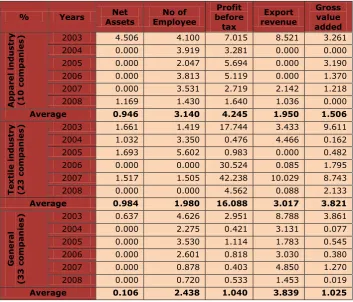
Table 3 shows the total percentages of input excesses and output shortfalls in each year. The average input excess percentages in the input “Net assets” becomes 0.946, 0.984 and 0.106. Although, it reaches above 0.90 in the textile and apparel industries, the input excesses in terms of “Net assets” are different in each year taking even zero values in some years.
Considering the average percentage values and the percentage values in each year together, the worst year is 2003 and then both of the industries improve their benefits from the resources by decreasing their slacks in net assets.
- 527 -
Examining the results of the industry in terms of output shortfalls, the textile and apparel industries individually and two industries in general show poorer performance in maximization of the outputs. The average output shortfall becomes in the output of “Profit before tax”, 4.245, 16.088, 1.040 for the apparel, textile and two industries in general, respectively. Even, 2006 and 2007 became very painful for the textile industry whereas 2006 is the worst year in terms of efficiencies. The output shortfalls are high for apparel industry in those years but the scores lag far behind the textile industry.
Regarding the two outputs of “Export revenue” and “Gross value added”, the apparel industry is lacking of output shortfall in the output of “Export revenue” while the textile industry is lacking basically of the output “Gross value added”.
% Years Assets Net Employee No of before Profit tax Export revenue Gross value added App a re l in du st ry (1 0 c o mp a n ie
s) 2003 4.506 4.100 7.015 8.521 3.261
2004 0.000 3.919 3.281 0.000 0.000
2005 0.000 2.047 5.694 0.000 3.190
2006 0.000 3.813 5.119 0.000 1.370
2007 0.000 3.531 2.719 2.142 1.218
2008 1.169 1.430 1.640 1.036 0.000
Average 0.946 3.140 4.245 1.950 1.506
T e xt ile in du st ry (2 3 c o mp a n ie
s) 2003 1.661 1.419 17.744 3.433 9.611
2004 1.032 3.350 0.476 4.466 0.162
2005 1.693 5.602 0.983 0.000 0.482
2006 0.000 0.000 30.524 0.085 1.795
2007 1.517 1.505 42.238 10.029 8.743
2008 0.000 0.000 4.562 0.088 2.133
Average 0.984 1.980 16.088 3.017 3.821
G e n e ra l (3 3 c o mp a n ie
s) 2003 0.637 4.626 2.951 8.788 3.861
2004 0.000 2.275 0.421 3.131 0.077
2005 0.000 3.530 1.114 1.783 0.545
2006 0.000 2.601 0.818 3.030 0.380
2007 0.000 0.878 0.403 4.850 1.270
2008 0.000 0.720 0.533 1.453 0.019
Average 0.106 2.438 1.040 3.839 1.025 Table 3.The Total Percentage of Input Excesses and Output Shortfalls
- 528 -
of export revenue becomes much more apparent. Based on the findings about the input excesses and output shortfalls, it can be concluded that, the capacity utilization in terms of number of employees is important for both of the industries. Nonetheless, it is much more suggested to increase the outputs especially the profit before tax and export revenues.
Briefly, in this study, the efficiencies of textile and apparel companies are analyzed by input-oriented DEA model under variable return to scale assumption. The analysis are first performed for the textile and apparel industries individually, and then for both industries in general. The analysis reveal that the average efficiency scores of the apparel industry is higher than the textile industry and two industries together whereas the standard deviations and the CV values of apparel industry is much lower than those. In addition, 10 companies from the textile, 3 companies from the apparel and 16 companies from both the textile and apparel industries get a lower average DEA score for the whole period analyzed. Although the apparel industry showed the highest stability with the six companies being efficient in whole period of selected years, the ratio of the inefficient companies in two industries in general increased in the recent years. Regarding the input excesses and output shortfalls, it is not reasonable to state that the net assets and number of employees to be reduced in order to increase the efficiency; on the other hand, it may be recommended that the companies in the apparel industry should overcome the lack of insufficient level of exports, which will also lead to increase the efficiency of the textile and apparel industry as a whole. Finally, the textile industry needs to increase gross value added in order to be more efficient.
5. Conclusion
This study provides a framework for DEA application in determination and comparison of efficiency performance in an industry level.
- 529 -
References
Adler, N., Friedman, L., & Stern, Z.S. (2002). Review of ranking methods in the data envelopment analysis context. European Journal of Operational Research, 140, 249-265. http://dx.doi.org/10.1016/S0377-2217(02)00068-1
Altin, H. (2010). Financial efficiency test of the ISE industrial companies in the global crisis environment: Data envelopment analysis application. Anadolu University Journal of Social
Sciences, 10(2), 15-30. http://dx.doi.org/10.1023/A:1022804419183
Alvarez, R., & Crespi, G. (2003). Determinants of technical efficiency in small firms. Small
Business Economics, 20, 233-244.
Arig, T.T. (2011). Data envelopment analysis as an efficiency calculation method and application including evaluation about the relative financial efficiencies of ISE industrial
companies. Istanbul: Yildiz Technical University Institute of Social Sciences.
Ayvaci, O.A. (2011). Is Turkey Profitable. Retrieved from capital: http://www.capital.com.tr/is-turkey-profitable-haberler/23259.aspx?1.Page
Banker, R.D., Charnes, A., & Cooper, W.W. (1984). Some models for estimating technical and scale inefficiencies in data envelopment analysis. Management Science, 30(9), 1078-1092. http://dx.doi.org/10.1287/mnsc.30.9.1078
Bayrak, A., Ozcan, A.I., Anil, N.K., & Emre, F. (2003-2004). Istanbul ilinden secilmis tekstil sektorune ait firmaların veri zarflama analizi ile etkinliklerinin olculmesi. Review of Social
Economic and Business Studies, 3/4, 161-177.
BTSO, B.T. (n.d.). Tekstil ve konfeksiyon sektoru yeniden yapilanmak zorunda. Retrieved 08 22, 2012, from bursaekonomi:
http://www.bursaekonomi.com.tr/default.asp?page=newsopen.asp&opennews=152&qmshow =211
Chandra, P., Cooper, W.W., Shanling, L., & Rahman, A. (1998). Using DEA to evaluate 29 Canadian textile companies-Considering returns to scale. International Journal of Production
Economics, 54(2), 129-141. http://dx.doi.org/10.1016/S0925-5273(97)00135-7
Charnes, A., Cooper, W. W., & Rhodes, E. (1978). Measuring the efficiency of decision making units. European Journal of Operational Research, 2, 429-444. http://dx.doi.org/10.1016/0377-2217(78)90138-8
Cook, W.D., & Zhu, J. (2008). Data envelopment analysis: Modelling operational processes and
measuring productivity.
Cubbin, J., & Tzanidakis, G. (1998). Regression versus data envelopment analysis for efficiency measurement: An application to the England and Wales regulated water industry. Utilities
Policy, 7, 75-85. http://dx.doi.org/10.1016/S0957-1787(98)00007-1
- 530 -
Emrouznejad, A., Parker, B.P., & Tavares, G. (2008). Evaluation of research in efficiency and productivity: A survey and analysis of the first 30 years of scholarly literature in DEA.
Socio-Economic Planning Studies, 42, 151-157. http://dx.doi.org/10.1016/j.seps.2007.07.002
Goncharuk, A. (2007). Impact of political changes on industrial efficiency: a case of Ukrain.
Journal of Economic Studies, 34(4), 324-340. http://dx.doi.org/10.1108/01443580710817443
Gonzales, M. M., & Trujillo, L. (2008). Efficiency measurement in the port industry: A survey of the empirical evidence. Discussion paper series(7). City University Deparment of Economics. Gozu, C. (2003). Veri zarflama analizi ile etkinlik olcumu ve tekstil isletmelerine yonelik bir
uygulama. Ankara: Ankara University Institute of Social Sciences.
Jajri, I., & Ismail, R. (2006). Technical efficiency, technological change and total factor
productivity growth in Malaysian manufacturing sector.
http://mpra.ub.uni-muenchen.de/1956/1/MPRA_paper_1956.pdf adresinden alınmıştır
Kayali, C.A. (2009). Evaluation Financial Profitability Efficiencies of Textile Companies in 2007.
Tekstil ve Konfeksiyon, 1, 3-8.
Kayalidere, K., & Kargin, S. (2004). Cimento ve tekstil sektorlerinde etkinlik calismasi ve veri zarflama analizi. Dokuz Eylul University Journal of Graduate School of Social Sciences, 6(1), 196-219.
Laughlin, J., & Kean, R.C. (2002). Benchmarking for strategic planning based on faculty
productivity. Clothing and Textiles Research Journal, 20, 147-154.
http://dx.doi.org/10.1177/0887302X0202000303
Lin, S., Kincade, D.H., & Warfield, C. (1994). Productivity and production in the apparel industry. International Journal of Clothing Science and Technology, 6(1), 20-27. http://dx.doi.org/10.1108/09556229410054477
Loker, S. (2002). People and technology management in flexible manufacturing :An apparel industry case study. Clothing and Textiles Research Journal, 20-26.
Ray, S.C. (2004). Data envelopment analysis: Theory and techniques for economics and
operations research. Cambridge: Cambridge University Press.
http://dx.doi.org/10.1017/CBO9780511606731
Sherman, H.D., & Zhu, J. (2006). Service productivity management : Improving service
performance using data envelopment analysis . Boston: Springer Science.
Taymaz, E., & Saatci, G. (1997). Technical change and efficiency in Turkish manufacturing industries. Journal of Productivity Analysis, 8, 461-475. http://dx.doi.org/10.1023/A:1007796311574 Tektufekci, E. (2010). Evaluation of financial efficiency by data envelopment analysis in
Istanbul Stock Exchange listed publicly traded technology companies. Organizasyon ve
Yonetim Bilimleri Dergisi, 2(2), 69-77.
Tongzon, J. (2001). Efficiency measurement of selected Australian and other international ports using data envelopment analysis. Transportation Research Part A, 35, 107-122. http://dx.doi.org/10.1016/S0965-8564(99)00049-X
- 531 -
Yalama, A., & Sayim, M. (2008). Veri zarflama analizi yontemi ile imalat sektorunun performans degerlendirilmesi. Dokuz Eylul University Faculty of Economic and Administrative
Sciences Journal, 23(1), 89-107.
Zhang, Q., & Hathcote, J.M. (2008). Factors influencing apparel imports from China. Clothing
and Textiles Research Journal, 26-23.
Zhu, J. (2003). Quantitative models for performance evaluation and benchmarking. Springer Business Media.
Journal of Industrial Engineering and Management, 2012 (www.jiem.org)
El artículo está con Reconocimiento-NoComercial 3.0 de Creative Commons. Puede copiarlo, distribuirlo y comunicarlo públicamente
siempre que cite a su autor y a Intangible Capital. No lo utilice para fines comerciales. La licencia completa se puede consultar en