Teaching Virtual Experiments:
From Course Design to Learning Assessment
https://doi.org/10.3991/ijoe.v13i08.6880Dong Xiaoming, Chen Zhuo!!" Anqing Normal University, Anqing, Anhui, China
Abstract—Online learning has advantages over traditional learning due to its flexibility in terms of expanding learning scale and enhanced students’ learn-ing enthusiasm. On the other hand, virtual experiments can reinforce concepts of lecture materials and illustrate applications to complement textbooks. In or-der to enhance learning efficacy, we proposed a comprehensive method to im-plement online virtual experiments that incorporates learning assessment and course design based on the unique nature of virtual experiment. In addition a controlled experiment was adopted to explore its significance. The results show that it can help students to control the pace, frequency, time of the experiment and to evaluate their learning achievements effectively. That enhances students’ autonomous learning ability greatly.
Keywords—Online learning, virtual experiment, course design, assessment
1
Introduction
appli-cable learning assessment is indispensable. The popular methods of learning assess-ment mainly include linear regression, partial least squares, multivariate statistical analysis, grey relational analysis and analytic hierarchy process [6-9]. These methods assume that there is a linear connection between the learning efficacy and assessment indicators. In fact, the relationships among them are nonlinear. Therefore, it is diffi-cult to accurately describe the problem by using the linear model, which leads to the crucial difference between the assessment results and the actual impact. Hence, the evaluation system needs the transparency, objectivity, logical reasoning and easy implementation and that could be provided by the fuzzy logic comprehensive evalua-tion [10,11]. To solve the problem, this paper designed a method based on fuzzy comprehensive evaluation in order to assess the learning effectiveness of the virtual experiment.
The paper describes the integration of virtual experiment with online learning and an effective learning assessment method for better learning practice. The rest of the article is organized as follows. In section 2, we discussed the course design of the virtual experiment based on online learning. Section 3 proposes a fuzzy comprehen-sive evaluation model integrating with the distinguished learning behaviors that con-siders all aspects in learning process. The model can give a comprehensive assess-ment result of the learning achieveassess-ment and is effective to evaluate students’ learning quality. Through an example, section 4 describes the implementation of the proposed system along with obtained results. In Section 5, conclusions are drawn.
2
The Course Design
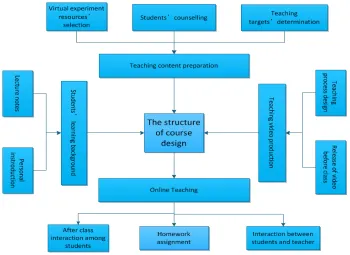
The course design is performed to improve the effect of teaching with virtual ex-periment. Fig 1. Shows the course design structure of online virtual experiments. There are three main components of the course design: teaching content preparation and production, online teaching process and after class interaction. The details of the process are described as follows.
2.1 Teaching content preparation and production
design is based on the virtual reality and multimedia technology. So, they need to ensure the effectiveness and completeness of the teaching video. It should be carried out in a flexible form through the design, the debugging, and the output final of virtu-al experiments. This will help to improve the students' interest in learning and to pre-sent students' abstract thought in an intuitive way. In addition this will ensure a prop-er, quick lead-in, a clear demonstration and a concise conclusion should be guaran-teed [13-14]. According to the actual teaching requirements, teachers can search on the web for concise video clips addressing the main principle between theory and virtual experiment, which can stimulate students' studying enthusiasm and broaden students' mind. Finally, the teachers need to choose the proper production tools con-sidering actual situation to produce virtual experiments' video.
Fig. 1. Course design structure of online virtual experiments
Various screen recorder software can be used to record the screen contents and voices inside or outside the computer. This method applies to multi-video clips, which ensures the fidelity of pictures and voices recorded.
2.2 Online teaching and after class interaction
web will be answered by the teacher. Question discussion and practice are the two important parts in the teaching of virtual experiments. Question discussion aims to solve common doubts of students. The teacher should create a free exchange situation for students and guide them to discuss. This flexible way is used to preliminarily convey the difficult teaching points. During this process, teacher needs to strengthen the organization and instruction of students’ group discussion as well as to enlarge their cognitive structure step by step in order to improve students’ ability.
To further enhance the effect of classroom teaching, students can exchange and communicate online with the teacher through the platform within specific time peri-ods. After-class Introspection and Interaction are important means to improve stu-dents' learning efficacy. After introspection, students can go on discussing what they have learnt in class on the internet, expressing their opinions and interacting with their teachers. To make the interaction more effective, the evaluation methods should be also more flexible and diverse. In addition to the traditional evaluation of teachers and teaching assistants, more peer assessment could be carried out. Peer assessment is very important in online education, which can develop the sense of cooperation in mutual evaluation.
The teacher should make full preparations and quantitative stand-ards of evaluation to facilitate the activities of mutual evaluation for carrying out smoothly. In the process of peer assessment, teachers or teaching assistants should guide, inspect and supervise the activities of the students' mutual evaluation through a variety of ways.The process evaluation and summative assessment should be com-bined in the online learning evaluation. The process evaluation mainly pays attention to the students' online learning during the course time, frequency and participation in the discussion and speech. Summative assessment is usually carried out in the final examination in which students can be divided into several online learning groups. Besides, students can upload the relevant video clips, which, after approved by their teacher, will be watched by other students for further discussion. Nowadays, SNS (Social Networking Services) have been widely used in communication among col-lege students. Therefore, students can share the micro-lesson video clips in various SNS to be learnt and discussed in a broader way.3
Learning Assessment of Virtual Experiment
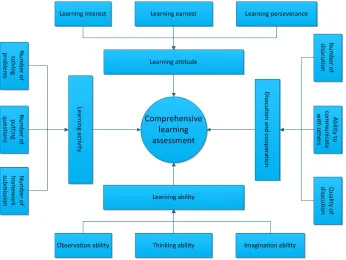
is the evaluation of the comprehensive learning performance. It can be divided into four main factors called the first level indexes. The four main factors are surrounding the main target as the figure shows, which are “learning attitude”, “learning activity”, “discussion and cooperation” and “learning ability” respectively. To evaluate the learning performance more delicate, we divide each first level index into four sub-factors are called the second level indexes. The sub-sub-factors are surrounding with the first level indexes, which are shown in the outermost periphery of Fig 2. Every index has the corresponding weight attributing to its different impact to the students’ behav-ior and each index has its own evaluation result called comment set.
Fig. 2. Various factors contributing to the learning assessment
For the convenience of the description, weight index set and comment set is pre-sented as follows: The first level index set is defined as U = {U1, U2, U3, U4} = {“learning attitude”, “learning activity “, “discussion and cooperation”, “learning ability”}, and the corresponding weight index set is defined as W= (W1, W2, W3, W4). The second level indicator set is defined as Ui= {ui1, ui2, ui3 }, (i=1, 2, 3,4). Mean-while, the corresponding weight index set is defined as Ai={ ai1, ai2, ai3 } which is often obtained by the comments of the related domain experts. The comment index set is defined as V={ V1,V2,V3,V4} ,which represents { Excellent ,good, middle, poor}. The whole evaluation procedure includes three steps and is shown as follows:
determined from the evaluation of the students for the distinguished index. For exam-ple, if there are 30 students thinking the second index U11 is “excellent” and the total number of the students is 100, the index U11 belongs to “excellent” would be 30/100=0.3.
The second step is fuzzy inference: the value of the first level indexes can be calcu-lated according to the value of the second level evaluation, which can be implemented by the fuzzy compound calculation between the membership degree of second level indexes and the weighted vectors given by the domain experts.
The third step is defuzzification: the result of the global evaluation can be calculat-ed from the first level evaluation, which can be implementcalculat-ed through the fuzzy com-pound calculation between the first level indicator membership and the global weighted vector.
4
Result Analysis and Discussion
We take the "digital electronic technology" course as an example to show the de-sign of the virtual experiments. The target is to improve the teaching results of the “Virtual Experiments” in the online environment, utilizing the interaction between the course design and the learning evaluation. The course design of virtual experiments is based on the learning evaluation, meanwhile the good evaluation method can give positive feedback for the course design. The design task is to implement a specific experiment effectively and the evaluation of the student's design is based on both the peer assessment among students and the teacher’s assessment. Though the fuzzy evaluation results can only give students comprehensive quality evaluation of the developed solutions, but there is an important step in the process of evaluation called peer assessment which can help students to obtain positive feedbacks through com-parison to improve their designs. To stimulate students’ creativity, there is a reference design in the teacher’s side, but there isn’t the best design in the students’ side. Stu-dents need to try their best to find better experiment design.
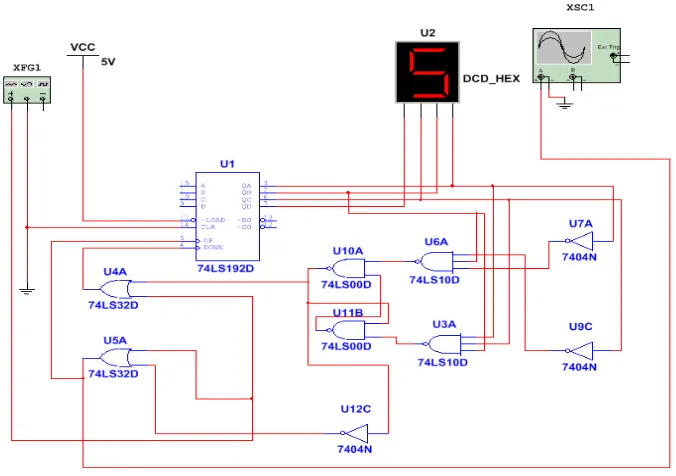
Fig. 3. A case of virtual experiment
A design case of a comprehensive experiment is selected as one micro lesson and the reference design is shown in Fig 3, which is designed based on Multisim. Before this comprehensive experiment would be carried out, it is supposed that students have completed such simple examples as counter and trigger. The comprehensive experi-ment is the integration of above simple experiexperi-ments which can be realized by the combination of counter 74LS192D and basic trigger. At the same time, students can make use of the advantages of virtual experiments and explore the output diversity in the virtual experiment platform. For example, the results of the experiment can be shown by the virtual LED display. Meanwhile, the virtual oscilloscope can be used to observe pin signal of the virtual device. After the students have completed this com-prehensive experiment through online operation in the fixed time, the fuzzy evalua-tion method could be used to assess students’ performance, which is shown in the next section.
4.1 Experiment design
students as well as the age and physical quality. To analyze the experimental data, SPSS13.0 statistical software and Microsoft Excel 2010 software were used. Be-sides, the fuzzy comprehensive evaluation was applied to implement the final learn-ing achievement assessment.
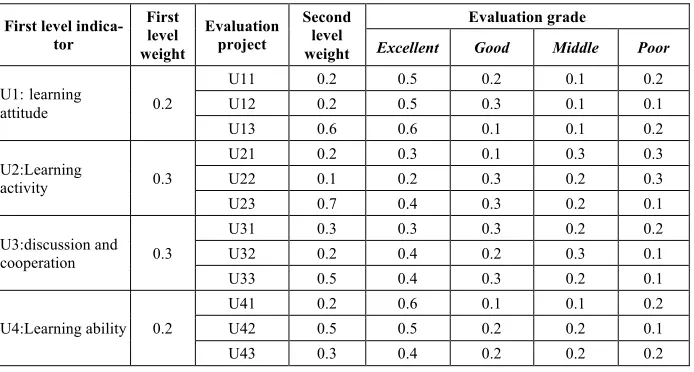
Table 1. The evaluation of the various learning behaviors
First level indica-tor First level weight Evaluation project Second level weight Evaluation grade
Excellent Good Middle Poor
U1:learning
attitude 0.2
U11 0.2 0.5 0.2 0.1 0.2 U12 0.2 0.5 0.3 0.1 0.1 U13 0.6 0.6 0.1 0.1 0.2
U2:Learning
activity 0.3
U21 0.2 0.3 0.1 0.3 0.3 U22 0.1 0.2 0.3 0.2 0.3 U23 0.7 0.4 0.3 0.2 0.1
U3:discussion and cooperation 0.3
U31 0.3 0.3 0.3 0.2 0.2 U32 0.2 0.4 0.2 0.3 0.1 U33 0.5 0.4 0.3 0.2 0.1
U4:Learning ability 0.2
U41 0.2 0.6 0.1 0.1 0.2 U42 0.5 0.5 0.2 0.2 0.1 U43 0.3 0.4 0.2 0.2 0.2
4.2 Results
Table 1 shows the evaluation of a certain student in the various learning behaviors, which are the statistical results of the questionnaire survey about the learning behav-iors. According to the model we have set up in the last section, the global evaluation set is {V1,V2,V3,V4}={ Excellent, good, middle, poor}, which are corresponding to the first level indexes Ui (i=1,2,3,4)={“learning attitude”, “learning activity”, “discus-sion and cooperation”, “learning ability”}. The weights of the second level indexes are also listed in Table 1, in which each first level index is decomposed into the four second level indexes. For example: the first level index U1 “learning attitude” are decomposed into four second level indexes {u11, u12, u13, u14}. The result of the first level evaluation can be inferred from the second level indexes and the value of the second level indexes are determined based on the mutual comments of students and the learning records on the platform.
The evaluation matrix of the second level indexes is shown as equations (1) and (2), which means the membership degree of the second level indexes belonging to the comment set {V1,V2,V3,V4}={ Excellent , good, middle, poor}:
!!! !!! !!!!!! !!! !!!!!! !!!!!! !!! !!! !!! !!! ! !!!
!!! !!!
!!! !!! !!!!!! !!!!!!
!!! !!! !!!!!! !!! !!! !!!!!! !!! !!! !!! !!! !!! ! !!!
!!! !!!
!!! !!! !!! !!!!!! !!!
!!! !!! !!! !!! ! (2)
The weighted vectors of the second level indexes are represented as equations (3~7), which mean the importance degree of the second level indexes relative to the first level indexes. This can be obtained according to Table 1, which is determined by the related domain experts. Because there are four second level indexes and four cor-responding weighted vectors, which are shown as follows:
!!! !!! !!! !!! (3)
!!! !!! !!! !!! (4)
!!! !!! !!! !!! (5)
!!! !!! !!! !!! (6)
The second step is fuzzy inference. The fuzzy compound calculation is selected to infer the first level indexes according to the second level indexes, which is shown in equation (7).
!!! !!!!!! !!!! !!! !!"! ! !"#!!!!!!!"#!!!! !!"!! (7) The four first level indexes can be inferred according to equations (1~7):
!!! !!!!!! !!! !!! !!! !
!!! !!!
!!! !!! !!!!!! !!!!!!
!!! !!! !!! !!! (8)
! !!! !!! !!! !!!
!!! !!!!!! !!! !!! !!! !
!!! !!!
!!! !!! !!! !!!!!! !!!
!!! !!! !!! !!! (9)
! !!! !!! !!! !!!
!!! !!!!!! !!! !!! !!! ! !!!!!! !!!!!! !!! !!!!!! !!!
!!! !!! !!! !!! (10)
! !!! !!! !!! !!!
!!!!!!!!! !!! !!! !!! !
!!! !!!
!!! !!! !!! !!!!!! !!!
!!! !!! !!! !!! (11)
! !!! !!! !!! !!!
Fig. 4. The evaluation of the “learning attitude”
Fig. 5. The evaluation of the “Learning activity”
Fig. 6. the evaluation of the “discussion and cooperation”
Fig. 7. the evaluation of the “learning ability”
#$ #%&$ #%'$ #%($ #%)$
#$ #%&$ #%'$ #%($
#$ #%*$ #%&$ #%+$ #%'$ #%,$
The last step is defuzzification, which is implemented according to the four first lev-el indexes results. The global evaluation matrix is determined according to the four first level indexes:
! !
!!! !!!
!!! !!! !!!!!! !!!!!! !!! !!!
!!! !!! !!!!!! !!!!!!
! (11)
Because the first level weight vector is:
! ! !!! !!! !!! !!! (12)
And the global evaluation vector can be calculated:
!! !!! ! !!! !!! !!! !!! !
!!! !!!
!!! !!! !!!!!! !!!!!! !!! !!!
!!! !!! !!! !!!! !!!!!
(13)
! !!! !!! !!! !!!
The final evaluation value can be calculated from the global evaluation vector, which is implemented based on equation (14), in which j represents the grade score and !! is the corresponding weight:
!"#$%&$%'( ! !!!!!!!!
!!! !
!!! !
!!!!!!!!!!!!!!!!!!!!!
!!!!!!!!!!!!!!! ! !!! (14)
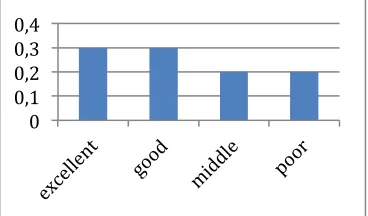
According to the final results, we draw a figure to describe the result as shown in Fig 8. Apparently, we can get a conclusion that the global evaluation is: The percent-ages of “excellent” and “good” are both 30%, the percentpercent-ages of “middle” and “poor” are both 20%. The top-grade score is 4, which means “excellent”, and the worst grade score is 1, which means “poor”. This student’s grade score is 2.7, which can be calcu-lated based on equation (14). The score of centesimal grade is 2.7/4*100=67.5. The result is convenient to decide the students’ learning performance on the online plat-form.
Fig. 8. Assessment of learning performance utilizing fuzzy comprehensive method
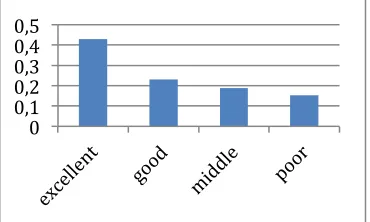
Another evaluation method is called the Simple Additive Weighting (SAW) that is selected for comparison. SAW [15] is a simple and widely used multi attribute deci-sion method. The method is based on the weighted linear combination and an evalua-tion score is calculated for each student by multiplying the weighted value given to his attribute. Fig 9 shows the comprehensive evaluation of learning performance uti-lizing SAW and applying the same indicator and the corresponding weight which is shown in Table 1.
Fig. 9. The comprehensive evaluation of learning performance utilizing SAW
The disadvantage of SAW is it's proportional linear transformation of the raw data. However, there isn’t a linear connection between the learning performance and as-sessment indicators. SAW ignores the fuzziness of experts’ judgment during the deci-sion-making process. Besides, some criteria could have an uncertain structure which cannot be measured precisely. Fuzzy evaluation can deal with fuzzy objects and make a more scientific, reasonable and practical quantitative evaluation.
5
Conclusion
Online learning of virtual experiments can help students to integrate knowledge from several discipline areas and to understand the relationship between theory and practice. In addition, it is important to evaluate the learning performance, which is an important guidance for both students and teachers. Therefore, an excellent evaluation method of learning performance is indispensable to guarantee a high quality educa-tional experience. This paper addressed the key points in the course design of virtual experiments. It also proposed an effective evaluation method targeted to identify students’ learning achievements according to their distinguished learning performance based on fuzzy comprehensive evaluation. This evaluation method is advantageous to handle uncertain information full of vagueness, uncertainty and subjectivity. As a result it will be more significant to improve students’ learning autonomy and the abil-ity of combining theory with practice, which can improve their learning efficiency greatly. Future work will consider the implementation of hybrid online labs and the corresponding evaluation method.
6
Acknowledgment
The paper was granted by the key research project of natural science of Anhui Pro-vincial Department of Education (KJ2017A354) and Quality Engineering of Anhui Provincial Higher Education (2016jyxm0621).
7
References
[1]Ji, Z. H. (2016). Application and Empirical Investigation of New MOOC Teaching System in Computer Application Course, International Journal of Emerging Technologies in Learning, 11: 62-67. https://doi.org/10.3991/ijet.v11i05.5696
[2]Koutroloulus, A. (2014). What Tweets Tell us About MOOC Participation. International Journal of Emerging Technologies in Learning, 9: 8-21. https://doi.org/10.3991/ ijet.v9i1.3316
[3]Wahed, A. M. and Nagy, Z. K. (2013). Developing the TriLab, a Triple Access Mode (Hands-On, Virtual, Remote) Laboratory, of a Process Control Rig Using LabVIEW and Joomla. Computer Applications in Engineering Education, 21(4): 614–626. https://doi.org/10.1002/cae.20506
[4]Restivo, M. T., Mendes, J., Lopes, A. M., Silva, C. M. and Chouzal, F. A. (2009). Remote Laboratory in Engineering Measurement. IEEE Transactions on industrial electronics, 56(12): 4836-4843. https://doi.org/10.1109/TIE.2008.2011479
[5]Al-Zahrani, F. (2010). Web-Based Learning and Training for Virtual Metrology Lab. Journal of Telecommunications, 1(2):42-54.
[6]Shimei, Li. and Qinglan, H. (2008). The Research on Colleague Teacher's Comprehensive Performance Evaluation Based on AHP Model [J]. Journal of Beijing Institute of Educa-tion (natural science ediEduca-tion), 3(5): 21-27.
[7]Hong, M. (2010). Evaluation of teaching quality by using grey trend correlation method [J]. Journal of Wuhan University of Technology, 32(15): 181-185.
[8]Chunyan, D., Zhengwu, W. and Rping, Z. (2005). A comprehensive evaluation of the qual-ity of classroom teaching based on neural network [J]. College Mathematics, 21 (3): 1-5. [9]Prosser, M. and Trigwell, K. (1991). Student evaluations of teaching and courses: Student
learning approaches and outcomes as criteria of validity. Contemporary Educational Psy-chology, 16: 293-301. https://doi.org/10.1016/0361-476X(91)90029-K
[10]Shah, A. D., Ladhake, S. A. (2013). Multi User feedback system based on performance and appraisal using Fuzzy logic decision support system. International journal for engi-neering applications and technology (IJFEAT)- issues 2(1):10.
[11]Bai, S. M. and Chen, S. M. (2008a). Automatically constructing grade membership func-tions of fuzzy rules for students’ evaluation. Expert Systems with Applicafunc-tions, 35(3): 1408–1414. https://doi.org/10.1016/j.eswa.2007.08.022
[12]Bai, S. M. and Chen, S. M. (2008b). Evaluating students’ learning achievement using fuzzy membership functions and fuzzy rules. Expert Systems with Applications, 34: 399– 410. https://doi.org/10.1016/j.eswa.2006.09.010
[13]Gaudin, C. and Chalies, S. (2015). Video viewing in teacher education and professional development: a literature review [J]. Educational Research Review, 2015, 16:41-67. https://doi.org/10.1016/j.edurev.2015.06.001
[15]Kaliszewski, I, and Podkopaev, D. (2016). Simple additive weighting-A metamodel for multiple criteria decision analysis methods [J]. Expert Systems with Applications, 155-161. https://doi.org/10.1016/j.eswa.2016.01.042
8
Authors
Dong Xiaoming is currently the associate Professor at School of Computer and In-formation, Anqing Normal University, Anqing, Anhui, China. He received his B.Sc. in Electrical Engineering and Automation from University of Beijing science and technology in China. He received his M.Sc. from Beijing science and Technology University in China. He received his PhD from Institute of Automation, Chinese Academy of Sciences. His research interest fields include machine vision, pattern recognition, wireless sensor networks.
Chen Zhuo (corresponding author) is currently the lecturer at School of Chinese Language and Literature, Anqing Normal University, Anqing, Anhui, China. Her research interest fields include teacher skill training, Microteaching.