Optimization and test for structural parameters of UAV spraying
rotary cup atomizer
Zhou Qingqing
,
Xue Xinyu
*,
Qin Weicai
,
Cai Chen
,
Zhou Liangfu
(Nanjing Research Institute for Agriculture Mechanization, Ministry of Agriculture, Nanjing 210014, China)
Abstract: Small unmanned aerial vehicle (UAV) pesticide application technology is developing rapidly in China. However, the spray efficiency of UAV sprayer is not stable, one important reason is that the lack of specialized aviation nozzle. Rotary cup atomizer is not easily to be blocked and has broad application foreground in UAV spray. In order to obtain good spraying quality and narrow droplet spectrum aviation spraying centrifugal nozzle, the impacts of rotary cup atomizer structural parameters on atomization property were studied. In this research, a centrifugal atomization test device was designed, on which a frequency converter was used to adjust the rotary speed, and a return valve was used to stabilize the flow rate and pressure of spray liquid. The droplet volume medium diameter (VMD) and droplet spectrum relative width (SRW) were tested by using laser particle analyzer and particle analysis system. The analysis results of variance and quadratic regression orthogonal test were used to optimize the structural parameters of rotary cup atomizer. The influences of rotary cup atomizer structural parameters on atomization property, such as groove shape, diameter, teeth number, cone angle and height were evaluated and analyzed by conducting single-factor test. The results showed that: the best optimized rotary groove shape was square, diameter and teeth number had significant effects on droplet VMD and SRW, while cone angle had no effect on the droplet VMD and SRW, height affected droplet VMDbut did not affect droplet SRW. Therefore, diameter and teeth number were selected as the variables of quadratic regression orthogonal test, droplet VMD and SRW regression model was established by using response surface analysis method. The optimized structural parameters respectively were: groove shape square, cone angle 60°, height 20 mm, diameter 61.5 mm and teeth number 149. Droplet VMD and SRW simulation value respectively were 200 μm and 0.562. The differences between simulation value and test value were 0.68% and 9.90% respectively, indicating that the regression model is accurate. The research result can provide a reference for further optimizing the structure parameters of rotary cup atomizer to meet the requirement of UAV spraying.
Keywords: rotary cup atomizer, atomization, droplet VMD, droplet SRW, optimization, mathematical model, response surface DOI: 10.3965/j.ijabe.20171003.3119
Citation: Zhou Q Q, Xue X Y, Qin W C, Cai C, Zhou L F. Optimization and test for structural parameters of UAV spraying rotary cup atomizer. Int J Agric & Biol Eng, 2017; 10(3): 78–86.
1 Introduction
Small unmanned aerial vehicle (UAV) pesticide
Received date: 2016-11-05 Accepted date: 2017-04-10 Biographies: Zhou Qingqing, MS, research interest: precise pesticide spraying, Email: [email protected]; Qin Weicai, MS, research interest: precise pesticide spraying, Email: [email protected]; Cai Chen, MS, research interest: precise pesticide spraying, Email: [email protected]; Zhou Liangfu, MS, research interest: precise pesticide spraying, Email: [email protected].
*Corresponding author: Xue Xinyu, PhD, Professor, research interests: crop protection and machinery engineering. Nanjing Research Institute for Agricultural Mechanization, Ministry of Agriculture, Nanjing 210014, China. Tel: 86-25-84346243, Email: [email protected].
application technology is developing rapidly in China because of its high working efficiency and easy operation. However, the spray efficiency of UAV sprayer is not stable for its uneven deposition distribution and high drift risk of aviation spraying. Pesticide drift and uneven deposition distribution lead to the low pesticide usage, terrible environmental pollution and high pesticide
residues[1-3]. The atomization performances of nozzle,
distribution is easier to control the droplet deposition and will also improve the utilization of pesticides[6,7]. Since centrifugal atomizing nozzle can atomize viscous liquid and is no easily to be blocked, it is currently widely used in low volume applications of aviation spraying field[8-11]. Therefore, optimizing the rotary cup structure parameters to obtain the narrow droplet spectrum can provide a way to increase the amount of spray deposition and reduce drift.
Some scholars analyzed atomization principle of
centrifugal atomizing nozzle theoretically[12]. The
atomization process was revealed and some theoretical formulas were obtained. Some scholars researched the atomization performance of centrifugal atomizing nozzle
by conducting experiments. Hooper and Spurgin[13]
used laser particle size analyzer (one of the most widely recognized tools in testing particle size) to study the influences of speeds and flow volumes in the wind tunnel test chamber on wind-wheel-drive cage nozzle droplet diameter curves. Malvenrn 2600/3600 droplet laser analyzer was used to study droplet volume distribution
and droplet number distribution of nozzle[14]. Craig et
al.[15] used high-speed camera and laser particle size
analyzer to study the atomization of rotary nozzle, and found that the nozzle outer edge of the tines could increase the consistency of droplet size. Ahmed and
Youssef[16] used a phase Doppler particle analyzer (PDPA)
to get a solution that rotary cup atomizer’s atomization performance was superior than rotary disk.
Most articles focused on the optimization of rotary speed and flow rate parameters. Rotary speed and flow rate do have a significant effect on the atomization performance. But in the fixed rotary speed and flow rate circumstances, the structural parameters of the centrifugal atomizing nozzle have not been studied systematically.
The rotary atomizer used in UAV currently is Micron’s production, mainly for hand-held ultra-low volume spray. The flow rate is less than 200 mL/min, speed is about 5000 r/min, and the droplet diameter is about 100 μm. It cannot completely meet the requirements
of UAV spraying, since UAV spraying is a high-altitude, high-speed and low-volume application. Aviation low volume spray requires 100-300 μm droplet size[11,17], and
the narrower droplet spectrum, the better. The working conditions are flow rate 700 mL/min and rotating speed 3600 r/min. The indicators are droplet volume medium
diameter (VMD, D50) and droplet spectrum relative width
(SRW, (D90–D10)/D50). In this research, firstly, the
groove shape was changed and optimized by using variance analysis. Secondly, the diameter, number of teeth, cone angle and height were changed individually based on optimized groove shape, the influence of droplet VMD and SRW were studied. Finally, the structural parameters that had significant influences on droplet VMD and SRW were selected as quadratic regression test factors. At last the droplet VMD and SRW regression models were obtained. Rotary atomizer structure optimization can obtain the narrow droplet spectrum rotary atomizer and provide reference for improving the quality of aviation spray.
2 Structure and working principle of rotary
cup atomizer
2.1 Structure
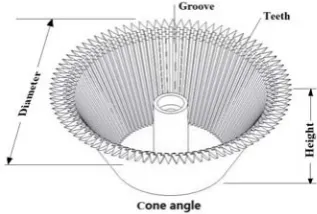
Rotary cup atomizer is different from rotary disk atomizer nozzle, it is a conical nozzle that has a certain height and cone angle, the model is ULVA +, produced by the British micron sprayers Limited (Micron Sprayers Ltd.). Rotary cup is the main working part of the rotary cup atomizer, its reference structural shape is shown in Figure 1, the shape of groove and tooth tip is equilateral triangle, cup diameter is 50 mm, the teeth/grooves number is 180, rotor cone angle is 60°, and the height is 20 mm. In the following optimization test, the change of rotary cup structure is on the basis of the reference rotary cup structure. These cups were made by using 3D printer, the material is photosensitive resin and
manufacturing precision is 100 μm.
2.2 Calculation of film thickness
The process of centrifugal nozzle’s liquid silk spray is divided into three steps: firstly, liquid is spread into thin film on the rotating cup, then the liquid filaments form on the edges of sharp teeth, finally liquid filaments break and form droplet[16,18]. The liquid flow of rotary cup surface is an axisymmetric swirl flow. According to polar coordinates hydrodynamics incompressible, Newtonian fluid quality conservation and momentum conservation laws, the following Equations (1) and (2) can be given[19]:
1
( ) 0
r r
u u
u
r r r θ
ρ ρ ρ
θ
∂ ∂
+ + =
∂ ∂ (1)
2
2 2
1
r r r
r z
r r r
u u
u u u p
u u
r r r z r
u u u
r r r z
θ θ θ ρ μ ρ ∂ + ∂ − + ∂ = − ∂ ∂ ∂ ∂ ∂ ⎡∂ ⎛ ∂ ⎞ ∂ ⎤ + ⎢ ⎜ + ⎟+ ⎥ ∂ ⎝ ∂ ⎠ ∂ ⎣ ⎦ (2)
where, ρ is the liquid density, kg/m3; r is the radius of the rotary cup, m; uris the radial velocity, m/s; uz is the axial
velocity, m/s; uθ is the tangential velocity, m/s.
Since the flow pattern of liquid on surface of the rotary cup is not slip flow, boundary condition is liquid-gas, interface pressure is approximately 0, joint rotary cup nozzle flow calculation Equation (3), we can get the rotary edge film thickness as Equation (4):
2
0 0 0
2
r r
Q u rd dz u rdz
π δ δ
θ π
=
∫ ∫
=∫
(3)1/3 2 2 3 2 Q r μ δ
π ω ρ
⎛ ⎞
= ⎜ ⎟
⎝ ⎠ (4)
where, δ is film thickness, m; μ is fluid kinematic
viscosity coefficient, N·s/m2; Q is flow rate, m3/s.
Liquid parameters and rotary cup parameters are shown in Table 1.
Table 1 Fluid parameters and rotary cup parameters
Name Value Name Value
Liquid viscosity μ/N·s·m-2 0.001 Liquid density ρ/kg·m-3 1000 Rotating speed ω/rad·s-1 376.8 Flow rate Q/m3·s-1 11.67×10⁻⁶ Radius r/mm 25
The impacts of the groove, teeth, cone angle, height and other parameters on the atomization performance are ignored in simplified hydrodynamic model. The groove and the sharp teeth have the function of draining and diversion liquid, so they can increase the adhesion of liquid inside the rotor. Cone angle and height can
influence the contact length of liquid with the rotor wall, thus affect the atomization performance. Therefore, studying the atomization performance influenced by rotor groove shape, diameter, number of teeth, and the height of the cone angle, can give a technical support to improve the rotary atomizing fluid model.
3 Atomization quality test
3.1 Test instruments and equipment
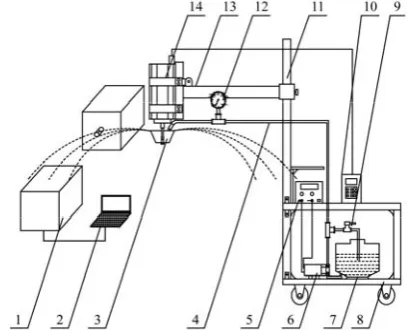
In this research, the centrifugal atomization test platform was designed, the motor speed was adjusted by using a frequency modulator, and the spray liquid flow rate and pressure were steadied by using a return valve. The test equipment is shown in Figure 2. The centrifugal atomization test platform consists of a centrifugal atomization device, a liquid supply system and a droplet size testing system. Centrifugal atomization device includes a spindle motor (Model: TDK65-0.8F- 24k, maximum zero-load speed 24 000 r/min), a frequency modulator (model: FC300-2.2G-T4-B3, output frequency 0-1000 Hz), a support platform. Liquid supply system consists of a diaphragm pump (rated pressure 12 V, maximum flow rate 2800 mL/min), DC power supply (voltage adjustable range 0-30 V, current measurement range 0-3 A), return valve, pressure gauge (measurement range 0-1 MPa). Droplet size test system consist of a laser particle size analyzer (Model: DP-02,
measuring range 0.1-1500 μm, Zhuhai OMC Instrument
Co., Ltd.) and laser particle size analysis system.
Note: 1. Laser particle size analyzer 2. Laser particle analyzer system 3. Rotary cup atomizer 4. Pipeline 5. DC power 6. Diaphragm pump 7. Tank
8. Support platform 9. Return valve 10. Frequency modulator 11. Lifter 12. Pressure gage 13. Rail 14. Spindle motor
3.2 Atomization performance evaluation
Droplet SRW is the reaction of the droplet size concentration degree, the narrower droplet spectrum, the more concentrated droplet size distribution is, which means that the droplet differential distribution is steeper. Narrow droplet spectrum, which is called controllable droplet, will improve deposition rate and reduce drift in
spraying. Droplet VMD (D50) represents the sum of all
the droplet volumes that smaller than this droplet diameter, which takes up 50% of the total volume of the sample droplet particles, it can be used to characterize
droplet diameter. Droplet SRW ((D90–D10)/D50)
indicates the degree of differential droplet size distribution concentration, the smaller the value, the better[13]. Since sample droplets accumulate form small to large, D10 and D90 respectively present the sum of all the droplet volumes that smaller than this droplet diameter, which take up 10% and 90% of the total volume of the sample droplet particles. In this paper, the droplet VMD (D50) and droplet SRW ((D90–D10)/D50) are indicators of atomization quality, and the droplet SRW is the main assessment indicator.
3.3 Test methods and conditions
Laser particle analyzer outputs D50, D10, D90 and the particle size differential distribution curves. Under most UAV spray operating conditions, application liquid
amount is 15 L/hm2, flight speed is about 3 m/s, UAV
spray width is about 5 m, there are two nozzles installed on the aircraft. So the rotary cup atomizer’s flow rate is
set to 700 mL/min[8,11], the rotary speed is 3600 r/min,
under these working conditions, the droplet differential distribution is stable unimodal distribution. The rotary cup was installed horizontally, and rotary cup outlet edge is 300 mm horizontal far from the laser, and is 20 mm vertically above the laser. Since the droplet size changes with the direction of the droplets tangent motion[21-23], according to the droplet trajectory analysis, the number of droplets measured at this sample point is larger, so we can get more accurate droplet size. Laboratory average temperature is (25±5)°C, relative humidity is (70±5)%, and the measure medium of experiment is water.
3.4 Experimental design
3.4.1 Effects of groove shape on atomization performance On the basis of reference rotary cup structure, the
shape of the groove was changed and six rotary cups with different groove shapes were designed, the groove shapes respectively are triangular, square, oblique, cylindrical, only with the teeth tip and smooth disk.
3.4.2 Effects of rotary cup structural parameters on the atomization performance
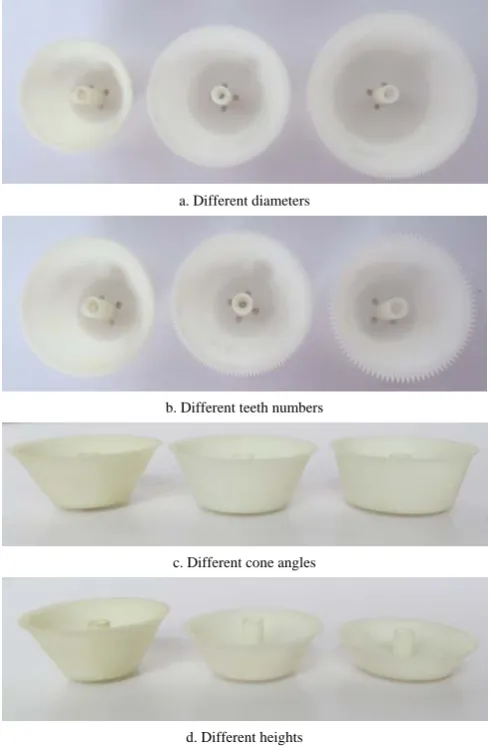
On the basis of the determined shape of the groove, according to the analysis of section “4.1 Optimization of the groove shape”, the groove shape is square. On the basis of rotary cup reference structure, the other structure parameters were fixed, and single structure parameter was varied one by one. For example, on the basis of teeth number 180, cone angle 60°, height 20 mm, change the rotary cup diameter, and design three cups with different diameters. Four sets of rotary cups were designed, the parameters were: diameter of 50 mm, 60 mm and 70 mm; teeth number of 180, 120 and 90 and the teeth number was equal to the groove number; cone angle of 60°, 45° and 30°; height of 20 mm, 15 mm and 10 mm, as shown in Figure 3.
a. Different diameters
b. Different teeth numbers
c. Different cone angles
d. Different heights
3.4.3 Atomization model test
According to the analytical results of atomization performance effected by rotary cup structural parameters, in order to obtain a narrow droplet spectrum rotary cup atomizer, diameter and teeth number, which have significant effects on droplet VMD and SRW, were chosen as two impact factors of quadratic regression design, i.e., on the basis of the square groove shape and basic taper angle 60°, basic height 20 mm, changed the diameter and teeth number. Nine rotary cups with different diameters and teeth number were designed. The factor level encoding parameters of quadratic regression experiment are shown in Table 2.
Table 2 Factors and levels of quadratic regression experiment
design (p=2)
Factors Level
Diameter/mm Teeth number
–1.414 50 80
–1 53.8 95
0 63 130
1 72.2 165
1.414 76 180
4 Test results and analysis
4.1 Optimization of groove shape
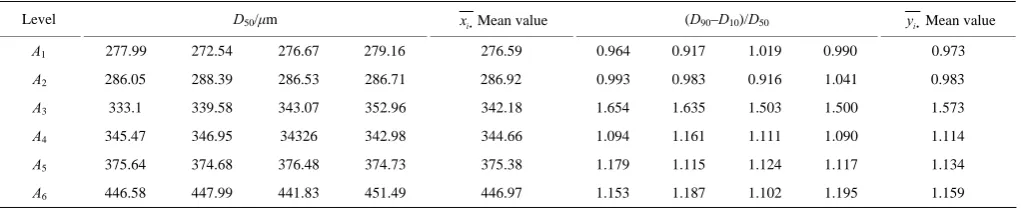
The droplet VMD (D50) and the droplet SRW
((D90–D10)/D50) of six rotary cups with different groove
shape are reported in Table 3. The analysis of variance was done by using SAS 9.2 statistical analysis software.
The mean comparison was done by using the least significant difference method, and the significance level
P is 0.05, the results of variance analysis and mean
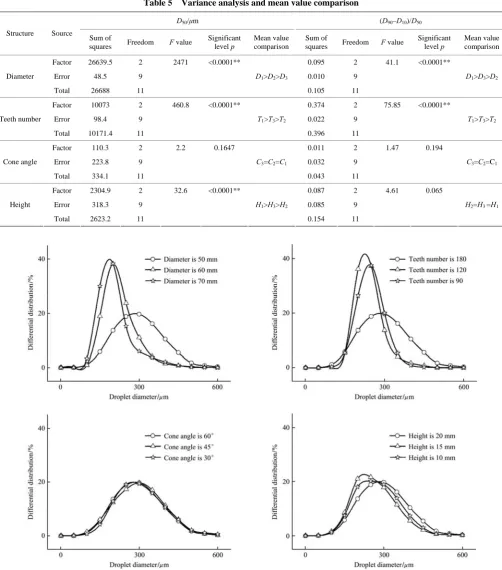
comparison of droplet VMD and SRW are shown in Table 4. The droplet VMD and SRW variance analysis and means comparison of different diameter, teeth number, cone angle and height are shown in Table 5.
According to the results of variance analysis and mean comparison, the droplet VMD in ascending order are: square, triangle, cylindrical, oblique, only with teeth tip and smooth disk. Droplet SRW in ascending order are: square, triangle, oblique, only with teeth tip, smooth disk and cylindrical. This indicates that the grooves and tooth tip play a role of drainage and diversion, and impact the droplet VMD and SRW. The square groove shape has the narrowest droplet SRW. Finally the optimizing result of groove shape is square.
4.2 Effects of rotary cup structure parameters on
atomization performance
According to test report of laser particle size analyzer, the particle size differential distribution curves of rotary cups with different structure were obtained. The particle size differential distribution was graded with step of
50 μm, the droplet size frequencies of each 50 μm step
within 0-600 μm particle size range were recorded, and
the differential distribution curve was drawn again. The droplet size distribution curves are shown in Figure 4.
Table 3 Droplet VMD and SRW of six rotary cups with different groove shapes
Level D50/μm xiiMean value (D90–D10)/D50 yiiMean value A1 277.99 272.54 276.67 279.16 276.59 0.964 0.917 1.019 0.990 0.973 A2 286.05 288.39 286.53 286.71 286.92 0.993 0.983 0.916 1.041 0.983 A3 333.1 339.58 343.07 352.96 342.18 1.654 1.635 1.503 1.500 1.573 A4 345.47 346.95 34326 342.98 344.66 1.094 1.161 1.111 1.090 1.114 A5 375.64 374.68 376.48 374.73 375.38 1.179 1.115 1.124 1.117 1.134 A6 446.58 447.99 441.83 451.49 446.97 1.153 1.187 1.102 1.195 1.159
Note: A1-A6 are triangle groove, square groove,cylindrical groove, serrated groove, only have teeth and smooth cup respectively, the same as below.
Table 4 Variance analysis and mean value comparison
D50/μm (D90–D10)/D50
Source
Sum of
Squares Freedom F value
Significant
level p Mean value comparison
Sum of
Squares Freedom F value
Significant
level p Mean value comparison Factor A 77526 5 945.41 <0.0001** 0.959 5 75.78 <0.0001**
Pure Error 295.2 18 0.045 18
Cor. Total 77821 23
A6>A5>A4=
A3> A2>A1
1.004 23
A3>A6=A5=
Table 5 Variance analysis and mean value comparison
D50/μm (D90–D10)/D50
Structure Source Sum of
squares Freedom F value
Significant level p
Mean value comparison
Sum of
squares Freedom F value
Significant level p
Mean value comparison Factor 26639.5 2 2471 <0.0001** 0.095 2 41.1 <0.0001**
Error 48.5 9 0.010 9
Diameter
Total 26688 11
D1>D2>D3
0.105 11
D1>D3>D2
Factor 10073 2 460.8 <0.0001** 0.374 2 75.85 <0.0001**
Error 98.4 9 0.022 9
Teeth number
Total 10171.4 11
T1>T3>T2
0.396 11
T1>T3>T2
Factor 110.3 2 2.2 0.1647 0.011 2 1.47 0.194
Error 223.8 9 0.032 9
Cone angle
Total 334.1 11
C3=C2=C1
0.043 11
C3=C2=C1
Factor 2304.9 2 32.6 <0.0001** 0.087 2 4.61 0.065
Error 318.3 9 0.085 9
Height
Total 2623.2 11
H1>H3>H2
0.154 11
H2=H3 =H1
Note: D1-D3 are rotary cup with diameters of 50 mm, 60 mm and 70 mm, respectively; T1-T3 are rotary cup with teeth numbers of 180, 120 and 90, respectively; C1-C3
are rotary cup with cone angles of 60°, 45° and 30°, respectively; H1-H3 are rotary cup with heights of 20 mm, 15 mm and 10 mm, respectively, the same below.
Figure 4 Droplets distribution of rotary cup atomizers with different diameters, teeth numbers, cone angles and heights
According to the droplet size differential distribution curve, analysis of variance and mean comparison, the diameter and teeth number had a significant influence on droplet VMD and SRW, while cone angle and height had a smaller impact. Droplet VMD and SRW decreased with the increase of diameter, the droplet SRW was
4.3 Atomization model
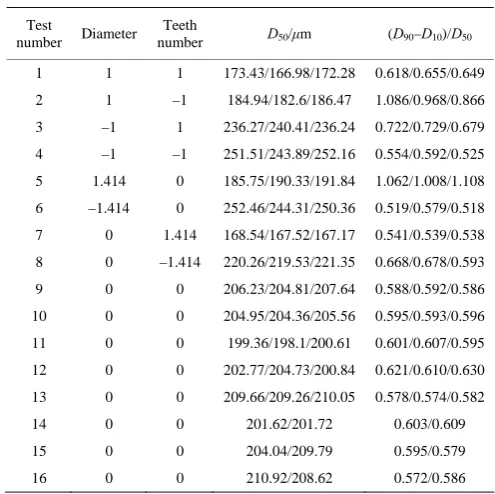
In order to obtain a narrow droplet spectrum centrifugal nozzle, regardless of cone angle and height, diameter and teeth number were chosen as two factors of quadratic regression analysis. Each factor had five levels in quadratic regression test, the total test points were nine, each test point was repeated three times, and the center test point was repeated 21 times. The test results of droplet VMD and SRW are reported in Table 6.
Response surface analysis was done by using SAS 9.2 statistical analysis software, quadratic regression models
of droplet VMD Y1 and droplet SRW Y2 were obtained.
Two regression models’ significant determination
coefficient R2 were 0.803 and 0.897 respectively, it
means that the regression equations fit well. The significance of regression coefficient are shown in Table 7, it is obvious that the cross term between diameter and
teeth number is very significant, indicating that there is a strong interaction between the two factors.
Table 6 Experimental levels and results of quadratic
Test
number Diameter Teeth
number D50/μm (D90–D10)/D50
1 1 1 173.43/166.98/172.28 0.618/0.655/0.649 2 1 –1 184.94/182.6/186.47 1.086/0.968/0.866 3 –1 1 236.27/240.41/236.24 0.722/0.729/0.679 4 –1 –1 251.51/243.89/252.16 0.554/0.592/0.525 5 1.414 0 185.75/190.33/191.84 1.062/1.008/1.108 6 –1.414 0 252.46/244.31/250.36 0.519/0.579/0.518 7 0 1.414 168.54/167.52/167.17 0.541/0.539/0.538 8 0 –1.414 220.26/219.53/221.35 0.668/0.678/0.593 9 0 0 206.23/204.81/207.64 0.588/0.592/0.586 10 0 0 204.95/204.36/205.56 0.595/0.593/0.596 11 0 0 199.36/198.1/200.61 0.601/0.607/0.595 12 0 0 202.77/204.73/200.84 0.621/0.610/0.630 13 0 0 209.66/209.26/210.05 0.578/0.574/0.582 14 0 0 201.62/201.72 0.603/0.609 15 0 0 204.04/209.79 0.595/0.579 16 0 0 210.92/208.62 0.572/0.586
Table 7 Significance test for regression coefficient of droplet size
D50/μm (D90–D10)/D50
Source
Coefficient Estimates Freedom t value Significant level p Coefficient Estimates Freedom t value Significant level p
Intercept 205.03 1 123.60 <0.0001** 0.595 1 52.36 <0.0001**
d –38.14 1 –17.38 <0.0001** 0.191 1 12.74 <0.0001**
n –17.63 1 –8.04 <0.0001** –0.059 1 –3.89 0.0004**
d2 16.13 1 5.11 <0.0001** 0.216 1 10.00 <0.0001** d* n –1.11 1 –0.25 0.8011 –0.243 1 –8.08 <0.0001**
n2
–8.98 1 –2.84 0.0071** 0.010 1 0.47 0.6422 Note: p<0.01 (highly significant, **: p<0.05 (significant, *).
The regression results are shown as Equations (5) and (6).
2 1
2
=205.03 38.14 17.63 16.13
1.11 8.98
c c c
c c c
Y d n d
d n n
− − + −
⋅ − (5)
2 2
2
=0.595 0.191 0.059 0.216
0.243 0.01
c c c
c c c
Y d n d
d n n
+ − + −
⋅ − (6)
where, dc, nc are the coded values of rotary cup diameter
d and the teeth number n.
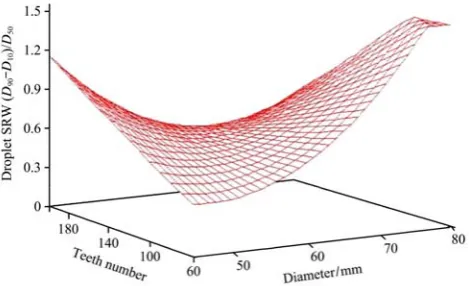
The response surface of the droplet VMD and SRW are shown in Figures 5 and 6, the quadratic regression response surface of droplet VMD and SRW were saddle.
To meet the low volume spray requirements of UAV spraying, the droplet size should be in range of 101- 300 μm[11,17].
Fmincon function was called in Matlab
software, to search the minimum constrained
optimization functions. Subject conditions were: Y1
equal to 200 μm, dc, nc within the [–2, 2] interval, to solve
the minimum value Y2. The results were dc= –0.169, nc
=0.537, Y2=0.5621. So the optimized diameter was
61.5 mm, teeth number was 149. This cup was made by using 3D printer, and the optimized rotary cup’s atomization performance was measured by the laser particle size analyzer. The average droplet VMD was
198.65 μm and droplet SRW was 0.624. The differences
between simulation value and test value were 0.68% and 9.90%, respectively, therefore the developed models can be regarded as a reliable representative of the
Note: Red is the top of response surface, blue is the bottom of response surface. Figure 5 Droplet VMD quadratic regression response surface
Note: Red is the top of response surface, blue is the bottom of response surface.
Figure 6 Droplet SRW quadratic regression response surface
5 Conclusions
We could get the conclusion that the diameter and teeth number of rotary cup have significant effects on droplet VMD and SRW by using the method of variance analysis and mean comparison. By combining the diameter and the number of teeth correctly, a centrifugal nozzle with narrow SRW could be obtained. The quadratic regression model of the droplet VMD and SRW that obtained by the orthogonal rotation design verified the reliability of the regression model.
The groove shape had a significant effect on droplet VMD and SRW. Grooves and teeth played a role in drainage and diversion, square groove shape had the smallest droplet VMD and the narrowest droplet SRW, so square groove is the best.
The diameter and teeth number had significant influences on droplet VMD and SRW, while cone angle and height had smaller effect. The droplet VMD and SRW decreased with the increase of diameter and the decrease of teeth number. When diameter increased to a certain value, the width of the droplet spectrum tended to be stable. When teeth number decreased to a certain
value, the droplet VMD increased while the droplet width stabilized. The height of rotary cup affected the droplet volume median diameter while had no effect on droplet SRW. The cone angle neither influenced droplet VMD nor droplet SRW.
Under the working conditions of rotational speed of 3600 r/min, flow rate of 700 mL/min, the regression model of droplet VMD and SRW were obtained. The
coefficients of determination R2 were 0.803 and 0.897
respectively. The optimized structural parameters respectively were groove shape square, cone angle 60°, height 20 mm, diameter 61.5 mm and teeth number 149. Droplet VMD and SRW simulation value respectively
were 200 μm and 0.562. The difference between
simulation value and test value were 0.68% and 9.90% respectively, therefore the developed models can be regarded as a reliable representative of the experimental results.
Acknowledgements
The authors acknowledge the financial support provided by the National Key Research and Development Plan (No. 2016YFD0200702); 2012 Foundation Project of Technology Innovation for Graduate in Jiangsu Province of China (No. CXLX12_0658); Special Fund for Agro-scientific Research in the Public Interest (No.201203025); National High Technology Research and Development Program of China (863 program, 2013AA102303); Synergistic Innovation Center of Modern Agricultural Equipment and Technology in Jiangsu Province (NZXT01201403); Agriculture Intelligent Equipment and Technology Research Key Laboratory Open Research Topic in Jiangsu province (NZ201005) and the Natural Science Foundation of Jiangsu Province, China (BK 20151074).
[References]
[1] He X K. Improving severe draggling actuality of plant protection machinery and its application techniques. Transactions of the CSAE, 2004; 20(1): 13–15. (in Chinese) [2] Qiu B J, Wang L W, Cai D L, Wu J H, Ding G R, Guan X P.
[3] Kilroy B. Aerial application equipment guide. United States Department of Agriculture Forest Service, 2003; pp. 3–17.
[4] Yan Y f, Zhang L, Gao Z Y, Pu G. Atomization performance of low pressure swirl atomizing nozzle. CIESC Journal, 2009; 60(5): 1141–1147.
[5] Liao J, Zang Y, Zhou Z Y, Luo X W. Quality evaluation method and optimization of operating parameters in crop aerial spraying technology. Transactions of the CSAE, 2015; 31(Supp.2): 38–46. (in Chinese)
[6] Yuan H Z, Wang G B. Effects of droplet size and deposition density on field efficacy of pesticides. Plant Protection, 2015; 41(6): 9–16.
[7] Mao Y J, Wang X, Ma W. Numerical analysis method for predicting droplet size distribution of nozzles. Transactions of the CSAE, 2009; 25 (Supp.2): 78–82. (in Chinese) [8] Qin W C, Xue X Y, Zhou L X, Zhang S C, Sun Z, Kong W,
et al. Effects of spraying parameters of unmanned aerial vehicle on droplets deposition distribution of maize canopies. Transactions of the CSAE, 2014; 30(5): 50–56. (in Chinese) [9] Zhang S C, Xue X Y, Qin W C, Sun Z, Ding S M, Zhou L X.
Simulation and experimental verification of aerial spraying drift on N-3 unmanned spraying helicopter. Transactions of the CSAE, 2015; 31(3): 87–93. (in Chinese)
[10] Zhou L X, Xue X Y, Sun Z, Zhang S C, Kong W, Zhang T, et al. Experimental study on electrical-driven centrifugal nozzle of aerial sprays. Chinese Agricultural Mechanization, 2011; (1): 107–111. (in Chinese)
[11] Fan Q N. The research on the pesticide spray system using for the mini unmanned helicopter. Nanjing: Nanjing Forestry University, 2011. (in Chinese)
[12] Ledebuhr R, Hetherington M H. Rotary atomizer drip control method and apparatus. CA 2763916 A1 [P]. 2013. [13] Hooper G H S, Spurgin P A. Droplet size spectra produced
by the atomization of a ULV formulation of fenitrothion with a Micronair AU5000 rotary atomizer. Crop Protection, 1995, 14(1): 27–30.
[14] Dong H M, Zhu Z P, Tao X P, Zhao L, Yan H R. Distribution characteristics of fog droplets from air-cooling fan. Transactions of the CSAE, 2004; 20(2): 118–121. (in Chinese)
[15] Craig I P, Hewitt A, Terry H. Rotary atomiser design requirements for optimum pesticide application efficiency. Crop Protection, 2014; 66:34–39.
[16] Ahmed M, Youssef M S. Influence of spinning cup and disk atomizer configurations on droplet size and velocity characteristics. Chemical Engineering Science, 2014; 107(14): 149–157.
[17] Ru Y, Jin L, Zhou H P, Jia Z C. Performance experiment of rotary hydraulic atomizing nozzle for aerial spraying application. Transactions of the CSAE, 2014; 30(3): 50–55. (in Chinese)
[18] Liu J, Yu Q, Guo Q. Experimental investigation of liquid disintegration by rotary cups. Chemical Engineering Science, 2012; 73(19): 44–50.
[19] Ellwood K R J, Tardiff J L, Alaie S M. A simplified analysis method for correlating rotary atomizer performance on droplet size and coating appearance. Journal of Coatings Technology & Research, 2013; 11(3): 1–7.
[20] Ahmed M, Youssef M S. Characteristics of mean droplet size produced by spinning disk atomizers. Journal of Fluids Engineering, 2012; 134(7): 3412–3427.
[21] Rahimi-Gorji M, Pourmehran O, Gorji-Bandpy M, Ganji D D. An analytical investigation on unsteady motion of vertically falling spherical particles in non-Newtonian fluid by collocation method. Ain Shams Engineering Journal, 2014; 59(2): 531–540.
[22] Mohebi M M, Evans J R G. The trajectory of ink-jet droplets: Modelling and experiment. Chemical Engineering Science, 2005; 60(13): 3469–3476.