UNIVERSITI TEKNIKAL MALAYSIA MELAKA
Study the Effect of Wire-EDM Parameters on
Surface Roughness for Machining Die-Steel
Thesis submitted in accordance with the requirements of the Universiti Teknikal Malaysia Melaka for the Bachelor Degree of Manufacturing Engineering in
Manufacturing Process ( Honours ).
By
Mohd Syafiq Bin Dzulkapli
UTeM Library (Pind.1/2007)
√ √
BORANG PENGESAHAN STATUS TESIS*
UNIVERSITI TEKNIKAL MALAYSIA MELAKA
JUDUL:
SESI PENGAJIAN: 2007/2008
Saya _____________________________________________________________________
mengaku membenarkan tesis (PSM/Sarjana/Doktor Falsafah) ini disimpan di Perpustakaan Universiti Teknikal Malaysia Melaka (UTeM) dengan syarat-syarat kegunaan seperti berikut:
1. Tesis adalah hak milik Universiti Teknikal Malaysia Melaka.
2. Perpustakaan Universiti Teknikal Malaysia Melaka dibenarkan membuat salinan untuk tujuan pengajian sahaja.
3. Perpustakaan dibenarkan membuat salinan tesis ini sebagai bahan pertukaran antara institusi pengajian tinggi.
4. **Sila tandakan (√)
STUDY THE EFFECT OF WIRE-EDM PARAMETERS ON SURFACE ROUGHNESS FOR MACHINING DIE-STEEL
MOHD SYAFIQ BIN DZULKAPLI
Disahkan oleh:
(TANDATANGAN PENULIS) Alamat Tetap:
No 470 , LORONG TITIWANGSA 5, TAMAN BUKTI SETIA,
70400 SEREMBAN
Tarikh: 27 March 2008
(TANDATANGAN PENYELIA) Cop Rasmi:
Tarikh: 27 March 2008
* Tesis dimaksudkan sebagai tesis bagi Ijazah Doktor Falsafah dan Sarjana secara penyelidikan, atau disertasi bagi pengajian secara kerja kursus dan penyelidikan, atau Laporan Projek Sarjana Muda (PSM).
(Mengandungi maklumat TERHAD yang telah ditentukan oleh organisasi/badan di mana penyelidikan dijalankan) (Mengandungi maklumat yang berdarjah keselamatan atau kepentingan Malaysia yang termaktub di dalam AKTA RAHSIA RASMI 1972)
TIDAK TERHAD TERHAD
√
DECLARATION
I hereby, declared this thesis entitled “Study the Effect of Wire-EDM Parameters on Surfaces Roughness for Machining Die-Steel” is the result of my own research except as cited in references.
Signature : ………. Author’ s Name : MOHD SYAFIQ BIN DZULKAPLI
APPROVAL
This thesis submitted to the senate of UTeM and has been accepted as partial fulfilment of the requirements for the degree of Bachelor of Manufacturing (Manufacturing Process) wit Honours. The members of the supervisory committee
are as follow:
ABSTRACT
ABSTRAK
DEDICATION
ACKNOWLEDGEMENTS
I would like to thanks to my parent for giving me a support and encouragement to finish this thesis in partial fulfillment for Bachelor of Manufacturing Engineering (Process )
As appreciation and great helpful I had received during completing this thesis, I would like to dedicate my thankfulness to my supervisor Pn Rosidah Bt Jaafar for PSM 1 and Dr Mohd Rizal Salleh for PSM 2 for his supervision and guidance to finish this thesis. I would like to acknowledge (EDM) laboratory technicians, who have been so warmth and kind to provide sincere assistance and good cooperation during the training period. Also not to forget to the Mr Sharul as my second
evaluator, Mr Hadzley our Head of FKP department and all FKP lectures that giving help to finish this thesis.
TABLE OF CONTENTS
Abstact ... i
Abstrak... ii
Dedication... iii
Acknowledgements... iv
Table of Contents... v
List of Figure ... viii
List of Table...x
List of Abbreviation, Symbols, Specialized Nomenclature ... xi
1. INTRODUCTION... 1
1.1 Background... 1
1.2 Problem Statements ... 2
1.3 Objectives ... 3
1.4 Scopes of the Project... 3
2. LITERATURE REVIEW... 4
2.1 Electric Discharge Machine (EDM) ... 4
2.1.1 Spark generator ... 6
2.1.2 Servo System ... 7
2.1.3 Dielectric system... 7
2.1.4 Mechanical Structure ... 8
2.2 Material Removal Mechanism... 8
2.2.1 Breakdown (Ignition) Phase ... 9
2.2.2 Discharge Phase... 10
2.2.3 Erosion (Crater Formation) Phase ... 10
2.3 Basic principle of Electrical Discharge Machining (EDM)... 11
2.4 Wire Electrical Discharge Machine (Wire EDM) ... 13
2.4.1 Introduction... 13
2.4.3 The Principle of Wire Electrical Discharge Machine (Wire EDM) ... 16
2.4.4 Parameters... 18
2.4.5 Dielectric fluid. ... 19
2.4.5.1Deionized water. ... 19
2.4.5 Wire elctrode... 20
2.4.6 Flushing. ... 21
2.5 Material of Worpiece. ... 22
2.5.1 Cold Work Steel... 23
2.5.2 AISI D2... 23
2.5.4 EDM... 24
2.6 Surface Metrology. ... 24
2.6.1 Surface evaluation... 25
2.6.2 Surface texture ... 25
2.6.3 Surface roughness ... 26
2.6.4 Surface roughness factor on Wire EDM ... 29
2.6.5 Characteristic of EDM surfaces... 30
2.7 Design of Experiment (DOE). ... 32
2.7.1 DOE overview ... 32
2.7.2 Two Level Factorial Design ... 32
3. METHODOLOGY... 34
3.1 Introduction... 34
3.2 Selection machines and material... 35
3.2.1 Wire EDM... 35
3.2.2 Portable Surface Roughness Tester ... 38
3.2.3 Material... 39
3.2.4 Wire Electrode ... 39
3.3 Profile Design and Drawing ... 40
3.4 Identify the method of DOE ... 40
3.4.1 Two Level Factorial Design and Minitab software ... 40
3.5 Parameters... 41
3.6 Conduct of experiment- machining using wire EDM... 42
3.6.2 Metallurgy Microscope... 43
3.7 Data collection and analysis ... 44
4. RESULTS... 45
4.1 Surface Roughness Data ... 45
4.2 Factorial Design Analysis ... 49
4.3 Reduced Model ... 52
4.4 Surface Texture... 53
5. DISCUSSION...55
6. CONCLUSSION AND RECOMENDATION... 57
6.1 Conclussion... 57
6.2 Recommendation ... 58
REFERENCES... 59
APPENDICES
A. Gant chart for PSM1 A Gant chart for PSM2 B Profile drawing
LIST OF FIGURES
2.1 Basic Elements of an EDM system. 6
2.2 Evolution of a single spark in the EDM process 12
2.3 wire EDM machine. 14
2.4 Schematic of wire-EDM system 16
2.5 Basic principle of wire 17
2.6 A schematic diagram of wire rotation in wire EDM operation 21
2.7 AISI D2 die steel compositions 23
2.8 Coefficient of Thermal Expansion (x10-6/C°) 23 2.9 Standard terminology and symbol to describe surface finish. The
quantities are given in µin
25
2.10 The Arimethic mean value 27
2.11 Coordinate used for surface roughness measurement 28 2.12 ISO-Recommended Roughness Values and Grade
Numbers for the specification of surface roughness
39
3.1 Flow chart for overall project 35
3.2 Mitsubishi wire EDM machine RA 90 series 36 3.3 Mitutoyo Portable surface roughness (SJ 301) 38
3.4 EDM brass cutting wire electrode. 39
3.5 Technical drawing for profile design. 40 3.6 3.7 4.1 4.2 4.3 4.4
Calibration process using Mitutoyo Portable Surface Roughness Metallurgy Microscope
Surface Roughness (Ra) versus IP and Off Time (OFF) Surface Roughness (Ra) versus Voltage Open (Vo) Surface Roughness (Ra) versus Off Time ( OFF) Normal probability plot of the effects
4.5 4.6 4.7
Interaction Plot (data means) for Surface Roughness (Ra) Main Effects Plot (data means) for Surface Roughness (Ra ) Pareto Chart of the Effects
LIST OF TABLES
2.1 Basic types of tool and die steel 22
3.1 Machine specification 36
3.2 Total of the experiment test 41
3.3
4.1 4.2
Values of each parameter
Surface roughness value for material die steel. Surface texture results
41
LIST OF ABBREVIATIONS, SYMBOLS, SPECIALIZED
NOMENCLATURE.
% - percent °C - Celsius
µ - micro
µin - micro inch
A - Ampere
AA - arithmetic average ANOVA - analysis of variance
CNC - computer numerical control DC - direct current
DOE - design of experiment EDM - electrical discharge machine in - inch
IP Peak current
kHz - kilohertz mm - millimeter
MRR - material removal rate
OFF Off time
PSM - Projek Sarjana Muda Ra - arithmetic mean value Rq - root mean square average SEM - scanning electron microscope
V - Volt
CHAPTER 1
INTRODUCTION
1.1 Background
The development in manufacturing machining have create new era to the many industrial such as automotive, aerospace and other industrial that need precision in their products. The new machines have introduced to change the old conventional method in machining process. The ability of this machine also improves because of the requirement in many industries that need accuracy and reduce machine time.
Accompanying the development of mechanical industry, the demands for alloy materials having high hardness, toughness and impact resistance are increasing. One of those technological developments is novel materials for making various kinds of dies. New die steels have been continuously introduced to the die manufacturers, and affect their die-making processes or their die quality (Boonmung and Kanlayasari, 2007). Nevertheless, those materials are difficult to be machined by traditional machining methods. Hence, non-traditional machining methods including electrolytic grinding, supersonic machining and electrical discharging machining (EDM) are applied.
Wire-EDM uses electro-thermal mechanisms to cut electrically conductive material. The material is removed by a series of discrete discharges between the wire electrode and the workpiece in the presence of a dielectric fluid, which creates a path for each discharge as the fluid becomes ionized in the gap. The region in which discharge occurs is heated to extremely high temperatures, so that the work surface is melted and removed.
There are many parameter and variables that influence the EDM operation. The parameters that were used influenced the result of the surface roughness. The
parameters which influence surface roughness arepulse-on time (ON), pulse-off time
(OFF), pulse-peak current (Ip), and wire tension (WT), cutting tool and material of
workpiece
The research of this paperwork is to study the wire EDM machining process performance In this paperwork will be focuses on the effect of wire EDM parameters on the surface roughness for machining die steel. The several parameters stated will be study to analyzed machining performance in surface roughness. The evaluations are defined from the experiment outcomes.
1.2 Problem Statement
1.3 Objectives:
1. To study the effect of wire-EDM parameters on surface roughness for
machining die steel by conducting several machining process.
2. To evaluate the quality of the surface roughness produce by different
EDM parameters using surface roughness tester.
3. To find the derivative parameters that affects the EDM surface roughness.
1.4 Scope of the Project
CHAPTER 2
LITERATURE REVIEW
2.1 Electrical Discharge Machine (EDM).
The beginning of EDM came during the Second World War, when two Russian physicists B.R. and N.I. Lazarenko published their study on The Inversion of the Electric Discharge Wear Effect which related to the application to manufacturing technology of the capacity of electrical discharges, under controlled distribution, to remove metal.
EDM was being used at that time to remove broken taps and drills. The early “Tap-Busters” disintegrated taps with hand fed electrodes, burning a hole in the center of the tap or drill, leaving the remaining fragments that could be picked out. This saved workpieces and very expensive parts from being scrapped and re-made. This process opened the birth of Vertical EDM, also called: Sinker, Conventional, Ram, Plunge or Diesinker EDM, because the burned downward in the Z-axis. These machines were, and still are primarily used to make precision cavities in metal for the mold industry.(kalpakjian, S and Schmid, S.R, 2000)
complex shapes and cavities in softer, more readily machined material. The EDM is one of unconventional method that use in machining process as the development in manufacturing technology.
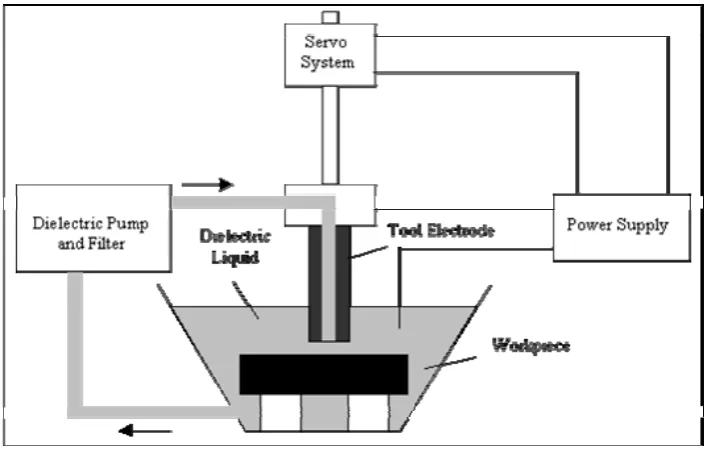
Basically Electric Discharge Machining (EDM) is a process for eroding and removing material by transient action of electric sparks on electrically conductive materials. This process is achieved by applying consecutive spark discharges between charged workpiece and electrode immersed in a dielectric liquid and separated by a small gap. Usually, localized breakdown of the dielectric liquid occurs where the local electrical field is highest. Each spark melts and even evaporates a small amount of material from both electrode and workpiece. Part of this material is removed by the dielectric fluid and the remaining part resolidifies rapidly on the surfaces of the electrodes. The net result is that each discharge leaves a small crater on both workpiece and electrode. Application of consecutive pulses with high frequencies together with the forward movement of the tool electrode towards the workpiece, results with a form of a complementary shape of the electrode on the workpiece.
Figure 2.1. Basic elements of an EDM system. (Nedians., Fortunecity, 2007)
Every EDM machine has the following basic elements as shown in Figure 2.1.
1. Spark generator
2. Servo system
3. Dielectric liquid
4. Mechanical structure
2.1.1 Spark Generator .
The required energy is in the form of pulses usually in rectangular form. Recent studies have been shown that application of pulses in the form of trapezoids resulted with a marked improvement in cutting efficiency. The optimum pulse form is not exactly a trapezoid, but similar.
the way in which the voltage is transformed and the pulse is controlled. The discharge may be produced in a controlled manner by natural ignition and relaxation, or by means of a controllable semiconductor switching elements. Nowadays, sophisticated computer aided spark generators are in use as a result of fast development in electronics industry. These types of generators give us a better manner in controlling physical parameters.
2.1.2 Servo System.
Both electrode and workpiece are eroded during the process, after a certain time dimensions of the electrodes will be changed considerably. The result is increase in interelectrode gap. This will increase the voltage required for sparking. This problem can be solved by increasing the pulse voltage or decreasing the gap distance. The former is not feasible since most of the electrical energy is used for overcoming breaking strength and producing plasma in dielectric liquid rather than machining, in addition to that, the required voltage can increase to the levels that spark generator can not supply, therefore; the interelectrode gap should be maintained constant during the process. This can be achieved by a servo system which maintains a movement of the electrode towards the workpiece at such a speed that the working gap, and hence, the sparking voltage remains unaltered.
2.1.3 Dielectric Circuit.
2.1.4 Mechanical Structure.
EDM machines have similar construction with conventional drilling and milling machine frames with vertical tool feeding and horizontal worktable movements. Since there is not a real contact between electrodes, that’s why, it is considered that, the frame elements not taking much force as in conventional machining so simpler design is possible. This consideration needs a little bit attention, because gas bubbles collapses at the end of discharge and cause high frontal shock waves, therefore; the frame should be strong enough to keep its dimensional stability. (Nedians., Fortunecity, 2007)
2.2 Material Removal Mechanism.
A perfect general theory for EDM can not constructed since each machining condition has its own particular aspects and involves numerous phenomena, i.e., heat conduction and radiation, phase changes, electrical forces, bubble formation and collapse, rapid solidification. In addition, theories of how sparks eroded the workpiece and electrode have never been completely supported by the experimental evidence since it’s very difficult to observe the process scientifically. Thus, most of the published studies are mostly concerned with simplified models of different events of EDM. Development of high-speed computers and comprehensive numerical techniques enabled scientist to involve more parameters in their models than before, but still many aspects of the process can not be explained in detail.
Melting, vaporization and even ionization of the electrode materials occurs at the point where the discharge takes place. Flushing action of the dielectric liquid pulls away whole vaporized and some of melted material. The result is formation of a crater on both electrode surfaces. Theoretical models based on one spark can be extended to the machining with same side effects. Generally the physics of the sparks can be investigated in three phases.
(ii) Discharge phase
(iii) Erosion(Crater Formation) phase
Breakdown phase takes a relatively small percent of the total spark time. It varies from few microseconds to several hundreds depending on discharge conditions. Erosion is only observed only in later stages of spark, partly after the discharge has eased.
2.2.1 Breakdown (Ignition) Phase.
Breakdown in liquids is the initial condition for plasma formation. There are several proposed theories which try to explain the breakdown phase, but consistent results with experiments can not be obtained. A simplified expression can be given as below.
The charge induced on the two electrodes by the power supply creates a strong electric field. This field is strongest where the electrodes are closest to each other. This is the point where discharge takes place. Molecules and ions of the dielectric fluid are polarized and oriented between these two peaks and forming a narrow, low-resistance channel. When the dielectric strength of the liquid in the gap exceeded due to the electric field, breakdown occurs. Electrons emitted from both electrodes and the stray electrons and ions in the dielectric liquid are accelerated. When accelerated electrons and ions reached to the electrons a current flow starts which is the beginning of the discharge phase.
2.2.2 Discharge Phase.