Distributed Experiments and Distributed Learning
https://doi.org/10.3991/ijoe.v16i06.13661
Andreas Pester (*) The British University, Cairo, Egypt [email protected]
Thomas Klinger
Carinthia University, Villach, Austria
Abstract—The paper, an enhanced version of conference key presentation, investigates, how the development of new needs in education and developments in IT triggered technology enhanced learning. Online labs play an important in that area. Federation of labs is the new direction to answer the challenges, which come from the intensive use of online labs in the modern learning environments. VISIR Federation is a concrete attempt to implement such a federation. Distrib-uted labs in a federation need commitments from the participants in organization, sharing lab and learning resources.
Keywords—Online labs, pocket abs, RLMS, VISIR, learning
1
Brief History of Technology Enhanced Learning
The use of technology in the education process is much older than the use of com-puters in the classroom. For example, already in the sixties last century punch cards were used for semi-automated knowledge tests. But the real use of technology in the teaching and learning process started with the use of personal computers in the class-room. The combination of the PC with the world wide web added an additional thrust to this process. [2].
A next step in that success story was the computer or web-based management of the students, trainers, courses, learning materials, learning process and learning administra-tion. We know this as Learning Management Systems.[2]. The first big hype was in the zero years with a lot of open source and commercial tools. The tendency was going to single, robust, secure and integrated systems, which offer a personalized learning envi-ronment. Most of these platforms are based on social-constructionist pedagogy, which puts the learner in the center and fosters collaborative learning. One widely used exam-ple is the platform Moodle.[3]
But not the technology makes the learning smarter, but pedagogical scenario, which use the advantages of these tools and try to strengthen the advantages of learning with the help of technology and to overcome the disadvantages, which relate to the use of these kind of technologies in the learning and teaching processes. Different authors ex-pect, that the old classroom teaching model will be outraged in the middle of the 21st century. [4].
But already in the very beginning of the computer aided, later e-learning phase the question came up, how to be with the practical, experimental part, which is a basic and necessary part of science and engineering. Traditionally this knowledge and these skills were taught in hands-on labs. The combination of lab experiments with the internet was the birth of a research direction, which is often called remote experiments, remote labs, online simulation, virtual or online labs. All these denominations describe a little bit different content, but they point all in the same direction – to gain experimental knowledge with the use of technology enhanced learning. [5]. In the last years another trend started: to use cheap data acquisition cards like MyDAQ, Arduino etc. in combi-nation with different sensors to create pocket labs, which are local, but can be combined via cloud technology to lab networks and in such a way scaled to different numbers of users. Smart labs with 3D-printing in combination with learning can be subsumed also under this direction.
A lot of experiments are unique, it is not so easy to grab the signals and data from the experiment, that in a standardized way they would be delivered via internet to the experimenter, visualized in virtual instruments or analyzed with the help of special soft-ware tools. For this reason, the development of online labs and their use in education, but also in industrial environments was always a little bit separated from the general e-learning research and practice.
2
Experiment and Experimental Learning
First time experiments were systematically used in western science by Galileo Ga-lilei, who observed the moon and the course of the stars and the sun to proof the helio-centric model. After that experiments have been got a fundamental part of science and later also engineering. The experimental way of gaining new knowledge has become so important, that sciences are classified as experimental and as theoretical ones. Theoret-ical sciences like mathematics cannot proof new knowledge with the use of experi-ments, but physics or biology are validating knew knowledge this way.
2.1 Experiment
on one a hypothesis, which the experimenter tries to validate or to falsify. One of the most important properties for experiments is the reproducibility of the results by other scientists, in other places and during other time slots. [6].
In the teaching and learning processes systematic experimentation is used to set-up and validate hypotheses to understand and analyze a theoretical context to be studied. It depends from the used didactical concept, if the experiments are used just to illustrate the theory and if based on experimental results hypotheses are formulated, validated and generalized to some insights in natural laws, causal connections e.g. This kind of learning is often used in inquiry-based learning approaches.
One big advantage of online labs is that it gives users access either to experimental benches, which cannot be use in the classroom (electromagnetic microscope) or more users can access more experiments, if the experiments are connected in a network.
2.2 Learning lab typology
The labs, which are used in learning and teaching environments, can be classified as: • Hands-On Labs
• Online Labs: • Remote Labs
• Simulators (also Online Simulators) • Virtual Labs
• Pocket Labs
Hands-on labs are the classical (educational) laboratories, with a limited number of places and a limited access time. Sometimes the access time is extended, but for security reasons some restrictions are always in place. The advantage is, that during the work hours students have direct access to the lab engineers, can get advices and communicate with their classmates. This kind of labs can be used for demonstrations, for guided lab sessions and for open lab sessions. It is a combination of instruction-led and social learning.
Online labs can be considered as the general term for Remote Labs, Simulators, and Virtual Labs, because all of them can be accessed online.
Remote labs are in the best case accessible 24/365. The number of users is restricted by the technical solution (batched or interactive mode) and by the bandwidth of the internet connection. The experiment is real, the measured values are real, nit calculated. In a lot of cases various forms of visualization for the measured data are used. The communication with instructors and classmates in most of the cases is restricted or at least not integrated in the technical solution. The use modes can be demonstration, guided (restricted) and open lab sessions. For remote experiments special security re-quirements come up, to avoid misuse and damages in the lab.
of a given real process in a computer program. In a simplified way we can say that simulations are experiments, running on a hardware-software system, cloud etc. Such experiments are good for demonstrations and guided lab sessions, in some cases the software allows open lab sessions. The measured values are calculated ones (with all errors coming from the used computer arithmetic, not from nature). There are a lot of open source products, which allow to develop good simulations like EasyJava Simula-tions, which can be accessed locally or over the internet. Most of the commercial sim-ulation programs like Matlab/Simulink, Maple/MapleSim, Modelica etc. have also fea-tures to develop online simulations. An example is Matlab Online, which runs even on a smartphone and can be connected to a predefined list of sensors.
Virtual or Hybrid labs are systems that combine both (online) simulations and re-mote laboratories technologies to deliver real experiments and simulations to end users. For example, in labs in which the circuit under test is a programmable ASIC (digital or analog) or a microprocessor, it is possible to deliver their design/application software to the users via the internet. With the help of a remote lab it’s possible to test the real hardware system. The advantages and disadvantages of these kind of labs are like them of remote labs.
Pocket labs are small, portable devices of hardware, combined with free or afford-able software, thus enabling students to be free in place and time for carrying out labor-atory exercises. [7]. It is not necessary to connect them to the internet, they can run also only in a local network, connected to a PC or other computing unit. The advantage is a more active part of the learner, who actively participates in the design of the experi-mental environment. The lab is mobile, not connected to some special place.
As Pocket Labs provide actual and physical contact of students with real hardware, they can be used especially for basic exercises and for students without much experi-ence. If electric or electronic components are used, a limitation will be for standard and cheap components, as any other solution will not be feasible due to financial reasons. [8].
2.3 “New” lab characteristics
The additional characteristics of online and pocket labs in comparison to hands-on labs are:
• 24/365 accessibility
• Increased possibility to learn by experience
• Broader use of explorative and/or inquiry-based learning • Closer connection of secondary, tertiary and museum education • Share of resources in lab federations
• Possibility to manage bigger user, experiment and lab groups
• Access of students from emerging and developing countries on a real basis to modern lab equipment.
These labs are mostly used in education, more seldom in research and more and more in the industries.
One way, how online services are more extensively used in research, is the collection and distribution of open and semi-open data, which are collected in unique research labs like CERN, in physics, astronomical sciences, biology etc. and offered for further scientific use. In that way a bigger generation of postgraduate students can participate in research.
2.4 Why remote labs in science and engineering education
In a lot of universities, the number of accessible places for teaching and learning in labs is restricted. But both, science and engineering, have practical exercises and lab sessions as a necessary part in their curriculum. They cannot be replaced by simulations alone, because the measured and the calculated value can differ very much by the in-fluence of real live factors.
On the other side, education in general is changing to a more individualized and personal process. The classical classroom system is not fitting anymore the upcoming requirements. So, a bigger part of the learning material will be delivered online, but the classical distant education prefers “book sciences”, because lab sessions is hard to de-liver. Solutions can be the use of remote and pocket labs and their combination.
To get a better overview about this different kind of laboratory concepts, see the scheme in Fig. 1.
• Classic labs take place at the campus as usual; students do exercises in groups at a predefined time, with different success levels.
• Remote labs are located at University locations as well, with the difference that stu-dents can remotely log in from another location and control existing hardware. • Pocket labs, finally, are again uniting the locations of students and labs; however,
this location can now be anywhere. Moreover, they enable students to be more time flexible to do their exercises. [9] [10]
2.5 Pocket labs
Fig. 2 shows a typical Pocket Lab, consisting of a National Instruments’ myDAQ in combination with a breadboard which can be used for electric and electronic experi-ments. This device is affordable, lightweight and therefore handheld, with a virtual os-cilloscope, multimeter, function generator, and other useful instruments. Own instru-ments and applications can be developed using LabVIEWTM. The device contains also an expansion plug for the connection of sensors and actuators. Also, entire experiment boards can be connected to perform more complex laboratory exercises.
Fig. 2. Example of a pocket lab [7].
3
Distributed Online Lab Architecture
In the beginning of the online lab development the architecture for the internet con-nection of lab exercises was dominated by single solutions for standalone remote labs, using either GBPS bus connections between the measurement device and the web server or later DAQ cards. No user or lab management was included, security issues had been on a second priority.
3.1 Stand-alone remote lab
The stand-alone ad hoc solutions were used in the first years, when the stable solu-tion of the lab experiment to the internet was on a priority. Quite often the access was restricted with a user-ID and a password. Most of the remote experiments had been developed in areas without moving parts: in electronics, electrical engineering, physics etc. [11]. Experiments with moving parts like in mechanics, mechatronics, control or chemistry were not so much developed.
Fig. 3. Stand-alone lab architecture
With the grow of user, user groups, the definition of different user roles, but also the number of developed experiments, the needs for remote lab management systems grew.
On the other side it was quite soon clear, that no university alone is not able to de-velop and to maintain all necessary experiments for the teaching process. An exchange of remote experiments was preferable.
The requirement for such systems was a combination of a user management, a lab session management and the scalability of the system for different number of users and lab sessions.
3.2 Distributed labs
was regularly checked and maintained. At that stage, the idea of remote lab manage-ment systems was discussed, and different systems had been developed.
4
Remote Lab Management Systems (RLMS)
4.1 Requirements, functionalities and architecture of RLMS
RLMS are a middleware between the experiment user and the experiment provider. They work as broker systems between
• The experimenter and the experiment
• The experiments and the Learning Management Systems (LMS)
Sometimes they include a communication environment between the experiment us-ers, tutors and/or developers. Sometimes they connect different online labs to a virtual workbench. The user management shares the experiment – user administration, pro-vides authorization and data storage. The lab session administration includes a calen-dar-based booking for longer running experiments and a queueing system (FIFO) for fast running experiments, and a priorization of requests. The biggest challenge for RLMS is the scalability of the middleware to different amounts of users on the one-side hand and numbers of experiments or labs on the other-side hand. Normally the lab ac-cess policy is defined by the lab owners and integrated in the middleware including all changes. The RLMS provides only the management of the user-experiment connections in different modes, in a batched and in an interactive mode.
RLMS should be reliable, have a single sign-on and separate the lab session man-agement tasks from the user manman-agement tasks.
Modern RLMS can be seamless integrated in all LMS, which support a Learning Tools Interoperability (LTI) plugin like Moodle or others. Well known examples of RLMS are the iLAB middleware, [14] the WebLab Deusto platform [15] and others. WebLab Deusto is the system, which is nowadays supported and widely used.
4.2 Batched mode
In the batched mode the experiment user specifies the parameters of the experiment before providing the experiment, sends his request to a queue, and this request is pro-cessed by the RLMS on an available the lab server, which offers the chosen experiment and has a free time-slot. This mode supports the performance optimization of the lab server and a multi-user regime. It is used especial for standard experiments with a-predefined experiment structure, which allows mainly the change of parameters, but not the structure of the experiment by itself.
4.3 Interactive mode
In the interactive mode the user controls the experiment partly or in general. He can change the structure, and not only parameters of the experiment. This mode requires a wider bandwidth and a scheduling system. It allows a direct communication between the user and the lab server. A multi-user mode is (only) possible, when the duration of the measurement is quite short (in milli second range) and a multiplexer system appli-cable. The VISIR system is an example for the use of the interactive mode.
Fig. 5. The VISIR system at CUAS, former CTI [17].
5
Distributed Experiments - Lab Federations
5.1 Why RLMS are not enough
RLMS had a wide success and different e-learning provider offered the use remote experiments in their educational programs. A special request came from universities of distance education like UNED in Spain and others, which have big user groups (pro-fessors and students) and offer programs in science and engineering on distances, which cannot be bridged in an easy and time-effective way. But quite soon some challenges raised up in an extensive use of RLMS in educational processes.
solved using an RLMS. Also, the storage capacity of components is restricted (for ex-ample for VISIR (Virtual Instrument Systems in Reality) experiments with around 70 components for a 10 components board). The typical list of electronic components in a hands-on lab has much more components. Different attempts had been undertaken, to find a robust solution for this kind of problems. One way out can be the federation of labs of different experiment providers.
The idea is to convince different online lab or online experiment providers to share not only experiments, but stay with their own RLMS, but also to use one RLMS. Dif-ferent organizations (online lab provider) using the same RLMS support federation pro-tocols, but, each remote laboratory is considered as an individual entity. So, the organ-izations, providing the same remote lab can balance their clients/users load. This im-proves the users’ involvement in the remote lab environment. As a result, time response and availability are improved. But it will be not enough to share the lab, same experi-ments should be repeated in every of the labs, participating in the federation.
5.2 The PILAR approach
The PILAR project is one of the attempts to implement the federation idea in prac-tice, five lab providers and different user organizations are working together, to imple-ment the VISIR platform as a federated online lab. [18] VISIR is an interactive hard-ware-software platform for experiments mainly in electronics and electrical engineer-ing, developed at Blekinge Tekniska Högskola (BTH) in Sweden in the last 15 years and used by universities in Spain, Portugal, Austria, Argentina, Brazil and other coun-tries. [19] [20]. In the beginning it was designed as stand-alone online labs, which ex-change their experience. The lab providers sometimes also offered open access to VISIR for external users, but there was no agreed policy. The PILAR project aims to combine the efforts in a lab federation. The federation principles implemented in the PILAR lab policy are:
• Redundancy: scalability, reliability and availability should be increased at the ex-pense of diversity
• Diversity: Each VISIR node can specialize in a specific topic (component’s reusa-bility in the matrix)
• Combined: empowering scalability for those common experiments and dedicating each node in a specific area
• Agreed-Shared approach: Each node must design a percentage of their component boards based on the federation needs.
• The implementation of these principles was based on very intensive discussions and negotiations, because each of the participating provider of VISIR nodes had his own practice of the use of the system.
6
Distributed Learning
The development and use of online experiments and online labs for learning and teaching requires a corresponding didactic. Technology enhanced learning works bet-ter, if the learner is an active one. So, the applied didactics should be based on learner-centered didactics. In the case of online labs this can be, e.g.:
• Inquired-based learning: Experimentally inquired knowledge leads to some theoret-ical conclusions and generalizations
• Inverted classroom: Combines the self-paced learning of theory with the guided group-oriented learning of practical skills and experimental tasks
• Community of practice of online labs: Supports social learning in the area of science and engineering, using experimental knowledge
• Project-based learning: Online labs give an additional incentive for deeper study of some special (interdisciplinary) tasks in small project groups
• Personalized learning: Online labs support the self-paced, personalized learning of students
6.1 Distributed earning with Online Labs
These are some scenarios for the application of online labs. The use of online labs and/or hands-on labs had been realized in learning scenarios in different ways:
• Online labs as a preparation for hands-on lab sessions • Online labs as supplement to hands-on lab sessions • Online labs as a replacement of hands-on lab sessions
In practice the supplement solution is the most used solution. One of the constraints of online labs is the missing non-visual sensory experience and the practical skills, which should be learned additionally in hands-on sessions and (until now) cannot be replaced by virtual worlds on screens.
Nevertheless, it has been shown, that from the learning effect of subject knowledge for a high school or on a bachelor level in universities, online labs give the same results as hands-on labs. Especial for part time students’ online labs have the advantage, that the experimental part can be passed in much more time- and place-flexible way as the use of hands-on labs. [23].
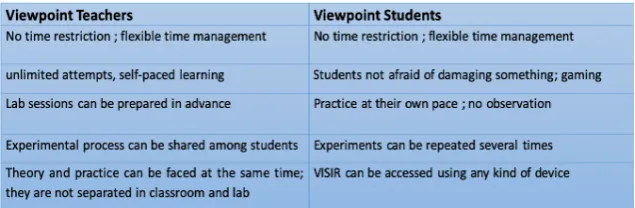
The pedagogical approach of distributed labs is based on principles like: • Free exchange of didactical material between members of the federation • Exchange of lab provider services versus didactical services
• Exchange of teachers inside the federation • Common learning in mixed student groups
Fig. 6. The pros for the use of the VISIR platform
Fig. 7. The cons for the use of the VISR platform
6.2 Distributed learning with pocket labs
Pocket Labs provide the great advantage that the sensory experience of real hardware is still there. Again, some didactic aspects must be considered: [7].
• Motivation: Students might skip the exercises at all or part of them, thus considering lower grades. To prevent this, the laboratory exercises must be integrated into the respective courses in such a way, that they are not only essential for passing the course, but also serve as an obvious tool for the understanding of the course topics. • Supporting Materials: The preparation and distribution of supporting materials must
be considered thoroughly. Especially if the exercises are part of beginner's courses in the first or second semester of the study program, the instructions for them must be well prepared and should serve as a systematic manual for the exercise.
• Preparation of Exercises: It is obvious, that all laboratory exercises for Pocket Labs must be thoroughly prepared and tested, before they are submitted to students. An important issue is, whether the laboratory exercises with Pocket Labs are integrated into existing courses or are stand-alone. Another possibility is, to define Pocket Lab exercises as optional so that they may provide further and deeper understanding of the topics of a corresponding lecture or in general.
7
Conclusion
The paper discussed different directions for the further development of STEM edu-cation especial at the university level in relation to learning on and with experiments. Online experiments, provided by only one university will not solve the organizational and technical questions, federations of labs can be an answer. But this has consequences for the commitments of participating members in the federation, which should be clear, before someone starts to participate. Another direction is the combination of online and pocket labs in different technical implementations. The shown examples are only one possibility how to use it, but one, which is successfully already used in the student-centered learning scenarios.
8
Acknowledgement
The authors acknowledge the support of the School of Engineering & IT, Carinthia University of Applied Sciences, the VISIR+ project Erasmus+ Capacity Building in Higher Education 2015 nº 561735-EPP-1-2015-1-PT-EPPKA2- CBHE-JP and PILAR project Erasmus+ Strategic Partnership nº 2016-1-ES01-KA203-025327 (Platform In-tegration of Laboratories based on the Architecture of visiR).
The authors would like to extend his sincerest gratitude and appreciation to The Brit-ish University in Egypt (BUE) for the excellent mutual cooperation and for facilitating the publication of this article.
9
References
[1]Hannafin J. M., Land S. M. The foundations and assumptions of technology-enhanced stu-dent-centered learning environments. Instructional science (1997), 25:167. DOI.org/10.1023/A:1002997414652 https://doi.org/10.1023/A:1002997414652
[2]McGill T. J., Klobas J. E., A task-technology fit view of learning management system im-pact. Computers & Education (2009), 52:2, https://doi.org/10.1016/j.compedu.2008.10.002 [3]Moodle. Empowering educators with a flexible, open source LMS. https://moodle.com/ [4]Harari Y.N., 21 Lessons for the 21st Century, Random House (2018), Chapter Education [5]Auer M.E., Pester A., Ursutiu, D; Samoila C., Distributed and Remote Labs in Engineering,
IEEE International Conference in Industrial Technology (2003), IEEE Explorer, https://doi.org/10.1109/ICIT.2003.1290837
[6]Shadish, W. R.; Cook, Th. D.; Campbell, D. T. (2002). Experimental and quasi-experimental designs for generalized causal inference. Boston: Houghton Mifflin. ISBN 0-395-61556-9. [7]Klinger, T. et al. (2017). Parallel Use of Remote Labs and Pocket Labs. 14th International
Conference on Remote Engineering and Virtual Instrumentation (REV), New York. https://doi.org/10.1007/978-3-319-64352-6_42
[9]Madritsch, C. and Klinger, T. (2017). Pocket Labs in IoT Education. 20th International Con-ference on Interactive Collaborative Learning (ICL), Budapest, Hungary.
[10]Klinger, T. and Kreiter, C. (2017). Experiences with the Use of Pocket Labs in Engineering Education. 20th International Conference on Interactive Collaborative Learning (ICL), Buda-pest, Hungary.
[11]Garbi-Zutin D., Auer M.E. Remote Electronic Laboratory with ispPAC10 in: International Association of Online Engineering (Ed.), Interactive Computer Aided Learning ICL 2006, Sep 2006, Villach, Kassel University Press
[12]Richter, T., Boehringer, D., Jeschke, S.: Lila: A European project on networked experiments. In: Automation, Communication and Cybernetics in Science and Engineering 2009/2010, pp. 307-317 (2011 https://doi.org/10.1007/978-3-642-16208-4_27
[13]Ton de Jong et al. (2014) Innovations in STEM education: The Go-Lab federation of online labs. Smart learning Environments 1:3, Springer Open Journal https://doi.org/10.1 186/s40561-014-0003-6
[14]Harward, V.J. et al. (2008). The iLab Shared Architecture: Awe Services Infrastructure to Build Communities of Internet Accessible Laboratories. Proceedings of the IEEE 2008. p. 931 - 950. https://doi.org/10.1109/JPROC.2008.921607
[15]Garcia-Zubia, J et al. (2011), Application and user perceptions of using the WebLab-Deusto-PLD in technical education. First Global Online Laboratory Consortium Remote Laborato-ries Workshop, IEEE Xplorer, https://doi.org/10.1109/GOLC.2011.6086780
[16]Zutin D.G. (2018) Online Laboratory Architectures and Technical Considerations. In: Auer M., Azad A., Edwards A., de Jong T. (eds) Cyber-Physical Laboratories in Engineering and Science Education. Springer, Cham https://doi.org/10.1007/978-3-319-76935-6_1
[17]Zutin D.G., Auer M.E. (2011), "Work in progress" Integrating educational online lab plat-forms around the iLab Shared Architecture," in 41st ASEE/IEEE Frontiers in Education Conference (FIE 2011), Rapid City, SD. https://doi.org/10.1109/FIE.2011.6142780 [18]Garcia-Loro F. et al (2019), PILAR: Sharing VISIR Remote Labs Through a Federation.
IEEE Global Engineering, Education Conference (EDUCON), IEEE Xplore, https://doi.org/10.1109/EDUCON.2019.8725093
[19]Gustavsson I., J. et al (2006), An instructional electronics laboratory opened for remote op-eration and control", International Conference on Engineering Education, 2006.
[20]Gustavsson, I. et al. (2008). A Flexible Electronics Laboratory with Local and Remote Workbenches in a Grid. International Journal of Online Engineering (iJOE).
[21]International Association of Online Engineering (IAOE), VISIR Special Interest Group, http://online-engineering.org/SIG_visir.php
[22]International Society for Engineering Pedagogy, http://www.igip.org
[23]Viegas, C. et al. Impact of a remote lab on teaching practices and student learning. Computer & Education (2018), 126, Impact of a remote lab on teaching practices and student learning https://doi.org/10.1016/j.compedu.2018.07.012
10
Authors
(Russia), Karlskrona (Sweden), Yerevan (Armenia), Bauru (Brazil) and other places. Email: [email protected]
Thomas Klinger studied Electrical Engineering at the University of Technology Vienna and worked there as Assistant Lecturer for three years while working on his PhD thesis. After that, he worked for seven years at Philips in Klagenfurt, Austria, holding positions as development engineer, and, in the last years, development man-ager. Since 1998, he is professor at CUAS; in the first years teaching System Integra-tion. He has been Dean of the Engineering & IT department for about 10 years and was elected twice for the position of CUAS' Vice Rector. Currently he owns no higher po-sition at CUAS and teaches Electrical and Electronic Engineering and Image Pro-cessing. Email: [email protected]
![Fig. 1. Online and Pocket Labs – Overview [15]](https://thumb-us.123doks.com/thumbv2/123dok_us/552747.2054800/5.595.166.431.426.644/fig-online-pocket-labs-overview.webp)
![Fig. 2. Example of a pocket lab [7].](https://thumb-us.123doks.com/thumbv2/123dok_us/552747.2054800/6.595.195.400.366.547/fig-example-pocket-lab.webp)
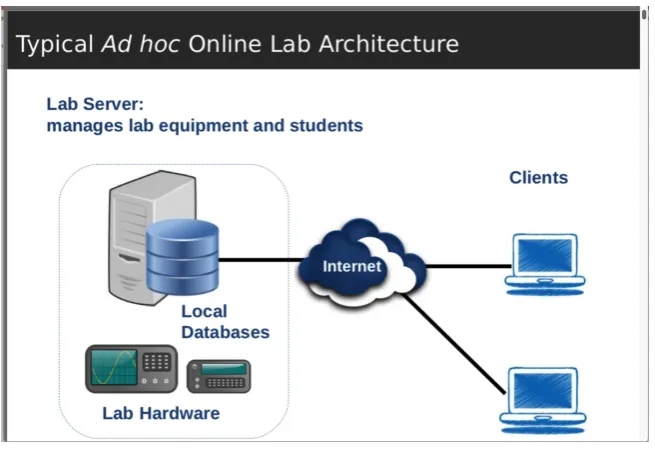
![Fig. 4. A typical RLMS architecture [16].](https://thumb-us.123doks.com/thumbv2/123dok_us/552747.2054800/8.595.156.445.522.676/fig-a-typical-rlms-architecture.webp)
![Fig. 5. The VISIR system at CUAS, former CTI [17].](https://thumb-us.123doks.com/thumbv2/123dok_us/552747.2054800/9.595.143.414.429.507/fig-visir-cuas-cti.webp)