Helmholtz Free Energy F
In purely mechanical system the work done
during change of state is minus the change in potential energy which is given by :
In thermodynamical system there is no such
simple relationship between the work and variation in energy because energy can be exchanged between the system and its
environment in the form heat. We have instead the 1st law of thermodynamics:
W
PE
Helmholtz Free Energy F
Many processes occur in thermodynamical
systems while it is in thermal contact with the environment, So that exchange of heat between the system and the environment can take place.
In that case the work W may be larger or
smaller than –ΔU, depending whether the system absorb or gives up heat to the
Helmholtz Free Energy F
We now suppose that our system is in
thermal contact with a reservoir at constant T during which the system is taken from
state A to state B.
In this case :
Since T is constant
B B A
A
dQ S S
T
B A
Helmholtz Free Energy F
The work in this process is: We can rewrite the above equation as:
Let us define new function called the
Helmholtz free energy:
W
Q
U
W
T S
U
BA AA
B B A B
W
TS
TS
U
U
W
U
TS
U
TS
Helmholtz Free Energy F
In terms of F the work is: The Helmholtz Free energy sets an upper
limit on the amount of work which can be performed by the system.
The work is less than or equal to the decrease in the free energy F.
The decrease in F is the amount of energy
which can be freed from the system and transformed in to work.
A B
Helmholtz Free Energy F
If the system is in thermal
equilibrium and dynamically isolated
from the surrounding in such a way
that it cant exchange energy in the
form of work with the surroundings
(W=0) then:
Helmholtz Free Energy F
The above equation suggest that
the free energy cant increase it can
only decrease.
A consequences of this fact is that,
if the free energy is minimum the
system is in stable equilibrium. F
cant increase.
Compare F with mechanical potential
energy in stable equilibrium.
PE
X
F
Configuration and dissipative
Work
W=Wconfig+Wdiss
To use the nomination used in our text book let
us set W’=Wconfig , A=Wdiss
W=W’+A
At constant T we derived
At constant volume V, W’T =0
'
1 2 1 2
T T T
W
F
F
W
A
F
F
, 1 2
limit
T V
A
F
F
this sets an upper
onthe non
pdv work
Helmholtz Free Energy F
T VS
P
V
T
F
U
TS
dF
dU TdS
SdT
dF
PdV
SdT
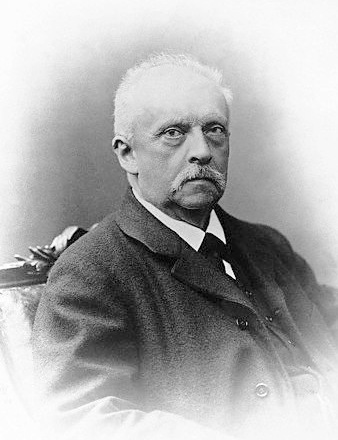
Hermann von Helmholtz
Hermann Ludwig Ferdinand von
Helmholtz (August 31, 1821 – September
8, 1894) was a German physician and
physicist .As a young man, Helmholtz was interested in natural science, but his father wanted him to study medicine at the Charité because there was financial support for
medical students.
He made significant contributions to several widely varied areas of modern science.
In physiology , psychology, theories of vision, ideas on the visual perception of space, color vision research, and on the
sensation of tone, perception of sound, and
Hermann von Helmholtz
In physics, he is known for his theories on the conservation of energy, work in
electrodynamics, chemical thermodynamics, and on a mechanical foundation of
thermodynamics.
As a philosopher, he is known for his
philosophy of science, ideas on the relation
between the laws of perception and the laws of nature.
A large German association of research
His first important scientific
achievement, in 1847 on the
conservation
of energy
. He discovered the principle of
conservation of energy while studying
muscle
metabolism
.
He tried to demonstrate that no energy is
lost in muscle movement, motivated by
the implication that there were no
vital
forces
necessary to move a muscle.
Helmholtz and electromagnatic theory
In 1870, Helmholtz published the first Part of
“On the Theory of Electrodynamics,” “Equations of Motion of Electricity in
Conductors at Rest,” in Crelle's
Journal für die
reine und angewandte Mathematik
. In theessay, Helmholtz supported Maxwell's work, but criticized Wilhelm Weber's
electrodynamic equations, charging that Weber's equations posit an infinite kinetic energy, which contradicts Helmholtz's
Helmholtz and electromagnatic theory
Weber and Helmholtz disputed the question
throughout the 1870's. Over the next several years, Helmholtz published two more Parts of “On the Theory of Electrodynamics,” in which he responded to Weber and continued to
support Maxwell's assertion that light is an
Helmholtz was able to prove three theorems in fluid dynamics using these notions. In their modern expression, they are:
1) “Fluid particles originally free of vorticity
[rotation] remain free of vorticity.
Vorticity is the curl of the velocity
Hermann von Helmholtz and
Fluid dynamics
v
2) Fluid particles on a vortex line remain on a
vortex line, so that vortex lines move with the fluid.
Vortex line is the tangent to the vorticity
3) The strength of the vorticity is proportional
to the length of the vortex line
These laws are used still in fluid dynamics, though they are modified slightly from
Helmholtz's original version
Helmholtz and thermodynamics
1.
Drawing on the earlier work of
Carnot
,
Clapeyron
and
Joule
, he
postulated a relationship
between
mechanics
,
heat
,
light
,
electricity
and
magnetism
by
treating them all as
manifestations of a single
force
Helmholtz and thermodynamics
2) In 1882, Helmholtz gave an address, “The
Thermodynamics of Chemical Processes,” at the Berlin Academy. Up until Helmholtz's address, chemical reactions had been
explained by “chemical forces” or “affinities” between chemical substances, measured
quantitatively by the heat developed during a chemical reaction.
3) In his address, Helmholtz “proved that
4) In particular, the equations for a system
containing heat as a variable contain entropy as a variable quantity. Entropy is an
inconvenient variable, difficult to control for and hold constant as one can hold
temperature, pressure, and volume constant.
The Legendre transform allows a researcher to convert equations containing entropy into equations expressed only in terms of
temperature, pressure, and volume. The
Legendre transform can be applied correctly only under certain conditions, which must be specified.
5) Helmholtz proposed the notion of a “
FREE
ENERGY
” to account for cases involving heat and entropy. Many equations involvingF
and not
T
orS
are fully reversible, and soHelmholtz's work allowed for the application of the Hamiltonian to many chemical
processes.
6) While “Helmholtz was not the most important
contributor” to theoretical chemistry, “his thermodynamic theory of 1882–1883 was the pioneering work on which much of the new
theoretical chemistry rested.
Hermann von Helmholtz
In the 1850s and 60s, building on the
publications of
William Thomson
, Helmholtz
and
William Rankine
popularized the idea of
the
heat death of the universe
.
In 1871 Helmholtz moved from Heidelberg to Berlin to become a professor in physics. He became interested in
electromagnetism and the Helmholtz equation is named for him. Although he did not make major contributions to this field, his student Heinrich Rudolf Hertz became
Hermann von Helmholtz
The Helmholtz equation often arises in the
study of physical problems involving partial
differential equations (PDEs) in both space and time. The Helmholtz equation, which
represents the time-independent form of the original equation, results from applying the
technique of separation of variables to reduce the complexity of the analysis.
2
2
0
k
Gibbs Free Energy
At constant P, W’T,P =P(v2-v1) , the above eq becomes:
Now we define Gibbs Free energy G as:
'
1 2
T T
W
A
F
F
2 1 , 1 2
, 1 1 2 2
(
)
(
) (
)
T P
T P
P V
V
A
F
F
A
F
PV
F
PV
G
F
PV
U TS
PV
H TS
, 1 2
T P
Gibbs Free Energy
G
H
TS
dG
dH
TdS
SdT
dG
SdT
VdP