Fixed Point Theory and Applications Volume 2010, Article ID 439682,18pages doi:10.1155/2010/439682
Research Article
Application of the Banach Fixed-Point Theorem to
the Scattering Problem at a Nonlinear Three-Layer
Structure with Absorption
V. S. Serov,
1H. W. Sch ¨uermann,
2and E. Svetogorova
21Department of Mathematical Sciences, University of Oulu, P.O. Box 3000, Oulu 90014, Finland 2Department of Physics, University of Osnabr ¨uck, Barbarastraße 7, D-49069 Osnabr ¨uck, Germany Correspondence should be addressed to V. S. Serov,[email protected]
Received 29 August 2009; Accepted 23 April 2010
Academic Editor: Massimo Furi
Copyrightq2010 V. S. Serov et al. This is an open access article distributed under the Creative Commons Attribution License, which permits unrestricted use, distribution, and reproduction in any medium, provided the original work is properly cited.
A method based on the Banach fixed-point theorem is proposed for obtaining certain solutions
TE-polarized electromagnetic waves of the Helmholtz equation describing the reflection and transmission of a plane monochromatic wave at a nonlinear lossy dielectric film situated between two lossless linear semiinfinite media. All three media are assumed to be nonmagnetic and isotropic. The permittivity of the film is modelled by a continuously differentiable function of the transverse coordinate with a saturating Kerr nonlinearity. It is shown that the solution of the Helmholtz equation exists in form of a uniformly convergent sequence of iterations of the equivalent Volterra integral equation. Numerical results are presented.
1. Introduction
Scattering of transverse-electricTE electromagnetic waves at a single nonlinear homoge-neous, isotropic, nonmagnetic layer situated between two homogehomoge-neous, semiinfinite media has been the subject of intense theoretical and experimental investigations in recent years. In particular, the Kerr-like nonlinear dielectric film has been the focus of a number of studies
1–6.
Exact analytical solutions have been obtained for the scattering of plane TE-waves with Kerr-nonlinear films7,8. As far as exact analytical solutions were considered in those papers, absorbtion was excluded, at most it was treated numerically9–11.
was not solved till now. In the following we propose a solution based on the Banach fixed-point theorem contraction principle of the functional analysis 12. To demonstrate the broad range of applicability of this theorem we consider a nonlinear lossy dielectric film with spatially varying saturating permittivity. In Section 2we reduce Maxwell’s equations to a Volterra integral equation2.12 for the intensity of the electric field Ey and give a solution in form of a uniform convergent sequence of iterate functions. Using these solutions, we determine the phase function ϑy of the electric field, and, evaluating the boundary conditions in Section 3, we derive analytical expressions for reflectance, transmittance, absorptance, and phase shifts on reflection and transmission.
It should be emphasised that the contraction principle includes the proof of the existence of the exact bounded i.e., ”physical” solution of the problem and additionally yields approximate analytical solution by iterations. Furthermore, the rate of convergence of the iterative procedure and the error estimate can be evaluated12. Thus this approach is useful for physical applications.
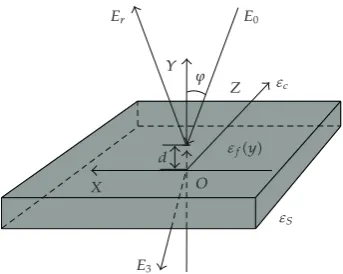
Referring toFigure 1, we consider the reflection and transmission of an electromag-netic plane wave at a dielectric film between two linear semiinfinite mediasubstrate and cladding. All media are assumed to be homogeneous inx- andz-direction, isotropic, and nonmagnetic. The film is assumed to be absorbing and characterized by a complex valued permittivity functionεfy.
A plane wave of frequencyω0and intensityE20, with electric vectorE0parallel to the z-axisTE, is incident on the film of thicknessd. Since the geometry is independent of the
z-coordinate and because of the supposed TE-polarization, fields are parallel to the z-axis
E 0,0, Ez. More precisely, we look for solutionEof Maxwell’s equations
rotH−iω0εE,
rotEiω0μ0H
1.1
that satisfy the boundary conditionscontinuity ofEz and∂Ez/∂y at interfacesy ≡ 0 and y ≡ d and wheredue to TE-polarization H Hx, Hy,0. Due to the requirement of the translational invariance inx-direction and partly satisfying the boundary conditions, the fields tentatively are written aszdenotes the unit vector inz-direction
Ex, y, t
⎧ ⎪ ⎪ ⎪ ⎨ ⎪ ⎪ ⎪ ⎩
z E0eipx−qc·y−d−ω0tEreipxqc·y−d−ω0t
, y > d,
z Eyeipxϑy−ω0t, 0< y < d,
z E3eipx−qsy−ω0t
, y <0,
1.2
whereEy,p√εck0sinϕ,k0ω0√ε0μ0,qc,qs, andϑyare real andEr |Er|expiδrand E3|E3|expiδtare independent ofy.
We assume a permittivityεyof the three-layer system modelled by
εy ε0
⎧ ⎪ ⎪ ⎪ ⎪ ⎨ ⎪ ⎪ ⎪ ⎪ ⎩
εc, y > d,
εf
yε0fεR
yiεI
y aE
2y
1arE2y, 0< y < d,
εs, y <0,
Er
Y
E0
ϕ
Z εc
d
X
εfy
O
E3
εS
Figure 1:Configuration considered in this paper. A plane wave is incident to a nonlinear slabsituated between two linear mediato be reflected and transmitted.
with real constantsεc,εs,ε0f,a,rand real-valued continuously differentiable functionsεRy, εIyon0, d.
2. Reduction of the Scattering Problem to the Solution of
a Volterra Integral Equation
By inserting 1.2 and 1.3 into Maxwell’s equations we obtain the nonlinear Helmholtz equations, valid in each of the three mediaj s, f, c,
∂2E j
x, y
∂x2
∂2E j
x, y
∂y2 k
2 0
εy ε0
Ej
x, y0, js, f, c, 2.1
whereEjx, ydenotes the time-independent part ofEx, y, t.
Scalingx, y, z, p, qc, qsbyk0and using the definition ofε/ε0in1.3,2.1reads
∂2E j
x, y
∂x2
∂2E j
x, y ∂y2 εj
y Ej
x, y0, js, f, c, 2.2
where the same symbols have been used for unscaled and scaled quantities. Using ansatz
1.2in2.2, we get for the semiinfinite media
qj2εj−p2, js, c. 2.3
For the filmjf, we obtain, omitting tildes,
d2Ey
dy2 −E
y
dϑy
dy
2
ε0f εR
y−p2 aE 2y
1arE2y
Ey0, 2.4
Eyd 2ϑy
dy2 2
dϑy
dy
dEy
dy εI
Equation2.5can be integrated leading to
E2ydϑ
y
dy c1−
y
0
εIτE2τdτ, 2.6
wherec1is a constant that is determined by means of the boundary conditions:
c1E20
dϑ0
dy −qsE
20. 2.7
Insertion of dϑy/dyaccording to equation2.6into2.4leads to
d2Ey
dy2
q2fy−p2Ey aE 3y
1arE2y−
c1−
y
0 εItE2tdt
2
E3y 0, 2.8
with
qf2yε0fεR
y. 2.9
As for real permittivity, realqstransmissionimplies thatc1/0.
SettingIy aE2y, multiplying2.8by 4E3y, and differentiating the result with respect toy, we obtain
d3Iy
dy3 4
dq2fy−p2Iy
dy 2
dq2fy
dy I
y−2I
ydIy/dy32rIy
1rIy2
−4εI
yac1−
y
0
εItItdt
.
2.10
Equation2.10can be integrated with respect toIyto yield
d2Iy
dy2 4κ
2Iy−4ε R
yIy2 y
0
dεRt dt Itdt
− 2 r2
2rIy 1
1rIy−ln
1rIy
4 y
0 εIt
t
0
εIzIzdz
dt−4ac1
y
0
εItdtc2,
2.11
whereκ2ε0
The homogeneous equationd2Iy/dy24κ2Iy 0 has the solution
I0ya|E3|2cos2κy 2.12
so that the general solution of2.11reads13
IyI0
y
y
0
dtsin 2κ
y−t
2κ
·
−4εRtIt 2 t
0
dεRτ
dτ Iτdτ −
2
r2
2rIt 1
1rIt−ln1rIt
4 t
0 εIτ
τ
0
εIzIzdz
dτ−4ac1
t
0
εIτdτc2
,
2.13
where the constantc2must be determined by the boundary conditions.
The Volterra equation2.13is equivalent to2.1for 0 < y < d. According to2.13 IyandI0ysatisfy the boundary conditions aty0. Evaluating some of the integrals on the righthand side,2.13can be written as
IyI0
y 1 κ2
y
0
sin2κy−τdεRτ dτ Iτdτ
− 2 κ
y
0
sin 2κy−τεRτIτdτ
− 2 rκ
y
0
sin 2κy−τIτdτ
− 1 κr2
y
0
sin 2κy−τ 1
1rIτdτ
1 κr2
y
0
sin 2κy−τln1rIτdτ
4 y
0
εIzIzdz y
z
sin 2κy−t
2κ
t
z
εIτdτ
dt,
2.14
withon the evaluation ofc2see Appendix A
I0
yI0
yc2sin 2κy
2κ2 −4ac1
y
0
sin 2κy−t
2κ
t
0
εIzdzdt, 2.15
ac1−qsI0, 2.16
c22I0q2sq2f0−p2− 2I 20
1rI0 2
r2
2rI0 1
1rI0−ln1rI0
, 2.17
Let us introduce in the Banach spaceC0, dbounded integral operatorsN1, N2, N3, N4, N5, Ncby
N1I
1
κ2
y
0
sin2κy−τdεRτ dτ Iτdτ,
N2I −
2
κ
y
0
sin 2κy−τεRτIτdτ,
N3I −
2
κ
y
0
sin 2κy−τIτdτ,
N4I −1 κ
y
0
sin 2κy−τ 1
1rIτdτ,
N5I 1
κ
y
0
sin 2κy−τln1rIτdτ,
NcI 4 y
0 εIsψ
y, sIsds,
2.18
where constantc2is given byA.3and
ψy, s
y
s
sin 2κy−t
2κ
t
s
εIτdτ
dt 2.19
with the valuesN1, N2, N3, N4, N5, Nc, andI0swhich are defined as
N1
1
κ20max≤y≤d
y
0
sin2κy−τ·dεRτ dτ
dτ,
N2
2
κ0max≤y≤d y
0
sin 2κy−τ· |εRτ|dτ,
N3 2 κ0max≤y≤d
y
0
sin 2κ
y−τdτ,
N4 1 κ0max≤y≤d
y
0
sin 2κ
y−τdτ,
N5 1 κ0max≤y≤d
y
0
sin 2κ
y−τdτN4,
Nc4 max 0≤y≤d
y
0
|εIz| ·ψ
y, zdz,
I0max
0≤y≤d|I0|.
2.20
Theorem 2.1. If
N1N2NcN32N4
r <1, 2.21
I0s
1/r2N 4
1−N1N2Nc N3N4/r < ρ,
2.22
then in any ballSρ0there exists a unique solution of the nonlinear integral equation2.14and this solution can be obtained as a uniform limit
Iy lim j→ ∞Ij
y 2.23
of the iterations of 2.14.
Proof. Let us introduce the iterations of2.14as follows:
Ij
yI0y 1 κ2
y
0
sin2κy−τdεRτ
dτ Ij−1τdτ
− 2 κ
y
0
sin 2κy−τεRτIj−1τdτ
− 2 rκ
y
0
sin 2κy−τIj−1τdτ
− 1 κr2
y
0
sin 2κy−τ 1
1rIj−1τ
dτ
1 κr2
y
0
sin 2κy−τln1rIj−1τ
dτ
4 y
0
εIzIj−1zdz
y
z
sin 2κy−t
2κ
t
z
εIτdτ
dt,
2.24
wherej 1,2, . . . ,andI0yis given by2.15. In order to prove that the sequence2.24is
uniformly convergent to the solution of2.14it suffices to check that all conditions of the Banach fixed-point theorem12are fulfilled.
We consider the nonlinear operatorFas
FI:I0yN1I N2I 1 rN3I
1
r2N4I
1
r2N5I NcI. 2.25
Then2.14can be rewritten in operator form
We considerρsuch thatImax0≤y≤dIy ≤ρ.First we must check whether this operator Fmaps the ballSρ0to itself. Indeed, ifIy∈Sρ0, then
FI ≤ I0N1 · IN2 · INc · I1
rN3 · I
1 r2N4 ·
1 1rmin0≤y≤dI
y
1
r2N4 ·rI
≤ I0N1 ·ρN2 ·ρNc ·ρ 1
rN3 ·ρ
1
r2N4
1
rN4 ·ρ.
2.27
Thus, the following inequality must be valid:
I0
1
r2N4
N1N2Nc 1
rN3N4
·ρ < ρ. 2.28
This inequality holds if
I0
1/r2N 4
1−N1N2Nc N3N4/r
< ρ, 2.29
and, thus, if
N1N2Nc
N3N4
r <1. 2.30
It means that for this value ofρ2.29continuous mapFtransfers ballSρ0in itself. Hence,
2.14has at least one solution insideSρ0. For uniqueness of this solution it remains to prove thatFis contractive12. To prove the contraction ofFwe consider
FI1−FI2 N1I1−I2 N2I1−I2 NcI1−I2
1
rN3I1−I2
1
r2N4I1−N4I2
1
r2N5I1−N5I2.
2.31
Hence
FI1−FI2 ≤ N1I1−I2N2I1−I2NcI1−I2
N31
rI1−I2
1
r2N4I1−N4I2
1
r2N5I1−N5I2
.
The following estimations hold:
i
r12N4I1−N4I2
≤ max
0≤y≤d 1
κr2
y
0
sin 2κy−τ· 1
1rI1τ−
1 1rI2τ
dτ
max
0≤y≤d 1
κr2
y
0
sin 2κ
y−τ· rI2τ−rI1τ 1rI1τ1rI2τ
dτ
≤ 1 r 0max≤y≤d
1
κ
y
0
sin 2κ
y−τdτ· I1−I2,
2.33
hence
r12N4I1−N4I2
≤ N4
r · I1−I2. 2.34
And
ii
r12N5I1−N5I2
≤max
0≤y≤d 1
κr2
y
0
sin 2κ
y−τ· |ln1rI1τ−ln1rI2τ|dτ. 2.35
Using
|ln1rI1−ln1rI2|
ln1rI1 1rI2
ln
1rI1−I2 1rI2
≤rI1−I2, 2.36
equation2.35yields
r12N5I1−N5I2
≤ 1
r2 · N4 ·r· I1−I2 N4
r I1−I2. 2.37
Thus, from2.32, one obtains
FI1−FI2 ≤
N1N2Nc N3
r
N4
r
N4 r
· I1−I2
N1N2
N32N4 r
· I1−I2,
so thatFis contractive if
N1N2Nc
N32N4
r <1. 2.39
Thus, the theorem is proved.
Corollary 2.2. If one denotes bymthe left-hand side of inequality2.39(2.21), the solutionIy
of 2.14can be approximated by the iterationsIjyas follows:
I−Ij≤ mj
1−mI1−I0
≤ mj
1−m
1
κr20max≤y≤d
y
0
sin 2κ
y−τdτmI0
≤ mj
1−m
d2
r2 mI0
,
2.40
wherej0,1,2, . . .andI0is defined in2.15.
Proof. See12.
Remark 2.3. For the sufficient condition 2.39 2.21 to hold parameters must be chosen
such that2.39 2.21holds even ifris smallEquation2.14represents the exact solution
Iyif2.21and2.22are satisfied.Iycan be approximated by the first iterationI1ywith
the errord2/r2m/1−mm2/1−mI
0, wheremdenotes the left-hand side of2.21.
Condition2.21must hold for a particularr > 0. In the limitr → 0and lossless medium
2.14transforms to2.41in14. In order to obtain a condition of the type of2.21for all 0 < r < 1 uniformly, combination ofN3, N4, N5 and part ofI0s within the estimations is necessary. It seems impossible to obtain a condition of the type of2.21uniformly with respect to all nonnegativer. It is possible only to obtain such kind of condition uniformly for 0 < r <1 or for 1< r <∞independently. In this respect, some mathematical complications arise that are not the main point of this paper.
Remark 2.4. Estimation ofI0cf., Appendix Bgives
I0 ≤I0
1 2|c2|d
22
3a|c1|εId
3, 2.41
where constantsc1andc2are defined by2.16, respectively. Combining2.40and2.41, we
obtain the error of approximation
I−Ij≤ d2 r2 ·
mj 1−m
mj1
1−m
I0 1 2|c2|d
22
3a|c1|εId
3
:Rj, 2.42
3. Reflectance, Transmittance, Absorptance, and Phase Shifts
Conservation of energy requires that absorptance A, transmittanceT, and reflectanceRbe related by
A1−R−T, 3.1
with
T qs qc
I0
aE2 0
, 3.2
R |Er| 2
E2 0
. 3.3
Due to the continuity conditions atyd,
E0|Er|eiδr Edeiϑd, 3.4
2E0e−iϑd i qc
dEy
dy
yd
Ed
⎛ ⎝1− 1
qc dϑy
dy
yd ⎞
⎠, 3.5
reflectance, transmittance, absorptance, and the phase shift on reflection, δr, and on transmission,δt, can be determined. Combination of3.4and3.5yields
aE02 1
4 ⎧ ⎪ ⎨ ⎪ ⎩
dIy/dyyd2
4q2 cId
Id
⎛
⎝1qsI0 d
0 εIτIτdτ qcId
⎞ ⎠
2⎫⎪⎬
⎪
⎭, 3.6
a|Er|2 1 4
⎧ ⎪ ⎨ ⎪ ⎩
dIy/dyyd2
4q2 cId
Id
⎛
⎝1− qsI0 d
0εIτIτdτ qcId
⎞ ⎠
2⎫⎪
⎬ ⎪
⎭. 3.7
Inserting equations3.6and3.7into3.1and using3.2and3.3, we obtain
A 1
qcaE20
d
0
εIτIτdτ. 3.8
The continuity conditions3.4,3.5and3.2,3.6imply that
δr −arcsin
dIy/dyyd
4qcaE02
√
for the phase shift on reflection, and
δtϑ0 d
0
qsI0 qcaE20Aτ
Iτ dτarcsin
⎛ ⎜
⎝−dIy/dyyd
4qc aE20Id ⎞ ⎟
⎠, 3.10
with
Au: 1
qcaE20
τ
0
εIuIudu, 3.11
for the phase shift on transmission.
4. Numerical Evaluations
A numerical evaluation of the foregoing quantities is straightforward. It is useful to apply a parametric-plot routine using the first approximationI1y. If the parameters satisfy the convergence conditions2.21and2.22, the results obtained forI1yare in good agreement
with the purely numerical solution of2.11 cf., Figures2and3.
Iterating equation2.24once by insertingI0τaccording to2.15,2.16forIj−1τ,
the first approximationI1yis given by
I1yI0y 1 κ2
y
0
sin2κy−τdεRτ
dτ I0τdτ
− 2 κ
y
0
sin 2κy−τεRτI0τdτ
− 2 rκ
y
0
sin 2κy−τI0τdτ
− 1 κr2
y
0
sin 2κy−τ 1
1rI0τdτ
1 κr2
y
0
sin 2κy−τln1rI0τdτ
4 y
0
εIzI0zdz
y
z
sin 2κy−t
2κ
t
z
εIτdτ
dt.
4.1
For the numerical evaluations the following steps can be performed.
iPrescribe the parameters of the problem such that2.21and2.22are satisfied.
iiPrescribe a certain upper boundaccuracyof the right-hand sideRj of2.42and perform a parametric plot ofRjwithI0as parameterwithj 1. IfR1aE20is
0 0.2 0.4 0.6
I1
y,
a
E
20
0 0.25
0.5 0.75 1
aE2 0
0 0.25
0.5 0.75
1
y
Figure 2:Dependence of the field intensityI1y, aE20inside the slab on the transverse coordinateyand aE2
0for r1000, εI0.1, εc1, εs1.7, ε0f3.5, ϕ1.107, d1, γ0.033, andb0.1.
0.05 0.06 0.07 0.08 0.09 0.11 0.12
I
1
y
0.2 0.4 0.6 0.8 1
d y
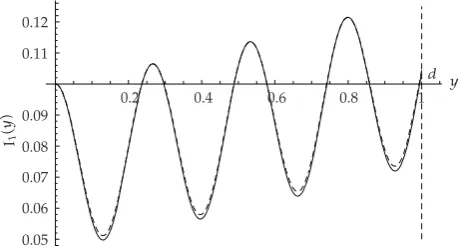
Figure 3:Dependence of the field intensityI1y, aE02inside the slab on the transverse coordinateyfor a|E3|20.1. The other parameters are as inFigure 2. Solid curve corresponds to the first iteration of2.24
and dashed curve to the numerical solution of the system of differential equations2.4,2.5.
iiiIfR1aE02exceeds the prescribed accuracy, calculateI2yaccording to2.24and check again according to stepiior enlarge the accuracy so thatR1aE20is smaller or equalthantothe prescribed accuracy.
The reason for the satisfactory agreement between the exact numerical solution and the first approximationI1y cf.,Figure 3is due to the foregoing explanation.
Ifa|E3|2is fixedas in the numerical example below, and thusaE20according to3.6,
inequality2.42can be used to optimize the iteration approach with respect to another free parameter, for example,dorrorp, as indicated.
Using the first approximation, the phase function can be evaluated according to2.6
as
ϑ1
yarcsinϑ1d−qsI0 y
d dτ I1τ−
y
d dτ I1τ
τ
0
0 2.5
5 7.5 10
ϑ1
y,
a
E
20
0 5
10 15 20
20aE 2
0
0 5
10 15
20 20y
Figure 4:Phase functionϑ1y, aE20according to4.2inside the slab. Parameters are as inFigure 3.
0 0.1 0.2
A
1
d,
a
E
20
0.25 0.5
0.75 11.25
20aE 2
0
0
0.25
0.5
0.75 1
d
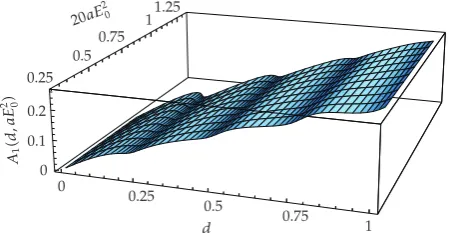
Figure 5:AbsorptanceA1depending on the layer thicknessdand on the incident field intensityaE02for
the same parameters as inFigure 3.
where
sinϑ1d −dI1y/dy
yd
4qc aE02I1d
. 4.3
Thus, the approximate solution of the problem is represented by 4.1 and 4.2. The appropriate parameter isI0 aE20, sinceE
0in4.3can be expressed im terms ofI0as
shown in3.6.
For illustration we assume a permittivity according to
εf
yεf0εR
yiεI
Iy
−0.2 0 0.2
0
.
5
ϑr
1
0 0.2
0.4 0.6
0.8
100aE 2 0
1.5
1
0.5 0
5.5d
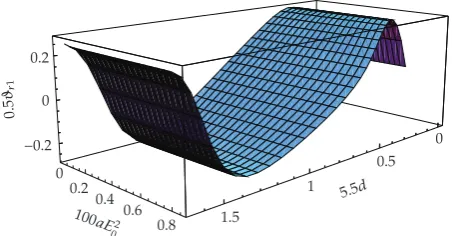
Figure 6:Phase shift on reflectionδr1depending on the layer thicknessdand on the incident field intensity aE2
0for the same parameters as inFigure 3.
with
εR
yγcos2by
d , 4.5
whereε0f, γ, b, d, rare real constants. For simplicity,εIis also assumed to be constant. Results for the first iterate solutionI1y, aE20are depicted in Figures2and3. UsingI1y, aE20, the
phase functionϑ1y, aE2
0, absorptanceA1d, aE20, and phase shift on reflectionδr1y, aE20
are shown in Figures4,5, and6, respectively. The left-hand side of condition2.21 2.39
is 0.572 for the parameters selected in this example. Results forR, T and the phase shift on transmission can be obtained similarly.
5. Summary
Based on known mathematics, we have proposed an iterative approach to the scattering of a plane TE-polarized optical wave at a dielectric film with permittivities modelled by a complex continuously differentiable function of the transverse coordinate.
The result is an approximate analytical expression for the field intensity inside the film that can be used to express the physical relevant quantitiesreflectivity, transmissivity, absorptance, and phase shifts. Comparison with exact numerical solutions shows satisfac-tory agreement.
It seems appropriate to explain the benefits of the present approach as follows.
iThe approach yieldsapproximatesolutions in cases where the usual methodscf., References1–6fail or could not be applied till now.
iiThe quality of the approximate solutions can be estimated in dependence on the parameters of the problem.
On the other hand, the conditions of convergence explicitly depend on the permittivity functions in question and thus have to be derived for every permittivity anewcf.,14and
Appendices
Appendix A
The constant of integrationc2is determined by2.11withy0 as
c2 d 2Iy
dy2
y0
4q2f0−p2I0 2
r2
2rI0 1
1rI0 −ln1rI0
. A.1
According to2.7, the second derivative of the field intensityIyaty0 is given by
d2Iy
dy2
y0
2q2sI0−2qf20−p2I0− 2I
20
1rI0, A.2
leading to, taking into account boundary conditions,E0 E3e−iϑ0and dEy/dy|y00,
c22q2sI0 2
qf20−p2I0− 2I
20
1rI0 2
r2
2rI0 1
1rI0−ln1rI0
.
A.3
Appendix B
WithεRx∈C10, dandεIx∈C0, done obtains
N1
1
κ20max≤y≤d
y
0
sin2κy−τ·ε Rτdτ
≤max
0≤y≤d y
0
y−τ2dτ·εR 1
3d
3ε R,
N2
2
κ0max≤y≤d y
0
sin 2κy−τ· |εRτ|dτ
≤4 max
0≤y≤d y
0
y−τdτ· εR2d2εR,
N3 2 κ0max≤y≤d
y
0
sin 2κ
y−τdτ ≤4max
0≤y≤d y
0
N4N5 1 κ0max≤y≤d
y
0
sin 2κ
y−τdτ
≤2max
0≤y≤d y
0
y−τdτ d2,
Nc4max 0≤y≤d
y
0
|εIz| ·ψ
y, zdz
≤4εImax 0≤y≤d
y
0
y
z
sin 2κ
y−τ
2κ
t
z
|εIτ|dτdtdz
≤4εI2max 0≤y≤d
y
0
y
z
y−tt−zdtdz d 4
6 εI
2,
I0 ≤max
0≤y≤da|E3|
2·cos 2κy|c2|max 0≤y≤d sin2κy
2κ2
4a|c1|max 0≤y≤d
y
0
sin 2κy−t
2κ
t
0
|εIτ|dτdt
≤a|E3|2
1 2|c2|d
24a|c
1| · εImax 0≤y≤d
y
0
y−ttdt
a|E3|21
2|c2|d
2 2
3a|c1| · εId
3. B.1
ForεR, given by4.5, we obtain
εR ≤γ, εR≤ ⎧ ⎪ ⎪ ⎨ ⎪ ⎪ ⎩
2γb2
d , 2b≤1, γb
d, 2b >1.
B.2
Acknowledgments
Financial support by the Deutsche ForschungsgemeinschaftGraduate College 695 ”Nonlin-earities of optical materials”is gratefully acknowledged. One of the authorsV. S. Serov gratefully acknowledges the support by the Academy of FinlandApplication no. 213476, Finnish Programme for Centres of Excellence in Research 2006–2011. The authors are grateful to anonymous referee whose valuable comments have very much helped to improve the quality of the presentation.
References
1 W. Chen and D. L. Mills, “Optical response of a nonlinear dielectric film,”Physical Review B, vol. 35, no. 2, pp. 524–532, 1987.
3 W. Chen and D. L. Mills, “Optical behavior of a nonlinear thin film with oblique S-polarized incident wave,”Physical Review B, vol. 38, no. 18, pp. 12814–12822, 1988.
4 K. M. Leung, “Exact results for the scattering of electromagnetic waves with a nonlinear film,”Physical Review B, vol. 39, pp. 3590–3598, 1989.
5 Th. Peschel, “Investigation of optical tunneling through nonlinear films,”Journal of the Optical Society of America B, vol. 5, no. 1, pp. 29–36, 1988.
6 H. W. Sch ¨urmann and R. Schmoldt, “On the theory of reflectivity and transmissivity of a lossless nonlinear dielectric slab,”Zeitschrift f ¨ur Physik B, vol. 92, pp. 179–186, 1993.
7 H. W. Sch ¨urmann, V. S. Serov, and Yu. V. Shestopalov, “Reflection and transmission of a plane TE-wave at a lossless nonlinear dielectric film,”Physica D, vol. 158, no. 1–4, pp. 197–215, 2001.
8 K. M. Leung, “Exact results for the scattering ofelectromagnetic waves with a nonlinear film,”Physical Review B, vol. 39, pp. 3590–3598, 1989.
9 H. W. Sch ¨urmann and R. Schmoldt, “Optical response of a nonlinear absorbing dielectric film,”Optics Letters, vol. 21, no. 6, pp. 387–389, 1996.
10 K. P. Yuen and K. W. Yu, “Optical response of a nonlinear composite film,”Journal of the Optical Society of America B, vol. 14, no. 6, pp. 1387–1389, 1997.
11 F. J. Gordillo-V´azquez and C. Pecharrom´an, “An effective-medium approach to the optical properties of heterogeneous materials with nonlinear properties,”Journal of Modern Optics, vol. 50, no. 1, pp. 113–135, 2003.
12 E. Zeidler, Applied Functional Analysis: Applications to Mathematical Physics, vol. 108 of Applied Mathematical Sciences, Springer, New York, NY, USA, 1995.
13 I. Stakgold,Boundary Value Problems of Mathematical Physics, vol. 1, Macmillan, New York, NY, USA, 1967.