Research on Localization of Unknown Nodes in Wireless
Sensor Network based on Centroid Iteration
https://doi.org/10.3991/ijoe.v13i03.6867
Dina Li
Xi’an Innovation College of Yan'an University, Xi'an, China [email protected]
Abstract—This paper proposes the localization of unknown nodes based on the centroid iteration algorithm. It uses the range-free localization method and proposes the iteration stopping criterion for centroid iteration algorithm and node localization flow chart according to the location of the unknown nodes based on the plane enclosed by N beacon nodes and those where the received signals of the unknown node are gradually weakened, and finally achieves the accurate localization of unknown communication nodes. Simulation results show that with the proportion of beacon nodes increasing, the relative error of calculation is gradually reduced; when the proportion of beacon nodes remains the same, with the radio range of the node increasing, the relative error of local-ization gradually decreases. When the radio range is small (R=15m, R=20m), with the proportion of beacon nodes increasing, the relative error of localization increases instead of decreasing. Compared with other three traditional centroid localization algorithms, the algorithm proposed in this paper can achieve the minimum relative localization error at different radio ranges. Under this algo-rithm, the localization is accurate and highly resistant to RSSI errors. Calcula-tion results show that the optimal radio range R = 30m.
Keywords—wireless sensor network; centroid iteration algorithm; node locali-zation; range-free localization.
1
Introduction
The wireless sensor network has been widely used in military reconnaissance, harsh environment exploration, disaster relief and other fields. To the wireless sensor network technology, the precise localization of nodes is extremely important - it is the premise for applications like positioning and tracking of monitoring targets and also a basic subject and hot spot in current wireless sensor network researches [1-3].
The range-based localization algorithm locates a node mainly by calculating the dis-tances between the unknown node and the surrounding beacon nodes, mainly includ-ing range-based localization by received signal strength, signal propagation time and time difference of arrival of signals [8]. The range-based localization algorithm is generally highly accurate, but it has high demands for network hardware equipment and requires complex computation – in other words, the communication costs are high [9]. The range-free localization algorithm mainly uses information like network con-nectivity or inter-node hop count to locate a node. It includes the centroid localization algorithm and Monte Carlo localization algorithm [9-11]. The range-free localization algorithm does not need to accurately calculate the distances between the unknown node and beacons nodes, reducing the network computation amount and communica-tion costs [12].
Centroid algorithm is a classic range-free node localization algorithm. The tradi-tional centroid localization algorithm estimates the coordinate of the unknown node by averaging the coordinates of the known nodes around it. However, the computa-tion accuracy is low because the distance between the unknown node and the beacon nodes is not taken into account. Later, researchers improved the traditional centroid algorithm and achieved many research results [13-16].
This paper proposes the localization of unknown nodes based on the centroid itera-tion algorithm. It uses the range-free localizaitera-tion method and proposes the iteraitera-tion stopping criterion for centroid iteration algorithm and node localization flow chart according to the location of the unknown nodes based on the plane enclosed by N beacon nodes and those where the received signals of the unknown node are gradually weakened, and finally achieves the accurate localization of unknown communication nodes. The research results can be used as theoretical reference for the localization of wireless sensor network nodes.
2
Localization of Unknown Nodes based on Centroid Iteration
Algorithm
2.1 Principle for node localization algorithm
Let there be an unknown node M(x, y) on a 2D plane, and the node connects with
N beacon nodes F1, F2, … Fn. Let the coordinate of Fn be (xn, yn), and then the
dis-tance dMn between Fn and M can be expressed as follows:
(
) (
2)
2Mn n n
d
=
x x
!
+
y y
!
(1)Let the centroid of the 2D plane enclosed by F1, F2, … Fn be M1(xM1, y M1), and
1 1 1 1
1
1
N M n n N M n nX
x
N
Y
y
N
= =!
=
""
#
"
=
"$
%
%
(2)The distance dMM1 between M1 and the unknown node M can be expressed as
fol-lows:
(
) (
2)
21 1 1
MM M M
d
=
x x
!
+
y y
!
(3)Based on the above formulas, we can see that when the coordinates of F1, F2, …Fn
and the distances between them and the unknown node are known, we can obtain the coordinate of centroid in the area enclosed by the beacon nodes and the distance be-tween this centroid and the unknown node using Formula (1)-(3). We substitute For-mula (2) into (3) and make a number of simplifications and then:
(
)
2 1(
)
2 1(
)
21 2
1 1 1 1 1
1 N 1 N N N N
MM Mn i j i j
n i j i i j i
d d x x y y
N N ! ! = = = + = = + " # = ! $ ! + ! % & '
(
( (
( (
(4)Let the two terms on the right side of the equation (4) be G1 and G2, which are
simplified into:
(
)
( )
2 1 1 1 2 2 2 1 1 1 1 N Mn n N N ij i j iG d N G d N = ! = = + " = # # $ # = #%
&
& &
(5)dij is the distance between two random beacon nodes Fi and Fj. Let’s suppose the
distances between N beacon nodes and the unknown node M satisfies the following inequality (6):
1 2 3 1
0
<
d
M"
d
M"
d
M" ### "
d
Mn!"
d
Mn (6)According to (6), we can figure out that G1<(dmn)2 and G2>0. According to (1)-(6),
we can get to know that dMM1<dMn, i.e., there is at least one node Fn among the beacon
nodes, whose distance to the unknown node M is definitely greater than the distance
dMM1 between the centroid M1 of the space formed by beacon nodes and M. We
substi-tute M1 for the beacon nodes Fn, which is the farthest away from the unknown node
M, so the new 2D plane is formed by F1, F2, … Fn-1 and M1, and the distance between
the centroid of the new 2D plane and M is definitely shorter than dMM1. By using the
Though this method can help us get a precise node location, it will also increase communication costs and computation amount. Therefore, in this paper, we substitute the received signal strength indicator (RSSI) for the distance between the unknown node and the beacon node to simplify the iterative algorithm. Let the received signal
strength between the unknown node M and Fn be Sn. Then based on the signal
free-space propagation theory, we get:
1 1 Mn n M
d
P
P
d
!"
#
=
$
%
&
'
(7)! is the correlation parameter. Let !=3.2—4.5. Then the RSSI PMM1 between the
unknown node and the centroid M1 is:
( )
2 2
5 1 2
10
1 2
1 1 1
10 1
10
A
A N N N
MM n ij
N i j i
P P d
N N ! ! ! " " " " = = = +
# % & $
' (
= ' )) **" (
+ ,
' (
- .
/
/ /
(8)
The expression for A is A=-10lgP1, with the optimal value range being 45-50.
Ac-cording to Formula (2) and (8), we can continuously narrow the range of the plane where the unknown node is located through multiple iterations without calculating the distances between beacon nodes and the unknown node to increase the node localiza-tion accuracy.
2.2 Conditions to terminate the centroid iteration algorithm
The number of iterations is an important part of centroid iteration localization algo-rithm. Too few iterations cannot make the computation reach a high accuracy while too many iterations will increase computation amount and also can easily put the algorithm in an infinite loop. According to the preceding section, we can get to know
that when the number of iterations is n+1, the distance dMMn+1 between the centroid
Mn+1 of the 2D plane formed by F1, F2,…Fn-1 and Mn and the unknown node should
satisfy the following equation:
(
) (
)
( )
(
)
1 2 2 2 1 2 1 2
1 2
1 1 1 1
1 N 1 N N N
MMn Mn MMn ij iMMn
n i j i i
d d d d d
N N ! ! ! ! + = = = + = " # " # = $ + %! $ + %
&
(
' &( (
(
' (9)diMMn is the distance between the i-th beacon node Fi and the centroid of the 2D
plane obtained after n iterations. The centroid distance after 2 iterations is:
(
) (
2)
2 1(
)
2 1(
)
21 1 2
1 1
1 1 N N
MMn MMn Mn MM iMMn iMn
i i
d d d d d d
N N ! ! + = = " # " #
! = & ! '+ $ ! %
Let the two terms on the right side of the equation be G3 and G4. Then we can
easi-ly figure out that G3>0 and G4<0. After making a number of transformations to (10),
we get:
(
) (
2)
2(
)(
)
21 1 2
1
1
MMn MMn Mn MM NMMn
N
d
d
d
d
d
N
N
+
+
!
"
#
=
$
#
%
#
(11) From (11), we can see that with the number of iterations increasing, the area of the plane formed by various nodes will gradually decrease, but when the number of itera-tions reaches a certain value, the accuracy of the unknown node localization after n+1 iterations may not necessary be higher than that after n iterations.
In order to cover all circumstances, we consider the location of the unknown node M in two scenarios:
(1) The unknown node has always been in the 2D plane formed by the beacon nodes. Then the condition to terminate the algorithm is when the RSSI between the centroid obtained after iterations and the unknown node M is greater than the set threshold value "1, i.e.:
1
MMn
P
>
!
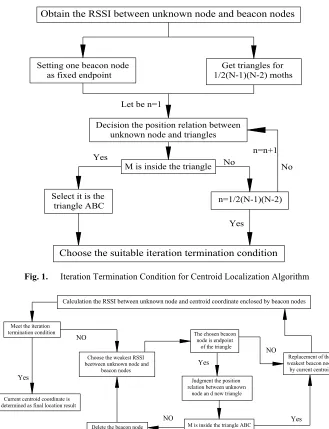
(12)(2) The unknown node is outside the 2D plane formed by the beacon nodes. Then we choose any beacon node as the fixed end point and construct 1/2(N-1)(N-2) trian-gles. And the condition to terminate the algorithm is when the rate of change in the estimation accuracy of the localization algorithm is less than a certain threshold value
"2, i.e.
1 2
MMn MMn
P
"
P
"<
!
(13)3
Centroid Iteration Algorithm Flow and Simulation Test
3.1 Iteration algorithm flow
Obtain the RSSI between unknown node and beacon nodes
Setting one beacon node
as fixed endpoint 1/2(N-1)(N-2) moths Get triangles for
Let be n=1
Decision the position relation between unknown node and triangles
M is inside the triangle
Yes No
Select it is the
triangle ABC n=1/2(N-1)(N-2)
n=n+1
Choose the suitable iteration termination condition
No
Yes
Fig. 1. Iteration Termination Condition for Centroid Localization Algorithm
Calculation the RSSI between unknown node and centroid coordinate enclosed by beacon nodes
Yes
Current centroid coordinate is determined as final location result
Choose the weakest RSSI beetween unknown node and beacon nodes
The chosen beacon node is endpoint of the triangle
Judgment the position relation between unknown node an d new triangle
M is inside the triangle ABC Delete the beacon node
Replacement of the weakest beacon node by current centroid Meet the iteration
termination condition
Yes
NO
Yes
NO NO
Fig. 2. Flow Chart of Node Localization Algorithm Based on Centroid Localization Algo-rithm
node as the new triangle endpoint and use the algorithm proposed in this paper to determine the relation between M and the new triangle. Afterwards, it determines the iteration algorithm per Fig. 1 and carry out node localization.
3.2 Simulation test
We perform simulation and analysis of the proposed centroid iteration algorithm.
The design range of the wireless sensor network is 200m!200m, and the radio range
of the beacon nodes is 100m. Let’s suppose there are B beacon nodes in the test area
and U unknown nodes. Unknown nodes are randomly distributed in the sensing area, while beacon nodes are evenly distributed in the entire test area. We define the rela-tive error of the centroid iteration algorithm in node localization as:
(
) (
2)
21
1 U
c c
i
Err x x y y
U R =
= ! + !
"
#
(14)R is the communication radius of the node; (x,y) is the real coordinate of the
un-known node; and (xc,yc) is the coordinate obtained by the centroid iteration
localiza-tion algorithm.
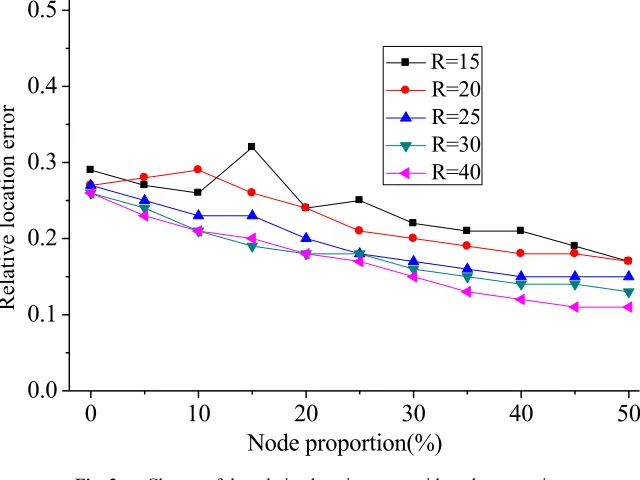
Fig. 3 shows the relative location error of the centroid iteration algorithm under
different proportions of beacon nodes around the unknown node when R=15m, 20m,
25m, 30m and 40m. From the figure we can see that, on the whole, with the increase in the proportion of beacon nodes, the relative error is on gradual decrease; with the same proportion of beacon nodes, when the communication radius of the node is increased, the relative location error is gradually decreased. We can also see from the figure that when the communication radius is small (R=15m or R=20m), with the increase in the proportion of beacon nodes, the relative location error is increased. That is because when the communication radius is small, there is a greater chance that the unknown node will appear in the 2D plane formed by beacon nodes. So the loca-tion accuracy of the algorithm experiences irregular fluctualoca-tions.
0
10
20
30
40
50
0.0
0.1
0.2
0.3
0.4
0.5
R
ela
tiv
e l
oc
atio
n
er
ror
Node proportion(%)
!
R=15
R=20
R=25
R=30
R=40
Fig. 3. Change of the relative location error with node proportion
0
10
20
30
40
50
0.0
0.1
0.2
0.3
0.4
0.5
0
10
20
30
40
50
0.0
0.1
0.2
0.3
0.4
R=20m
!This paper MCL Centroid APIT
R
el
at
ive l
ocat
ion error
R=40m
Node proportion(%)
0
10
20
30
40
50
0
5
10
15
20
25
30
A
ve
ra
ge
lo
ca
tio
n e
rr
or
(m
)
Node communication radius(m)
!
5 beacon nodes
7 beacon nodes
10 beacon nodes
14 beacon nodes
17 beacon nodes
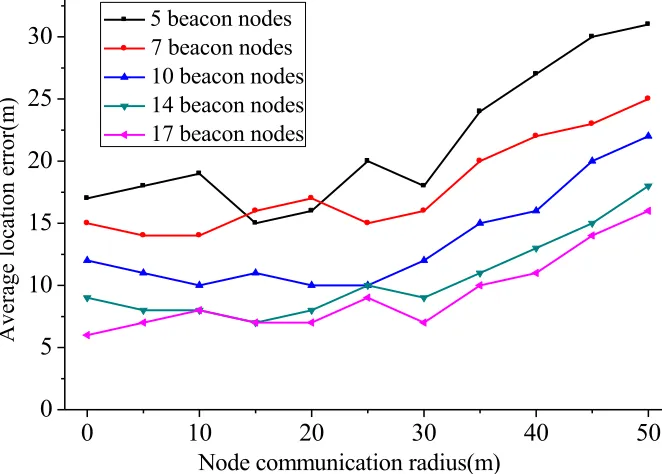
Fig. 5. The average location error with different beacon nodes
Fig. 5 shows the changes in the average location error with the increase in the communication radius when there are 5, 7, 10, 14 and 17 beacon nodes around the unknown node M. From the figure, we can see that then when the communication radius remains unchanged, the more beacon nodes there are, the smaller the average location error will be; we can also see that, under any of the 5 numbers of beacon nodes, when the communication radius is 0-30m, there is not much change in the location error; when the communication radius is greater than 30m, the error is signif-icantly increased. So based on all the analysis, we conclude that the optimal commu-nication radius R=30m.
4
Conclusions
This paper proposes the localization of unknown nodes based on the centroid itera-tion algorithm. It uses the range-free localizaitera-tion method and achieves the accurate localization of unknown communication nodes through the plane enclosed by N bea-con nodes and those where the received signals of the unknown node are gradually weakened. The conclusions of this research are as follows:
(2) Simulation results show that with the proportion of beacon nodes increasing, the relative error of calculation is gradually reduced; when the proportion of beacon nodes remains the same, with the radio range of the node increasing, the relative error of localization gradually decreases. When the radio range is small (R=15m, R=20m), with the proportion of beacon nodes increasing, the relative error of localization in-creases instead of decreasing. Compared with other three traditional centroid localiza-tion algorithms, the algorithm proposed in this paper can achieve the minimum rela-tive localization error at different radio ranges. Under this algorithm, the localization is accurate and highly resistant to RSSI errors. Calculation results show that the opti-mal radio range R = 30m.
5
References
[1]Wang, X., Bischoff, O., Laur, R., Paul, S. (2009). Localization in wireless ad-hoc sensor networks using multilateration with rssi for logistic applications. Procedia Chemistry, 1(1), 461-464. https://doi.org/10.1016/j.proche.2009.07.115
[2]Go, S., Chong, J. W. (2015). Improved toa-based localization method with bs selection scheme for wireless sensor networks. Etri Journal, 37(4), 707-716. https://doi.org/10.4218/ etrij.15.0114.1251
[3]Wen, C. Y., Chan, F. K. (2010). Adaptive aoa-aided toa self-positioning for mobile wire-less sensor networks. Sensors, 10(11), 9742-9770. https://doi.org/10.3390/s101109742
[4]Zhao, J., Zhao, Q., Li, Z., Liu, Y. (2013). An improved weighted centroid localization al-gorithm based on difference of estimated distances for wireless sensor networks. Tele-communication Systems, 53(1), 25-31. https://doi.org/10.1007/s11235-013-9673-6
[5]Zhao, C., Xu, Y., Huang, H. (2014). Weighted centroid localization based on compressive sensing. Wireless Networks, 20(6), 1527-1540. https://doi.org/10.1007/s11276-014-0686-1
[6]Tomic, S., Mezei, I. (2016). Improvements of dv-hop localization algorithm for wireless sensor networks. Telecommunication Systems, 61(1), 93-106. https://doi.org/10.1007/ s11235-015-0014-9
[7]Niculescu, D., Nath, B. (2003). Dv based positioning in ad hoc networks. Telecommunica-tion Systems, 22(1), 267-280. https://doi.org/10.1023/A:1023403323460
[8]Baggio, A., Langendoen, K. (2008). Monte-carlo localization for mobile wireless sensor networks. Ad Hoc Networks, 6(5), 718-733. . https://doi.org/10.1016/j.adhoc.2007.06.004
[9]Huang, R., Záruba, G. V. (2009). Monte carlo localization of wireless sensor networks with a single mobile beacon. Wireless Networks, 15(8), 978-990. https://doi.org/10.1007/ s11276-008-0096-3
[10]Shen, X., Wang, Z., Jiang, P., Lin, R., Sun, Y. (2005). Connectivity and rssi based locali-zation scheme for wireless sensor networks. Lecture Notes in Computer Science, 3645, 578-587. https://doi.org/10.1007/11538356_60
[11]Hu, Y., Yao, W. (2011). Linear-regression-based weighted centroid localization algorithm in wireless sensor network. Procedia Engineering, 15(9), 3068-3072.
[12]Meng, X. Z., Song, B. Y. (2009). Hwc locating algorithm in wireless sensor network. Computer Engineering, 35(7), 104-106.
[14]Sasikala, E., Rengarajan, N. (2015). An intelligent technique to detect jamming attack in wireless sensor networks (wsns). International Journal of Fuzzy Systems, 17(1), 76-83.
https://doi.org/10.1007/s40815-015-0009-4
[15]Sivasankari, H., Aparna, R., Venugopal, K. R., Iyengar, S. S., Patnaik, L. M. (2013). Tgar: trust dependent greedy anti-void routing in wireless sensor networks (wsns). Lecture Notes in Electrical Engineering, 150, 39-45. https://doi.org/10.1007/978-1-4614-3363-7_5
[16]Sivasankari, H., Venugopal, K. R., Iyengar, S. S., Patnaik, L. M. (2012). Bayesian estima-tion model for trust dependent greedy antivoid routing (tgar) in wireless sensor networks (wsns). Science of Computer Programming, 12(3), 207-253.
6
Author
Dina Li, female, Fuping City of Shaanxi Province, China, lecturer, graduate. Re-search areas: communication system, modern signal processing, microcontroller sys-tem development, wireless sensor networks, etc. Now engaged in the research and teaching of electronic technology, signal processing, microcontroller technology and wireless sensor networks as primary lecturer in Xi'an Innovation College of Yan'an University, Xi'an 710100, China ([email protected]).