Vol. 5, No. 4 (2015): 1181-1188 Research Article
Open Access
I
ISSSSNN::22332200--66881100
Overcoming medication errors
Leon Cruz A/L Francis Cruz
1* and Panisha Nagarathnam
21
Asia Metropolitan University, Faculty of Pharmacy, Selangor, Malaysia. 2
La Trobe University, Faculty of Pharmacy, Australia.
* Corresponding author: Leon Cruz A/L Francis Cruz, e-mail: [email protected]
ABSTRACT
The overview of a medication error and certain types of error that could cause patients medication plan to turn into a wrong way. Medication error also could lead to many other unwanted outcomes that could be harmful to patient. The types of medication errors that normally occur with its explanation are given. A potential error from the prescriber is explained and the error from the perspective of patient is also mentioned. There are certain steps that can be taken in order to overcome these medication errors and how a patient can react in order to overcome these medication errors. An example of a medication error case study is also presented with the discussion on the error.
Keywords:
Medication error.1. INTRODUCTION
Medication errors, broadly defined as any error in the prescribing, dispensing, or administration of a drug, irrespective of whether such errors lead to adverse consequences or not, are the single most preventable cause of patient Harm. A medication error is any preventable event that may cause or lead to inappropriate medication use or client harm while the medication is in control of health care professional client or consumers [1].
As we all know medication error is a major issue that is going on in the health care side. What is a medication error? In a normal term medication error it means that an error occur in the treatment plan. There are various errors that can take place which can cause serious problems to the patient. Below are some example of types of errors and the fundamental causes of error,
Choosing a medicine—irrational, inappropriate, and ineffective prescribing, under prescribing and overprescribing;
Writing the prescription—prescription errors, including illegibility;
Manufacturing the formulation to be used— wrong strength, contaminants or adulterants, wrong or misleading packaging;
Dispensing the formulation—wrong drug, wrong formulation, wrong label;
Administering or taking the drug—wrong dose, wrong route, wrong frequency, wrong duration;
Monitoring therapy—failing to alter therapy when required, erroneous alteration.
Medication error can lead to ‘a failure in the treatment process that leads to, or has the potential to lead to, harm to the patient’ [2]. The term here means that the
failure in the treatment, this can be due to patient compliance, or can be due to the prescriber or due to the pharmacist who is dispensing the medication. It depends who is the cause of the medication error. Medication error can also be due to the failure of the medication plan to be completed as intended, or the use of an incorrect medication plan to achieve a goal. Examples of certain medication errors are
HYDROXYZINE HCL 50 mg for HYDRALAZINE HYDROCHLORIDE 50mg
0.5mg XANAX is mistaken for 5mg of XANAX
Amoxicillin for Ampicillin
This medication errors could lead to many fetal and many other secondary causes that could be a treat and could not be cured. Medication error is things that are taking place in a healthcare setting in a daily basis. Certain hospitals have come up with certain plans that Received: 11 June 2015 Accepted: 10 July 2015 Online: 27 July 2015
could reduce the medication errors and yet there are
mistakes that are taking place this is due to carelessness and lack of attention and also knowledge and many other factors.
Table 1: Types of Medication Error
1.1 Errors Due to Prescriber
Prescribers can be also a major factor causing the medication error to occur. Prescriber that has lack of knowledge on the certain drug is a cause also [3]. If the prescriber has less knowledge about a drug then the prescriber could not determine if that particular drug is suitable for the patient or not based on the patient’s condition, this could be a cause to make the treatment plan to be a failure. When the prescriber has lack of knowledge on the contraindication and the indications then this could be something that is dangerous. Normally a prescriber only can prescribe a medication to patient after diagnosing the patient and getting to know the patient’s condition well. If the prescriber fail to be well versed in the medication that is about to be prescribe then the treatment would be a failure. The prescriber has to also consider the patients conditions such as allergies, pregnancy and co-morbidities. If the patient do not consider all this then the medication could cause more harmful effect to the patient comparing to good outcome.
Wrong patient
Wrong dose
Wrong time
Wrong drug
Wrong route
Dispensing a medication to a wrong patient is something that happens even till today, the best way to overcome this is by asking the patient their name and to confirm that before the medication is dispensed. By practicing this we can overcome the problem of wrong patient which is also included as part of medication error. Even patient should be alert to see the name stated of the medication to overcome this problem of medication error. Wrong dose is something that is very crucial as we know medication could cause many problems by just a slight increase in the medication dose. Moreover drugs with a narrow therapeutic index like example DIGOXIN could be threat to life. Drugs with narrow therapeutic index have to monitor through therapeutic drug monitoring system (TDM). [4] Drugs such as Paracetamol taking in a wrong dose could lead to hepatotoxicity. [5] Wrong timing of medication or wrong frequency of medication is also considered as a medication error. Wrong timing of medication could not produce the desired effect of the drug this could lead to failure in the drug treatment plan. For example drug that is used for treating peptic ulcer the proton pump inhibitor (Omeprazole, Pantoprazole) have to be taken 30mins before meal to suppress the acid production. [6] By taking the drug in a wrong time the treatment plan would not be achieved. Prescriber that prescribe wrong drug is a major part of medication error. This confusion can be due to the drugs name.
Table 2: Example of Sound alike Drugs
This could be a major cause that prescriber prescribe the wrong drug to the patient. This is a leading factor of medication error that causes patients life to be in threat. Wrong route of a medication is also a cause of medication error. Medication that supposed to be administered via intramuscular but the medications is administer via intravenous could cause complication to the patient [7]. Drugs if not given in the intended route could not produce the desired outcome; this would lead
to a main factor of treatment failure in the patient. At times the reason behind the wrong route of medication is due to lack of training in administering the medication [8].
Handwriting is a factor that leads to many medication errors as prescribers do not write it in a tidy way which causes misinterpretation of the prescription and this also increases the workload of the pharmacist.
Figure 2: Example of untidy writing on a prescription.
Example of physicians’ handwriting that could not be read and this is a factor that causes much medication error. Verbal communication is also a fact that causes a medication error. Lack of clear communication skill can cause medication error.[9] Inadequate information in
the prescription can also lead to medication error. Because medication is dispensed based on the order in the prescription thus when the dose or frequency or the medication name not written properly it could cause medication error.
In certain situation staffs in the hospital could also be a factor that leads to medication error and this is due to the circumstances.
Pressure
Lack of experience
Multitasking
Failure to check
Poor communication.
Absence of safety cultures in the workplace
1.2 Errors Due to Patient
Medication error can also be due to patient and patient itself can be a cause to the failure to the treatment plan [10]. This is stated because patients do not take active role in their own medication use, by having this attitude of being careless can contribute to the errors. Patients need to be actively involved in their medication plan to ensure there is a positive outcome and they follow the orders that are given by the physician or the pharmacist. Another factor that could cause medication error from the patients prospective is due to the fact that patients have more than 1 doctor. They might be consulting with few doctors for a disorder and this could lead to confusion within the patient. Different physicians have a different treatment plan for each patient so by having few doctors it could lead to confusion and could lead to medication error, and then finally the treatment plan will be a failure [11]. Patient compliance is also an issue that could cause a medication error in patient [12]. At times there are certain patient who does not reveal much about their disease conditions and other co-morbidities to the physicians and this could be a factor that leads to medication error in patients. Patients who are on poly pharmacy should take more care and be more active in their treatment plan as they are having few medications to be taken at a time thus this could lead to medication error [13]. Patients who cannot communicate well with the doctors also could be a cause of medication error [14].
2. STEPS TO BE DONE TO OVERCOME MEDICATION ERROR
There are certain measures taken to overcome the medication error problem in the healthcare setting. “Prevention is always better then cure”, thus certain steps have to be taken in order to overcome the medication error problems. There will be a great impact and reduce in rate of medication error if the healthcare professionals start implementing measures to overcome the medication error problem.
Always double check "high-alert drugs" by doing independent calculations. High-alert drugs are those medications that have an increased risk of causing harm to patients when used in error. By double checking the medication it can prevent many medication errors and added on to this proper labeling should be done for medications that look alike or sound alike. Thus this can make the person who handling the drug to differentiate the drug well and will reduce medication error. By
developing this checking habits errors can be reduce and patient’s life won’t be in threat.[15]
Using generic name is also a good way to overcome medication errors, as that would be a common name and the pharmacist would know the best brand drug to be given in that particular generic name. Physicians also should practice a good writing skill with a complete prescription with the full name, dosage form, strength, frequency. Physicians should practice being more careful when the prescription is written.[16]
The prescriber should know the medication well before the medication is prescribed in taking into consideration of the patients conditions such as, allergies, co-morbidities, other medication, pregnancy and breast feeding, patients’ size. By taking all this into consideration then the prescriber should prescribe the drug. In order for this to take place in a smooth way the prescriber should know well about the drug. Thus prescriber should do a good homework on the medication they prescribed.
The prescriber should also question the patients on any other medication and OTC medication and the dietary supplements by knowing all this conditions then the prescriber can know the drug- drug interaction, drug – food interaction and etc.
The prescribed should use memory aids such as textbooks, the primary source, secondary source, and the tertiary sources for a better confirmation of the medication information to avoid errors.
There are some specific abbreviations that have been frequently mistaken and caused medical errors. These symbols or abbreviations should never be used in any form of communication, including writing prescriptive orders. An example would be writing "qd" for a daily order that can be misinterpreted for "qid," which would quadruple the dose. Another error-prone abbreviation would be to use "U" for a unit. U has sometimes been misinterpreted as a zero, causing an overdose of 10 times the amount of medication that was intended for a patient. The bottom line is that healthcare professionals should write out the words rather than using commonly misread symbols or abbreviations.
the amount of medicine needed. In this case, the zero should precede the decimal point, as in 0.1 mg.
Sufficient personnel must be available to perform tasks adequately. Policies and procedures should ensure that reasonable workload levels and working hours are established. Suitable work environments should exist for the preparation of drug products. Potential error sources within the work environment, such as frequent interruptions, should be identified and minimized. [17] Lines of authority and areas of
responsibility within the hospital should be clearly defined for medication ordering, dispensing, and administration. The system should ensure adequate written and oral communications among personnel involved in the medication use process to optimize therapeutic appropriateness and to enable medications to be prescribed, dispensed, and administered in a timely fashion. All systems should provide for review and verification of the prescriber’s original order (except in emergency situations) before a drug product is dispensed by a pharmacist. Any necessary clarifications or changes in a medication order must be resolved with the prescriber before a medication is administered to the patient. Written documentation of such consultations should be made in the patient’s medical record or other appropriate record. Nursing staff should be informed of any changes made in the medication order. Changes required to correct incorrect orders should be regarded as potential errors, assuming the changes occurred in time to prevent the error from reaching the patient
All discontinued or unused drugs should be returned to the department of pharmacy immediately on discontinuation or at patient discharge. Discharged patients must not be given unlabeled drug products to take home, unless they are labeled for outpatient use by the pharmacy in accordance with state and federal regulations. Discharged patients should be counseled about use of any medications to be used after discharge.
2.1 Patients Role to Overcome Medication Error
1. Make a medication list, this list is to ensure all the medications taken are on time and it’s easy to give the physicians for further treatment plan.
2. Together with this list also patient can write down the instruction of the medication in the way that they could understand to avoid complications when administering the drug. 3. Patients should be actively involved in the
medication plan to make sure that the patient is aware of the medication taken and the use of the medication. By this they can know the
things that they should avoid when the on the medication to give a better outcome to the patient.
4. Patients should ask question to the prescriber for a better understanding of the drug and the treatment plan. Example of a questions patient should ask the doctor while the treatment is planned.
a. What is the medication’s name and what is it supposed to do?
b. How often and how long should I take the medication?
c. Are there potential side effects? Which side effects should I report?
d. Should the medication be taken until it’s finished or just until I feel better? e. Should I avoid particular foods,
beverages, medicines or activities while taking this medication?
f. Is a generic equivalent available and appropriate?
5. Don’t take any other persons medication because the dose might be different based on the size of the body. As the dose can be different so patients have to avoid this. Patient should also avoid taking expired medication as it could also cause problem.
2.2 Example of Case Study Due to Medication Error
A 52-year-old male taking warfarin daily for prevention of stroke with atrial fibrillation develops a skin infection and visits the local urgent care center on a weekend for treatment. The patient receives a diagnosis of cellulitis and a prescription for Bactrim®, trimethoprim/sulfamethoxazole (TMP/SMX), to be taken twice daily. The drug is dispensed by a pharmacy near the urgent care center, not the patient’s usual pharmacy. Several days later, the patient is admitted to the hospital with an acute bleed and an elevated international normalized ratio (INR).
Warfarin is a most frequently prescribed drug for the case of stroke or Atrial fibrillation. As we all also know that Warfarin is more prone to medication error and interaction. It has more food drug interaction, drug-drug interaction. Patient on Warfarin, have to be very careful on the diet plan and the other medications that the patients take. There are many factors that could lead the increase in the INR reading of the patient.
In the scenario above, a medication was prescribed that was known to affect the metabolism of Warfarin. Studies have shown that through inhibition of CYP enzymes, TMP/SMX as well as other antibiotics and medications may significantly increase Warfarin levels and the patient’s INR, therefore placing the patient at increased risk for bleeding. The best way is for the pharmacist to choose an antibiotic that has less effect on the Warfarin.
aware of his entire medical or medication history, including the use of Warfarin. The person who is prescribing the medication should have adequate amount of knowledge on the drug before it is dispensed to the patient. A patient receiving the Warfarin medication should be advised on the importance and all safety measures of the drug to be actively participating in the treatment plan to avoid any problems.
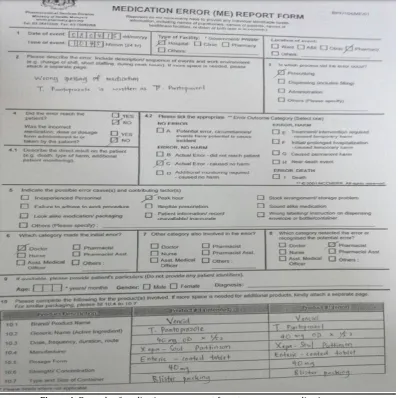
The methodology here is based on the observation and studying the cases in a hospital to measure and ensure the types medication error. By the observation the types and the cause could be diagnose and the steps to prevent the medication error could also be identified
and it could be suggested. The example of the form is attach as a prove of the methodology and how it was done.
3. CONCLUSION
Medication error is something that every healthcare professionals and patient should take into consideration, as this is one of the most common problems that we all face in the healthcare field. Physicians, pharmacist, nurses have to practice more the measures to overcome and to avoid medication error.
Figure 4: Example of medication error report form to overcome medication error.
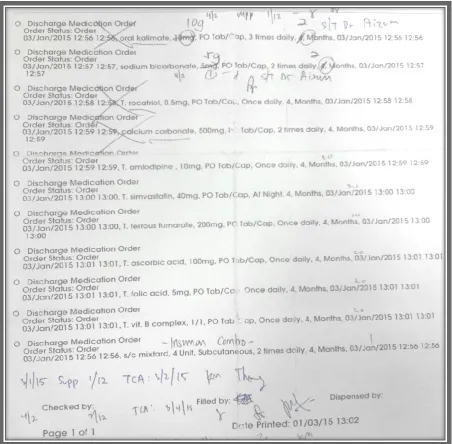
Figure 6: Example of discharge prescription with error.
4. REFERENCES
1. Lesar, T. S., Briceland, L., & Stein, D. S. (1997). Factors related to errors in medication prescribing. Jama, 277(4), 312-317.Roy, V., Gupta, P., & Srivastava, S. (2006). CHAPTER-14 MEDICATION ERRORS: CAUSES & PREVENTION. Health administrator, 19(1), 60-64.
2. Allan, E. L., & Barker, K. N. (1990). Fundamentals of medication error research.American Journal of Health-System Pharmacy, 47(3), 555-571.
3. Hartwig, S. C., Denger, S. D., & Schneider, P. J. (1991). Severity-indexed, incident report-based medication error-reporting program. American Journal of Health-System Pharmacy, 48(12), 2611-2616.
4. Desoky, E. S. E., Al-Ghamdi, H. A., Halaby, F. H., & Al-Beshri, M. (2003). Therapeutic monitoring of digoxin and antiepileptic drugs in Egypt and Saudi Arabia. Therapeutic drug monitoring, 25(2), 211-214.
5. Moling, O., Cairon, E., Rimenti, G., Rizza, F., Pristerá, R., & Mian, P. (2006). Severe hepatotoxicity after therapeutic doses of acetaminophen. Clinical therapeutics, 28(5), 755-760.
6. Richardson, P., Hawkey, C. J., & Stack, W. A. (1998). Proton pump inhibitors.Drugs, 56(3), 307-335.
7. Calabrese, A. D., Erstad, B. L., Brandl, K., Barletta, J. F., Kane, S. L., & Sherman, D. S. (2001). Medication administration errors
in adult patients in the ICU. Intensive care medicine, 27(10), 1592-1598.
8. Osborne, J., Blais, K., & Hayes, J. S. (1999). Nurses' perceptions: when is it a medication error?. Journal of Nursing Administration, 29(4), 33-38.
9. Hulka, B. S., Cassel, J. C., Kupper, L. L., & Burdette, J. A. (1976). Communication, compliance, and concordance between physicians and patients with prescribed medications. American Journal of Public Health, 66(9), 847-853.
10.Cohen, Michael Richard. Medication errors: causes, prevention, and risk management. Jones & Bartlett Learning, 1999. 11.Anderson, D. J., & Webster, C. S. (2001). A systems approach
to the reduction of medication error on the hospital ward. Journal of advanced nursing, 35(1), 34-41.
12.Hulka, B. S., Cassel, J. C., Kupper, L. L., & Burdette, J. A. (1976). Communication, compliance, and concordance between physicians and patients with prescribed medications. American Journal of Public Health, 66(9), 847-853.
13.Hajjar, E. R., Cafiero, A. C., & Hanlon, J. T. (2007). Polypharmacy in elderly patients. The American journal of geriatric pharmacotherapy, 5(4), 345-351.
nursing home setting. Journal of the American Medical Directors Association, 8(9), 568-574.
15.Zhan, C., Hicks, R. W., Blanchette, C. M., Keyes, M. A., & Cousins, D. D. (2006). Potential benefits and problems with computerized prescriber order entry: analysis of a voluntary medication error-reporting database. American Journal of Health-System Pharmacy, 63(4), 353-358.
16.Berman, A. (2004). Reducing medication errors through naming, labeling, and packaging. Journal of medical systems, 28(1), 9-29.
17.Aronson, J. K. (2009). Medication errors: what they are, how they happen, and how to avoid them. QJM, 102(8), 513-521.
*****