Volume 9 Article 12
4-1-2011
Synthesis of Element 117
Robert de Lara
College of DuPage
Follow this and additional works at:http://dc.cod.edu/essai
This Selection is brought to you for free and open access by the College Publications at [email protected].. It has been accepted for inclusion in ESSAI by an authorized administrator of [email protected].. For more information, please [email protected].
Recommended Citation
17
Synthesis of Element 117
by Robert de Lara
(Honors Chemistry 1552)
hemical Engineering News reports the creation of two isotopes of superheavy element 117 at the Flerov Laboratory of Nuclear Reactions (FLNR) at the Joint Institute for Nuclear
Research (JINR) in Dubna, Russia. Ununseptium (Uus) is the temporary name of element 117. In their experiment, six atoms of two isotopes were synthesized, 293117 and 294117, with the
results being published in Physical Review Letters on April 9th, 2010 (Oganessian et al. 2010). It was conducted under FLNR lead physicist Yu. Ts. Oganessian.
Previously, superheavy elements were synthesized via reactions between stable neutron-rich projectiles such as heavy nickel-64 or zinc-70 being shot at doubly magic lead-208 or singly magic bismuth-209. These reactions were termed “cold fusion” and have led to the discovery of isotopes with atomic number (Z) less than or equal to 113 and the number of neutrons (N) less than or equal to 165.
A new method for synthesizing superheavy elements was pioneered at the JINR for elements with Z greater than or equal to 112 and N close to the stable, magic number of 184. In this process, doubly magic calcium-48 projectiles were fired at actinide (Z=89 - 103) radioactive targets of uranium-curium and californium. Four isotopes of element Z = 112 and 14 new isotopes of elements Z = 113-116 and 188 were identified using this new technique (Oganessian et al. 2010). Alpha decay was observed for each synthesized isotope, which would terminate via spontaneous fission. Total decay times for these isotopes ranged from 0.1 s to 1 minute, increasing as Z decreases. Recently, the synthesis of these isotopes has been confirmed by several independent studies (Wilson and Kemsley 2010).
In June 2009 the FLNR laboratory began a seven month long experiment to synthesize element 117 in which the team would modify their technique. In this instance, isotopes of element 117 were produced in a fusion reaction in which calcium-48 projectiles were smashed repeatedly onto targets coated with radioactive 249. To accomplish this, six arc-shaped berkelium-249 plates were created at the Research Institute of Atomic Reactors. These arc-shaped plates were then mounted onto a rotating disc that revolved at 1700 rpm (see Figure 1). Calcium-48 projectiles were then fired at the targets at two different excitation energies of 35 MeV (dose 2x10¹⁹) and 39
MeV (dose 2.4×10¹⁹) employing the Dubna gas-filled recoil separator and the heavy ion cyclotron
U-400 at the JINR (Oganessian et al. 2010). In rare instances, the two elements fused to produce two isotopes of the new superheavy element, 293117 and 294117. In April 2010, the FLNR published their
results stating that one atom of 294117 and five atoms of 293117 had been synthesized (Wilson and
Kemsley 2010).
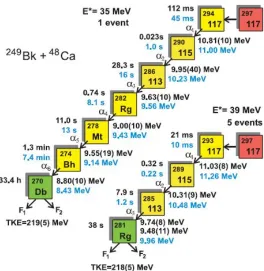
In addition to the projectile-target apparatus, sensors were positioned around the apparatus to detect particles from alpha decay thus allowing for decay chains to be constructed for element 117 (see Table 1). Like its cousins element 116 and element 118, which have already been created, the decay chain for element 117 has isotopes with half-lives that are in keeping with theories of elements near the presumed “island of stability”. This is to say, that as the 293117 and 294117 isotopes
underwent alpha decay, the observed half-life grew larger before reaching spontaneous fission at roentgenium-281 and darmstadtium-270 respectively (see Table 1). Half-life was observed to be 1.2 seconds and 7.4 minutes at these endpoints (seen in blue in Table 1). Independent theoretical
calculations in a quantum tunneling model predicted the alpha-decay half-lives of isotopes of
C
ununseptium (namely, 289–303117) to be around 0.1–40 ms which would be consistent with the FLNR results (Samanta et al. 2007). Element 117 was more difficult to create than 116 and 118 for a number of reasons, says team member and LLNL nuclear chemist Dawn Shaughnessy. Odd-numbered elements have more complex decay chains in addition to the radioactive berkelium-249 plated having a half-life of only a year (Wilson and Kemsley 2010).
The significance of creating these superheavy elements is that by observing the trend in decay, further evidence for the existence of an “island of stability” can be generated. This is to say
that isotopes of some transuranium elements (Z greater than 92) would be able to be much more stable, with half-lives of at least minutes or days as compared to fractions of a second. In the results for the synthesis of element 117, the trend of increasing half-life as the isotope got lighter supports the theory of an “island of stability”.
The hypothesis of an “island of stability” was proposed first by Glenn T. Seaborg which incorporates the additional hypothesis that the atomic nucleus is made of “shells” or quantum energy levels for protons and neutrons to populate. Complete shells are said to be “stable” and to have longer half-lives than isotopes with incomplete shells. A filled shell occurs at a “magic number” of neutrons and protons i.e. 2, 8, 20, 126. Magic number 184 is a possible number of neutrons for superheavy elements. If element 117 could be synthesized to create 301117 (N=184) it would
19
Figure 1: Synthesis for Element 117 Isotopes
Table 1: Decay Chains for 293117 and 294117
References
Samanta, C.P., D.N. Basu, and R. Chowdhury. 2007. Predictions of alpha decay half-lives ofheavy and superheavy elements. Nucl. Phys. A789: 142
Wilson, E.K. and J. Kemsley. 2010. Element 117 Created. Chemical and Engineering News 15:9 Yu. Ts. Oganessian,F. Sh. Abdullin, P. D. Bailey, D. E. Benker, M. E. Bennett, S. N.
Dmitriev, J. G. Ezold, J. H. Hamilton, R. A. Henderson, M. G. Itkis, Yu.V. Lobanov, A. N. Mezentsev, K. J. Moody, S. L. Nelson, A. N. Polyakov, C. E. Porter, A.V. Ramayya, F. D. Riley, J. B. Roberto, M. A. Ryabinin, K. P. Rykaczewski, R. N. Sagaidak, D. A.
Shaughnessy, I.V. Shirokovsky, M. A. Stoyer, V. G. Subbotin, R. Sudowe, A. M. Sukhov, Yu. S. Tsyganov, 1V. K. Utyonkov, A. A. Voinov, G. K. Vostokin, and P. A. Wilk. 2010. Synthesis of a New Element with Atomic Number Z = 117. Physical Review Letters 14: 142502-142506.
Sources
http://pubs.acs.org/cen/email/html/8815notw8.html http://en.wikipedia.org/wiki/Element_117
http://en.wikipedia.org/wiki/Half_life
http://en.wikipedia.org/wiki/Radioactive_decay http://en.wikipedia.org/wiki/Alpha_decay http://en.wikipedia.org/wiki/Mass_number http://en.wikipedia.org/wiki/Halogen
http://en.wikipedia.org/wiki/Island_of_stability