159
The Paradox of Emerging Technologies in Playing Fundamental Role on Administration Employee’s Roles and Responsibilities
R. J. Mogale, S. S. Mkhomazi, E. M. Rankhumise Tshwane University of Technology, South Africa
Abstract: This article aims to put forward the imperatives of emerging technologies in playing fundamental role on administration work effectiveness and efficiency. The nature of office work has changed through time due to the emergence of new technologies that are adopted and implemented in the government departments. The emerging technologies are the heartbeat of any organisation and simultaneously they are the structure and thread holding it all together. With this study, a survey design was adopted and data collection was done through structured questionnaire. The study argues that the influx of emerging technologies increases the relationship with stakeholders and shareholders, responsiveness, transparency and accessibility of quality service delivery. This has resulted in government departments enhancing the effective communication between government and citizens, while it creates opportunities for government employees. Therefore, the study concludes that with the emergence of technologies, it is important for government departments to initiate new technologies in the departments to faster transactions, provide excellent service delivery to citizens of South Africa and as well as improving mass communication.
Keywords: Emerging technologies, administrative employees, fundamental role
1. Introduction
Emerging technologies have evolved rapidly and they have essentially re-shaped the workplace and how work is executed. Taking into account the future endeavours, emerging technologies could have major implications for the business models and how the work is arranged in order to be more aligned to the new technologies. In the context of this evolution, employers make decisions about investing in skills to ensure that the employees are versed with the emerging technologies. This is as a result that emerging technologies change the roles and responsibilities and competencies in various positions. This phenomenon has attracted the attention of scholars worldwide in terms of the development of automation enabled by emerging technologies which had a broad impact on jobs, skills and the nature of work. Research revealed that the use of emerging technologies has fundamentally changed the practices and procedures of nearly all forms of endeavour within organisations, governance and civil service (Adeoye, Oluwole & Blessing, 2013). The nature of office work has changed over time due to the emergence of new technologies that are adopted and implemented in the government departments and other organisations. According to Gravens (2000) cited by Irungu (2012) the drivers of change in today’s world include, deregulation, global excess capacity, global competition, changing customer expectations, information and communication technologies (ICTs), demographic shifts and changing work and lifestyles. As change continues to reshape our lives, the old office equipment such photocopying, telephones, computers, information processing, furniture and other office machinery have shifted away from industrial to office automation as new technologies are ever-increasing. Therefore, latest technologies will make existing machines redundant to use resulting in organisations investing on latest technologies available in the market. In this instance, it becomes important to adopt the new technologies in the work environment. As a results of these paradigm shift, it is imperative for the users to adapt and use these latest technologies.
2. Literature Review
160
in different ways and public managers have to deal with all of these types of accountability. They maintain that this types of accountability shapes relations and information exchanges between managers and civil servants within government organisations and form a linkage between practices within government organisations and the relevant environment of these organisations. Furthermore, Sharma and Chandel (2013) assert people are shifting their work methods from traditional ones to technology based work. Therefore, new skill-set is critical to keep up with ways of doing things that add value to the work environment and the adoption of emerging technologies.
Over the past few years, different types of emerging technologies are rapidly introduced at an alarming rate, which are adopted by many organisations to strengthen their accountability, transparency and increase its operational process. Most of these emerging technologies are already in use. They allow people to plan, and share data and enable government departments to improve their service delivery, efficiency in problem solving and effectiveness in access to information. Technologies include products and services such as desktop computers, laptops, hand-held devices, wired or wireless intranet, business software, network security among others (Binuyo & Aregbeshola, 2014). Meijer and Bovers (2005) state that ICTs are used to support the key functions of government and ICTs are both used within government organisations and in linking between the organisation and the outside world such as citizens, companies and other organisations. They further stressed that database systems, workflow management systems, email systems and web technology systems are all used to support government operations, engage citizens and provide government services. Figure 1 below presents some of the common emerging technologies used in many organisations and government.
Figure 1: Emerging technologies
Technologies presented in figure 1 provides significant improvements with programmes such as word processing; communication in the form of electronic mail, database in improve business efficiency, eliminating unnecessary delays in communication between routine filling and correspondence (Ogbonna & Ebimobowei, 2013). For example, in the government sectors technologies play a major role in accelerating service delivery. ICTs are being introduced to an organisation in order to increase operational efficiency, quality, and transparency (Zimmermann & Finger, 2005). South African government departments have embraced the use of technology in all spheres. Olufemi (2012) contends that governments that adopted technology have the opportunity to achieve high efficient service delivery. There is no doubt that the use of technologies plays a critical role in improving efficiency and effectiveness of any organisation. This notion is corroborating with what Pirzada and Ahmed (2013) found in their study that every organisation uses the
ICT’S
Smart phones
Mobile devices (MD)
Personal computers &
Mobile computers (PC &
MC)
Video Conferencing
Instant messaging
Emails
161
common technologies which in some way contribute in achieving organisational objectives easily. Similarly, Ayandele and Adeoye (2010) revealed that technology is fast becoming an important tool of growth for the world’s economy, creating countless opportunities for many enterprising individuals, organisations and communities globally. They serve to enhance the organisation’s communication, reduce human labour, support short and long-term organisational goals and distribute complex information to appropriate people when necessary (Kumar, 2014). Therefore, the use of emerging technologies for basic service delivery is improving and government departments continue to adopt them for various reasons such as: (i) to improve socioeconomic condition, (ii) internal and external communication, (iii) to faster service delivery, (iv) to improve decision making process, (v) sustain organisation performance and (vi) to promote economic growth.
However, the implementation of emerging technologies to many organisations is sometimes complicated and requires extensive training. What is the more critical is organisational culture and behaviours of employees that can enable or constraint the utility of these technologies in organisations (Naghibi & Baban, 2011). A well designed system based on collaborative effort will improve organisational effectiveness. This will assist organisations and government departments included to provide quick services, anytime and anywhere (Abbas et al., 2014).
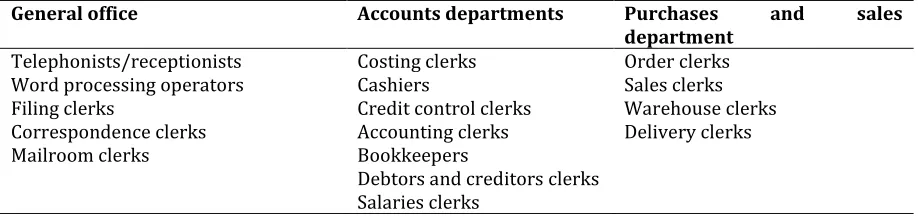
Administrative employees: According to Ngcobo et al. (2006) administrative employees are usually responsible for many tasks in the organisation, which includes choosing office furniture, office design and layout, office automation, telecommunication technology, application software, and forms design and control among others. The roles listed above require skill-set and average educational background which is important in enabling administrative employees to carry out their roles and responsibilities effectively (Igbinedion, 2010). Acquiring latest skills on technology will contribute positively to the administrative employee capability to be an innovator, problem solver, competitive and good thinker. Even though administration roles have advance in a massive way through time as the world keeps changing and innovative ways of thing that made the job of administrative employees more easily and less stressful such as technological devices which they can store, keep information and other resources flowing from one position to another and distribute information to the appropriate people. Ezenwafor (2013) in his article reveal that functions of administrative employee in an organisation cover production of different types of documents for the office, proofreading the document for accuracy, disseminating, storing (traditionally or electronically) and retrieving stored documents when needed. Administrators play a major role in the efficiency of any organisation. Badenhorst et al. (2005) asserts that there are certain duties and functions that are found in every organisation, the so-called generic functions (communication, reception and filing). Table 1 below reflects the administrative duties in different divisions and with different titles respectively.
Table 1: administrative duties in different divisions
Source: Badenhorst et al., 2005)
In every organisation administrators are assigned to different roles and responsibilities. It is clear from table 1.1 above that administrative duties may vary from divisions, departments and organisations. All that is required is the right people at the right positions to perform administrative tasks. These people according to Ezenwafor and Okeke (2011) need administrative competencies, human relation competencies, communication competencies, personality competencies, and office technology management competencies for effective performance in today’s office.
General office Accounts departments Purchases and sales
department Telephonists/receptionists
Word processing operators Filing clerks
Correspondence clerks Mailroom clerks
Costing clerks Cashiers
Credit control clerks Accounting clerks Bookkeepers
Debtors and creditors clerks Salaries clerks
162
Benefits of emerging technologies: The adoption and use of emerging technologies holds benefits for organisations and individuals as identified by Pirzada and Ahmed (2013) namely, (i) With technology people are getting help in every department, (ii) it saves time, It has made our life easier and people are making fewer mistakes, (iii) it has brought the world closer together, we share information quickly and efficiently from phones, internet and fax machines and (iv) organisation know the taste of customer. Technology will continue to improve public administrative efficiency by making information accessible, reduce administrative activities and lastly enhance good governance. Good governance is generally characterised by participation, transparency and accountability. According to Kumar (2014), using information system can enable an organisation to streamline its operations into a cohesive functioning unit. Ojo (2014) stated that the discovery of ICT has made the activities of government more accessible to the government while the traditional barrier of distance becomes surmountable through the modern approach of communication. He further maintains that the recent advances in communication technologies and the Internet provide opportunities to transform the relationship between governments and citizens in a new way, thus contributed to the achievement of good governance goals. Sarrayrih and Sriram, (2015) posit that the aim of ICTs in government (ICTs) is to promote more efficient and effective government, facilitate more accessible government services, allow greater public access to information, and make government more accountable to citizens (Working Group). Pirzada and Ahmed (2013) further assert that technology provides unique way for organisations to develop a distinct advantage in a competitive market and to outperform their competitors. Organisations are able to meet their obligations through technology which allows for a paradigm shift in the business vision. Advantages of technology for the government involve that the government may provide better service in terms of time, making government more efficient and more effective.
Disadvantages of emerging technologies: Emergence and innovation in technologies is dividing the universe in different dissection (Beena & Mathur, 2012). South Africa is experiencing an ICT skills shortage (Lotriet, Matthee & Alexander, 2010). Technology has brought massive enlightment in every government department since it has emerged. It challenges office managers and administrative employee’s designers to address a host of vital socio-economic issues such as reliable infrastructure, skilled human resources, open government and other essential issues of capacity building (Amiaya, 2014). As the information technology evolve to meet the technology demands of today’s workplace, different challenges are arising such as skill-set, governance of information among others and information technology (IT) users are striving to meet them (Kumar, 2014). According to Pirzada and Ahmed (2013) the disadvantage of advance technology is that machines are complex and complicated and people who are responsible they don’t operate the machines properly. Organisations and government departments are challenged to keep up with the emerging technologies that can enable them to survive in this digital society.
163
usability of government online due to factors such as the access to internet technology and usability of services and the ability to access to computers.
The impact of ICT in government administrative environment: Information and Communication Technology (ICT) have a definite effect on an individual and organisational structure. According to Naghibi and Baban (2011) changes already affect top to bottom of the organisation at most of the time and administrative environments are no exception. These challenges are characterised by change in nature of work, responsibilities and roles. Technologies include products and services such as desktop computers, laptops, hand-held devices, wired or wireless intranet, business software, network security among others (Binuyo & Aregbeshola, 2014). These technologies are utilised by administrative employees on daily basis to carry out their roles and responsibilities. The use of ICT has become very important to all organisations that intend to remain competitive in the market (Irungu, 2012). However, significant changes have been taking place in the office environments and this characterised by change in office work. The nature and background of office work is no longer the same as the one of the past. The advent of emerging technologies has totally revolutionised the way government access, process, stores, retrieve and disseminate information both within and outside organisation or across the globe (Adegbemile, 2012). Organisations around the globe and government included are undergoing unprecedented change (Patrick & Kumar, 2011). Employees in government departments are considerably affected by innovations that are becoming pervasive. These innovative ways of doing things has influenced many organisations across the world “to rely increasingly on the use of ICTs for the internal dissemination of key corporate information, whether this is via email, intranet, mobile technologies, or multimedia applications” (Greenwood & Cooke, 2008).
In this digital era ICTs have changed the scope of work. The world of work will never be the same again. In spite of these changes Beena and Mathur (2012) point out that “ICT is the driving force in the world and intensely making impact on economy, development and social growth of any nation”. This is confirmed by Ghodbane (2008) when acknowledging that ICT is the driving force of the new economy. However, some organisations and governments resist change because their perception of technology is that, it will negatively influence the effectiveness of an individual performance work. Other business environments may perceive evolving technologies as contributing significantly to organisation and individual work and most importantly provide more efficient and effective service delivery to the right people on time. The primary objective of the study was to determine how emerging technologies enable or constrain employees in carrying out their roles and responsibilities within the South African government departments.
3. Methodology
Research design and approach: In this study, a cross-sectional design was used where a quantitative approach was followed. A survey was conducted among the administrative employees from the two selected government departments namely, Department of Education and the Department of Transport. This design was used as researchers wanted to reach many people and it is cost effective. Using a convenient sampling, 247 administrative employees were sampled from the two departments.
Data collection: Data was collected using a structured questionnaire where the researchers personally distributed questionnaires by visiting the two departments and the respondents were allowed ample time to complete the questionnaires and return. This method allowed respondents to ask possible questions in case they had some doubts on the questionnaire.
164
4. Results and DiscussionSample realisation: A total 247 questionnaires were distributed to the two government departments by the researchers. Of great importance is that of the 247 questionnaires distributed, 165 (58%) were returned which were duly completed. From the data collected, it emerged that 88(53.33%) of the participants from both Department were females, while 77(46.67%) were males. This result is a true reflection of the administrative environment which is a female-dominated field as noted by (Van Antwerpen & Ferreira, 2010). These percentages indicated that the majority of the administrative positions in the government sector were occupied by females. The majority of the participants were in assistant director 35(24.14%), senior administrator positions 33(22.76%) and other designations that did not form part of the list 30(20.69%). Regarding the number of years of service in their current positions, 62(37.58%) of the participants had between five and eight years’ work experience in their respective departments. It can be discerned that both departments were well equipped with experienced administrative employees who had been holding their respective positions for years. A total of 85(65.38%) indicated that they were in a possession of degree certificates as their highest educational qualifications. This was followed by 28(21.54%) participants who had attained other qualifications and 11(8.46%) who are in possession of a grade 12 certificate only. A significant majority 72(57%) of administrative employees were between the ages of 31 to 40 years. The above demographics were deemed critical and relevant to this study as it gave a clear picture of the type of population that participated in this study to obtain rich information for the analysis of the primary data that is presented below.
ICT skill level in terms of use: It is critical in this technological era that organisations move from ancient ways of doing things to more innovative ways. The years of handling office roles and responsibilities pushing paper are gone. In this 21st century technology plays a critical role for any organisation in order to achieve
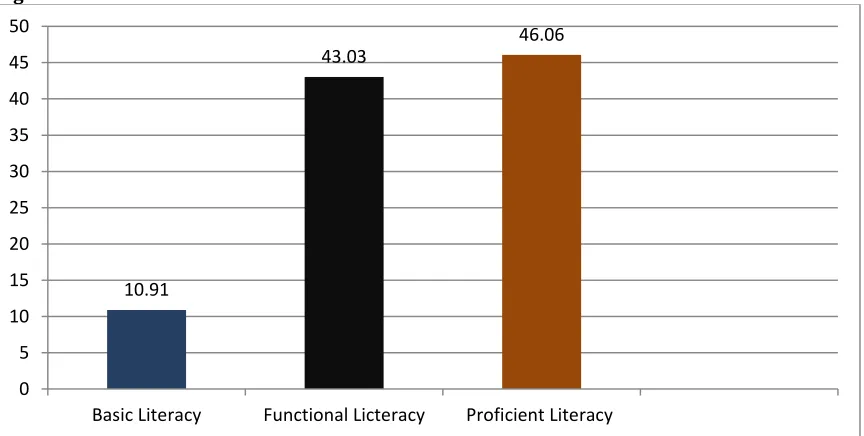
their strategic goals and to mark its presence in this competitive innovative century. In support of the aforesaid statement, Berisha-Namani (2010) reveals that information has become essential to make decisions and crucial asset in organisation in organisation. The ICT skill levels are required in all government departments in order for the administrative employees to present information in the required format. It is critical that social workers have both competency and literacy with ICTs (Perron, Taylor, Glass & Margerum-Leys, 2010). Therefore; organisation should be moving with times in terms of ICT skill level and technology that they use. Administrative employees must possess different types of literacy in order to be competent in their working environment such as proficiency, functional and basic literacy. When utilising technologies, various skill-set and is required in order to operate different office machines. From the figure 2 below it was clear that majority of staff members from both government departments do have different skill level in terms of use.
Figure 2: ICT skill level in terms of use
10.91
43.03
46.06
0 5 10 15 20 25 30 35 40 45 50
165
The effectiveness of administrative employees in an organisation strongly depends on the available office technology as well as the skills and competencies of such secretary to perform office duties (Dosunmu, Bukki & Akintola, 2017). However, the skill-set and literacy level of individuals differ as indicated in figure 2 above. It is evident that government administrative employees possess a high proficient literacy level of 76(46.06%) while functional literacy presented a lower percentage of 71(43.03%). There is a significant relationship (𝑝 = 0.001) between literacy level and departments. This means that participants from the two departments hold different view in terms of ICT skill levels. There is however skill imbalance in administrative employees since emerging technologies are perceived and accepted differently. Moreover, the lack of skills-set can influence their attitudes and beliefs results in acceptance and rejection. The findings depicted in figure 1.2 are in line with what Evanson. Usoro and Umondo (2012) found in their study that in order to be efficient in all areas of the organisation, administrative employees need to possess a specialised knowledge of work simplification, work measure and work standards based on the present day technology. For this reason, there is need for acquiring the latest basic ICT skill level by the administrative employees to remain suitable on their occupations. Furthermore, Garrido, Sullivan and Gordon (2012) explain that government consider an ICT skilled workforce a strategic asset that spurs economic growth, promotes competitiveness, and improves business productivity.
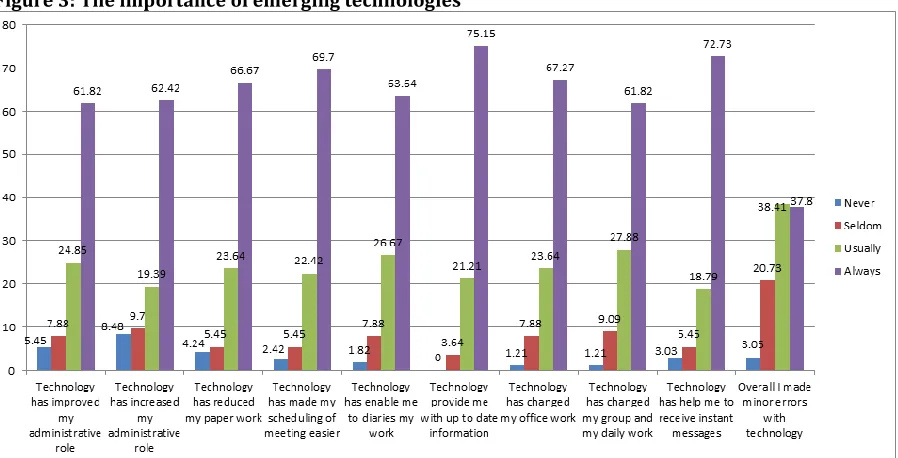
The significance of emerging technologies: Technology has changed the majority of administrators’ office work as indicated in Figure 3 below. In particular, participants, 111(67.27%)indicated that emerging technologies had changed their office work. For instance, information technology has fundamentally altered interpersonal communications (Rahm, 1999). This author further stressed that from electronically enhanced Internet romances to new office interactions, the changes in person-to-person interchange are vast. Some of the changes that were experienced were how technology has improved their administrative roles as presented by 102(61.82%; Pr=0.12). There is no significant relationship between responses among respondents in relation to the importance of emerging technology with regards to improve the respondent’s administrative role and department. This means that the respondents’ opinion with regards to this question does not differ significantly between the two departments. Information technology has drastically changed the office functions, jobs are now done in a new way (Dosunmu et al., 2017). For example, it has reduced paper work by making it easier to schedule meetings 115(69.7%). From the analysis, it emerged that employees’ on the importance of emerging technologies were not significant among employees from the two departments with respects to (𝑃𝑟 = 0.187) as regards to enabling employees to diarise tasks and appointments digitally as indicated in Figure 3 below. Furthermore, emerging technologies had an influence on how work groups and daily routines were carried out 102(61.82%)due to the fact that it reduced errors. Therefore, the association between the respondents in response to the influence of emerging technologies is not significant (𝑃𝑟 = 0.781). This however, has created an opportunity for the government administrative employees to understand the significance of emerging technologies for their office work.
166
2.42 7.88 2.42 9.09
38.79
24.85 50.91
63.64
0 10 20 30 40 50 60 70
The use of emerging technologies meet my expectations
The primary use of emerging technology in my work improve the presentation of
my work
Never
Seldom
Usually
Always
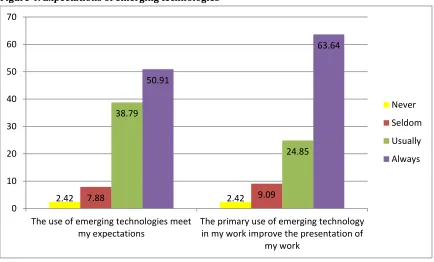
However, the participants had different expectations when coming to how the emerging technologies impacted on their office work. Although the government administrative employees as well as the managers acknowledged the significance of the emerging technologies, there were, however, different views when it came to individuals’ expectations with regard to the emerging technologies as presented in Figure 4 below. It is clear from the above Figure that the majority of participants from both departments mentioned how the use of emerging technologies had met their expectations as presented by 84(50.91%)However, this shows no significant differences (Pr = 0.194) among respondents from the two departments in relation to the use of emerging technologies which meet their expectations. The important role of expectations for emerging technologies is the functions of innovation systems approach as confirmed by (Alkemade & Suurs, 2012). Furthermore, 64(38.79%) respondents indicated that these technologies usually met their expectations. The success of every organisational investment on technology is determined by its adoption and successful use in all divisions within the organisation. In both government departments not all the administrative employees were embracing these technologies as they seldom met their expectations as stated by 13(7.88%) of the participants. In addition to that, was the 4(2.42%) of the selected administrative employees from the both departments who regarded these technologies as not meeting their expectations. Contrary to this sentiment, Cain and Haque (2008) attest that if ICT, used well, can improve efficiency and organisational workflow.
Figure 4: Expectations of emerging technologies
167
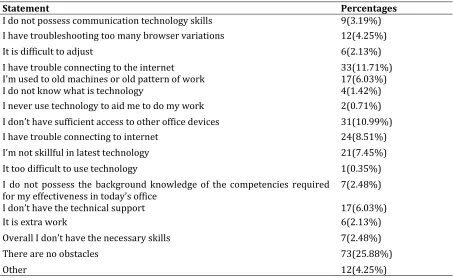
Although emerging technologies held promises for the effective office administration in modern offices they were also associated with countless challenges. It is therefore critical for organisations to provide skilled and well equipped manpower to match the current modern office obstacles. Evanson et al. (2012) assert that effective utilisation of emerging technologies in office administration can be achieved only if organisations are able to identify obstacles associated with its utilisation. Therefore, the majority of administrative employees did have technological skills apart from a minority 9(3.19%) among the participants, it is clear from Table 2 above that there were few challenges with regard to knowledge of utilising the emerging technologies. For example, the majority of the participants possessed background knowledge of the competencies required for individuals’ effectiveness in today’s office environment. In addition, it is clear that only 7(2.48%) of the selected administrative employees did not possess such knowledge. One can argue that knowledge goes hand-in-hand with skills-sets, and among the participants from both government departments, some 7(2.48%) did not possess the necessary skills to use technology in their environment. Although some employees were challenged by various obstacles with regard to using technology, some employees enjoyed the benefits that come with the utilising of emerging technologies.
Table 2: Obstacles associated with the use of technologies
The participants from both departments 73(25.88%)indicated that, overall, they did not have any obstacles preventing them from using emerging technologies in their respective environments as can be seen in Table 2 above. On the other hand, a few of the employees were faced with challenges regarding utilising the emerging technologies; therefore, it is the duty of organisations to ensure that all employees are familiar with emerging technologies in this digital society. When employees recognize their organisation interest in them through offering training programs, they in turn apply their best efforts to achieve organizational goals, and show high performance on job and this also confirm what Elnaga and Imran, (2013) found in the study. Similarly, Yamoah (2013) also found that those employees who have taken trainings were more capable in performing different task & vice versa. Training is required to equip all employees with the necessary technological skills to ensure their effectiveness in the office environment so that some of the identified obstacles could be addressed, Administrative employees should be trained and retrained frequently to acquire the competencies and skills to deal with the present-day challenges of emerging technologies. These findings are in line with what Evanson et al. (2012) found in their study that there are many constraints against the adoption of
full-Statement Percentages
I do not possess communication technology skills 9(3.19%) I have troubleshooting too many browser variations 12(4.25%)
It is difficult to adjust 6(2.13%)
I have trouble connecting to the internet 33(11.71%)
I’m used to old machines or old pattern of work 17(6.03%)
I do not know what is technology 4(1.42%)
I never use technology to aid me to do my work 2(0.71%) I don’t have sufficient access to other office devices 31(10.99%)
I have trouble connecting to internet 24(8.51%)
I’m not skillful in latest technology 21(7.45%)
It too difficult to use technology 1(0.35%)
I do not possess the background knowledge of the competencies required
for my effectiveness in today’s office 7(2.48%)
I don’t have the technical support 17(6.03%)
It is extra work 6(2.13%)
Overall I don’t have the necessary skills 7(2.48%)
There are no obstacles 73(25.88%)
168
fledged technology one of the reasons; it is implementation is apparently too slow in addressing the challenges associated with implementation efforts.
5. Conclusion and Recommendations
The primary objective of this study was to determine how emerging technologies enable or constrain employees in carrying out their roles and responsibilities within the South African government departments. It is evident from the findings that government administrative employees have a fair proficient literacy level and functional literacy. This however, suggests that the administrative employees possess a knowledge relating to ICT. It can further be concluded that use of emerging technologies has substantively changed the way they do their office work. The respondents indicated that they embrace the emerging technologies; however, they do not always meet their expectations. The use of emerging technologies has improved the presentation of their work within their divisions. Overall it emerged that the administrative employees do not have obstacles preventing them from using emerging technologies. In order to ensure that there is a continuous effective use of emerging technologies within government departments, it is recommended that the employees should attend refresher courses to familiarise them with new versions of the software packages.
Limitations and Future Research: The current study has a number of limitations which point to directions for future directions. First, study used a convenient sampling which consisted of administrative employees in the selected departments. The findings of the study may therefore not be generalised to other departments beyond the two. This however, suggests that future research should use a larger and more representative sample in order to allow the generalisability of the findings throughout the government departments and other contexts. Second, the current study was a cross-sectional which means that some of the possible respondents were not present at the time of data collection and these participants could have provided a different perspective on the matter under investigation.
References
Abbas, J., Muzaffar, A., Mahmood, H. K., Muhammad, A. R. & Rizvi, S. S. U. (2014). Impact of technology on performance of employees (A case study on Allied Bank Ltd, Pakistan). World applied science journal, 29(20), 271-276.
Adegbemile, O. (2012). Information and communication technology (ICT) availability and utilization in management of secondary schools in Kaduna State, Nigeria. Journal of educational and social research, 2(7), 82-89.
Adeoye, Y. M., OluwolE, A. F. & Blessing, L. A. (2013). Appraising the role of information communication technology (ICT) as a change agent for higher education in Nigeria. International journal of current research and academic review, 1(4), 110-120.
Alkemade, F. & Suurs, R. A. A. (2012). Patterns of expectations for emerging sustainable technologies. Technological Forecasting & Social Change, 79, 448–456.
Amiaya, A. O. (2014). Challenges and strategies for utilizing information and communication technology among office technology and management educators in Nigerian polytechnics. 21st Century Academic Forum Conference at UC Berkely, 2(1),1-11.
Ayandele, M. R. & Adeoye, O. S. (2010). Changing work environment through information and communication technology (ICT): Challenges to secretarial staff. International journal of computer applications, 9(10), 35-40.
Badenhorst, C. J., Van Rooyen, A. W. P., Ferreira, E. J., Groenewald, D., Joubert, H. J., Marcus, J. S. F., Steenekamp, S., Swanepoel, F., Van Den Berg, A. & Van Heerden, A. (2005). Business and office administration: an outcomes-based approach. 2nd ed. Heinemann: Sandton
Beena, M. S. & Mathur, M. (2012). A study on the ICT awareness of M. Ed. trainees. International journal of business management & economic research, 3(4), 573-578.
169
Binuyo, A. O. & Aregbeshola, R. A. (2014). The impact of information and communication technology (ICT) on commercial bank performance: Evidence from South Africa. Problems and perspectives in management, 12(3), 59-68.
Cain, C. & Haque, S. (2008). Organisational Workflow and Its Impact on Work Quality: An Evidence-Based Handbook for Nurses,2, 217-244.
Cain, C. & Haque, S. (2008). Organizational Workflow and Its Impact on Work Quality. In Patient Safety and Quality: An Evidence-Based Handbook for Nurses; Hughes, R., Ed.; Agency for Healthcare Research and Quality: Rockville, MD, USA,
Dosunmu, M. M., Bukki, A. O. & Akintola, O. A. (2017). Influence of Office Automation on Secretarial Administrators’ Effectiveness in Ogun State-Owned Universities. Journal of Research & Method in Education, 7(3), 49-52.
Elnaga1, A. & Imran, A. (2013). The Effect of Training on Employee Performance. European Journal of Business and Management, 5(4), 137-147.
Evanson, E. A., Usoro, H. & Umoudo, B. I. (2012). Office administration in an era emerging technologies: The Nigerian situation. The intuition, 5(1), 1-8.
Ezenwafor, J. I. & Okeke, A. U. (2012). Retraining university secretarial staff of effectiveness in the work environment of the ICT era. International journal of educational research and development, 4(1), 130-136.
Ezenwafor, J. I. (2013). Enhancing the relevance of secretarial staff in the University of System. Journal of Emerging Trends in Educational Research and Policy Studies, 4(3), 424-432.
Garrido, M., Sullivan, J. & Gordon, A. (2009). Understanding the links between ICT skills training and employability: An analytical framework. Proceedings of the 4th ACM/IEEE International Conference on Information and Communication Technologies and Development, A 15.
Ghodbane, W. (2008). ICT job shifts and ICT cluster assessment: An exploratory study. Proceedings of SIG GlobDev’s First Annual Workshop, Paris, France December 13th 2008.
Greenwood, H. & Cooke, L. (2008). ICT in the workplace: access for all or digital divide? New information perspectives, 60(2), 143-157.
Igbinedion, V. I. (2010). Knowing the graduate office secretary. Ozean journal of social sciences, 3(1), 116-120. Irungu, I. W. (2012). Influence of information and communication technology on performance of aviation
industry-a case of Kenya airways ltd. Dissertation. The University of Nairobi.
Kumar, R. (2014). Information Technology: Roles, Advantages and Disadvantages. International Journal of Advanced Research in Computer Science and Software Engineering, 4(6), 1020-1024
Kumar, R., Sharma, M. K., Agarwal, M. & Kumar, S. (2011). Impact of ICT in growth and development of rural system in Uttarakhand. World rural observations, 3(2), 103-106.
Lotriet, H., Matthee, M. & Alexander, P. M. (2010). Challenges in ascertaining ICT skills requirements in South Africa. South African computer journal, 46, 38-48.
Mbithi, M. K. (2011). Entrepreneurial skills among business owners in the Tshwane metropolitan municipality. Dissertation, Tshwane University of Technology.
Meijer, A. J. & Bovers, M. (2005). Public accountability in the information age. In Bekkers, V., & Homburg, V. The information ecology of e-government. E-government as institutional and technological innovation in public administration. Amsterdam: IOS Press, 171-182.
Naghibi, M. A. & Baban, H. (2011). Strategic change management: the challenges faced by organisations. International conference on economic & finance research, 4, 542-544.
Ngcobo, M., Msimango, G., Majiya, N., Dube, B., Ndaba, T. & LuthulI, T. (2006). Business administration for office professionals: A South African perspective. LexisNexis: Durban.
Ogbonna, G. N. & Ebimobowei, A. (2013). Information technology and the performance of accountants in the Nigerian oil and gas industry. Research journal of applied sciences, engineering and technology, 6(2), 202-212.
Ojo, J. S. (2014). E-governance: an imperative for sustainable grassroots development in Nigeria. Journal of public administration and policy research, 6(2), 77-89.
Olufemi, F. J. (2012). Electronic governance: myth or opportunity for Nigerian public administration. International journal of academic research in business and social sciences, 2(9), 122-140.
170
Pirzada, K. & Ahmed, M. (2013). Effect of new technology on firm’s business objectives: a case study of Pak-Suzuki company. International journal of business administration, 4(3), 95-101.
Radniecki, T. (2013). Study on emerging technologies librarians: how a new library position and its competencies are evolving to meet the technology and information needs of libraries and their patrons. Paper presented at IFLA World Library and Information Congress, 1-16.
Rahm, D. (1999). The role of information technology in building public administration theory. Knowledge, Technology, and Policy, 12(1), 74-84.
Sarrayrih, M. A. & Sriram, B. (2015). Major challenges in developing a successful e-government: A review on the Sultanate of Oman. Journal of King Saud University - computer and information sciences, 27(2), 230-235.
Sharma, S. K. & Chandel, J. K. (2013). Technology acceptance model for the use of learning through websites among students in Oman. International Arab journal of e-technology, 3(1), 44–49.
Van Antwerpen, S. V. & Ferreira, E. (2010). Males in predominately female-dominated positions: A South Africa perspectives. J. Contemp. Manage, 7, 363-379.
Yamoah, E. E. (2013). Employee Training and Empowerment: A Conceptual Model for Achieving High Job Performance. Journal of Education and Practice, 4(13), 27-30.