1331
Faeq Malallah Mahmood Albalaki
1, AFMJ Volume 3 Issue 02 February 2018
Volume 3 Issue 02 February-2018, (Page No.-1331-1339)
DOI:10.18535/afmj/v3i2.05, I.F. - 4.614
© 2018, AFMJ
Decentralized Structures and Organizational Performance: The Mediating
Role of Activity-Based Costing Implementation
Faeq Malallah Mahmood Albalaki
1, Zarifah Abdullah
2, Hasnah Kamardin
31
Department of Accounting, College of Administration &Economic, Mosul University, Mosul, Iraq.
2Tunku Puteri Intan Safinaz School of Accountancy (TISSA), College of Business, Universiti Utara Malaysia.
3Tunku Puteri Intan Safinaz School of Accountancy (TISSA), College of Business, Universiti Utara Malaysia.
*
Corresponding Author : Faeq Malallah Mahmood Albalaki
*PhD candidate at Tunku Puteri Intan Safinaz School of Accountancy (TISSA), College of Business, Universiti Utara Malaysia.
Abstract: The aim of this paper is to empirically examine the mediating effect of activity based costing (ABC) implementation
on the relationship between decentralized structures and organizational performance from a contingency theory perspective. The decentralized structures are investigated using two dimensions: the vertical and horizontal structures. Since there is little evidence on the effect of decentralized structures on ABC implementation from Arab countries, this paper uses Iraqi manufacturing companies as the sample of the study. The data is analyzed using a PLS3 and the results indicate that vertical decentralized structure is positively and significantly associated with ABC implementation and organizational performance. ABC implementation is also positively and significantly associated with organizational performance. In contrast, the results show that horizontal decentralized structure has a strong negative effect on both ABC implementation and organizational performance. This study also demonstrates that ABC implementation has no mediating effect on the relationships of both the decentralized structures and organizational performance.Key Words: ABC Implementation, Vertical Decentralized, Horizontal Decentralized, Organizational Performance, Iraq.
Introduction
There have been significant levels of achievements from different researchers in establishing and articulating the contributions of ABC implementation on different levels of organizational performance. ABC is a system that helps in making an apt strategic decisions with regards to product mix, outsourcing, pricing and assessment of production processes and performance (Banker, Bardhan, & Chen, 2008).However, few studies have been conducted on the relationships between decentralized structures, ABC
implementation, and organizational performance in
developing countries. In particular, no relevant evidence exists in Iraq.
Contingency theory hypothesizes that under decentralized structure, more sensitive and sophisticated accounting information system is needed.In addition, it assumes that effective organizational performance is achieved by matching decentralized structure to management accounting system (MAS) (Gordon & Miller, 1976). However, Iraqi industrial companies suffer from poor performance, and this may be attributed to the incompatibility of the organizational structure with the functions of performance evaluation (Ibrahim, 2014). In this paper, the authors argue that a good match between the decentralized organizational structures
and ABC system will lead to higher organizational performance.
Furthermore, previous studies (Chia, 1995; Soobaroyen and Poorundersing, 2008)have only considered the indirect effect of MAS (in general) on the relationship between decentralized structure and organizational performance. As such, the paper aims to contribute to a better understanding on which kinds of decentralized structure proposed in Mintzberg’s, (1979) model are motivated to implement ABC system. It also aims to investigate the impact of ABC implementation on organizational performance in the context of Iraqi industries.
The remainder of the current research is structured as follows: It first briefly reviews the relevant literatures and develops hypotheses. Then, describes the research method applied, followed by the findings. Finally, it presents a discussion of the results, conclusions and directions for future study.
Literature Review
Decentralized Organizational Structures and ABC
Implementation
Implementation”
1332
Faeq Malallah Mahmood Albalaki
1, AFMJ Volume 3 Issue 02 February 2018
organization. In essence, decentralized structure implies the impossibility of an individual to make the entire decision in the organization (Subramaniam & Mia, 2001). For instance, a decentralized structure permits the division of authority of making decision over the implementation of ABC across the organizational hierarchy which as a result, have the tendency of affecting the functionalities and performance of ABC as a costing system (Zhang, Hoque, and Isa, 2015). Mintzberg (1979)categorized decentralized structures into vertical decentralized structure and horizontal decentralized structure. Vertical decentralized structure is defined as the dispersion of decision-making responsibilities from the top management to medium and unit managers (Lunenburg, 2012). This structure allows both the top and down of the organizational hierarchy to get involved in decision making
process (Mintzberg, 1980). Meanwhile, horizontal
decentralized structure involves the division of decision-making control with individuals outside the organizational hierarchy (Hudson & Bielefeld, 1997). Elhamma and Moalla (2015) elaborated that vertical decentralized structure entails formal division and dispersion of authority while horizontal is the informal dispersion of decision-making authority. Chia (1995) revealed from a contingency study conducted in Singapore that there is a positive relationship between decentralized organizational structure and MAS information. The implication of Chia’s result is that the organization implements a sophisticated MAS when the level of decentralization is high, it enhances the accessibility of relevant information and by extension, the quality of decisions. More recently, a study conducted by Elhamma and Moalla (2015), based on a contingency theory, reported that there is a significant high usage of ABC among
organizations with vertical decentralized structure.
Meanwhile, Liu and Pan (2007) demonstrated that hierarchical command and communication structure (vertical decentralized structure) and active participation of high numbers of committed professionals (horizontal decentralized structure) have significant impact in enhancing the success and diffusion of ABC implementation. However, the actual link between decentralized organizational structures and ABC implementation has not been investigated in Iraq. Therefore, this study formulates the following hypotheses:
H1: Vertical decentralized structure has a positive and significant effect on ABC implementation.
H2: Horizontal decentralized structure has a positive and significant effect on ABC implementation.
ABC Implementation and Organizational Performance ABC is a cost management system which calculates costs based on the individual activities that are executed in the course of manufacturing a product or delivering a service (Raz and Elnathan, 1999). ABC system has been argued to be one of the efficient methods of measuring the financial
and non-financial performances, through providing
information about cost objects and all activities (Chong& Cable, 2002; James, 2013). Baxendale (2001) added that, the strength of ABC as a sophisticated accounting system lies on the application of accounting information generated to prepare product profitability, eradicate unnecessary cost information for strategic decision making process and managerial planning, and reevaluate product pricing. Majority of previous studies have indicated significant and positive relationship between ABC implementation and profitability (Plowman, 1997), higher quality levels (Ittner, Lanen, and Larcker, 2002), financial performance (Cagwin and Bouwman, 2002), competitiveness (Elhamma, 2015) and financial and non-financial performance improvement (Chea, 2011; Zaman, 2009).However, studies in the Iraqi context are scarce. Therefore, it is worth investigating the
relationship between ABC implementation and
organizational performance in the Iraqi manufacturing
sector, particularly because improving the overall
performance of these companies is a current challenge. Therefore, this paper hypothesizes that:
H3: ABC implementation has a positive and significant effect on organizational performance.
Decentralized Structures and Organizational Performance Researchers have discussed the reasons why large organizations need to choose a decentralized structure to enhance their performance. Chia (1995)concludes that through decentralized structures the organizations are able to provide its decision makers with greater responsibility and control over its activities and also greater access to the required type of information. Evidently, Chen and Huang (2007) used regression analysis in146 large companies in Taiwan, and their findings concluded that decentralized structure leads to higher performance compared to other dimensions of organizational structure.
Meanwhile, Farhanghi, Abbaspour, and Ghassemi (2013) in a study involving 242 engineers of consultant firms in Iran found that there is a significant relationship between the performance of organizations and the structure in which an organization implements. In a very recent study, Uyar and
Kuzey (2016) employed a covariance-based SEM
techniques to analyze the survey conducted among Turkish companies. Their findings demonstrated that decentralized structureas a contingency factor has a significant influence on organizational performance. However, Tavitiyaman, Zhang, and Qu (2012) reviewed that the relationship
between organizational structure and organizational
performance is yet to be exhaustively studied.
Although numerous studies have been undertaken on the
relationship between organizational structure and
Implementation”
1333
Faeq Malallah Mahmood Albalaki
1, AFMJ Volume 3 Issue 02 February 2018
decentralized structures would enhance organizational performance. H4 and H5 are hypothesized as follows: H4: Vertical decentralized structure has a positive and significant effect on organizational performance.
H5: Horizontal decentralized structure has a positive and significant effect on organizational performance.
Decentralized Structures, ABC Implementation and Organizational Performance
An ABC system has a critical role in accessing timely and accurate information as well as enhancing productive decisions and managerial plans (Abdel-Kader and Luther, 2008). Empirical studies (e.g. Elhamma and Moalla, 2015; Liu and Pan, 2007) confirm that there are relationships between decentralized structure and ABC implementation. Decentralized structure also has an indirect relationship to organizational performance. Soobaroyen and Poorundersing (2008) employed a regression-path analysis to analyze the survey conducted in an African developing country context. Their findings empirically demonstrated that the relationship between decentralized structure and performance is medaited by MAS information. Similarly, the findings presented by Chia (1995) confirmed that there are
significant influence of decentralized structure on
sophisticated MAS and enhancement of organizational performance.
Arguments on the relationship between organizational structure and the implementation of ABC are still on-going in the literature. Meanwhile, previous studies on the implementation of ABC, decentralized structures and organizational performance of both developed and developing countries are limited. More so, there is only one study (Elhamma and Moalla, 2015) that investigates the relation between vertical and horizontal decentralized structures with ABC implementation. Therefore, this study predicted the following hypotheses:
H6:ABC implementation mediates the relationship between vertical decentralized structure and organizational performance.
H7:ABC implementation mediates the relationship between
horizontal decentralized structure and organizational
performance.
Accordingly, the theoretical framework for this research is illustrated in Figure 1.The framework relies on the contingency theory and depicts the relationship between decentralized structures namely; vertical decentralized structure and horizontal decentralized structure, ABC implementation and organizational performance.
Figure 1: Theoretical Framework
Methodology
The methodology used in this research is a quantitative, and it is based on mailed survey questionnaire to collect information about large manufacturing companies in Iraq. This target sample was selected because they are more likely to adopt and implement ABC system according to Innes and Mitchell (1995). The questionnaires were sent to the chief financial officers of all 305 companies because they are usually responsible for performance measurement. The researchers obtained 239 (78%) filled questionnaires within 4 months and one week, starting from 1st of March 2017.Four questions (Yes/No answers) were used to distinguish between ABC implementer groups and non- implementer: (1) non-implementation of ABC at all, (2) planning to implement, (3) ABC implementation for activity cost analysis, and (4) ABC implementation for measuring product cost and decision-making process. Of the 239 companies, 112 of them were not adopted or implemented ABC system and therefore were not useable. 13 respondents did not fully complete the questionnaires and therefore were also excluded. Thus, it left with the useable responses of 114 organizations that have either implemented ABC; either at the adoption level or at the implementation level.
Table 1 displays the dimensions and items for the variables examined. McGowan’s (1998) instrument is used to measure ABC implementation through four dimensions: (1) impact on organizational process (measured with 6 items), (2) perceived usefulness of ABC (measured with 5 items), (3) technical characteristics of ABC (measured with 4 items), and (4) employee attitude (measured with 4 items). Organizational performance is measured using the instrument developed by Govindarajan (1984) with eight (8) items for measuring both financial and non-financial performance. Finally, nine (9) items were adopted from Elhamma and Moalla (2015) for measuring both vertical decentralized structure (measured with 5 items) and horizontal decentralized structure (measured with 4 items). All items are measured by a seven-point Likert-type scale ranging from 1 to 7.
In order to assess the direct and indirect relationships between the variables, path coefficients are computed using structural equation modeling (SEM)-partial least squares (PLS3) path model (Chin, 1998; Cohen, 1988). PLS3 is useful when the theory sets out to explain the effect of
Decentralized
Structures
ABC Implementation Vertical Decentralized
structure
Organizational Performance Horizontal
Implementation”
1334
Faeq Malallah Mahmood Albalaki
1, AFMJ Volume 3 Issue 02 February 2018
variables that intervene in relationships between
independent variables and dependent variables (Hair, Sarstedt, Hopkins, and Kuppelwieser, 2014). In the current study, decentralized structures and the implementation of ABC are input variables while the outcome of the investigation is the effect on organizational performance. However, the path model also includes relationship between decentralized structures and ABC implementation leading to a mediation effect.
The seven hypotheses drawn from the research model are tested by the SEM-PLS3. For this test to occur, it is necessary to make a preliminary assessment of measurement and structural models (Hair et al., 2014). According to the nature of measures used (Bisbe, Batista-Foguet, and Chenhall, 2007) in the current study, the measurement model is considered as a reflective-reflective type. The variables understudied in this research are operationalized as a reflective type of Hierarchical Component Model (HCM) consisting of six Lower Order Components (LOCs) which are the dimensions of ABC implementation (4) and
organizational performance (2). The results of both the measurement and structural models are reported in the following subsections.
Findings
Measurement Model
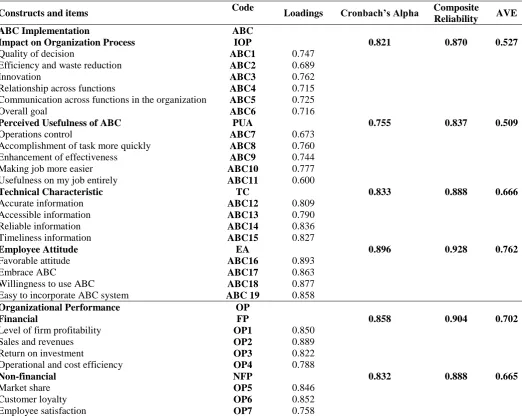
The reliability and validity of the LOCs were assessed by the measurement model of PLS3-SEM path model. As shown in Table 1, the reliability analysis (internal consistency reliability) has been achieved for all reflective constructs as represented by Cronbach’s Alpha and Composite Reliability (Hulland, 1999), which is above the threshold of 0.60 and 0.70for all variables respectively. Meanwhile, items reliability is assessed by checking the loadings which should be 0.50 and above (Hair et al., 2014). As shown in Table 1, The loadings of all items are above 0.60. The Average Variance Extracted (AVE) of the reflective dimensions are higher than 0.50 (Henseler, 2007) indicating that the convergent validity is established and also achieved.
Table 1: OuterLoadings, Cronbach’s Alpha, Composite Reliability, AVE and R Square for the First Stage Hierarchical Construct Model
Constructs and items Code Loadings Cronbach’s Alpha Composite
Reliability AVE
ABC Implementation ABC
Impact on Organization Process IOP 0.821 0.870 0.527
Quality of decision ABC1 0.747
Efficiency and waste reduction ABC2 0.689
Innovation ABC3 0.762
Relationship across functions ABC4 0.715
Communication across functions in the organization ABC5 0.725
Overall goal ABC6 0.716
Perceived Usefulness of ABC PUA 0.755 0.837 0.509
Operations control ABC7 0.673
Accomplishment of task more quickly ABC8 0.760
Enhancement of effectiveness ABC9 0.744
Making job more easier ABC10 0.777
Usefulness on my job entirely ABC11 0.600
Technical Characteristic TC 0.833 0.888 0.666
Accurate information ABC12 0.809
Accessible information ABC13 0.790
Reliable information ABC14 0.836
Timeliness information ABC15 0.827
Employee Attitude EA 0.896 0.928 0.762
Favorable attitude ABC16 0.893
Embrace ABC ABC17 0.863
Willingness to use ABC ABC18 0.877
Easy to incorporate ABC system ABC 19 0.858
Organizational Performance OP
Financial FP 0.858 0.904 0.702
Level of firm profitability OP1 0.850
Sales and revenues OP2 0.889
Return on investment OP3 0.822
Operational and cost efficiency OP4 0.788
Non-financial NFP 0.832 0.888 0.665
Market share OP5 0.846
Customer loyalty OP6 0.852
Implementation”
1335
Faeq Malallah Mahmood Albalaki
1, AFMJ Volume 3 Issue 02 February 2018
R&D activities OP8 0.804
Vertical Decentralized VD 0.846 0.891 0.621
Recruitment/Dismissal OS1 0.771
Launching of a new product OS2 0.812
Choice of suppliers/customers OS3 0.831
Pricing sale OS4 0.815
Operational reorganization OS5 0.704
Horizontal Decentralized HD 0.777 0.836 0.564
Involved in all types of decisions OS6 0.637
Consulting coworkers OS7 0.683
Consulted by coworkers OS8 0.830
Involved employees in decisions OS9 0.833
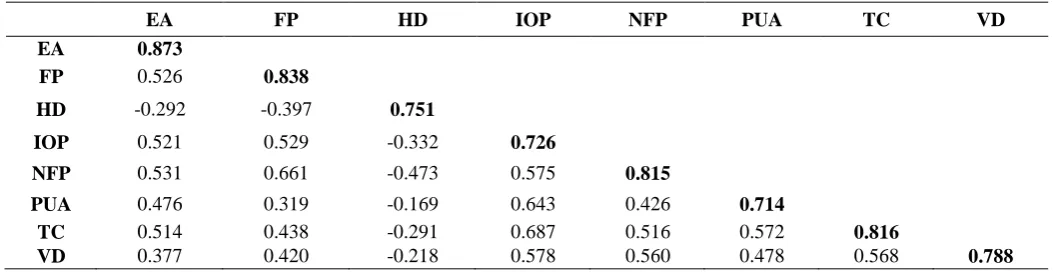
Additionally, to ascertain the discriminant validity of the reflective constructs for LOCs, the square root of AVE of each dimensions should be higher than its correlations with any other construct (Fornell and Larcker, 1981). As shown
in Table 2, the diagonal bolded values represent the square root of AVE, which are above the correlation of any reflective variable with one another. This clearly indicates the discriminant validity is established at LOCs.
Table 2: Discriminant Validity (Fornell-Larcker Criterion) for First Stage Hierarchical Construct Model
EA FP HD IOP NFP PUA TC VD
EA 0.873
FP 0.526 0.838
HD -0.292 -0.397 0.751
IOP 0.521 0.529 -0.332 0.726
NFP 0.531 0.661 -0.473 0.575 0.815
PUA 0.476 0.319 -0.169 0.643 0.426 0.714
TC 0.514 0.438 -0.291 0.687 0.516 0.572 0.816
VD 0.377 0.420 -0.218 0.578 0.560 0.478 0.568 0.788
To assess the second stage hierarchical construct model, the latent variable scores in the first order model were recomputed under the variables in the second stage hierarchical construct model. As a result, the dimensions of the constructs in the first stage model served as items for the constructs in the second stage model (Henseler, 2007). The
result of the second stage which is the hierarchical measurement model revealed the second order model (Table 3) is fit as the Cronbach’s alpha, Composite Reliability and AVE values were all above the expected threshold of 0.60, 0.70 (Hair et al., 2014) and 0.50 respectively (Chin, 1998).
Table 3: Loadings, Cronbach’s Alpha, Composite Reliability and AVE for Second Stage Model
Construct Loadings Cronbach’s Alpha Composite Reliability AVE
ABC Implementation 0.841 0.893 0.678
Impact on Organizational Process 0.881
Perceived Usefulness of ABC 0.800
Technical Characteristics 0.848
Employee Attitude 0.759
Organizational Performance 0.796 0.907 0.830
Financial 0.899
Non-Financial 0.923
Vertical Decentralized 1.000 Nil Nil Nil
Horizontal Decentralized 1.000 Nil Nil Nil
Additionally, Table 4 presents the discriminant validity of the second-order model which is assessed with the square root of the AVE values and it was expected to be greater than the correlations among latent constructs. The result of the discriminant validity shows the square root of the AVE
Implementation”
1336
Faeq Malallah Mahmood Albalaki
1, AFMJ Volume 3 Issue 02 February 2018
Table 4: Discriminant Validity (Fornell-Larcker Criterion) for Second Stage Hierarchical Constructs Model
1 2 3 4
ABC Implementation 0.823
Horizontal Decentralized -0.335 1.000
Organizational Performance 0.652 -0.480 0.911
Vertical Decentralized 0.612 -0.218 0.542 1.000
Structural Model
In order to discuss the proposed hypotheses in this study, the structural equation model was employed using bootstrap technique (Hair et al., 2014) to examine the relationships between decentralized organizational structures(vertical andhorizontal), ABC implementation and organizational performance. As presented in Table 5, the results revealthat vertical decentralized structurehas a significant and positive effect on ABC implementation (β = 0.164, p<0.10) and therefore H1 is supported. Also, the results demonstrate that ABC implementation has a positive and significant effect on
organizational performance (β = 0.347, p<0.01). This provides the basis to support H3. The results also show thatvertical decentralized structure has a positive and significant effect on organizational performance (β = 0.178, p<0.10). Therefore, H4 is supported. Conversely, there is a
negative but significant effect between horizontal
decentralized structure and ABC implementation (β = -0.097, p<0.10). This suggests that H4 is not supported. Also, there is a significantand negative effect of horizontal decentralized structure on organizational performance (β = -0.281, p<0.01). This shows that H5 is not supported too.
Table 5: Structural Model Assessment
H Relationships Beta SE t-Values p-Values Decisions
H1 VD -> ABC 0.164 0.125 1.310 0.095* Supported
H2 HD -> ABC -0.097 0.067 1.446 0.074* Not Supported
H3 ABC ->OP 0.347 0.113 3.067 0.001*** Supported
H4 VD ->OP 0.178 0.120 1.481 0.070* Supported
H5 HD ->OP -0.281 0.067 4.209 0.000*** Not Supported
Note: *: P<0.10; ***: P<0.01
In addition, Table 6 presents the results of the indirect effect of ABC implementation. The result of H6 demonstrated that, ABC implementation does not mediate the relationship between vertical decentralized structure and organizational performance (β= 0.057, t=1.071, p<0.10). Hence, H6 is
rejected. Also, the result presented in Table 6 shows that, ABC implementation has no mediation effect on the relationship between horizontal decentralized structure and organizational performance (β= -0.034, t=1.178, p<0.10). On this basis, the H7 is not supported.
Table 6: Testing the Mediation Effect of ABC Implementation
Confidence Intervals
H Mediation
Path Beta SE t-Value p-Value Lower Limit (5%) Upper Limit (95%) Decision
H6 VD>ABC>OP 0.057 0.053 1.071 0.142 -0.018 0.162 Not Supported
H7 HD>ABC>OP
-0.034 0.029 1.178 0.120 -0.089 0.000 Not Supported
Discussion
The results presented in Table 5 reveal that the relationship
between vertical decentralized structure and ABC
implementation is significant and positive. However, the relationship between horizontal decentralized structure and ABC implementation is significant but negative. These results imply that vertical decentralized structure is more enabling and effective in influencing the implementation of ABC system as compared to horizontal decentralized structure. This result does not suggest that manufacturing
Implementation”
1337
Faeq Malallah Mahmood Albalaki
1, AFMJ Volume 3 Issue 02 February 2018
ABC system for coordinating a complex process among the vertical structure of organizational managers. In other words, by implementing ABC system, managers can make individual decisions based on the information provided through ABC system. In essence, vertical decentralized
structure is practically more favorable for the
implementation of ABC as compared to horizontal decentralized structure. Previous studies such as Lee and Yang (2011) and Elhamma and Moalla (2015) have also demonstrated that vertical decentralized organizational structure is significantly related to ABC implementation. Furthermore, this present result can be explained in relation to the theoretical perspectives of contingency theory on the
relationship between ABC implementation and
organizational performance. The results reveal that there is a fit between ABC implementation and organizational performance. According to contingency theorists (Haldma and Laats, 2002), the fit between ABC implementation and organizational performance reflects the feasibility of
improving organizational performance through the
implementation of ABC system. Similarly with previous contingency-based studies (such as studies by: Elhamma and Moalla, 2015; Banker et al., 2008; Cagwin and Bouwman, 2002;Ittner et al., 2002), the current study shows that the implementation of ABC system among Iraqi organizations have important implications on organizational performance. Additionally, the results of this study reveal that both vertical and horizontal decentralized structures have significant effects on organizational performance. Even though, only vertical decentralized structure has a positive significant effect on organizational performance while horizontal decentralized structure has a negative significant effect, the implication of these findings is that vertical decentralized structure which is practiced by manufacturing organizations has the influence to enhance organizational performance. Meanwhile, horizontal decentralized structure does not have a supportive effect on organizational performance. In essence, this study demonstrates that vertical dispersion of responsibilities among employees and managers in the manufacturing companies in Iraq is found to
be positively influential to the performance of
manufacturing organizations. Hence, the top and down distribution of organizational responsibilities allow smooth and flawless decision-making process which therefore enhances organizational performance. This result is in line with contingency-based studies which have similarly demonstrated that vertical decentralized structure positively affect organizational performance (Chia, 1995; Chen and Huang, 2007; Hoque, 2011; Uyar and Kuzey, 2016; Elhamma and Moalla, 2015).
The results presented in Table 6 reveal that there is no significant mediating effect of both vertical and horizontal decentralized structure and organizational performance through ABC implementation. This result implies that
among the manufacturing companies in Iraq, the effect of vertical decentralized structure does not go through the ABC implementation. The weak of the vertical decentralized structure / ABC-implementation coefficient might be responsible for the insignificance of the indirect relationships. Surprisingly, this result does closely support Hoque's (2011) findings. Hoque (2011) found that decentralized structure (increased delegation) has no indirect effect on organizational performance through changes in MAS. On the other hand, although H2, H3 and H5 are significant, the indirect effect of ABC implementation on the relationship between horizontal decentralized and organizational performance is not supported. This can be explained by the very strong negative relationship between horizontal decentralized structure and organizational performance which undermines the indirect effect of ABC implementation. The results of both H6 and H7 are in
contrast with previous research (Soobaroyen and
Poorundersing, 2008; Abdel-Kader and Luther; 2008) which suggest that MAS and its practices mediate the relationship
between decentralized structure and organizational
performance.
Conclusion
This study concludes that horizontal decentralized structure has negative but significant effects on both ABC
implementation and organizational performance.
Meanwhile, vertical decentralized structure has significant and positive effect on both ABC implementation and organizational performance. ABC implementation is found to have positive significant effect on organizational performance. Although ABC implementation has no mediating effect on the relationships between both horizontal and vertical decentralized organizational structure and organizational performance, the findings reported in this study have significant theoretical and practical implications. Theoretically, the results of this study provide the empirical evidence on the contingency theory perspective that under decentralized structure, more sophisticated accounting information system is needed (Gordon & Miller, 1976). The findings of this study posits another important theoretical contribution of contingency theory that MA systems are adopted in order to assist managers in achieving some desired company outcomes or goals (Haldma and Laats, 2002).Practically, the findings of this research implies that to ascertain a successful implementation of ABC and to achieve a high level of performance among manufacturing companies especially in Iraq they must focus on vertical decentralized organizational structure.
Implementation”
1338
Faeq Malallah Mahmood Albalaki
1, AFMJ Volume 3 Issue 02 February 2018
from the population of this study. Thus, the cross-sectional nature of data collection provides a static perspective on the effect of decentralized organizational strategies on ABC implementation and organizational performance. Based on this limitation, it is recommended that a longitudinal design which could allow the measurement of ABC implementation on organizational performance over a longer period of time needs to be carried out. This will enable to measure the study variables at a different stages of ABC implementation.
References
1. Abdel-Kader, M., & Luther, R. (2008). The impact of firm characteristics on management accounting practices: A UK-based empirical analysis. The British Accounting Review, 40(1), 2-27.
2. Banker, R. D., Bardhan, I. R., & Chen, T.-Y. (2008). The role of manufacturing practices in mediating the impact of activity-based costing on plant performance. Accounting, organizations and society, 33(1), 1-19.
3. Baxendale, S. J. (2001). Activity-based costing for the small business: A primer. Business Horizons, 44(1), 61-68.
4. Bisbe, J., Batista-Foguet, J. M., & Chenhall, R.
(2007). Defining management accounting
constructs: A methodological note on the risks
of conceptual misspecification. Accounting,
organizations and society, 32(7), 789-820.
5. Cagwin, D., & Bouwman, M. J. (2002). The
association between activity-based costing and
improvement in financial performance.
Management Accounting Research, 13(1), 1-39. 6. Chea, A. (2011). Activity-based costing system in
the service sector: A strategic approach for enhancing managerial decision making and competitiveness. International Journal of Business and Management, 6(11), 3-10.
7. Chen, C. J., & Huang, J. W. (2007). How
organizational climate and structure affect
knowledge management—The social interaction perspective. International journal of information management, 27(2), 104-118.
8. Chenhall, R. H., Kallunki, J.-P., & Silvola, H. (2011). Exploring the relationships between strategy, innovation, and management control systems: The roles of social networking, organic innovative culture, and formal controls. Journal of Management Accounting Research, 23(1), 99-128.
9. Chia, Y. M. (1995). Decentralization, management
accounting system (MAS) information
characteristics and their interaction effects on managerial performance: A Singapore study.
Journal of Business Finance & Accounting, 22(6), 811-830.
10. Chin, W. W. (1998). The partial least squares approach to structural equation modeling. Modern methods for business research, 295(2), 295-336. 11. Chong, V. K., & Cable, R. (2002). A study on the
implementation of an activity-based costing (ABC) system in an Australian Oil and Gas company.
Asian Review of Accounting, 10(2), 81-99.
12. Cohen, J. (1988). Statistical power analysis for the behavioral sciences (2nd ed.). Hilsdale. NJ: Lawrence Earlbaum Associates.
13. Csaszar, F. A. (2012). Organizational structure as a determinant of performance: Evidence from mutual funds. Strategic Management Journal, 33(6), 611-632.
14. Elhamma, A. (2015). The relationship between
activity based costing, perceived environmental uncertainty and global performance. International Journal of Management, Accounting and Economics, 2(1), 73-90.
15. Elhamma, A., & Moalla, H. (2015). Impact of uncertainty and decentralization on activity-based costing use. International Journal of Accounting and Economics Studies, 3(2), 148-155.
16. Farhanghi, A. A., Abbaspour, A., & Ghassemi, R. A. (2013). The effect of information technology on organizational structure and firm performance: An analysis of consultant engineers firms (CEF) in Iran. Procedia-Social and Behavioral Sciences, 81, 644-649.
17. Fornell, C., & Larcker, D. F. (1981). Structural equation models with unobservable variables and measurement error: Algebra and statistics. Journal of marketing research, 18(1) 382-388.
18. Gordon, L. A., & Miller, D. (1976). A contingency
framework for the design of accounting
information systems. Accounting, organizations
and society, 1(1), 59-69.
19. Govindarajan, V. (1984). Appropriateness of
accounting data in performance evaluation: An
empirical examination of environmental
uncertainty as an intervening variable. Accounting, organizations and society, 9(2), 125-135.
20. Hair Jr, J. F., Sarstedt, M., Hopkins, L., & Kuppelwieser, V. G. (2014). Partial least squares structural equation modeling (PLS-SEM) An
emerging tool in business research. European
Business Review, 26(2), 106-121.
21. Haldma, T., & Laats, K. (2002). Contingencies influencing the management accounting practices
of Estonian manufacturing companies.
Management Accounting Research, 13(4), 379-400.
22. Henseler, J. (2007). A new and simple approach to
Implementation”
1339
Faeq Malallah Mahmood Albalaki
1, AFMJ Volume 3 Issue 02 February 2018
23. Hoque, Z. (2011). The relations among
competition, delegation, management accounting systems change and performance: A path model.
Advances in Accounting, 27(2), 266-277.
24. Hudson, B. A., & Bielefeld, W. (1997). Structures of multinational nonprofit organizations. Nonprofit management and Leadership, 8(1), 31-49.
25. Hulland, J. (1999). Use of partial least squares (PLS) in strategic management research: A review
of four recent studies. Strategic management
journal, 20(2), 195-204.
26. Ibrahim, H. K. (2014). The role of the accounting responsibility as a tool for monitoring and
evaluating performance. Baghdad College of
Economic sciences University(41), 375-404. 27. Innes, J., & Mitchell, F. (1995). A survey of
activity-based costing in the UK's largest
companies. Management Accounting Research,
6(2), 137-153.
28. Ittner, C. D., Lanen, W. N., & Larcker, D. F. (2002). The association between activity‐ based costing and manufacturing performance. Journal of accounting research, 40(3), 711-726.
29. James, P. C. (2013). An analysis of the factors influencing the adoption of activity based costing (ABC) in the financial sector in Jamaica.
International Journal of Business and Social Research, 3(7), 8-18.
30. Laitinen, E. K. (2014). Influence of cost accounting change on performance of manufacturing firms.
Advances in Accounting, 30(1), 230-240.
31. Lee, C.-L., & Yang, H.-J. (2011). Organization
structure, competition and performance
measurement systems and their joint effects on
performance. Management Accounting Research,
22(2), 84-104.
32. Liu, L. Y., & Pan, F. (2007). The implementation of activity-based costing in china: An innovation action research approach. The British Accounting Review, 39(3), 249-264.
33. Lunenburg, F. C. (2012). Organizational structure: Mintzberg’s framework. International journal of scholarly, academic, intellectual diversity, 14(1), 1-8.
34. McGowan, A. S. (1998). Perceived benefits of
ABCM implementation. Accounting horizons,
12(1), 31.
35. Mintzberg, H. (1979). The structuring of
organization. A Synthesis of the Research. Englewood Cliffs, NJ.
36. Mintzberg, H. (1980). Structure in 5's: A Synthesis
of the Research on Organization Design.
Management science, 26(3), 322-341.
37. Plowman, B. (1997). The cost of the customer. The
TQM Magazine, 9(1), 54-60.
38. Qunhui, L., & Yang, H. (2011). The effects of
organizational structure on time-based
performance: An empirical study in Chinese automobile industry. Journal on Innovation and Sustainability. RISUS ISSN 2179-3565, 2(3). 39. Raz, T., & Elnathan, D. (1999). Activity based
costing for projects. International Journal of Project Management, 17(1), 61-67.
40. Soobaroyen, T., & Poorundersing, B. (2008). The effectiveness of management accounting systems: Evidence from functional managers in a developing country. Managerial Auditing Journal, 23(2), 187-219.
41. Subramaniam, N., & Mia, L. (2001). The relation
between decentralised structure, budgetary
participation and organisational commitment: The moderating role of managers' value orientation
towards innovation. Accounting, Auditing &
Accountability Journal, 14(1), 12-30.
42. Tavitiyaman, P., Zhang, H. Q., & Qu, H. (2012).
The effect of competitive strategies and
organizational structure on hotel performance.
International Journal of Contemporary Hospitality Management, 24(1), 140-159.
43. Tran, Q., & Tian, Y. (2013). Organizational structure: Influencing factors and impact on a firm.
American Journal of Industrial and Business Management, 3(2), 229-236.
44. Uyar, A., & Kuzey, C. (2016). Contingent factors, extent of budget use and performance: A structural equation approach. Australian Accounting Review, 26(1), 91-106.
45. Zaman, M. (2009). The Impact of activity based costing on firm performance: The Australian
experience. International Review of Business
Research Papers, 5(4), 200-208.
46. Zhang, Y. F., Hoque, Z., & Isa, C. R. (2015). The effects of organizational culture and structure on
the success of activity-based costing
implementation. Advances in Management