International Journal of Advances in Engineering Research http://www.ijaer.com (IJAER) 2017, Vol. No. 13, Issue No. III, March e-ISSN: 2231-5152, p-ISSN: 2454-1796
13
INTERNATIONAL JOURNAL OF ADVANCES IN ENGINEERING RESEARCH
AN EXPERIMENTAL AND NUMERICAL STUDY ON
CONCRETE BY PARTIAL REPLACEMENT OF FINE
AGGREGATE USING STAINLESS STEEL SLAG
*N.JAYARAJ XAVIER, ** B.JOSE RAVINDRA RAJ
*Post Graduate Student, Department of Civil Engineering, PRIST UNIVERSITY, Trichy-Thanjavur Highway, Vallam, Thanjavur- 613 403
**Assistant Professor, Department of Civil Engineering, PRIST UNIVERSITY, Trichy-Thanjavur Highway, Vallam, Thanjavur- 613 403
ABSTRACT
These days concrete plays a major role in construction industry. Availabilityof construction material is less day by day. So we can introduce a new kind ofmaterial in construction industry to reduce the cost as well as user friendly material.Stainless steel slag is one of the materials that is considered as a by-product(waste material) obtained during the matte smelting and refining of steel. It has thephysical properties similar to the fine aggregate, so it can be used as a replacement forfine aggregate in concrete. By the replacement of 1%, 2% and 3% of steel slag (byweight) as a replacement for fine aggregate will produce a concrete with durabilityrequirements. This work shows the results of an experimental study on various strengthparameters of concrete containing Stainless steel slag as a replacement of fine aggregate such compressive test. Numerical analysis is performed in Ansys 14.5 for split tensile test and flexural strength. For this research work M30 grade is used and the tests are conducted for various proportions of Stainless steel slag with fine aggregate 1%, 2% and 3%.The obtained results were compared with those ofconventional concrete.
KEY WORDS :ANSYS, STAINLESS STEEL
INTRODUCTION
Concrete is probably the most extensively used construction material in the world.However long-term performance of structures has become vital to the economies of allnations. Concrete has been the major instrument for providing stable and reliableInfrastructure.The main objective of this work
1.To study the compression and flexural of the concrete by using Stainless steel fiber,replacing the fine aggregate with very less percentage.
2. Validate the compression test results in ANSYS
International Journal of Advances in Engineering Research http://www.ijaer.com (IJAER) 2017, Vol. No. 13, Issue No. III, March e-ISSN: 2231-5152, p-ISSN: 2454-1796
14
INTERNATIONAL JOURNAL OF ADVANCES IN ENGINEERING RESEARCH
METHODOLOGY
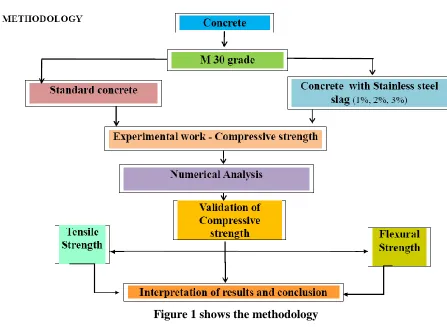
Methodology of the present work is shown in Fig 1
EXPERIMENTAL WORK
1. Standard cubes (Id: S) with M30 MPa was casted (no replacement is made in this). Therefore this stands as the Bench mark for all other cubes for itsproperty. 2. Six number of cubes were casted (3 for 7th day test and 3 for 28th day test).
3. For replacement concretes, the IDs were used as ―A‖ for 1% replacement in theweight of the sand, ―B‖ for 2% replacement and ―C‖ for 3% replacement.
4. For these replacements mixes A, B, C mixes 6cubes for each mix , 3 for 7th dayand 3 for 28th day were casted and tested.
5. Cylinder and beam were casted for the standard concrete only, since the nonavailability of stainless steel slag.
6. While testing the movement of plates in the compression testing machine wasnoted through a strain gauge.
NUMERICAL WORK
1. The model for standard cubes were made and the strain observed wasvalidated.
2. With this validation, the models of beam and cylinder for the mix A, B and Cwere modeled and checked for their stresses.
3. These beam and cylinder were not casted for experimental work.
International Journal of Advances in Engineering Research http://www.ijaer.com (IJAER) 2017, Vol. No. 13, Issue No. III, March e-ISSN: 2231-5152, p-ISSN: 2454-1796
15
INTERNATIONAL JOURNAL OF ADVANCES IN ENGINEERING RESEARCH Figure 1 shows the methodology
MIX PROPORTION
Mix design was done as per IS: 10262 – 2009 for M30 Grade of concrete and mix ratio was found to be 1:1.53:3.67 and water cement ratio 0.38. slump was found to be 100 mm
CUBE COMPRESSIVE STRENGTH
For cube compression testing of concrete, 150mmx150mmx150mm size cubes were used. And kept in curing for 7 and 28 days Removing the specimen from water after specified
curing time and wipe out excess water from the surface. Compressive strength test performed as per IS 516:1959
FLEXURE STRENGTH TEST
International Journal of Advances in Engineering Research http://www.ijaer.com (IJAER) 2017, Vol. No. 13, Issue No. III, March e-ISSN: 2231-5152, p-ISSN: 2454-1796
16
INTERNATIONAL JOURNAL OF ADVANCES IN ENGINEERING RESEARCH TENSILE STRENGTH TEST
Strength of the concrete can be broadly classified as direct and indirect methods. Thedirect methods suffer from a number of difficulties related to holding the specimenproperly in the testing machine without introducing stress concentration and to theapplication of uniaxial tensile load which is free from eccentricity to the specimen.Even a very small eccentricity of load will induce bending and axial force conditionsand the concrete fails at apparent tensile stress other than the tensile strength. Because ofthe difficulties involved in conducting the direct tensile test, numbers of indirectmethods have been developed to determine the tensile strength.
NUMERICAL WORK
Numerical analysis was performed in Ansys 14.5 (V).The following steps are followed 1. Geometry and Elements
2. Assemblies and Contact Types 3. Analysis Settings
4. Run analysis 5. Obtaining results
For a linear static structural analysis, the displacements {x} are solved for in the matrixequation below:
[K] is constant
• Linear elastic material behavior is assumed • Small deflection theory is used
• Some nonlinear boundary conditions may be included {F} is statically applied
• No time-varying forces are considered
• No inertial effects (mass, damping) are included
It is important to remember these assumptions related to linear static analysis. Since the load is added in the ―y‖ axes, deformation to be measured in the axes, thereforethe above formula will be modified accordingly.
Geometry and Elements
In structural analyses, all types of bodies supported by Simulation may be used.For surface bodies, thickness must be supplied in the ―Details‖ view of the ―Geometry‖branch.The cross-section and orientation of line bodies are defined within Design Modeler andare imported into Simulation automatically.
MATERIAL PROPERTIES
Young’s Modulus and Poisson’s Ratio are required for linear static structural analyses:Material input is handled in the ―Engineering Data‖ application.
– Mass density is required if any inertial loads are present.
– Thermal expansion coefficient is required if a uniform temperature load is applied. Inthis work thermal expansion is not considered.
International Journal of Advances in Engineering Research http://www.ijaer.com (IJAER) 2017, Vol. No. 13, Issue No. III, March e-ISSN: 2231-5152, p-ISSN: 2454-1796
17
INTERNATIONAL JOURNAL OF ADVANCES IN ENGINEERING RESEARCH
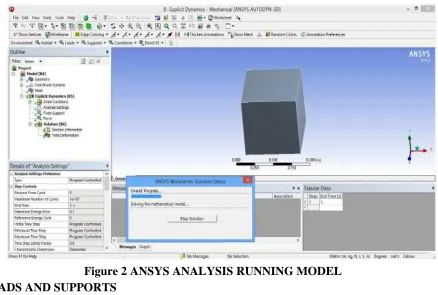
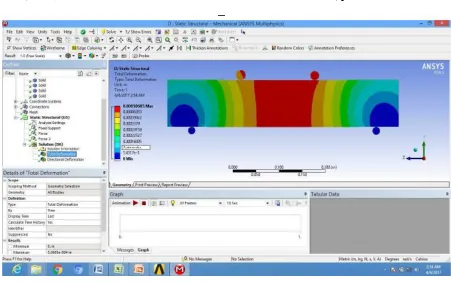
– Stress Limits are needed if a Stress Tool result is present shall be used, which is notcovered in this work. ANSYS Analysis running model is shown in fig 2
Figure 2 ANSYS ANALYSIS RUNNING MODEL LOADS AND SUPPORTS
Loads and supports are thought of in terms of the degrees of freedom (DOF) available for the elements used. Supports, regardless of actual names, are always defined in terms of DOF.
Load is given in the top face i.e., ―y‖ positive whereas ―y‖ negative face was kept fixed.RESULTS AND POSTPROCESSING
Numerous structural results are available: 1. Directional and total deformation.
a. Components, principal, or invariants of stresses and strains. – Contactoutput. – Reaction forces.
2. The deformation of the model can be plotted:a. Total deformation is a scalar quantity: The x, y, and z components of deformation can be requested under ―Directional‖, in
International Journal of Advances in Engineering Research http://www.ijaer.com (IJAER) 2017, Vol. No. 13, Issue No. III, March e-ISSN: 2231-5152, p-ISSN: 2454-1796
18
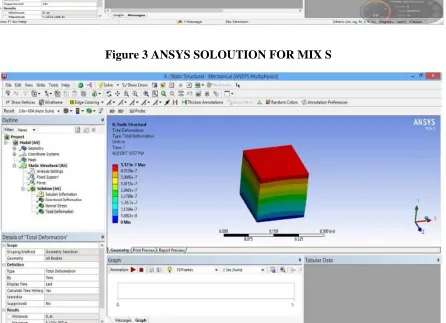
INTERNATIONAL JOURNAL OF ADVANCES IN ENGINEERING RESEARCH Figure 3 ANSYS SOLOUTION FOR MIX S
International Journal of Advances in Engineering Research http://www.ijaer.com (IJAER) 2017, Vol. No. 13, Issue No. III, March e-ISSN: 2231-5152, p-ISSN: 2454-1796
19
INTERNATIONAL JOURNAL OF ADVANCES IN ENGINEERING RESEARCH Figure 5 shows ANSYS SOLUTION FOR MIX B
International Journal of Advances in Engineering Research http://www.ijaer.com (IJAER) 2017, Vol. No. 13, Issue No. III, March e-ISSN: 2231-5152, p-ISSN: 2454-1796
20
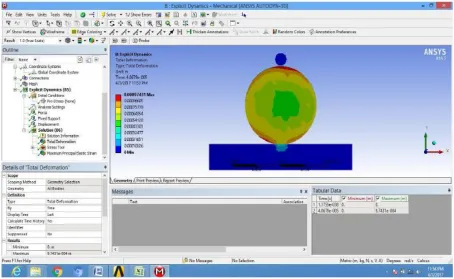
INTERNATIONAL JOURNAL OF ADVANCES IN ENGINEERING RESEARCH Figure 7 shows ANSYS ANALYSIS BEAM TOTAL DEFLECTION
RESULTS AND DISCUSSIONS
CONTOL CONCRETE CUBE:
Strengths at 7th day, an average value of 20.74 MPa isobtained, and for the 28th day, it is 37.04 MPa. This is slightly more than thecharacteristic compressive strength. While seeing the weights of the cubes, an averagevalue of 8.515 kg is obtained.
MIXA-1%REPLACEMENT
Their strengths at 7th day, anaverage value of 21.33 MPa is obtained, and for the 28th day, it is 39.70 MPa. This isslightly more than the characteristic compressive strength. While seeing the weights ofthe cubes, an average value of 8.515 kg is obtained.
MIX B- 2% REPLACEMENT
Strengths at 7th day, an average value of 21.33 MPa is obtained, and for the 28th day, it is 39.70 MPa. This is slightly more than the characteristic compressive strength.
International Journal of Advances in Engineering Research http://www.ijaer.com (IJAER) 2017, Vol. No. 13, Issue No. III, March e-ISSN: 2231-5152, p-ISSN: 2454-1796
21
INTERNATIONAL JOURNAL OF ADVANCES IN ENGINEERING RESEARCH Strengths at 7th day, an average value of 21.93 MPa is obtained, and for the 28th day, it is 40.59 MPa. This is slightly more than the characteristic compressive strength.
VALIDATION OF RESULTS IN ANSYS
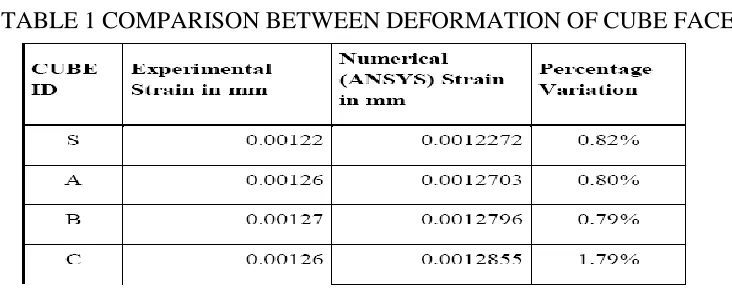
The strength obtained in the Experimental work is made as input in the Ansys program.As that of experimental cube test, the cube models analysis was made. To validate the results of the experimental work, the displacement of the face was checked with ―deformation prob‖ tool. The strains measure is tabulated in the following table. As perthat table, it is founded that the percentage deviation is 0.82% for Standard model, 0.8%for Mix A, 0.79% for mix B and 1.79% for mix C. In all the above mixes, it is found that the variation of the percentage is very minimum. The reason behind this may be theleast count of the strain gauge measured the strain. In Ansys result, the deformation measured is considered upto 10-7mm . If the decimals are reduced then the percentageerror may be minimum or nil.Therefore the conclusion of the validation may be said that, the Numerical results arematching with the experimental one.
TABLE 1 COMPARISON BETWEEN DEFORMATION OF CUBE FACE
NUMERICAL ANALYSIS RESULTS
Results of the numerical analysis are tabulated as below. Flexural and tension tests wereperformed in the numerical analysis. Comparing the results it is founded that the tensionstress of the standard cube was 3.56MPa and it was 3.63MPa, 3.70MPa, 3.81MPa forMix A, B and C respectively. As the same, Flexural strength is measured as 3.59MPa,3.52 MPa, 3.83 MPa and 3.86 MPa for Standard mix (S) and mixes A, B and Crespectively.
DISCUSSION IN THE RESULTS OBTAINED
COMPRESSION TEST:International Journal of Advances in Engineering Research http://www.ijaer.com (IJAER) 2017, Vol. No. 13, Issue No. III, March e-ISSN: 2231-5152, p-ISSN: 2454-1796
22
INTERNATIONAL JOURNAL OF ADVANCES IN ENGINEERING RESEARCH
compression property of the concrete is increasing with the increase in the addition of the stainless steel material. It may reach an optimum value to minimize thecost and extract high strength, if this research work is continued further.
TENSILE STRENGTH
Results obtained in the ansys model is viewed and the observations are listed as,i) 7.16% of increase in tension for the Mix C, which is maximum that other mixesA and B.ii) Further addition of the may lead to increase in the tensile strength of theconcrete, since the fiber particles of the stainless steel gives additional tensilestrength to the concrete.
FLEXURAL STRENGTH
Ansys results for flexural results shows that, for the standard mix, flexural and tensilestrength are same. For other mixes, there is some variation between flexural and tensilestrengths. It is observed that, flexural strength has decreased in the case of mix A. this isquite surprising. This is to be studied separately, which may consume much time. Forthis purpose this dissertation work has not touched with the points dealing with thereduction of flexural strength for an addition of 1% replacement of sand in the M30 mixconcrete.
For all other concrete mixes, it is clearly viewed that, the flexural strength increases with increase in the addition of stainless steel slag. Maximum value reached is for the mix C , which is 7.67% more than the standard mix.
CONCLUSION
As a conclusion of the work executed, the following conclusions are drawn:
1.Compression test results shows strength increase by 9.6% with the normalconcrete, when 3% of replacement is made.
2. Tensile and flexural tests shows 7.16% and 7.67% increase from their respectivenormal (standard sample) strengths for the mix ―C‖.
3. This shall be concluded that, more the replacement, more the result of increase instrength in terms of compression, tension & flexure.
4. While comparing the cost, Stainless steel (slag) costs more. Therefore it is upto tothe designer to fix the percentage replacement of sand, if this work isreferred for execution.
REFERENCE
1. ―Engineering Performance of Concrete Beams Reinforced with GFRP Bars and Stainless
steel‖ by Arivalagan. S, Journal of Global Journal of researches inengineering Civil And Structural engineering Volume 12 Issue 1 Version 1.0January 2012
2. ―Engineering Properties of Self-compacting Concrete Containing Stainless Steel Slags‖ by
International Journal of Advances in Engineering Research http://www.ijaer.com (IJAER) 2017, Vol. No. 13, Issue No. III, March e-ISSN: 2231-5152, p-ISSN: 2454-1796
23
INTERNATIONAL JOURNAL OF ADVANCES IN ENGINEERING RESEARCH
Development of Civil, Urban and TransportationEngineering Conference, Procedia Engineering 142 ( 2016 ) 79 – 86
3. ―Evaluation of mechanical and structural behavior of austenitic and duplexstainless steel
reinforcements‖ by Eduardo Medinaa, Juan ManuelMedinaa, Alfonso Cobob, David M. Bastidas, Journal Construction and BuildingMaterials Volume 78, 1 March 2015, Pages 1–7 4. ―Strengthening of axially loaded circular concrete columns using stainless steelwire mesh
(SSWM) – Experimental investigations‖ by Varinder Kumar, P.V.Patel, Alfonso Cobob, David M. Bastidas, Journal Construction and BuildingMaterials, Volume 124, 15 October 2016, Pages 186–198
5. ―Smart textile reinforcement with embedded stainless steel yarns for the detectionof wetting
and infiltration in TRC structures‖ by Y. Goldfeld, T. Quadflieg, T.Gries, O. Rabinovitch,
Journal of Sensors and Actuators A: Physical Volume 243,1 June 2016, Pages 139–150
6. ―Smart Lean duplex stainless steels—The role of molybdenum in pitting corrosionof concrete
reinforcement studied with industrial and laboratory castings‖ by T.J.Mesquita, E. Chauveaub, M. Mantelb, N. Kinsmanc, V. Rochea, R.P. Nogueiraa,Journal of Materials Chemistry and Physics Volume 132, Issues 2–3, 15 February2012, Pages 967–972
7. ―Corrosion performance of steel reinforcement in simulated concrete poresolutions in the presence of imidazoline quaternary ammonium salt corrosioninhibitor‖ by Fei-long Fei, Jie Hu, Jiang-xiong Wei, , Qi-jun Yu, Zheng-shan Chen, Journal of Construction and Building Materials Volume 70, 15 November2014, Pages 43–53
8. ―Microstructure related mechanical behaviors of short-cut super-fine stainless wirereinforced
reactive powder concrete‖ by Baoguo Hana, Sufen Donga B, JinpingOua C, ChenyuZhanga, YanleiWanga, XunYud, Siqi Ding, Journal of Materials& Design Volume 96, 15 April 2016, Pages 16–26
9. ―Innovative usages of stainless steel slags in developing self-compactingconcrete‖ by
Yeong-Nain Sheena, Duc-HienLeb, Te-Ho Suna, Journal ofMaterials & Design Volume 96, 15 April 2016, Pages 16–26
10. ―Elevated temperature material properties of stainless steel reinforcing bar‖ by L.Gardnera,
Y. Bua, P. Francisb, N.R. Baddoob, K.A. Cashellc, Journal ofMaterials & Design Volume 96, 15 April 2016, Pages 16–26
11. ―Electrically conductive behaviors and mechanisms of short-cut super-finestainless wire reinforced reactive powder concrete‖ by Sufen Dong, BaoguoHan ,JinpingOu, Zhen Li,
LinyangHan, Xun Yu ,Journal of Cement andConcrete Composites, Volume 72, September 2016,
Pages 48–6.
12. ―Corrosion Behavior of Stainless Steel Rebars Embedded in Concrete: anElectrochemical
Impedance Spectroscopy Study‖ by R.G. Duarte, A.S.Castela, R. Neves, L. Freire, M.F. Montemor, Journal of ElectrochimicaActa,Volume 124, 1 April 2014, Pages 218–224
13. ―Greener self-compacting concrete using stainless steel reducing slag by‖ Yeong-Nain
International Journal of Advances in Engineering Research http://www.ijaer.com (IJAER) 2017, Vol. No. 13, Issue No. III, March e-ISSN: 2231-5152, p-ISSN: 2454-1796
24
INTERNATIONAL JOURNAL OF ADVANCES IN ENGINEERING RESEARCH
14. ―Flexural performance of concrete beams reinforced with aluminum alloy bars‖by Guohua Xing, Osman E. Ozbulut Journal of Engineering Structures Volume126, 1 November 2016, Pages 53–65
15. ―Assessment of stainless steel reinforcement for concrete structuresrehabilitation‖ by J.T. Pérez-Quiroz , J. Terán, M.J. Herrera, M. Martínez, J.Genescá, Volume 64, Issue 11, November 2008, Pages 1317–1324
16. ―Proposed criterion to assess the electrochemical behavior of carbon steelreinforcements
under corrosion in carbonated concrete structures after patchrepairs‖ by J.L.S. Ribeiro, Z. Panossian, S.M.S. Selmo, Journal of Constructionand Building MaterialsVolume 40, March 2013, Pages 40–49
17. ―Corrosion behaviour of new stainless steels reinforcing bars embedded inconcrete‖ by M.C.
García-Alonso, M.L. Escudero, J.M. Miranda, M.I. Vega, F.Capilla, M.J. Correiac, M. Saltac, A. Bennani, J.A. González, Journal of Cementand Concrete Research Volume 37, Issue 10, October 2007, Pages 1463–1471
18. Ansys work bench help tutorials19. IS: 383-1970, ―Indian Standard code for coarse and fine aggregates fromnatural sources of concrete.
20. IS: 456-2000, ―Indian Standard code of practice for plain and reinforcedconcrete.